Yearly Archives: 2013

The birds and the bees

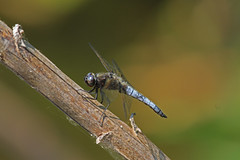
Insects have been hit hard by climatic aberrations in recent years and on my meanderings around the Cambridgeshire countryside this year numbers of bees and butterflies sightings have been down compared to previous years. It’s now the middle of June and I saw the first dragons of the year today; two damselflies. I also read this week in ‘The Guardian‘ newspaper that a third of managed honeybee colonies in the USA were wiped out in 2012. This article makes very sobering reading. And it’s a similar story in Europe, but in Europe neonicotinoid pesticides, which have been implicated in colony collapse disorder, have been banned for two years to evaluate their effect on honeybees. My concern is that the onslaught on the bees is complicated and removing one variable may not show a significant effect in the limited two year duration of the ban. But I hope it does!

Early last month the sun finally broke through and gave us some insect friendly weather and it was remarkable how quickly the microfauna emerged.

Beefly – Bombylius major

Beeflies are found over large parts of the globe and can be seen hovering in sunny glades from the springtime. The narwhal of the Dipteran world, the spike looks fearsome but is only used to probe flowers for nectar, there is  no sting. Beeflies procreate by flicking their eggs into the entrance to the burrows of wasps and bees where the larvae feed on the grubs of the occupants.

A pair of hoverflies doing their best to rectify the decline in the insect population

I think these hoverflies are ‘Eristalis pertinax’ but I’m not certain. It was good to see them though, especially as they were taking their biological responsibilities so seriously.
Addendum: on the subject of climatic aberration mentioned at the top of this post I just found and read with increasing concern this link:

http://robertscribbler.wordpress.com/2013/04/12/human-climate-change-is-wrecking-the-jet-stream-uk-met-office-calls-emergency-meeting/

which my blogging buddy Sam posted on her excellent WP blog ‘Science on the Land‘. This provides a chilling insight (in every sense) into why the weather in the northern hemisphere is behaving the way it is. And it doesn’t look as though it’s going to get any better folks.

Flowers for all seasons

Last year in springtime the weather was dreadful and I didn’t many chances to take photographs for weeks. So I trawled back through my archive and found these old pictures of wild flowers which I thought I would post to brighten things up a tad. But by the time I got round to posting it was too late in the year so the post got parked until this year.

And the flowers are now blooming again, so two years after I took the pictures now seems like a good time to share them! I won’t bore you botanical minutiae this time, but I hope you enjoy the pictures!

Greater periwinkle

(Vinca Major)

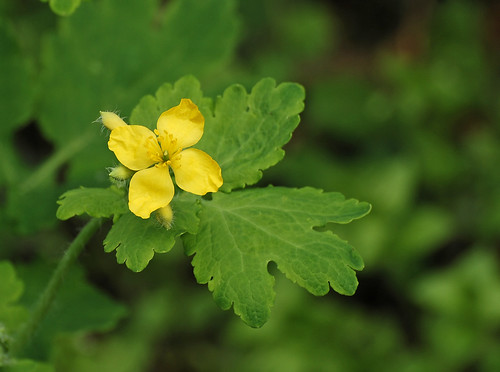
Greater celandine

(Chelidonium majus)

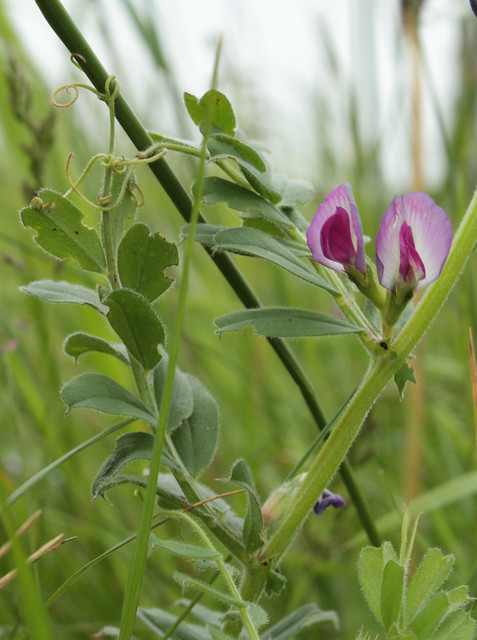
Common vetch

(Vicia sativa)

White campion

(Silene alba)

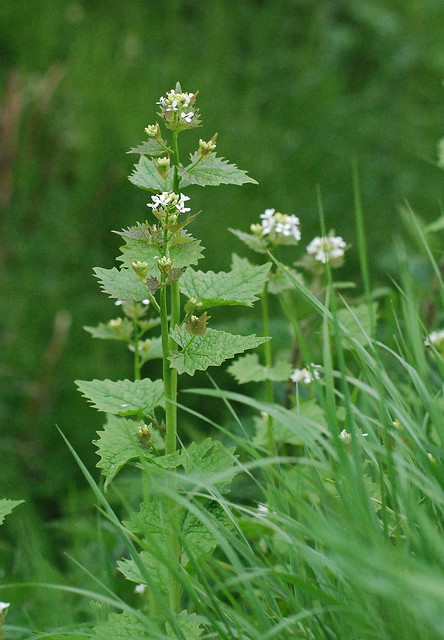
Jack By The Hedge

(Alliara petiolata)

Herb bennet

(Geum urbanum)

Needs as needs must

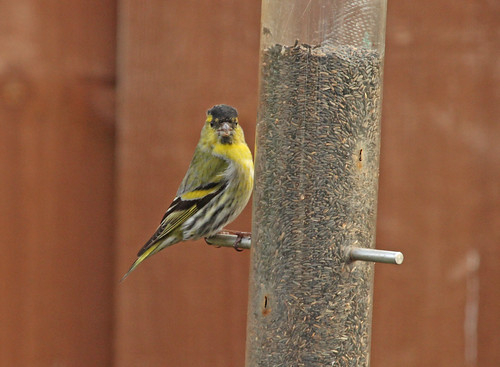
Two species of bird are said to use niger seed feeders, but up until this winter I’d only ever seen one of them on mine, and that’s the goldfinch (Carduelis carduelis, Dansk: stillits). The other species, that I had never seen was the siskin (Carduelis spinus, Dansk:  grønsisken).

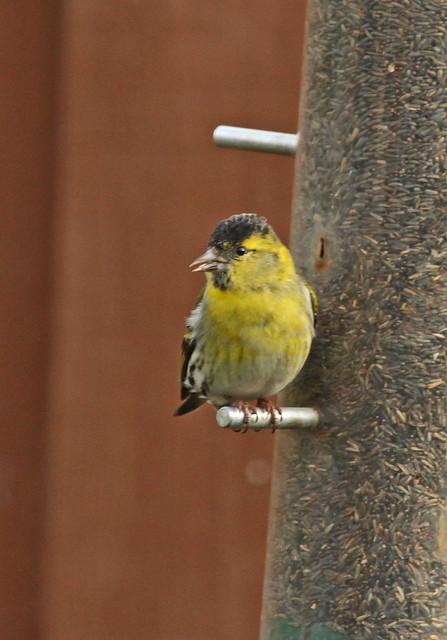
A siskin refuelling on niger seed

Not only had they not appeared on the feeders but I hadn’t seen one for years before this winter. My friend in the village said that he had seen one on his feeders and it was reported that the dreadful weather last year had caused such a shortage of wild seed, the siskins natural food source, that they were showing up in gardens in unusual numbers. Needs as needs must when hunger prevails.
The normal diet of the siskin consists of seeds from spruce, pine, alder or birch trees and they will occasionally feed on invertebrates too. In the photograph above it’s easy to see the long and pointed but powerful beak it would need to extract the seeds from pine cones.

The conservation status of the siskin according to the British Trust for Ornithology is green and they don’t appear to be in any danger, which is unusual in itself these days, so it’s surprising I haven’t seen one for so long. It’s a resident breeder here in the UK and a passage and winter visitor, flying in from further north in Europe.

They are particularly handsome birds and although it’s a pleasure to see them I hope the need to use garden feeders doesn’t go on from year to year or their green conservation status may not last.

Bridlington beach

After spending the morning up at Flamborough Head I spent the afternoon on the beach in Bridlington harbour.

Flamborough Lighthouse from the beach at Bridlington

Groups of knot were scouring the tideline

I like knot, they are very busy birds hunting invertebrates on the tidal mud and their taxonomic name is ‘Calidris canutus‘ (Dansk: islandsk ryle) named after the Viking king famed for being able to hold back the tides. I think that’s probably where the English name comes from too, because the Danish spelling of ‘Canute‘ is ‘Knud‘ – which isn’t a million miles from ‘Knot‘. They can sometimes be seen in enormous flocks of to 100,000 birds, which is a sight I’d love to see.

A knot and a redshank with an oddly distended neck

The knot has the most gorgeous rufous breeding plumage where the breast turns to a coppery red colour and the light parts of the feathers on the back turn brown, but as I only ever see them in winter I’ve never seen the full breeding regalia.

Another redshank (Tringa totanus, Dansk: rødben) cooling its feet in the ‘surf’

I wrote about the turnstone (Arenaria interpres, Dansk: stenvender) in my last post about Bridlington, but this one was a real character. It scuttled along the parapet of the sea wall as people were walking to and fro just a few feet away and was quite happy for me to point a camera at it. And I got some nice portraits of it standing on the stone sea wall with the blue sea in the background:

And the whole time we were in Bridlington a lone barnacle goose (Branta leucopsis, Dansk: bramgås) was in residence. Barnacle geese nest way up in the Arctic, in Greenland and Spitsbergen. Because they are never seen on a nest in the UK it was thought that they didn’t originate from eggs but that they started life as goose barnacles which live in deep water but can sometimes be found washed up on debris dislodged from the sea bed.

Barnacle goose fattening up in England before a long flight north to the Arctic

That time of year

Spring appears to have now definitely sprung, but before that the weather was very cold and many songbirds were coming to the garden to feed. One of the regular species was the blackcap pair which arrived during the fierce weather after Christmas and left around three or four weeks ago when the weather started to warm up.

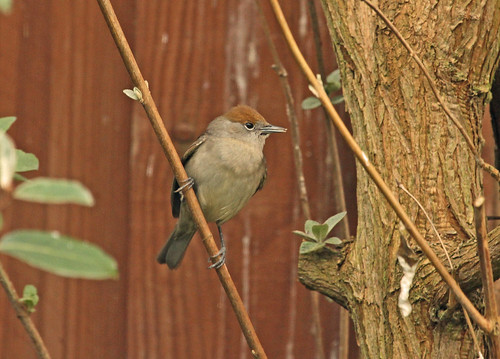
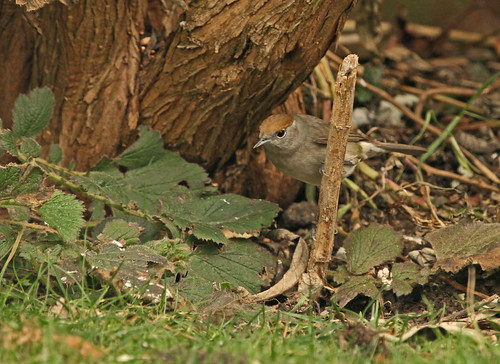
The female blackcap – easily identified by her brown cap

There are two types of blackcap in the UK: those that migrate to sub-Saharan Africa to overwinter and those which migrate here from central Europe to overwinter. So I guess my pair, which oddly I rarely ever saw in the garden at the same time, were European visitors sampling our balmy winter weather.

Even though the female was the first blackcap I saw in the garden she visited nowhere near as often as the male and it took me a while to get a good portrait of her, but I managed to get these just before they disappeared to enjoy their springtime and rear their chicks in Germany or Poland.

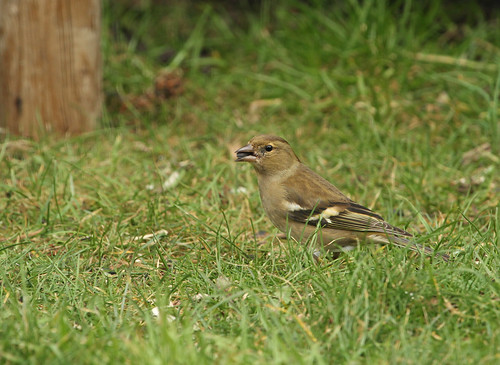
Constant visitors all the way through the winter and still resident are my pair of chaffinch which are always welcome to brighten up a dull day.

Cock chaffinch resplendent in full courtship plumage

…and the charmed lady

The chaffinch pair probably have a nest nearby with chicks in, but before eggs and chicks the delicate matter of mating needs to be taken care of:

A pair of collared dove demonstrating that the act of lurv is not always so delicate

Spring has indeed sprung!

The day after the day before

It’s been far too long since my last post, life has been frenetic resulting in little or no time for WP’ing. But I’m back now and after I’ve completed this post I shall be taking a grand tour of all your blogs that I’ve been  neglecting recently!

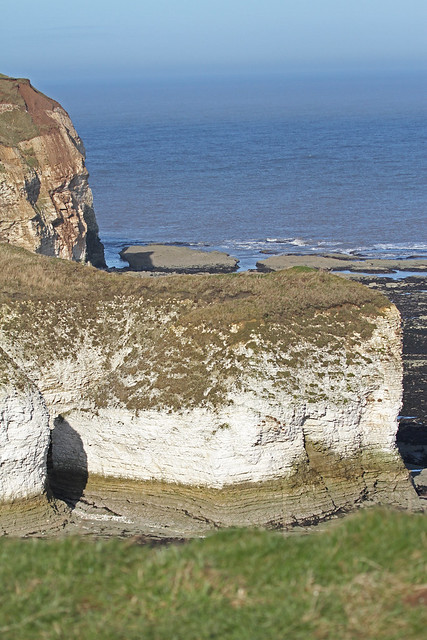
In my last post I mentioned the frigid weather conditions prevailing on top of the cliffs at Bempton back at the end of February. But the day after that clifftop adventure was bright, sunny and warm, and we were up on top of Flamborough Head, just a few miles south of Bempton, running around in shirt sleeves. What a difference a day makes.

Looking north along the cliffs from Flamborough lighthouse in lovely warm sunshine!

On a sunny day the coast in that part of the world is a wonderful place to be, and there’s wildlife in abundance:

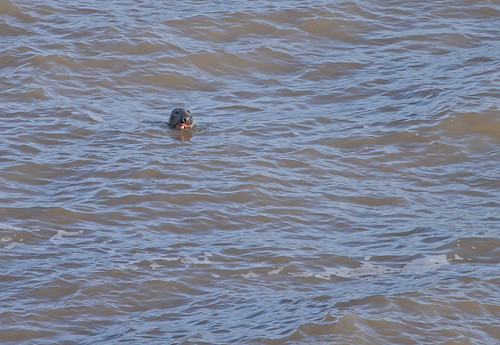
North Atlantic grey seal enjoying breakfast in relaxed fashion

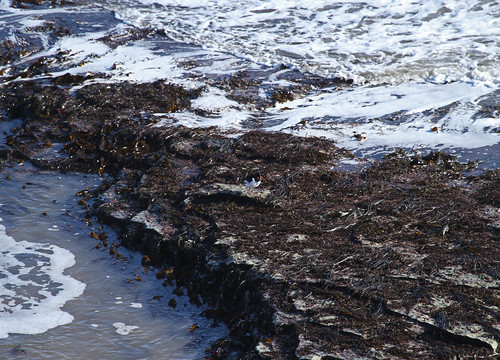
And while the seals were taking life easy in the sea the shoreline was patrolled by various seabirds including this oystercatcher who was picking over the recently exposed seaweed looking for crustaceans.

Not the best picture of an oystercatcher (Haematopus ostralegus, Dansk: strandskade) I’ve ever taken but I like the rock and the surf! After the clifftop we headed down to the harbour at Bridlington where the tide was out and lots of seabirds were picking over the detritus you might expect to find around a working harbour.

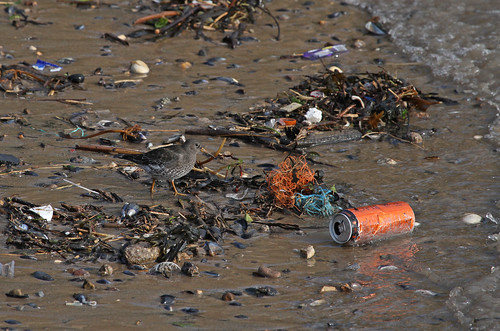
Purple sandpiper (Calidris maritima, Dansk: sortgrå ryle)

The purple sandpiper breeds in the Arctic, very rarely in the UK, but overwinters on the coast here where it can be found in large flocks, often alongside turnstone.

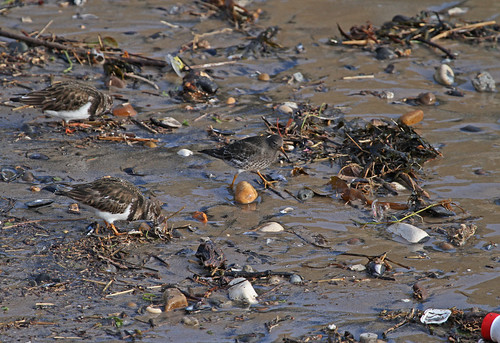
A lone purple sandpiper accompanied by a pair of turnstone

Even though the tons of litter that lined the beaches offended me, the birds didn’t seem to mind, they were racing along the tide lines picking over all the debris, human and natural.

The turnstone (Arenaria interpres, Dansk: stenvender) is also a winter visitor to the UK, very rarely breeding here. It feeds mainly on insects during the summer but according to the British Trust for Ornithology they also feed on birds eggs, chips and even corpses. It suggests the corpses are human but I wonder where they would find one of those, I’ve never encountered one on my seaside meanderings!

The Gannets and The Climmers

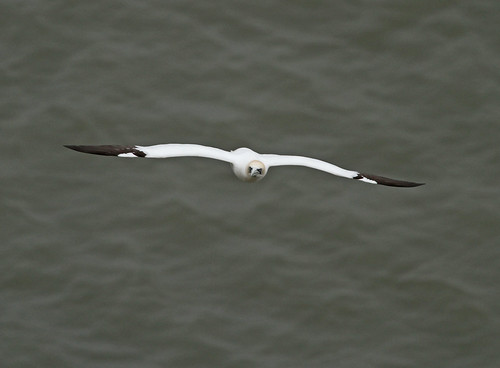
In my last gannet post the bird I showed was quite far off so here’s another one which alighted on the cliff just 10m or so from where I stood.

Sizing me up to decide whether I posed any threat

And it quickly reached the conclusion that this shivering piece of humanity obviously would pose no threat whatsoever and landed close by on the cliff:

I think this is a particularly elegant touch down for such a big bird, avoiding injury whilst landing on a tiny piece of cliff in very strong winds.

It wasn’t at all bothered by my presence or the whirring of the shutter, and in the absence of any other predators up on the cliffs, now that the ‘climmers‘ are no more, this chap didn’t see me as a potential danger.

Climmers were men who’s job was to harvest seabird eggs from the cliffs by abseiling over the edge. I found this remarkable piece of film at the Yorkshire Film Archive of climmers doing their work. It’s absolutely not for the feint hearted!

As well as the climmers the Victorian passion for shooting anything and everything wild was shockingly indulged on the 18 miles of cliffs between Bempton and Scarborough. Boat loads of day trippers would set sail and shoot hundreds of birds every day, and in a book of 1838 entitled ‘Essays on Natural History’ by one Charles Waterton he estimated that between April and August 108,000 birds were shot. I don’t know if the shot birds were eaten, but the slaughter was primarily for ‘sport’ (!), and the feathers were also used in huge numbers in the millinery trade.

As a result the ‘Association for the Protection of Sea-Birds’ (APSB) was founded in 1868 in Bridlington by local naturalists including the vicar of Bridlington in an attempt to prevent the annual carnage taking place just a few miles away on their local cliffs.

Then in June 1869 protection of the birds was enshrined in law with the passing of the ‘Sea Birds Preservation Act’. This provided protection for 35 species by introducing a closed season between April 1st and August 1st, and apparently the first successful prosecution under the Act took place in Bridlington on 10 July 1869 after a Mr Tasker, of Sheffield, had shot 28 birds. He was fined a total of £3 19s!

And the result of the dedication of those Victorian naturalists, pioneers at a time when animal welfare was very low on the political agenda, is the multitudes of birdlife to be seen on the cliffs today. Hats off to those splendid folk!

Fulmarus glacialis

A couple of weeks ago I posted about my trip to Bempton Cliffs and I showed you the gannets. There were four species of seabird in residence including the gannet, the other three being fulmar (Fulmarus glacialis, Dansk: mallemuk), guillemot (Uria aalge, Dansk: lomvie) and razorbill (Alca torda, Dansk: alk). By the time I got there the only other one on the cliffs was the fulmar, the other two had disappeared out to sea to hunt fish.

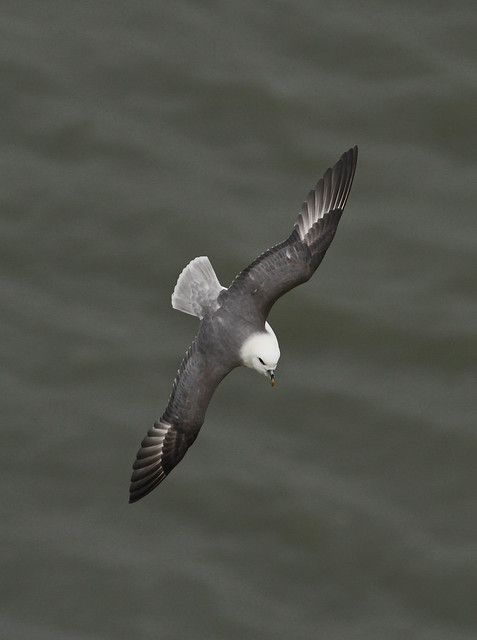
The fulmar in flight at Bempton Cliffs

Fulmars are the closest we get in this part of the world to an albatross. They both belong to the ‘tubenoses’, the taxonomic order ‘Procellariiformes‘ and the albatrosses are the family Diomedeidae and the fulmars are the Procellariidae, along with the shearwaters and petrels. The tubenoses have nostrils which also function to excrete salt which is ingested from sea water.

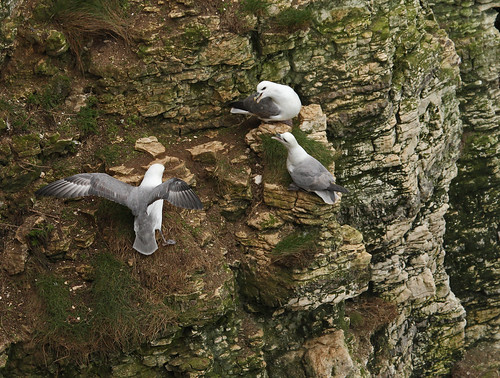
I think these two had the best spot on the cliffs, in their own little cave – as sheltered as it gets up there!

The cliffs are a huge place and there were probably hundreds of fulmars spread out over them and they were constantly taking to the air, looping round and returning, like this one who kept getting a somewhat frosty reception every time it tried to land in this spot:

Fulmars are apparently less than competent on the ground, unlike their cousins the albatrosses (apart from the landings of course), but similarly to the albatrosses they are consummate aeronauts. The winds were ferocious when I was up at Bempton but the birds glided along with little or no effort and never seemed to make a bad landing on the cliffs.

They are particularly long lived birds, the older ones reaching 40 years and beyond. They attain sexual maturity at 9 and they pair for life, breeding in nests on sea cliffs and rocky islands.

This is the northern fulmar and it frequents the extreme latitudes of the northern hemisphere. It’s one of two species, the other being the southern fulmar, Fulmarus glacialoides, which is found in the corresponding extremities of the southern hemisphere and fortunately neither of these species is endangered.

Whilst reading about the taxonomy of the fulmar I got distracted by the albatross which is a bird that has always fascinated me. The facts and figures around albatrosses are mind boggling and the one that made my jaw drop was the wingspan of the wandering albatross (Diomedea exulans) which can reach up to 3.5m, which is a shade longer than 11 feet! They must be an unforgettable sight.

An unusual but entertaining day at work

Earlier this week I was learning about a technique called ‘dynamic light scattering’ (DLS) which is used to determine the size of very small particles, even those as small as protein molecules. My teacher was a scientist called Ken who designs and builds DLS machines. It came up in conversation that he lives close to the southern end of the M40 corridor where I’ve seen lots of red kites and read stories of them stealing food from people, so I asked if he sees them in his neighbourhood.

Red kite (Milvus milvus, Dansk: rød glente), this one was at Hamerton in Cambridgeshire

Red kites are big, distinctive, birds of prey and they’re a conservation success story in the UK, having been almost driven to extinction but then reintroduced in the 1990’s since when their numbers have rocketed. And as it happens they are very common indeed in that part of the world and Ken kindly agreed to upload this video clip to You Tube so I could post a link to it here. This all happened in Ken’s garden and I think it’s highly entertaining stuff,  I think I’d struggle every morning to get out the front door to go to work if I had this kind of show going on in my garden!

Later on, at the end of the same day, a big flock of a few thousand starlings were murmurating over the Cambridge Science Park as I left work to come home. I was keeping one eye on the starlings and one eye on the road when I stopped at a red traffic light on the edge of the Science Park and the starlings were swirling and wheeling around the sky just in front of me. Then a sparrowhawk drifted by but the starlings carried on murmurating until the hawk suddenly accelerated up towards them. Then all of the flocks shrunk down into very tight groups and focussed on taking evasive action. It was a piece of natural theatre going on in the sky which was spectacular to watch. Then the traffic lights went green and I had to move on so I didn’t get to see the culmination of the chase, but it was a captivating end to the day.

Snug as a bug

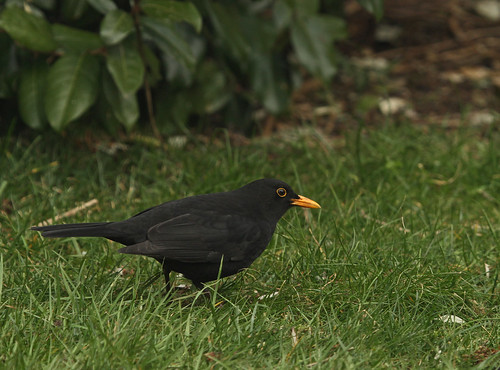
About this time last year I published a post about the battling blackbirds in my back garden. The weather last February was mild and vry pleasant and I think the breeding season really got going then. As you can see, full on combat ensued. This year has seen none of the aggression of past year, at least not in my garden, but whilst watching the other birds I noticed this female blackbird making repeated trips to collect moss from my lawn. I’ve never understood why us Brits in particular want our garden lawns to look like the centre court at Wimbledon (before the All England Championships), I’d much rather see sights like this:

Behind the magnificent mossy muzzy is a female blackbird

She has been toing and froing for at least three days now collecting these huge beakfuls of moss and I reckon her chicks are going to be as snug as a bug in the nest she is busy constructing.

The male has also been very busy in the garden but his activities are rather less altruistic…

Seed or fruit, which is it to be?

There might even be a worm under there…

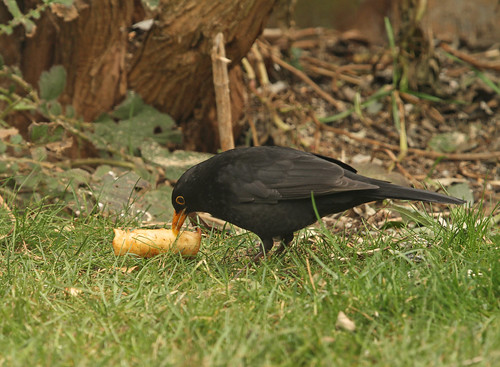
Result! That bloke in there has left me an apple core

All his visits seem to be focussed solely on replenishing his energy supply, but the reason I’ve seen no battles this year is because he’s dealt with the opposition, so I guess he needs to concentrate on feeding himself up again.

The blackbird (Turdus merula, Dansk: solsort) and the fieldfare (Turdus pilaris, Dansk: sjagger), both members of the thrush family, like fruit and any old grapes, apple cores or pears get thrown out for them.