Category Archives: Countryside walks

Essex adder challenge

Danbury Common near Chelmsford in Essex is a National Trust site that is a mixture of woodland and heathland and is renowned for reptiles, in particular teh European adder (Vipera berus). The weather for the last 2-3 weeks has been ideal for resurrecting hibernating reptiles so myself and my friend, Dave, who is a very accomplished nature photographer, went along to try to get some pictures of adders. They are the only venomous reptile native to the UK and their preferred habitat is heathland. Dave originates from Essex and is familiar with Danbury Common and assured me that we would definitely see adders, so I was rather excited as I’ve never seen a wild one before.
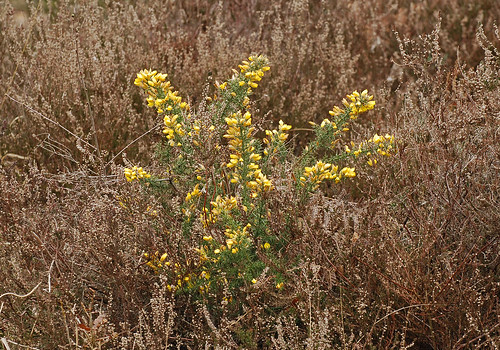

The heathland terrain was perfect reptile territory, there are substantial areas of gorse and heather intermingled with bracken

Unfortunately two events conspired against us: the weather on Saturday morning was the coldest it has been for weeks and with 100% cloud cover there was little warmth to entice the adders out of their burrows, and secondly there had been an accidental fire right over the main hibernaculum, all of which resulted in the total absence of adders and any other reptiles!

Despite that, the Common is a great place for wildlife so we wandered around to see what else was in residence and were rewarded by the first blackcap (Sylvia atricapilla, Dansk: munk) and chiffchaff (Phylloscopus collybita, Dansk: gransanger) sightings of the year for me.


A male blackcap, one of a pair

Until recently blackcap were considered to be summer migrants to the UK, spending there winters in sub Saharan Africa and as far down as South Africa.  More recently they have been winter residents too and it is thought this is the result of westward migration of birds from eastern Europe and also from the Low Countries, not our summer residents staying put. They disappear from my regular haunts around Histon in the winter, but my friend who lives on the other side of the village, just half a mile away, has been hearing them sporadically through the winter.

I heard several chiffchaff and saw a couple too, but they didn’t come close enough to photograph, but the woods were full of great tit (Parus major, Dansk: sortemejse) which were more amenable to pose for a portrait:
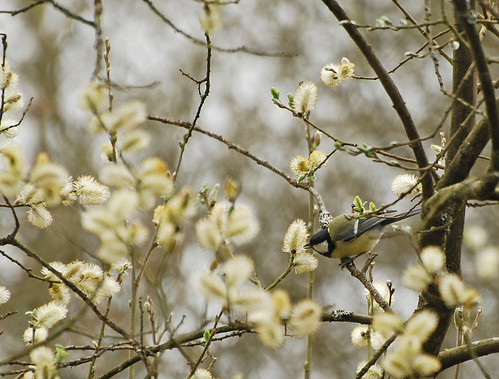

Male great tit feeding on pussy willow. The tree was busy with at least four great tit, a pair of blue tit and a long tailed tit

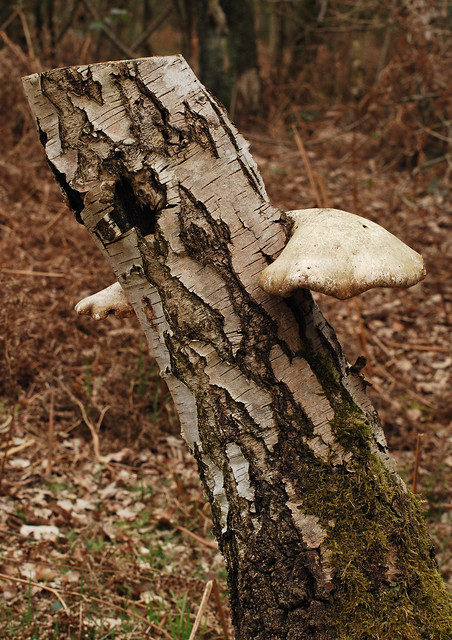
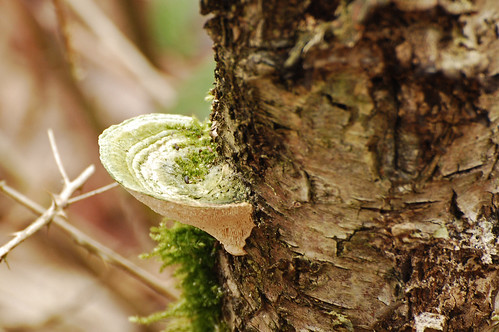
Backwarden nature reserve and Danbury Common are bisected by a road and Backwarden is an area of woodland containing sycamore, oak, birch and willow similar to that on the Common. Many of the trees were hosting various fungi including moulds and these brackets growing out of the stumps of felled trees:
…and this amazing mass of gelatinous psychedelic slime mould which I thought resembled candle wax:


I’ve never seen anything quite like this before but it appeared the sap had welled up out of the felled tree and the sugar rich solution was providing a glut of nourishment to opportunistic fungi.

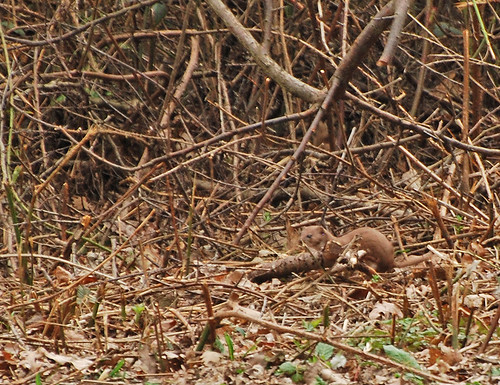
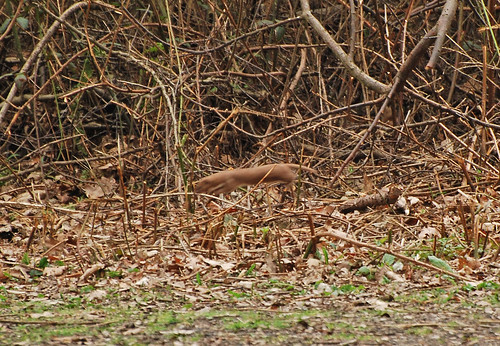
The highlight of the trip, in the absence of snakes, was a weasel (Mustela nivalis) which bounded across the path and stopped to scrutinise us for long enough to take a couple of photographs. It’s years since I’ve seen weasel and we had to zoom in on the pictures to decide whether it was a weasel or a stoat (Mustela erminea). The stoat is around 30cm long so is bigger than the weasel which is around 20cm, and the stoat has a black tip to its tail which our little creature didn’t. Stoats go completely white in the winter except for the black tip of their tails and it is the pelts of the winter stoat which are used to make the ermine gowns of members of the UK House of lords.
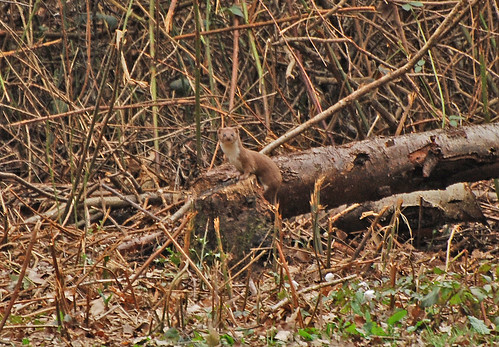

Momentarily distracted by our presence

Then probably a potential prey item. Ready…
Set…
Go!

And he was off, like a brown furry exocet, at quite phenomenal speed. The pictures aren’t very good quality, but you can clearly see what he is and it may be a good few years before I get to photograph another! I’ll try to get to Danbury again over the summer and if I manage to take some pictures of an adder I’ll post them here.

Buds and blooms

Many fellow bloggers out there have been posting some lovely images of spring events and as this time of year is an exciting one from a nature perspective I felt inspired to get out and get some pictures of vernal regeneration in my part of the world.

I didn’t have to wander too far, the apple and hazel trees and the beech hedge in my garden are showing signs of waking up from the winter slumber:


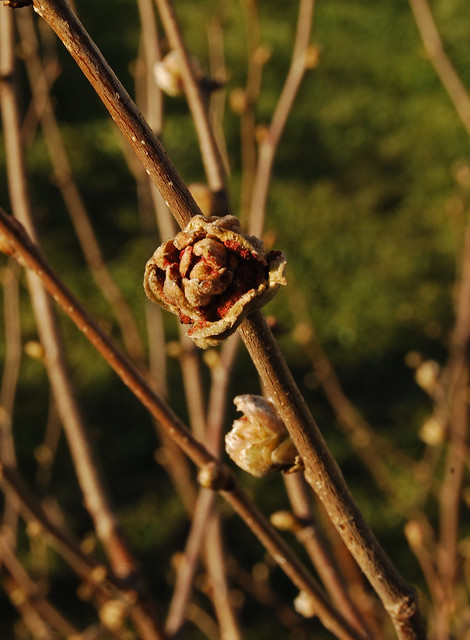
Nascent apple blossom about to burst into life

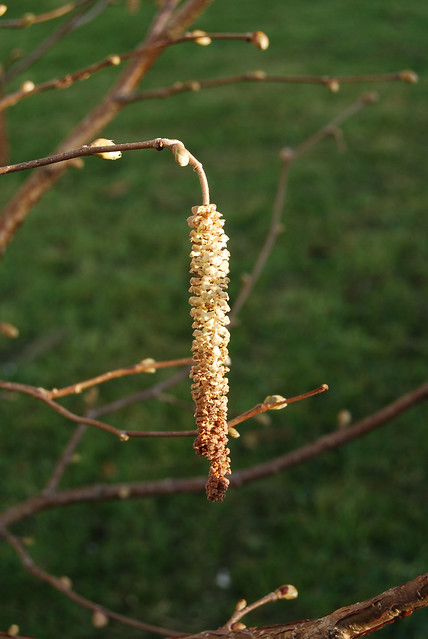
A catkin – the flower of the hazel tree, above. And below, the diminutive inflorescence that will eventually become a hazelnut.

Hazel trees (Corylus avellana) produce catkins early in the year which are monoecious, which means they are either male or female, the one above is a male one, the females being tiny and hidden in the buds and the pollen is wind dispersed.  They provide not only nuts but if left to their own devices hazel ‘poles’ sprout from the ground which grow tall and straight and are coppiced to make fencing, and in the days when wattle and daub was used for building  walls the poles were used to make the wattle on which mud was plastered to provide the daub.

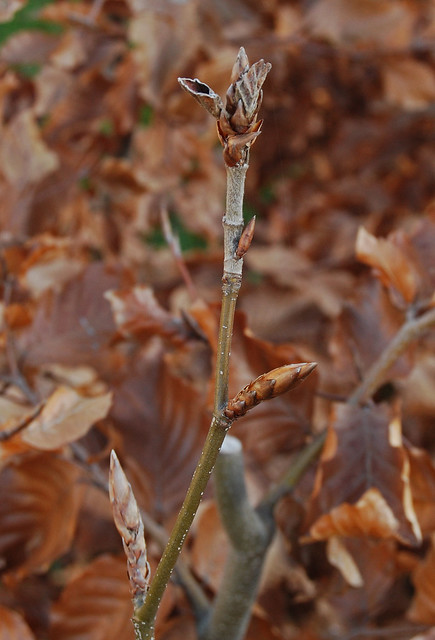
Beech leaves sprouting from the apical buds at the top of a hedge


A couple of hundred metres along the road on the grass verge was this cluster of lesser celandines (Ranunculus ficaria)

According to the font af all wisdom that is Wiki, lesser celandine used to be known as ‘pilewort’ because it was thought of as a remedy for haemorrhoids. I like this cluster because all the flowers are in different stages of opening, from a tightly closed green bud to a fully open flower.

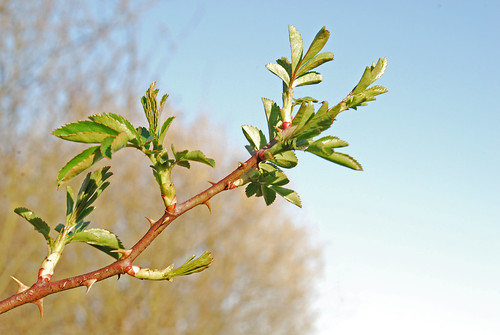
Once into the fields the hedgerows were lined with the thorny stems and freshly shooting leaves of the bramble:

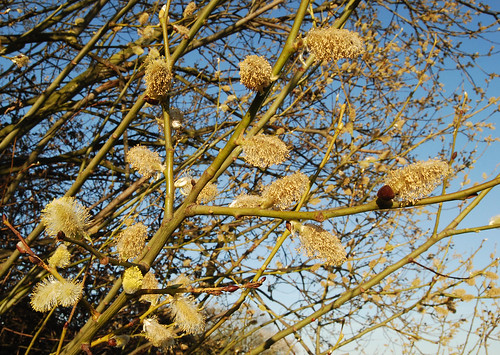
Lining the drainage ditches which delineate the field margins in this part of the world are willow trees (Salix cinerea) which need the water that drains from the fields and in the spring are covered in the furry catkins which give the tree its common name of ‘pussy willow’:

Willow catkin – unlike the hazel the catkins of the willow are dioecious, containing both male and female reproductive machinery in the same catkin

The wood of another species of willow tree (white willow, Salix alba) is very light and very strong and is used to make cricket bats and the bark of the willow contains a compound called salicylic acid which is the chemical precursor of aspirin. The analgesic properties of willow bark have been known of for centuries and have been maximised by acetylating salicylic acid to make aspirin. As well as analgesia, aspirin is now used as an anticoagulant to reduce the risk of heart attack and stroke and recent studies suggest it may have anti-carcinogenic activity too.

The plants in this post are a random selection from the garden, roadside verge and the countryside within 200 of my house and all of them provide us with something useful. The beech is structural and is ideal for hedging. Apple, bramble and hazel all have edible fruits. Lesser celandine may shrink your chalfonts* and the willow provides drugs to treat pain, heart disease and cancer (not forgetting cricket bats).

* Chalfonts = ‘Chalfont St Giles’ (I’m sure you can work it out)

The North Fields

If you’ve been reading my recent posts you’ll know they’ve mainly been from the part of my village (Histon, Cambridgeshire) called Rowleys Meadow. I have two routes out of the village, the Meadow and what I call the North Fields, and the terrain is very different. The Meadow isn’t farmed and has many hedges, thickets and trees and is therefore better for birds in the Winter because it has a much higher density of numbers and species. But now it’s officially Spring, after the Equinox on March 20th/21st, I decided to visit the North Fields which are all under the plough. I’ve been over there on a few evenings at dusk and after dark in the last few weeks and heard golden plover (Pluvialis apricaria, Dansk: hjejle) and skylark on the ground but I haven’t been over there in daytime for a while.

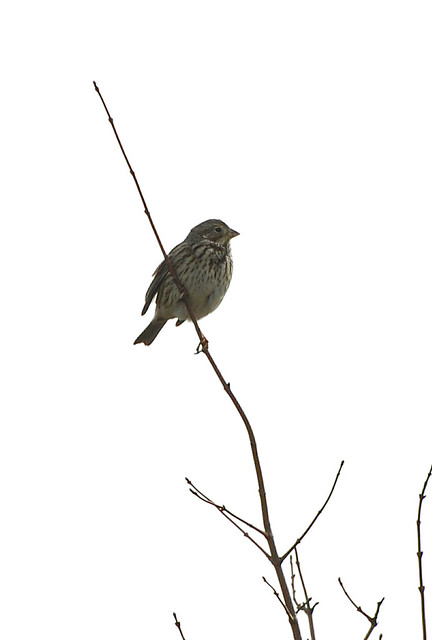
The main reason I headed over there was because I wanted to find out if the large numbers of linnet and corn bunting which disappear from the fields every year at harvest time had returned. My first impression on entering the fields was that I should have gone to the Meadow, there was virtually no movement of any kind, but I stuck to my guns and that turned out to be a good decision. I didn’t expect to see corn bunting, which are becoming increasingly scarce on our farms, yet, but I had only gone half a mile or so before I heard the unmistakeable sound of a male calling. I heard him long before I saw him but I knew where he would be perched from where his song was coming from, it is a favourite perch all the time they are in residence:

Corn bunting (Emberiza calandra, Dansk: bomlærke) sitting in a favourite place and singing loud

It’s not the best picture of a corn bunting because the sun was still low in the sky directly behind with a thin layer of high white cloud inbetween. Consequently it was impossible to get anything other than a silhouettte without overexposing the shot, so that’s what I did so his colors can be seen. He wasn’t the only one I saw, there were three altogether, so I hope there’ll be a good few more in the next few weeks.

Another bunting which put in an appearance was a male reed bunting. There were several of these too, and just along the ditch from here was a flock of between 10-20 yellowhammers alternating between a hedgerow and the ground where they were feeding.


Reed bunting male (Emberiza schoeniclus, Dansk: rørspurv)

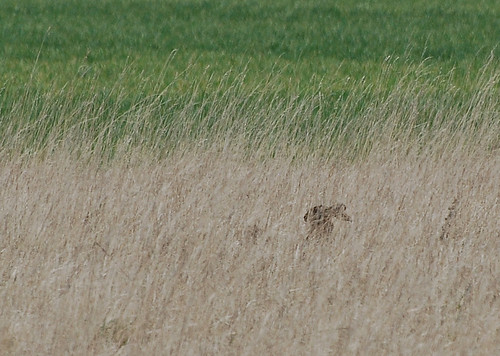
I didn’t go close enough to photograph the yellowhammers because I didn’t want to disturb them. Well, partly that, but also because I’d been distracted by a pair of hares (Lepus europaeus) chasing each other around in the long grass:

I couldn’t get close enough to get a picture of the whole hare, they were too wary of me and the dog, who’s a lurcher, so their timidity was well justified! But I like the way their ears poked up above the grass with the characteristic black tips.


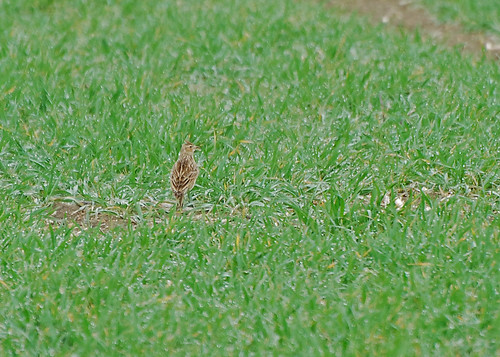
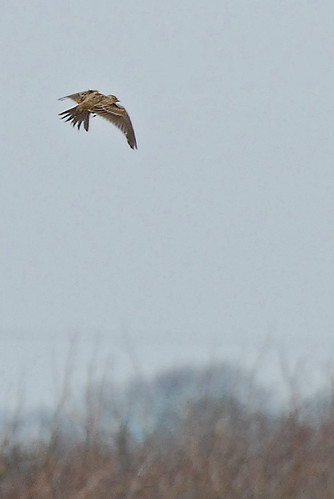
Skylark waiting on the ground between high speed aerial duels with other larks

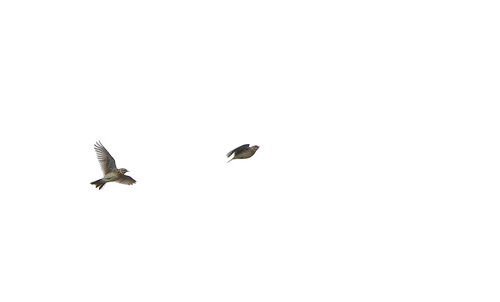
The other bird which was present in large numbers was the skylark (Alauda arvensis, Dansk: sanglærke). I stopped counting when I got to 30, and I wasn’t yet half way around my walk. They were on the ground, up high singing the amazing song that is is so much part of a British summer, and chasing each other around just above the ground at high speed in groups of up to around half a dozen.

I saw a TV show some years ago in which skylark song had been hugely slowed down and deconstructed, and they claimed the music of some classical composers (including I think, Beethoven) was based on the same structure. I was left sceptical, not least because Ludwig V was deaf and may therefore have struggled to analyse skylark song. But even so, it was fascinating!


Low level dogfight


High level chase

And singing his heart out

One of my other fascinations is etymology. I think that may originate from speaking two languages, and the first one I spoke, Danish, is one of the precursors of the current one, English, so a large number of English words have their derivation in Danish thanks to our Viking invaders all those centuries ago. The expression ‘larking about’ (and ‘lark’ may well be from the Danish ‘lærke’) originates from falconry. In days of yore, the men would go hunting with their peregrine falcons and the ladies would only be allowed to use the much smaller merlin which couldn’t catch birds bigger than larks. Hence ‘larking about’ became a term of derision based on the size of your falcon.

But I digress. The corn bunting are back, the sky was full of larks and the hares were getting frisky. I’ll keep you posted when the linnet and other summer visitors arrive.

More signs of Spring

The weekend before last, the 3rd/4th of March, was generally pretty murky and grey and generally not very pleasant, but a stroll around the fields and meadows of Histon showed up some encouraging signs of Springtime. To start with, several birds including blackbirds and house sparrows were plucking nesting material out of the shrubbery in my garden.

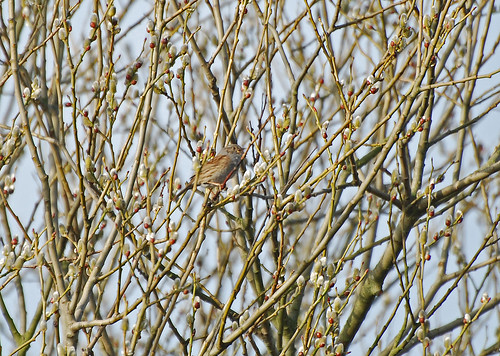
And in the meadow the buds of the willow, ‘pussy willow‘, were bursting out

…and amongst the buds was this little dunnock singing his head off. Dunnock (Prunella modularis, Dansk: jernspurv) make a big sound for such a small bird. You can here the song here.

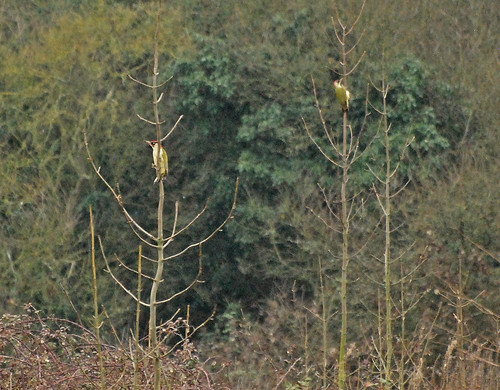
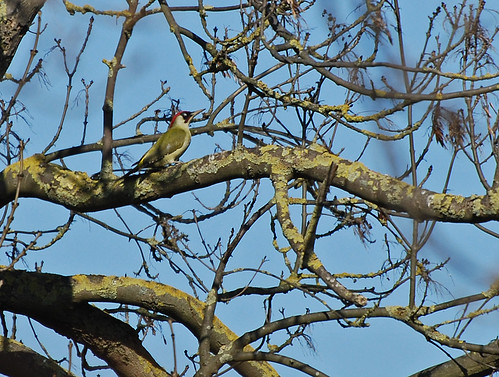
And other birds which are all adding to the avian orchestra around here at the moment are the green woodpecker (Picus viridis, Dansk: grønspætte) whose striking call I posted a link to a short while ago:


Not just one green woodpecker, but a pair. There are lots of these in the meadow but it’s seldom I see two together, and even more seldom they let me photograph them!

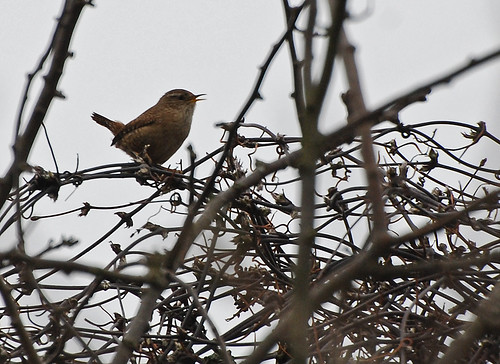
And this delightful wren who sat high and sung loud

I was very pleased with my wren picture because I rarely see them in a suitable place and they’re usually flitting in and out the undergrowth and don’t stay still for long enough to photograph. And even though it was very murky that morning and I had to use ISO 400, I like this shot. Like dunnock, wrens also make an amazing sound for such a small bird. And wrens (Troglodytes troglodytes, Dansk: gærdesmutte) really are tiny, they are 4-5cm long and weigh approximately 10g but they make a huge sound which is easily recognisable as it’s punctuated by short stretches of ‘whirring’ which differentiates it from other small bird song.

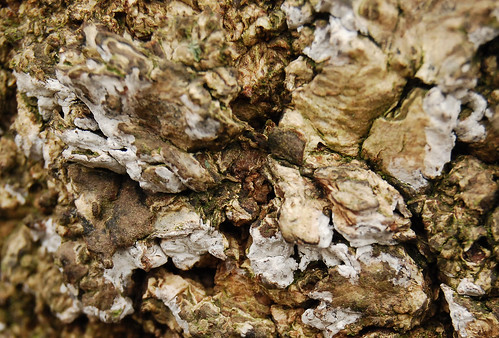
And the last thing to catch my eye on this trip was this tree bark. I couldn’t tell what type of tree it is so I’m waiting for the leaves to open so I can give it it’s proper name, but it has some wonderfully textured bark which is covered in a white mould:


I had to get down and crawl through the leaf litter to get to the base of the tree

Lots of early Springtime phenomena were going on, from pairs of green woodpeckers to singing wrens and blackbirds collecting nesting material. More Springtime firsts next post.

Local Histon Lichens

A closer look at the trees and branches, live and otherwise, in my local meadow which I posted about recently, revealed large quantities of lichen. I’d seen it there before but never really paid it sufficient attention so a couple of weekends ago I decided to rectify this shabby state of affairs.

To my highly untrained eye there didn’t seem to be more than 4-5 species but the ones that were there were present in abundance. There are four basic  morphologies of lichens: they are crustose – the flat ones which form very thin layers, foliose – form leaf like structures but where the leaves lie flat and don’t protrude far from the surface of the substrate, fruticose – have longer branched structures and can look like small shrubs and lastly squamulose –  have horizontal, scaly, overlapping lobes and look rather like some fungi I’ve seen growing on dead wood.


A grey/green crustose species and a fruticose species, the yellow one.

Lichens can be extremely sensitive to pollutants, and as a rule of thumb the foliose species are generally more sensitive and are only found in places where the environment is clean and free of fumes and other chemical pollutants. Consequently the species I find in my local patch, being close to a big town, are of the crustose and fruticose varieties. Sensitivity to pollutants can cut both ways though, those susceptible to acid pollution will obviously suffer in a low pH environment, but others which have a high demand for nitrogen can really benefit from pollution by agricultural fertilisers.

The ones I found were all growing on the surface of live deciduous trees and dead branches and the trees in the meadow are predominantly ash and oak. I’m not going to try to identify the different species here because I don’t have the requisite expert knowledge to unambiguously name lichens, but I plan to do some reading and observing and I’ll post again if I find out what they are. Even though I don’t know the species I think their colours and structures render them particularly photogenic.

The ‘thallus‘ (main body) of the yellow lichen above has the leafy structures of a fruticose species surrounding round saucer shaped structures which are called ‘apothecia‘ and are the reproductive machinery of this lichen. Within the apothecia are tiny structures called ‘paraphyses‘ and these surround the ‘asci‘ from which the fungal spores are generated. Masses of this yellow species covered many trees and fallen branches in the meadow.


Another fruticose lichen which has the leafy structures but no reproductive apothecia – I’m assuming it’s another species and not a different stage in the life cycle of the yellow one


The grey/green species here is definitely a different one. It has some erect leafy and spiky parts and it appears to have apothecia which are more cup shaped

The fungal spores produced from the asci are microspcopic and dispersed on the wind and it is a matter of conjecture how they manage to settle on the requisite species of alga to form a new lichen.

Some species can reproduce both the fungal and the algal part simultaneously by growing structures called ‘lobules‘ or ‘isidia‘ which basically consist of outgrowths of the thallus of crustose or foliose lichens which break off and are dispersed by wind and water. Or there are structures calles ‘soredia‘ which are algal cells enmeshed in a bundle of fungal ‘hyphae‘ (threadlike structures of fungal cells) which are similar to the middle part of the body, the ‘medulla‘.

If anyone out there knows the names of these lichens or has any other snippets of lichen related information please leave a comment as I’d be very interested to hear them.

A stroll through the Meadow

Last Sunday I spent a glorious couple of hours in the piece of scrub near my house where me and the dog while away significant chunks of our time. He chases rabbits, cats, pheasants and generally enjoys doing what dogs do, and I marvel at all the wildlife to be found in my local bit of wilderness. It’s probably about 300m x 150m and it’s called ‘Rowleys Meadow’ even though it’s not a meadow, and it lies on the northern edge of the village with houses lining it’s southern periphery. On the east, west and north side are old hedgerows and some wonderful old trees and in the middle are stands of young ash trees, grassy areas and large clumps of brambles.

It plays host to an astonishing variety of wildlife which in the winter and early spring is mainly birds, although a peacock butterfly fluttered by last Sunday and on several warmer days since Christmas I’ve seen bumble bees flying around there . But on this particular day it was the birds that stole the show (click here for a full list of all my sightings on this outing on February 26th).

There are very healthy numbers of green woodpecker here due to the trees and the grassland where they can find there favourite food of ant and termites. They’re tricky to photograph in the Meadow because they’re hidden in the grass and they’re very skittish, so it’s difficult to get close enough when they’re on the ground or in the trees.

Green woodpecker with his black eyepatch and scarlet military policemans cap. This one did let me get close enough… just

There are regularly 5-10 green woodpeckers (Picus viridis, Dansk: grønspætte) to be found as I circumnavigate the Meadow. It’s easy to spot them, both the colours and the low bouncing flight, often no more than 15 feet from the ground, are very distinctive. And of course it’s call is like no other creature, if you’ve never heard it listen here. Scroll down to the entry from Lars Krogh from Lindet Skov in Denmark dated 19/04/2011 where there is a very good recording of a male greenie yaffling and drumming.

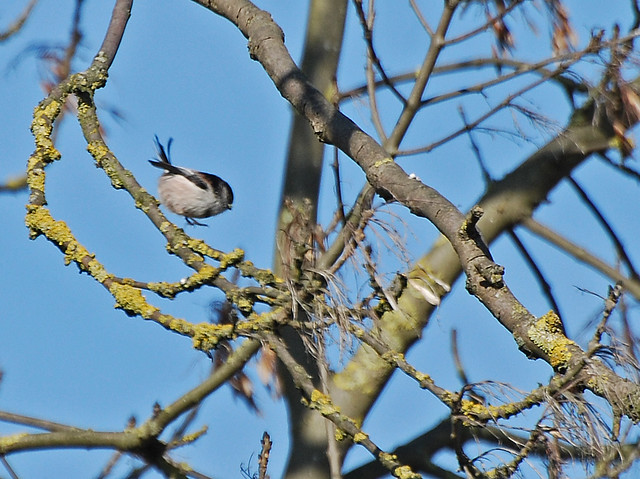
Another bird which I almost always see in the Meadow is the long tailed tit (Aegithalos caudatus, Dansk: halemajse). But for the tail, they’re tiny: the adults weigh 7-8g with a wingspan of 18cm. The long tailed tit is one of those creatures that make we wonder how such tiny ones can survive a long freezing winter. They can also be very difficult to photograph as they never stay still for more than a few seconds.


On final approach…

But when you are lucky enough to capture them they make delightful pictures!


Touchdown!

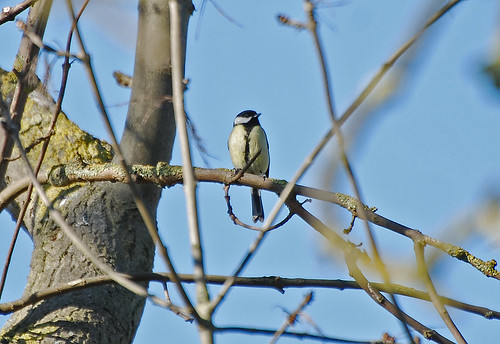
You may have noticed the lichens on the branches, I’ll share some photographs of those in the next post. In another tree adjacent to the one with the long tailed tits was a pair of great tits (Parus major, Dansk: sortemejse), among others. I like great tits, they’re handsome birds and they’re entertaining to watch feeding in my garden, especially when there is a family of them. The pair here are a male and a female:

Male great tit, his black stripe stretches all the way across his chest from toe to toe, making him very desirable indeed. I think the ‘A’ indicates he is the alpha male

The stripe of the female is much narrower:


Great tit female

And very shortly after I took the pictures of the great tits, a female sparrowhawk circled slowly overhead. The trees and hedges suddenly went very quiet as all the small birds concealed themselves from this fearsome predator. I’m not sure if she was hunting as I spotted a second, possibly a male, sparrowhawk circling much higher up. She was probably not more than a hundred feet up, but the male was several hundred feet up. I watched a pair of sparrowhawks do this over my garden once before, where the male was much higher, and I think it may be part of the courtship routine. (If anyone can confirm or refute that please drop me a line and let me know).


A female sparrowhawk circling over the hedges at the north end of the Meadow

All in all it was a very enjoyable and rewarding trip in bright warm sunshine and the  birdlife was there in spades.

Crystallised countryside

After the snow at the beginning of February, last weekend the temperatures in this part of the world plummeted to a wintry -12C creating a cold crystalline landscape.

So here are some pictures from the frost bound south Cambridgeshire countryside:

Ash saplings and brambles festooned with ice crystals on the shaded north side. The sun had already stripped the south side bare of frost

It was still early in the morning so the sun was low in the sky and created ghostly scintillations as it reflected from showers of dancing frost crystals dislodged by wafts of icy breeze.

As I walked my footsteps made loud cracking and crunching sounds but when I stood still it was completely silent. No cars, no birdsong, just the sound of the breeze. It was absolutely beautiful.

The rays of the sun couldn’t reach the grass stems so they remained coated with crystals through the day

Giant burdock

The burrs of the burdock (Arctium lappa) normally provide seeds for goldfinches to feast on but today they were twice their normal size and weighed down by a thick coating of frost.

Guns Lane Raptors

Last Saturday before the snow came I went for a hike along Guns Lane heading north from Histon up to Rampton. It was an unusual walk because there was very little wildlife of any sort, and apart from small numbers of the usual birds such as chaffinch, blackbird and blue tit, and a small flock of 19 lapwing which flew over, there were also very few birds.

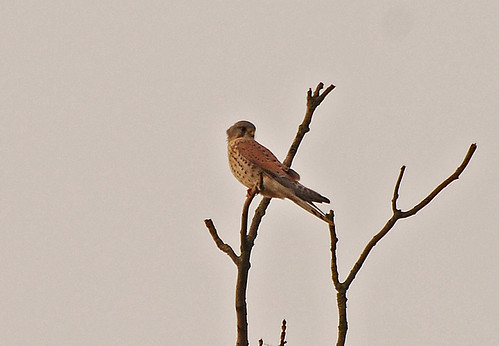
Two birds that were around were several kestrels (Falco tinnunculus, Dansk tårnfalk) and a lone buzzard (Buteo buteo, Dansk: musvåge). Kestrels are one of my favourite birds, I never tire of watching them. They are compact birds, 34cm long with a 76cm wingspan, and their plumage is very attractive, which can be seen in the pictures below, and their flying skills combined with their UV vision and agile talons make them a superbly well designed weapons platform. So of course, as well as watching them, I try to photograph them.

This handsome male bird sat in the top of a tree carefully watching me as I got closer:

And decided I was too close as I got to the bottom of his tree:


Kestrel exiting the top of an ash tree showing of his talons and array of flight feathers

A bird that I never saw in this country until I was at least post-grad age was the buzzard. I saw them when I was on holiday in Denmark as a kid, but not here until I started holidaying in the south west and I’d see the occasional one in Cornwall, Devon and Pembrokeshire.


Like the kestrel, this buzzard was keeping a keen eye on my activities

But from the early 1990’s buzzards have spread to recolonise most of the rest of the country and are regularly seen them gliding overhead around home and perched on fence posts and telegraph poles by the side of the roads. The buzzard is a resident breeder in the UK and is a bird of open heath and farmland, its preferred prey is small mammals but will also take birds and reptiles, and when times are hard insects and earthworms can find their way onto the menu.

Buzzards are big birds with wingspan around 1.2 m and are unmistakeable when either down low like this one:


Also like the kestrel, exiting its perch when my unwanted attentions were deemed too intrusive…

…and gliding away to another less public location

…or when thermalling up high, minimising the effort required to stay aloft.

Meandering away on a non raptor related tangent, as I’m writing this post I’m looking out my window and there are blue tit, great tit, robin, dunnock, chaffinch, blackbird, long tailed tit and starling in my back garden. And goldfinch, and they’re the first ones to visit since last summer. As I posted about last time, the birds are being driven into gardens by the bitterly cold weather. It was -12C first thing this morning and it is now bright and sunny at 1pm, but the temperature is still only -3C. By the way, if you feed the birds try to put some food out the night before if you can, because the smaller songbirds such as blue tit and wren can die very quickly if they don’t find food soon after dawn when the weather is so cold.

Wonderful Wildlife of Wicken Fen

Around 10 years ago I used to do voluntary work at Wicken Fen which lies in the flat emptiness between Cambridge and Ely. Wicken Fen is one of the last and the largest piece of remaining fenland in East Anglia and is home to a plethora of wildlife. It’s owned and managed by the National Trust in such a way that diverse habitats favouring different species are established and maintained. When I worked there we were engaged in various activities such as repairing boardwalks, fences and hides, scrub clearance, which was a good activity for freezing winter days because it involved a huge fire to burn the felled scrub, but my favourite job was building raised ponds with wheelchair access so disabled children could safely do some pond dipping. Which is an activity that everyone should be able to do, child or not. All you need is a net, a jar, a magnifying glass and a pond and a sunny day is turned into a fantastic voyage of biological discovery.

My re-exploration last weekend started from Upware at the back end of the Fen where we parked and joined Wicken Lode. We had counted over 30 species of birds within the first half hour of our walk. If it had been solely down to my good self the number would have been rather less because my skills when it comes to recognising birdsong are a tad limited. Fortunately I was with my friend, David, who’s aural acuity is considerably better honed than mine, and I’m highly envious of his ability to detect the song of distant bird species and identify them. One of the first birds to greet us in the car park was this mistle thrush perched on top of a telegraph pole:

Mistle thrush – Turdus viscivorus (Dansk: misteldrossel)

… and a great spotted woodpecker, also finding a handy perch at the top of a telegraph pole:


Great spotted woodpecker – Dendrocops major (Dansk: Stor flagspætte)

Great spotted woodpeckers make a characteristic drumming sound by doing what their name suggests and it is the frequency of the drumming, of around 40 beats per second, which generates the resonant sound. Anatomical examination of their skulls has revealed the presence of built in shock absorbers which prevent them damaging their brains when they drum. They feed on tree seeds such as acorns and insects which they dig out from under the bark of trees and they can also take birds eggs and chicks which they have been known to steal from birdboxes by drilling holes through the walls and plucking them out.

We eventually managed to tear ourselves away from Upware and head out along Wicken Lode on to the Fen where a Cetti’s warbler (Cettia cetti, Dansk: cettisanger) gave away his location by singing in a way that only Cetti’s can. It’s an amazing sound and I can highly recommend having a listen here. These recordings don’t quite do it justice, but you get a feel for it. Also on the Lode were a family of three mute swans; male, female and one cygnet. Mute swans are always photogenic but I felt particularly blessed when the male spread hs wings and shook himself down:

Mute swans (Cygnus olor,  Dansk: knopsvane)

We turned off the Lode and headed along Harrisons Drove where we came across a field of very impressive bovines. In  order to manage the fen (and at the same time draw in more visitors, no doubt) cattle and horses are used to trim the vegetation back naturally. I’d never seen the cattle before and they are magnificent animals – looking more like a cross between a highlander and a bison than traditional farm cattle:


They must be hardy beasts indeed to survive on the meagre nourishment offered by the fen

Also along the drove I spotted a hen harrier (Circus cyaneus, Dansk: Blå kærhøg) quartering the field, either a female or a juvenile, identifiable by the pale band around the rump just infront of the tail feathers. In my opinion, spotting a harrier, even a fleeting glimpse, justifies an expedition into the fens early on a freezing morning. Alas it was too far away to photograph, but when after another couple of hundred metres we entered a hide overlooking a lake, there were plenty of subjects for photography…

This lake was home to hundreds of ducks – we estimated around 800 from 5 species that we could see… as well as coot and mute swan. Watched over by the longhorns.

I don’t think this lake is there in the summer because looking at the area on Google Maps there is no water, and David pointed out that their were no diving ducks such as pochard (Aythya ferina, Dansk: taffeland – which tranlates as ‘table duck’ which shows what the Danes think of them!) tufted duck (Aythya fuligula, Dansk: troldand) or goldeneye (Bucephala clangula, Dansk: hvinand), suggesting the water was too shallow. But there were large numbers of shallow feeders such as gadwall (Anas strepera, Dansk: knarand), shoveller (Anas clypeata, Dansk: skeand), pintail (Anas acuta, Dansk: spidsand), mallard (Anas platyrhynchos, Dansk: gråand) and wigeon (Anas penelope, Dansk: pibeand). We had seen three flocks of wigeon (and heard them too, they make a great sound) fly over and land on the water just before we got to the hide.  Some of them were on the lake above and lots more were on an adjacent one:


Wigeon. Lots of them! I counted around 60 in this group.

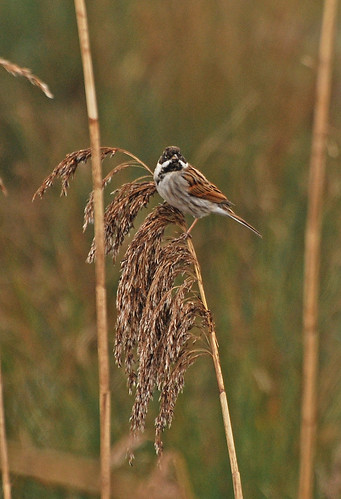
And in between the two lakes were numerous reed bunting (Emberiza schoeniclus, Dansk: rørspurv) flitting between the hedgerow and the path and pausing to pluck seeds from the seedheads of the reeds, hence their name…

Male reed bunting – one of my better reed bunting shots

And the female:
We saw 44 species of birds that we could identify on our way around Upware and the Fen. And as well as all the birds Wicken is home to a phenomenal diversity of insects, large mammals including roe deer and otter, small mammals including shrews, voles, mice and the predators that hunt them, and reptiles including lizards which can be seen basking in the sun on the boardwalks and fenceposts early on summer mornings. Now I’ve been back and rediscovered the Fen I’ll make sure I get back later in the year and post about the changing wildlife in what is a unique collection of ecosystems.

The curse of the cabbage patch – and other beauties

The last post on this blog, ‘The Frozen Fen‘, had a decidedly wintry feel, and because of that, combined with the fact that I didn’t manage to get out and about and get any interesting pictures last weekend, I feel like brightening things up with some colourful butterfly pictures which I didn’t get a chance to publish in 2011 because of the dire shortage of butterflies.

I mentioned in a post last year that 2011 was a very bad year for butterflies, and that was a result of the mild Spring and very hot April which kick started the proceative processes. But after April the rest of the Summer was dreadful – cold and wet – and that resulted in catastrophic depletion of butterfly numbers. This winter has been mild so far (which is why I have had almost no birds in my garden compared to other years) and I’m hoping it stays that way and our Lepidopterans have a chance to recover their numbers this year.

So here are a few of the butterflies which I hope will put in appearances in and around the village this summer:


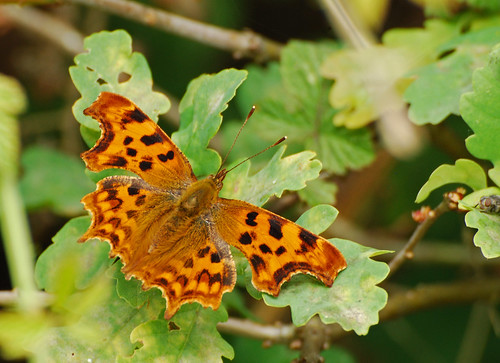
A comma (Polygonia c-album) soaking up some rays from a cluster of oak leaves

The comma is a member of the Nymphalidae family and is primarily a woodland butterfly which gets its name from its only white marking which is on the underside of the wings and is shaped like a comma. Bizarre that such a distinctive butterfly is named after such a tiny part of it’s anatomy, a bit like calling a tiger a ‘full stop’ because of the black spot behind its ear!  They are also seen in gardens (including mine) in the late summer where they stock up on nectar to replenish their body fat reserves prior to hibernation. Until fairly recently they were restricted to the west of England but have now spread to cover virtually all of England and Wales with sightings in Scotland and Ireland too.

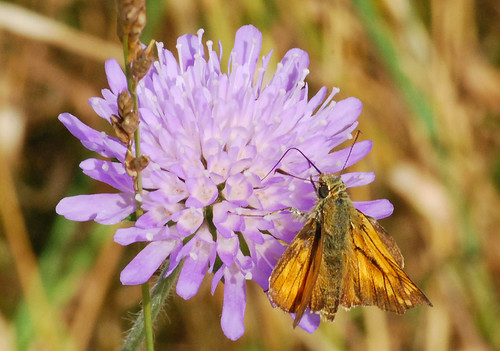
Large skipper (Ochlodes faunus)

I like the large skipper, it is a butterfly of open grassland and I often see them feeding on field scabius flowers, as this one is, and the colour combination is sumptuous, set against the green and brown of the grass stems. I like the geometry too – it reminds of a hornet (as in the McDonnel Douglas F18 hornet – the American navy fighter plane) – but I’d rather have the skipper flying around Histon!

Small copper (Lycaena phlaeas)

The small copper is a handsome little butterfly who frequents open grassland, heathland, wasteland, verges and woodland rides and is distributed throughout Great Britain. I see it here because it likes to feed on ragwort, yarrow, thistles and red clover which are all abundant in the fields close to Histon. They also feed on daisy, dandelion and buttercups which are common throughout the UK too. Despite their dietary promiscuity I don’t see them very often so I was pleased to get this picture.


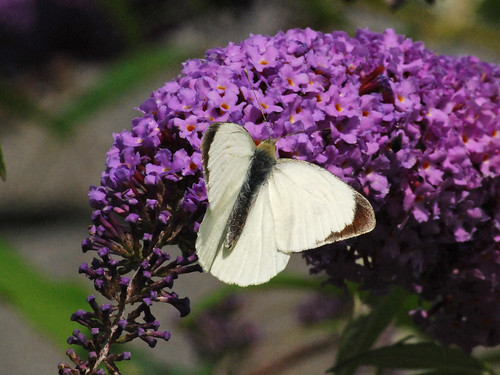
Large white (Pieris brassicae)

The curse of the cabbage patch! The large and small white are collectively known as ‘cabbage whites’ due to the devastation their caterpillars can wreak on the fruits of the labours of hapless allotment owners. The one pictured here is a male and he is easily distinguished from the female because she has two black spots on her forewings and another small black streak where the wings join and the male has no spots or streaks. As a species they are easily distinguished from other whites because they are noticeably bigger. The cabbage whites are also two of our most common butterflies which renders them additionally unpopular amongst the vegetable growing fraternity. Which is a pity really, because a field full of whites on a hot summer day mixed in with browns, blues and all the other butterflies is a spectacular sight.