Category Archives: fen

A very welcome return

When I was a kid and we holidayed every year in Denmark, the stork was an iconic bird and one we never saw in the UK, and we would take trips down to Ribe in southern Jylland – the Danish mainland – to see storks nesting on church towers, thatched rooves and wagon wheels the locals had mounted on tall poles for that purpose.

In recent years a successful reintroduction program undertaken on the Knepp estate in Sussex with birds from Warsaw zoo has resulted in storks breeding again in England. The last recorded breeding in the UK happened in 1416 so it’s been a very long time coming!

Yesterday I went for a walk around Burwell Fen and Wicken Fen and the spring weather was perfect for nature watching; and birds, butteflies and mammals were out in abundance. But the star of the show was a stork sitting atop the Tower Hide at Wicken Fen. I’d been tipped off by another person enjoying a walk in the spring sunshine that it was there, but I was a tad sceptical until I rounded the bend and there it was. The first time I’d seen one outside Denmark or central Europe. Suffice to say I was beside myself.

White stork – Ciconia ciconia – perched on the Tower Hide at Wicken Fen in Cambridgeshire

The stork is a migrant to Europe after overwintering in Africa and is up to 1.1m tall with a wingspan of around 1.8m. It’s a big bird and nests in small colonies on spectacular nests made out of sticks and I hope they start building them in Cambridgeshire again in the not too distant future.

I’d deliberately left my camera in the car to just enjoy the scenery and of course I half regretted that, so I took these images with my phone. Not the best quality photo’s of a stork but I’m very pleased with them and they record a very special sighting for me.

After taking flight from the hide it soared higher and higher over the Fen for probably 10-15 minutes or so before disappearing.

Apart from the stork, the Fens were alive with othe creatures and even though I don’t like lists this time it’s worth sharing a selection of what I saw and heard:

Hare, roe deer, orange tip butterflies, peacock (butterflies), speckled wood, brimstone, oystercatcher, lapwing, shelduck, swift (the first I’ve seen – and heard – this year), swallow, kestrel, sparrowhawk, marsh harrier, hobby, peregrine falcon, buzzard, cetti’s warbler, sedge warbler, grasshopper warbler – and all of these whilst being constantly serenaded by wrens and cuckoos.

If only I’d taken my camera 🙂

Owl Outing to Burwell Fen

The short eared owl is resident in northern England and Scotland where breeding populations reside, but in my part of East Anglia,near Cambridge, they are only seen in winter time when migrants from Scandinavia arrive.

A really good place to see short eared owls is Burwell Fen a few miles to the east of Cambridge. it’s a wide open scrubby space bordered by farmland and by Wicken Fen which is managed by the National trust and is itself an important nature reserve.

I went there with some friends who hadn’t seen a short eared owl before and were excited at the possibility, and as with all things natural, even though I was reasonably confident we would see one, there’s never any certainty. We met up there one afternoon in early January and within 5-10 minutes one appeared hunting over the grassland.

Short eared owl – Asio flammeus – quartering the Fen

I don’t know if the cattle that were grazing the Fen were flushing the voles that the owls feed on but this one seemed to be spending a lot of time hunting around the cattle.

One owl taking exception to a second one encroaching into it’s space

As we watched over the Fen for the next couple of hours at least 3-4 owls were in the air, and here’s photographic evidence that were at least two!

It was a bright sunny winter afternoon in January and because of the time of year the sun was low in the sky all day and the light was spectacular. It lit up the Fen, which can appear grey and featureless on a cloudy winter day, in gorgeous pink and orange hues. It was beautiful to look at but challenging to photograph! And before the sun sunk below the horizon a barn owl also appeared to hunt small rodents.

A ghostly barn owl – Tyto alba – appeared just before dusk, the night shift replacing the day shift

And shortly after the sun sunk below the horizon in a polychromatic blaze of colour…

By now it was too dark to see the wildlife, and too cold to linger, but it had been a wonderful introduction to the Fen and to short eared owls for my friends!

Springtime Fenland birdlife

After my last post, my long time blogging friend, Scott, mentioned in a comment that he was reading a book set in my part of the world, viz the fenland of East Anglia. And that reminded me that during the Covid lockdown we’ve beeen allowed to drive a few miles to exercise outdoors, and back in April I ventured over to a local fen for a walk with my camera.

The Fens are a unique ecosystem characterised by lakes, reed beds and low scrub which create habitat for a wide range of wildlife and they’re a great place to see flowers, birds, mammals and reptiles. It was a glorious sunny day when I was there and the wildlife was abundant, including this male reed bunting who posed beautifully for his portrait:

Reed bunting Ouse Fen 18 Apr 2020_3015Reed bunting (Dansk – Rørspurv, Latin – Emberiza schoeniclus)
Cuckoos (Dansk – gøg, Latin – Cuculus canorus) were cuckoo’ing all around the Fen – it’s apparently a good year for cuckoos here in the UK, and I heard one for the first time ever in the village a few weeks ago – and bittern (Dansk – rørdrum, Latin – Botaurus stellaris) were booming. The bittern is a smallish brown heron which lives and breeds in reedbeds and is extremely rare in the UK, only 191 males were recorded in the UK by the British Trust for Ornithology (BTO) in 2017. Their booming call is an amazing sound and it can carry for over a kilometre. It’s difficult to find a recording that really does it justice but if you click on the link this one hopefully gives you a good idea of what they sound like. Even though when they boom they’re very disticntive and easy to hear, they’re not easy to see unless in flight as they blend in perfectly with the background of the reedbeds. But one of these days I hope I can post one of my own pictures of a bittern to show you.

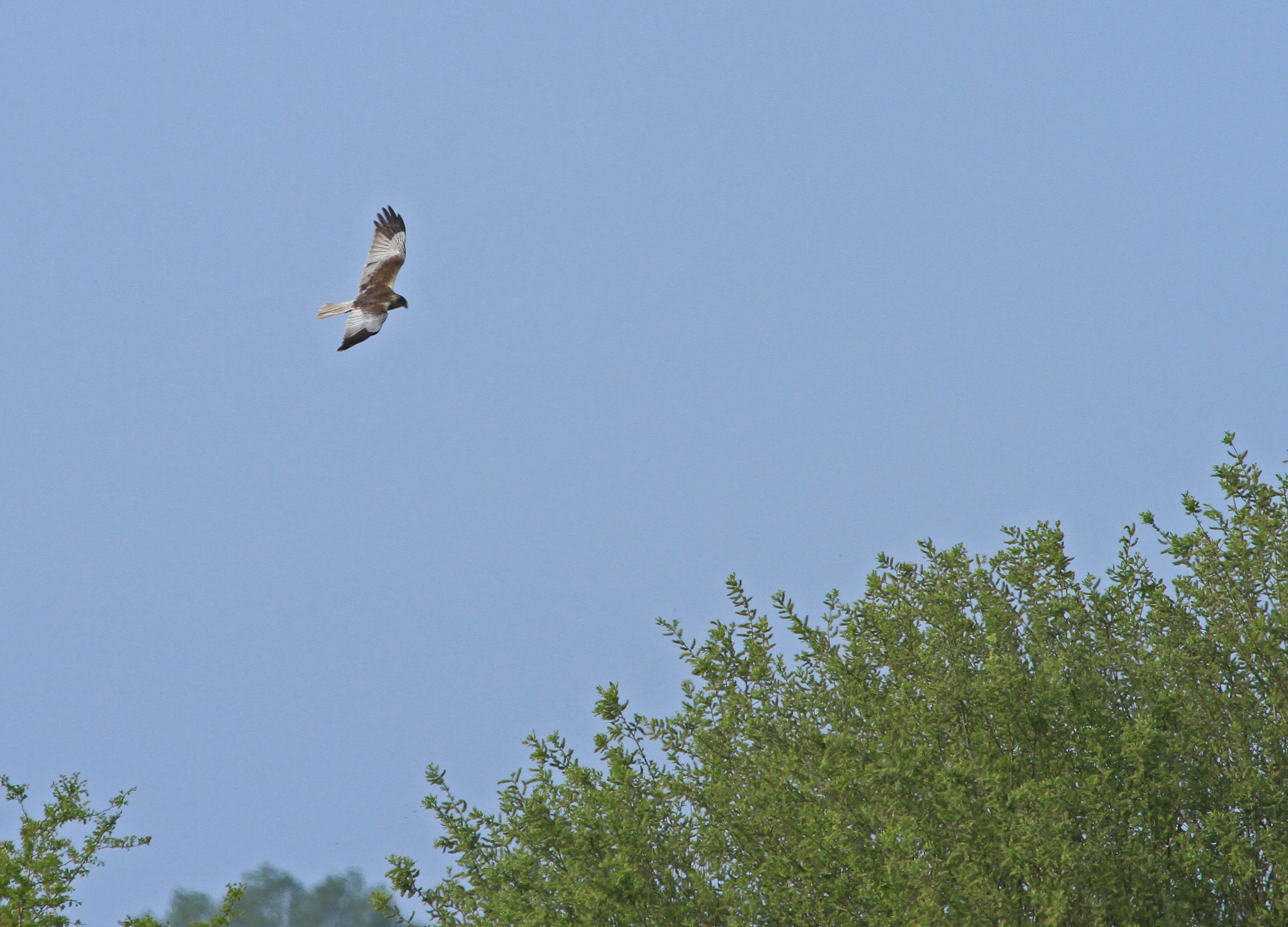
However, one bird that is easy to see is the marsh harrier:

Marsh harrier Ouse Fen 18 Apr 2020_3040Marsh harrier (Dansk – Rørhøg , Latin – Circus aeruginosus)

The marsh harrier is another one of the British birds of prey whose numbers have recovered significantly since the 1960’s presumably after the pesticide DDT was banned, and this one is a male hunting small mammals or birds over the low scrub of the fen.

The marsh harrier is a constant on the Fen, and it seems the bittern may be coming one too, which is fantastic. But the cuckoo isn’t, they’ve laid their eggs for the host species to rear and will soon be heading back on the perilous journey to the rainforests of sub-Saharan west Africa, hopefully to return to the UK next year to fill the spring air with their wonderfully distinctive call.

The Common Crane

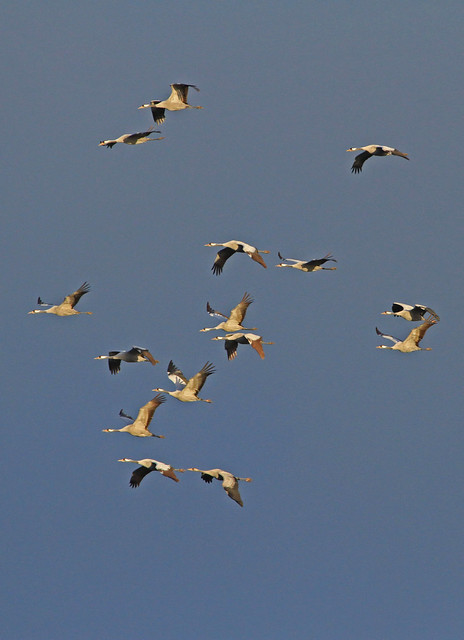
A couple of weeks a go I was on an early morning train heading out across the Fens near March in Cambridgeshire where I saw a group of 30-40 cranes in a field next to the train line. I’ve only ever had one fleeting glimpse of a common crane in the UK before so it was properly exciting to see such a large group of these statuesque birds. So much so that two days later I drove to the vicinity of the first sighting to see if I could find them again. And after a little driving around this is what happened…

14 common cranes (Grus grus, Dansk: trane)

These 14 birds were part of a group of 19 that flew right overhead and it was a quite incredible sight! According to the BTO the common crane is amber listed after being hunted to extinction four centuries ago. It has recolonised East Anglia naturally since 1979 and according to the Weekly News from BirdGuides a record 54 pairs of an estimated 180 birds were counted this year in the UK.


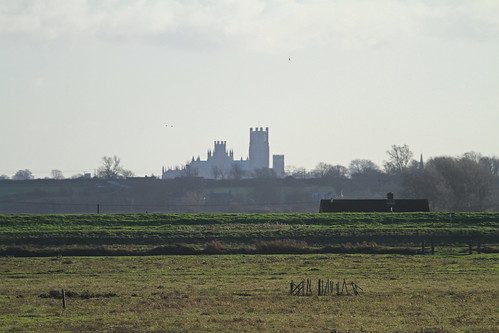
After this sighting I headed on to the Ouse Washes where this group formed part of a larger group of 40-45 birds, so I saw approximately a quarter of the UK population. They were too far away to get a photograph but captivating to watch in the distance through binoculars. They were a mile or so off to the left and straight in front, several miles away, was Ely Cathedral:

Which even though it was made by humans is also a majestic site on a sunny morning across the flat expanse of the Fens.