Category Archives: Insects

Local Lepidoptera

The class of insects known as the ‘Lepidoptera‘ is the one that encompassses moths and butterflies. Many species of both have emerged from hibernation and can be seen aplenty in gardens, parks and in the countryside.

Speckled wood (Pararge aegeria) and orange tip (Anthocharis cardamines) are abundant in scrub and hedgerows.
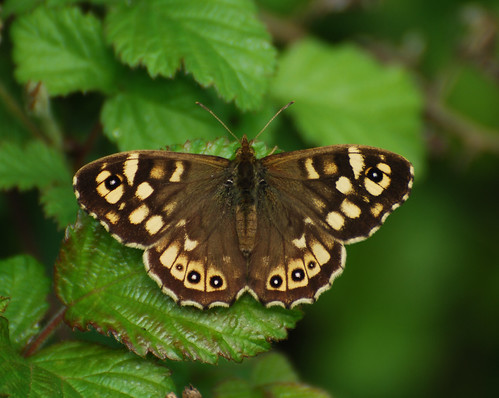

Speckled wood butterfly warming up on a bramble leaf

The speckled wood is an interesting butterfly for a couple of reasons. It has a north/south colour variation where  more northerly individuals have  whitish spots and more southerly ones have orange spots. The other unique feature of this species is that it can overwinter as both a larva and a pupa resulting in adults emerging all the way through from Spring to Autumn.

I don’t have a good picture of an orange tip as they are very difficult to catch stationary. I watched one sat on a cow parsley flowerhead for several minutes last weekend, but of course I’d left my camera at home. The males have a 40-50mm wingspan, creamy white upper parts with big orange patches on the wingtips which alaso have a black margin. Underneath they have wonderfully intricate green lacework which makes highly effective camouflage. The females don’t have the orange tip, which is thought to be a warning to predators that they are unpalatable, but they are easier to see on food plants as they are not busy looking for mates in the same way the males are. Photographs to follow, hopefully!

A few red admirals (Vanessa atalanta) have been spotted by me in Histon so far this year, although not more than two or three, but in the last two weeks large numbers of small tortoiseshells (Aglais urticae) and holly blues (Celastrina argiolus) are flying around in the hot sunny weather.


Red admiral on a bramble stem
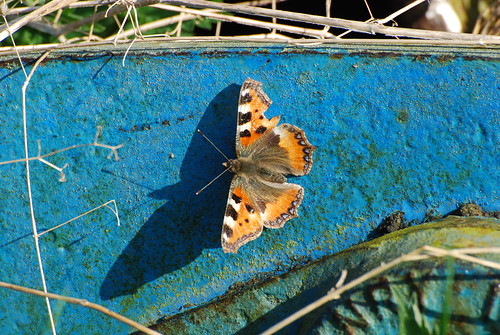

Small tortoiseshell butterfly looking somewhat tatterdemalion after emerging from hibernation, warming up in the early morning sunshine on an old farm machine

Holly blue butterfly

I haven’t seen many interesting moths yet this year, but late one evening last week, whilst quietly watching TV, this beauty emerged from behind the sofa, to the general consternatiion of all in the room, fluttered around very rapidly for several seconds before homing in on a lamp and alighting inside the shade:
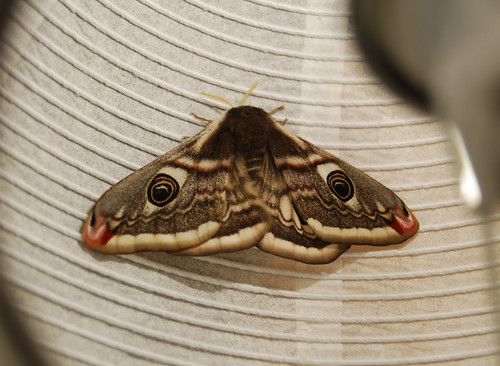

Emperor moth female inside a lampshade

As you can imagine, her choice of resting place gave an additional challenge to the photography but I like this picture. The male is even more colourful with orange hindwings and believe it or not the emperor moth, Saturnia pavonia, is native to the UK, not an import from the rainforests! Emperor moths are big with a wingspan over 7cm, and they live on moors and in open countryside where they feed on brambles. The males are out and about in daytime looking for mates in April and May and the females are abroad at night, I guesss looking for safe places to lay eggs. It is the UK’s only resident member of the Saturnidae family.

Norsey Wood

Last weekend my wanderings took me to Norsey Wood on the  eastern edge of Billericay in Essex. The weather was sunny and warm so a stroll through this chunk of ancient woodland was compulsory. The wood is a lovely place and has a history dating back 4000 years. It is now a mixed coppice bluebell wood and in a month or so the floor will be completely blue. At the moment, the bluebell leaves are sprouting but no flowers are out but there are wood anemones (Anemone nemorosa):

Wood anemone flowers pointing at the sun

And lesser celandines (Ranunculus ficaria):

Wood anemones are interesting plants. They’re toxic and contain chemicals which have been used medicinally but which can cause some pretty unpleasant effects if ingested such as vomiting, diarrhoea and gastric bleeding. Best avoided. Despite that, a wood floor covered in them is a wonderful sight to behold. Lesser celandine are rather lovely too, with similarly interesting properties. According to its Wikipedia entry it has warty nodules which resemble haemarrhoids, so ancient law dictated it must therefore possess anti-haemorrhoidal properties. Bizarre logic, but you never know, maybe there was a grain of truth in it. It doesn’t mention how the active ingredient was applied though!

I saw a group of four jays squabbling in a tree but the woods were generally fairly quiet for birds on that day. The animal which was present in enormous abundance was the woodant, Formica rufa,


Wood ant worker – these are around 1cm long

The workers are all female and if attacked they have a ferocious bite and can spray formic acid from the rear of the abdomen. A loner wouldn’t trouble a human but disturbing a nest which may contain several hundred thousand would be ill advised.


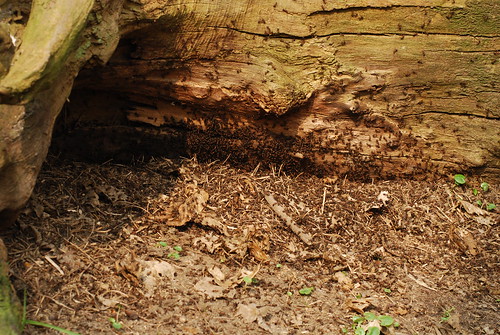
Thousands of woodants all busy around the entrance to the nest

They’re amazing creatures and build nests from plant material such as leaves and pine needles which can be a metre deep. As they act as an incubator and creche the temperature has to be very carefully controlled which is achieved by opening and closing vents to regulate airflow through the nest. So they’re fearsome warriors, highly competent parents and civil engineers too.

The organisation and division of labour amongst woodants is also remarkable. They have territories covering large areas and I’ve tracked them from a nest to a foraging site and the distance is many tens if not hundreds of meters which they negotiate in straight lines where possible and will clear away any debris which  blocks the way. Amazing creatures.

I’m hoping to make a trip to Norsey Wood in May when the bluebells are in bloom so I’ll hopefully post from there again later in the year.

Dragonfly discoveries

Dragonflies are amazing insects which it seems can be seen just about anywhere. In 2010 I’ve even spotted them over my garden in Histon. It occurred to me I should put some effort into photographing and learning about them as I sat with my family eating a picnic on a bench overlooking the fountain in the Cambridge University Botanical Gardens. Numerous small, magnificently bright red, individuals were whizzing around the pond, and a few big blue ones a short distance away from the pond (the small red ones were a species of darter, and the big blue ones were hawkers – probably migrant hawkers). I attempted to photograph these for subsequent identification but alas my photographic skills were’t up to the job on that occasion. Despite that I looked up some information and lots of great pictures at http://www.dragonflysoc.org.uk/home.html. This is a great website and started me off on a journey of discovery which is now pretty much finished this year but which I plan to resume as soon as possible next year.

Subsequent walks around Milton Country Park and the fields north of Histon provided lots of opportunities to see many species of dragonflies and damselflies:


Female brown hawker sunbathing on a birdbox at Milton Country Park

Migrant hawker male. The yellow ‘golf tee’ on segment S2 is diagnostic 

Dragonflies originate from species which fossil records date to the Carboniferous period, around 300 million years ago, and could have a wingspan up to 70cm! They comprise the taxonomic sub-order known as ‘Anisoptera‘ and are part of the order ‘Odonata‘ which also includes damselflies (Zygoptera) and another group which is virtually extinct called ‘Anisozygoptera‘. There are now around 5300 species of dragonflies of which approximately 40 reside in the UK.

Dragonflies lay eggs underwater either loose, protected by a hygroscopic gel, or inside plants. The eggs of some species can lie dormant over winter and resume development when temperatures rise in springtime. Time to hatching is temperature dependent but is usually around 2-5 weeks and the larvae develop in water, all British species overwinter once as larvae but time to adulthood can be up to 5 years. Metamorphosis from larva to adult is triggered by increasing day length and temperature in spring, and includes the transition to breathing air and growth of their incredible compound eyes. Each eye is made up of around 29000 individual elements called ‘ommatidia‘. They also possess three addtional ‘simple eyes’ call ‘ocelli‘ which are sensitive to light intensity and assist in controlling flight via direct nerve connections to the flight muscles. Dragonflies have excellent colour vision and can also see ultra violet light. It makes me wonder what the neural activity behind all that optical prowess is capable of: are dragonflies merely responding directly to visual stimuli via reflex arcs, or is there more sophisticated image processing going on?


Common darter, immature male

Common darter, female. Note the compound eye.

Dragonfly larvae are ambush predators feeding on moving prey including other insect larvae, snails, small fish and tadpoles. Adults catch other insects in flight, holding their legs out in front like a bread basket to scoop prey from the air such as flies, flying ants, mosquitoes and even other, smaller, dragon flies.

Newly emergent dragonflies are powerful fliers and disperse widely. They are often seen a long way from water and can even cross seas. They reach maturity after a few days to a few weeks, a process also controlled by temperature, when the males will congregate at vantage points near water where females come to oviposit. The male will grasp the female around the head with his anal appendages and attempt to mate with the female by swinging her round to form the ‘copulatory wheel’ enabling him to pass a packet of sperm from the secondary male sexual organs located on his second abdominal segment to the female sex organs located on her eighth abdominal segment. After mating, sometimes under the guard of the male, to ensure his sperm is not displaced by another male, the female will oviposit underwater. And so the cycle begins again.


Broad bodied chaser – female