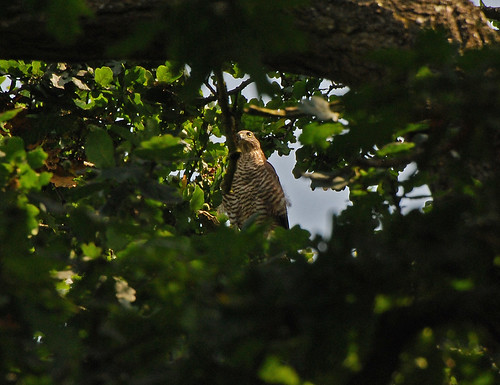
Category Archives: Birds of prey

A stroll through the Meadow

Last Sunday I spent a glorious couple of hours in the piece of scrub near my house where me and the dog while away significant chunks of our time. He chases rabbits, cats, pheasants and generally enjoys doing what dogs do, and I marvel at all the wildlife to be found in my local bit of wilderness. It’s probably about 300m x 150m and it’s called ‘Rowleys Meadow’ even though it’s not a meadow, and it lies on the northern edge of the village with houses lining it’s southern periphery. On the east, west and north side are old hedgerows and some wonderful old trees and in the middle are stands of young ash trees, grassy areas and large clumps of brambles.

It plays host to an astonishing variety of wildlife which in the winter and early spring is mainly birds, although a peacock butterfly fluttered by last Sunday and on several warmer days since Christmas I’ve seen bumble bees flying around there . But on this particular day it was the birds that stole the show (click here for a full list of all my sightings on this outing on February 26th).

There are very healthy numbers of green woodpecker here due to the trees and the grassland where they can find there favourite food of ant and termites. They’re tricky to photograph in the Meadow because they’re hidden in the grass and they’re very skittish, so it’s difficult to get close enough when they’re on the ground or in the trees.

Green woodpecker with his black eyepatch and scarlet military policemans cap. This one did let me get close enough… just

There are regularly 5-10 green woodpeckers (Picus viridis, Dansk: grønspætte) to be found as I circumnavigate the Meadow. It’s easy to spot them, both the colours and the low bouncing flight, often no more than 15 feet from the ground, are very distinctive. And of course it’s call is like no other creature, if you’ve never heard it listen here. Scroll down to the entry from Lars Krogh from Lindet Skov in Denmark dated 19/04/2011 where there is a very good recording of a male greenie yaffling and drumming.

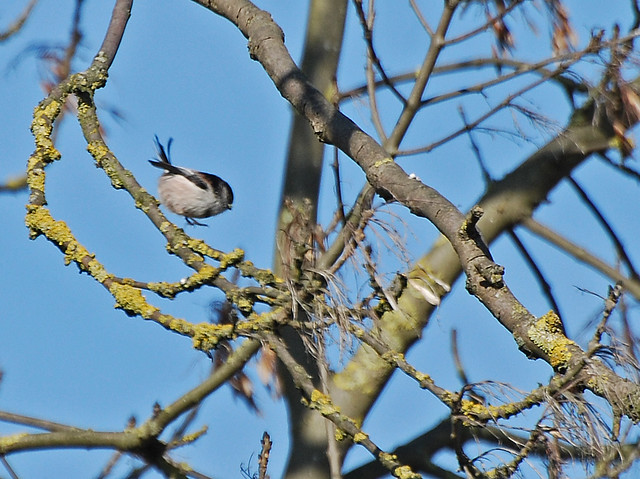
Another bird which I almost always see in the Meadow is the long tailed tit (Aegithalos caudatus, Dansk: halemajse). But for the tail, they’re tiny: the adults weigh 7-8g with a wingspan of 18cm. The long tailed tit is one of those creatures that make we wonder how such tiny ones can survive a long freezing winter. They can also be very difficult to photograph as they never stay still for more than a few seconds.


On final approach…

But when you are lucky enough to capture them they make delightful pictures!


Touchdown!

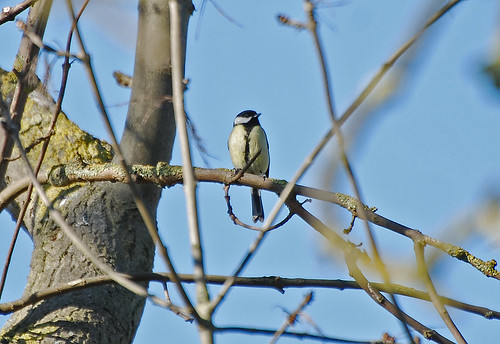
You may have noticed the lichens on the branches, I’ll share some photographs of those in the next post. In another tree adjacent to the one with the long tailed tits was a pair of great tits (Parus major, Dansk: sortemejse), among others. I like great tits, they’re handsome birds and they’re entertaining to watch feeding in my garden, especially when there is a family of them. The pair here are a male and a female:

Male great tit, his black stripe stretches all the way across his chest from toe to toe, making him very desirable indeed. I think the ‘A’ indicates he is the alpha male

The stripe of the female is much narrower:


Great tit female

And very shortly after I took the pictures of the great tits, a female sparrowhawk circled slowly overhead. The trees and hedges suddenly went very quiet as all the small birds concealed themselves from this fearsome predator. I’m not sure if she was hunting as I spotted a second, possibly a male, sparrowhawk circling much higher up. She was probably not more than a hundred feet up, but the male was several hundred feet up. I watched a pair of sparrowhawks do this over my garden once before, where the male was much higher, and I think it may be part of the courtship routine. (If anyone can confirm or refute that please drop me a line and let me know).


A female sparrowhawk circling over the hedges at the north end of the Meadow

All in all it was a very enjoyable and rewarding trip in bright warm sunshine and the  birdlife was there in spades.

Barn owls bounce back

Every now and again there is a piece of good news regarding the survival of a particular species. Yesterday on the BBC news website was just such a story. It concerned the resurgence of barn owls (Tyto alba, Dansk: slørugle) in the Trossachs around Loch Lomond in Scotland.

Watching barn owls silently quartering fields on a warm summers evening is a rare treat and getting rarer, so it was good to hear that in this area the numbers of field voles (Microtus agrestis) have rocketed by up to ten fold, which has led to a concommitant increase in the breeding success of the local barn owls.

A barn owl quartering a wheat field

Paradoxically, the reason the vole population exploded was the long freezing winters we had last year and the year before, in which large numbers of barn owls perished, but the voles were able to avoid the worst of the cold and move around by tunnelling under the snow and thereby avoid detection by airborn predators.

It was also interesting to read that the owls were maximising the benefit of the vole surplus by storing slaughtered prey in owl boxes, with up to 15 dead rodents in a single box.

Hopefully vole numbers will continue to remain high and barn owl numbers can recover even further. If anyone has heard similar reports about barn owl numbers in other parts of the country please let me know.

Guns Lane Raptors

Last Saturday before the snow came I went for a hike along Guns Lane heading north from Histon up to Rampton. It was an unusual walk because there was very little wildlife of any sort, and apart from small numbers of the usual birds such as chaffinch, blackbird and blue tit, and a small flock of 19 lapwing which flew over, there were also very few birds.

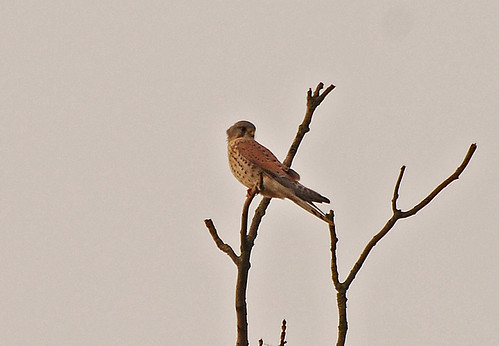
Two birds that were around were several kestrels (Falco tinnunculus, Dansk tårnfalk) and a lone buzzard (Buteo buteo, Dansk: musvåge). Kestrels are one of my favourite birds, I never tire of watching them. They are compact birds, 34cm long with a 76cm wingspan, and their plumage is very attractive, which can be seen in the pictures below, and their flying skills combined with their UV vision and agile talons make them a superbly well designed weapons platform. So of course, as well as watching them, I try to photograph them.

This handsome male bird sat in the top of a tree carefully watching me as I got closer:

And decided I was too close as I got to the bottom of his tree:


Kestrel exiting the top of an ash tree showing of his talons and array of flight feathers

A bird that I never saw in this country until I was at least post-grad age was the buzzard. I saw them when I was on holiday in Denmark as a kid, but not here until I started holidaying in the south west and I’d see the occasional one in Cornwall, Devon and Pembrokeshire.


Like the kestrel, this buzzard was keeping a keen eye on my activities

But from the early 1990’s buzzards have spread to recolonise most of the rest of the country and are regularly seen them gliding overhead around home and perched on fence posts and telegraph poles by the side of the roads. The buzzard is a resident breeder in the UK and is a bird of open heath and farmland, its preferred prey is small mammals but will also take birds and reptiles, and when times are hard insects and earthworms can find their way onto the menu.

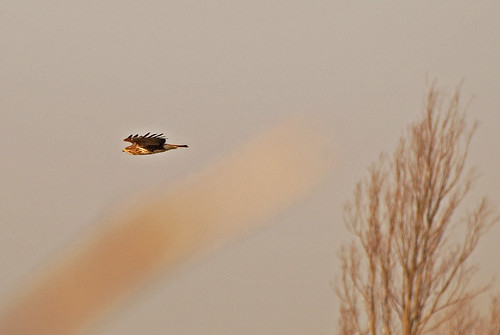
Buzzards are big birds with wingspan around 1.2 m and are unmistakeable when either down low like this one:


Also like the kestrel, exiting its perch when my unwanted attentions were deemed too intrusive…

…and gliding away to another less public location

…or when thermalling up high, minimising the effort required to stay aloft.

Meandering away on a non raptor related tangent, as I’m writing this post I’m looking out my window and there are blue tit, great tit, robin, dunnock, chaffinch, blackbird, long tailed tit and starling in my back garden. And goldfinch, and they’re the first ones to visit since last summer. As I posted about last time, the birds are being driven into gardens by the bitterly cold weather. It was -12C first thing this morning and it is now bright and sunny at 1pm, but the temperature is still only -3C. By the way, if you feed the birds try to put some food out the night before if you can, because the smaller songbirds such as blue tit and wren can die very quickly if they don’t find food soon after dawn when the weather is so cold.

The Motorway falcon

The kestrel (Falco tinnunculus, Dansk: tårnfalk) is so called because it is commonly seen hovering or perched on a branch next to the road side. This phenomenon led to the perception that the kestrel was widespread but unfortunately that’s not entirely accurate. In recent decades the eradication of all species other than the desired crop from agricultural land has left these highly specialised predators with limited options for hunting their regular prey of small rodents. But motorway verges present large areas of relatively untouched grassland with a healthy supply of mice and voles so they’ve become regular hunting grounds for the kestrel.

The individual in the photographs below was perched beautifully and I’d just got it framed when an unseen dog flushed it from it’s perch:


A male kestrel taking to the air

A hunting kestrel is immediately recognisable by it’s hovering flight which provides a stable platform for the onboard weapons system of phenomenal eyesight to spot the prey and talons to despatch it and carry it away. Technically kestrels don’t hover in the way that helicopters do, they fly directly into the wind at the same speed as the wind so they don’t move forward. It’s well worth taking a close look at a ‘hovering’ kestrel through binoculars or a telescope where all the fine and rapid adjustments of the control surfaces necessary to maintain a stable position in space can be seen.

The kestrel has another trick up its sleeve which enables it to hunt small, well camouflaged, rodents scurrrying through dense undergrowth. Rodents such as voles urinate constantly and they use this to delineate their territory and to communicate information to other voles. Rodent urine contains compounds which reflect UV light and kestrels are able to see near UV and thereby track the rodents down to the end of the urine trail.

Incidentally, the reason humans can’t see UV is because it is filtered out by the lens and some people who have had their cataracts dealt with by the insertion of artificial lenses, can see UV. I found this video clip at http://birdchaser.blogspot.com. which contains some interesting information about various creatures’ use of UV light 

I think the one below may be the same individual. It was perched in exactly the same spot a week later and I’ve seen a male there several times during that week. This time it was me that flushed it, but it didn’t zoom away in typical falcon fashion, it alighted on the ground between it’s tree and me and didn’t appear particularly bothered by me or the dog.

I see kestrels either just perched in a tree or hunting most days but I never get tired of photographing them, or just watching them doing what they do.

All those flocking waders

The Cambridgeshire Fens can be a bleak and windswept part of the world as the winter months descend, and today it was very bleak and very windswept, but it’s a great location for getting out and seeing some exciting and scarce wildlife.


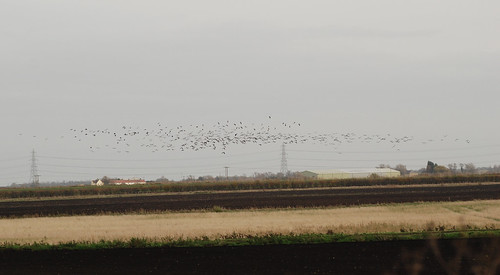
A small flock of lapwing and golden plover over Burwell Fen

For those of you who don’t know the Fens they’re characterised by wide open flatness and big skies. They were originally under water but were drained by Dutch engineers in the 17th and 18th centuries to leave high quality arable land. The soil is extremely rich in organic material which gives the soil the rich black colour evident in the picture above.

I set off there on Saturday with my friend David because there had been a report on the Cambridge Bird Club website of short eared owls (Asio flammeus, Dansk: mosehornugle) in the vicinity. After wending our way through Swaffham Prior and Reach we rocked up at Tubney Fen where we sat in a new National Trust hide overlooking a new pond with new reed beds which had four coots (Aythya fuligula, Dansk: blishøne) and a pair of mute swans (Cygnus olor, Dansk: knopsvane) paddling on it. And no other signs of life whatsoever.

As we watched, the mute swans took off and looped round low right in front of us and landed back on the water. At least one of them landed on the water in the spectacular and graceful way that mute swans do. The other one crash landed on the ground just short of the water and after regaining its equilibrium stood looking highly indignant but managed to retain it’s dignity in a way that only a mute swan could in those circumstances. We hoped it wasn’t injured but it looked to be suffering from little more than damaged pride.

After another five minutes sat in the hide the lack of further activity and the low temperature caused us to move on, and on the way back to the car we spotted eight whooper swans in a field several hundred meters away. The whooper (Cygnus cygnus, Dansk: sangsvane) is a winter migrant to the UK and a very scarce breeder, usually less than ten pairs a year will breed here. It’s a similar size to the mute swan but it’s neck is straighter and the beak is straight with a black tip and pale yellow base. Their breeding territory is in the high Arctic and they migrate south as far as Africa for the winter.


A family unit of eight whooper swans – two adults with white plumage and the charateristic yellow beak and six cygnets with pale grey/white plumage and without the yellow beak

We decided to move on to Burwell Fen from Tubney Fen and on the way we were considerably closer to the swans so we stopped for another look. And as we looked David noticed that a pale brown stripe in an adjacent field was in fact a flock of golden plovers (Pluvialis apricaria, Dansk: hjejle) and lapwings (Vanellus vanellus, Dansk:  vibe). When I was a kid I spent a fair amount of time out and about exploring the countryside and huge flocks of lapwing consisting of hundreds and possibly thousands of birds were a fairly common sight. But their numbers have been dwindling for decades and these days I’m pleased if I see more than twenty. A carrion crow was getting agitated in the tree beyond the plovers because a buzzard (Buteo buteo, Dansk: musvåge) was perched there too, but the crow wouldn’t get too close and the buzzard just sat tight and ignored it. There turned out to be 243 lapwing in this flock and for me that alone justified the trip.


Around 10% of the lapwing in our flock of 243

There were also several hundred golden plover. As we watched another even bigger flock joined them and when they were flushed into the air we could see another flock as big again in the middle distance and beyond that another that was enormous. So we estimated that between these flocks there were several thousand birds. It was a amazing sight.

The flocks of waders eventually settled so we made off further into the Fen, pausing to gaze at a group of roe deer (Capreolus capreolus) relaxing in a field:


These very well camouflaged roe deer didn’t seem at all perturbed by our presence

As we watched the deer, a sparrowhawk (Accipiter nisus, Dansk: spurvehøg) quartered the field and then a peregrine falcon (Falco peregrinus, Dansk: vandrefalk) swooped past car, travelling with the customary haste that species is renowned for.

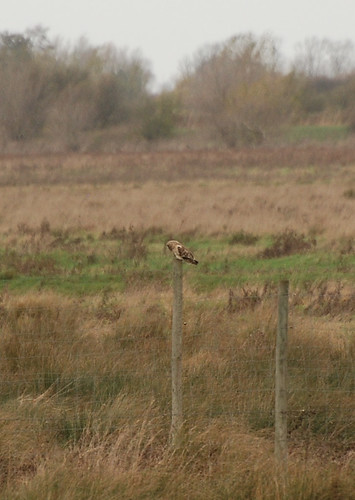
Arriving eventually at a car park, we continued on foot over a bridge where several kestrels (Falco tinnunculus, Dansk: tårnfalk) were quartering all the fields around and almost immediately spotted a short eared owl. It was perched on a fence post in the middle of the adjacent field and I initially mistook it for a little owl because I was looking at it from front-on and I could only see the top half, but when we saw it through David’s spotting scope we could clearly see it was of the short eared variety.

Short eared owl hunting rodents the easy way, not wasting any energy

As a result of the inclement weather, low light and strong wind, and only having a 300mm lens I couldn’t get any good photographs, but it’s unmistakeably a short eared owl, so I’m happy.

We saw various small songbirds such as chaffinch (Fringilla coelebs,  Dansk: bogfinke) and goldfinch (Carduelis carduelis, Dansk: stillits), five bird of prey species, whooper swans, and countless thousands of golden plover and lapwing. So despite the cold it was fine way to spend a Saturday morning.

Butterflies, and all that jazz

Ronnie Scott’s Jazz Club isn’t where I would expect to find subjects for wildlife photography. And, along with the inside of various other hostelries around the City of London, so it proved. That’s where I found myself this weekend and consequently I didn’t manage to take any photographs. So as the weather is so dull and foggy I thought I’d try to brighten things up with some butterfly pictures which were captured at another, less crepuscular, time of year.

Last year I went to a place called Fermyn Wood near Kettering in Northamtonshire with a friend of mine, to look for purple emperors. For the more ornithological among you, particularly if you like birds of prey, this was one of the original release sites for red kites (Milvus milvus, Dansk: rød glente) , and they are still there in abundance. And sure enough one appeared very low overhead before lazily flapping off across the treetops.


This splendid creature is a white admiral (Limenitis camilla), feeding on the nectar from bramble flowers at Fermyn

We set off early to arrive around 8am because at that time of day the butterflies are sunning themsleves on the ground and taking in salts. They get salts from various sources including animal droppings, carrion, sap runs on trees, and sweat. My friend has a photograph of a purple emperor sipping sweat from his sock by inserting its proboscis through the eyehole of his trainer! We encountered a few emperors but they were all whizzing past higher up in the tree canopy. They live in deciduous woods where they spend most of their time feeding on aphid honeydew, apart from this one who sat obligingly on the path and let us take photographs:


Purple emperor (Apatura iris) taking on salts from the substrata

He was sufficiently obliging to unable us to take pictures of the underside of his wings, which are themselves spectacular, but he wasn’t willing to reveal the full irridescent splendour of the top side, which is where their name derives from.  They are big, with an average wingspan of around 8cm, and the males are the most gorgeous deep purple. Alas for the female of the species, she is a rather less dramatic brown colour. I was therefore on a mission to get pictures of the upper side of the wings in 2011 but they are only around for 1-2 weeks of the year and it wasn’t when I could get there. But that’s fine, it gives me something to look forward to next year… or the year after.

On the ground close by the purple emperor was a small tortoiseshell, which are considerable more common and can be found on buddleia bushes up and down the country, but are also amazingly colourful.


Small tortoiseshell (Aglais urticae)

I don’t usually like full on portraits of butterflies, but I like this one because set against the parched earth the flamboyant colours of the butterfly are a sight to behold, all the tiny cells of the different colours in the blue and white peripheral spots are clearly visible. It’s a stunner!


The balance of nature

At the end of May this year the BBC screened an episode of Countryfile in which John Craven interviewed a member of the scientific staff at the Game and Wildlife Conservation Trust (GWCT). Taking things literally I’d assumed the this was a trust who’s aim was the conservation of game and wildlife. However, as the interview progressed I began to question this assumption as the discussion centred around a study to be carried out by the GWCT in which magpies were to be eradicated from a specified test area to assess the local effect on songbird populations. I don’t think that removal of a native species such as the magpie by trapping and killing them is an ethical way to study predator/prey relationships. But is it scientific?

The magpie – villain of the piece – apparently

The interviewee from the GWCT, Dr Jeremy Stoate, justified the cull on scientific grounds suggesting that increased predator numbers result in significant reductions of prey populations and the species they identified as being largely responsible was the magpie.

Magpies are bold, brassy, ubiquitous, and are generally percieved as being a tad raffish. They undoubtedly predate songbird nests, but I struggled to understand how this could justify slaughtering them. Numerous other species of bird and mammal such as sparrowhawk, kestrel, owls, great spotted woodpeckers, rats, stoats and probably the biggest killer of small birds, domestic cats, all predate songbirds and some raid nests to poach eggs and chicks.

So why was it only magpies that were to be exterminated?

The action was being justified on a scientific basis, and whilst I’m no ecologist, I am a scientist, and the whole thing seemed unscientific, so I decided to do a little research of my own on the subject. Interestingly, since I did my initial research in June, it appears that references to the study on the GWCT website have been taken down. At least, I couldn’t find any.

However, what I did find out was that the study was commissioned and financed by another ‘conservation’ organisation called Songbird Survival. Whilst I believe that GWCT do have a genuine interest in the countryside as a whole, the same cannot be said for Songbird Survival. It is a registered UK charity whose statement of activities on UK Charity Commission website is this:

THE PRINCIPAL OBJECTIVE OF THE CHARITY IS TO IMPROVE, PROTECT AND PRESERVE FOR THE BENEFIT OF THE PUBLIC THE POPULATION OF SONG AND OTHER SMALL BIRDS BY THE CONSERVATION AND RECREATION OF HABITATS, BY SUITABLE EDUCATION OF THE PUBLIC AND LOBBYING MP’S AND THE HOUSE OF LORDS, TO EFFECT CHANGES IN THE LAW WHERE WE FEEL IT IS NECESSARY.

However, the details on the Charity Commission website also list the trustees, and that makes interesting reading too…

LORD COKE, MR CLIVE PATRICK SHERWOOD, MR FRED VALENTINE INGRAMS, MR JOHN RICHARD PUGH, LORD MICHAEL RICHARD RANKEILLOUR, MR ROBERT JOHN MIDDLEDITCH, MR DAVID GRIFFITH, MR NICK FORDE, LORD JOHN HADDINGTON, MR HUGH VAN CUTSEM, MR COLIN STRANG STEEL

All of these trustees are big landowners, or relatives of landowners, some with shooting estates, and they all support hunting and shooting. Lord Coke is the owner of Holkham Hall in Norfolk and he and several of his gamekeepers have been prosecuted for killing birds of prey by shooting and poisoning. So I’m struggling to believe that these people really have the best interests of songbirds at heart when they are funding ‘scientific’ destruction of a single predator species which has been implicated in taking gamebirds. And via the titled gentlemen listed as trustees they would be ideally placed to carry out their stated aim of ‘lobbying MP’s and the House of Lords‘.

Back to the science though. I recently attended a lecture in which Dr Mike Toms of the British Trust for Ornithology (BTO) talked about garden birds and how gardens are becoming an increasingly important sanctuary for increasing numbers of songbirds, and therefore predators, such as magpies, great spotted woodpeckers and sparrowhawks. In the course of his lecture Dr Toms talked about the decrease in songbird numbers and how magpies were being blamed but said that magpie predation was not the cause of the decline in numbers but habitat destruction and current agricultural practices were the primary reasons. I emailed Dr Toms and he was kind enough to send me several links to published work by the BTO into bird predation. This list included this publication: ‘Population changes of avian predators and grey squirrels in England: is there evidence for an impact on avian prey populations? Journal of Applied Ecology 47: 244- 252‘ describing a collaborative study between the BTO, GWCT and the University of St Andrews in which the impact of 2 groups of predators, those which predate adult birds and fledglings and those which predate nests (including the magpie) were analysed for 29 prey populations. Quoting directly from this paper:

For 22 avian prey species, there is no evidence that increases in common avian predators and grey squirrels are associated with large-scale depression of prey abundance or population declines‘.

Then:

Unexpected was a large number of positive (my italics) associations between predators and prey, particularly for native avian nest predators, which largely exonerates these predators as driving declines in passerine numbers

And:

Analyses of large-scale and extensive national monitoring data provide little underlying evidence for large-scale impacts of widespread avian predators and grey squirrels on avian prey populations…

The paper also describes negative correlations between the remaining seven prey species and predator numbers, and accepts that some of these may be causally related. Although e.g. the relationship between sparrowhawk and tree sparrow is probably significant, that between buzzard and goldfinch almost certainly isn’t. However, in an email from Dr Toms to me he indicates that the GWCT study showed negative causal relations on  a local level but, crucially, not at a population level.

This last point is key to the argument. In a study of population dynamics, if conclusions are to be drawn about overall depletion of numbers in response to a specific influence small local studies cannot be extrapolated to enable conclusions for the population as a whole, and to do so is erroneous at best, misleading at worst.

Incidentally, I also found a publication on the website of Songbird Survival entitled ‘Detecting an impact of predation on bird populations depends on the methods used to assess the predators’, (Methods in Ecology and Evolution (2010),1,300-310, Nicoll M., Norris K.). This is an interesting paper because rather than analysing actual population data it investigates the methods used to analyse the data. And in the summary the last point recommends: ‘…the findings for studies which use opportunistic data, for a limited number of predator species, should be treated with caution and that future studies employ bespoke census techniques to monitor predator abundance for an appropriate suite of predators.’

This is interesting because it argues that the methods used to analyse opportunistic, observational data must be carefully optimised to ensure that conclusions drawn from the data adequately reflect the observations.

None of the publications suggest that slaughtering the predators is a rational scientific way to assess the negative impact on prey species. And I’m inclined to think that culling is poor science, particularly as the latest evidence suggests predator numbers don’t reflect negatively on songbird populations and in some instances there is actually a positive correlation between predator and prey, presumably because the predators remove the sick and the slow before they can add their DNA to the genepool.

I think the notion that predators destroy prey populations is bizarre because I was taught, and importantly, I believe it to be the case, that prey abundance determines predator numbers, not vice versa. If prey numbers decline then shortly afterwards so do predator numbers. Taking the reverse of this theory to it’s logical conclusion, if predator numbers determine prey numbers, all prey species would eventually become extinct and then the predators would also become extinct and the balance of nature which has prevailed for the last few billion years would be turned on its head. Which is absurd.

So population studies which are centred around the slaughter of predators seem to me to fly in the face of all current theory and are therefore morally indefensible aswell as being scientifically unsound, especially when commissioned and financed by such obvious vested interests as Songbird Survival.

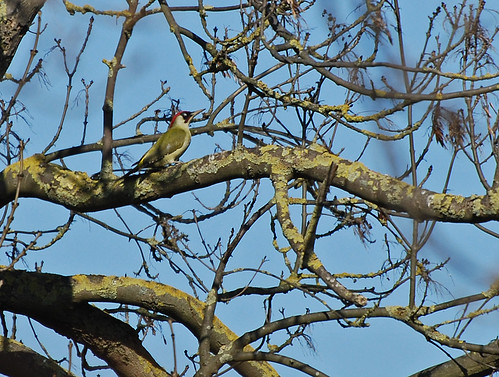
Subbuteo

Falco subbuteo, (lærkefalk in Danish), after which the table football game is named (it was the games creators favourite bird apparently), is a summer visitor to our shores. It is a migrant breeder and passage visitor, spending the winter in Africa and despite being widespread throughout Europe, there are only around 2000 pairs in the UK which are predominantly confined to the south and east below a line from the Severn to the Humber estuaries.

They breed in nests abandoned by other birds, often those of crows, and they feed on insects and birds which they take out the air in flight. To do that they need to be fast, and they are extremely fast, taking dragonflies and small birds by utilising their amazing speed either in level flight or in a stoop. They have a slate grey back and are white with black speckles underneath with dark, grey/black head, eye patches and moustaches similar to a small peregrine falcon (vandrefalk), and I find the easiest visual differentiator is the red thighs and underside of the tail.

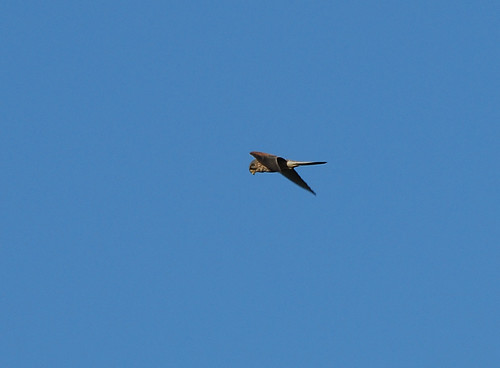
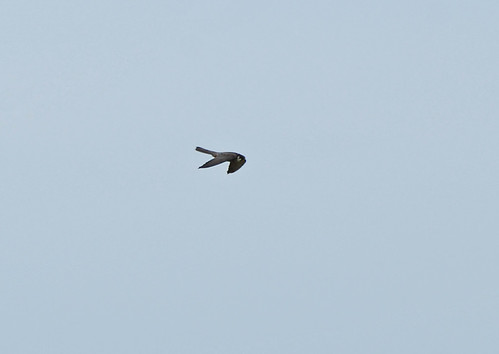
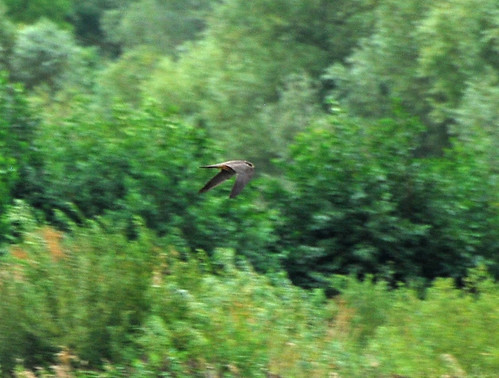
Whilst I was at Fen Drayton nature reserve last weekend I watched one hunting and I managed to get some pictures, which aren’t the best quality, but I hope convey some of the drama of their high velocity hunting technique:

Beginning the approach:

…homing on the target:

…and pulling up with empty talons:

The red thighs are visible in the second and third photographs above, and are diagnostic for the hobby.

It’s exhilarating watching a wild predator hunting, especially at the speed these guys do it. And it presents an interesting photographic challenge too, one which I’m yet to perfect as the high speed flight of the hobby requires high speed panning. I’m looking forward to the next chance I get to practice.

A trip to the coast

Last weekend I found myself poking into the nooks and crannies of Fareham in Hampshire. My only previous visits to Fareham had been when I was playing rugby against them some years ago. So it was fun to go back and explore it in a more leisurely fashion and find out what flora and fauna are there. And I was very pleasantly surprised. (A bit of a digression, but as I’m sitting writing this, back in Histon, I can hear a muntjac deer barking somewhere along our road).

Our friends who we were staying with live a short 10 minute walk from the town centre, a route which took me across a piece of ‘managed wasteland’ called the Gillies. This is a mixture of scrubby woodland and is thick with flowers and an abundance of insects and birds.


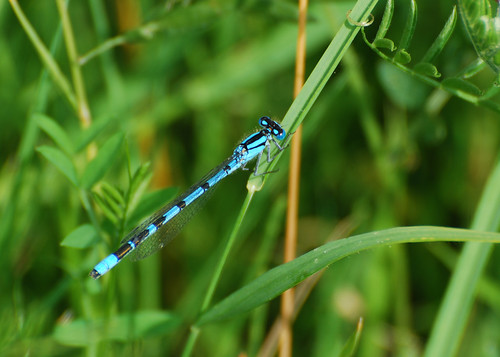
A common blue damselfly – Enallagma cyathigerum perched on a grass stem

I was hoping to see some species which I don’t see in Cambridgeshire, but alas this was not the case. But I guess that’s a tad churlish as I saw lots of great wildlife. The approach to the Gillies took me under a bridge which I think carries a railway line and glancing up as I passed under it early on the Saturday morning a pair of fallow deer sauntered across. I can’t think of any other town in the UK where I’ve seen that! Alas. I’d left my camera behind.


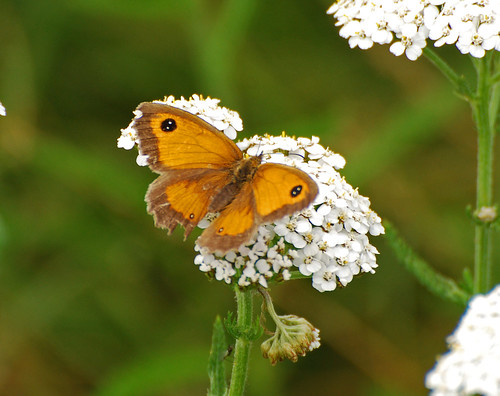
A somewhat tatterdemalion gatekeeper sipping nectar from yarrow flowers

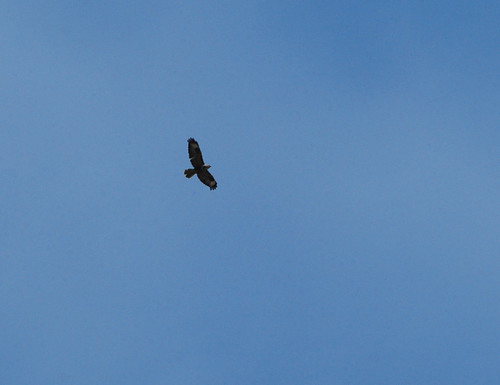
A glance skyward in the midst of a butterfly hunt with the children, with several blackcaps singing in the bushes, revealed this buzzard circling lazily in the scorching sunshine over Fareham town centre:

…and then a few minutes later:

Shortly after the buzzard had disappeared we had ventured into some adjacent woodland where the quiet was shattered when a pair of fairly big birds chased each other into the top of a big old oak tree screeching as they went. They continued their slanging match for a couple of minutes and it turned out to be two sparrowhawks, and this one appeared in this gap for just long enough to snap a photograph. It’s not the best shot ever of a sparrowhawk but I really like it as it was in the midst of a fight and it sat still for just long enough for a single shot.

One creature I didn’t see but which my host told me she saw during a run through here earlier in the afternoon was a slow worm which slithered across the path infront of her. I haven’t seen one for many years but there are rare reptiles frequenting this place too. It’s a truly remarkable location.

So if you ever find yourself in Fareham feeling a tad disappointed by the 1950’s town planners’ attempts to rectify the damage done by the Luftwaffe, ask a local for directions to the Gillies and go and marvel at all the local wildlife.

Milvus milvus

If you haven’t seen a red kite, Milvus milvus, hopefully you will soon. They are truly magnificent birds and are a remarkable success story in the annals of UK wildlife conservation. Several stages of reintroduction of Swedish and Spanish birds into northern Scotland and the Chilterns in 1989 were followed by subsequent reintroductions into other release sites in the East Midlands, Derwent Valley, Yorkshire, Dumfries and Galloway, central Scotland, Aberdeen and Ulster. The later reintroductions have used chicks from UK breeding pairs which is, I think, a good indication of the success of the longer term success of the original program.

The latest numbers I have heard for our UK population is 1700 breeding pairs, and growing. The reason I’m writing about red kites now is because 3 weeks ago I had an email from a colleague to tell me to look out the window because a red kite was flying past! I only saw the email an hour after the event so I missed that one, but another appeared a week later which I did see.

And then on Saturday as I was wandering along the road I live on, this magnificent creature was slowly quatering the gardens looking for worms, small mammals, or carrion:

The red plumage of the underside of the red kite is clearly visible. The pale patches on this one suggest it’s a juvenile

And red kites are big birds, they have a wingspan of 185cm. They weigh between 2 and 3 pounds (1 and 1.3kg), so for such a big bird they’re not heavy and are consequently not particularly strong. They feed primarily on carrion but they are unable to open the carcasses of bigger animals such as sheep so they rely on other carrion feeders such as corvids (crows) to do the initial butchering before they can feed. They don’t take live prey bigger than small mammals such as mice or voles or bird chicks, so don’t be concerned about your cat… or your children!

Whilst cycling into work yesterday morning (25th July) along the cycle path beside our new guided busway a red kite was quartering a field adjacent to that, so with 4 sightings in the last 3 weeks within a 2 mile radius, I think a juvenile may have moved into the area and is finding sufficient food to keep it here. I hope so.

Red kites are often wing tagged on the leading edges of both wings, on the left the tag reveals the location of the birds origin and on the right the year it hatched. The tags are big enough to be seen from a distance with binoculars or a scope and each location and year have a different colour. If you see a tagged bird and you want to discover its origin take a look here at RedKite.net where the tag colours are decoded.

I’ll hopefully be able to report again soon on local red kites.