Category Archives: Migrants

Meadow warblers

Our migrant warblers were all back from Africa and nesting by the beginning of June. There are four species which normally frequent my local countryside, the blackcap (Sylvia atricapilla, Dansk: munk), chiffchaff (Phylloscopus collybita, Dansk: gransanger), willow warbler (Phylloscopus trochilus, Dansk: løvsanger) and the whitethroat (Sylvia communis, Dansk: tornsanger).

The blackcap have been conspicuous by their absence this summer. The central European winter population, of which a pair took up residence in the garden last winter, disappeared in the spring and that was the last time I saw one. Chiffchaff were, as always, the first winter visitor I noticed returning because of their characteristic song calling out from the trees. There are several other birds singing in the background here but the call of the chiffchaff is clear above the others, and it’s easy to see where it gets its name from.

Chiffchaff male declaring his availability in early spring

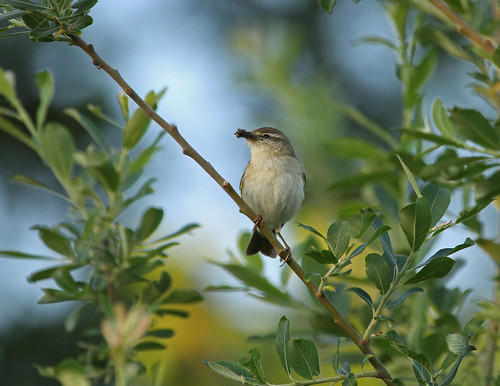
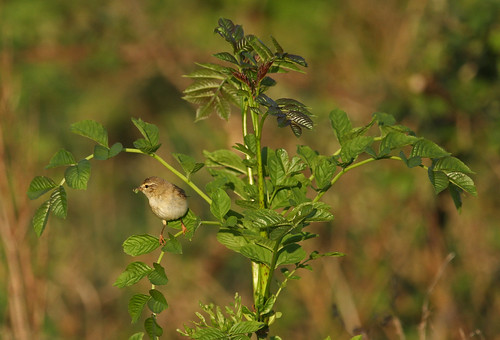
It’s now at the start of September and I haven’t seen a chiffchaff for a while, but through the summer I regularly saw willow warblers which were nesting in a bramble thicket that I passed when I was out walking the dog. Willow warblers are very easy to mistake for chiffchaff by sight but willow warbler song is quite different.

Willow warbler parent with a beak full of insects heading for the nest

The song isn’t the only diagnostic differentiator between these two species, there are a couple of others but they are more subtle. The most noticeable is the colour of the legs, chiffchaff have dark, almost black, legs and the willow warblers are red brown. Differences in plumage of the willow warbler are the brighter stripe over the eye (the ‘supercilium‘), a more promounced dark eyestripe and the patch under the eye (the ‘ear covert’) is olive grey with a pale patch immediately below the eye, compared to the more uniform dark grey colour of the chiffchaff. So if you get a good look through binoculars it’s not too difficult to tell them apart, but the song is the easiest way.

Another foray to collect flies for the chicks

Pausing to check up on me before heading into the nest

For a couple of weeks there was a spot in the field where I could stand close to the nest and watch the comings and goings of the adult willow warblers bringing food for the youngsters, and they seemed cautious but otherwise content for me to be there if I stood still.

Whitethroat male – my best ever bird portrait!

My favourite warbler is the whitethroat. They are easy to tell at a distance, even without optical assistance, and this is my favourite picture of one. The male whitethroat has a jingly jangly song and when he’s advertising for ladies he perches on top of a bush and flies repeatedly in a jerky motion straight up and then flutters back down to the same spot.

And while I was busy photographing the warblers I was being serenaded night after night by this chap:

A male songthrush (Turdus philomelos, Dansk: sangdrossel) filling the meadow with song

A tad incongruous in a post about warblers, I grant you, but he was there all the time and his songwas magnificent! As with the chiffchaff there are several other birds calling too, but the thrush is easily distinguishable from the noise. This is the first time I’ve posted a link to my own (amateurish!) sound recording, but I think it’s OK. Let me know what you think.

A day out at Minsmere

RSPB Minsmere is nestled on the North Sea coast in Suffolk sandwiched between the heather and gorse of Dunwich Heath and the nuclear power station at Sizewell. I spent a day there at the end of June and the plan had been to make a 5 a.m. start and get there for the sunrise. But the weather on that morning was foul so I started later and stopped off on the way there at RSPB Lakenheath Fen, on the west side of Suffolk, to wait for the rain to abate. Lakenheath Fen was previously owned by the Bryant and May match makers so the woodland there is primarily poplar which is apparently the wood of choice to make match sticks. Consequently the air is filled with that wonderful noise that poplars make when the wind blows.

Despite the pouring rain, which precluded photoghraphy on the Fen, the omens were good. There were reports of a red footed falcon which I didn’t see, but I did see a wild otter, the first time I’ve ever seen one. And I heard a bittern booming, and it was the first time I’d heard that too. So that was two new encounters even before I’d reached the coast.

The bittern (Botaurus stellaris, Dansk: rørdrum) is a small brown heron which lives in reed beds and hunts fish so stealthily that it’s next to impossible to see until it moves. The booming is an amazing sound and the recording can’t really do it justice, it can be heard for more than a kilometer and the only thing I can liken it to is a distant foghorn. Coming through the reedbeds early on a quiet rain sodden morning gave it a ghostly quality which is difficult to describe. Bittern are rare and to give you an idea of how unusual it is to see, or hear, one, there were only 600 individuals in the whole of the UK in 2010/2011 and only the males boom. East Anglia is a good place to look though because they migrate here across the North Sea from Holland, and the first breeding record was in Norfolk in 1911, having been extinct in the UK in 1868.

From the Fen I headed off in my rainsoaked state to Minsmere. But the gods were with me as the sun came out on the way and stayed out for the rest of the day. It turned into a scorcher.

Common whitethroat male guarding his bushes

On the way into the reserve from the carpark the habitat is woodland which opens out onto grassland before arriving at the fresh water and salt water lagoons. There were reports of stone curlew on the heath and an old twitcher with a telescope claimed to have spotted them, but I couldn’t find them and remained sceptical. But in an adjacent bush was a male whitethroat patrolling the apex, even though it was the end of June he was one of the first I’d seen this year. Pausing momentarily to snap the whitethroat I then wended my way to a hide overlooking the salt water lagoons.

Sandwich tern (Sterna sandvicensis, Dansk: splitterne) snapped from the comfort of the hide

The main hide overlooking the lagoon is, in my opinion, pretty much perfect. It’s a modern and substantial affair and it made me chuckle listening to the twitchers grumbling about how they preferred sitting in a draughty cold shed with limited views and no comfort whatsoever. I’ve got no problem doing it the old fashioned way when it’s the only option, but when the facilities are to hand I much prefer to sit in warmth and comfort with panoramic views through huge glazed windows which can be opened if so desired. And on this occasion the facilities were available, so that’s what I did, and I hope you like the results…

A pair of common terns – “Where’ve you been? I’ve been worried sick. You treat this place like a hotel!”

The common tern (Sterna hirundo, Dansk: fjordterne) on the left had been sitting there for many minutes, then the one on the right arrived to be scolded mercilessly by it’s companion, and this happened each time the second one came back after a brief fishing trip. The common tern could easily be mistaken for the arctic tern (Sterna paradisaea, Dansk: havterne) but is easily distinguished at a glance by the black tip to its beak which is absent in the arctic tern. Both species are consummate aeronauts and fishermen, and they both breed in Europe before migrating south to Africa and beyond.

There were big numbers of all kinds of seabirds on the lagoon including the terns. Gulls, black tailed godwits, a spoonbill (another first ever sighting for me), and numerous ducks including shoveller and shelduck, none of which I got really good photographs of. But this pair of gadwall (Anas strepera, Dansk knarand) were feeding close by and did allow me to photograph them:

Male gadwall behind nesting black headed gulls…and the female of the species

Gadwall can often be seen on lakes inland in the winter when they appear drab and uninteresting compared to say a shoveller or a goldeneye, but in bright light in their finest breeding plumage I think they’re quite splendid.

The star of the show at Minsmere is often the avocet. I’ve seen them and photographed them here before but this time they were nesting on a mudflat close by:

The iconic avocet (Recurvirostra avoseta , Dansk: klyde)

Avocet parent-to-be looking after the nest

The other avocet parent was sitting on the nest and occasionally stood up to turn the eggs. It did this every few minutes giving nice views of the eggs which would be extremely well camouflaged when exposed to potential predators such as the great black backed gull.

At one point a pair of peregrine falcons appeared and proceeded to launch multiple waves of tandem attacks on the ground nesting birds. It reminded me of the scene at the start of the film ‘Battle of Britain’ when the Luftwaffe fighters swoop down and shoot up a British airfield. Suffice to say all hell broke loose, it was highly entertaining to watch, and I’ll write more about that in my next post.

It’s not just the birdlife which marks Minsmere out as a special place for wildlife. I knew there were red deer (Cervus elaphus) in this part of Suffolk but I’d only ever seen occasional individuals and one or two small groups in the past. But on the way off the reserve in the early evening there was a big field in which there were several hundred of them.

Grazing red deer

On first spotting these I thought they were livestock on a farm, but then I realised there were no fences that they wouldn’t be able to simply step over so they must be wild. I’d never seen so many of these in one place before.

On an unrelated note (the trip to Minsmere was in June and I’m writing this in August), so far this year in Cambridgeshire there has been a dearth of butterflies especially small tortoiseshell. But the day before yesterday there was one flitting around the entrance to work when I came home and when I got here there were five more on my buddleia bush. And yesterday there were more in the garden. So I hope they’re making a late recovery, along with other hard hit species, from the Lepidopteran devastation inflicted on them by the cold weather in previous three years.

Wicken wheatears.. and some other creatures

The blogging Muse left me in the Spring and I switched to acquisition mode, since when I’ve been out and about taking a lot of photographs. I’ve now got enough images to keep me posting until the end of the year  so I’ve reverted to posting mode and at the same time I’ll be catching up with all my fellow bloggers who I’ve been neglecting for too long!

At the end of April the sunny weather prompted me to take an early morning walk around Wicken Fen. At that time of year fairly large areas of flat pasture immediately adjacent to the fen are flooded and provide habitat for overwintering waterfowl, along with all the other winter visitors and early spring migrants to be found on the Fen. So in good weather at that time of year there’s usually plenty of wildlife. The pasture which isn’t flooded is managed by grazing it with Highland cattle:

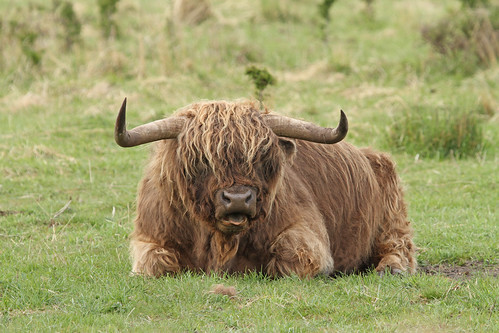
The Wicken Highland bull

I’m no expert on cattle so I don’t know for sure, but because this old guy was on his own and also because of the sheer size of him, I think that he’s a bull (and he didn’t stand up to allow unambiguous gender assignment by an amateur observer). He was absolutely enormous, even laying down I estimate the top of his head was around 5 feet off the ground, he was the size of a car!

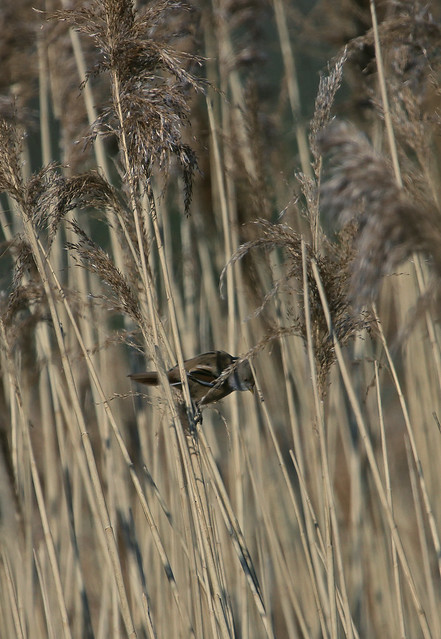
Back to the birds though, one which I’ve only seen at reserves on the coast before is the bearded tit (Panurus biarmicus, Dansk: skægmejse), but on this particular morning there was at least two of them flitting around the reed beds between The Mere and Adventurers Fen.

Female bearded tit

I’m yet to get a really good photograph of a bearded tit and this one continues the tradition. It would have been OK but it is too blue because I didn’t have my glasses on when I set the white balance, so I mistook the ‘sun’ setting for the ‘incandescent light’ setting. Alas, an unavoidable consequence of hurtling into middle age! I tried to post process the image but alas I couldn’t get it to look quite right so I decided to leave it as it is and own up to my incompetence!

The bearded tit is a resident breeder and passage/winter visitor and there are only around 600 breeding pairs in the UK, so it’s good to know they are just up the road from where I live. Their conservation status is amber in the UK due to a recent decline in their breeding range but they are not a species of concern in Europe as a whole. They live and breed in reedbeds and feed on invertebrates in the summer and seed in winter.

Another iconic inhabitant of the Wicken reedbeds is the marsh harrier (Circus aeruginosus, Dansk: rørhøg). The colour of the sky reveals the weather on this glorious April morning as a male marsh harrier thermalled overhead. He was in the company of eight others, and that’s an amazing sight.

A marsh harrier gaining height as the earth warmed up in the early morning sunshine

The marsh harrier frequents reedbeds and marshland and feeds on frogs, insects, reptiles and small vertebrates. Its conservation status is amber in the UK due to its small non-breeding population and a localised breeding population, but as with the bearded tit its not a species of concern in Europe. It almost died out in the UK in the 1960’s but has recovered since then and has changed its behaviour by starting to also nest on farmland, and many individuals now overwinter here too. Those that migrate head down to central and southern Africa for the winter. Another recent raptor success story along with sparrowhawks and red kites, but still a work in porogress to secure the UK population.

Male reed bunting

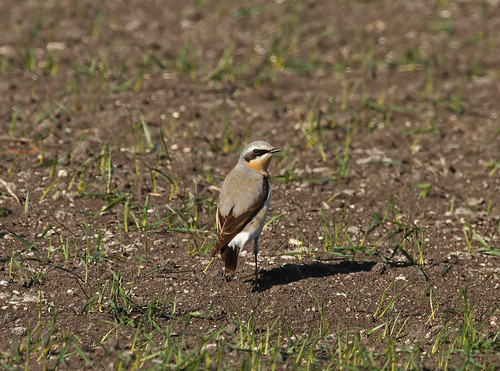
Small songbirds such as the reed bunting (Emberiza schoeniclus, Dansk: rørspurv) were busy proclaiming their availability from the tops of the hedgerows, but the highlight of the trip was a small group of around half a dozen wheatear (Oenanthe oenanthe, Dansk: stenpikker) feeding in a field adjacent to the Fen as I arrived:

Male wheatear – rear view

The name ‘wheatear’ may derive from the archaic ‘white arse’ which is a local name for it in some parts of England. It’s a migrant breeder in the UK and overwinters in Africa. After the last ice age its range extended northwards with the retreating ice, but they still all migrate back to Africa in the winter, even those individuals that breed in Alaska!

… and from the front

The female is also a striking bird even though she doesn’t have the same slate grey back and black eye stripe that the male does.

The female wheatear

I watched the wheatears for 20 minutes or so before heading on to the Fen and when I returned around 3 hours later they had all gone. So it appears it was an overnight rest and refuelling stop for them before heading further north and west to their summer breeding grounds.

Bridlington beach

After spending the morning up at Flamborough Head I spent the afternoon on the beach in Bridlington harbour.

Flamborough Lighthouse from the beach at Bridlington

Groups of knot were scouring the tideline

I like knot, they are very busy birds hunting invertebrates on the tidal mud and their taxonomic name is ‘Calidris canutus‘ (Dansk: islandsk ryle) named after the Viking king famed for being able to hold back the tides. I think that’s probably where the English name comes from too, because the Danish spelling of ‘Canute‘ is ‘Knud‘ – which isn’t a million miles from ‘Knot‘. They can sometimes be seen in enormous flocks of to 100,000 birds, which is a sight I’d love to see.

A knot and a redshank with an oddly distended neck

The knot has the most gorgeous rufous breeding plumage where the breast turns to a coppery red colour and the light parts of the feathers on the back turn brown, but as I only ever see them in winter I’ve never seen the full breeding regalia.

Another redshank (Tringa totanus, Dansk: rødben) cooling its feet in the ‘surf’

I wrote about the turnstone (Arenaria interpres, Dansk: stenvender) in my last post about Bridlington, but this one was a real character. It scuttled along the parapet of the sea wall as people were walking to and fro just a few feet away and was quite happy for me to point a camera at it. And I got some nice portraits of it standing on the stone sea wall with the blue sea in the background:

And the whole time we were in Bridlington a lone barnacle goose (Branta leucopsis, Dansk: bramgås) was in residence. Barnacle geese nest way up in the Arctic, in Greenland and Spitsbergen. Because they are never seen on a nest in the UK it was thought that they didn’t originate from eggs but that they started life as goose barnacles which live in deep water but can sometimes be found washed up on debris dislodged from the sea bed.

Barnacle goose fattening up in England before a long flight north to the Arctic

Sylvia – another unusual visitor

Like a lot of other folk I gave up making new year resolutions a long time ago because the resolve would normally last until the 2nd or 3rd of January before slipping quietly unnoticed into the flotsam and jetsam of recent history, never to be seen again. But for 2013 I made two resolutions – the first was to get current with my wildlife diaries which have been appallingly neglected for far too long – and the second resolution was not to condemn the first one to the black hole into which it would normally be swallowed. And so far so good, hence I’m feeling rather pleased with myself.

This years listings can be found here at ‘Histon Wildlife Diaries 2013‘ and if you notice gaps of more than a couple of weeks opening up please feel free to leave a pointed reminder that I need to get my finger out and get up to date!

As a consequence of my girded up loins and renewed efforts I’ve been spending more time peering into the garden to see which creatures are in residence. Just before Christmas I saw the first blackcap in the garden, it was a male with his coal-black cap, like a judge about to hand down the ultimate sentence, and he stayed for all of 2-3 seconds before zooming off into the sanctuary of our neighbours orchard. And of course I was very pleased with this visitation because it’s always good to welcome a newcomer.

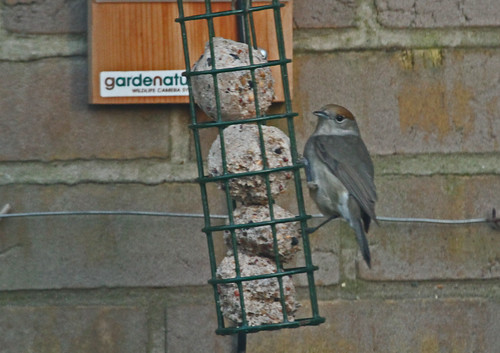
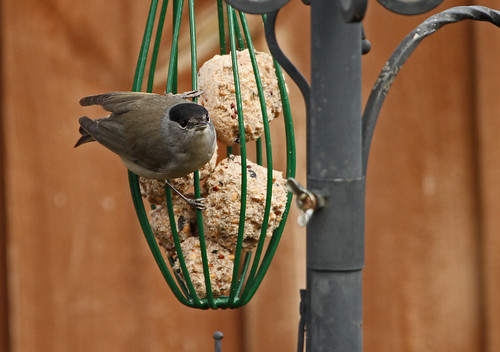
Then a couple of weeks ago when the winter weather was at its filthiest here in Cambridge a female appeared and spent some time refuelling on my fatball feeder:


A female blackcap (Sylvia atricapilla, Dansk: munk) on the birdcam fatball feeder

The birdcam used to be around 6m away from where it is now but there were very few takers for the lardy delights on offer.  But since I moved it to its current location it has been busy every day with numerous bird species. The reason for the change is the lack of cover in the original location which left the birds exposed to the possibility of predation by the local sparrowhawk. But now they have cover within a metre or so and and I can sit and watch them all in close up on the TV. And one of the first to arrive after I moved it was my lady blackcap, who you’ll have immediately noticed has a rufous brown cap, not the blackcap of the male. The specific name ‘atricapilla‘ means ‘blackcap‘ and the Danish name ‘munk‘ means ‘monk‘. I wonder which godly habits gave him that name, or is it simply his ecclesiastical bonnet?

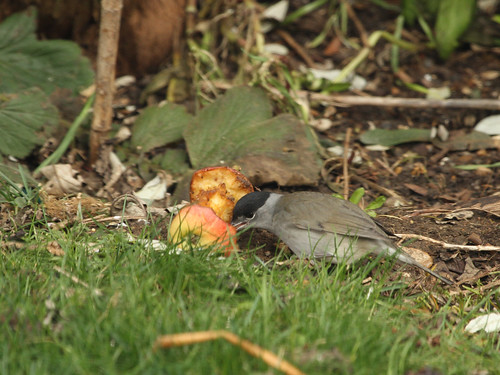
She arrived early on a murky morning, fed quickly and left, and that was the last I’ve seen of her. But a couple of days later a male blackcap arrived and he’s been visiting several times a day every day ever since then:


The male blackcap feeding on an old apple

I’m puzzled as to why the female has been so conspicuous by her continued absence, I guess that now the weather is considerably more pleasant she is more comfortable feeding out in the countryside.

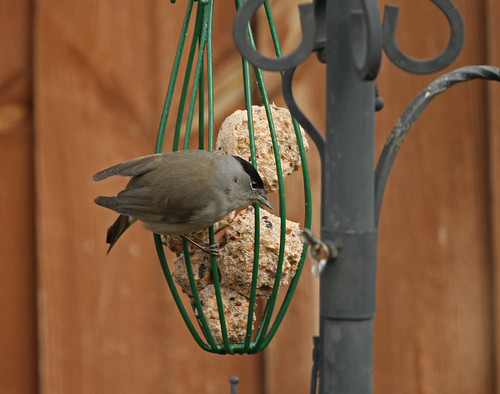
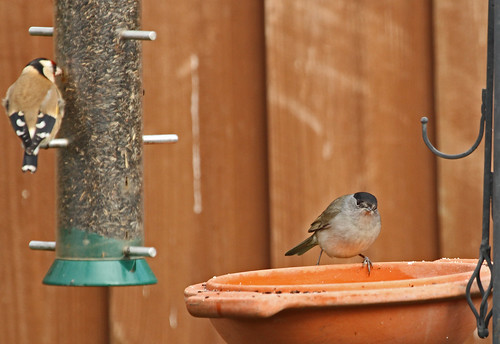
The male doesn’t restrict himself to ground feeding on fruit but is a more regular visitor to the fatballs.

And he tops up with water too. In the picture below he is wary of the goldfinch nibbling niger seed on the adjacent feeder. He was also aware of my presence behind a glass door around 8m away and when the goldfinch disappeared he threw numerous glances in my direction, but so long as I remained still he wasn’t too bothered.

Until recently it was thought that the blackcap was a migrant breeder here in the UK and that they spent their winters in Africa, apart from a sub population that remained here in the winter. But it is now thought that all of ours overwinter south of the Mediterranean and our winter visitors are a separate population from central Europe which migrate here to overwinter. In which case my visitors will be heading back east in the near future. After that I’ll hopefully see and hear our migrant breeders out in the hedgerows where they make a distinctive call which I think sounds like someone flint-knapping.

The British Trust for Ornithology have published a factsheet about blackcaps and their migration behaviour which is worth a read. We also have passage visitors as Scandinavian birds head south and it appears that garden bird feeders are having a major impact on the behaviour of blackcaps and other species too, such as nuthatch, which are now spreading into Scotland, assisted by garden feeding and climate change.

A special winter visitor

When the snows came a few weekends ago an influx of birds came to my garden to feed up on the seeds and fatballs I put out for them. I also threw out some squidgy grapes which had been getting overripe at the bottom of the punnet. And as well as all the usual species a winter visitor from Scandinavia also appeared.

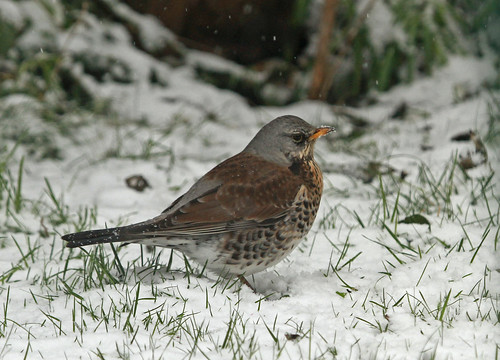
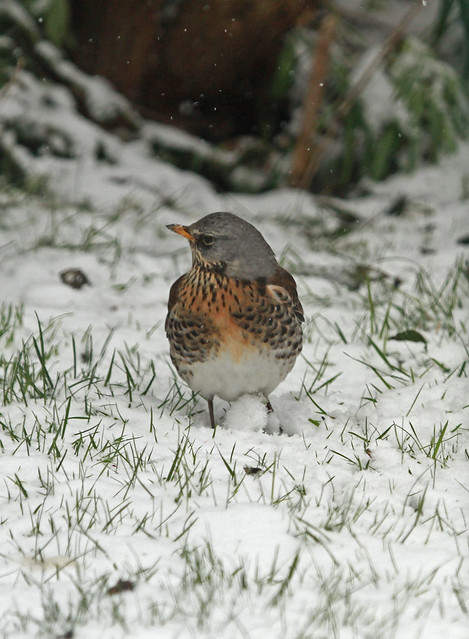
Fieldfare – Turdus pilaris (Dansk: sjagger)

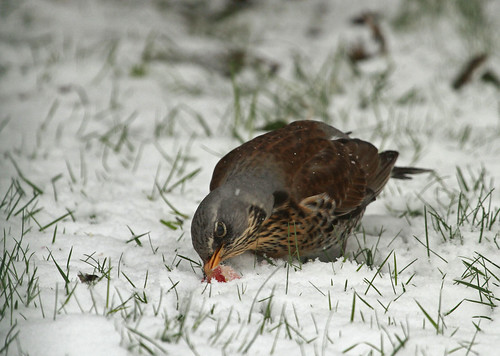
The fieldfare is a species of thrush from Scandinavia which migrates to overwinter in the UK. They’re hardy, feisty birds and utterly resplendent in their psychedelic finery! I’ve seen large flocks of them flying above the countryside around Histon but rarely within the village itself. And then this handsome bird arrived in my garden to feed on the squidgy grapes.

Dismembering a grape

It finished the grapes and then took up residence under a bush in the garden and repelled all comers. Whenever another bird came within striking distance it would emerge from its refuge at speed and chase it off. Which sufficed for everything smaller than a blackbird.

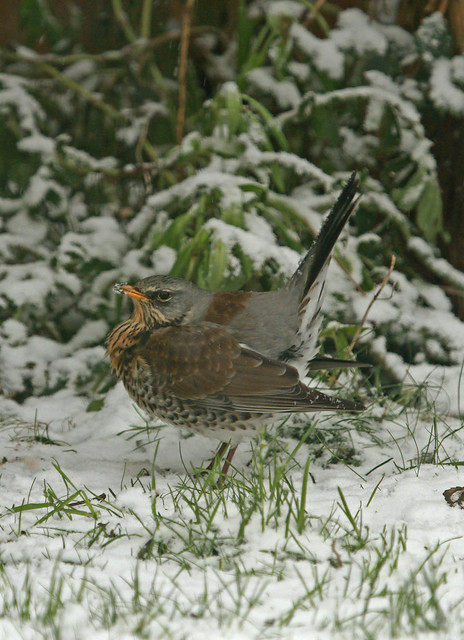
After the grapes had gone I augmented its diet with some apple, which coinidentally is also a favourite food of blackbirds. And within minutes there was competition for the fruit. The fieldfare adopted a very distinctive stance when the blackbird, or anything bigger, like a collared dove or a wood pigeon came within range and several fights ensued. And the fieldfare wasn’t always the winner because blackbirds are also accomplished pugilists when they need to be. So it all worked out evens, they both got some apple and a good scrap would keep them fit too:

The’repel all boarders’ stance, wings down, tail in the air. If that didn’t suffice then all out assault ensued

The fieldfare, I assume it was the same one, appeared in the garden after first light every morning until the rain washed away all the snow and it hasn’t been seen since. At the same time the trees and bushes in the village were also frequented by the fieldfares during the snow but they all disappeared with the snow too.

Mating Mutes

The sun is shining a lot now and the snow has totally disappeared. Unlike two weekends ago which was bitterly cold and the lakes at Milton Country Park were partially iced over. It’s not always easy to see all the water birds but they had been coralled into smaller areas by the ice. Ducks abounded at the park with teal (Anas crecca, Dansk: krikand), gadwall (Anas strepera, Dansk: knarand), wigeon (Anas penelope, Dansk: pibeand) and tufted duck (Aythya fuligula, Dansk: troldand) in numbers, as well as the customary mallard (Anas platyrhynchos, Dansk: gråand). There were two highlights of the trip, a goldcrest was busy hunting in a bush just a few feet away and seemed undisturbed by our presence. Goldcrest (Regulus regulus, Dansk: fuglekonge) are beautiful little birds, they are our smallest breeding species, weighing 4-7 grams, and the northern populations migrate south in winter with Scandinavian individuals crossing the North Sea to overwinter in the UK.

Mute swan pair with a male tufted duck in the background

I didn’t manage to get pictures of the goldcrest, which is a pity, but I did manage to get pictures of the second highlight, which was a pair of mute swans (Cygnus olor, Dansk: knopsvane). And if the goldcrest is our smallest breeder, the mute swan is one of the biggest (if  not thee biggest), weighing in at a hefty 10.5-12kg, and breeding is what this pair had in mind.

Mute swans pair for life and the courtship dance is delightful to watch, they gracefully circled each other, repeatedly intertwining their necks:

And the dance culminated in mating. The male climbed on board the female and grasped the back of her neck with his beak, the whole thing lasted just a few seconds, which was just as well for the lady as her head was held underwater and she actually disappeared from view.

And after mating they rose up, breast to breast out of the water and continued the necking dance:

Finally, they relaxed back into the water and finished the ritual by bobbing their heads towards each other, and apart from the mating moments the whole thing was very calm and sedate. I think mutes are simply regal, they are very big, powerful, animals and I can’t hink of any creature which is quite so pristine.

And shortly after mating the male climbed out of the water onto the ice for a post-coital stretch up to his full height and opened his wings, surrounded by a retinue of coot (Fulica atra, Dansk: blishøne) and gadwall. A fitting finale to this series of captivating natural events.

RSPB Big Garden Birdwatch – the tally

I filled up the birdfeeders first thing this morning, made a jug of coffee, and sat in the window waiting for the birds to flock in. And very little happened. So I waited a little longer. And still nothing happened, and I put it down to the fact the sun was shining, all the snow had gone and the temperature was in double figures.

A dunnock mopping up seed scattered by great tits on the hanging feeder

Then at 9.26am a group of four long tailed tits arrived on the fat balls and from then on the birds came and went in rapid succession. So the plan was to count from 9.26 to 10.26 until at around 9.50 the dog vomited on the carpet so the next 20 minutes weren’t spent counting birds. The finish time was therefore a tad delayed, but the final counts were:

Species                                 Total counted                    Maximum number at one time

Long tailed tit                              18                                                              5
Blue tit                                            18                                                              3 Dunnock                                          3                                                               1
Collared dove                                6                                                               2
Blackbird                                       13                                                               2
Greenfinch                                      5                                                               4
Wood pigeon                                  6                                                               2
Robin                                                 3                                                                2
Starling                                             5                                                                2
Great tit                                            3                                                               2
Chaffinch                                         2                                                                1

A female greenfinch enjoying some longed for sunshine

So all in all, what with the Vesuvian intervention from the dog, it was an entertaining hour and a half.

What a difference a frost makes

Having bemoaned the lack of wildlife in my garden, last Saturday the weather turned very cold here and after replenishing the bird feeders they were flocking in in droves! These resilient little guys were obviously finding sufficient sustenance elsewhere until the cold set in but now they’re here in numbers daily, and today we have had 10-15cm of snow and it hasn’t stopped yet so I reckon they’ll be around for a while longer too.

One of the species which I have missed because they are normally here all through the winter is the chaffinch (Fringilla coelebs, Dansk: bogfinke):

The cock chaffinch always adds a splash of welcome colour

Chaffinch are resident breeders in the UK and can generally be seen and heard in trees and hedgerows all year round. Another resident breeder I hadn’t in the garden or in the countryside much this year was the dunnock (Prunella modularis, Dansk: jernsurv), the archetypal ‘LBJ‘ or ‘Little Brown Job’. When viewed closely they’re anything but LBJ’s. They feed on the ground so I always throw a handful of seed in the undergrowth for them. This little guy has been terrorised by my resident robin, but the arrival of a second robin has given him respite as my resident no longer has his eye on the ball.

My dunnock keeping one eye on the ground for seed while the other looks for the robin

The coal tit (Periparus ater, Dansk: sortmejse) is a pine tree specialist, seeking insects and spiders in the summer and seeds in the winter. This makes it a bit of a mystery here because we have very few conifers in the vicinity, but there are at least two flitting in and out of the garden all day:

The coal tit waiting it’s turn to get on the seed tray

A blue tit (Cyanistes caerulius, Dansk: blåmajse) about to join the coal tit and grab a seed

Starling – (Sternus vulgaris, Dansk: stær)

Starlings are a bird that used to be very common and would murmurate in humungous numbers but this only happens now in a very few places. When I was an undergrad in Liverpool they would gather on icy winters evenings over Old Haymarket in vast numbers. The aerial manouvres were breathtaking, as was the acrid ammoniacal stench from the guano left behind on the pavements! I generally only see them in small flocks of a few tens these days, but they regularly come and avail themselves of the fatballs in my garden. And they’re more than welcome!

And finally, usually the most visible diner at my avian restaurant, the ubiquitous blackbird. Even they were conspicuous by their relative absence until very recent weeks, but now they’re back in  numbers:

And no English garden is complete without a feisty blackbird (Turdus merula, Dansk: solsort). Having said that, according to the British Trust for Ornithology the blackbird is a ‘Migrant/Resident Breeder, Passage/Winter Visitor’ and they migrate within the UK but also in winter we get an influx from Europe coming from Germany and Poland and other parts of eastern Europe. It makes me chuckle that whilst us folk moan about the weather and then jet off to the Canary Isalands in the winter, the blackbirds are coming here to make the most of our balmy winter climate. Just goes to show, everything’s relative!

Geddington swallows

A couple of months ago I was at my sisters place in Geddington, a small village in the Northamptonshire countryside which is right next door to one of the original release sites for the reintroduction of red kites into the UK. Consequently, one doesn’t have to look too hard to see red kites there, but on this particular trip it was swallows that were the stars of the show.

Geddington is a very old village and the cottages in the middle, one of which is occupied by my sister, are built from Northamptonshire ironstone, which is a gorgeous building material. Not only is her house built with it but so is her very substantial shed. She leaves the door to the shed open all the time because there are bats roosting there, and in the summer swallows use nests built in the eaves there.


A brood of swallows on the verge of fledging

Swallows (Hirundo rustica, Dansk: landsvale) migrate here from South Africa in the Spring and they generally arrive back around the second weekend in May. They return to the same place every year and often refurbish an old nest which can be used year after year, and there are records of the same nest being used for decades.

I usually get an excited phone call from my sister in the middle of May to tell me her swallows have returned. They come back again and again and she comes over all maternal when the first one arrives.


A pair of very recent fledglings which haven’t yet plucked up the courage to venture outside

They have now done all their breeding and feeding up and are congregating on roof tops and power lines and contemplating the enormous feat of flying down through Europe, across the Mediterranean and the Sahara desert before crossing the rest of sub-Saharan Africa to South Africa. Where they will spend the next 6 months before doing the whole thing again in reverse. Awesome!