Category Archives: Birds

Hungry Heron

The current beautiful but brutally cold weather we are experiencing is lethal for many tiny creatures but also larger birds including our grey heron (Ardea cinerea). Cold spells such as the current one can result in the death of a large proportion of our heron population as they are unable to fish for their normal food supply when water courses freeze over.

Statuesque grey heron on Cambridge Science Park

The grey heron is a member of the family containing  bitterns and egrets and aswell as being the largest European heron is one of the largest UK birds.  They stand almost a metre tall with an average wingspan approximately 185cm and feed predominantly on fish and other creatures, in or close to water, such as frogs and other amphibians, but have been known to take small mammals, reptiles and insects.
Herons are considered to be among the more intelligent birds due to their ability to hunt and catch such a wide range of prey. One individual in Histon has recently exemplified this intelligence in an unusual and amusing way. It arrived in my friends garden looking very sorry for itself a few weeks ago at the start of the winter weather. My friend, being a thoroughly decent sort, gave it some fish from his freezer after which the heron decided to loiter. After several free and very easy meals of frozen pollock it took up residence in the garden and when the stipulated mealtime was not observed to its full satisfaction would sidle along to the door and tap on the glass with it’s bill to summon the next course.


The Histon heron
Waiting for a snack…

…and tucking in to a pollock fillet…
…then retired to a nearby vantage point for some post-prandial relaxation

As well as being sizeable birds heron can be stealthy and are extremely efficient fishermen. They catch smaller fish and eels in their bill but as you can see from the photographs the bill is a fearsome weapon and is used to spear larger prey. I once encountered a heron pecking at a prey item on the bank of the Lode at Wicken Fen, as I approached the heron flew away and I found an enormous pike on the riverbank, approximately 2 feet long (I don’t know if a heron would be capable of catching and killing such a big fish) and it had made a surgical incision running from top to bottom immediately behind the gill and had been busy extracting the entrails.

Heron are not migrants to or from the UK but they have been known to cross the English Channel and turn up in France and the Iberian peninsula. They have various common names including the ‘hernshaw’ in Lincolnshire, the ‘marshmens harnser’ in Norfolk and a ‘shiterow’ or ‘shiteheron’ thought to originate from the herons habit of defecating when disturbed prior to take off!

So if your pond is overstocked with fish in the freezing cold weather and could use  some thinning out why not spare a thought for the struggling heron and break the ice so he can refuel and stave off the cold.


The Waxwing

At this time of year a look at the ‘What’s About‘ blog page of the Cambridgeshire Bird Club (CBC) website to see if there are any interesting avian visitors in the locale is well worth while. On Monday this week (29th November 2010) there was a posting on the CBC site recording a sighting of waxwing in Brimley Road, Arbury, north Cambridge. They were spotted feeding on the berries of the many rowan trees in this street. Having never seen a waxwing and having marvelled at the spectacular pictures I’d seen of them I went there at lunchtime to have a look for myself. Alas, there were no waxwing to be seen but I persevered and went there again on Wednesday lunchtime with my friend and fellow wildlife enthusiast, Joe. Again to no avail. So we decided to make an early morning trip on Thursday, reasoning that the waxwing would be more likely to be there at breakfast time.

Thursday morning was snowy and absolutely freezing cold but I set off at 7.45 with my camera. On this occasion it was third time lucky:

Five of the seven waxwing frequenting Brimley
Road last Thursday

The trip was definitely worthwhile! It was a murky, grey, cold morning and until I got within around 30m of the birds I thought they were starlings. But as I got closer the crest became evident and then the colours… and they were absolutely stunning. A blaze of colour brightening up an otherwise grim morning.

The scientific name for waxwing is ‘Bombycilla garrulus‘ which means ‘chattering silk tail’. They are predominantly resident in conifer forests in Scandinavia and are partial winter migrants to the UK. I.e. some of the population head south in winter – known as an ‘irruption‘ – when food supplies in the north which consist of a variety of fruit and berries including crab apple, rowan, cotoneaster and mistletoe, are insufficient to support the whole population. An article in todays edition of the ‘Chronicle and Echo‘, the local newpaper in Northampton, reported that that current weather conditions in Scandinavia are really atrocious so record numbers of waxwing are migrating south giving rise to a ‘waxwing winter‘.

Waxwing feed in flocks, perching in the top of a tree and making occasional forays en masse to nearby fruit trees where they go into a ‘feeding frenzy’ for a few minutes before returning to their perch. This behaviour was observed on Brimley Road, the 7 birds there were sitting in the top of a crab apple tree and moving to an adjacent tree which looked like a rowan with white berries, to feed. There are species of rowan from China which have white berries so I guess this tree was a Chinese variety. We watched them for approximately 45 minutes during which time they appeared almost completely unfazed by our presence or the constant hubbub prevailing in a suburban street just before the school bell.

They are approximately the size of starling and at a distance can be mistaken for starling, as I did. They are 18cm long with a 34cm wingspan and they make a call like someone quietly ringing a small porcelain bell. There are up to approximately 200,000 pairs in Europe and it’s conservation status is green.

I don’t normally go twitching, especially in places as public as this, and I thought people would think we were a tad bonkers. But it was a pleasant surprise how many people stopped to ask us what we were looking at and showed a real interest in the birds. One chap even stopped his van in the middle of the road for a chat, only moving when the traffic behind honked the horn.

A great way to spend an hour before work, despite the freezing weather!


Guns Lane

As I mentioned in my previous post, Guns Lane links the north of Histon with Willingham and Ely, and provided the raw materials for my winter warmer, sloe gin. Due to the profusion of heavily laden trees and bushes – hawthorn, dog rose etc., providing food and cover for the resident wildlife, it is a great place to go birdspotting too.

My first stroll up there this winter was three weekends ago, 13th November 2010) and the profusion of birdlife on display was spectacular. Shortly after entering Guns Lane from Cottenham Road under a copse of tall trees several chaffinch were flitting around at the top. Closer inspection revealed the sumptuous pink breast and black cap of a cock bullfinch who exited the tree accompanied by three others. That was only the second time I’ve seen more than one bullfinch since I was at school. And the first time was the weekend before in Girton. Bullfinch feed on the buds of fruit trees in springtime and have been accredited with decimating fruit crops and I believe it is still legal to trap them in some parts of the UK. Consequently, their numbers dropped dramatically in recent decades so it’s great to see them in threes and fours.

Further on a wren appeared at around eye height craning on a tall grass stem to see me. It didn’t appear overly perturbed by my presence and followed me along the path for 30-40m. Simultaneously, several goldfinch were patrolling the top of the hawthorn trees on the other side of the lane until a visit by a kestrel frightened all the smaller birds away.

N.b. You can find full list of my sightings by clicking on this link to my wildlife diary.

All along the walk numerous small birds such as blue tit, great tit, a flock of long tailed tits, chaffinch and goldfinch appeared and redwing and large flocks of fieldfare are now regular fixtures.


Looking north along Guns Lane on the edge of Histon. These bushes are a hotspot for blue tit, great tit, long tailed tit and magpie

On another walk there had been very little birdlife to see until approaching a bend a little further on from the spot in the photo above, there was a commotion going on which I thought was due to my presence. As I approached blue tit, chaffinch, blackbird and even a green woodpecker took to the air all alarm calling and as I rounded the bend a buzzard emerged from a bush close by and glided up the lane away from me for 50-60m before turning off into a field. That all happened within 30 feet of where I stood and I don’t often get to see a buzzard that close – all very exciting!

Blue tit feeding in a bush on Guns Lane
Fieldfare – this one was difficult to photograph due to the position in the top of a tree and the bright white sky behind – I aim to get some better pictures as soon as possible!

Adjoining the lane at the Histon end of the lane is a field of scrub, which I call Church Field, and is always full of birds, with regular sightings of green woodpecker, chaffinch, greenfinch, latterly bullfinch, kestrel and the occasional sparrowhawk, among various others.


Looking north east across Church Field – it’s a good mixture of old established trees, young scrub and grass

The weather this weekend past (27th and 28th November 2010) was freezing:

and during an early morning foray into Church Field last Sunday (28th November 2010) a kestrel was perched on the uppermost branch of a tree with his feathers ruffled as protection against the cold:

Male kestrel trying to stay warm on a fiercely cold morning

It’s unusual to be able to get close and take photographs of most birds including birds of prey, so I was very grateful to this one for sitting tight for so long. He kept a watchful eye on me as I slowly sidled round the bottom of his tree which gave me time to capture a few decent shots. I particularly like this one looking down the lens with his feathers all ruffled up. On my way back through the field a couple of hours later a cock bullfinch flew right over my head, his colours against the bright blue sky were vibrant.

The section of the lane approaching the Oakington to Cottenham road is different habitat consisting of old, thick hedgerows which are frequented by big flocks of fieldfare and flat open fields which this weekend were hosting small flocks of lapwing (~20) and larger flocks of golden plover (at least 40) in the midst of which a heron landed and sat catching its breath until after I was out of sight. The hedges bordering the fields here are also home to many small birds such as chaffinch, goldfinch and dunnock.


Part of a small flock of 22 lapwing in a field off Guns Lane

And part of a larger flock of golden plover

The end of a walk on Gun Lane can also be the best part and I usually linger right by the Cottenham Road end where trees overhang the lane on both sides. These trees and bushes are usually full of birds including blackbird, chaffinch, blue tit, great tit, coal tit, house sparrow, dunnock, goldfinch and sometimes they’re all on parade at the same time.


House sparrow male in a hawthorn tree at the Cottenham Road end of the lane

And this brave squirrel sat watching me as I was photographing the birds

As you can hopefully see, this is a really good place to go for a stroll and see lots of really good wildlife. All the pictures and observations in this post were collected in just three walks. I’ll post again soon to tell you about my next outings on Guns Lane.


Murmuration

Did anyone see the article about ‘murmuration on the BBC news website yesterday?

This is the technical term for the aerial swarms of starlings that occur immediately prior to settling into their roost site in the evening.

It’s phenomenon I’ve seen before but not for many years. I was an undergraduate in Liverpool in the mid 1980’s and I recall on winter evenings there were frequently murmuratons of starlings going on over St Johns Garden behind St Georges Hall in the centre of the city.

This is a great name for one of natures truly spectacular, and mesmerising, events. I don’t know how many birds were involved in the murmurations I saw but I believe it can be up to tens of thousands. The overhead spectacle is awesome, and in a rather different respect so is the effect it has on the pavements beneath… and the resultant stench!

The BBC article refers to some new research from two Italian biologists who studied the flocks of starlings over Rome, and using clever camera work they divined how the birds maintain the shape of the flock. There was also speculation about why they murmurate. I think it must be down to evasion of predators such as peregrine falcons.

I can’t resist the temptation to gratuitously insert one of my starling photographs here, because on an individual level aswell as in enormous swarms they are beautiful creatures. They have sumptuously iridescent plumage particularly when they catch sunlight at the right angle:


Sturnus vulgaris

Alas, I don’t have any of my own photographs of murmurations but I intend to rectify that situation in the future, at which time I will post again about these endearing creatures.

Winter garden visitors

Redwing and fieldfare have now made the journey south from Scandinavia to overwinter in the fields and hedgerows of the UK and the first frosts have happened over alot of the country. The weather has turned generally pretty cold so it’s time to spare a thought for the struggling wild creatures. I’ve now cleaned and replenished my feeders to help the birds survive the winter months. For example, a blue tit weighs between 10-12 grams so a night spent asleep in sub-zero conditions is an extremely challenging time and they need regular food supplies to keep warm. You’ll notice the photographs in this post weren’t all shot in the cold winter months but all the species shown are regular winter visitors to my garden.


Greenfinch waiting for a vacant space on the seed feeder

I hang bird feeders from the trees in my front garden with peanuts, mixed seed and fat balls in along with a ground station with peanuts, seed and sultanas. There are some good online suppliers out there including the RSPB, Soar Mill Seeds and the one I’ve now been using for a few years is Vine House Farm. This combination of feeds attracts a wide range of birds including starling, blackbird, blue tit, great tit, long tailed tit, robin, greenfinch, chaffinch, rook, jackdaw, carrion crow, collared dove and wood pigeon.


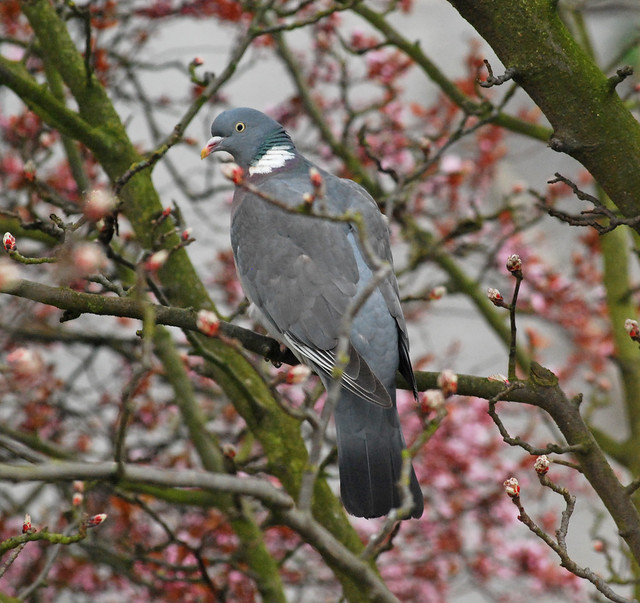
Wood pigeon perched in the cherry tree in my front garden


One of the Churchyard rooks sitting on a neighbours’ TV aerial contemplating a raid on the ground feeder


One of the blue tit pair in my crab apple tree checking for danger before disappearing into the nest box

 There are also infrequent visits from great spotted woodpecker, song thrush, wren, sparrowhawk and even a yellowhammer put in an appearance on one occasion.

In my back garden I also hang peanut and mixed seed feeders and a niger seed feeder for goldfinch. I have two suspended seed feeders above ground out of the way of marauding cats and squirrels which work well for ground feeders such as chaffinch and dunnock. A similar range of small birds appear in the back garden but the crows, woodpecker and sparrowhawk  don’t seem to venture in there, but dunnock and goldfinch are regular visitors all through the year.

Goldfinch – one of this years offspring. It still doesn’t have the black head markings and the face is pale orange rather than the deep red of the adults.

Adult goldfinch


Dunnock

Living on the edge of countryside surrounded by gardens with big old trees and an orchard is obviously a good place to be to see birds (and bats in the summer), but being in the middle of the village or even in the middle of a city like Cambridge, well away from countryside, doesn’t preclude seeing interesting birdlife. A friend in Histon has seen siskin and redpoll in his garden, neither of which are common garden birds, and another friend in the centre of Cambridge has regular visits from sparrowhawk and jay. So simply hanging up a couple of birdfeeders with nuts and mixed seed can turn an urban garden into a mini nature reserve, and you can sit in the warm with a cup of coffee and watch it all out the window. I’ve been amazed to see what has turned up in my garden in the last few years!

Larus ridibundus – 23rd October 2010

There were several ornithological highlights to be enjoyed in the Histon fields this weekend. It looks as though autumn is here properly as the weather has turned more chilly, so for the last week or two I’ve been hoping to see some of our winter visitors arriving from the north and the east. It was an exciting day today because the first flock of the year of several hundred fieldfare (Turdus pilaris) duly appeared, flying low and fast from east to west. Alas, they didn’t stop, but it was great to see them arriving safely in numbers. I’m anxious to get some photographs of fieldfare so now I have my new 300mm zoom lens I’m hoping this winter will provide some opportunities to capture them on pixels. If I manage to get some good shots I’ll post them here as and when.

For the record, I’m an amateur wildlife photographer and I use all my own pictures to illustrate my posts. I use a Nikon D40x and a combination of lenses: Nikkor 18-55mm kit lens that came with my camera which I use for flowers, insects and landscapes, Nikkor 55-200mm zoom which I used as my default general purpose lens until a month ago when I acquired a Nikkor 70-300mm zoom lens which gives me that extra bit of reach. I don’t often sit in hides or wait for wildlife to come to me, I walk around and photograph anything I encounter which I think is interesting and photogenic. Which covers just about everything!

Back to ornithology, other good sightings this weekend have included corn bunting (Emberiza calandra) which is a real favourite of mine as they have a wonderfully distinctive call and they often sit proud  on top of hedges and let me take photographs from a distance of less than around 20 feet, and they’ll sit tight as long as I don’t make any sharp movements – even the dog running past doesn’t faze them.


Corn bunting

Other regulars this week have included yellowhammer (Emberiza citrinella), reed bunting (Emberiza schoeniclus), long tailed tit (Aegithalos caudatus), goldfinch (Carduelis carduelis), and skylark (Alauda arvensis). The latter are great to watch at the moment, on a sunny day they whizz around low and high chasing each other at incredibly high speed in groups of up to 5 or 6. Lone larks sing the characteristic skylark song up high, and plenty more can be seen on the ground feeding in ploughed fields, and disappearing into the scrub of unploughed fields where they don’t seem to stay for long before joining in another game of aerial tag.


Skylark

However, I’m digressing from my main theme of this weekend which is ‘Larus ridibundus’, or the black headed gull. Both yesterday and today (23rd and 24th October 2010) there have been a flock of 35-50 black headed gulls on the ground in two different, but adjacent, ploughed fields. I think it’s easy to dismiss gulls as not being very interesting but a closer inspection of a flock of gulls is a real treat. They are consummate aeronauts with beautiful plumage and are highly gregarious in winter. Consequently I’ve spent a sizeable chunk of this weekend enjoying watching them and trying to photograph them:


Adult black headed gull with brown face (this one was taken last summer at Seahouses in Northumberland – not Histon)

Adult black head in winter plumage – note the dark spot behind the eye and the red beak and legs (this and the rest of the gull pictures in this post were taken in Histon)


Note the white tail and forewing and the black tips of the first five primaries

Black headed gulls are fairly small as gulls go, around 35cm long and 100-110cm wingspan. They build nests on the ground on coastal and inland reedbeds and marshes, lay one clutch of 2-3 eggs per year and live on average for around 10-15 years. It is not an endangered species with approximately 1.5million pairs in Europe. (For a full set of facts and figures check out the BTO BirdFacts website (http://www.bto.org/birdfacts/), this site is excellent for comprehensive metrics datasets on all common UK birds). Black headed gulls are rather inaccurately named as they don’t have a black head at all. It is dark brown and only covers the front part of the face and is only present in summer when it serves as a form of aggression between rival males. They stand face to face to maximise the visible area of the dark mask to each other, but within a breeding pair aggression is minimised by displays involving turning the head to show the white nape to the partner. The dark hood recedes in winter to a small dark spot just behind the eye. Adults have a deep red bill and legs and pale grey back with a white tail and white outer edge of upper and lower wings formed by 4-5 primaries with black tips.


Juvenile diving in on an insect or worm. It has the dark tip to the tail, pale brown mottled upper wings and pale buff legs characteristic of an immature individual

Juveniles have mottled brown plumage with a dark tail tip and orangey-buff legs. They feed on worms, insects, seeds, waste and carrion, and can be seen on inland water, grassland and farmland aswell as on the coast during the winter.

I think they’re amazing to watch so next time you see a flock of gulls have a good look and appreciate the beauty of these creatures – you wont be disappointed!

Weekend field walks 9th and 10th October 2010

This Saturday (9th October,2010) I was lucky enough to be accompanied by my friend David on a long walk around the Histon countryside. David is a zoologist and knows considerably more about the wildlife than myself, consequently it was a terrific walk and something of an education.

We set off around 8.15am and the weather was mild but very grey with 100% low cloud cover. Very soon after entering the fields we heard a jay making alot of noise in some trees bordering gardens at the back of the main road.  As we passed a small sycamore tree a possible meadow pipit passed overhead and we heard a second flying past later on in our walk. Shortly after that a large flock of golden plover flew over at high speed and several groups varying in size from approximately 5-10 up to 70-80 were spotted in the air and on the ground in several other fields. Many evenings whilst walking at night last winter I heard birds on the ground making a short whistle consisting of a single  note and had no idea which species was responsible. Our golden plovers in the air were making exactly the same noise so the mystery of the night time whistlers was solved too. A kestrel and a sparrowhawk made solitary appearances and a peer into an old tumbledown barn revealed a little owl – a good day for birds of prey.

The mild damp conditions of late have been ideal for fungi. Gorgeous bright yellow heads of the yellow fieldcap mushroom (Bolbitius vitellinus) lined the walk, all at various stages of growth from recently sprouted, just a couple of centimeteres tall with very rounded unopened caps, to old and nibbled specimens around 10cm tall and the caps more dull in colour and 4-5cm in diameter:


Recently emerged yellow fieldcap mushrooms


Older yellow fieldcap


A cluster of four mature yellow fieldcaps

We also found a ‘substance’ which preliminary inspection suggested the most likely identity was dog vomit! It occurred every few paces for several hundered metres wrapped around grass stems – suggesting a very poorly dog. When it was gently disturbed at the edge it had a powdery consistency and blew away in the breeze like dry Ready Brek. It varied in colour from grey/white to pale buttery yellow, so we concluded it must have been some kind of mould:


Mucilago crustacea – a slime mould. This stuff can move slowly to new food. Only at a snails pace, but don’t stand still for too long!

Toward the end of our outing as we headed back to the village a small flock of gulls consisting of a lone herring gull, a black headed gull and around 30 lesser black backed gull were beautifully contrasted against the dark ground in a ploughed field. Despite the grey weather it was a great day for wildlife.

After the nature fest on Saturday followed by just one or two small drinks with some good friends in the evening, I contemplated a shorter stroll this morning to blow away the cobwebs. But the weather was absolutely glorious and the profusion of birdlife resulted in another whole morning spent in the countryside. I heard six green woodpecker, one of which was exiting an old oak tree at high speed having been flushed out by a buzzard. A second buzzard appeared over the farmhouse with a sparrowhawk shadowing it right overhead but at much greater height. The buzzard quartered the fields and then headed off south west over Histon:


The unmistakeable shape of a buzzard. I love watching
big birds of prey so seeing two buzzards in one walk
was very special

Despite the weather no swallows were around today, I saw small numbers (less than 10) on Saturday and Sunday last weekend but we’re now heading towards mid-October so the last stragglers must be heading for Africa.

Many songbirds put in an appearance today which has been an unusual event since the harvest got underway at the beginning of August. Two yellowhammer, two corn bunting, numerous reed bunting, dunnock, blue tit, robin and a pied wagtail were all spotted today.


A corn bunting on the right and a male reed bunting sitting together and as I watched a female reed bunting arrived. Marvellous!

Yellowhammer

I was particularly pleased to see the wagtail, it’s the first one I’ve seen in the fields this year, whereas last year they were on display almost every day. I hope that’s not a nationwide phenomenon.

A lone kestrel and two sparrowhawks were up and about today so another good day for birds of prey. Also as yesterday, many skylark were extremely active playing tag and because of the lovely weather they were singing up high. I managed to go one better with the pipits of yesterday as I watched one fly up out of a small bush when disturbed by me landing in another one about 30m away in full view. The local churchyard rooks were omnipresent, digging out invertebrates in most of the fields accompanied by countless wood pigeon and carrion crows.

It was difficult to choose a highlight from this weekend, but as I sat on a tractor trailer in the sunshine making some notes a common darter dragonfly buzzed past and settled on an old plough to sun itself. It’s late in the year for dragonflies so that was good to see.


Mature male common darter warming up in the morning sunshine sat on an old plough

I shall post again soon about our local birds and hopefully next time I shall have seen the first winter immigrants such as fieldfare and redwing. Fingers crossed.