Category Archives: Birds

The gannet – the ultimate fisherman

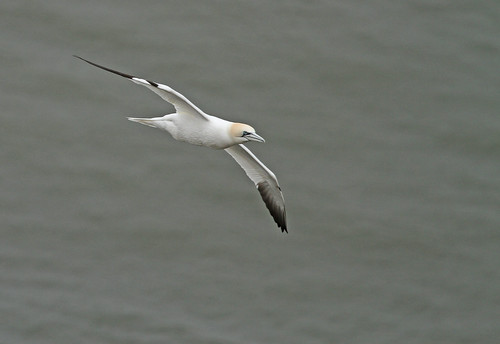
One of natures most splendid sights is the gannet in flight. It is a diving seabird and I believe it’s one of the worlds biggest divers. They are 94cm long with a wingspan of 174cm and they dive for fish from an average height of around 25m at speeds of up to 100km/hr (60miles/hr)! They fold their wings back just before they enter the water and watching it from above the surface is  absolutely breathtaking.

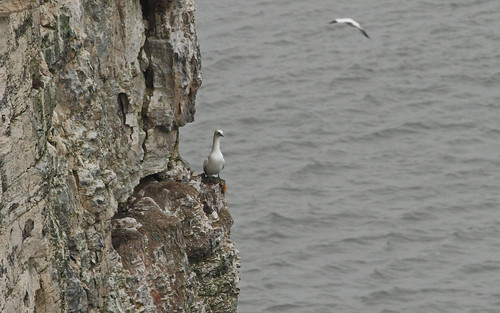
This particular gannet (Morus bassanus, Dansk: sule) landed on a ledge a couple of hundred feet up the cliff face at Bempton in East Yorkshire. The top of the cliffs is an RSPB reserve and it’s one of my favourite places to be. On the particular day I was there – February 13th – it was ferociously cold. I was well wrapped up, the air temperature was about 1 degree C, but the killer was a fierce offshore wind howling across and causing a lot of windchill. The birds didn’t seem to mind it though.

This gannet seemed to be just relaxing on its ledge until another flew past close by and then it took off:

I really like this sequence of events and the rocky ledge so high off the water was the perfect place to capture it!

There’ll be more from Bempton and that part of the world in the near future.

Ever the optimist

The font of all wisdom in my area for what birdlife is around is the Cambridge Bird Club ‘What’s About‘ blog. A short while ago there was a report of a sighting of a bittern at one of my regular nature walks, Milton Country Park. This was an exciting development because I’ve never seen a bittern before, so on the following Saturday morning I set off before dawn to be in situ at sun up to try and see it. The bittern (Botaurus stellaris, Dansk: Rørdrum) is a small brown heron which lives in reedbeds and is so perfectly camouflaged it is almost impossible to find until it breaks cover. It’s famous for the ‘booming‘ call of the male which can be heard up to 1km away, so I set off hopeful of not only seeing one but maybe hearing it boom too. Ever the optimist!

The conservation status of the bittern in the UK is red, meaning it is scarce and under threat. Alas, the chap I was hoping to catch a glimpse of was very scarce indeed, to the point of being completely absent. Oh well, next time maybe. But every cloud and all that, even though the bittern had absconded there was other birdlife in abundance.

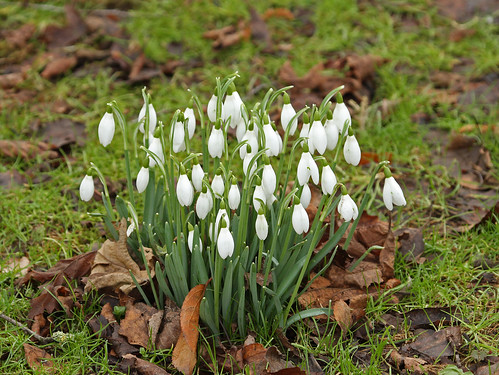
And not only birds, snowdrops were blossoming on the forest floor

The Country Park is made up of old gravel or quarry pits surrounded by a mixture of grassy scrub and mature woodland. Up in the treetops great spottted woodpeckers were hammering holes…

Great spotted woodpecker (Dendrocops major, Dansk: stor flagspætte)

I think this one is a female – the male has a red patch on the back of his neck which I think was absent on this one. The woodpeckers drumming sound results from the frequency of drilling rather than the power. They have energy absorbing tissues in the head to prevent brain damage and they strike at a frequency of 10-40 times a second which makes the tree trunk resonate, and that’s how they create their unique sound. Treecreepers were spiralling up these trees too, but they were just too quick to get a photograph.

But on the lakes there were hundreds and hundreds of water birds of all types:

Courting great crested grebes (Podiceps cristatus, Dansk: toppet lappedykker)

The full mating ritual of the great crested grebe is a wonderful sight. I’ve only ever seen it a couple of times and it involves swimming away from each other to a distance of 20-30m or so, then turning and swimming rapidly towards each other and when they meet they rise up in a vigorous display of necking before settling back into the water facing each other and creating a heart shape with their heads and necks. This is repeated mofre tha once and is utterly absorbing and delightful to watch. I was fervently hoping that my pair here were going to perform but they were content to simply preen, commune and doze. Still lovely though.

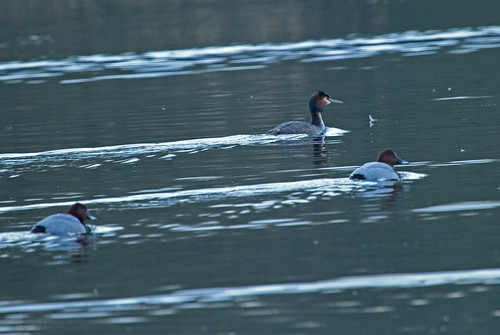
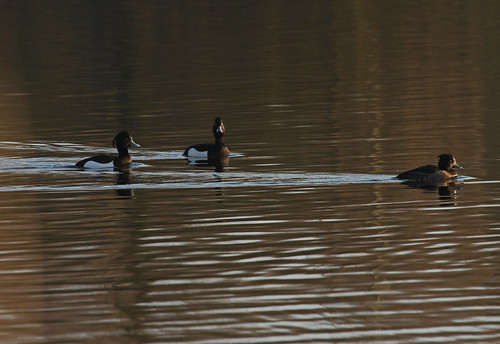
Another male great crested grebe with a pair of male pochard in hot pursuit (Aythya ferina, Dansk: taffeland)

Two male tufted ducks (Aythya fuligula, Dansk: troldand) eyeing a lady with bad intent. Love, or something, was in the air!

Both pochard and tufted duck are divers and the rapid spread of the tufted duck in the UK in the 19th century is though to be the result of colonisation of UK waterways by the zebra mussel which originates in southern Russia.

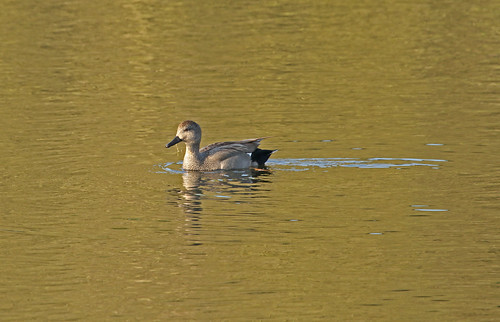
A male gadwall (Anas strepera, Dansk: knarand)

On a grey murky day the gadwall looks like a dull grey/brown duck but when the sun shines on them they are quite handsome birds, easily recognised on the water by the black rump, general brown plumage and the grey/black beak.

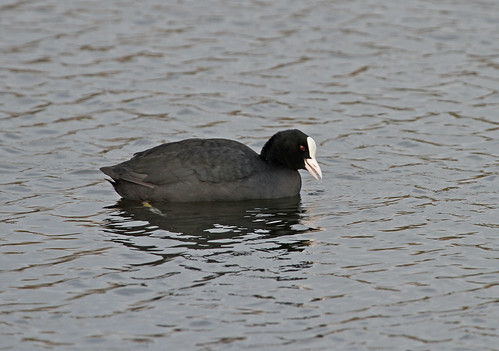
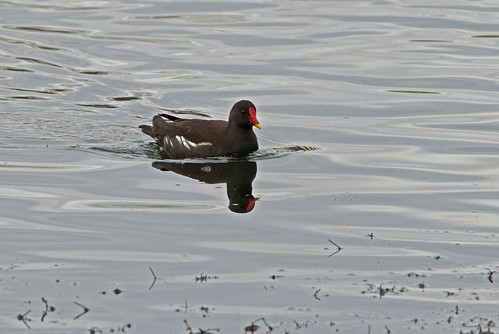
Coot and moorhen (Fulica atra, Dansk: blishøne and Gallinula chloropus, Dansk: grønbenet rørhøne, respectively) are both members of the family Rallidae along with water rail (which I saw on a previous recent visit to the Country Park, but not this one, even though I spent 10-15 minutes quietly looking where I saw one before) and crakes, which aren’t to be found in these parts.

The coot…

…and the moorhen

The male coots were in the mood for love and fighting out on the water on all the lakes, and were too numerous to count, and the occasional, more secretive and less aggressive, moorhen ventured into view from the reeds at the lake edges.


The brown heads are male wigeon, the black and white ones are male tufted duck, the two brown ones in the foreground are a pair of gadwall and out of focus at the back is another gadwall and a coot

As the sun came up the birds on the water semed to spring into life and large groups of various species busy feeding. All the pictures in this post were taken in a couple of hours or so from dawn until 10-11am and within a 300m radius. But as the sun arose and the light changed the colour of the water changed dramatically and gave some wonderfully varied backgrounds.

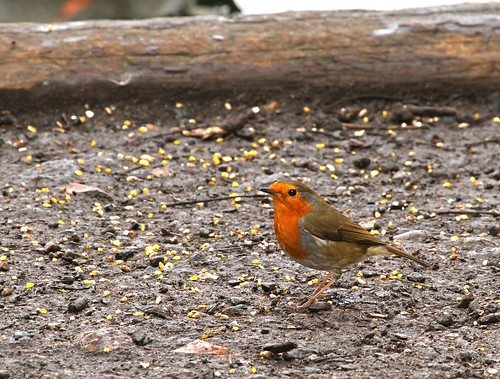
I stopped at a gap in the undergrowth to photograph the various species above and as I stood snapping the robin hopped into view between me and the water pecking at the seeds on the ground left by a benevolent walker for the ducks:

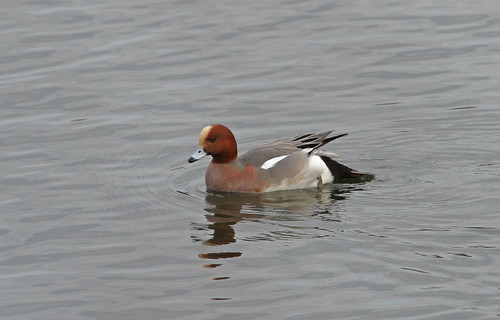
I think the most colourful, and therefore my favourite duck of that morning was the wigeon:

A pair of wigeon (Anas penelope, Dansk: pibeand), the male behind, the lady in front

The male on his own – resplendent in his psychedelic finery

The wigeon is a resident breeder in the UK and it’s conservation status is amber, which surprised me because I see plenty of them on the lakes around Cambridgeshire. They are vegetarians feeding on leaves and shoots and rhizomes, and in my view they are one of our prettiest ducks.

So no bittern on this trip but lots of other wildlife on the water and in the trees!

Sylvia – another unusual visitor

Like a lot of other folk I gave up making new year resolutions a long time ago because the resolve would normally last until the 2nd or 3rd of January before slipping quietly unnoticed into the flotsam and jetsam of recent history, never to be seen again. But for 2013 I made two resolutions – the first was to get current with my wildlife diaries which have been appallingly neglected for far too long – and the second resolution was not to condemn the first one to the black hole into which it would normally be swallowed. And so far so good, hence I’m feeling rather pleased with myself.

This years listings can be found here at ‘Histon Wildlife Diaries 2013‘ and if you notice gaps of more than a couple of weeks opening up please feel free to leave a pointed reminder that I need to get my finger out and get up to date!

As a consequence of my girded up loins and renewed efforts I’ve been spending more time peering into the garden to see which creatures are in residence. Just before Christmas I saw the first blackcap in the garden, it was a male with his coal-black cap, like a judge about to hand down the ultimate sentence, and he stayed for all of 2-3 seconds before zooming off into the sanctuary of our neighbours orchard. And of course I was very pleased with this visitation because it’s always good to welcome a newcomer.

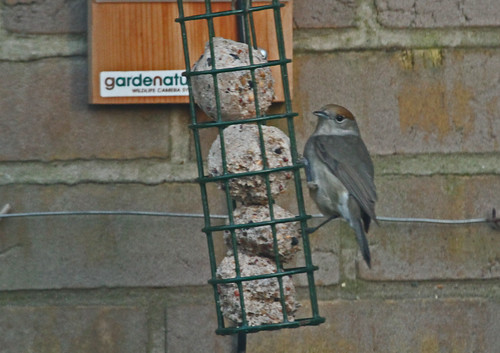
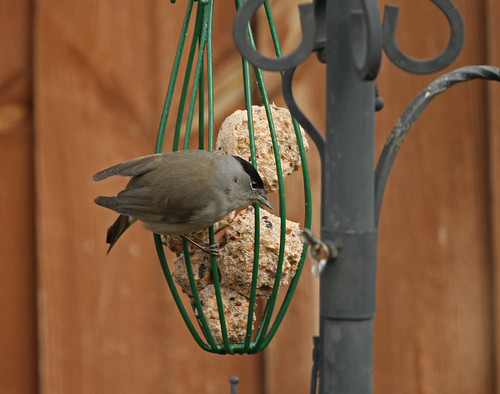
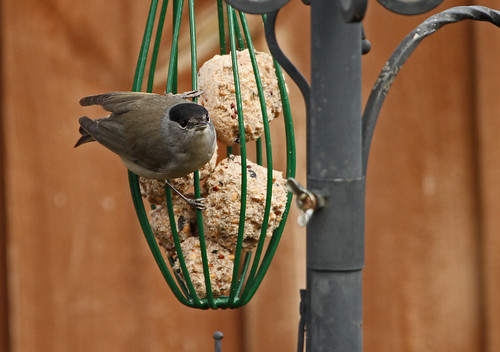
Then a couple of weeks ago when the winter weather was at its filthiest here in Cambridge a female appeared and spent some time refuelling on my fatball feeder:


A female blackcap (Sylvia atricapilla, Dansk: munk) on the birdcam fatball feeder

The birdcam used to be around 6m away from where it is now but there were very few takers for the lardy delights on offer.  But since I moved it to its current location it has been busy every day with numerous bird species. The reason for the change is the lack of cover in the original location which left the birds exposed to the possibility of predation by the local sparrowhawk. But now they have cover within a metre or so and and I can sit and watch them all in close up on the TV. And one of the first to arrive after I moved it was my lady blackcap, who you’ll have immediately noticed has a rufous brown cap, not the blackcap of the male. The specific name ‘atricapilla‘ means ‘blackcap‘ and the Danish name ‘munk‘ means ‘monk‘. I wonder which godly habits gave him that name, or is it simply his ecclesiastical bonnet?

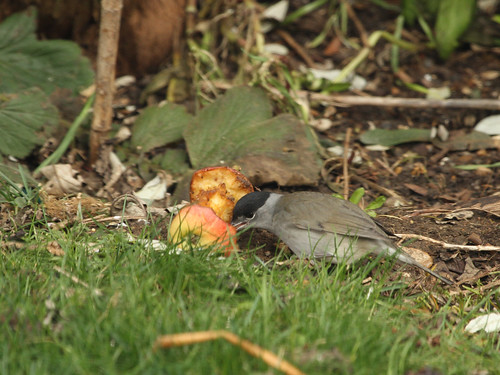
She arrived early on a murky morning, fed quickly and left, and that was the last I’ve seen of her. But a couple of days later a male blackcap arrived and he’s been visiting several times a day every day ever since then:


The male blackcap feeding on an old apple

I’m puzzled as to why the female has been so conspicuous by her continued absence, I guess that now the weather is considerably more pleasant she is more comfortable feeding out in the countryside.

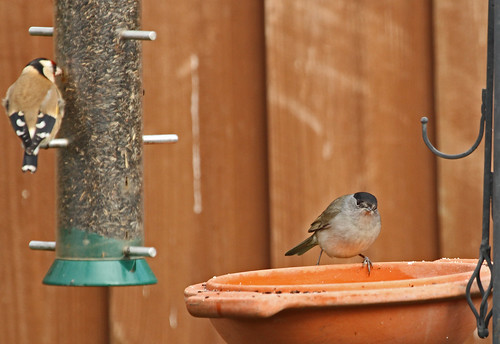
The male doesn’t restrict himself to ground feeding on fruit but is a more regular visitor to the fatballs.

And he tops up with water too. In the picture below he is wary of the goldfinch nibbling niger seed on the adjacent feeder. He was also aware of my presence behind a glass door around 8m away and when the goldfinch disappeared he threw numerous glances in my direction, but so long as I remained still he wasn’t too bothered.

Until recently it was thought that the blackcap was a migrant breeder here in the UK and that they spent their winters in Africa, apart from a sub population that remained here in the winter. But it is now thought that all of ours overwinter south of the Mediterranean and our winter visitors are a separate population from central Europe which migrate here to overwinter. In which case my visitors will be heading back east in the near future. After that I’ll hopefully see and hear our migrant breeders out in the hedgerows where they make a distinctive call which I think sounds like someone flint-knapping.

The British Trust for Ornithology have published a factsheet about blackcaps and their migration behaviour which is worth a read. We also have passage visitors as Scandinavian birds head south and it appears that garden bird feeders are having a major impact on the behaviour of blackcaps and other species too, such as nuthatch, which are now spreading into Scotland, assisted by garden feeding and climate change.

A special winter visitor

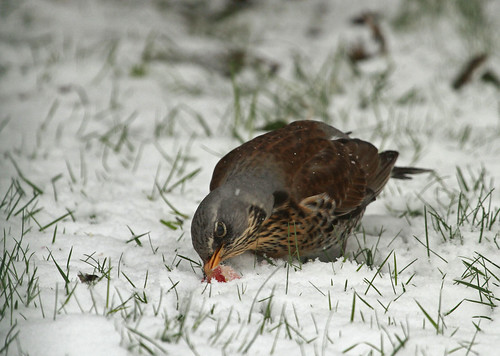
When the snows came a few weekends ago an influx of birds came to my garden to feed up on the seeds and fatballs I put out for them. I also threw out some squidgy grapes which had been getting overripe at the bottom of the punnet. And as well as all the usual species a winter visitor from Scandinavia also appeared.

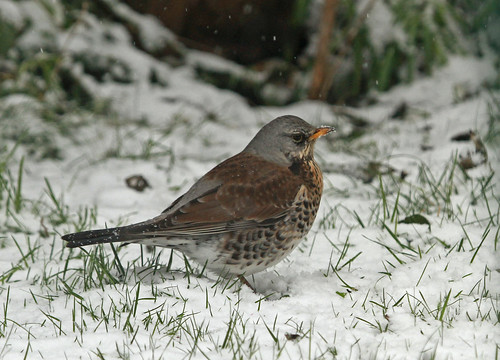
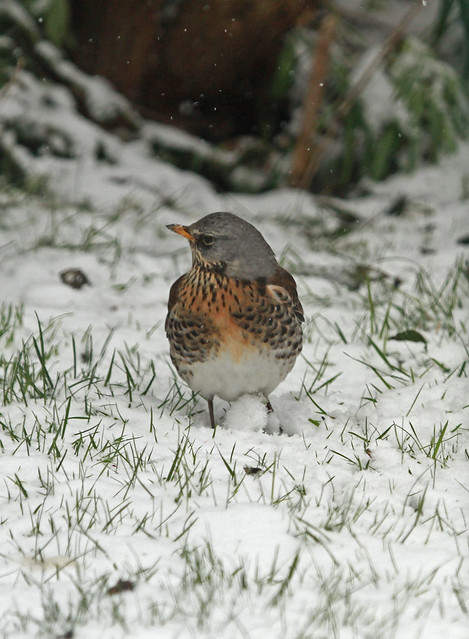
Fieldfare – Turdus pilaris (Dansk: sjagger)

The fieldfare is a species of thrush from Scandinavia which migrates to overwinter in the UK. They’re hardy, feisty birds and utterly resplendent in their psychedelic finery! I’ve seen large flocks of them flying above the countryside around Histon but rarely within the village itself. And then this handsome bird arrived in my garden to feed on the squidgy grapes.

Dismembering a grape

It finished the grapes and then took up residence under a bush in the garden and repelled all comers. Whenever another bird came within striking distance it would emerge from its refuge at speed and chase it off. Which sufficed for everything smaller than a blackbird.

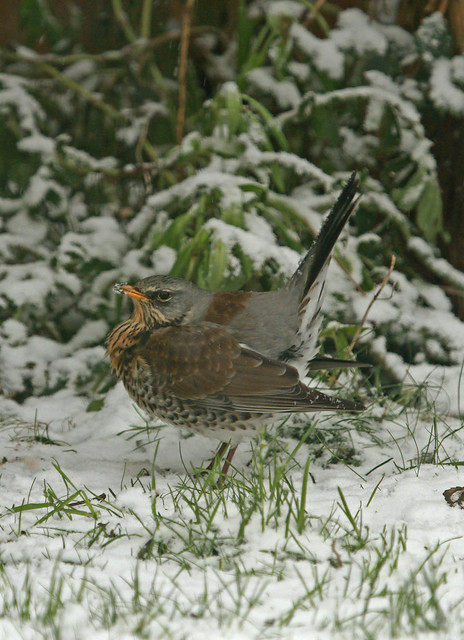
After the grapes had gone I augmented its diet with some apple, which coinidentally is also a favourite food of blackbirds. And within minutes there was competition for the fruit. The fieldfare adopted a very distinctive stance when the blackbird, or anything bigger, like a collared dove or a wood pigeon came within range and several fights ensued. And the fieldfare wasn’t always the winner because blackbirds are also accomplished pugilists when they need to be. So it all worked out evens, they both got some apple and a good scrap would keep them fit too:

The’repel all boarders’ stance, wings down, tail in the air. If that didn’t suffice then all out assault ensued

The fieldfare, I assume it was the same one, appeared in the garden after first light every morning until the rain washed away all the snow and it hasn’t been seen since. At the same time the trees and bushes in the village were also frequented by the fieldfares during the snow but they all disappeared with the snow too.

Mating Mutes

The sun is shining a lot now and the snow has totally disappeared. Unlike two weekends ago which was bitterly cold and the lakes at Milton Country Park were partially iced over. It’s not always easy to see all the water birds but they had been coralled into smaller areas by the ice. Ducks abounded at the park with teal (Anas crecca, Dansk: krikand), gadwall (Anas strepera, Dansk: knarand), wigeon (Anas penelope, Dansk: pibeand) and tufted duck (Aythya fuligula, Dansk: troldand) in numbers, as well as the customary mallard (Anas platyrhynchos, Dansk: gråand). There were two highlights of the trip, a goldcrest was busy hunting in a bush just a few feet away and seemed undisturbed by our presence. Goldcrest (Regulus regulus, Dansk: fuglekonge) are beautiful little birds, they are our smallest breeding species, weighing 4-7 grams, and the northern populations migrate south in winter with Scandinavian individuals crossing the North Sea to overwinter in the UK.

Mute swan pair with a male tufted duck in the background

I didn’t manage to get pictures of the goldcrest, which is a pity, but I did manage to get pictures of the second highlight, which was a pair of mute swans (Cygnus olor, Dansk: knopsvane). And if the goldcrest is our smallest breeder, the mute swan is one of the biggest (if  not thee biggest), weighing in at a hefty 10.5-12kg, and breeding is what this pair had in mind.

Mute swans pair for life and the courtship dance is delightful to watch, they gracefully circled each other, repeatedly intertwining their necks:

And the dance culminated in mating. The male climbed on board the female and grasped the back of her neck with his beak, the whole thing lasted just a few seconds, which was just as well for the lady as her head was held underwater and she actually disappeared from view.

And after mating they rose up, breast to breast out of the water and continued the necking dance:

Finally, they relaxed back into the water and finished the ritual by bobbing their heads towards each other, and apart from the mating moments the whole thing was very calm and sedate. I think mutes are simply regal, they are very big, powerful, animals and I can’t hink of any creature which is quite so pristine.

And shortly after mating the male climbed out of the water onto the ice for a post-coital stretch up to his full height and opened his wings, surrounded by a retinue of coot (Fulica atra, Dansk: blishøne) and gadwall. A fitting finale to this series of captivating natural events.

RSPB Big Garden Birdwatch – the tally

I filled up the birdfeeders first thing this morning, made a jug of coffee, and sat in the window waiting for the birds to flock in. And very little happened. So I waited a little longer. And still nothing happened, and I put it down to the fact the sun was shining, all the snow had gone and the temperature was in double figures.

A dunnock mopping up seed scattered by great tits on the hanging feeder

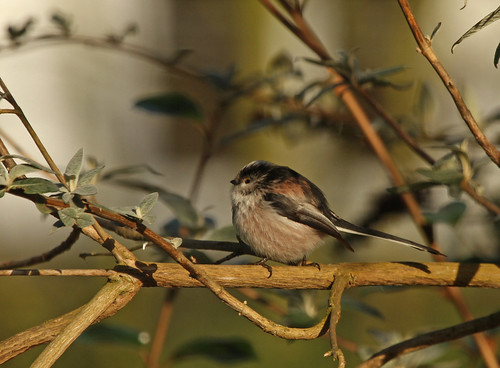
Then at 9.26am a group of four long tailed tits arrived on the fat balls and from then on the birds came and went in rapid succession. So the plan was to count from 9.26 to 10.26 until at around 9.50 the dog vomited on the carpet so the next 20 minutes weren’t spent counting birds. The finish time was therefore a tad delayed, but the final counts were:

Species                                 Total counted                    Maximum number at one time

Long tailed tit                              18                                                              5
Blue tit                                            18                                                              3 Dunnock                                          3                                                               1
Collared dove                                6                                                               2
Blackbird                                       13                                                               2
Greenfinch                                      5                                                               4
Wood pigeon                                  6                                                               2
Robin                                                 3                                                                2
Starling                                             5                                                                2
Great tit                                            3                                                               2
Chaffinch                                         2                                                                1

A female greenfinch enjoying some longed for sunshine

So all in all, what with the Vesuvian intervention from the dog, it was an entertaining hour and a half.

RSPB Big Garden Birdwatch

This weekend, the 26th and 27th January 2013, is the weekend of the Royal Society for the Protection of Birds (RSPB) annual Big Garden Birdwatch. This is a form of citizen science by which the RSPB can harness the collective spotting power of the nation to assist in compiling data on the nations bird populations.

The idea is to spend one hour noting which bird species visit a chosen area and the maximum number of each seen at any one time. This point is important because an individual can make several visits over the course of an hour, so counting total numbers will overestimate the numbers of a particular species.


A long tailed tit paying a visit to my garden this morning

If you want to make a pot of tea and sit by the window for a relaxing hour sipping and counting the details of how to take part are here on the RSPB’s website. Even if you don’t get many interesting birds in your garden, or even many birds at all, this is important and useful data too for compiling population sizes and distributions, so every participant is crucial in creating an accurate picture of the health of the nations birdlife. Which is in turn a useful indicator of the health of the natural environment in the UK as a whole.

I’m going to do my recording tomorrow morning and I’ll post my results here too.

Alas, no bullfinch, but…

The weekend before last I went for a walk around the lakes of RSPB Fen Drayton. It was a customarily grey and cold morning and there was a lot of water standing where there wouldn’t normally be. But the lakes were full of ducks, waders and other water birds and the trees and hedgerows were thronged with other birds, but alas no bullfinch. To explain, the approach road to the car park is lined with hawthorn and other trees and they are home to many bird species including bullfinch, so I was hoping to see one or two and get photographs. But on this occasion alas, they were conspicuous by their absence.

No bullfinch, but hey ho, woodpeckers there were:

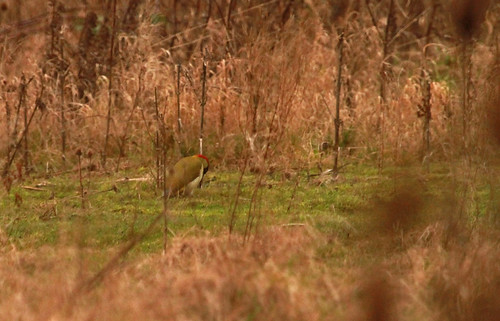
Green woodpecker (Picus viridis, Dansk: grønspætte) mining ants next to the car park at Fen Drayton lakes and fastidiously refusing to look up

And the green woodpecker wasn’t the only woodpecker hanging around the lakes:

Great spotted woodpecker (Dendrocops major, Dansk: stor flagspætte) patrolling the treetops

There was also great crested grebe (Podiceps cristatus, Dansk: toppet lappedykker), a large flock of mixed waders including bar tailed godwit (Limosa lapponica, Dansk: lille kobbersneppe) and several flocks of greylag geese (Anser anser, Dansk: grågås). And lots and lots of lapwing:

A small fraction of a much bigger flock of lapwing, I make it 84 in this group

In the 1970’s lapwing (Vanellus vanellus, Dansk: vibe) were a common sight in the English countryside. Huge flocks consisting of hundreds, if not thousands, of individuals weren’t particularly unusual. My Dad used to call them plovers, or ‘peewits’, a name they acquired because of their distinctive call. But like many species, they have suffered hugely from habitat destruction as a result of modern farming methods. On this particular morning at Fen Drayton there was at least one flock and possibly two, at opposite ends of the lakes, there were a heck of a lot of them and they were frequently rising into the air en masse. And since the snow arrived this week there has also been a small flock of 30-40 birds close to Cambridge Science Park which I spotted on my way to work, and a small group of them alighted on the field right outside my lab.

A blue tit deftly plucking seeds from a swaying reed seedhead

On the last part of my outing round the lakes I headed for a hide overlooking an expanse of water where I was hoping to see water birds. A flight of four goosander containing a male and three females flew over on the way there and seemed to be a good omen! Outside the hids this blue tit (Cyanistes caerulius, Dansk: blåmejse) was busy hopping from stem to stem in the reeds outside acrobatically harvesting the seeds.

And on the water there were A LOT of birds. The flock of lapwing higher up this post were on the ground at the far side of this lake, and the water was hosting gulls, ducks, swans and a lone heron. One of the loveliest ducks, easily identified by it’s triangular black head, white cheek spot and his regal black and white plumage is the goldeneye.

Goldeneye drake – elegance personified

There were a pair of goldeneye here, (Bucephala clangula (great name too!), Dansk: hvinand) and as with other duck species the lady is drab in comparison with the resplendent males. I spent half an hour waiting for them to paddle into the gap in the reeds just infront of this one for a clear shot. But they never did, so this is the best picture I could get. But isn’t he a beauty!

What a difference a frost makes

Having bemoaned the lack of wildlife in my garden, last Saturday the weather turned very cold here and after replenishing the bird feeders they were flocking in in droves! These resilient little guys were obviously finding sufficient sustenance elsewhere until the cold set in but now they’re here in numbers daily, and today we have had 10-15cm of snow and it hasn’t stopped yet so I reckon they’ll be around for a while longer too.

One of the species which I have missed because they are normally here all through the winter is the chaffinch (Fringilla coelebs, Dansk: bogfinke):

The cock chaffinch always adds a splash of welcome colour

Chaffinch are resident breeders in the UK and can generally be seen and heard in trees and hedgerows all year round. Another resident breeder I hadn’t in the garden or in the countryside much this year was the dunnock (Prunella modularis, Dansk: jernsurv), the archetypal ‘LBJ‘ or ‘Little Brown Job’. When viewed closely they’re anything but LBJ’s. They feed on the ground so I always throw a handful of seed in the undergrowth for them. This little guy has been terrorised by my resident robin, but the arrival of a second robin has given him respite as my resident no longer has his eye on the ball.

My dunnock keeping one eye on the ground for seed while the other looks for the robin

The coal tit (Periparus ater, Dansk: sortmejse) is a pine tree specialist, seeking insects and spiders in the summer and seeds in the winter. This makes it a bit of a mystery here because we have very few conifers in the vicinity, but there are at least two flitting in and out of the garden all day:

The coal tit waiting it’s turn to get on the seed tray

A blue tit (Cyanistes caerulius, Dansk: blåmajse) about to join the coal tit and grab a seed

Starling – (Sternus vulgaris, Dansk: stær)
Starlings are a bird that used to be very common and would murmurate in humungous numbers but this only happens now in a very few places. When I was an undergrad in Liverpool they would gather on icy winters evenings over Old Haymarket in vast numbers. The aerial manouvres were breathtaking, as was the acrid ammoniacal stench from the guano left behind on the pavements! I generally only see them in small flocks of a few tens these days, but they regularly come and avail themselves of the fatballs in my garden. And they’re more than welcome!

And finally, usually the most visible diner at my avian restaurant, the ubiquitous blackbird. Even they were conspicuous by their relative absence until very recent weeks, but now they’re back in  numbers:

And no English garden is complete without a feisty blackbird (Turdus merula, Dansk: solsort). Having said that, according to the British Trust for Ornithology the blackbird is a ‘Migrant/Resident Breeder, Passage/Winter Visitor’ and they migrate within the UK but also in winter we get an influx from Europe coming from Germany and Poland and other parts of eastern Europe. It makes me chuckle that whilst us folk moan about the weather and then jet off to the Canary Isalands in the winter, the blackbirds are coming here to make the most of our balmy winter climate. Just goes to show, everything’s relative!

New Year Ducks

For the last 14 months or so I’ve been saving my spare pennies in order to upgrade my photographic hardware and the plan was to put the money towards the Canon 100-400mm telephoto zoom lens which I mentioned in my last post.

(I’ve bought several items in the last 7 or 8 months or so from an online second hand camera shop and I’m going to give these guys a free plug because they have been very good indeed. They are called ‘MPB Photographic‘ and are based in Brighton, UK. I got a cheap Canon 18-55mm lens, a Manfrotto tripod, several filters and the battery grip for my Canon DSLR. All were good prices and the quality has been excellent and exactly as described on the website, so I’ve saved between £5-600 so far! Apparently, the pictures of items on the website are always of the item you are actually buying, not a new one, and the images are zoomable so you can get a good look at it too. So after buying my lens there and it being in mint condition I’ve decided that I’ll buy second hand if they have what I’m after).

The good lady wife gave me the lens for Christmas and I was very excited about getting out and about with it between Christmas and New Year, and then on Christmas Day I came down with the lurg and was incapacitated for a week. But on New Years Day I was feeling a little more human, and the sun came out, so I was determined to get to a lake and try to take photographs of distant water birds.

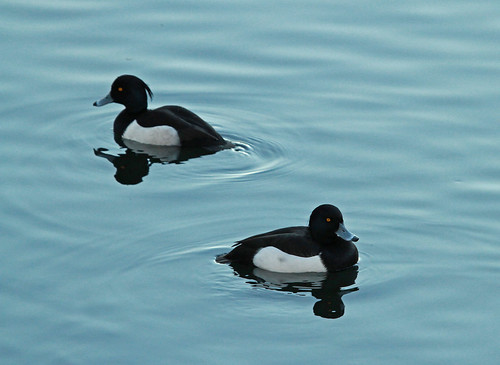
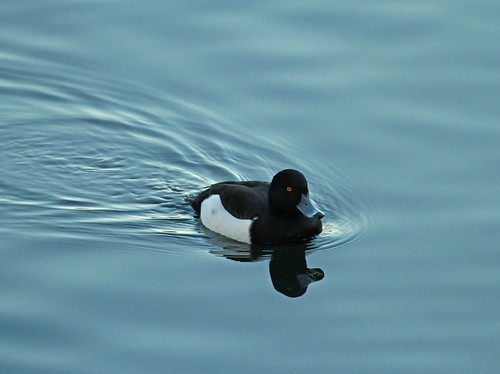
Tufted duck (Aythya fuligula) – the male of the species, with his reflection and his piercing yellow eye

I drove the short distance to Milton Country Park on the north side of Cambridge, which was full to overflowing with folk walking off their New Years Eve hangovers. I’ve been on a mission to get a good photograph of a tufted duck because they’re handsome birds and I’ve taken many sub standard pictures which simply don’t cut the mustard, so I was pleased to get these pictures in lighting conditions that were challenging. It was a very cold but sunny day and by the time I got there in the mid afternoon the sun was already behind the trees, so the light was starting to fail and I needed high ISO to get a picture. But despite that the quality of the images is pretty good I reckon!

The male tufties were grouped together, there were around half a dozen of them, and a way distant was a female, paddling around on her own and she seemed to be avoiding the males.

The female tufted duck and a black headed gull in winter plumage
The lady of the species is dark brown on top with mottled brown flanks and is rather less noticeable than the male. Bit I really like this picture of her because of the colour of the water. She was 60-70m beyond the group of males in the pictures above and I really liked the difference in the colour of the water due to the sun shining on the trees behind her and reflecting on the water, but where the males were the water was the colour of the reflected sky.

So I’m very satisfied with the performance of my new zoom lens and I’ll be posting lots more pictures to show you in the very near future.

(P.S. I’ve been really struggling to keep up with all your blogs and it’s been a source of major irritation, but I’m now going to try to catch up with you all over the next week or so. See you soon. F)