Category Archives: Ducks

Returning migrants and lots more besides

Occasionally, but fairly infrequently, it’s a struggle to find enough interesting nature to put together a post, and then every now and again so much happens that it’s difficult to fit it all in. Last weekend was one of the latter.

It started to get interesting as I was cycling to work on Friday morning, a bird caught my eye in a hedge outside work and first off I thought it was a bullfinch, which I’ve never seen on Cambridge Science Park before. But then I got a better look at it and it was immediately apparent it wasn’t a bullfinch, it had similar colours but in a different pattern, so I did a quick U-turn to get a better look. It turned out to be a black redstart male in full breeding regalia (Phoenicurus ochruros, Dansk: husrødstjert). He was magnificent but alas, because I was heading to work I was camera-less, so if you’ve never seen one, dig out a bird reference book and check him out, it’s worth the effort.

I went back to work on Saturday morning with my camera to see if he was still there but there was no sign of him so I carried on to Milton Country Park, on the northern edge of Cambridge. It was a bright sunny morning and I arrived there just after 8.30 and it was already warm. And it augured well because it turned into a real bird fest. I was hoping to see some returning migrants and as I got out the car I could hear chiffchaff (Phylloscopus collybita, Dansk: gransanger) calling in the trees around the carpark. The first migrant I actually saw was completely unexpected and turned out to be a pair of sand martins (Riparia riparia, Dansk: digesvale) which I haven’t seen for years. There were also swallows (Hirundo rustica, Dansk:  land svale) flying low over a lake and this is roughly the same time I saw the first swallow last year. Like swallows, sand martins also over winter in South Africa, but unlike swallows they nest in burrows which they excavate in sandy banks. There are some man made burrows for the sand martins at the country park but so far they’ve been ignored by the martins, but the occassional kingfisher pair have availed themselves of the opportunity.
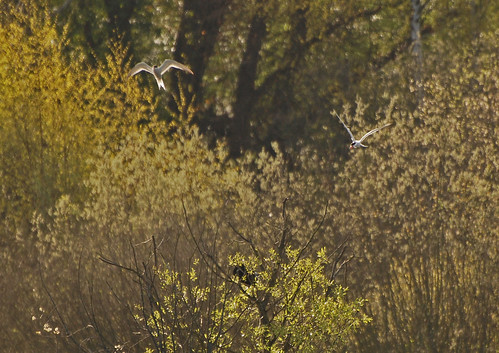
Close to where the swallow was hunting is a small island with a tree on it where cormorants (Phalacrocorax carbo, Dansk: skarv) can often be seen perched. This time there was a carrion crow (Corvus corone, Dansk: sortkrage) sat on top and a pair of common terns (Sterna hirundo, Dansk: fjordterne) were taking exception to its presence and were working as a team to dive bomb it:
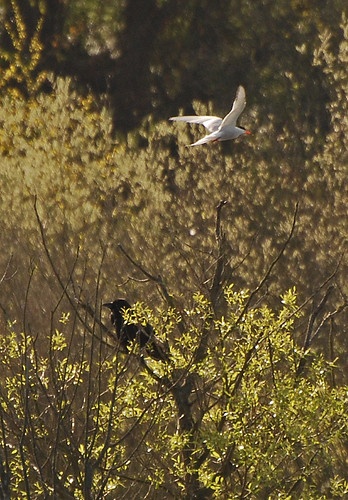
A singleton…


… and in tandem

I almost felt a little sorry for the crow, but I’ve watched them terrorise so many birds, especially buzzards and other birds of prey, in a similar fashion that the sympathy was a tad less enthusiastic than it may otherwise have been.

A migrant which was present all over the country park was the blackcap (Sylvia atricapilla, Dansk: munk), in one bush there were a minimum of four and possibly six or even more. They were squabbling away in the  bush presumably in the midst of a territorial dispute. I saw the first blackcap of 2012 a few weeks ago at Danbury Common in Essex during my unsuccessful mission to look for adders.
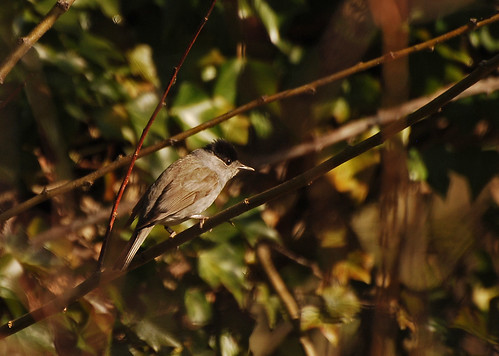

Blackcap male, the female is similar but easily distinguished because her cap is a rusty brown colour.

As well as the migrants the trees and bushes were full of the song of more familiar resident species such as the robin, blue tit, great tit, blackbird and wren. All were energetically vociferous, filling the air with a wonderful cacophany. And amongst these I caught a tantalising glimpse of a much less common species, the treecreeper (Certhia familiaris, Dansk:  træløber). Treecreepers are very aptly named and are fun to watch as they hunt insects in the crevices of tree trunks, spiralling upwards in a corkscrew pattern. A pair of sparrowhawk and a pair of buzzard were also busy performing their aerial courtship routines.

There were none of the winter ducks such as tufted duck (Aythya fuligula, Dansk: troldand), pochard (Aythya ferina, Dansk: taffeland), gadwall (Anas strepera, Dansk: knarand), teal (Anas crecca, Dansk: krikand) or widgeon (Anas penelope, Dansk: pibeand) on the water, they had all headed off north to their breeding grounds. But several birds including coot (Fulica atra, Dansk: blishøne) and greylag geese (Anser anser, Dansk: grågås) had chicks on the water:
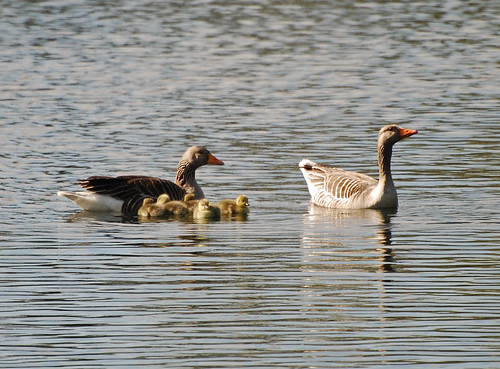

Greylag geese with six chicks

I paused to try to get a shot of a great crested grebe (Podiceps cristatus, Dansk: toppet lappedykker), all now in full brown breeding plumage:

And as I stretched over the water, trying hard to get a clean shot of the grebe, and even harder not to pitch headlong into the lake, a grey heron (Ardea cinerea, Dansk: fiskehejre) flew low overhead:
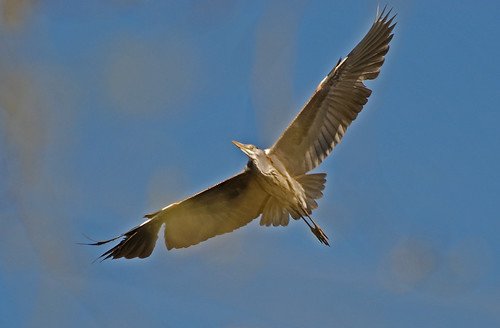
It was so low I thought it must have pitched up very close to where I was but on an adjacent lake, and a quick scan revealed it sat in the top of a tree being pestered by the common tern that had earlier been harrassing the carrion crow:

The terns were deeply unhappy with any potential predator, although they were less keen to buzz a pair of sparrowhawks which were in the air above the same stretch of water!
Minsmere in wintertime

My meanderings around Suffolk in February inevitably led me to RSPB Minsmere. I’d heard there were bittern (Botaurus stellaris, Dansk: rørdrum), which I’ve never seen before, and smew (Mergellus albellus, Dansk: lille skallesluger) which I’ve also never seen, in residence there. Indeed, theere had been an influx of bittern from Holland due to the fierce winter weather there and numbers were up, so I felt a little twitching was in order.

For those of you unfamiliar with the geography, Minsmere is characterised by woodland on the inland side to the north and east with a network of reedbeds and lakes behind a sand and shingle bank running along the coast. It lies between Dunwich Heath and the Coastguard Cottages to the north, and Sizewell to the south. It is a haven for numerous species of bird and my friend told me that on a morning trip there with a dawn start he spotted over 100 species of birds by lunchtime. And I reckon that’s an impressive tally. Many mammals also live and visit here including red deer, fox and otter.

As it is an RSPB reserve there are hides for observing the wildlife and as I set off along the bank which forms the sea defences to find one various gulls and great crested grebes (Podiceps cristatus, Dansk: toppet lappedykker) were on the sea. I paused to watch a marsh harrier (Circus aeruginosus, Dansk: rørhøg) quartering the reedbeds, and then headed on to an open hide where I installed myself to see what was in residence.


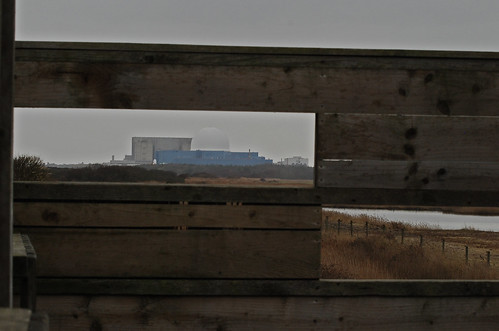
The view from the south end of the hide

From the lower right hand window of the hide are the reedbeds of the reserve and from the upper left window is the reactor dome of Sizewell nuclear power station. The power station reminds me that I’m very grateful for havens such as Minsmere but I also wonder why on earth does it have to be just there, the juxtaposition offends me somewhat. But there it is, so I contented myself with looking out the front of the hide and here are some of the birds I could see:


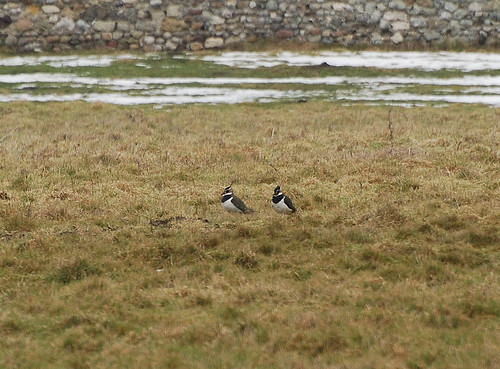
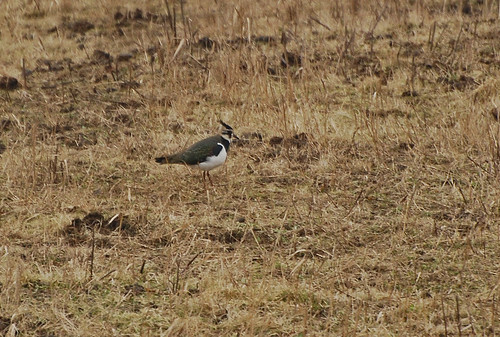
A lone lapwing foraging for sustenance

Immediately in front of my hide, in which I was the only occupant, was a water filled channel separated from the lakes just beyond by a thin strip of reeds, and immediately to the fore was a single lapwing (Vanellus vanellus, Dansk vibe). Low grassy islands in the lakes were home to various species of duck, the most numerous being…


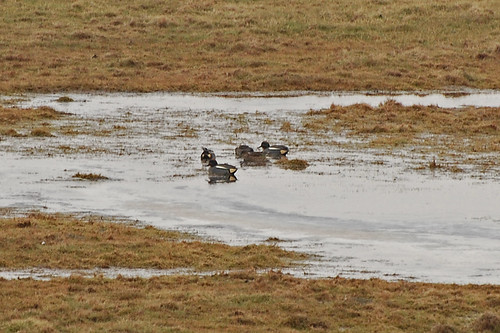
Teal, two males and a female (Anas crecca, Dansk: krikand)


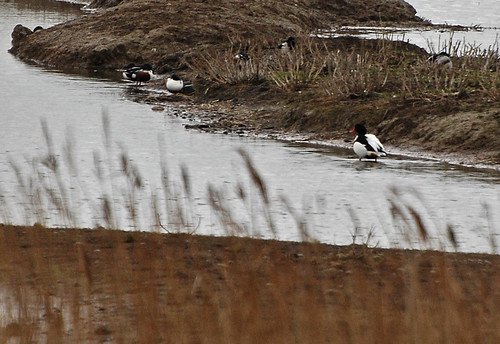
Shelduck (Tadorna tadorna, Dansk: gravand), and lurking in the background is a shoveler (Anas clypeata, Dansk: skeand)

All of these ducks are resident or nigrant breeders and winter visitors and where I am I only see them in winter. According to the BTO the teal is unusual in that it has no other names in the UK, which is an interesting little factlet which obviously needs to be challenged. If anyone knows of a local name for the teal please let me know. Another amusing piece of nomenclature is the shoveler, so named presumably for its shovel like beak and in Danish is known as the ‘skeand‘, which translates into English as the ‘spoon duck’. It uses it’s magnificent beak to filter small molluscs and crustaceans from the beds of shallow water by sweeping it across the surface and sifting the food from the disturbed sediment.

Alas, most of the birds were just too far away for my 300mm lens, but I plan to upgrade my optics this year so next time I post from Minsmere I’ll hopefully have lots of high quality close ups too.

Springtime sojourn to the Suffolk coast

Last week we headed off to to the seaside for a few days and our chosen detination was Dunwich, a tiny village on the Suffolk coast which in medieval times was the capital of the region and a thriving, wealthy port for moving cargo and people between East Anglia and the European mainland. It’s an amazing place with very interesting history which I wrote about in a post last year.

We stayed in my favourite inn called The Ship which has panoramic views over the Dingle Marshes which stretch several miles north to Walberswick, which is renowned for it’s annual crabbing champi0nship. It is also where the king of art nouveau, Charles Rennie Mackintosh moved to after he had abandoned architecture to become a watercolourist and where the series of flowers known as the ‘Walberswick collection’ was painted.

The marshes along this part of the coast are full of wildlife, including rare birds such as harriers and bittern, mammals such as otters as well as a host of marsh and heathland plants and the associated fauna. It’s a wonderful place. The view from our window at The Ship was generally dominated by low grey cloud which occasionally saw fit to rain on us, but even so the wildlife was much in evidence without even leaving the inn:


The tree opposite our window played host to numerous small birds including this house sparrow (Passer domesticus, Dansk: gråspurv) and blue tit (Cyanistes caerulius, Dansk: blåmejse)
And a couple of hundred metres beyond the tree were some pools of rainwater where lapwing and these teal were on parade each morningAnd beyond that was a ditch where a little egret (Egretta garzetta, Dansk: silkehejre) was hunting every day

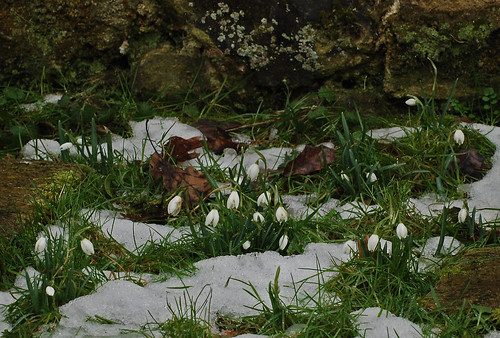
So, as you can imagine, it wasn’t so easy to haul myself away from my nice centrally heated room and my cup of tea and go out into the wintry mornings, when I could sit by the window and see all this! But I eventually extricated myself and walked a circuit of the village taking in the local church and graveyard, the remains of the Franciscan Friary and the woods inbetween, and was very adequately rewarded. The local church has the remains of a medieval leper hospital in its grounds which is a fascinating place historically, but is now inhabited solely by sheep and snowdrops (Galanthus nivalis). There were no sheep while we were in there but the snowdrops were growing out between the melting snow.


Snowdrops infront of the be-lichened walls of the ancient leper hospital in the grounds of St James church


A lapwing pair pausing in the Friary between displays of breathtaking aerobatic excellence

The Friary is long deserted by the Franciscan brethren and is now a ruin, but it still plays host to the local wildlife. As well as the lapwing (Vanellus vanellus, Dansk: vibe) , there was a songthrush (Turdus philomelos, Dansk: sangdrossel) foraging amongst the  grassy tufts and robins (Erithacus rubecula, Dansk: rødhals) singing from the trees beyond.

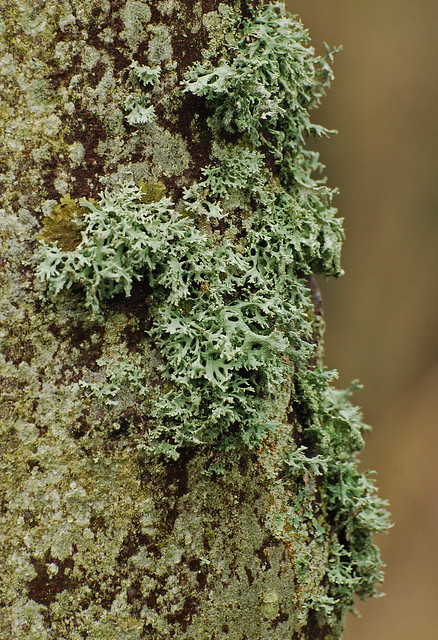
A deciduous tree adjacent to the Friary was completely covered in lichen

I don’t know which species the lichens are on the tree trunk but I think there are at least four. The flat resupinates can be seen on old wood and even brick walls in towns and villages, but the feathery species are much more susceptible to atmospheric pollution and therefore only exist where the air is clean.

Beyond Dunwich to the south is the gorse covered heathland of Dunwich Heath which is owned and managed by the National Trust, and beyond that is the RSPB reserve at Minsmere where I watched a marsh harrier quartering the reedbeds and where another walker told me he had seen smew and a bittern in one of the lakes on the reserve. I went to look there but I didn’t see either, but I did see other birds, and some splendid lichens. Of which more in a later post.

Wonderful Wildlife of Wicken Fen

Around 10 years ago I used to do voluntary work at Wicken Fen which lies in the flat emptiness between Cambridge and Ely. Wicken Fen is one of the last and the largest piece of remaining fenland in East Anglia and is home to a plethora of wildlife. It’s owned and managed by the National Trust in such a way that diverse habitats favouring different species are established and maintained. When I worked there we were engaged in various activities such as repairing boardwalks, fences and hides, scrub clearance, which was a good activity for freezing winter days because it involved a huge fire to burn the felled scrub, but my favourite job was building raised ponds with wheelchair access so disabled children could safely do some pond dipping. Which is an activity that everyone should be able to do, child or not. All you need is a net, a jar, a magnifying glass and a pond and a sunny day is turned into a fantastic voyage of biological discovery.

My re-exploration last weekend started from Upware at the back end of the Fen where we parked and joined Wicken Lode. We had counted over 30 species of birds within the first half hour of our walk. If it had been solely down to my good self the number would have been rather less because my skills when it comes to recognising birdsong are a tad limited. Fortunately I was with my friend, David, who’s aural acuity is considerably better honed than mine, and I’m highly envious of his ability to detect the song of distant bird species and identify them. One of the first birds to greet us in the car park was this mistle thrush perched on top of a telegraph pole:

Mistle thrush – Turdus viscivorus (Dansk: misteldrossel)

… and a great spotted woodpecker, also finding a handy perch at the top of a telegraph pole:


Great spotted woodpecker – Dendrocops major (Dansk: Stor flagspætte)

Great spotted woodpeckers make a characteristic drumming sound by doing what their name suggests and it is the frequency of the drumming, of around 40 beats per second, which generates the resonant sound. Anatomical examination of their skulls has revealed the presence of built in shock absorbers which prevent them damaging their brains when they drum. They feed on tree seeds such as acorns and insects which they dig out from under the bark of trees and they can also take birds eggs and chicks which they have been known to steal from birdboxes by drilling holes through the walls and plucking them out.

We eventually managed to tear ourselves away from Upware and head out along Wicken Lode on to the Fen where a Cetti’s warbler (Cettia cetti, Dansk: cettisanger) gave away his location by singing in a way that only Cetti’s can. It’s an amazing sound and I can highly recommend having a listen here. These recordings don’t quite do it justice, but you get a feel for it. Also on the Lode were a family of three mute swans; male, female and one cygnet. Mute swans are always photogenic but I felt particularly blessed when the male spread hs wings and shook himself down:


Mute swans (Cygnus olor,  Dansk: knopsvane)

We turned off the Lode and headed along Harrisons Drove where we came across a field of very impressive bovines. In  order to manage the fen (and at the same time draw in more visitors, no doubt) cattle and horses are used to trim the vegetation back naturally. I’d never seen the cattle before and they are magnificent animals – looking more like a cross between a highlander and a bison than traditional farm cattle:


They must be hardy beasts indeed to survive on the meagre nourishment offered by the fen

Also along the drove I spotted a hen harrier (Circus cyaneus, Dansk: Blå kærhøg) quartering the field, either a female or a juvenile, identifiable by the pale band around the rump just infront of the tail feathers. In my opinion, spotting a harrier, even a fleeting glimpse, justifies an expedition into the fens early on a freezing morning. Alas it was too far away to photograph, but when after another couple of hundred metres we entered a hide overlooking a lake, there were plenty of subjects for photography…

This lake was home to hundreds of ducks – we estimated around 800 from 5 species that we could see… as well as coot and mute swan. Watched over by the longhorns.

I don’t think this lake is there in the summer because looking at the area on Google Maps there is no water, and David pointed out that their were no diving ducks such as pochard (Aythya ferina, Dansk: taffeland – which tranlates as ‘table duck’ which shows what the Danes think of them!) tufted duck (Aythya fuligula, Dansk: troldand) or goldeneye (Bucephala clangula, Dansk: hvinand), suggesting the water was too shallow. But there were large numbers of shallow feeders such as gadwall (Anas strepera, Dansk: knarand), shoveller (Anas clypeata, Dansk: skeand), pintail (Anas acuta, Dansk: spidsand), mallard (Anas platyrhynchos, Dansk: gråand) and wigeon (Anas penelope, Dansk: pibeand). We had seen three flocks of wigeon (and heard them too, they make a great sound) fly over and land on the water just before we got to the hide.  Some of them were on the lake above and lots more were on an adjacent one:


Wigeon. Lots of them! I counted around 60 in this group.

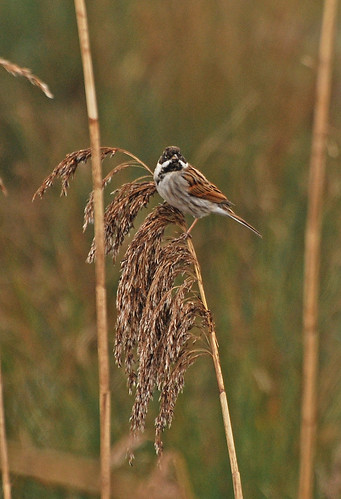
And in between the two lakes were numerous reed bunting (Emberiza schoeniclus, Dansk: rørspurv) flitting between the hedgerow and the path and pausing to pluck seeds from the seedheads of the reeds, hence their name…

Male reed bunting – one of my better reed bunting shots

And the female:
We saw 44 species of birds that we could identify on our way around Upware and the Fen. And as well as all the birds Wicken is home to a phenomenal diversity of insects, large mammals including roe deer and otter, small mammals including shrews, voles, mice and the predators that hunt them, and reptiles including lizards which can be seen basking in the sun on the boardwalks and fenceposts early on summer mornings. Now I’ve been back and rediscovered the Fen I’ll make sure I get back later in the year and post about the changing wildlife in what is a unique collection of ecosystems.