Category Archives: water birds

Mating Mutes

The sun is shining a lot now and the snow has totally disappeared. Unlike two weekends ago which was bitterly cold and the lakes at Milton Country Park were partially iced over. It’s not always easy to see all the water birds but they had been coralled into smaller areas by the ice. Ducks abounded at the park with teal (Anas crecca, Dansk: krikand), gadwall (Anas strepera, Dansk: knarand), wigeon (Anas penelope, Dansk: pibeand) and tufted duck (Aythya fuligula, Dansk: troldand) in numbers, as well as the customary mallard (Anas platyrhynchos, Dansk: gråand). There were two highlights of the trip, a goldcrest was busy hunting in a bush just a few feet away and seemed undisturbed by our presence. Goldcrest (Regulus regulus, Dansk: fuglekonge) are beautiful little birds, they are our smallest breeding species, weighing 4-7 grams, and the northern populations migrate south in winter with Scandinavian individuals crossing the North Sea to overwinter in the UK.

Mute swan pair with a male tufted duck in the background

I didn’t manage to get pictures of the goldcrest, which is a pity, but I did manage to get pictures of the second highlight, which was a pair of mute swans (Cygnus olor, Dansk: knopsvane). And if the goldcrest is our smallest breeder, the mute swan is one of the biggest (if  not thee biggest), weighing in at a hefty 10.5-12kg, and breeding is what this pair had in mind.

Mute swans pair for life and the courtship dance is delightful to watch, they gracefully circled each other, repeatedly intertwining their necks:

And the dance culminated in mating. The male climbed on board the female and grasped the back of her neck with his beak, the whole thing lasted just a few seconds, which was just as well for the lady as her head was held underwater and she actually disappeared from view.

And after mating they rose up, breast to breast out of the water and continued the necking dance:

Finally, they relaxed back into the water and finished the ritual by bobbing their heads towards each other, and apart from the mating moments the whole thing was very calm and sedate. I think mutes are simply regal, they are very big, powerful, animals and I can’t hink of any creature which is quite so pristine.

And shortly after mating the male climbed out of the water onto the ice for a post-coital stretch up to his full height and opened his wings, surrounded by a retinue of coot (Fulica atra, Dansk: blishøne) and gadwall. A fitting finale to this series of captivating natural events.

Alas, no bullfinch, but…

The weekend before last I went for a walk around the lakes of RSPB Fen Drayton. It was a customarily grey and cold morning and there was a lot of water standing where there wouldn’t normally be. But the lakes were full of ducks, waders and other water birds and the trees and hedgerows were thronged with other birds, but alas no bullfinch. To explain, the approach road to the car park is lined with hawthorn and other trees and they are home to many bird species including bullfinch, so I was hoping to see one or two and get photographs. But on this occasion alas, they were conspicuous by their absence.

No bullfinch, but hey ho, woodpeckers there were:

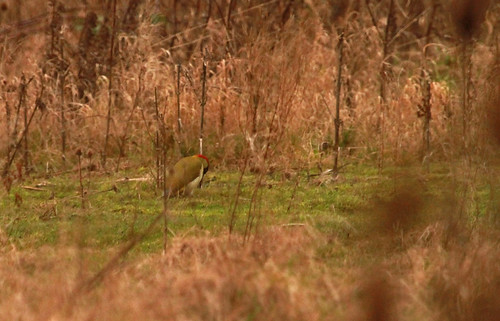
Green woodpecker (Picus viridis, Dansk: grønspætte) mining ants next to the car park at Fen Drayton lakes and fastidiously refusing to look up

And the green woodpecker wasn’t the only woodpecker hanging around the lakes:

Great spotted woodpecker (Dendrocops major, Dansk: stor flagspætte) patrolling the treetops

There was also great crested grebe (Podiceps cristatus, Dansk: toppet lappedykker), a large flock of mixed waders including bar tailed godwit (Limosa lapponica, Dansk: lille kobbersneppe) and several flocks of greylag geese (Anser anser, Dansk: grågås). And lots and lots of lapwing:

A small fraction of a much bigger flock of lapwing, I make it 84 in this group

In the 1970’s lapwing (Vanellus vanellus, Dansk: vibe) were a common sight in the English countryside. Huge flocks consisting of hundreds, if not thousands, of individuals weren’t particularly unusual. My Dad used to call them plovers, or ‘peewits’, a name they acquired because of their distinctive call. But like many species, they have suffered hugely from habitat destruction as a result of modern farming methods. On this particular morning at Fen Drayton there was at least one flock and possibly two, at opposite ends of the lakes, there were a heck of a lot of them and they were frequently rising into the air en masse. And since the snow arrived this week there has also been a small flock of 30-40 birds close to Cambridge Science Park which I spotted on my way to work, and a small group of them alighted on the field right outside my lab.

A blue tit deftly plucking seeds from a swaying reed seedhead

On the last part of my outing round the lakes I headed for a hide overlooking an expanse of water where I was hoping to see water birds. A flight of four goosander containing a male and three females flew over on the way there and seemed to be a good omen! Outside the hids this blue tit (Cyanistes caerulius, Dansk: blåmejse) was busy hopping from stem to stem in the reeds outside acrobatically harvesting the seeds.

And on the water there were A LOT of birds. The flock of lapwing higher up this post were on the ground at the far side of this lake, and the water was hosting gulls, ducks, swans and a lone heron. One of the loveliest ducks, easily identified by it’s triangular black head, white cheek spot and his regal black and white plumage is the goldeneye.

Goldeneye drake – elegance personified

There were a pair of goldeneye here, (Bucephala clangula (great name too!), Dansk: hvinand) and as with other duck species the lady is drab in comparison with the resplendent males. I spent half an hour waiting for them to paddle into the gap in the reeds just infront of this one for a clear shot. But they never did, so this is the best picture I could get. But isn’t he a beauty!

New Year Ducks

For the last 14 months or so I’ve been saving my spare pennies in order to upgrade my photographic hardware and the plan was to put the money towards the Canon 100-400mm telephoto zoom lens which I mentioned in my last post.

(I’ve bought several items in the last 7 or 8 months or so from an online second hand camera shop and I’m going to give these guys a free plug because they have been very good indeed. They are called ‘MPB Photographic‘ and are based in Brighton, UK. I got a cheap Canon 18-55mm lens, a Manfrotto tripod, several filters and the battery grip for my Canon DSLR. All were good prices and the quality has been excellent and exactly as described on the website, so I’ve saved between £5-600 so far! Apparently, the pictures of items on the website are always of the item you are actually buying, not a new one, and the images are zoomable so you can get a good look at it too. So after buying my lens there and it being in mint condition I’ve decided that I’ll buy second hand if they have what I’m after).

The good lady wife gave me the lens for Christmas and I was very excited about getting out and about with it between Christmas and New Year, and then on Christmas Day I came down with the lurg and was incapacitated for a week. But on New Years Day I was feeling a little more human, and the sun came out, so I was determined to get to a lake and try to take photographs of distant water birds.

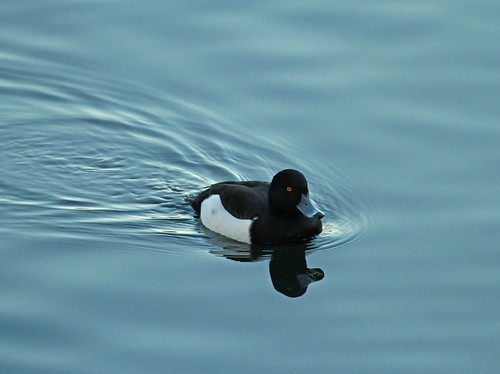
Tufted duck (Aythya fuligula) – the male of the species, with his reflection and his piercing yellow eye

I drove the short distance to Milton Country Park on the north side of Cambridge, which was full to overflowing with folk walking off their New Years Eve hangovers. I’ve been on a mission to get a good photograph of a tufted duck because they’re handsome birds and I’ve taken many sub standard pictures which simply don’t cut the mustard, so I was pleased to get these pictures in lighting conditions that were challenging. It was a very cold but sunny day and by the time I got there in the mid afternoon the sun was already behind the trees, so the light was starting to fail and I needed high ISO to get a picture. But despite that the quality of the images is pretty good I reckon!

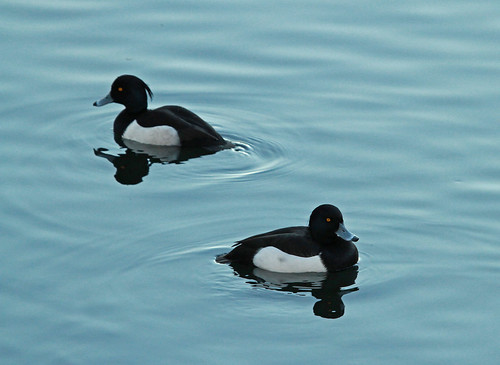
The male tufties were grouped together, there were around half a dozen of them, and a way distant was a female, paddling around on her own and she seemed to be avoiding the males.

The female tufted duck and a black headed gull in winter plumage

The lady of the species is dark brown on top with mottled brown flanks and is rather less noticeable than the male. Bit I really like this picture of her because of the colour of the water. She was 60-70m beyond the group of males in the pictures above and I really liked the difference in the colour of the water due to the sun shining on the trees behind her and reflecting on the water, but where the males were the water was the colour of the reflected sky.

So I’m very satisfied with the performance of my new zoom lens and I’ll be posting lots more pictures to show you in the very near future.

(P.S. I’ve been really struggling to keep up with all your blogs and it’s been a source of major irritation, but I’m now going to try to catch up with you all over the next week or so. See you soon. F)

Titchwell ducks

I like ducks. A couple of hours spent by the side of a lake gazing at and identifying numerous duck species is time well spent in my opinion. (N.b. as I write this I’m sipping a glass of a very tasty Chilean Cabernet and listening to The Lyre of Orpheus by Nick Cave. How much better can life get?)

Anyway, back to the ducks. Inbetween chasing swifts with my camera and snapping marsh harriers and avocets there were several species of duck availing themselves of the bounty supplied by the fresh and salt water mudflats at Titchwell.


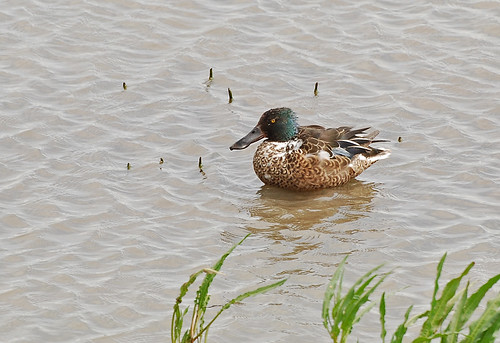
Shoveler male

Shoveler (Anas clypeata, Dansk – skeand) can be seen on the lakes close to Cambridge but it’s rare to see them close up. At Titchwell there are so many birds there that if I wait long enough it’s very likely I’ll get close up, and so it proved with several species of duck. The shoveler is immediately recognisable by his enormous beak which he uses to filter crustaceans, molluscs and other small creatures from the water. The pale blue patch just visible on the upper forewing is just visible on this one and is diagnostic for the shoveler. The blue-winged teal also has a blue patch here but the teal is smaller and doesn’t have the distinctive beak of the shoveler.


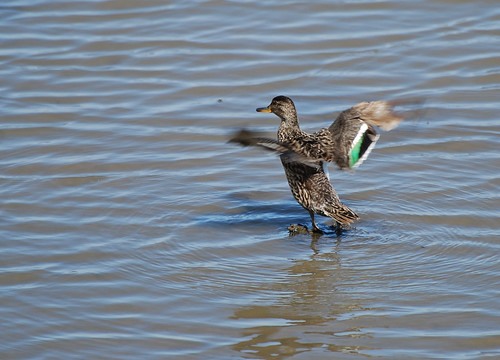
Teal female (Anas crecca, Dansk: krikand)

The teal is the smallest duck and the male plumage is handsome. Like the mallard, the female is predominantly brown but she has the lovely green patch on the lower forewing, visible on the lady above as she stretches her wings. Teal can form big flocks on coastal wetlands out of the breeding season. They are named after their call.


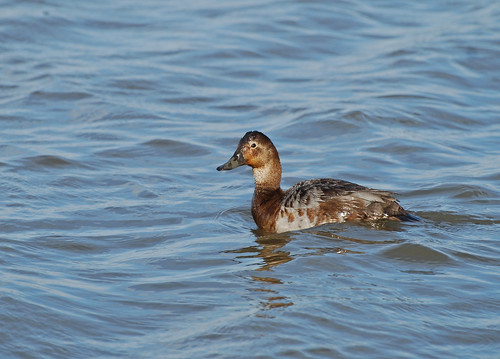
Pochard female (Aythya ferina, Dansk: taffeland)

Another species which kept flitting into view was the pochard. Pochard are not regular breeders in the UK, but in the winter there can be around 40,000 here which have migrated in from Eastern Europe and Russia and they can be seen on lakes, gravel pits and estuaries.


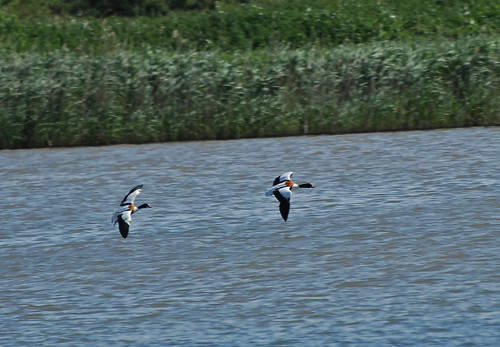
A pair of shelduck (Tadorna tadorna, Dansk: gravand) on final approach

I think one of the  most majestic ducks is the shelduck. The red beak, black head, and brown, white and black body make it very distinctive. Shelduck are big too, almost, but not quite, the size of a small goose. They were persecuted in some sandy areas of the UK in the 19th century apparently because they competed with rabbits for burrows. Which sounds to me like any excuse, because why would anyone worry about a few homeless rabbits! Despite that there are now around 60,000 individuals overwintering in the UK and around 11,000 breeding pairs. The conservation status is amber in the UK but it is a species of least concern in Europe as a whole.

The Magnificent Mute

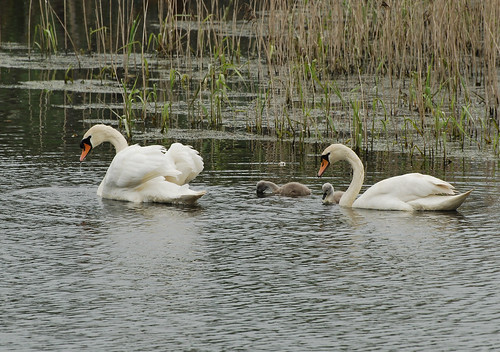
Mute swans are beautiful birds. There are few sights as impressive as a male mute, wings cocked, protecting his youngsters. The family below were on a very small lake at RSPB Fen Drayton and just before I took the pictures below, the male had launched a pre-emptive strike against a perceived threat at the other side of the lake, around 40m away. I couldn’t see who the interloper was but the sight and the sound of the big male as he raced across the lake, wings outstretched and beating on the water, must have been extremely intimidating. It was unnerving from where I was standing!


The male on the left is back with his brood after nullifying the threat. But he’s still got his wings cocked.

The mute (Cygnus olor, Dansk: knopsvane) is one of the biggest flying birds with a wingspan greater than two metres and an average weight for the male of approximately 11kg, it is a very impressive bird indeed and a group in the air flying close by is a real jaw dropper.

In the UK mute swans belong to the monarch and no one else is allowed to take them. They are marked every year, a practice that was originally identifying them  for the monarchs table, but I think Her Maj’s palate has evolved since then and eating swans is, fortunately, no longer fashionable.

It is native to the UK and a resident breeder but when things get too cold on mainland Europe winter migrants can show up here too. They tend to remain in their home territory all year round but can also form groups in the winter and move to a winter feeding ground, presumably this behaviour is driven by the temperature, availability of food and safety in numbers.

The ‘mute‘ in ‘mute swan’ is apparently derived from the fact that the mute swan is not as noisy as other swans. I’ve strayed too close to a nest before though, and at that moment mute was probably the last adjective to spring to mind as they voiced their discontent by making a violent hissing sound to warn me off. I took the hint and retreated as swiftly as possible.

Serendipity II – The charismatic cuckoo

I don’t recall having seen a cuckoo before, even though I’ve heard their unique call many times. But on my sojourn over to Wicken Fen a couple of weeks ago there were lots of them. ‘Lots‘ is a relative term because cuckoos are becoming increasingly scarce, their conservation status is red due to recent declines in the breeding population and in 2000 there were 9.6-19000 breeding pairs in the UK. But on this trip we heard and saw at least 5 and possibly several  more.

Just before I spotted the first cuckoo I glanced across the lake and this was the view:


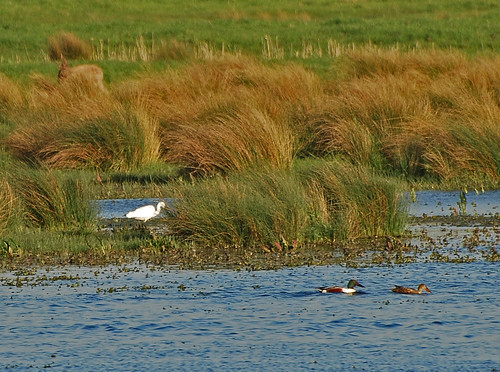
A pair of shoveler in the foreground, a little egret behind and a roe deer just beyond the reeds

I really like this picture because of the colours of the reeds and the water in the evening sunshine, but also because it contains three interesting species. Apart from rabbits, any wild mammal is exciting to see in this country, so the roe deer was a pleasing encounter. The little egret (Egretta garzetta, Dansk: silkehejre) is a member of the heron family which is now resident in the UK, presumably as a result of climate change. I associate them with warmer places because that’s where I saw them before 2000, but nowadays they’re not particularly uncommon here. And in the forefround are two shoveler (Anas clypeata, Dansk: skeand) which are migrant visitors to the UK, but this pair obviously liked it enough to linger and are still here in the middle of May, long after they would normally have left.

And then there were the cuckoos:


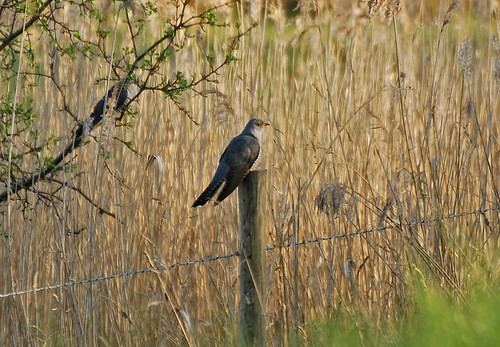
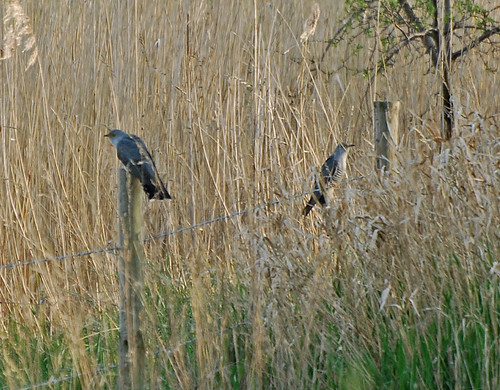
A pair of cuckoo, Cuculus canorus, Dansk: gøg

The cuckoo is an incredible bird and until very recently it was poorly understood. Last year the British Trust for Ornithology (BTO) managed to tag five male cuckoos with tiny satellite tracking devices and found out that they headed to the tropical sub-Saharan rainforests of Cameroon and the Democratic Republic of Congo. The cuckoo arrives back in England from Africa in late March or April and departs in July or August. It leaves earlier than other species because its parasitic breeding strategy removes the need for chick rearing. That means the cuckoo spends a minimum of 8 months a year in Africa so to call it a British bird is, I suppose, less than accurate, even though it breeds here.


The classic hanging wings pose which I always associate with the cuckoo

The tagged birds were all fitted with solar powered devices which transmit location data once every 48hr. The tracking data revealed that all five birds headed south over France and across the Mediterranean before heading down across Africa to Cameroon and DRC. All five made it. One of the birds died in Cameroon and two more died on the way back, but two of the five made it back to East Anglia this year. I believe the BTO plan to tag more birds including females and I’m very keen to see the results of that experiment.

The cuckoo is an iconic bird in the UK and it’s call is very distinctive. The call is generally recognised as a signal that Spring has arrived and there are local traditions around the UK based on the cuckoo. It is said in Worcestershire that the cuckoo is never heard before Tenbury Fair on April 21st or after Pershore Fair on June 26th. The song actually changes in June from the characteristic ‘cuck-coo‘ song to a shortened ‘cuck‘, and there is a rhyme about this:

In April I open my bill
In May I sing night and day
In June I change my tune
In July far far I fly
In August away I must

My Dad remembers a similar rhyme he used to sing when he was a kid in the 1940’s which was essentially the same but with some local Northamptonshire words substituted in.

I’m not quite sure what these two were doing but they were acting as a pair, and every minute or two one of them would dive off into the adjacent reedbeds to return a minute or so later. As I mentioned above, cuckoos are parasites and they could have been looking for nests to parasitise. There breeding strategy is unique, at least as far as I know. They lay their eggs in the nests of one of three other small songbird species: the reed warbler, the meadow pippit and the dunnock. All of these are the size of a sparrow (ish) so are much smaller than the cuckoo which is dove-sized, which I guess guarantees that the cuckoo chick will be much bigger than its ‘siblings’ and it won’t be threatened. The cuckoo chick then ejects the other chicks from the nest to die and the parents assume it is one of their own and feed it until it fledges. I’ve seen film of a cuckoo chick turfing out the other chicks and it’s a remarkable process, and not particularly pleasant to watch!

Despite their unsavoury procreation habits they are spectacular and charismatic birds and I hope the BTO research can find ways to guarantee their continued return here to brighten up the Spring and Summer.

Wild Geese

At the same time I was experimenting with ISO and coots at Milton Country Park there were geese in the vicinity too. A small flock of greylag geese (Anser anser, Dansk: grågås) were grazing in a field  immediately adjacent to the park.

There is another flock of greylags I encounter every day on my way to and from work. There are around 20-30 that have taken up residence in a field that is on my cycle route. The field is adjacent to a lake and the cycle path passes between them and every morning I pass by there are numerous heads poking up above the crop. I’m surprised the farmer puts up with this because the field now has a number of large threadbare patches as a result of the goose activity. But the geese have been there for a couple of months now and so far he hasn’t shot them so I imagine he probably doesn’t plan to. Which I’m rather pleased about.


Five of a small group of greylags ensconced in a field immediately adjacent to Milton Country Park

The RSPB website tells us that the greylag is the ancestor of domestic geese and is one of the largest and bulkiest geese native to the UK. It also describes it as ‘uninspiring‘. However, a few weeks ago on my way to work the flock of greylags were spooked and flushed up into the air. They headed for the safety of the lake which was only around 75m away so they didn’t need to gain height and one of them veered around and was heading straight for me at headheight. We simultaneously computed that if we continued on our current trajectories the end result would be an ugly collision twixt self and goose! So I braked and the goose wheeled, and it duly arrived at the lake unscathed, passing a few metres in front of me. My adrenaline levels were significantly elevated for the remainder of my journey to work and I can attest to the fact that this particular greylag was indeed very large and very bulky. And anything but uninspiring.

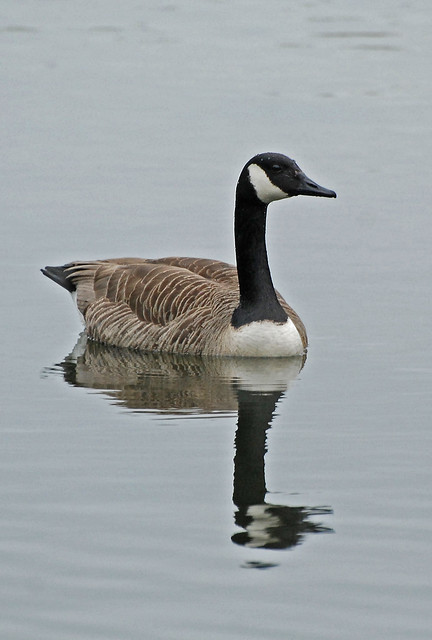
A lone canada goose – I like the symmetry of the reflection

The canada goose (Branta canadensis, Dansk: canadagås) was introduced to the UK and is now a resident breeder here and can be seen all over the UK apart from northern Scotland, and like the greylag it feeds on vegetation. I think it’s a handsome bird.

The indomitable coot

The coot (Fulica atra, Dansk: blishøne) is a common water bird found on lakes and rivers in all of the UK apart from north west Scotland. They are related to the rails and crakes, they are extremely aggressive and will see off bigger birds who are sufficiently unwise to encroach on their territory.

Whilst wandering around the lakes at Milton Country Park on Saturday it was early in the morning and the light was really murky, so I experimented with the ISO settings to try and extract some half decent images from the gloom, and in these two images the ISO was 1600 or higher. The high ISO has given the pictures a slightly grainy feel, but that’s to be expected, and I like the colours:

The coot was diving repeatedly and resurfacing with beaks full of weed

I like the colours and the reflection of the beak

Apparently the baldness as in ‘bald as a coot’ comes from the white saddle above the beak, which I think is a tad strange because the chicks really are bald.

Coots are omnivores and their innate aggression extends to their chicks which when food is short they discourage from begging by biting them, sometimes so hard it kills them. It’s a tough existence being a coot chick, they are also regular prey items for other creatures such as herons. On a busy lake with other species of birds the coots are good fun to watch as they chase off allcomers.

Misplaced mallard

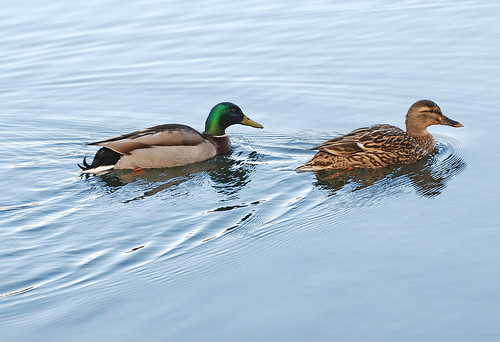
This pair of mallard weren’t misplaced at all, they were on a lake at Milton Country Park doing exactly what you’d expect mallard to do,

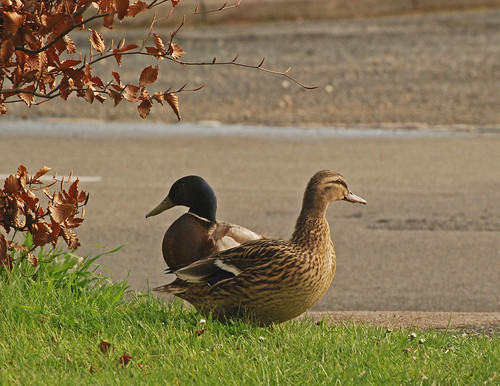
But this pair were very misplaced:

Romeo and Juliet

They appeared in my garden, relaxing under the crab apple tree, a couple of days ago, they disappear early in the morning and return in the afternoon. They’ve repeated this for the last three days now and they were here at dusk today sitting on the grass under the tree.

They seem completely unfazed by most interruptions including cats, humans and me flying past on my bike when I didn’t realise they were in situ. There is no water within half a mile so I don’t know why they are here, but it’s the first time we’ve had ducks in the garden and the children are very excited by their presence, so they’re welcome to stay as long as they want.

Returning migrants and lots more besides

Occasionally, but fairly infrequently, it’s a struggle to find enough interesting nature to put together a post, and then every now and again so much happens that it’s difficult to fit it all in. Last weekend was one of the latter.

It started to get interesting as I was cycling to work on Friday morning, a bird caught my eye in a hedge outside work and first off I thought it was a bullfinch, which I’ve never seen on Cambridge Science Park before. But then I got a better look at it and it was immediately apparent it wasn’t a bullfinch, it had similar colours but in a different pattern, so I did a quick U-turn to get a better look. It turned out to be a black redstart male in full breeding regalia (Phoenicurus ochruros, Dansk: husrødstjert). He was magnificent but alas, because I was heading to work I was camera-less, so if you’ve never seen one, dig out a bird reference book and check him out, it’s worth the effort.

I went back to work on Saturday morning with my camera to see if he was still there but there was no sign of him so I carried on to Milton Country Park, on the northern edge of Cambridge. It was a bright sunny morning and I arrived there just after 8.30 and it was already warm. And it augured well because it turned into a real bird fest. I was hoping to see some returning migrants and as I got out the car I could hear chiffchaff (Phylloscopus collybita, Dansk: gransanger) calling in the trees around the carpark. The first migrant I actually saw was completely unexpected and turned out to be a pair of sand martins (Riparia riparia, Dansk: digesvale) which I haven’t seen for years. There were also swallows (Hirundo rustica, Dansk:  land svale) flying low over a lake and this is roughly the same time I saw the first swallow last year. Like swallows, sand martins also over winter in South Africa, but unlike swallows they nest in burrows which they excavate in sandy banks. There are some man made burrows for the sand martins at the country park but so far they’ve been ignored by the martins, but the occassional kingfisher pair have availed themselves of the opportunity.

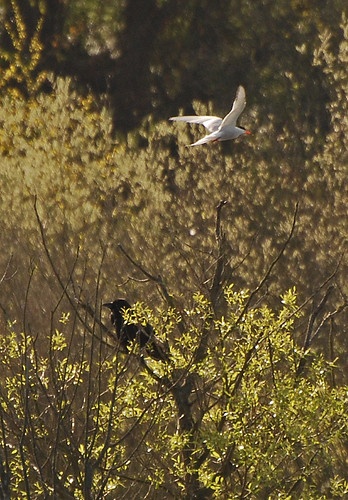
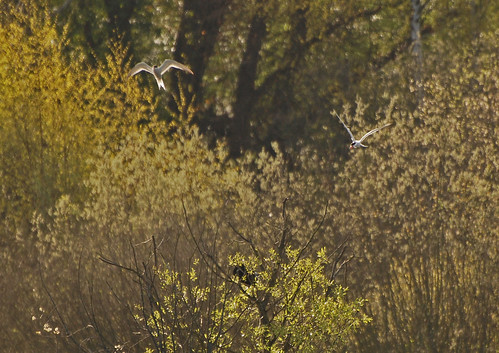
Close to where the swallow was hunting is a small island with a tree on it where cormorants (Phalacrocorax carbo, Dansk: skarv) can often be seen perched. This time there was a carrion crow (Corvus corone, Dansk: sortkrage) sat on top and a pair of common terns (Sterna hirundo, Dansk: fjordterne) were taking exception to its presence and were working as a team to dive bomb it:

A singleton…


… and in tandem

I almost felt a little sorry for the crow, but I’ve watched them terrorise so many birds, especially buzzards and other birds of prey, in a similar fashion that the sympathy was a tad less enthusiastic than it may otherwise have been.

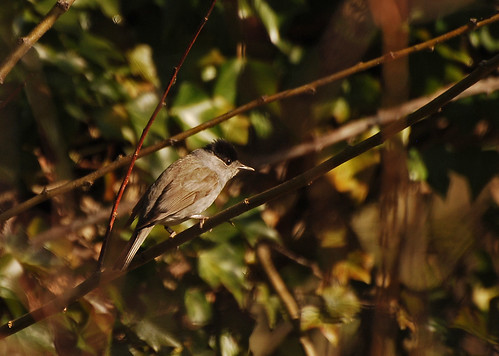
A migrant which was present all over the country park was the blackcap (Sylvia atricapilla, Dansk: munk), in one bush there were a minimum of four and possibly six or even more. They were squabbling away in the  bush presumably in the midst of a territorial dispute. I saw the first blackcap of 2012 a few weeks ago at Danbury Common in Essex during my unsuccessful mission to look for adders.
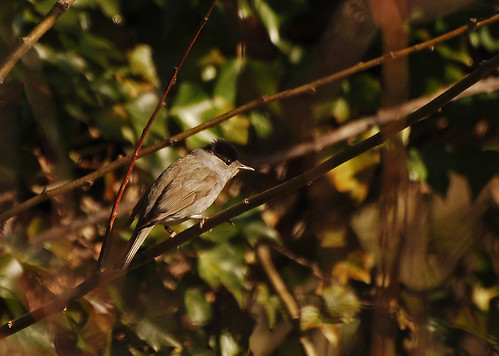

Blackcap male, the female is similar but easily distinguished because her cap is a rusty brown colour.

As well as the migrants the trees and bushes were full of the song of more familiar resident species such as the robin, blue tit, great tit, blackbird and wren. All were energetically vociferous, filling the air with a wonderful cacophany. And amongst these I caught a tantalising glimpse of a much less common species, the treecreeper (Certhia familiaris, Dansk:  træløber). Treecreepers are very aptly named and are fun to watch as they hunt insects in the crevices of tree trunks, spiralling upwards in a corkscrew pattern. A pair of sparrowhawk and a pair of buzzard were also busy performing their aerial courtship routines.

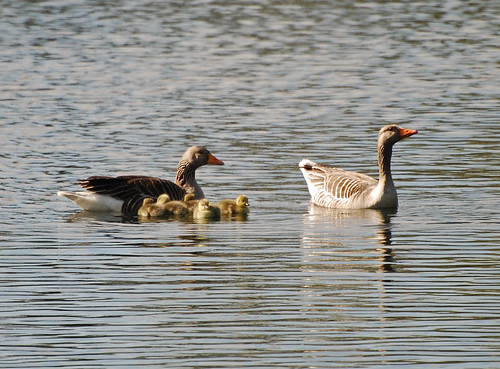
There were none of the winter ducks such as tufted duck (Aythya fuligula, Dansk: troldand), pochard (Aythya ferina, Dansk: taffeland), gadwall (Anas strepera, Dansk: knarand), teal (Anas crecca, Dansk: krikand) or widgeon (Anas penelope, Dansk: pibeand) on the water, they had all headed off north to their breeding grounds. But several birds including coot (Fulica atra, Dansk: blishøne) and greylag geese (Anser anser, Dansk: grågås) had chicks on the water:


Greylag geese with six chicks

I paused to try to get a shot of a great crested grebe (Podiceps cristatus, Dansk: toppet lappedykker), all now in full brown breeding plumage:

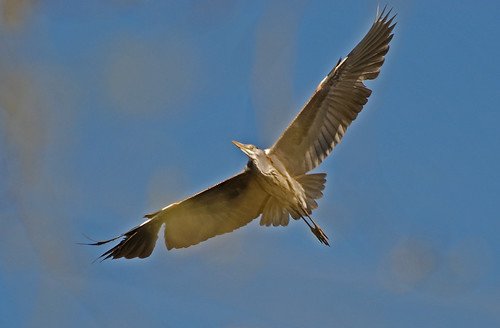
And as I stretched over the water, trying hard to get a clean shot of the grebe, and even harder not to pitch headlong into the lake, a grey heron (Ardea cinerea, Dansk: fiskehejre) flew low overhead:

It was so low I thought it must have pitched up very close to where I was but on an adjacent lake, and a quick scan revealed it sat in the top of a tree being pestered by the common tern that had earlier been harrassing the carrion crow:

The terns were deeply unhappy with any potential predator, although they were less keen to buzz a pair of sparrowhawks which were in the air above the same stretch of water!