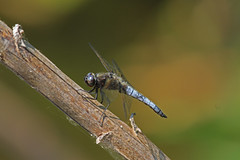
Category Archives: Buxhall Farm Histon

Local Lepidoptera

The class of insects known as the ‘Lepidoptera‘ is the one that encompassses moths and butterflies. Many species of both have emerged from hibernation and can be seen aplenty in gardens, parks and in the countryside.

Speckled wood (Pararge aegeria) and orange tip (Anthocharis cardamines) are abundant in scrub and hedgerows.
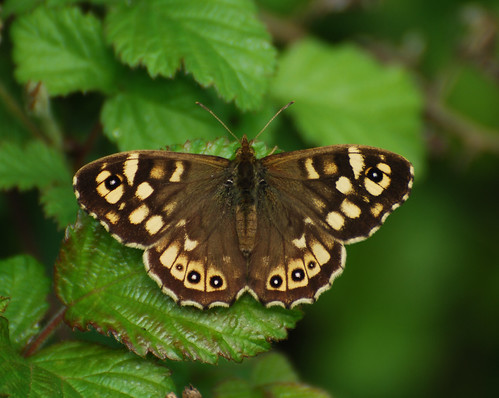

Speckled wood butterfly warming up on a bramble leaf

The speckled wood is an interesting butterfly for a couple of reasons. It has a north/south colour variation where  more northerly individuals have  whitish spots and more southerly ones have orange spots. The other unique feature of this species is that it can overwinter as both a larva and a pupa resulting in adults emerging all the way through from Spring to Autumn.

I don’t have a good picture of an orange tip as they are very difficult to catch stationary. I watched one sat on a cow parsley flowerhead for several minutes last weekend, but of course I’d left my camera at home. The males have a 40-50mm wingspan, creamy white upper parts with big orange patches on the wingtips which alaso have a black margin. Underneath they have wonderfully intricate green lacework which makes highly effective camouflage. The females don’t have the orange tip, which is thought to be a warning to predators that they are unpalatable, but they are easier to see on food plants as they are not busy looking for mates in the same way the males are. Photographs to follow, hopefully!

A few red admirals (Vanessa atalanta) have been spotted by me in Histon so far this year, although not more than two or three, but in the last two weeks large numbers of small tortoiseshells (Aglais urticae) and holly blues (Celastrina argiolus) are flying around in the hot sunny weather.


Red admiral on a bramble stem
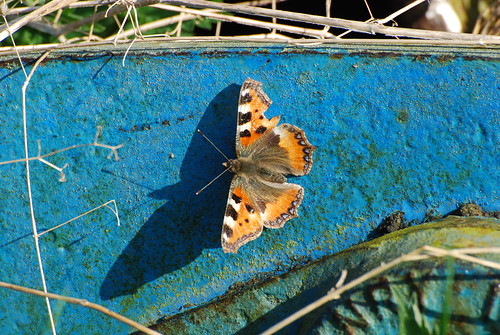

Small tortoiseshell butterfly looking somewhat tatterdemalion after emerging from hibernation, warming up in the early morning sunshine on an old farm machine

Holly blue butterfly

I haven’t seen many interesting moths yet this year, but late one evening last week, whilst quietly watching TV, this beauty emerged from behind the sofa, to the general consternatiion of all in the room, fluttered around very rapidly for several seconds before homing in on a lamp and alighting inside the shade:
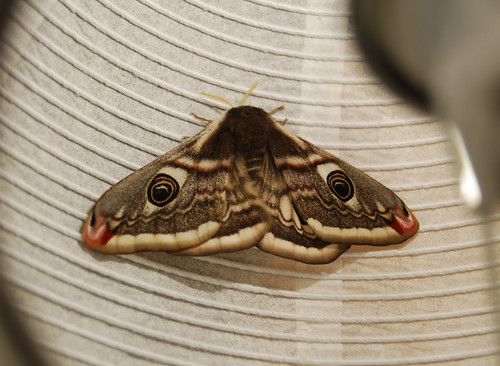

Emperor moth female inside a lampshade

As you can imagine, her choice of resting place gave an additional challenge to the photography but I like this picture. The male is even more colourful with orange hindwings and believe it or not the emperor moth, Saturnia pavonia, is native to the UK, not an import from the rainforests! Emperor moths are big with a wingspan over 7cm, and they live on moors and in open countryside where they feed on brambles. The males are out and about in daytime looking for mates in April and May and the females are abroad at night, I guesss looking for safe places to lay eggs. It is the UK’s only resident member of the Saturnidae family.
Springtime song

The weather this  Saturday was glorious – no wind, blue sky and warm sunshine. Perfect for a stroll around the countryside. So I set off around 8am and apart from the warmth, the first thing I noticed was the air laden with the  fragrances of spring blossom.

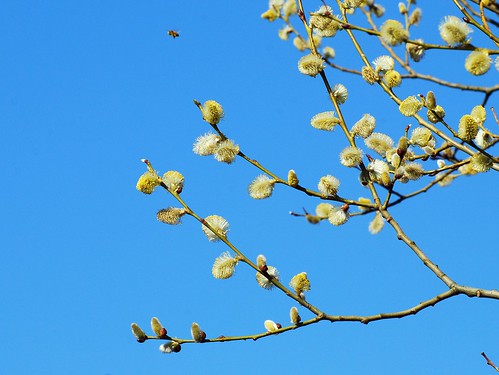
In the last week the spring weather has caused trees and flowers including the willow to blossom…


Pussy willow – the furry catkin of the willow tree against a gorgeous blue sky, and a lone honeybee

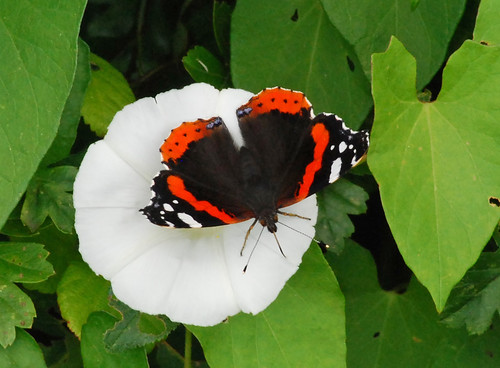
Butterflies are waking up after hibernation. A red admiral (Vanessa atalanta) flew through my garden last week and a friend told me he saw a brimstone in his garden and another wended its way gently past a window at work today.

Red admiral on a bindweed flower
Red admiral feeding on a convulvulus flower

Red admiral are resident and can be seen all year round when weather permits. Brimstone (Gonepteryx rhamni) are also resident and hibernate over the winter but they are now out and about aroused by the warm weather. Bumble bees have also become more abundant in the last few weeks and I now see them on most days.

The birds are all singing and a walk through parks and fields is accompanied by the song of greenfinch, blue tit, great tit, dunnock and robin, most noticeably. And on my hike across the fields abundant yellowhammer, reed bunting and corn bunting, three Emberiza species, were all in full voice:


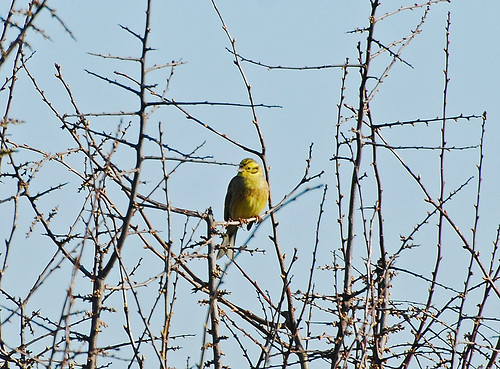
E.citrinella – one of many yellowhammer, this one is a male, patrolling the hedgerows

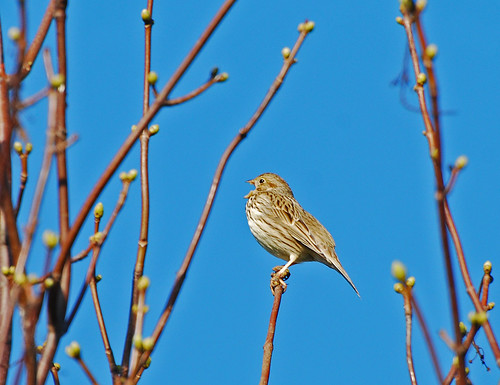
E.schoeniclus – reed bunting male

E.calandra – corn bunting making its very distinctive call

Yellowhammer, reed bunting and corn bunting perch in hedgerows and  make feeding forays to the ground in the neighbouring fields where they feast on seeds and during the breeding season and  summer will eat invertebrates. I pass one location where there has been a mixed group of 20-30 reed bunting and yellowhammer present regularly over the last month. Corn bunting have made a recent comeback to the fields around Histon, they disappear at harvest time, middle to end of August, and reappear in the Spring when they can be seen perched on top of brambles, bushes and short trees making their very characteristic song.

Skylark were also singing constantly. Farmland species such as these have seen their habitat severely depleted in recent times, consequently their numbers are reduced as a result.

A red fox and a small group of roe deer put in appearances, the fox was heading a cross the fields to Landbeach heading away from a place I photographed cubs last year, so I hope they are breeding here again this year.


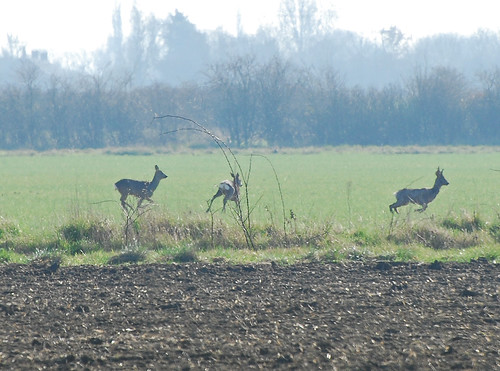
Roe deer – Capreolus capreolus – the leader on the right is sporting native antlers

A pair of crows chased off a buzzard which thermalled over the fields before disappearing into the haze towards Waterbeach and a flock of several hundred black headed gulls squawked noisily over the fields. I observed them for several minutes with binoculars and I think they were all black heads, but there could have been a few individuals of other species mixed in. A sparrowhawk flew at very high speed from the Linnet Hedge across South Bean Field before rising up and passing through a gap in the treeline, causing mayhem with the birdlife in the gardens beyond and a female kestrel was looking for rodents in the South Fallow Field. It was the first time I’d seen birds of prey here for several months so it was great to see three species on one walk.

Histon forays, weekend 5th – 6th March 2011

This weekend I’ve been out and about on my regular walks north of Histon. (Click here for a sketch map of the locality). Yesterday I was out around the fields to the north between Histon and Cottenham. It was a cold grey morning and it was noteworthy for several reasons.

The birdlife was plentiful. (Click here for my wildlife diary where I’ve listed all sightings). Just a few minutes after telling my friend, David, that I hadn’t seen a corn bunting for around 6 months but that they frequent that area in numbers during the summer and disappear very quickly after the harvest, we saw one sitting in a bramble:

It was the first one this year and the first of several we spotted yesterday. It was a good morning for buntings in general. Last time I was here, around three weeks ago a mixed flock of reed bunting and yellowhammer were  in the east end of the Owl Shed Hedge (see post from 29th Jan entitled “Buntings abound: 29th and 30th January 2011). They were there again on Saturday and reed bunting were present in most of the hedges and ditches we peered into. Skylark were present in large numbers too, singing up high and darting around low. A look  on the floor of the Old Water Pump, which has a platform for barn owls to roost and breed, revealed numerous owl pellets most of which were very old, but some of them looked fresher, possibly from within the last 6 months.

One of the ‘Pump House’ barn owls from three years ago

This is a very good thing as barn owls haven’t bred there since 2008 and I haven’t seen one in the vicinity since last year, and then only a couple of sightings all year.

Other appearances which livened up the walk were a muntjac deer, Muntiacus reevesi, introduced from China to the UK in the first half of the 20th century, which was rooting around at the back of the gardens of the houses on Cottenham Road, and a stock dove was sitting in the trees in the same area. I may have seen these before and mistaken them for wood pigeon, but David’s expert knowledge put me straight on the differences. They don’t have the white neck and wing bands of the wood pigeon and they have a dark eye which is diagnostic – that of the wood pigeon is lighter.

I set off in the other direction this morning to head out of Histon north west towards Oakington along Guns Lane and into Rowleys Meadow. I took a slow walk and was very adequately rewarded. Right at the start of the Lane where it joins Cottenham Road blue tit, great tit, greenfinch, chaffinch, starling and song thrush were present and finches were singing constantly,


Greenfinch male singing for a mate in the top of a tree on Guns Lane

…and a chaffinch male displaying his gorgeous black and white tail in a fan. I’ve posted a few photographs of chaffinch lately, even though they’re common I think they’re spectacular!

A couple of surprises today, firstly the number of bullfinch; I saw a single male in Rowleys Meadow which may have had a female with it but I couldn’t see it well enough to confirm, and another pair of males flew along Guns Lane hopping from hedge to hedge infront of me for 50-100m. And secondly, the number of dunnock. They were present in every bush and bramble in the Meadow and on the Lane singing constantly – if you haven’t heard dunnock song, have a listen here, it’s lovely.


Dunnock sitting on a bramble singing

Dunnock have a rather interesting approach to breeding. They don’t pair off as most birds do, a female will be mated by at least two males who will stimulate the females to eject a rivals sperm from the cloaca with their beak. DNA analysis has shown young in the same clutch can have more than one father. I like dunnock, they look boringly grey/brown when seen flitting around the undergrowth, but when they catch the light they are certainly not drab. And their song and their antics at breeding time are anything but boring!

Just as I was about to leave the countryside and head home I noticed a pair of starling sitting on top of a hedge checking out me and the dog. As I turned to point my camera at them they didn’t fly away but simply kept an eye on me so I could get this picture:

The glorious plumage of the starling!

Spring is well underway now and the activities of the wildlife are reflecting that. It’s a great time to be poking around in the woods and hedgerows.

Buntings abound: 29th and 30th January 2011

This weekend my meanderings took me to the open fields Histon and Cottenham, an area I haven’t properly explored for quite a long time. As I set off early on Saturday morning the weather was murky and very cold and consequently I was feeling pessimistic about encountering the local wild creatures.

Fortunately I was mistaken. The wild creatures were there aplenty. Flocks of mixed gulls, rooks, Corvus frugilegus, (N.b. I’m planning to make a taxonomic index of Latin names for the species on an adjacent page so I can avoid writing them here), and in particular, wood pigeon, Columba palumbus. Wood pigeon can often be seen in flocks but on this occasion there were many flocks, the  largest containing thousands of individuals. They are a farmers curse as they can devastate fields of new shoots, hence the sound of shotgun fire punctuating my progress. My father told me stories of my grandmother being given wood pigeon during World War II – a valuable source of free meat – and when opened up the crops liteally exploded as they were stuffed completely full of fresh green shoots. Multiply that up by several thousand birds and the damage they can do to crops is obvious. Still, they’re impressive to watch in those kind of numbers.

My aforementioned pessimism was tempered by the sight of hazel trees, Corylus avellana, covered in catkins, the first suggestion of approaching Spring time.
Hazel saplings festooned with the first catkins of 2011 – Spring is imminent!

And indeed, a friend told me on Monday morning she had seen daffodils shooting in the village. So I reckon that makes it official. In the same hedgerow as the catkins – the Merlin Hedge – (click here for a sketch map of my walk route), were a flock of greenfinch, Carduelis chloris, and a small group of fieldfare, Turdus pilaris, feeding on the ground. The greenfinch were manic, chasing each other as a flock around the fields either side of the hedgerow.

Turning right at the end of the hedge heading past the Yellowhammer Hedge – which didn’t contain any yellowhammers, or indeed any other birdlife – a big fox, Vulpes vulpes, was standing in the middle of the field beyond watching me and the dog:


A fox taking a keen interest in what me and the dog were doing

The fox was around 300m away and the quality of the image gives a good idea of the murky grey weather condiitions. Doesn’t convey how cold it was though! This one has a distinctly grey coat and I’ve seen foxes in this area before with similar coloration, so it could be the same one or one of his offspring. He’s close to where foxes reared a litter of cubs last year so he could be one of that family.  After the excitement of seeing the fox, I was scanning the adjacent field for any other signs of life and spotted a second fox – it could have been the same one but he’d have had to move very fast to get to the second location. And as it disappeared through a hedge a group of three roe deer, Capreolus capreolus, entered the same field.


Roe deer bounding across a field – and a bird taking to the air somewhere between me and them

The dog spotted the deer as soon as I did and immediately pricked his ears up, he was around 25m away from me and in order to avoid any dog/deer interaction I called him and the deer instantly turned to look even though they were around 300m away. They have incredibly acute hearing.

Between us and the deer were a flock of skylark, Alauda arvensis, on the ground (it could be one of them taking off in the photograph). It was impossible to count them accurately as they were whizzing around at very high speed close to the ground where their camouflage rendered them almost invisible, but I estimate there were between 10 and 20.

I’d been hoping to see yellowhammer, Emberiza citrinella, and I’d spent some time peering at the Yellowhammer Hedge and the surrounding fields but without seeing many birds at all. Then as I approached the end of the hedgerow leading to the Owl Shed I could see a flock of small birds flitting between the hedge and the Fallow Field and they turned out to be a mixture of reed bunting, Emberiza schoeniclus, and yellowhammer:


Mixed group of reed bunting and yellowhammer


Female yellowhammer
…and a male of the species. What a glorious colour!

Both species were numerous and could be seen flying around the hedge all the way along to the Owl Shed and dropping down onto the ground to look for food and to hide from me.


Reed bunting male

Young male reed bunting

The remainder of my Saturday morning sojourn was not quite so lively but numerous fieldfare, redwing (Turdus iliaca), chaffinch (Fringilla coelebs) and a kestrel (Falco tinunculus) were busy around the pig farm.

On Sunday 30th January the weather was brighter and more mild so I set off again towards the Owl Shed to try to get some more photographs. Despite the improved weather there was nowhere near the amount of wildlife around I’d seen the day before, although a hare (Lepus europaeus) appeared in the field where I first saw the fox. And fortunately the reed bunting and yellowhammer were still in the end of the hedgerow where I’d left them on Saturday, although not in the same numbers. So I got my pictures and then had to rush home to get off to my nephews 18th birthday party.

A very enjoyable weekend all round, and in particular the Emberiza species congregated in the Owl Shed Hedge.

North Histon field walk

Most of my meanderings are across fields adjoining Histon on the northen edge of Cambridge, UK. Farmland here stretches almost unbroken, with the exception of the Cottenham to Landbeach road, and a few minor lanes, for 6-7 miles to the Wilburton to Streatham Road and is interspersed with scrub and plenty of mature trees offering shelter and food for the local wildlife. I’ve been keeping a wildlife diary since the middle of 2009. The 2010 edition is here and I’ve drawn a map of the Histon north fields area which is a little bit ‘Lord of the Rings’ style but it shows where all the locations mentioned in the diary are in relation to each other. Of course, all the location names are figments of my imagination from two years ago, so none of them would be found on an official map!

The photographs below will hopefully help you visualise the places and habitats I’m describing.  I have lots of pictures of the landscape features taken at various times of year, but all the pictures below were taken late in the afternoon, 3-4.30pm, last Sunday  (7th November, 2010) and I’m using these because the sun was low in the southwestern sky making the colours wonderfully vivid. There are no animals or birds in these shots, unless you’ve zoomed in and have spotted some that I haven’t. So if you wanted to see animals I apologise, and if you find any please let me know! The pictures start and finish with my favourite poplar tree and get progressively darker, and the light more blue, as the sun dipped below the western horizon:

Linnet Hedge heading towards the Poplar with South Bean Field on the left

Entering the fields from the B1049 I walk along the Linnet Hedge where in the summer numerous linnet appear most days perching on the power lines and feeding in the fields immediately adjacent to it. Not just linnet though, there are dunnock, house sparrow, blue tit, great tit, chaffinch, greenfinch, goldfinch, blackbird, wren, whitethroat, yellowhammer, blackcap and kestrel regularly sighted in or around it.

Heading east-south-east towards the Poplar Tree I turn left and head towards the sycamore tree at Hedge End along West Ditch  to the Merlin Hedge.


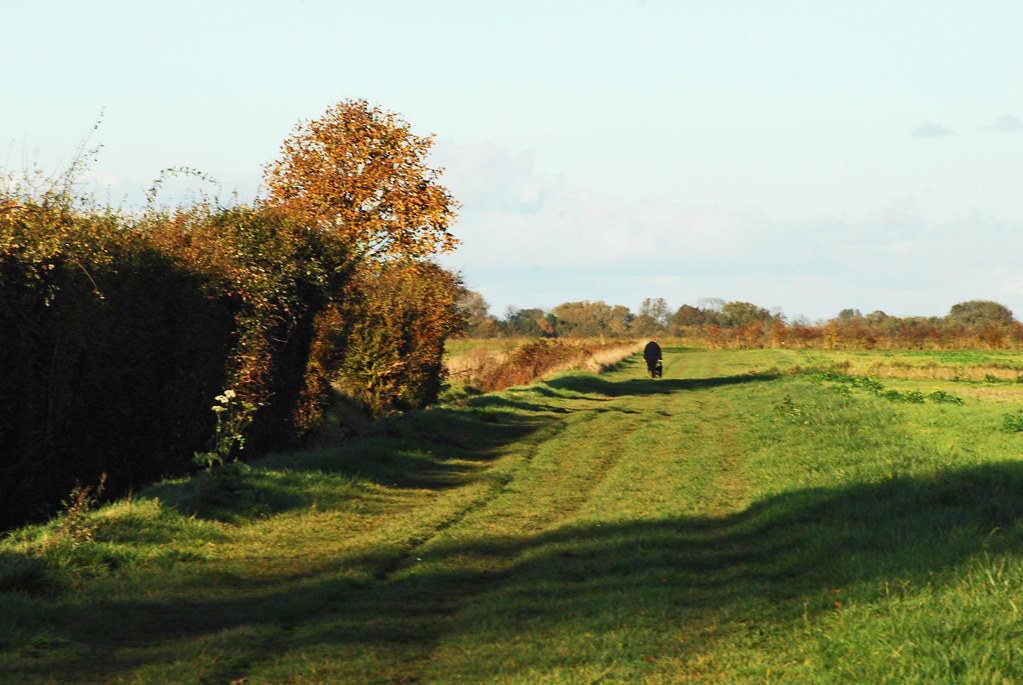
Poplar Hedge on the left leading to the small sycamore at Hedge End where it becomes the West Ditch, Middle and North Bean Fields on the right, Merlin Hedge at the end of the track. Lone dog walker in the distance.

West Ditch is a great place to see all kinds of wildlife. Apart from being full of many wild flowers from Spring through to Winter, it is full of birds too, such as wren, linnet, goldfinch, reed bunting and corn bunting.  One evening this summer at the far end of the West Ditch I was distracted by the buzzing of an insect which turned out to be a privet hawk moth. Alas, it was too dark for a photo, but they are black and pink and up to 12cm wingspan, so an impressive sight. Common darter dragonflies also patrol up and down here.


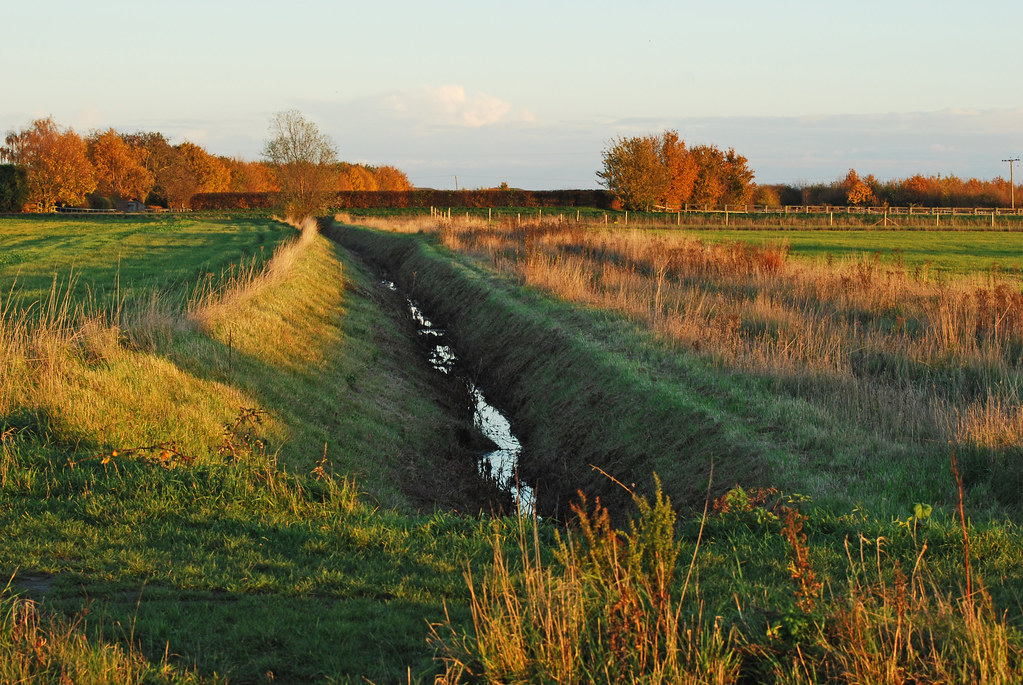
Ditch running northwest to southeast between the sycamore tree at Hedge End and the farm

The Merlin Hedge is so called because not long after I started walking there I was half way along it when a merlin approached at quite incredible speed flying 2m off the ground and as it crossed the hedge, 10m in front of where I stood, it dived to catch a swallow which proved too elusive so it veered back on course and went on its way. All that lasted just 15-20 seconds or so but it was immensely exciting to watch.


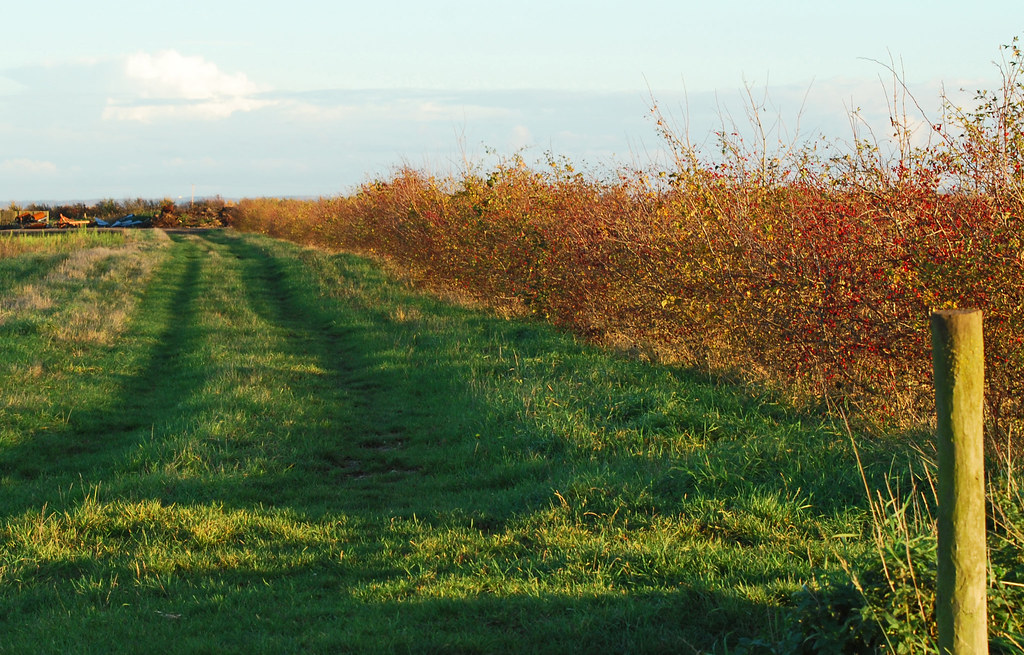
Merlin Hedge running southeast towards the Bonfire and a machine store

At the end of the  Merlin Hedge I usually double back round the wooden post down the other side of the West Ditch towards the sycamore tree, turning right down the southern edge of the Beet Field:


Southern edge of Beet Field looking west to the back of the gardens of the B1049

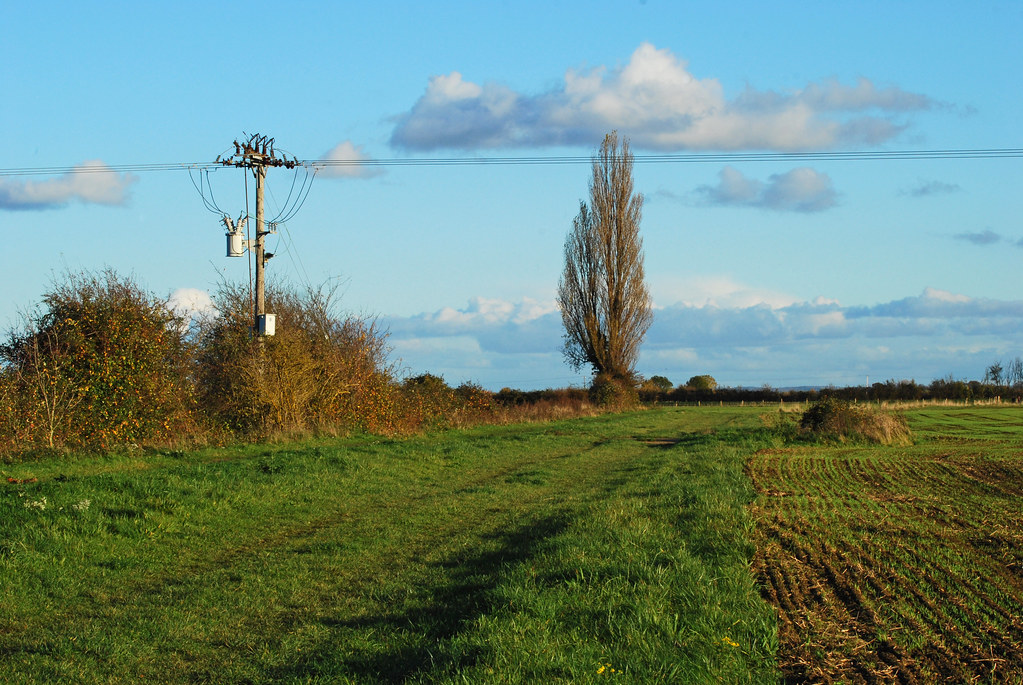
At the end of this track a left turn takes me along the back of the gardens, allotments and horse paddocks to the South Fallow Field at the far end of which  I cross the B1049 and head for home. But I can’t finish without including this picture of the Poplar Tree across the PX Field:


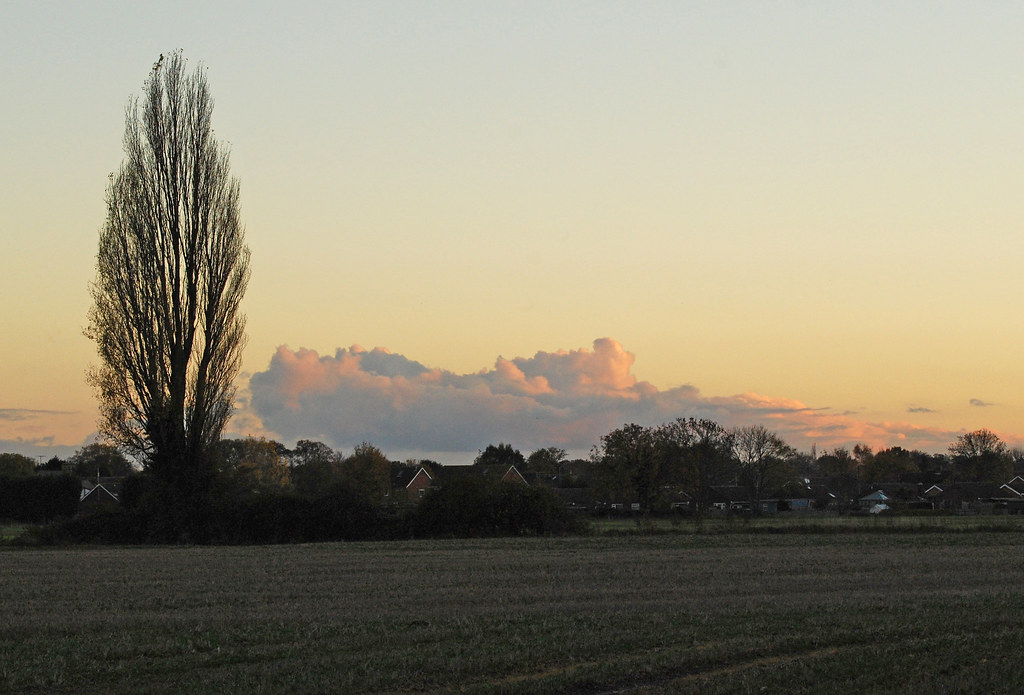
Poplar tree in the late afternoon sun. I love the colours in the sky!

Larus ridibundus – 23rd October 2010

There were several ornithological highlights to be enjoyed in the Histon fields this weekend. It looks as though autumn is here properly as the weather has turned more chilly, so for the last week or two I’ve been hoping to see some of our winter visitors arriving from the north and the east. It was an exciting day today because the first flock of the year of several hundred fieldfare (Turdus pilaris) duly appeared, flying low and fast from east to west. Alas, they didn’t stop, but it was great to see them arriving safely in numbers. I’m anxious to get some photographs of fieldfare so now I have my new 300mm zoom lens I’m hoping this winter will provide some opportunities to capture them on pixels. If I manage to get some good shots I’ll post them here as and when.

For the record, I’m an amateur wildlife photographer and I use all my own pictures to illustrate my posts. I use a Nikon D40x and a combination of lenses: Nikkor 18-55mm kit lens that came with my camera which I use for flowers, insects and landscapes, Nikkor 55-200mm zoom which I used as my default general purpose lens until a month ago when I acquired a Nikkor 70-300mm zoom lens which gives me that extra bit of reach. I don’t often sit in hides or wait for wildlife to come to me, I walk around and photograph anything I encounter which I think is interesting and photogenic. Which covers just about everything!

Back to ornithology, other good sightings this weekend have included corn bunting (Emberiza calandra) which is a real favourite of mine as they have a wonderfully distinctive call and they often sit proud  on top of hedges and let me take photographs from a distance of less than around 20 feet, and they’ll sit tight as long as I don’t make any sharp movements – even the dog running past doesn’t faze them.


Corn bunting

Other regulars this week have included yellowhammer (Emberiza citrinella), reed bunting (Emberiza schoeniclus), long tailed tit (Aegithalos caudatus), goldfinch (Carduelis carduelis), and skylark (Alauda arvensis). The latter are great to watch at the moment, on a sunny day they whizz around low and high chasing each other at incredibly high speed in groups of up to 5 or 6. Lone larks sing the characteristic skylark song up high, and plenty more can be seen on the ground feeding in ploughed fields, and disappearing into the scrub of unploughed fields where they don’t seem to stay for long before joining in another game of aerial tag.


Skylark

However, I’m digressing from my main theme of this weekend which is ‘Larus ridibundus’, or the black headed gull. Both yesterday and today (23rd and 24th October 2010) there have been a flock of 35-50 black headed gulls on the ground in two different, but adjacent, ploughed fields. I think it’s easy to dismiss gulls as not being very interesting but a closer inspection of a flock of gulls is a real treat. They are consummate aeronauts with beautiful plumage and are highly gregarious in winter. Consequently I’ve spent a sizeable chunk of this weekend enjoying watching them and trying to photograph them:


Adult black headed gull with brown face (this one was taken last summer at Seahouses in Northumberland – not Histon)

Adult black head in winter plumage – note the dark spot behind the eye and the red beak and legs (this and the rest of the gull pictures in this post were taken in Histon)


Note the white tail and forewing and the black tips of the first five primaries

Black headed gulls are fairly small as gulls go, around 35cm long and 100-110cm wingspan. They build nests on the ground on coastal and inland reedbeds and marshes, lay one clutch of 2-3 eggs per year and live on average for around 10-15 years. It is not an endangered species with approximately 1.5million pairs in Europe. (For a full set of facts and figures check out the BTO BirdFacts website (http://www.bto.org/birdfacts/), this site is excellent for comprehensive metrics datasets on all common UK birds). Black headed gulls are rather inaccurately named as they don’t have a black head at all. It is dark brown and only covers the front part of the face and is only present in summer when it serves as a form of aggression between rival males. They stand face to face to maximise the visible area of the dark mask to each other, but within a breeding pair aggression is minimised by displays involving turning the head to show the white nape to the partner. The dark hood recedes in winter to a small dark spot just behind the eye. Adults have a deep red bill and legs and pale grey back with a white tail and white outer edge of upper and lower wings formed by 4-5 primaries with black tips.


Juvenile diving in on an insect or worm. It has the dark tip to the tail, pale brown mottled upper wings and pale buff legs characteristic of an immature individual

Juveniles have mottled brown plumage with a dark tail tip and orangey-buff legs. They feed on worms, insects, seeds, waste and carrion, and can be seen on inland water, grassland and farmland aswell as on the coast during the winter.

I think they’re amazing to watch so next time you see a flock of gulls have a good look and appreciate the beauty of these creatures – you wont be disappointed!

Dragonfly discoveries

Dragonflies are amazing insects which it seems can be seen just about anywhere. In 2010 I’ve even spotted them over my garden in Histon. It occurred to me I should put some effort into photographing and learning about them as I sat with my family eating a picnic on a bench overlooking the fountain in the Cambridge University Botanical Gardens. Numerous small, magnificently bright red, individuals were whizzing around the pond, and a few big blue ones a short distance away from the pond (the small red ones were a species of darter, and the big blue ones were hawkers – probably migrant hawkers). I attempted to photograph these for subsequent identification but alas my photographic skills were’t up to the job on that occasion. Despite that I looked up some information and lots of great pictures at http://www.dragonflysoc.org.uk/home.html. This is a great website and started me off on a journey of discovery which is now pretty much finished this year but which I plan to resume as soon as possible next year.

Subsequent walks around Milton Country Park and the fields north of Histon provided lots of opportunities to see many species of dragonflies and damselflies:


Female brown hawker sunbathing on a birdbox at Milton Country Park

Migrant hawker male. The yellow ‘golf tee’ on segment S2 is diagnostic 

Dragonflies originate from species which fossil records date to the Carboniferous period, around 300 million years ago, and could have a wingspan up to 70cm! They comprise the taxonomic sub-order known as ‘Anisoptera‘ and are part of the order ‘Odonata‘ which also includes damselflies (Zygoptera) and another group which is virtually extinct called ‘Anisozygoptera‘. There are now around 5300 species of dragonflies of which approximately 40 reside in the UK.

Dragonflies lay eggs underwater either loose, protected by a hygroscopic gel, or inside plants. The eggs of some species can lie dormant over winter and resume development when temperatures rise in springtime. Time to hatching is temperature dependent but is usually around 2-5 weeks and the larvae develop in water, all British species overwinter once as larvae but time to adulthood can be up to 5 years. Metamorphosis from larva to adult is triggered by increasing day length and temperature in spring, and includes the transition to breathing air and growth of their incredible compound eyes. Each eye is made up of around 29000 individual elements called ‘ommatidia‘. They also possess three addtional ‘simple eyes’ call ‘ocelli‘ which are sensitive to light intensity and assist in controlling flight via direct nerve connections to the flight muscles. Dragonflies have excellent colour vision and can also see ultra violet light. It makes me wonder what the neural activity behind all that optical prowess is capable of: are dragonflies merely responding directly to visual stimuli via reflex arcs, or is there more sophisticated image processing going on?


Common darter, immature male

Common darter, female. Note the compound eye.

Dragonfly larvae are ambush predators feeding on moving prey including other insect larvae, snails, small fish and tadpoles. Adults catch other insects in flight, holding their legs out in front like a bread basket to scoop prey from the air such as flies, flying ants, mosquitoes and even other, smaller, dragon flies.

Newly emergent dragonflies are powerful fliers and disperse widely. They are often seen a long way from water and can even cross seas. They reach maturity after a few days to a few weeks, a process also controlled by temperature, when the males will congregate at vantage points near water where females come to oviposit. The male will grasp the female around the head with his anal appendages and attempt to mate with the female by swinging her round to form the ‘copulatory wheel’ enabling him to pass a packet of sperm from the secondary male sexual organs located on his second abdominal segment to the female sex organs located on her eighth abdominal segment. After mating, sometimes under the guard of the male, to ensure his sperm is not displaced by another male, the female will oviposit underwater. And so the cycle begins again.


Broad bodied chaser – female

Weekend field walks 9th and 10th October 2010

This Saturday (9th October,2010) I was lucky enough to be accompanied by my friend David on a long walk around the Histon countryside. David is a zoologist and knows considerably more about the wildlife than myself, consequently it was a terrific walk and something of an education.

We set off around 8.15am and the weather was mild but very grey with 100% low cloud cover. Very soon after entering the fields we heard a jay making alot of noise in some trees bordering gardens at the back of the main road.  As we passed a small sycamore tree a possible meadow pipit passed overhead and we heard a second flying past later on in our walk. Shortly after that a large flock of golden plover flew over at high speed and several groups varying in size from approximately 5-10 up to 70-80 were spotted in the air and on the ground in several other fields. Many evenings whilst walking at night last winter I heard birds on the ground making a short whistle consisting of a single  note and had no idea which species was responsible. Our golden plovers in the air were making exactly the same noise so the mystery of the night time whistlers was solved too. A kestrel and a sparrowhawk made solitary appearances and a peer into an old tumbledown barn revealed a little owl – a good day for birds of prey.

The mild damp conditions of late have been ideal for fungi. Gorgeous bright yellow heads of the yellow fieldcap mushroom (Bolbitius vitellinus) lined the walk, all at various stages of growth from recently sprouted, just a couple of centimeteres tall with very rounded unopened caps, to old and nibbled specimens around 10cm tall and the caps more dull in colour and 4-5cm in diameter:


Recently emerged yellow fieldcap mushrooms


Older yellow fieldcap


A cluster of four mature yellow fieldcaps

We also found a ‘substance’ which preliminary inspection suggested the most likely identity was dog vomit! It occurred every few paces for several hundered metres wrapped around grass stems – suggesting a very poorly dog. When it was gently disturbed at the edge it had a powdery consistency and blew away in the breeze like dry Ready Brek. It varied in colour from grey/white to pale buttery yellow, so we concluded it must have been some kind of mould:


Mucilago crustacea – a slime mould. This stuff can move slowly to new food. Only at a snails pace, but don’t stand still for too long!

Toward the end of our outing as we headed back to the village a small flock of gulls consisting of a lone herring gull, a black headed gull and around 30 lesser black backed gull were beautifully contrasted against the dark ground in a ploughed field. Despite the grey weather it was a great day for wildlife.

After the nature fest on Saturday followed by just one or two small drinks with some good friends in the evening, I contemplated a shorter stroll this morning to blow away the cobwebs. But the weather was absolutely glorious and the profusion of birdlife resulted in another whole morning spent in the countryside. I heard six green woodpecker, one of which was exiting an old oak tree at high speed having been flushed out by a buzzard. A second buzzard appeared over the farmhouse with a sparrowhawk shadowing it right overhead but at much greater height. The buzzard quartered the fields and then headed off south west over Histon:


The unmistakeable shape of a buzzard. I love watching
big birds of prey so seeing two buzzards in one walk
was very special

Despite the weather no swallows were around today, I saw small numbers (less than 10) on Saturday and Sunday last weekend but we’re now heading towards mid-October so the last stragglers must be heading for Africa.

Many songbirds put in an appearance today which has been an unusual event since the harvest got underway at the beginning of August. Two yellowhammer, two corn bunting, numerous reed bunting, dunnock, blue tit, robin and a pied wagtail were all spotted today.


A corn bunting on the right and a male reed bunting sitting together and as I watched a female reed bunting arrived. Marvellous!

Yellowhammer

I was particularly pleased to see the wagtail, it’s the first one I’ve seen in the fields this year, whereas last year they were on display almost every day. I hope that’s not a nationwide phenomenon.

A lone kestrel and two sparrowhawks were up and about today so another good day for birds of prey. Also as yesterday, many skylark were extremely active playing tag and because of the lovely weather they were singing up high. I managed to go one better with the pipits of yesterday as I watched one fly up out of a small bush when disturbed by me landing in another one about 30m away in full view. The local churchyard rooks were omnipresent, digging out invertebrates in most of the fields accompanied by countless wood pigeon and carrion crows.

It was difficult to choose a highlight from this weekend, but as I sat on a tractor trailer in the sunshine making some notes a common darter dragonfly buzzed past and settled on an old plough to sun itself. It’s late in the year for dragonflies so that was good to see.


Mature male common darter warming up in the morning sunshine sat on an old plough

I shall post again soon about our local birds and hopefully next time I shall have seen the first winter immigrants such as fieldfare and redwing. Fingers crossed.