Category Archives: Milton Country Park

Hawkers and darters

A lunchtime visit to Milton Country Park on the northern periphery of Cambridge this week to look for dragonflies turned out to be an hour well spent. For the first 10 minutes they were conspicuous by their absence but then a brown hawker appeared over a small pond, very distinctive with it’s rufous wings shimmering in the sunlight. I tried to photograph it in flight but it proved beyond my talents. Even though there were three or four whizzing around the pond at any one time  I moved to a place under a tree which was overhanging the water and knelt down and waited. Within a couple of minutes a female brown hawker alighted on a log floating in the water and started ovipositing:

She seemed to be completely unfazed by my presence and busily worked her way along the log probing below and above the waterline for a suitable crevice to secrete her eggs.

She was there for around 10-15 minutes in total and every so often she took off but seemed to always to return either to her log or to a spot on the pond bank 5-6 feet from me. Even when my friend, Joe, came to see she still went about her business taking little notice of us.


She eventually departed along with all the other hawkers so we strolled along to a different location which was a wooden jetty protruding into another of the lakes. It’s surrounded all the way by dense rushes and has previously been a good place to see dragons. And that didn’t let us down either. We saw only two species, a pair of blue tailed damselfy and numerous common darters. All males. The males of this species are easily distinguished from the female as they are a glorious red and gold compared to the less vibrant green of the female.

The male of the species…

…and the lady:

There were several male common darters perched along the wooden jetty (the female above was snapped in Histon a couple of weeks ago), they were also happy to let us get up close and would occasionally dart away suddenly to chase a prey insect before returning to the same spot.


The compound eyes of the common darter – I like the depth of field in this picture rendering just the dragon in focus

When I was out for a stroll with my friend, David, who’s a bit of a dragonfly expert, last weekend, we found a dead migrant hawker dragonfly. We were marvelling at the complexity of the compound eye and he told me that a chap in the States had counted the facets in the eye of an American species, and apparently he got up to around 28000! He must have had a string of long winter evenings to fill. But dragonflies are amazing creatures and I can see how they inspired him to want to do it.

I also took a couple of nice bird photo’s on this trip but I’ll save those until next time.

Dragon hunt

Not the fire-breathing type but Anisoptera. I spotted the first dragon this year over Easter during a picnic at Grantchester Meadows, south of Cambridge. It wasn’t, technically speaking a dragonfly, but a damselfly, specifically, a large red damselfly (Pyrrhosoma nymphula), which is one of the first to emerge after the Winter. Due to the weather this year many things have happened earlier than usual and the large red was out and about in late April. And they are magnificently red:


Large red damselfly male. There are three colour forms of the female all of which have more dark banding on the abdomen than the male

Milton Country Park on the northern edge of Cambridge is a great place to see numerous species of dragonfly and damselfly, and on a foray there on Saturday with my friend, David, we counted 10 species. Dragonflies – I’m using this generic term interchangeably to cover dragonflies (Anisoptera) and damselflies (Zygoptera) – are remarkable creatures, there are few more accomplished aeronauts in the animal kingdom, and the various life cycles are amazing.

The life cycles involve an aqautic larval stage, the larvae hatching from eggs laid either underwater or inside plant material close to the waters surface. The duration of the larval stage is affected by various factors including temperature, and for species such as the blue tailed damselfly (Ischnura elegans), this results in the difference in duration of the larval stadium (developmental stage) of 1 year in warmer parts and 2 years where it’s colder.


Blue tailed damselfly, immature male

After the larval stage, metamorphosis, switched on by warmer temperatures and extended day length, occurs over a few weeks and concludes with the emergence of the adult from the larval cuticle when it will dry out and take to the air. The drying out process is hazardous as it renders the new adults susceptible to predation by birds, consequently they time their emergence to occur at night or in the early morning. New adult dragonflies then disperse from water for approximately a few days to a few weeks, until they are sexually mature, when they return to the water for the serious business of finding a mate and starting the whole process over again.

This is a very incomplete and generic description of the dragonfly lifecycle, but if you want to discover more I recommend a book called ‘Field guide to the dragonflies and damselflies of Great Britain and Ireland’ written by Steve Brooks and illustrated by Richard Lewington (ISBN 978 0 9531399 0 3). It’s a very well written book with lots of easy to read information and high quality illustrations. And because there are only around 40 or so species of dragon and damselfy in GB and Ireland it won’t take you all year to read!

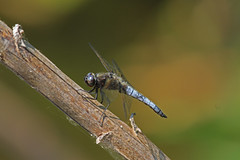
On our walk we saw hairy and emperor dragonflies (Brachytron pratense and Anax imperator respectively), both species of hawker, which I couldn’t get good photographs of as they were whizzing around over the water at high speed and never seemed to settle within range. Similarly with the four-spotted chaser (Libellula quadrimaculata), but then as we positioned ourselves in a very good viewing location on one of the smaller lakes a scarce chaser (Libellula fulva) appeared on a nearby seedhead and with occasional forays stayed there all the time we were there, giving some great photo opportunities:


Scarce chaser male, the female has a yellow abdomen with a thin black spine and doesn’t have the three black end segments

There were lots of damselflies too, apart from the large red and blue tailed already mentioned. Variable damselfly (Coenagrion pulchellum):

Azure damselfly (Coenagrion puella):

And common blue damselfly (Enallagma cyathigerum)

This pair of common blues are in ‘tandem’ with the green eyed female underneath. This position is adopted by non-territorial damselflies where the male grips the female behind the head and in this way ensures that no other male can mate with her before his eggs have been laid – a process called ‘ovipositing’. The eggs hatch out after 2-5 weeks and the larvae begin their development underwater where they are ambush predators, feeding on a variety of prey from other insect larvae to tadpoles and even small fish!

They are amazing creatures, and more species will be emerging over the next weeks and month so hopefully I can gather some more images of other species for subsequent posts before the Summer ends.