The Gannets and The Climmers

In my last gannet post the bird I showed was quite far off so here’s another one which alighted on the cliff just 10m or so from where I stood.

Sizing me up to decide whether I posed any threat

And it quickly reached the conclusion that this shivering piece of humanity obviously would pose no threat whatsoever and landed close by on the cliff:

I think this is a particularly elegant touch down for such a big bird, avoiding injury whilst landing on a tiny piece of cliff in very strong winds.

It wasn’t at all bothered by my presence or the whirring of the shutter, and in the absence of any other predators up on the cliffs, now that the ‘climmers‘ are no more, this chap didn’t see me as a potential danger.

Climmers were men who’s job was to harvest seabird eggs from the cliffs by abseiling over the edge. I found this remarkable piece of film at the Yorkshire Film Archive of climmers doing their work. It’s absolutely not for the feint hearted!

As well as the climmers the Victorian passion for shooting anything and everything wild was shockingly indulged on the 18 miles of cliffs between Bempton and Scarborough. Boat loads of day trippers would set sail and shoot hundreds of birds every day, and in a book of 1838 entitled ‘Essays on Natural History’ by one Charles Waterton he estimated that between April and August 108,000 birds were shot. I don’t know if the shot birds were eaten, but the slaughter was primarily for ‘sport’ (!), and the feathers were also used in huge numbers in the millinery trade.

As a result the ‘Association for the Protection of Sea-Birds’ (APSB) was founded in 1868 in Bridlington by local naturalists including the vicar of Bridlington in an attempt to prevent the annual carnage taking place just a few miles away on their local cliffs.

Then in June 1869 protection of the birds was enshrined in law with the passing of the ‘Sea Birds Preservation Act’. This provided protection for 35 species by introducing a closed season between April 1st and August 1st, and apparently the first successful prosecution under the Act took place in Bridlington on 10 July 1869 after a Mr Tasker, of Sheffield, had shot 28 birds. He was fined a total of £3 19s!

And the result of the dedication of those Victorian naturalists, pioneers at a time when animal welfare was very low on the political agenda, is the multitudes of birdlife to be seen on the cliffs today. Hats off to those splendid folk!

Fulmarus glacialis

A couple of weeks ago I posted about my trip to Bempton Cliffs and I showed you the gannets. There were four species of seabird in residence including the gannet, the other three being fulmar (Fulmarus glacialis, Dansk: mallemuk), guillemot (Uria aalge, Dansk: lomvie) and razorbill (Alca torda, Dansk: alk). By the time I got there the only other one on the cliffs was the fulmar, the other two had disappeared out to sea to hunt fish.

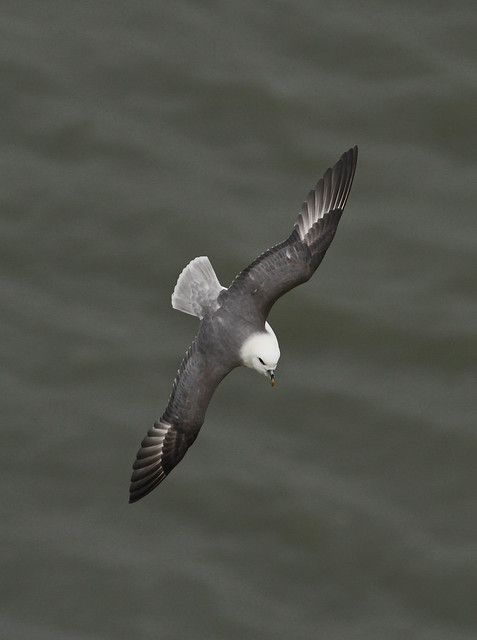
The fulmar in flight at Bempton Cliffs

Fulmars are the closest we get in this part of the world to an albatross. They both belong to the ‘tubenoses’, the taxonomic order ‘Procellariiformes‘ and the albatrosses are the family Diomedeidae and the fulmars are the Procellariidae, along with the shearwaters and petrels. The tubenoses have nostrils which also function to excrete salt which is ingested from sea water.

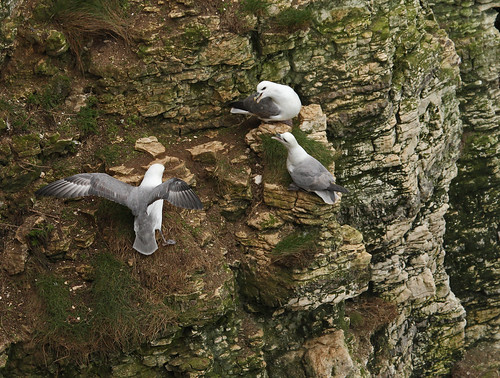
I think these two had the best spot on the cliffs, in their own little cave – as sheltered as it gets up there!

The cliffs are a huge place and there were probably hundreds of fulmars spread out over them and they were constantly taking to the air, looping round and returning, like this one who kept getting a somewhat frosty reception every time it tried to land in this spot:

Fulmars are apparently less than competent on the ground, unlike their cousins the albatrosses (apart from the landings of course), but similarly to the albatrosses they are consummate aeronauts. The winds were ferocious when I was up at Bempton but the birds glided along with little or no effort and never seemed to make a bad landing on the cliffs.

They are particularly long lived birds, the older ones reaching 40 years and beyond. They attain sexual maturity at 9 and they pair for life, breeding in nests on sea cliffs and rocky islands.

This is the northern fulmar and it frequents the extreme latitudes of the northern hemisphere. It’s one of two species, the other being the southern fulmar, Fulmarus glacialoides, which is found in the corresponding extremities of the southern hemisphere and fortunately neither of these species is endangered.

Whilst reading about the taxonomy of the fulmar I got distracted by the albatross which is a bird that has always fascinated me. The facts and figures around albatrosses are mind boggling and the one that made my jaw drop was the wingspan of the wandering albatross (Diomedea exulans) which can reach up to 3.5m, which is a shade longer than 11 feet! They must be an unforgettable sight.

An unusual but entertaining day at work

Earlier this week I was learning about a technique called ‘dynamic light scattering’ (DLS) which is used to determine the size of very small particles, even those as small as protein molecules. My teacher was a scientist called Ken who designs and builds DLS machines. It came up in conversation that he lives close to the southern end of the M40 corridor where I’ve seen lots of red kites and read stories of them stealing food from people, so I asked if he sees them in his neighbourhood.

Red kite (Milvus milvus, Dansk: rød glente), this one was at Hamerton in Cambridgeshire

Red kites are big, distinctive, birds of prey and they’re a conservation success story in the UK, having been almost driven to extinction but then reintroduced in the 1990’s since when their numbers have rocketed. And as it happens they are very common indeed in that part of the world and Ken kindly agreed to upload this video clip to You Tube so I could post a link to it here. This all happened in Ken’s garden and I think it’s highly entertaining stuff,  I think I’d struggle every morning to get out the front door to go to work if I had this kind of show going on in my garden!

Later on, at the end of the same day, a big flock of a few thousand starlings were murmurating over the Cambridge Science Park as I left work to come home. I was keeping one eye on the starlings and one eye on the road when I stopped at a red traffic light on the edge of the Science Park and the starlings were swirling and wheeling around the sky just in front of me. Then a sparrowhawk drifted by but the starlings carried on murmurating until the hawk suddenly accelerated up towards them. Then all of the flocks shrunk down into very tight groups and focussed on taking evasive action. It was a piece of natural theatre going on in the sky which was spectacular to watch. Then the traffic lights went green and I had to move on so I didn’t get to see the culmination of the chase, but it was a captivating end to the day.

Snug as a bug

About this time last year I published a post about the battling blackbirds in my back garden. The weather last February was mild and vry pleasant and I think the breeding season really got going then. As you can see, full on combat ensued. This year has seen none of the aggression of past year, at least not in my garden, but whilst watching the other birds I noticed this female blackbird making repeated trips to collect moss from my lawn. I’ve never understood why us Brits in particular want our garden lawns to look like the centre court at Wimbledon (before the All England Championships), I’d much rather see sights like this:

Behind the magnificent mossy muzzy is a female blackbird

She has been toing and froing for at least three days now collecting these huge beakfuls of moss and I reckon her chicks are going to be as snug as a bug in the nest she is busy constructing.

The male has also been very busy in the garden but his activities are rather less altruistic…

Seed or fruit, which is it to be?

There might even be a worm under there…

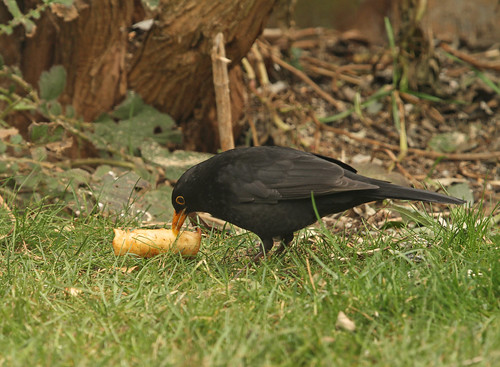
Result! That bloke in there has left me an apple core

All his visits seem to be focussed solely on replenishing his energy supply, but the reason I’ve seen no battles this year is because he’s dealt with the opposition, so I guess he needs to concentrate on feeding himself up again.

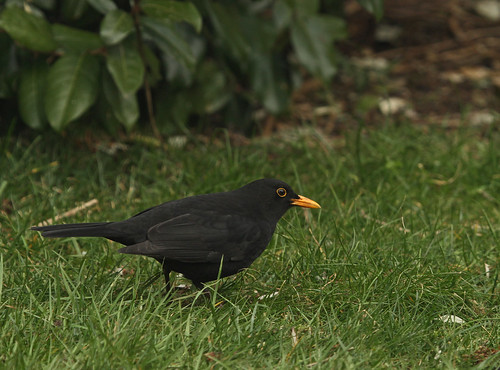
The blackbird (Turdus merula, Dansk: solsort) and the fieldfare (Turdus pilaris, Dansk: sjagger), both members of the thrush family, like fruit and any old grapes, apple cores or pears get thrown out for them.

The gannet – the ultimate fisherman

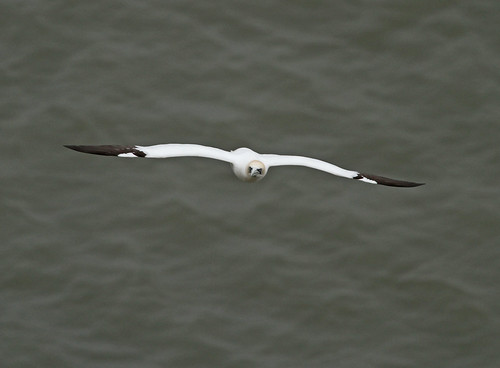
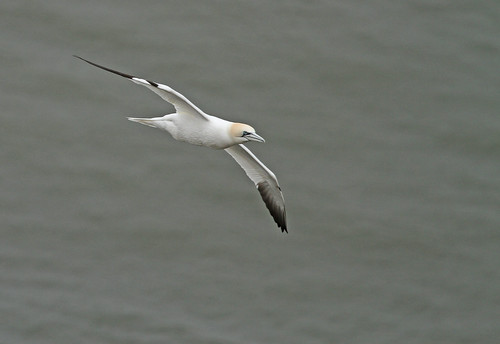
One of natures most splendid sights is the gannet in flight. It is a diving seabird and I believe it’s one of the worlds biggest divers. They are 94cm long with a wingspan of 174cm and they dive for fish from an average height of around 25m at speeds of up to 100km/hr (60miles/hr)! They fold their wings back just before they enter the water and watching it from above the surface is  absolutely breathtaking.

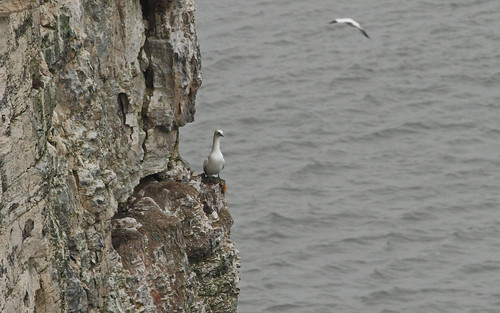
This particular gannet (Morus bassanus, Dansk: sule) landed on a ledge a couple of hundred feet up the cliff face at Bempton in East Yorkshire. The top of the cliffs is an RSPB reserve and it’s one of my favourite places to be. On the particular day I was there – February 13th – it was ferociously cold. I was well wrapped up, the air temperature was about 1 degree C, but the killer was a fierce offshore wind howling across and causing a lot of windchill. The birds didn’t seem to mind it though.

This gannet seemed to be just relaxing on its ledge until another flew past close by and then it took off:

I really like this sequence of events and the rocky ledge so high off the water was the perfect place to capture it!

There’ll be more from Bempton and that part of the world in the near future.

Ever the optimist

The font of all wisdom in my area for what birdlife is around is the Cambridge Bird Club ‘What’s About‘ blog. A short while ago there was a report of a sighting of a bittern at one of my regular nature walks, Milton Country Park. This was an exciting development because I’ve never seen a bittern before, so on the following Saturday morning I set off before dawn to be in situ at sun up to try and see it. The bittern (Botaurus stellaris, Dansk: Rørdrum) is a small brown heron which lives in reedbeds and is so perfectly camouflaged it is almost impossible to find until it breaks cover. It’s famous for the ‘booming‘ call of the male which can be heard up to 1km away, so I set off hopeful of not only seeing one but maybe hearing it boom too. Ever the optimist!

The conservation status of the bittern in the UK is red, meaning it is scarce and under threat. Alas, the chap I was hoping to catch a glimpse of was very scarce indeed, to the point of being completely absent. Oh well, next time maybe. But every cloud and all that, even though the bittern had absconded there was other birdlife in abundance.

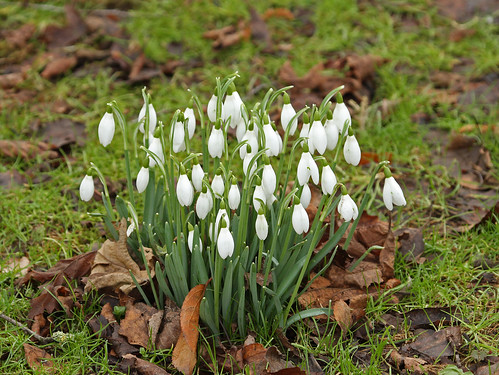
And not only birds, snowdrops were blossoming on the forest floor

The Country Park is made up of old gravel or quarry pits surrounded by a mixture of grassy scrub and mature woodland. Up in the treetops great spottted woodpeckers were hammering holes…

Great spotted woodpecker (Dendrocops major, Dansk: stor flagspætte)

I think this one is a female – the male has a red patch on the back of his neck which I think was absent on this one. The woodpeckers drumming sound results from the frequency of drilling rather than the power. They have energy absorbing tissues in the head to prevent brain damage and they strike at a frequency of 10-40 times a second which makes the tree trunk resonate, and that’s how they create their unique sound. Treecreepers were spiralling up these trees too, but they were just too quick to get a photograph.

But on the lakes there were hundreds and hundreds of water birds of all types:

Courting great crested grebes (Podiceps cristatus, Dansk: toppet lappedykker)

The full mating ritual of the great crested grebe is a wonderful sight. I’ve only ever seen it a couple of times and it involves swimming away from each other to a distance of 20-30m or so, then turning and swimming rapidly towards each other and when they meet they rise up in a vigorous display of necking before settling back into the water facing each other and creating a heart shape with their heads and necks. This is repeated mofre tha once and is utterly absorbing and delightful to watch. I was fervently hoping that my pair here were going to perform but they were content to simply preen, commune and doze. Still lovely though.

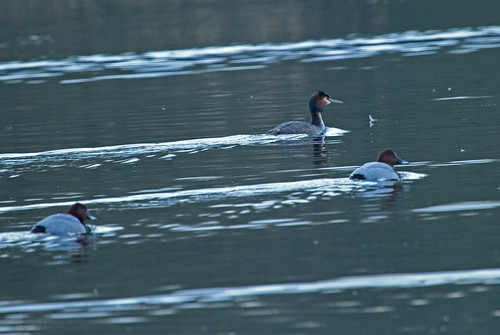
Another male great crested grebe with a pair of male pochard in hot pursuit (Aythya ferina, Dansk: taffeland)

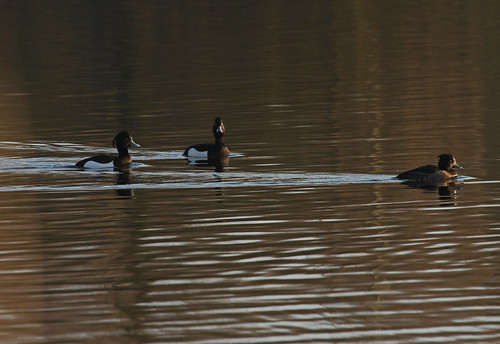
Two male tufted ducks (Aythya fuligula, Dansk: troldand) eyeing a lady with bad intent. Love, or something, was in the air!

Both pochard and tufted duck are divers and the rapid spread of the tufted duck in the UK in the 19th century is though to be the result of colonisation of UK waterways by the zebra mussel which originates in southern Russia.

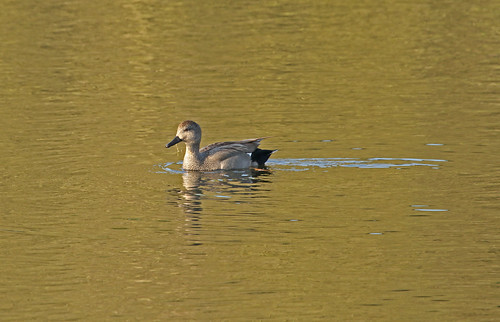
A male gadwall (Anas strepera, Dansk: knarand)

On a grey murky day the gadwall looks like a dull grey/brown duck but when the sun shines on them they are quite handsome birds, easily recognised on the water by the black rump, general brown plumage and the grey/black beak.

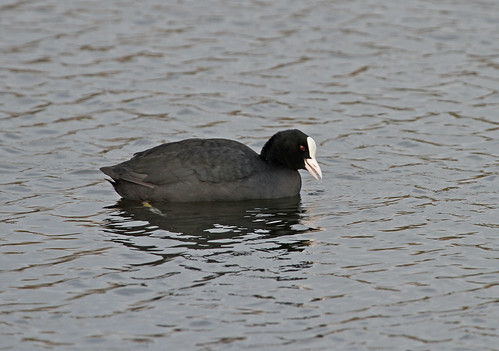
Coot and moorhen (Fulica atra, Dansk: blishøne and Gallinula chloropus, Dansk: grønbenet rørhøne, respectively) are both members of the family Rallidae along with water rail (which I saw on a previous recent visit to the Country Park, but not this one, even though I spent 10-15 minutes quietly looking where I saw one before) and crakes, which aren’t to be found in these parts.

The coot…

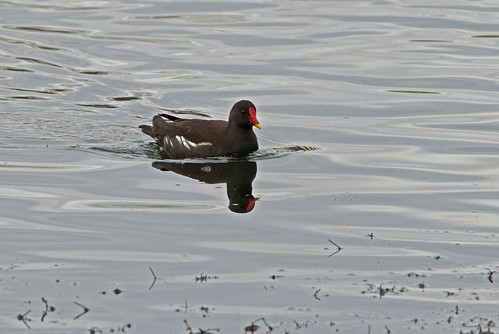
…and the moorhen

The male coots were in the mood for love and fighting out on the water on all the lakes, and were too numerous to count, and the occasional, more secretive and less aggressive, moorhen ventured into view from the reeds at the lake edges.


The brown heads are male wigeon, the black and white ones are male tufted duck, the two brown ones in the foreground are a pair of gadwall and out of focus at the back is another gadwall and a coot

As the sun came up the birds on the water semed to spring into life and large groups of various species busy feeding. All the pictures in this post were taken in a couple of hours or so from dawn until 10-11am and within a 300m radius. But as the sun arose and the light changed the colour of the water changed dramatically and gave some wonderfully varied backgrounds.

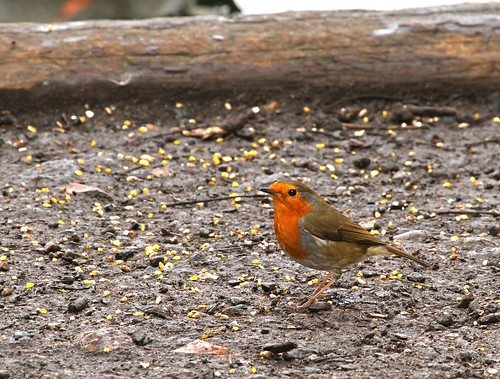
I stopped at a gap in the undergrowth to photograph the various species above and as I stood snapping the robin hopped into view between me and the water pecking at the seeds on the ground left by a benevolent walker for the ducks:

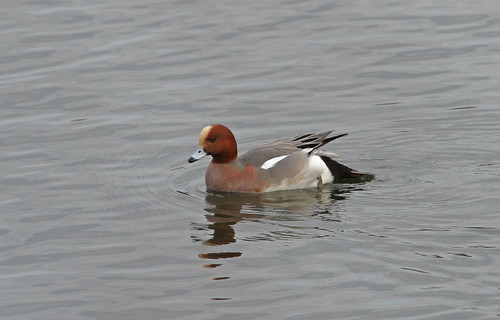
I think the most colourful, and therefore my favourite duck of that morning was the wigeon:

A pair of wigeon (Anas penelope, Dansk: pibeand), the male behind, the lady in front

The male on his own – resplendent in his psychedelic finery

The wigeon is a resident breeder in the UK and it’s conservation status is amber, which surprised me because I see plenty of them on the lakes around Cambridgeshire. They are vegetarians feeding on leaves and shoots and rhizomes, and in my view they are one of our prettiest ducks.

So no bittern on this trip but lots of other wildlife on the water and in the trees!

Sylvia – another unusual visitor

Like a lot of other folk I gave up making new year resolutions a long time ago because the resolve would normally last until the 2nd or 3rd of January before slipping quietly unnoticed into the flotsam and jetsam of recent history, never to be seen again. But for 2013 I made two resolutions – the first was to get current with my wildlife diaries which have been appallingly neglected for far too long – and the second resolution was not to condemn the first one to the black hole into which it would normally be swallowed. And so far so good, hence I’m feeling rather pleased with myself.

This years listings can be found here at ‘Histon Wildlife Diaries 2013‘ and if you notice gaps of more than a couple of weeks opening up please feel free to leave a pointed reminder that I need to get my finger out and get up to date!

As a consequence of my girded up loins and renewed efforts I’ve been spending more time peering into the garden to see which creatures are in residence. Just before Christmas I saw the first blackcap in the garden, it was a male with his coal-black cap, like a judge about to hand down the ultimate sentence, and he stayed for all of 2-3 seconds before zooming off into the sanctuary of our neighbours orchard. And of course I was very pleased with this visitation because it’s always good to welcome a newcomer.

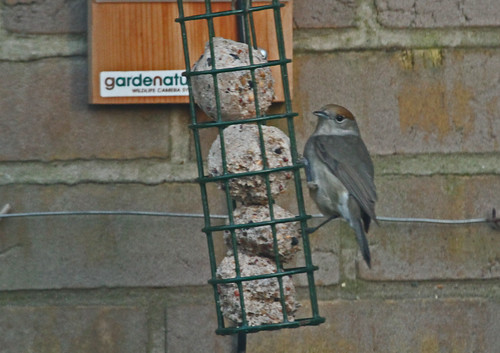
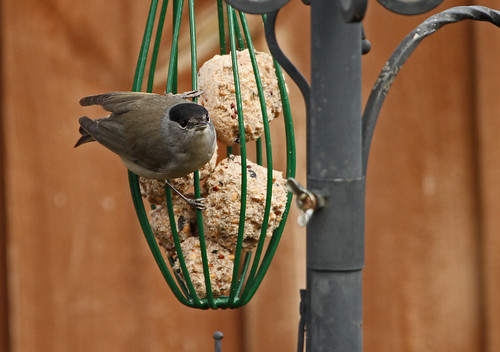
Then a couple of weeks ago when the winter weather was at its filthiest here in Cambridge a female appeared and spent some time refuelling on my fatball feeder:


A female blackcap (Sylvia atricapilla, Dansk: munk) on the birdcam fatball feeder

The birdcam used to be around 6m away from where it is now but there were very few takers for the lardy delights on offer.  But since I moved it to its current location it has been busy every day with numerous bird species. The reason for the change is the lack of cover in the original location which left the birds exposed to the possibility of predation by the local sparrowhawk. But now they have cover within a metre or so and and I can sit and watch them all in close up on the TV. And one of the first to arrive after I moved it was my lady blackcap, who you’ll have immediately noticed has a rufous brown cap, not the blackcap of the male. The specific name ‘atricapilla‘ means ‘blackcap‘ and the Danish name ‘munk‘ means ‘monk‘. I wonder which godly habits gave him that name, or is it simply his ecclesiastical bonnet?

She arrived early on a murky morning, fed quickly and left, and that was the last I’ve seen of her. But a couple of days later a male blackcap arrived and he’s been visiting several times a day every day ever since then:


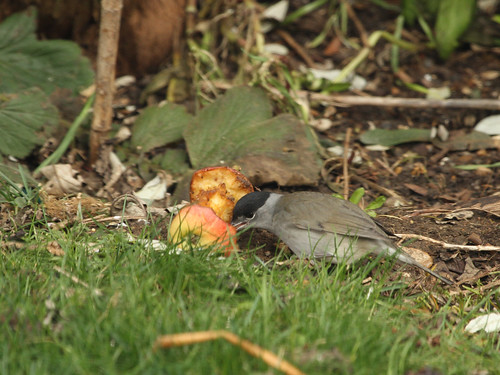
The male blackcap feeding on an old apple

I’m puzzled as to why the female has been so conspicuous by her continued absence, I guess that now the weather is considerably more pleasant she is more comfortable feeding out in the countryside.

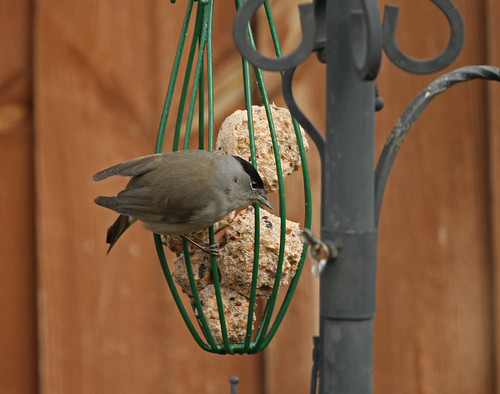
The male doesn’t restrict himself to ground feeding on fruit but is a more regular visitor to the fatballs.

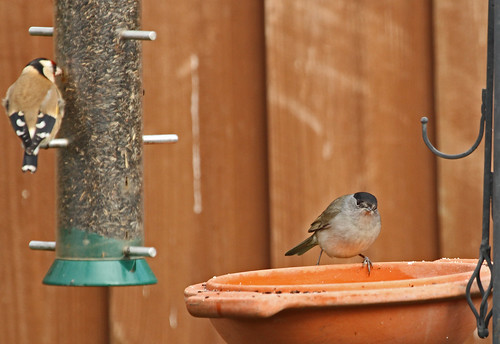
And he tops up with water too. In the picture below he is wary of the goldfinch nibbling niger seed on the adjacent feeder. He was also aware of my presence behind a glass door around 8m away and when the goldfinch disappeared he threw numerous glances in my direction, but so long as I remained still he wasn’t too bothered.

Until recently it was thought that the blackcap was a migrant breeder here in the UK and that they spent their winters in Africa, apart from a sub population that remained here in the winter. But it is now thought that all of ours overwinter south of the Mediterranean and our winter visitors are a separate population from central Europe which migrate here to overwinter. In which case my visitors will be heading back east in the near future. After that I’ll hopefully see and hear our migrant breeders out in the hedgerows where they make a distinctive call which I think sounds like someone flint-knapping.

The British Trust for Ornithology have published a factsheet about blackcaps and their migration behaviour which is worth a read. We also have passage visitors as Scandinavian birds head south and it appears that garden bird feeders are having a major impact on the behaviour of blackcaps and other species too, such as nuthatch, which are now spreading into Scotland, assisted by garden feeding and climate change.

Sustainability Pt2

As you know the EU voted last week to reform the Common Fisheries Policy with a large majority. Here is an email update on the position going forward to the next series of negotiations sent by the Liberal Democrat MEP, Chris Davies. The email subject was ‘Fish Fight Victory!‘, enough said:

Dear Fish Fighter

You will know, I am sure, that on Wednesday the European Parliament gave its backing to major reforms of the EU Common Fisheries Policy. But perhaps you don’t know of the amazing scale of that victory.

After some 180 votes on different amendments or attempts to delete particular reforms, MEPs voted by 502-137 to support the entire package.

We got just about everything we could want. Key amendments calling for all fish caught to be landed (no discards), and for annual quotas to be set so that fish stocks are increased, were approved by large majorities with more than 400 MEPs voting in favour. We insisted that scientific advice must be followed, called for fish stock recovery areas to be created, backed requirements that a long term management plan be established for every fishery, and demanded that governments that fail to meet their obligations should face financial sanctions.

This was the first time that the European Parliament was able to vote on CFP reform as a co-legislator, with equal powers to the Council (EU governments) to amend or reject the European Commission’s proposals. Now the bargaining begins to agree a joint position. Compromises will have to be made, but our decision gives the rapporteur, German MEP Ulrike Rodust, the strong negotiating mandate she will need to overcome opposition in the Council. The Irish Presidency currently in charge of the negotiations has said that it would like to reach agreement by June.

The main opposition to the changes came from Spanish and French EPP (right-of-centre) members, but they weren’t able to keep their group united. At least 70 of their colleagues, led by Scandinavians and German MEPs, refused to back their attempts to weaken the reforms.

I haven’t checked the records but I think you will find that all British MEPs from the main parties backed the reforms. My understanding is that UKIP members abstained on the final vote (Nigel Farage was not present).

How was such a large majority achieved? Credit can go to many individuals and to all the MEPs who voted with us, but there is no doubt that the campaign in several countries led by environment NGOs, including Hugh’s Fish Fight, has raised public awareness and ensured that many people made their views known to their MEPs. Our campaign within the Parliament was run on a cross-party basis. More and more of my colleagues came to accept that we can’t go on as we are, and recognised that fishermen will have a more secure future if we adopt the measures necessary to rebuild fish stocks.

I know the Fisheries Commissioner, Maria Damanaki, would like to say that the first positive steps are already being taken. We now have 27 sustainable fisheries in Europe, compared to just five a few years ago.

The reform campaign is not over yet. The next big series of votes will take place in the Fisheries Committee in April, when we consider the 3,000 amendments tabled to Commission proposals for changing the way the fisheries budget is used over the next seven years. Do we carry on subsidising a handful of shipowners, mainly in Spain and France to build ever more powerful fishing boats, or do we use the money instead to help coastal communities and find ways of assisting fishermen adjust to the demands of sustainable fishing?

I’ll let you know more about this when I know more myself.

Thank you for all your support in this campaign.

With regards

Chris Davies MEP

Liberal Democrat environment spokesman

Secretary, cross-party ‘Fish for the Future’ group

I’m writing this post overlooking Bridlington harbour on the North Sea coast in East Yorkshire and the harbour is full of small fishing boats of the kind I hope will have their future guaranteed by the reforms. And I can’t think of a better location to be in to write this post!

I received emails from several of the Conservative MEP’s who all voted for the reforms, so hats off to them for voting the right way and for taking the trouble to communicate with me about it. Amusing to note though that the UK Independence Party (UKIP) members abstained and that Nigel Farage (the leader of UKIP) didn’t consider saving the fisheries and the jobs and livelihoods of all our fishing communities sufficiently important to even turn up. Despite that it looks as though we’re now in a great position to make real headway to protect our fish and our oceans.
A special winter visitor

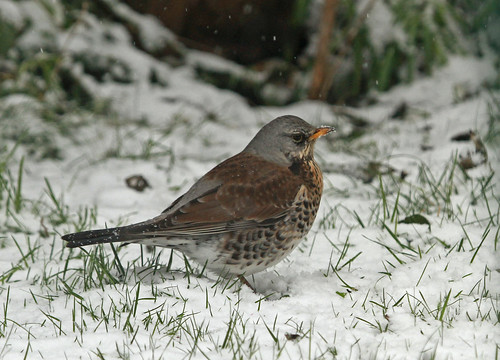
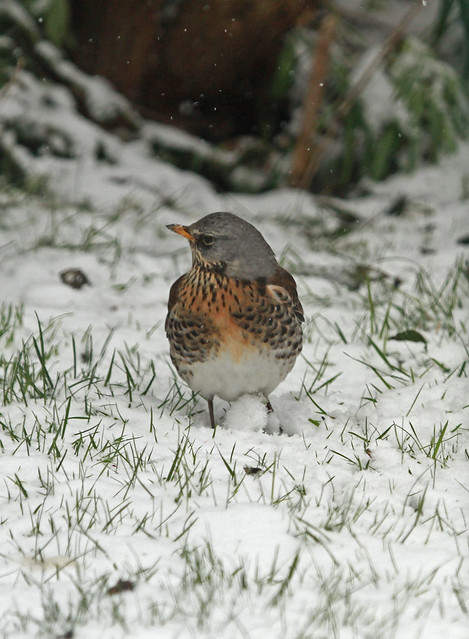
When the snows came a few weekends ago an influx of birds came to my garden to feed up on the seeds and fatballs I put out for them. I also threw out some squidgy grapes which had been getting overripe at the bottom of the punnet. And as well as all the usual species a winter visitor from Scandinavia also appeared.

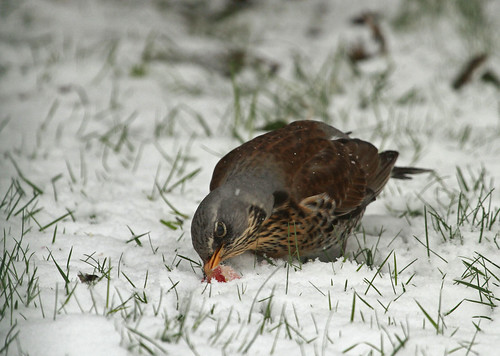
Fieldfare – Turdus pilaris (Dansk: sjagger)

The fieldfare is a species of thrush from Scandinavia which migrates to overwinter in the UK. They’re hardy, feisty birds and utterly resplendent in their psychedelic finery! I’ve seen large flocks of them flying above the countryside around Histon but rarely within the village itself. And then this handsome bird arrived in my garden to feed on the squidgy grapes.
Dismembering a grape

It finished the grapes and then took up residence under a bush in the garden and repelled all comers. Whenever another bird came within striking distance it would emerge from its refuge at speed and chase it off. Which sufficed for everything smaller than a blackbird.

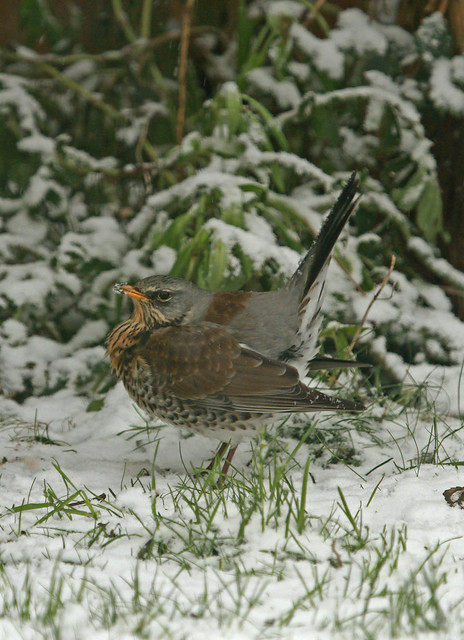
After the grapes had gone I augmented its diet with some apple, which coinidentally is also a favourite food of blackbirds. And within minutes there was competition for the fruit. The fieldfare adopted a very distinctive stance when the blackbird, or anything bigger, like a collared dove or a wood pigeon came within range and several fights ensued. And the fieldfare wasn’t always the winner because blackbirds are also accomplished pugilists when they need to be. So it all worked out evens, they both got some apple and a good scrap would keep them fit too:

The’repel all boarders’ stance, wings down, tail in the air. If that didn’t suffice then all out assault ensued

The fieldfare, I assume it was the same one, appeared in the garden after first light every morning until the rain washed away all the snow and it hasn’t been seen since. At the same time the trees and bushes in the village were also frequented by the fieldfares during the snow but they all disappeared with the snow too.

Sustainability

If any of you guys emailed your MEP’s to urge them to vote for fisheries reform, all I can say is ‘Good work!’.

I picked up an email from the European parliament yesterday afternoon and this is the text:

A major reform of the EU’s Common Fisheries Policy (CFP) which aims to cut fishing to sustainable stock levels, end dumping at sea, and base long-term planning on sound scientific data, was approved by Parliament on Wednesday. Overfishing is widely seen as the worst failure of the current CFP, dating from 2002. The new one is to take effect in 2014.

European Commission figures suggest that 80% of Mediterranean stocks and 47% of Atlantic ones are overfished. The reform voted in plenary sets out clear and strong measures to tackle this problem.

“We have shown today that the European Parliament is anything but toothless. We have used our power as a co-legislator, for the first time in fisheries policy, to put a stop to overfishing. Fish stocks should recover by 2020, enabling us to take 15 million tonnes more fish, and create 37,000 new jobs”, said fisheries reform rapporteur Ulrike Rodust (S&D, DE). Her report was adopted by 502 votes to 137, with 27 abstentions.

Stop overfishing by ending discards…

Discards – fish thrown back, usually because they are of an unwanted species or size – account for almost a quarter of total EU catches. Most of the discarded species die. To end this wasteful practice, MEPs voted to oblige fishing vessels to land all catches in accordance with a schedule of specific dates for different fisheries, starting from 2014.

Landed catches of fish that are undersized, for example, would be restricted to uses other than human consumption. Member states must ensure that fishing vessels comply with the discard ban.

…and respect maximum sustainable yield

From 2015, EU member states will be prevented from setting quotas that are too high to be sustainable. Fishermen will have to respect the “maximum sustainable yield” (MSY), i.e. catch no more than a given stock can reproduce in a given year. In today’s vote, MEPs sought to ensure that stocks recover by 2020 to above MSY levels and sustain them thereafter. Ultimately this should mean more fish, better catches and hence more jobs in the fishing industry.

Long-term planning to replace yearly quota-haggling

The reform will rely on multi-annual fish stock management plans to ensure that fishing stays sustainable. Taking a longer term approach should improve market predictability, which in turn should help the industry to invest better and plan ahead. Multi-annual plans will be based on more reliable and accurate scientific data, which EU member states will be obliged to collect and make available.

Next steps

Parliament will now start negotiations with the Council and the Commission on the reform plans before their second reading. The Irish Presidency of the Council has repeatedly said it hopes to achieve an agreement the end of June.

Result! And by a big majority too.