EU fisheries update – correspondence – 05/02/2013

As you know I emailed our local MEP’s to urge them to vote for the reforms to the EU Common Fisheries Policy and I thought I’d share a couple of replies with you.

The first is from the local Conservative MEP, Robert Sturdy:

Dear Dr Holding,

Thank you for contacting me about this important issue. We are in the midst of CFP reform negotiations in the Parliament and have a real opportunity here to ensure that we get the radical reform that we have campaigned so hard for. The Fisheries Committee has already voted on the package and the plenary vote will be February 6th. This will finalise the Parliament’s position on the CFP.

As you know, there are many issues at stake, including regenerating the ever depleting fish stocks. Two thirds of EU commercial fisheries are over-fished. Discards play a big part in this over-exploitation and the Conservatives voted in favour of an end to discards and an implementation of the discard ban. However, we must ensure that this discard ban is workable and does not end up with us moving from discarding at sea simply to discarding on land. Instead of finding new markets for the extra 1.8 million tonnes of unwanted catches, we should firstly aim to use more selective gears to keep these fish in the ocean. The discard ban should therefore go hand in hand with a tougher approach on selective gear to ensure that the unwanted catches are not caught in the first place.

The Conservative delegation also voted in favour of maintaining stocks above maximum sustainable yield (MSY) by 2020. This will ensure that all fish stocks will have recovered to sustainable levels and fishermen will have had the necessary time to adjust to the new approach. We must work with scientists and stakeholders to come up with workable legislation that conserves fish stocks for future generations and which provides for a sustainable fishing sector. MSY will be an important factor in this scenario.

We are also fully supportive of fisheries management plans that involve all stakeholders and are based on a regional basis. We would like to see an end to the micro-management from Brussels that has bedevilled the sector for decades. Regionalisation therefore lies at the core of the CFP reform package.

My colleague, Struan Stevenson, is the rapporteur on one of the main legislative CFP reports, the Common Market Organisation and as such, he is responsible for steering this through the Parliament. The reforms contained in his report devolve day-to-day management responsibility of fisheries, introduce better labelling on fisheries products for consumers and provide a strengthened role for Producer Organisations. We received almost unanimous support at both the committee and plenary vote and are about to embark on negotiations with the EU Council and the European Commission at the end of February.

Please be assured that I fully support ambitious and radical reform to ensure both a sustainable ocean and a sustainable industry.

Yours sincerely,

Robert Sturdy MEP

I was pleased with the tone and the content of this reply as Mr Sturdy details the Conservative stance with regard to not just discard and overfishing, but technical solutions to minimise the wrong catch in the first place. Just goes to show, common sense can also inform political debate. Who’d have thought!

The second is from the representative of the UK Independence Party (UKIP) MEP Stuart Agnew:

Dear Sir/Madam

Thank you for your recent email, addressed to Stuart Agnew MEP.  I am replying on his behalf.

Mr Agnew takes a serious interest in fisheries matters and has recently become a member of the European Parliament’s Fisheries Committee. He takes note of your views and he will be closely studying this package.

The Common Fisheries Policy has been a disaster. British fishing waters represent two thirds of the EU’s fishing grounds and were simply given away as part of the terms of our membership of the then Common Market by Edward Heath.  They were designated a ‘common resource’ to which the other member states have access, even those that are landlocked!

Best wishes,

Stuart Gulleford

Political Advisor to Stuart Agnew MEP
Office of Stuart Agnew MEP
UK Independence Party
145 New London Road
Chelmsford
Essex
CM2 0QT

Tel: 01245 266466
Fax: 01245 252071
Email: eastern@ukip.org
www.stuartagnewmep.co.uk
www.ukip.org

It appears that Mr Agnews ‘serious interest in fishing matters’ has rendered him so focussed that he completely forgot to address my point. Obviously he’s a very serious politician indeed.

Mr Gulleford completely ignored my point too, but took the opportunity to indulge himself with a little anti-European tub-thumping. You’ll notice his indignation that even land locked countries are allowed to fish in what he considers to be British waters (and I’m not sure where his assertion that British waters constitute two thirds of all EU fishing grounds originates from. Perhaps in his world Britain still has an empire and we own the North Atlantic). I wonder if he is similarly indignant about people who live in flat countries, such as Holland, being allowed to go to mountainous countries to go skiing. (May be he spends his winters at the foot of Ben Nevis with a placard with the exhortation ‘Dutchies go home – British mountains for British skiers!’  😉 )

EU fisheries update 04/02/2013 – addendum

I just found an email in my inbox from Chris Davies the Liberal Democrat MEP sitting on the EU Fisheries Committee. In it he asks us to write to our MEP’s urging them to vote for the changes to the Common Fisheries Policy in the Plenary vote on Wednesday 6th February. The debate on this is tomorrow, the 5th, followed by the vote on Wednesday.

If you follow the link lower down you can quickly find out who all your European MEP’s are and write an email to all of them. My email to my east of England MEP’s  is appended, please feel free to cut and paste if you wish, but bear in mind it will carry more weight if it is your own words.

This is the text of Chris’s email:

Vital Votes in European Parliament in February

Dear Fish Fighter

A quick note to let you know that the vote of the entire European Parliament on reform of the Common Fisheries Policy is due to take place on Wednesday 6 February, following a debate in the chamber at Strasbourg the day before.

The Parliament’s Fisheries Committee voted on the issue before Christmas, and the 13-10 outcome was very satisfactory.  Amongst a number of useful proposals it was agreed that legally binding targets should be set to rebuild fish stocks above maximum sustainable yield (MSY), and to end discards by introducing an obligation to land all catches.

The vote in a fortnight will give all MEPs the chance to support or reject this package, as well as to consider any further amendments that have yet to be tabled. 

The aim of reformers is to maintain the positive momentum, and alert MEPs who may be sympathetic but rarely take regard of fisheries issues to the importance of supporting reform on this occasion.  We’re confident but certainly not complacent.

Once the Parliament has voted we expect the rapporteur (the MEP designated to take a lead) to open negotiations with the Irish deputy ambassador whose task it is to try and thrash out a deal that will be acceptable to both the Parliament and the Council of Ministers.  Compromises will inevitably be reached, but the rapporteur, German social democrat Ulrike Rodust, has done a good job so far and she will be no pushover.  Her negotiating position will be strengthened if reformers can secure a commanding majority on February 6.

I am expecting British MEPs of all political parties to be supporting the reform position on MSY and discards.  However, you might like to email your region’s MEPs and encourage them.  You can do that easily by visiting www.writetothem.com and putting in your postcode.

I shall let you know if hostile amendments are tabled, and if we need further help to try and ensure that they do not win support.

With regards

Chris Davies MEP
Secretary, cross-party ‘Fish for the Future’ group
Lib Dem environment spokesman

And my email to the MEP’s

FOR THE ATTENTION OF:

  • Robert Sturdy MEP
  • David Campbell Bannerman MEP
  • Vicky Ford MEP
  • Stuart Agnew MEP
  • Geoffrey Van Orden MEP
  • Richard Howitt MEP
  • Andrew Duff MEP


Eastern

Monday 4 February 2013

Dear Stuart Agnew, Vicky Ford, David Campbell Bannerman, Robert Sturdy, Geoffrey Van Orden, Andrew Duff and Richard Howitt,

I write urging you to vote to accept the proposed changes to the Common Fisheries Policy at the vote at the EU Plenary meeting on Wednesday. I think this is a hugely important first step towards guaranteeing longer term survival of fish stocks which is essential to protect the ecosystem the fish need to thrive and thus continue to supply humans with food.

Hopefully this piece of legislation will form part of a framework for sustainably fished oceans and thereby secure the fishing industries and livelihoods of the communities that depend on them for survival, and the associated services and businesses that support the fishermen.

Continued depletion of the fish stocks will ultimately be catastrophic for these people so I hope you will vote for implementation of the changes to prevent this and guarantee the future of all the European fishing industries.

Yours sincerely,

Dr Finn P. Holding

EU fisheries update 04/02/2013

In December I published a series of posts about overfishing and discard and moves by the EU to protect fish stocks from overexploitation:

Looking after the forests and the fishes

Looking after the forests and the fishes Pt2

Looking after the forests and the fishes Pt3

The position at the end of December was that the Fisheries Committee had voted to recommend to the EU Plenary that controls on overfishing and discard should be implemented. The Plenary is scheduled to vote on this tomorrow and I received this email update from the European Parliament today in which the German Chair of the Fisheries Committee, MEP Ulrike Rodust, clarifies the position regarding the proposed controls and the ramifications once these are implemented. It makes interesting reading and I’ll report back when I’ve heard the result of tomorrows vote in the Plenary.

Plenty more fish in the sea? MEPs to decide on best way to tackle overfishing

 EU fishing stats 040213

MEPs will this week decide how to reform the EU’s common fisheries policy in order to put an end to overfishing while at the same time tackle unemployment in many coastal areas due to the decline of fisheries. Ahead of a debate on 5 February and vote the day after, we asked German Social Democrat Ulrike Rodust why she is calling for radical change in her recommendation to fellow MEPs.

How do you propose to protect stocks and put an end to overfishing?

My report, which was supported by the majority of the fisheries committee, will bring an end to the December ritual of fisheries ministers negotiating until 4am, neglecting scientific advice and setting too high fishing quotas. As of 2015 the principle of maximum sustainable yield shall apply, which means that each year we do not harvest more fish than a stock can reproduce. Our objective is that depleted fish stocks recover by 2020. One problem we have to tackle is the lack of scientific data: we will have to set up additional research and data collection programmes.

How would you address unemployment and related social problems among fishermen in coastal areas?

The good thing about ending overfishing is that not only nature will benefit, but also fishermen: bigger stocks produce higher yields. We will have to help fishermen get through the transitional period when there will have to be a bit less fishing for some species. What’s more, my group tabled an amendment which obliges member states to give fishing rights preferably to traditional small-scale fishermen. This part of the fishing sector produces more jobs and uses less detrimental fishing techniques most of the times.

Unfortunately, at some European coasts, there are simply too many fishermen chasing too few fish. Member states will have to reduce the number of active fishermen, but they should do this in a socially responsible way.

You propose member states close 10%-20% of their territorial waters to fishing within three years. Do you expect this to be endorsed by the Parliament and the Council?

The fisheries committee has already endorsed a general obligation for member states to create these fish stock recovery areas but without prescribing a certain percentage. My group will reintroduce a clearer obligation for the plenary vote. For the moment the Council does not agree, but our fisheries ministers will have to learn that there is co-decision and that the EP is a serious negotiation partner.

There have been negotiations to reform the EU’s common fisheries policy for more than 20 years. Will this reform finally resolve the sector’s  long-standing problems?

Ending overfishing and discards is indeed a historical change of the EU’s fisheries policy. Today the sector suffers a lot, not only because of the results of continued overfishing, but also because of cheap imports. By the way, many fishermen of the new generation support our plans. And we need the active support of fishermen. Fishing happens far out at sea, so you cannot simply rely on controls only. That’s why in the future fishermen will have a much greater say through the so-called advisory councils.

Mating Mutes

The sun is shining a lot now and the snow has totally disappeared. Unlike two weekends ago which was bitterly cold and the lakes at Milton Country Park were partially iced over. It’s not always easy to see all the water birds but they had been coralled into smaller areas by the ice. Ducks abounded at the park with teal (Anas crecca, Dansk: krikand), gadwall (Anas strepera, Dansk: knarand), wigeon (Anas penelope, Dansk: pibeand) and tufted duck (Aythya fuligula, Dansk: troldand) in numbers, as well as the customary mallard (Anas platyrhynchos, Dansk: gråand). There were two highlights of the trip, a goldcrest was busy hunting in a bush just a few feet away and seemed undisturbed by our presence. Goldcrest (Regulus regulus, Dansk: fuglekonge) are beautiful little birds, they are our smallest breeding species, weighing 4-7 grams, and the northern populations migrate south in winter with Scandinavian individuals crossing the North Sea to overwinter in the UK.

Mute swan pair with a male tufted duck in the background

I didn’t manage to get pictures of the goldcrest, which is a pity, but I did manage to get pictures of the second highlight, which was a pair of mute swans (Cygnus olor, Dansk: knopsvane). And if the goldcrest is our smallest breeder, the mute swan is one of the biggest (if  not thee biggest), weighing in at a hefty 10.5-12kg, and breeding is what this pair had in mind.

Mute swans pair for life and the courtship dance is delightful to watch, they gracefully circled each other, repeatedly intertwining their necks:

And the dance culminated in mating. The male climbed on board the female and grasped the back of her neck with his beak, the whole thing lasted just a few seconds, which was just as well for the lady as her head was held underwater and she actually disappeared from view.

And after mating they rose up, breast to breast out of the water and continued the necking dance:

Finally, they relaxed back into the water and finished the ritual by bobbing their heads towards each other, and apart from the mating moments the whole thing was very calm and sedate. I think mutes are simply regal, they are very big, powerful, animals and I can’t hink of any creature which is quite so pristine.

And shortly after mating the male climbed out of the water onto the ice for a post-coital stretch up to his full height and opened his wings, surrounded by a retinue of coot (Fulica atra, Dansk: blishøne) and gadwall. A fitting finale to this series of captivating natural events.

RSPB Big Garden Birdwatch – the tally

I filled up the birdfeeders first thing this morning, made a jug of coffee, and sat in the window waiting for the birds to flock in. And very little happened. So I waited a little longer. And still nothing happened, and I put it down to the fact the sun was shining, all the snow had gone and the temperature was in double figures.

A dunnock mopping up seed scattered by great tits on the hanging feeder

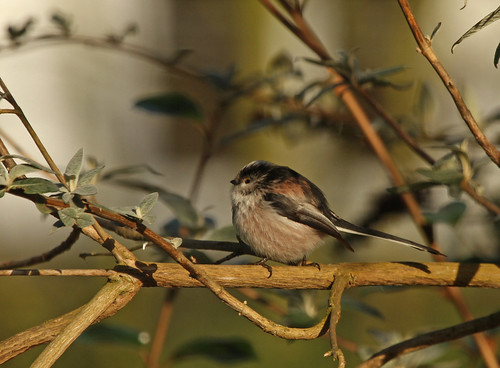
Then at 9.26am a group of four long tailed tits arrived on the fat balls and from then on the birds came and went in rapid succession. So the plan was to count from 9.26 to 10.26 until at around 9.50 the dog vomited on the carpet so the next 20 minutes weren’t spent counting birds. The finish time was therefore a tad delayed, but the final counts were:

Species                                 Total counted                    Maximum number at one time

Long tailed tit                              18                                                              5
Blue tit                                            18                                                              3 Dunnock                                          3                                                               1
Collared dove                                6                                                               2
Blackbird                                       13                                                               2
Greenfinch                                      5                                                               4
Wood pigeon                                  6                                                               2
Robin                                                 3                                                                2
Starling                                             5                                                                2
Great tit                                            3                                                               2
Chaffinch                                         2                                                                1

A female greenfinch enjoying some longed for sunshine

So all in all, what with the Vesuvian intervention from the dog, it was an entertaining hour and a half.

RSPB Big Garden Birdwatch

This weekend, the 26th and 27th January 2013, is the weekend of the Royal Society for the Protection of Birds (RSPB) annual Big Garden Birdwatch. This is a form of citizen science by which the RSPB can harness the collective spotting power of the nation to assist in compiling data on the nations bird populations.

The idea is to spend one hour noting which bird species visit a chosen area and the maximum number of each seen at any one time. This point is important because an individual can make several visits over the course of an hour, so counting total numbers will overestimate the numbers of a particular species.


A long tailed tit paying a visit to my garden this morning

If you want to make a pot of tea and sit by the window for a relaxing hour sipping and counting the details of how to take part are here on the RSPB’s website. Even if you don’t get many interesting birds in your garden, or even many birds at all, this is important and useful data too for compiling population sizes and distributions, so every participant is crucial in creating an accurate picture of the health of the nations birdlife. Which is in turn a useful indicator of the health of the natural environment in the UK as a whole.

I’m going to do my recording tomorrow morning and I’ll post my results here too.

Alas, no bullfinch, but…

The weekend before last I went for a walk around the lakes of RSPB Fen Drayton. It was a customarily grey and cold morning and there was a lot of water standing where there wouldn’t normally be. But the lakes were full of ducks, waders and other water birds and the trees and hedgerows were thronged with other birds, but alas no bullfinch. To explain, the approach road to the car park is lined with hawthorn and other trees and they are home to many bird species including bullfinch, so I was hoping to see one or two and get photographs. But on this occasion alas, they were conspicuous by their absence.

No bullfinch, but hey ho, woodpeckers there were:

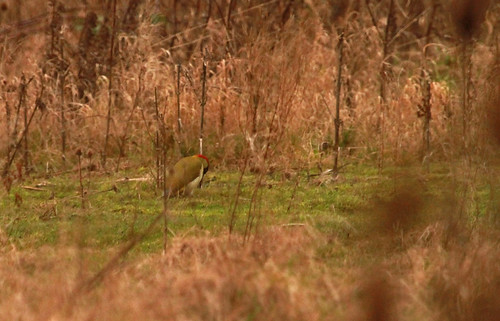
Green woodpecker (Picus viridis, Dansk: grønspætte) mining ants next to the car park at Fen Drayton lakes and fastidiously refusing to look up

And the green woodpecker wasn’t the only woodpecker hanging around the lakes:

Great spotted woodpecker (Dendrocops major, Dansk: stor flagspætte) patrolling the treetops

There was also great crested grebe (Podiceps cristatus, Dansk: toppet lappedykker), a large flock of mixed waders including bar tailed godwit (Limosa lapponica, Dansk: lille kobbersneppe) and several flocks of greylag geese (Anser anser, Dansk: grågås). And lots and lots of lapwing:

A small fraction of a much bigger flock of lapwing, I make it 84 in this group

In the 1970’s lapwing (Vanellus vanellus, Dansk: vibe) were a common sight in the English countryside. Huge flocks consisting of hundreds, if not thousands, of individuals weren’t particularly unusual. My Dad used to call them plovers, or ‘peewits’, a name they acquired because of their distinctive call. But like many species, they have suffered hugely from habitat destruction as a result of modern farming methods. On this particular morning at Fen Drayton there was at least one flock and possibly two, at opposite ends of the lakes, there were a heck of a lot of them and they were frequently rising into the air en masse. And since the snow arrived this week there has also been a small flock of 30-40 birds close to Cambridge Science Park which I spotted on my way to work, and a small group of them alighted on the field right outside my lab.

A blue tit deftly plucking seeds from a swaying reed seedhead

On the last part of my outing round the lakes I headed for a hide overlooking an expanse of water where I was hoping to see water birds. A flight of four goosander containing a male and three females flew over on the way there and seemed to be a good omen! Outside the hids this blue tit (Cyanistes caerulius, Dansk: blåmejse) was busy hopping from stem to stem in the reeds outside acrobatically harvesting the seeds.

And on the water there were A LOT of birds. The flock of lapwing higher up this post were on the ground at the far side of this lake, and the water was hosting gulls, ducks, swans and a lone heron. One of the loveliest ducks, easily identified by it’s triangular black head, white cheek spot and his regal black and white plumage is the goldeneye.

Goldeneye drake – elegance personified

There were a pair of goldeneye here, (Bucephala clangula (great name too!), Dansk: hvinand) and as with other duck species the lady is drab in comparison with the resplendent males. I spent half an hour waiting for them to paddle into the gap in the reeds just infront of this one for a clear shot. But they never did, so this is the best picture I could get. But isn’t he a beauty!

What a difference a frost makes

Having bemoaned the lack of wildlife in my garden, last Saturday the weather turned very cold here and after replenishing the bird feeders they were flocking in in droves! These resilient little guys were obviously finding sufficient sustenance elsewhere until the cold set in but now they’re here in numbers daily, and today we have had 10-15cm of snow and it hasn’t stopped yet so I reckon they’ll be around for a while longer too.

One of the species which I have missed because they are normally here all through the winter is the chaffinch (Fringilla coelebs, Dansk: bogfinke):

The cock chaffinch always adds a splash of welcome colour

Chaffinch are resident breeders in the UK and can generally be seen and heard in trees and hedgerows all year round. Another resident breeder I hadn’t in the garden or in the countryside much this year was the dunnock (Prunella modularis, Dansk: jernsurv), the archetypal ‘LBJ‘ or ‘Little Brown Job’. When viewed closely they’re anything but LBJ’s. They feed on the ground so I always throw a handful of seed in the undergrowth for them. This little guy has been terrorised by my resident robin, but the arrival of a second robin has given him respite as my resident no longer has his eye on the ball.

My dunnock keeping one eye on the ground for seed while the other looks for the robin

The coal tit (Periparus ater, Dansk: sortmejse) is a pine tree specialist, seeking insects and spiders in the summer and seeds in the winter. This makes it a bit of a mystery here because we have very few conifers in the vicinity, but there are at least two flitting in and out of the garden all day:

The coal tit waiting it’s turn to get on the seed tray

A blue tit (Cyanistes caerulius, Dansk: blåmajse) about to join the coal tit and grab a seed

Starling – (Sternus vulgaris, Dansk: stær)
Starlings are a bird that used to be very common and would murmurate in humungous numbers but this only happens now in a very few places. When I was an undergrad in Liverpool they would gather on icy winters evenings over Old Haymarket in vast numbers. The aerial manouvres were breathtaking, as was the acrid ammoniacal stench from the guano left behind on the pavements! I generally only see them in small flocks of a few tens these days, but they regularly come and avail themselves of the fatballs in my garden. And they’re more than welcome!

And finally, usually the most visible diner at my avian restaurant, the ubiquitous blackbird. Even they were conspicuous by their relative absence until very recent weeks, but now they’re back in  numbers:

And no English garden is complete without a feisty blackbird (Turdus merula, Dansk: solsort). Having said that, according to the British Trust for Ornithology the blackbird is a ‘Migrant/Resident Breeder, Passage/Winter Visitor’ and they migrate within the UK but also in winter we get an influx from Europe coming from Germany and Poland and other parts of eastern Europe. It makes me chuckle that whilst us folk moan about the weather and then jet off to the Canary Isalands in the winter, the blackbirds are coming here to make the most of our balmy winter climate. Just goes to show, everything’s relative!

New Year Ducks

For the last 14 months or so I’ve been saving my spare pennies in order to upgrade my photographic hardware and the plan was to put the money towards the Canon 100-400mm telephoto zoom lens which I mentioned in my last post.

(I’ve bought several items in the last 7 or 8 months or so from an online second hand camera shop and I’m going to give these guys a free plug because they have been very good indeed. They are called ‘MPB Photographic‘ and are based in Brighton, UK. I got a cheap Canon 18-55mm lens, a Manfrotto tripod, several filters and the battery grip for my Canon DSLR. All were good prices and the quality has been excellent and exactly as described on the website, so I’ve saved between £5-600 so far! Apparently, the pictures of items on the website are always of the item you are actually buying, not a new one, and the images are zoomable so you can get a good look at it too. So after buying my lens there and it being in mint condition I’ve decided that I’ll buy second hand if they have what I’m after).

The good lady wife gave me the lens for Christmas and I was very excited about getting out and about with it between Christmas and New Year, and then on Christmas Day I came down with the lurg and was incapacitated for a week. But on New Years Day I was feeling a little more human, and the sun came out, so I was determined to get to a lake and try to take photographs of distant water birds.

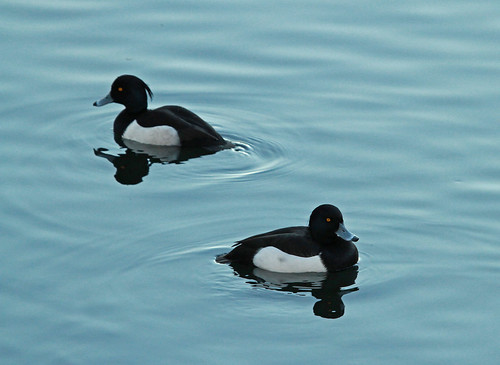
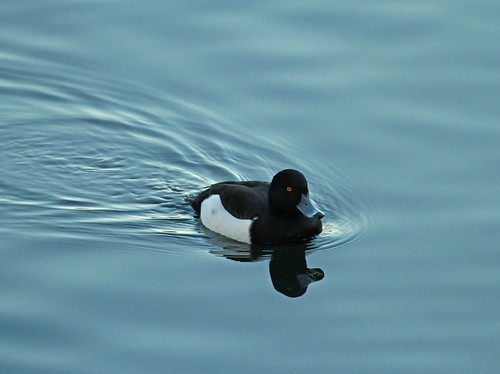
Tufted duck (Aythya fuligula) – the male of the species, with his reflection and his piercing yellow eye

I drove the short distance to Milton Country Park on the north side of Cambridge, which was full to overflowing with folk walking off their New Years Eve hangovers. I’ve been on a mission to get a good photograph of a tufted duck because they’re handsome birds and I’ve taken many sub standard pictures which simply don’t cut the mustard, so I was pleased to get these pictures in lighting conditions that were challenging. It was a very cold but sunny day and by the time I got there in the mid afternoon the sun was already behind the trees, so the light was starting to fail and I needed high ISO to get a picture. But despite that the quality of the images is pretty good I reckon!

The male tufties were grouped together, there were around half a dozen of them, and a way distant was a female, paddling around on her own and she seemed to be avoiding the males.

The female tufted duck and a black headed gull in winter plumage

The lady of the species is dark brown on top with mottled brown flanks and is rather less noticeable than the male. Bit I really like this picture of her because of the colour of the water. She was 60-70m beyond the group of males in the pictures above and I really liked the difference in the colour of the water due to the sun shining on the trees behind her and reflecting on the water, but where the males were the water was the colour of the reflected sky.

So I’m very satisfied with the performance of my new zoom lens and I’ll be posting lots more pictures to show you in the very near future.

(P.S. I’ve been really struggling to keep up with all your blogs and it’s been a source of major irritation, but I’m now going to try to catch up with you all over the next week or so. See you soon. F)

All the other garden birds…

In the last post I described the tits visiting my bird feeders. But of course they’re not the only species fattening up in the garden so this post is about the others. The berries and other food from the countryside are now becoming rather more scarce so greater numbers of more species are appearing.

One of the first to arrive, which has been around for a couple of months now, was my resident robin (Erithacus rubecula, Dansk: rødhals). Robins are fiercely territorial and this little guy being  no exception makes it clear that my garden is his manor, in fact it’s fair to say he’s a complete thug. He only picks on birds of a similar size or smaller and he won’t tolerate them for even a second. The two species he seems to dislike most are the dunnocks (Prunella modularis, Dansk jernspurv) and the coal tits (Periparus ater, Dansk: sortmejse) who have the temerity to enter his domain and he chases and beats them up remorselessly. Earlier this afternoon another robin turned up and I expected real fireworks as I’ve heard stories of rival robins fighting to the death and scalping each other! The fighting this time was restricted to a short chase and a bit of posturing and then it was all over, fortunately no injuries or fatalities were sustained.

A source of much concern this winter has been the absence of goldfinches (Carduelis carduelis, Dansk: stillits). I have a niger seed feeder for them which I keep full, but they ignored it until a few weeks ago, but even then there was only ever one or two making the occasional visit whereas previously they would be feeding there every day, often five or six at a time. And then a sparrowhawk (Accipiter nisus, Dansk: spurvehøg) attacked a goldfinch on the feeder and I didn’t see another one until a few days ago. I don’t know if the memory of the sparrowhawk was enough to keep them away but they have been conspicuous by their absence.

A lone goldfinch feeding on niger seed

There is a tall old tree 10 metres from my garden which I often see flocks of 20+ goldfinches in but they just don’t seem to want to drop down onto the feeder. Maybe if the weather turns icy they’ll alter their behaviour as food gets even more difficult to find.

Greenfinch (Carduelis chloris, Dansk:  grønirisk)
I’m always pleased to see greenfinches because they’re one of my favourite small birds and also because their numbers have been under threat from a nasty parasitic infection called ‘trichomonosis‘ which I posted about last year. So this little chap was very welcome. I was surprised to see him sitting on the niger seed feeder, but he wasn’t eating the seed, he was waiting for an opportunity to descend onto the seed tray which was already occupied.

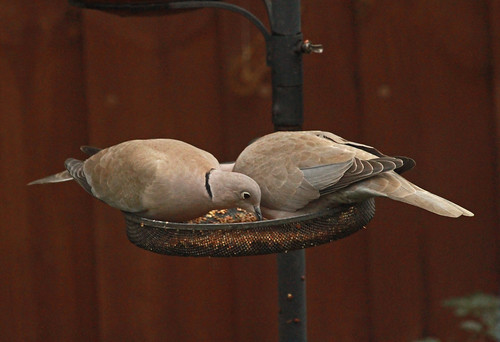
The small birds usually have free access to the seed tray but occasionally it’s fully occupied by a pair of collared doves:

Collared dove (Streptopelia decaocto, Dansk: tyrkedue)

This was one of a pair and its partner was just out of shot further along the fence. A lot of folk seem to be very unimpressed by collared doves but I like having them around and I particularly like this guy with his feathers ruffled by the wind.

Previously I’ve been taking my close ups with a Nikon D40x and a Nikon 70-300mm zoom lens. This has been a really good combination, it’s small and light and therefore easily portable and has performed really well. But last year I bought a Canon 7D because I wanted to upgrade my camera body to one which is more robust and with more capability. I chose Canon rather than Nikon because the lens I thought most appropriate for what I needed was the 80-400mm telephoto zoom, but every review I read of it was that it was no good at all for wildlife photography because the autofocussing speed was much too slow. So I reckon Nikon missed a trick there because Canon have the 100-400mm L series telephoto zoom for around the same price as the Nikon lens which I decided to go for because it is supposed to be good for wildlife.


Wood pigeon (Columba palumbus, Dansk: ringdue) keeping the small songbirds away from the seed tray all by himself

All the photographs in this post except for the greenfinch were taken in murky conditions using my new Canon lens and I’m very pleased with the image quality. So now I’m looking forward to experimenting with it further afield. I’ll post the results as soon as I can.