Butterflies, and all that jazz

Ronnie Scott’s Jazz Club isn’t where I would expect to find subjects for wildlife photography. And, along with the inside of various other hostelries around the City of London, so it proved. That’s where I found myself this weekend and consequently I didn’t manage to take any photographs. So as the weather is so dull and foggy I thought I’d try to brighten things up with some butterfly pictures which were captured at another, less crepuscular, time of year.

Last year I went to a place called Fermyn Wood near Kettering in Northamtonshire with a friend of mine, to look for purple emperors. For the more ornithological among you, particularly if you like birds of prey, this was one of the original release sites for red kites (Milvus milvus, Dansk: rød glente) , and they are still there in abundance. And sure enough one appeared very low overhead before lazily flapping off across the treetops.


This splendid creature is a white admiral (Limenitis camilla), feeding on the nectar from bramble flowers at Fermyn

We set off early to arrive around 8am because at that time of day the butterflies are sunning themsleves on the ground and taking in salts. They get salts from various sources including animal droppings, carrion, sap runs on trees, and sweat. My friend has a photograph of a purple emperor sipping sweat from his sock by inserting its proboscis through the eyehole of his trainer! We encountered a few emperors but they were all whizzing past higher up in the tree canopy. They live in deciduous woods where they spend most of their time feeding on aphid honeydew, apart from this one who sat obligingly on the path and let us take photographs:


Purple emperor (Apatura iris) taking on salts from the substrata

He was sufficiently obliging to unable us to take pictures of the underside of his wings, which are themselves spectacular, but he wasn’t willing to reveal the full irridescent splendour of the top side, which is where their name derives from.  They are big, with an average wingspan of around 8cm, and the males are the most gorgeous deep purple. Alas for the female of the species, she is a rather less dramatic brown colour. I was therefore on a mission to get pictures of the upper side of the wings in 2011 but they are only around for 1-2 weeks of the year and it wasn’t when I could get there. But that’s fine, it gives me something to look forward to next year… or the year after.

On the ground close by the purple emperor was a small tortoiseshell, which are considerable more common and can be found on buddleia bushes up and down the country, but are also amazingly colourful.


Small tortoiseshell (Aglais urticae)

I don’t usually like full on portraits of butterflies, but I like this one because set against the parched earth the flamboyant colours of the butterfly are a sight to behold, all the tiny cells of the different colours in the blue and white peripheral spots are clearly visible. It’s a stunner!


Forests and fungi

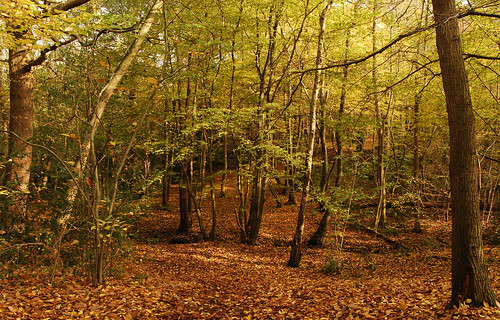
Norsey Wood is a small oasis of ancient woodland situated on the edge of Billericay in Essex.


Beech and birch of Norsey Wood in Autumnal sunshine

It’s a lovely fragment of forest left over from the days when the kings of England had hunting grounds where they would hunt wild boar and red deer, and it consists predominantly of oak, beech and birch. It was devastated by the hurricane in 1987 and many of the trees are still leaning at some rather unnatural angles.

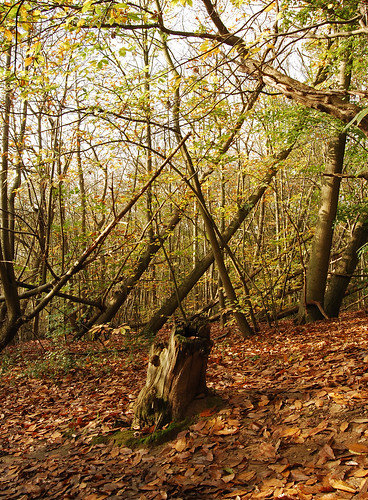
Hurricane damage

I attended a nature photography day at the Wetland and Wildlife Trust at Welney in Norfolk a couple of weeks ago where four top flight professional photographers talked about their work. I was inspired by all of them, but one in particular, a guy called David Ward, made me really think about how I take pictures. He called it ‘making‘ rather than ‘taking‘ a picture, which turned everything on it’s head for me. Previously I’d viewed photography in a rather scientific way as a means of creating a record of an exisitng phenomenon, but the concept of ‘making‘ a picture by focussing down on a small part of a subject to create something more abstract and thought provoking was a  notion which I really like. And there’s nothing like an ancient English wood in the autumn sunshine to suffuse me with paroxysms of artistic fervour!

So I tried to use a similar thought process when I was taking these photographs of the woods. I gave rather more thought to the composition, and as it was quite dark under the tree canopy with intermittent bright sunlight above it, the conditions were tricky. Technically I could have done better, but experimenting with new  thought processes was alot of fun and I hope you like the results!

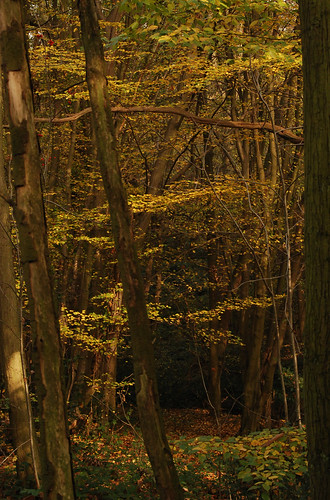
Layers of light

In the ‘hurricane damage’ picture I wanted to capture the angles of the trees that were blown over against the uprights of the undamaged trees, and in the ‘layers’ picture it was the sunlight on the four layers of yellow leaves against the mysterious darkness deep in the wood that captivated me. I think these images are OK and hopefully they convey a little of the atmosphere amongst the trees. If you agree – or indeed if you don’t – or you have  any other thoughts please post a comment and let me know.

If you’re still reading, thankyou for indulging me through my artistic interlude, but now I’ll return to the more familiar and prosaic territory of documenting my wildlife encounters. Going back alot of years to when I was sixteen and had just acquired my first SLR I took alot of ribbing about my fascination for fungi. But I still think they make great pictures and inbetween trying to shoot the trees of Norsey Wood I was capturing some of the amazing variety of fungi growing on and amongst the trees.

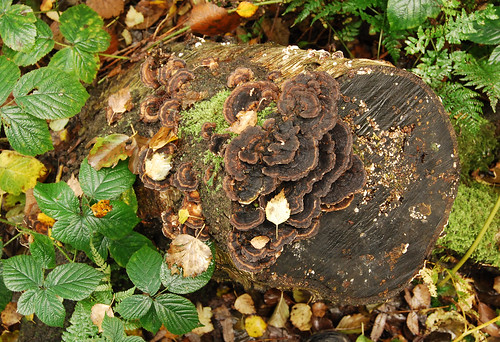
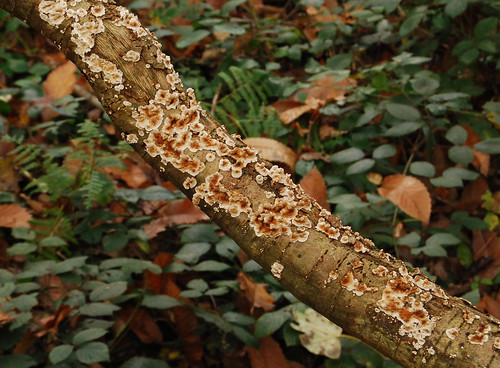
The floor of the wood was covered in a deep layer of multicoloured leaves which changed as the sun waxed and waned and poking through were tree stumps and dead branches plastered with bracket fungi,

I think this bracket is an ‘oak curtain crust’ (Hymenochaete rubiginosa)
And this resupinate is the toothed crust fungus (Basidioradulum radula)

The oak curtain crust grows on other trees than oak, in this instance a silver birch stump and the toothed crust is growing on a dead birch branch. Fungi are biochemically fascinating and they specialise in extracting nutrients from wherever they grow, in this case dead wood, but it could also be live wood or even live humans, as either parasites such as athletes foot, or saprophytes which extract nutrients without harming the host, or in a symbiotic relationship where the association with another live organism is mutually beneficial.

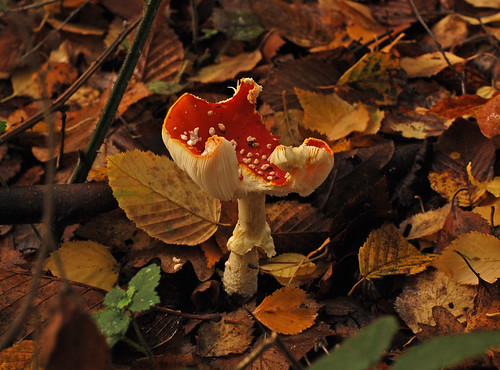
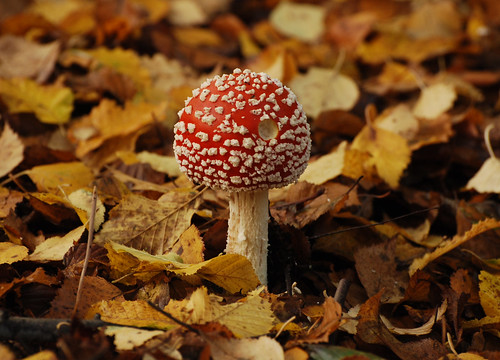
The most recognisable fungus which adorns many a Christmas card and childs drawing is the fly agaric (Amanita muscaria). So called because in days of yore in central Europe it was mixed with milk and used as an insecticide to kill flies. The specific name ‘muscaria‘ is derived from ‘musca‘ which is Latin for fly.


The bright red cap of the fly agaric. The gill structure, the ring on the stem and the white flecks on the cap are also diagnostic, but the flecks can be washed off by heavy rain

The fly agaric is generally considered to be poisonous due to a compound called muscimol, which also has psychoactive properties. Because of this, myths and legends have been ascribed to this mushroom including the use by the Vikings to induce the berserker rages in which they went into battle. Apparently, parboiling it deactivates the toxins and renders it edible, but I reckon if I served it up to my wife she’d suspect nefarious intant!


A group of fly agarics of various ages and sizes, and all of them have been nibbled by other inhabitants of the wood

The balance of nature

At the end of May this year the BBC screened an episode of Countryfile in which John Craven interviewed a member of the scientific staff at the Game and Wildlife Conservation Trust (GWCT). Taking things literally I’d assumed the this was a trust who’s aim was the conservation of game and wildlife. However, as the interview progressed I began to question this assumption as the discussion centred around a study to be carried out by the GWCT in which magpies were to be eradicated from a specified test area to assess the local effect on songbird populations. I don’t think that removal of a native species such as the magpie by trapping and killing them is an ethical way to study predator/prey relationships. But is it scientific?

The magpie – villain of the piece – apparently

The interviewee from the GWCT, Dr Jeremy Stoate, justified the cull on scientific grounds suggesting that increased predator numbers result in significant reductions of prey populations and the species they identified as being largely responsible was the magpie.

Magpies are bold, brassy, ubiquitous, and are generally percieved as being a tad raffish. They undoubtedly predate songbird nests, but I struggled to understand how this could justify slaughtering them. Numerous other species of bird and mammal such as sparrowhawk, kestrel, owls, great spotted woodpeckers, rats, stoats and probably the biggest killer of small birds, domestic cats, all predate songbirds and some raid nests to poach eggs and chicks.

So why was it only magpies that were to be exterminated?

The action was being justified on a scientific basis, and whilst I’m no ecologist, I am a scientist, and the whole thing seemed unscientific, so I decided to do a little research of my own on the subject. Interestingly, since I did my initial research in June, it appears that references to the study on the GWCT website have been taken down. At least, I couldn’t find any.

However, what I did find out was that the study was commissioned and financed by another ‘conservation’ organisation called Songbird Survival. Whilst I believe that GWCT do have a genuine interest in the countryside as a whole, the same cannot be said for Songbird Survival. It is a registered UK charity whose statement of activities on UK Charity Commission website is this:

THE PRINCIPAL OBJECTIVE OF THE CHARITY IS TO IMPROVE, PROTECT AND PRESERVE FOR THE BENEFIT OF THE PUBLIC THE POPULATION OF SONG AND OTHER SMALL BIRDS BY THE CONSERVATION AND RECREATION OF HABITATS, BY SUITABLE EDUCATION OF THE PUBLIC AND LOBBYING MP’S AND THE HOUSE OF LORDS, TO EFFECT CHANGES IN THE LAW WHERE WE FEEL IT IS NECESSARY.

However, the details on the Charity Commission website also list the trustees, and that makes interesting reading too…

LORD COKE, MR CLIVE PATRICK SHERWOOD, MR FRED VALENTINE INGRAMS, MR JOHN RICHARD PUGH, LORD MICHAEL RICHARD RANKEILLOUR, MR ROBERT JOHN MIDDLEDITCH, MR DAVID GRIFFITH, MR NICK FORDE, LORD JOHN HADDINGTON, MR HUGH VAN CUTSEM, MR COLIN STRANG STEEL

All of these trustees are big landowners, or relatives of landowners, some with shooting estates, and they all support hunting and shooting. Lord Coke is the owner of Holkham Hall in Norfolk and he and several of his gamekeepers have been prosecuted for killing birds of prey by shooting and poisoning. So I’m struggling to believe that these people really have the best interests of songbirds at heart when they are funding ‘scientific’ destruction of a single predator species which has been implicated in taking gamebirds. And via the titled gentlemen listed as trustees they would be ideally placed to carry out their stated aim of ‘lobbying MP’s and the House of Lords‘.

Back to the science though. I recently attended a lecture in which Dr Mike Toms of the British Trust for Ornithology (BTO) talked about garden birds and how gardens are becoming an increasingly important sanctuary for increasing numbers of songbirds, and therefore predators, such as magpies, great spotted woodpeckers and sparrowhawks. In the course of his lecture Dr Toms talked about the decrease in songbird numbers and how magpies were being blamed but said that magpie predation was not the cause of the decline in numbers but habitat destruction and current agricultural practices were the primary reasons. I emailed Dr Toms and he was kind enough to send me several links to published work by the BTO into bird predation. This list included this publication: ‘Population changes of avian predators and grey squirrels in England: is there evidence for an impact on avian prey populations? Journal of Applied Ecology 47: 244- 252‘ describing a collaborative study between the BTO, GWCT and the University of St Andrews in which the impact of 2 groups of predators, those which predate adult birds and fledglings and those which predate nests (including the magpie) were analysed for 29 prey populations. Quoting directly from this paper:

For 22 avian prey species, there is no evidence that increases in common avian predators and grey squirrels are associated with large-scale depression of prey abundance or population declines‘.

Then:

Unexpected was a large number of positive (my italics) associations between predators and prey, particularly for native avian nest predators, which largely exonerates these predators as driving declines in passerine numbers

And:

Analyses of large-scale and extensive national monitoring data provide little underlying evidence for large-scale impacts of widespread avian predators and grey squirrels on avian prey populations…

The paper also describes negative correlations between the remaining seven prey species and predator numbers, and accepts that some of these may be causally related. Although e.g. the relationship between sparrowhawk and tree sparrow is probably significant, that between buzzard and goldfinch almost certainly isn’t. However, in an email from Dr Toms to me he indicates that the GWCT study showed negative causal relations on  a local level but, crucially, not at a population level.

This last point is key to the argument. In a study of population dynamics, if conclusions are to be drawn about overall depletion of numbers in response to a specific influence small local studies cannot be extrapolated to enable conclusions for the population as a whole, and to do so is erroneous at best, misleading at worst.

Incidentally, I also found a publication on the website of Songbird Survival entitled ‘Detecting an impact of predation on bird populations depends on the methods used to assess the predators’, (Methods in Ecology and Evolution (2010),1,300-310, Nicoll M., Norris K.). This is an interesting paper because rather than analysing actual population data it investigates the methods used to analyse the data. And in the summary the last point recommends: ‘…the findings for studies which use opportunistic data, for a limited number of predator species, should be treated with caution and that future studies employ bespoke census techniques to monitor predator abundance for an appropriate suite of predators.’

This is interesting because it argues that the methods used to analyse opportunistic, observational data must be carefully optimised to ensure that conclusions drawn from the data adequately reflect the observations.

None of the publications suggest that slaughtering the predators is a rational scientific way to assess the negative impact on prey species. And I’m inclined to think that culling is poor science, particularly as the latest evidence suggests predator numbers don’t reflect negatively on songbird populations and in some instances there is actually a positive correlation between predator and prey, presumably because the predators remove the sick and the slow before they can add their DNA to the genepool.

I think the notion that predators destroy prey populations is bizarre because I was taught, and importantly, I believe it to be the case, that prey abundance determines predator numbers, not vice versa. If prey numbers decline then shortly afterwards so do predator numbers. Taking the reverse of this theory to it’s logical conclusion, if predator numbers determine prey numbers, all prey species would eventually become extinct and then the predators would also become extinct and the balance of nature which has prevailed for the last few billion years would be turned on its head. Which is absurd.

So population studies which are centred around the slaughter of predators seem to me to fly in the face of all current theory and are therefore morally indefensible aswell as being scientifically unsound, especially when commissioned and financed by such obvious vested interests as Songbird Survival.

Robins and rails

I headed down to the RSPB reserve at Fowlmere south west of Cambridge early yesterday morning (Saturday 5th November, 2011) with my friend and fellow wildlife enthusiast, David, where I was hoping to catch sight of a merlin or a kingfisher or another water bird which I don’t see in my regular haunts. It was a murky, grey morning and the air was holding so much moisture it felt damp. Consequently, conditions for photography were challenging,

Looking across the reedbeds at Fowlmere, distant trees looming out of the mist

Probably due to the weather it wasn’t easy to see the resident birdlife. We heard a great spotted woodpecker (Dendrocopos major, Dansk: stor flagspætte) from the car park but once we entered the reserve it was really quiet, apart from the faint roar of the traffic on the A10 and the occasional jet heading into Stansted airport. But of birds, there was not too much evidence. We heard some redwing (Turdus iliacus, Dansk: vindrossel) and fieldfare (Turdus pilarus, Dansk: sjagger) as they passed overhead unseen, and as we got close to the Reedbed hide a robin (Dansk: rødhals) and a songthrush (Turdus philomelos, Dansk: sangdrossel) were lurking in the bushes near the entrance and a stoat scampered across the bottom of the steps into the hide. From inside the hide we could see 15-20 mallard (Anas platyrhynchos, Dansk: gråand) on the water, and perched on a fencepost on the opposite side of the water was a kingfisher (Alcedo atthis, Dansk: isfugl).

I like the segmentation in this picture and the physical delineation by the fence of the cut and uncut reedbeds. And of course, the tiny spark of blue and orange of the kingfisher sitting in the middle.

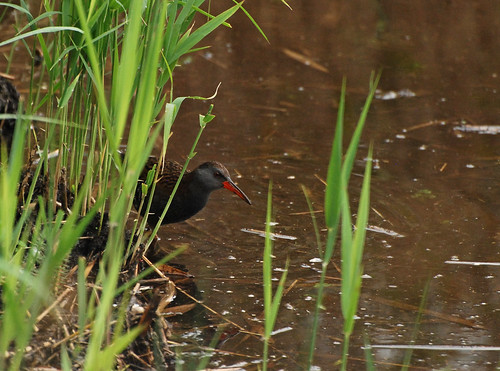
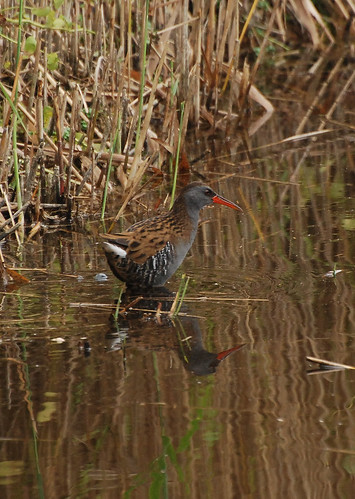
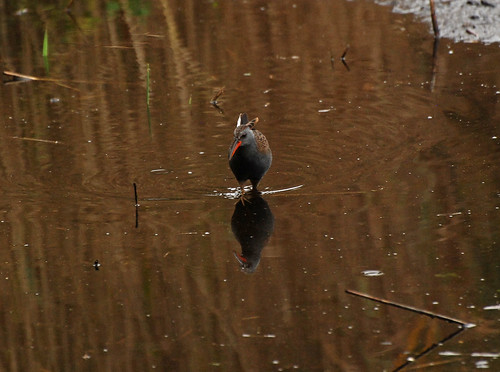
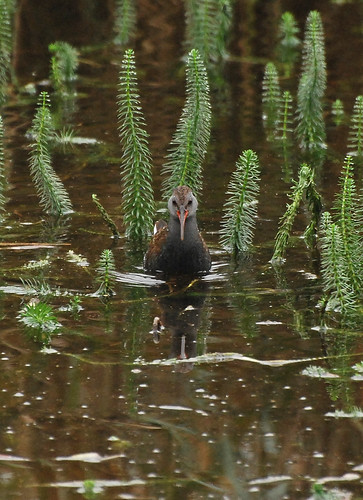
Also on the lake was a heron (Ardea cinerea, Dansk: fiskehejre) fishing in the shallows and half a dozen teal (Anas crecca, Dansk: krikand), and a muntjac deer wandered by. The kingfisher subsequently vacated and no further avian visitors appeared so we vacated too and made our way to the Drewer hide where we’d been told a water rail (Rallus aquaticus, Dansk: vandrikse) was busy feeding. And it didn’t let us down.

The water rail is from the same family as coots, gallinules (moorhens) and crakes and lives and feeds in and around shallow water predominantly on animals but also some plant material.

Water rail emerging from the reeds…


…looking for invertebrates in the mud


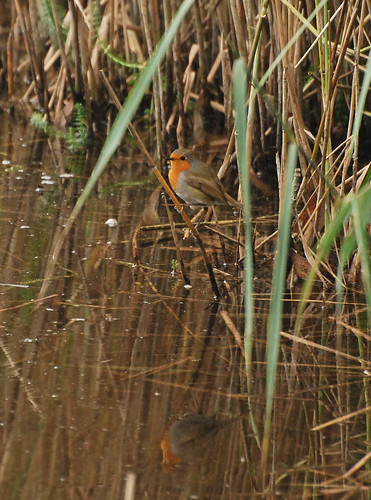
And whilst this charming waterbird was busy captivating my attention a robin was flitting between a nearby hawthorn bush and the reeds:

The robin seemed a tad out of place in the reeds, but a lovely dash of colour on a grey morning with its reflection in the pond


From the front it’s apparent that the water rail is a very slim bird facilitating easy movement between the stems in the reedbeds. I can’t remember the last time I saw one so it was a treat to see this one so close and it loitered for getting on for an hour, until after we left.

Autumnal Anisopterans

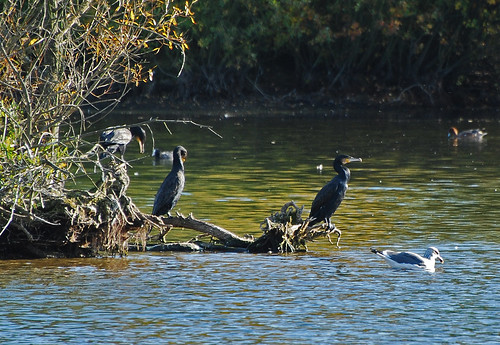
Yesterday, 28th October, was one of those glorious sunny autumnal days where the air was fresh but the temperature was raised by bright sunshine, and I’d heard that the winter migrants were arriving on the lakes at Milton Country Park on the northern edge of Cambridge. So I took my camera to work and headed there for a stroll at lunchtime in the hope of snapping a teal or wigeon or perhaps a more unusual visitor. Several waterbirds were on parade including these cormorants:

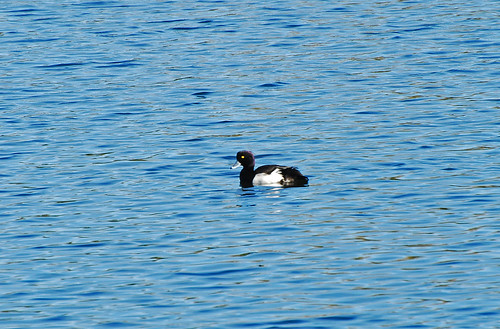
Several migrant duck species were there too, including wigeon (Anas penelope, Dansk: pibeand), the duck with the chestnut head in the background of the cormorant picture is a male wigeon, tufted duck (Aythya fuligula, Dansk: troldand):


A male tufted duck resplendent in his pied plumage and bright yellow eye

…and gadwall (Anas strepera, Dansk: knarand).

What I didn’t expect to see though, certainly not in the kind of numbers present, were dragonflies. It’s  nearly November and the weather has started to get more autumnal but the warm weather up to now must have suited these airborne predators. In particular common darters (Sympetrium striolatum) were conspicuous, six at one time including two mating pairs. It’s always a treat to watch dragonflies but especially on a sunny day at the end of October, living uo to their name and darting about making a loud low frequency buzzzing noise .

Stunning symmetry of a pair of mating common darters

The darters were sunning themselves on the fence lining a viewing jetty on the edge of a lake and while they were busy warming and copulating a migrant hawker (Aeshna mixta) was patrolling the adjacent reedbeds. All the dragons were pretty much oblivious to my presence unless I ventured too close then they would rise into the air, the copulating couple in tandem, only to return to pretty much the same spot with 30 seconds or so.


Migrant hawker

Every so often one or more of the common darters would chase the hawker away until it lived to its name and plucked one of them out of the air and butchered it whilst flying around our heads, scattering the inedible parts around us. After its aerial snack it headed up into the treetops and disappeared.


The hawker missed a trick. It went to alot of effort catching its darter on the wing when it could have had twice as much protein if it had spotted this pair. But I’m glad it didn’t!

Colourful Corvids

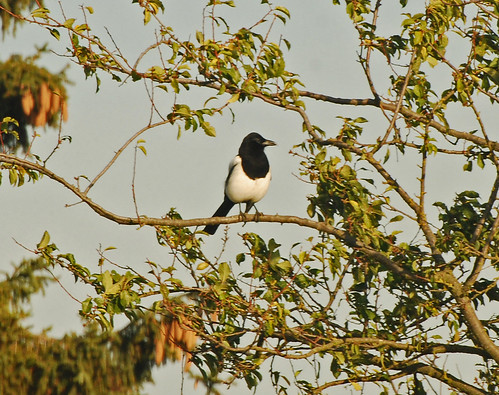
Rooks, crows and jackdaws are the most commonly seen and easily identified ‘crows’. They’re all black and they are widespread across the UK. But they’re not the only members of the crow or ‘Corvid‘ family. Ravens and choughs are also black members of the crow family, although the chough has bright red beak and legs, but both these species are fairly uncommon and seen mostly at or near the coast. There are two common and more colourful crows, the magpie (Pica pica, Dansk: husskade) and the jay (Garrulus glandarius, Dansk: skovskade).


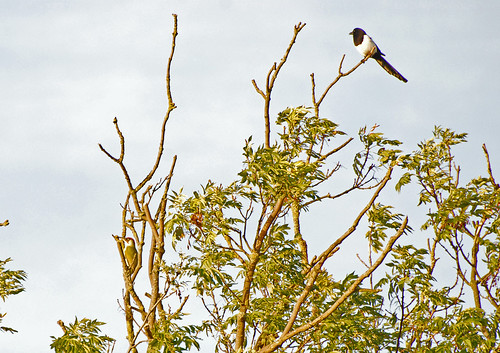
Magpies can be seen everywhere, this one was in a tree opposite my garden

Magpies have an unfortunate reputation on two counts. They are considered to be inveterate thieves, having a particular fondness for shiny objects and they are generally reviled for their feeding habits during nesting of raiding other birds nests and predating the chicks. Of which more in another post. It seems to me they are handsome birds which are much maligned, they simply do what all wild creatures do, i.e. whatever is required to survive and propagate the species. While I watched this one I could hear several green woodpeckers (Picus viridis, Dansk: grønspætte) yaffling around the field and eventually one chased this magpie away from the top of the tree:


The woodpecker, bottom left, was extremely unhappy with the presence of the magpie and voiced it’s discontent with lots of shrieking as it flew aggressively into the tree

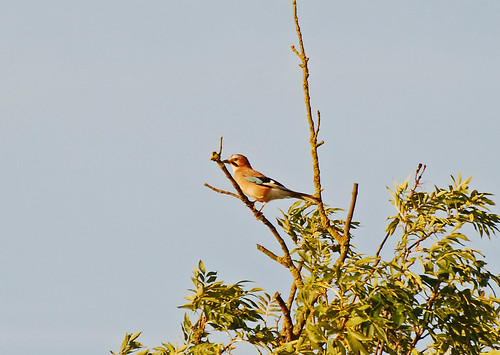
Jays are less frequently observed than magpies, predominantly dwelling in wooded areas in the countryside, but they are also seen in towns and villages where there are wooded areas. I’ve seen them along the Backs in Cambridge, and my friend who lives in a less wooded part of Cambridge has photographed them in his back garden. I encounter the occasional jay brightening up the day when I’m out walking around Histon, but last Sunday I had eight sightings, which is completely unprecedented. There were at least five individuals, one pair appeared together in the fields followed by a separate one a few seconds later, and another pair were busy burying acorns in the orchard opposite my garden. And they are spectacularly colourful, not at all what one might expect from a crow:


The splendid plumage of the jay!

Several jays and magpies came and went from this spot at the top of the tree in the space of a few minutes.


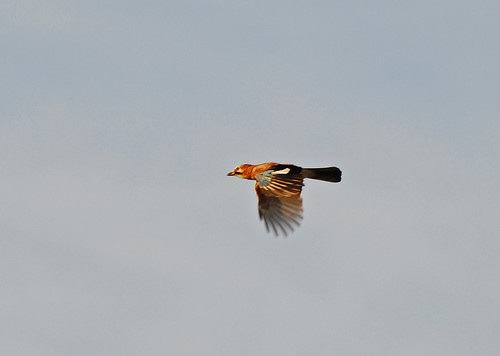
And when in flight the electric blue flash on the wing-bend opens up into a fan


As well as having an eye for sparkly trinkets jays are accomplished stashers and hoarders, and I’ve heard that a single jay can stash as many as 5000 acorns. They also show higher levels of intelligence whilst stashing, if they become aware they are being watched they will pretend to stash and then move away and hide their acorn somewhere else. I think that’s remarkable behaviour; moving away and hiding food elsewhere is one thing, but awareness of what another creatures intentions may be, and reacting to that by subterfuge suggests  a level of underdstanding and reasoning not commonly associated with creatures other than humans.


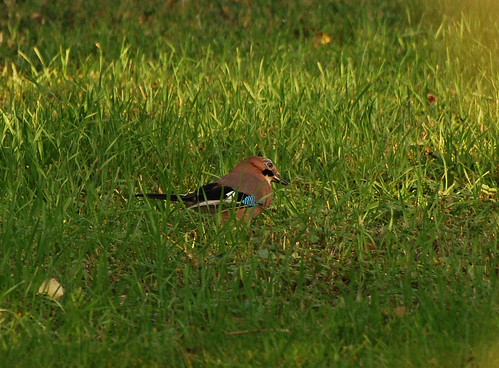
On the ground with an acorn in its beak looking for a suitable burial site, and checking its handywork :

As I watched this pair of jays at work, one of them put it’s acorn down and picked up a short stick, probably around 10cm long, and used it to make holes to bury the acorns in. So as well as the other tricks this jay used a tool to make bigger holes in the ground than it could manage with it’s beak in order to secrete its winter food supplies.

They’re remarkable birds, the Corvid family, and half an hour spent watching any crow species is entertaining and more than a little thought provoking.

Unseasonal Lepidoptera

I was walking in the countryside last Saturday morning around 8am and the weather was bright and sunny. It was also freezing and the grass was glistening  with the first frost of the Autumn. Despite the temperature it was a beautiful morning, enhanced by a deep blue, cloudless, sky and a three quarter moon, and as I wandered along a hedgerow a red admiral butterfly fluttered past.


Red admiral – not the one that fluttered by on Saturday, this one is from earlier in the year.

The colours of the red admiral are gorgeous. It was only when I studied a photograph of one that I really noticed the electric blue spots at the back of the wings and lining the tip of the forewings, and I wonder if the red circle is meant to resemble a fearsome Cyclopean eye to deter potential predators. Whatever the biological rationale they look stunning against the green foliage.

The appearance of the red admiral surprised me for two reasons, firstly because it was so cold, and secondly because in my part of the world all butterfly numbers seem to have been massively reduced compared to last year.

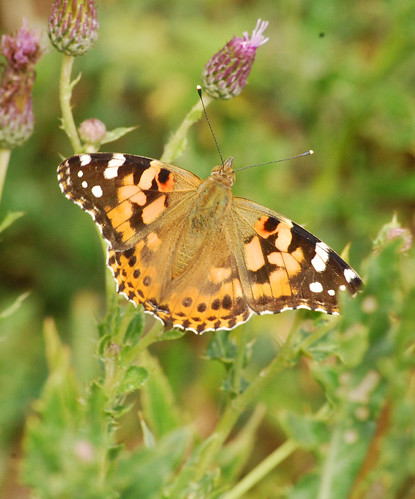
Last year was a really good year for butterflies and in early August, on a hot summer day, myself and my daughter went to a close-by fallow field and did the Big Butterfly Count organised by Butterfly Conservation (http://butterfly-conservation.org). We counted 9 species in our 15 minute survey window, including painted ladies which migrate to the UK for the summer from as far afield as Africa.

Painted lady

I think intercontinental migration is an astonishing feat of endurance for any creature, but for one as delicate and ephemeral as a butterfly it’s totally awe-inspiring. The odds stacked against any individual surviving such a journey must be mightily slim!

Conversely, it was very noticeable that the weather in 2011 was alot colder (it was the coldest summer since 1993 apparently) and butterfly numbers were significantly down compared to last year, in particular the common blue:

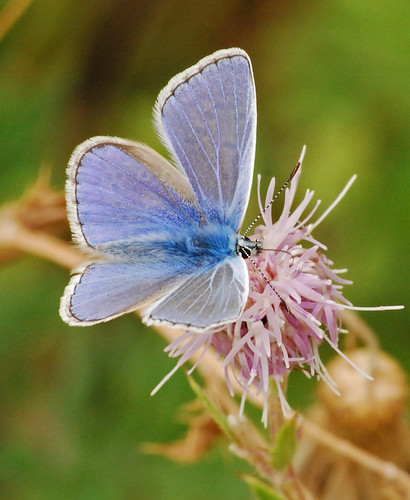
The aptly and, this year, inaptly named common blue. This one, with his wings wide open, is a male…

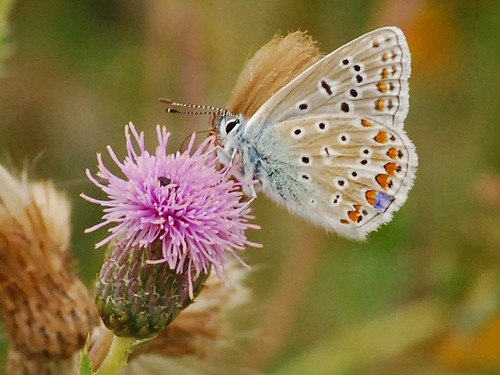
…and with his wings closed


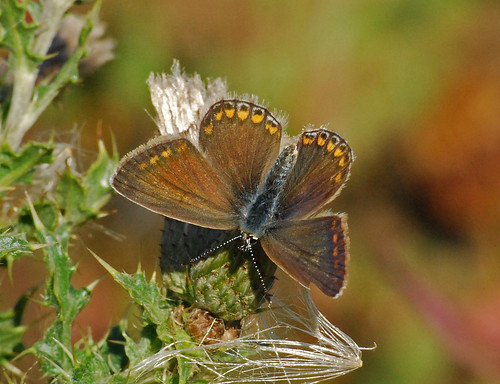
Bizarrely, the female common blue is actually brown

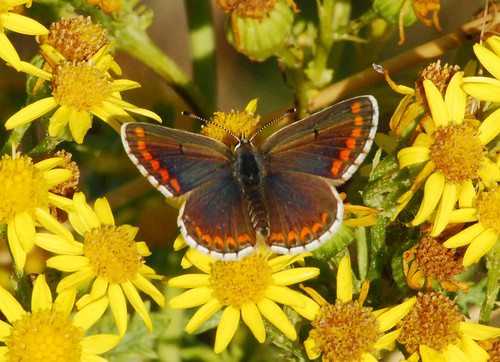
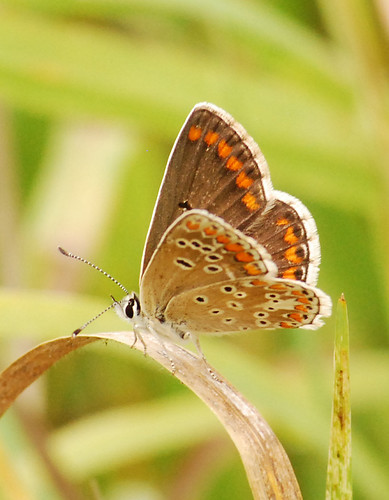
She is looking ragged after a hard summer of mating and egg laying necessary to secure next years population. Common blues and brown argus butterflies can commonly be seen together, they are closely related and the brown argus and female common blue can be tricky to tell apart. She is distinguishable from the brown argus by her overall shape which is very similar to the male above, the white around the orange spots on the hindwing, the blue along the wingroots and the lack of a black cell spot on the forewing, all of which are not observed on the brown argus:


Brown argus sipping nectar from ragwort flowers above. And below revealing the slight differences in the spot pattern compared to the common blue female:


The brown argus can have a blue irridescent sheen when it catches sunlight at the right angle and the wing veins extend through the white wing border, which they don’t in the female common blue.

During a walk through our field at the start of August last year I would see tens of common blue, both male and female, but on the same walk at the same time this year I was lucky to see more than 2 or 3. The results from this years Big Butterfly Count corroborated my unscientific observations and it reports that common blue numbers were down by 61% in this years survey. I’m hoping we get a milder winter this year and a warmer summer next year so the numbers of these beautiful creatures can recover.

I took lots of cool butterfly pictures last year, but as it was before I started writing the Naturephile I was hoping to post them this year. But it didn’t quite come to pass so I’ll try to sneak some of them out under spurious pretexts to brighten up this winter!

Cragside

Whilst exploring Northumberland in August we ventured into  Bamburgh Castle which is well worth a visit not least because it houses a museum dedicated to the Victorian engineering genius and arms manufacturer, William Armstrong. Armstrong used a portion of his colossal wealth to build a remarkable house at Cragside near Rothbury, which is also well worth a visit because it is set in some pretty amazing countryside which is teeming with wildlife. It’s also remarkable because it’s the first house on the planet to be lit by hydroelectricity. So the man who amassed wealth beyond belief by producing arms which were responsible for the deaths of an awful lot of people also set the stage for renewable energy. And that’s a dichotomy which, in my book, makes him a very interesting man.

So… on the way home from Northumberland we decided to avoid the A1 as far as we could which involved going close to Rothbury, and when, completely serendipitously,  we passed a road sign for Cragside (and having joined the National Trust whilst on the Farne Islands) we rapidly decided a visit there was on the days agenda.

And that was a good decision. The house itself would take a long time to explore so we stuck our heads in the front door and decided to explore the surroundings instead. It was a cold and windy day threatening rain, but despite that the gardens were full of flowers attracting bumble bees and butterflies, particularly red admirals. The wooded slopes were full of birds, particularly tits, and most particularly coal tits (Periparus ater, Dansk: sortmejse).

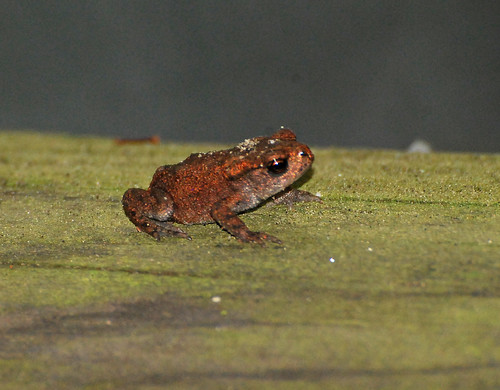
My son spotted a baby toad in the long grass but I didn’t want to disturb it too much so I didn’t get a photograph, but I was rewarded shortly after when I found this little chap walking along the woodwork of a bridge over a stream:


This nascent toad, Bufo bufo, was smaller than a 50p piece and slipped  into the water whilst crossing the bridge, but he sat still for just long enough

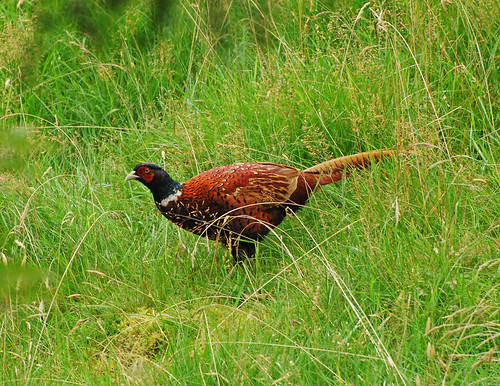
And as we were chasing toads a handsome cock pheasant appeared in the adjacent field,


Pheasant male, Phasianus colchicus (Dansk: fasan) showing off his magnificent plumage

The pheasant was introduced to the UK from Asia, where it’s native range extends from the Caucasus to China, around 1000 years ago. It is extensively hunted, which probably explains why it has been introduced to so many countries!

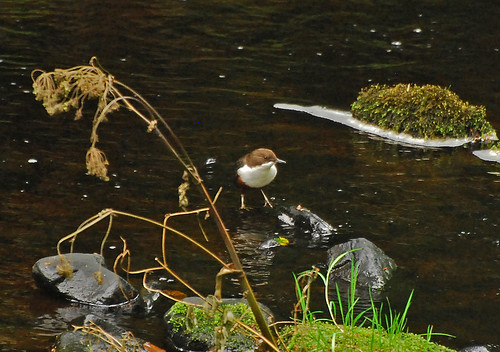
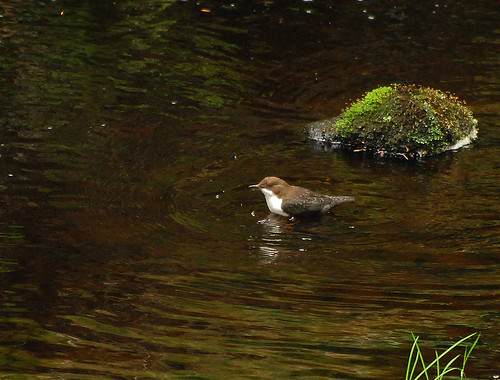
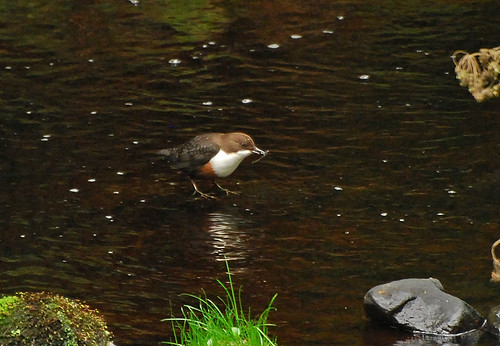
But the ornithological highlight of the visit to Cragside was the dipper (Cinclus cinclus, Dansk: vandstær). It flew past me at high speed low over the stream before landing on a rock which it used as a springboard to hunt insects underwater. I thought it is called a ‘dipper’ because of it’s diving prowess, but while it was perched on terra firma it flexed its legs resulting in a dipping motion of it’s head – so maybe it’s this action that gives it its name. I was wondering why it did the dipping and thought it may enable it to see small prey items underwater more easily.


Dipper perched on a rock contemplating a snack…


Hunting in the stream…


And with a catch – I think it has landed a damselfly

Dippers are unique in that they can swim underwater and even walk on the bottom as a result of having solid bones.

Photographically the dipper posed some interesting problems. It’s mostly a dark coloured bird and was in a dark coloured stream under tall trees on a cloudy morning so there was very little spare light, and it didn’t stay still for very long. Consequently I had to use ISO 800, f5.6 and 160th sec exposure and cross my fingers! Fortunately I was able to focus on the white breast and managed to get a few good shots. It’s a charming little bird and I was very pleased to be able to share some pictures with you.

Autumn arachnids

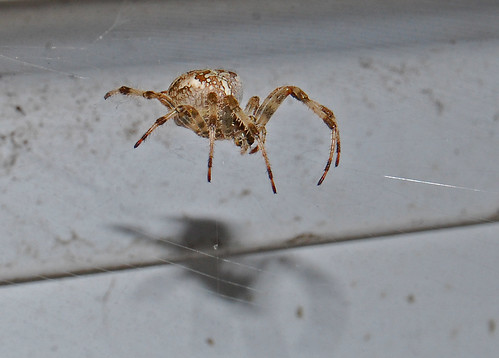
It’s that time of year when on misty mornings the trees and shrubs – and just about any amenable surface – are festooned with the webs of garden spiders (Araneus diadematus). This time last year I posted about an arachnid encounter that occurred outside my back door and this year seems to be a good year for them and my garden is full of them.


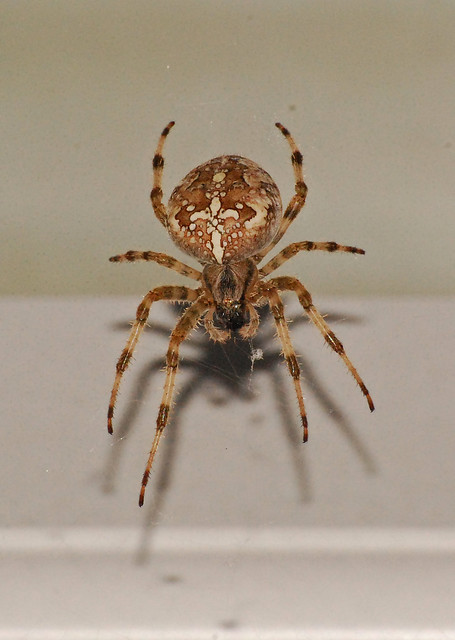
This female garden spider was waiting patiently for prey in her web outside my sons bedroom window


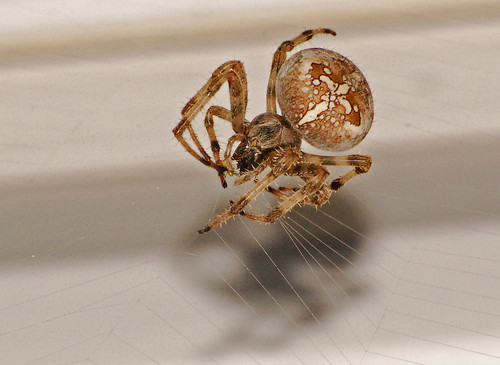
The lady in these photographs was spotted by my son and it is the biggest example of this species that I’ve ever seen. The data I’ve seen for them suggests a maximum body size of 18-20mm, she’s all of that and her leg span is around 4cm. She’s in her web outside a first floor window and is still clearly visible from the ground when she’s hiding under the guttering. She really is huge.

Garden spiders are a genus of the ‘orb weaver’ spiders, so named because the webs they build are circular, or orb shaped. The webs can be seen in hedgerows and window frames and just about anywhere else outside at the moment, laden with dew and glistening in the early morning sunshine.

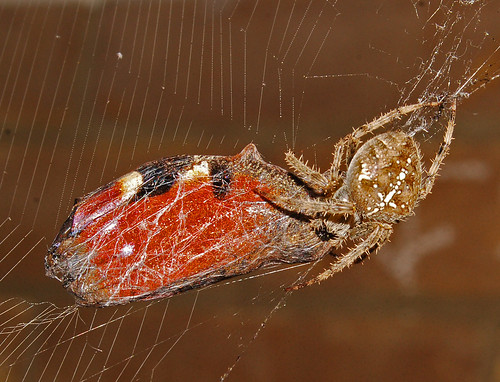
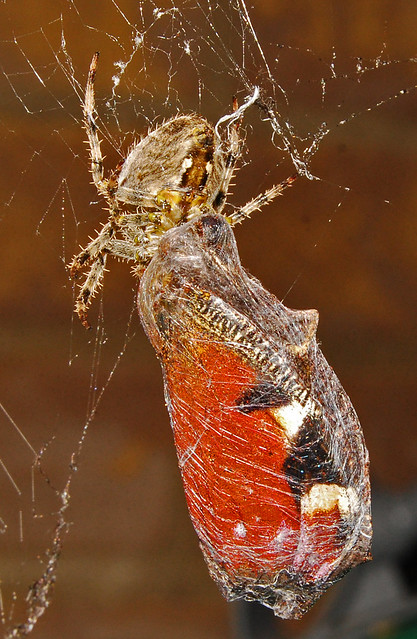
The one below was outside my kitchen window and was in the process of encasing what I think is a male small tortoiseshell butterfly in a silken coffin. It looks as though the butterfly put up a respectable fight as half the web was shredded, but to avail. The spider was poised for some time with its fangs in the body of the butterfly and was completely unfazed by me taking flash photographs within a few inches
They have rather interesting markings too, and another name for them is the ‘cross spider’ from the ornate cream coloured cross on the back of the abdomen. My daughter thinks the cross resembles a design from a stained glass window from a church. Spectacular creatures!
The Farne Isles

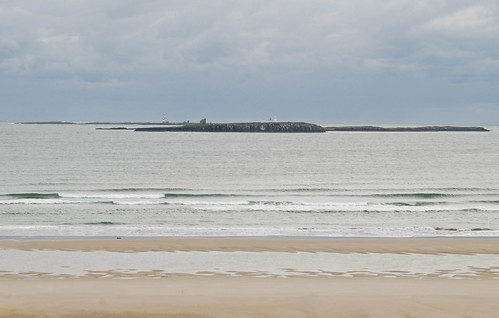
An absolute must for me when I go to the northeast of England is a boat trip to the Farne Islands. The Farnes are a group of small low islands lying a couple of miles off the coast between Bamburgh and Seahouses.

The Farne Islands from the Northumberland coast

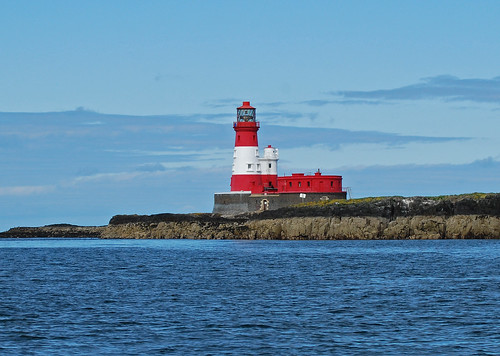
The islands were immortalised in 1838 by the heroic actions of Grace Darling, the 23 year old daughter of the Longstone lighthouse keeper. When a shipwreck was spotted during a North Sea storm on Big Harcar, a small rocky island nearby, Grace and her father crewed a 21 foot rowing boat to rescue the stranded passengers from the SS Forfarshire. Grace was 23 at the time of the rescue, which she survived only to be carried off by tuberculosis 3 years later. Which seems downright unfair to me.


The Longstone lighthouse from where the Darlings’ rescue mission was launched

The islands are currently owned by the National Trust and they are famous for enormous numbers of seabirds including guillemots (Uria aalge, Dansk: lomvie), razorbills (Alca torda, Dansk: alk), kittiwakes (Rissa tridactyla, Dansk: ride), puffins (Fratercula arctica, Dansk: lunde), terns, cormorants (Phalacrocorax carbo, Dansk: skarv), shags (Phalacrocorax aristotelis, Dansk: topskarv) and assorted gulls. During the breeding season there are many tens of thousands of numerous species nesting there.


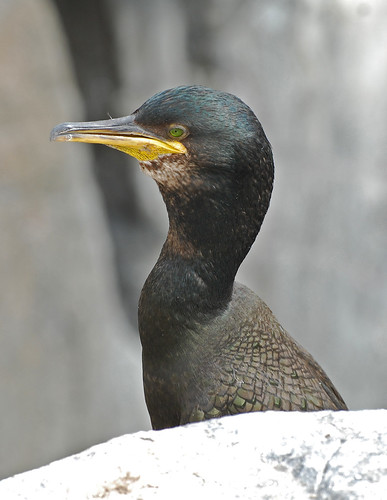
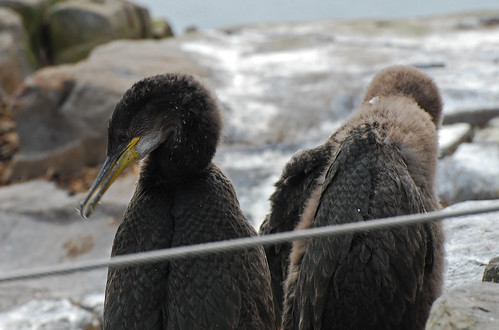
The shags on the Farnes were very relaxed and this one let me approach within 15 feet or so and didn’t seem remotely perturbed. Its yellow mandible and green eye are very distinctive. A few metres along the cliff top were this pair of downy youngsters :

…busy preening out the down and nurturing the nascent flight feathers. It’s remarkable how in such a short space of time nature provides these young fishermen with a full set of plumage capable of withstanding the rigours of these semi-aquatic hunters underwater feeding technique.

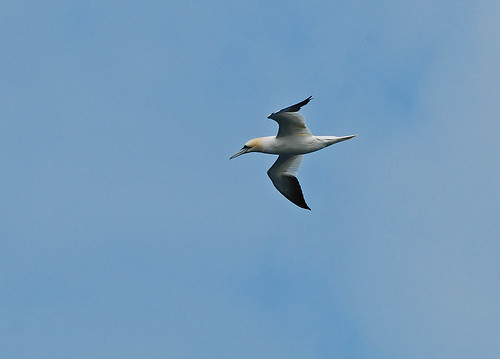
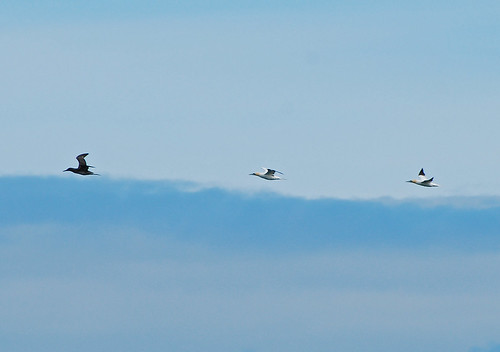
There were one or two turnstone patrolling the rocky shorelines of the islands but the vast majority of the seabirds were completely absent. However, one which did make numerous welcome appearances throughout the course of our trip was the gannet (Morus bassanus, Dansk: sule). They are our largest seabird and can be spotted from afar due to the titanium whiteness of their plumage and their black wingtips. They seemed to be simply passing through that day, all heading north, and none of them paused to dive for fish, which was a pity because it’s spectacular to watch. They were predominantly in family groups of 3-6 birds with adults and patchy darker coloured youngsters.


An adult gannet resplendent in its brilliant white plumage and pale yellow head


…and a family group of three being led by a dark coloured juvenile

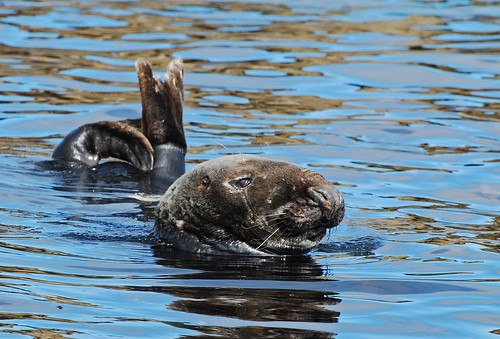
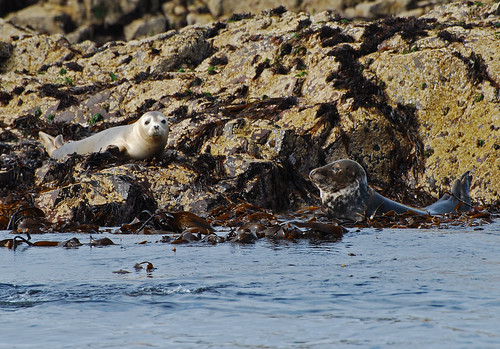
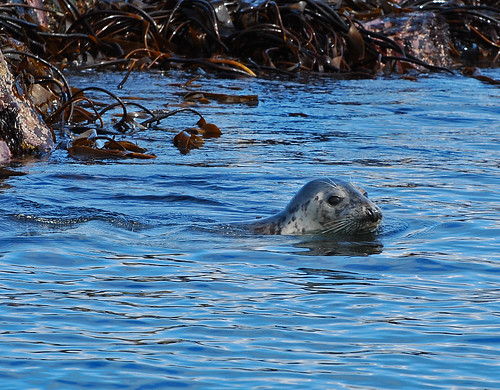
The other creature for which the Farne Islands is renowned is the seal. Specifically the  Atlantic grey seal. All the islands I saw had large groups of them consisting of territory conscious bulls and numerous smaller females and calves. The bulls were highly vocal, rearing up into threatening postures to intimidate any others that unwisely ventured too close. No more physical aggression was required but from the face of the male below they are quite capable of a proper fight resulting in scar tissue. Although I imagine that is most likely to happen during the more serious business of a competition for the attentions of the ladies.


A big bull Atlantic grey seal basking in calm waters
The seal on the right is a female minding her calf on the left
And another female launching herself into the sea from the rocks
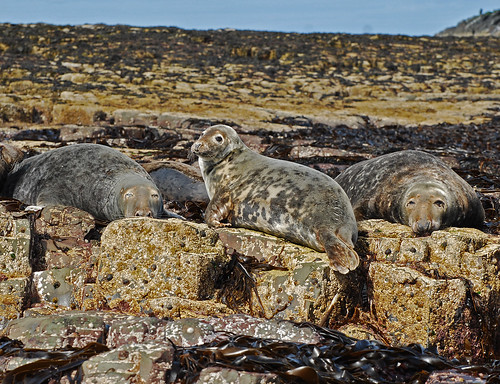
Several members of a bigger group basking in the sunshine

The rocks and the water was full of seals, most were simply basking in the sunshine, the females were minding the youngsters and the males were being generally grumpy. They would hang in the water peering at our boat and some of them were asleep in that position, standing on their tails with their heads poking out of the water. The waters looked crystal clear and it gave me a hankering to explore the islands in kayak and do some snorkelling. But that will have to wait until the next trip.