Avian East Anglia

I’ve just got back from a walk around Milton Country Park, on the northern edge of Cambridge, which was enjoyable and cold in equal measure. Of which more subsequently. And now I’m sitting watching our resident robin chase a dunnock around a bush in my back garden whilst pondering the diversity of birdlife in our area.

Avian diversity in East Anglia was the subject of a slideshow I saw last week organised by the local Cambridge RSPB group entitled ‘Birds of East Anglia’. The speaker was Bill Baston who is a highly accomplished bird photographer living in Suffolk, and has probably photographed nearly all the birds we see in this region. Bill has a very good website, www.billbaston.com, where he’s posted many excellent images from his travels to many parts of the world. For the photographers amongst you he uses Canon hardware with a 500mm telephoto lens.

East Anglia is an excellent place to see birds due to it’s proximity to mainland Europe and the North Sea. Many rare and sometimes exotic visitors can arrive here by mistake or due to being blown off course whilst heading south on the winter migration. The European bee-eater (Merops apiaster), the northern subspecies of long tailed tit (Aegithalos caudatus caudatus) which is immediately distinguishable from our regular British long tailed tit (A. c. rosaceus) by its completely white head, and the unmistakeable hoopoe (Upupa epops) can all occasionally be seen by the vigilant spotter.

Aswell as such visiting rarities it’s usually not necessary to travel too far to see our normal indigenous species, amongst which I include regular migrants. There is a large diversity of habitat in East Anglia, from the tidal mudflats of The Wash in the north of the region, famous for it’s enormous flocks of overwintering waders and geese, the Brecks on the Norfolk/Suffolk border where nightjar (Caprimulgus europaeus – the generic name from the Latin for ‘goatsucker’ as a result of the archaic, and mistaken, notion they suck milk from goats!) can be seen and heard ‘churring‘ on summer evenings, to the Blackwater estuary in Essex at the southern end of East Anglia which is also a great place to see large numbers of waders and other sea birds. In between  these extremities lie the Norfolk Broads, the UK’s largest protected wetland and National Park, Wicken Fen near Ely and Grafham Water near Huntingdon.

This is a small sample of all of the lovely places to see wildlife in this region. But if you don’t find yourself anywhere near these, parks, gardens, hedgerows and fields are all worth a glance – you never know what you might find.

9th January birdwalk

The weather on the 9th was dominated by two features: bright warm sunshine and a biting northerly wind. They were combining to make some brisk but very pleasant walking weather so I spent the morning exploring Guns Lane and fields north of Histon. Rowleys Meadow was very quiet, apart from the occasional blue tit (Cyanistes caerulius) or wood pigeon (Columba palumbus) and numerous unidentified gulls gliding over. Unusually, the only interesting sightings were a song thrush (Turdus philomelus), a pair of magpie (Pica pica) and a flock of hundreds of fieldfare (Turdus pilaris) which drifted over the field east of the Meadow – none of which were close enough to photograph.

Not long after emerging from the Meadow and turning  north up Guns Lane the situation changed dramatically and the hedges were full of birdlife.  Blue tit and great tit (Parus major) were busy looking for food and a pair of bullfinch (Pyrrhula pyrrhula) emerged from the hedge heading northward just as a small flock of approximately 15 fieldfare descended into a tree  in front of me, remaining in situ until I was directly underneath, in pole position for some photographs:

A pair of fieldfare, and…

…a single one

Shortly after taking these pictures and moving on, a second pair of bullfinch rose  out of the hedge. They may have been the same ones as earlier, but I’ve seen bullfinch here on numerous occasions lately so I’m hoping there are more than one pair in residence.

Having turned off the Lane and walked along the south side of a mature hedge containing some big old oak (Quercus robur) and ash (Fraxinus excelsior)  trees, I was admiring the perfect symmetry of a woodpecker hole around 5m up an oak tree when I noticed an insect emerge from it. It turned out to be a honeybee (Apis mellifera):


A lone honeybee entering a woodpecker hole casting its shadow on the threshold

And several more toing and froing in the sunshine. I love the texture and colours of this gnarled old oak tree

I was surprised to see so much honeybee activity on a freezing cold January morning. The south facing hedgerow was sheltered from the wind and  I think the bright sunshine had warmed up the tree sufficiently to waken the bees from their winter slumber. I was hoping they had sufficient stocks of honey to fuel them through their brief awakening before the cold forced them back into hibernation.

I carried on around the field looping back to Cottenham Road in Histon. The terrain on this route included alot of grassy scrub with patches of brambles and other low arboreal scrub consisting predominantly of hawthorn. A green woodpecker (Picus viridis) rose out the grass and dipped over the field to take cover in a tree and a group of five yellowhammer (Emberiza citrinella), which had been feeding on the ground, rose up and headed into another old oak tree which I’d passed by a couple of hundred metres back.  As I about-turned to try to get a photo they upped sticks and returned to their original location on the ground where, where their amazing camouflage rendered them completely invisible even from a distance of about 5m, As I approached so close they again flew into the same old tree and as their place on the ground and the tree were a fair distance apart I  decided not to disturb them again.

The landscape here looked as though it will be rich with birdlife in the Spring and Autumn so I’ll hopefully report more sightings as the year progresses


New Year Nature

The most spectacular natural phenomenon to occur over the New Year period was, in my opinion, the partial eclipse on the morning of Tuesday 4th January. It commenced before daybreak in the orient and by the time the sun rose in the UK it was well underway. A very early-morning glance through the curtains in Histon suggested the cloud cover would scupper any attempts to view it from here. The eclipse was due to complete around 9.30am and with an immense stroke of good fortune the clouds parted to reveal a blazing sun low in the eastern sky at 9.05 so I ran around the house trying to find a suitable eye shield to view it through. Grabbing the chance of a breakfast time chocolate feast my daughter suggested cellophane wrappers peeled from some leftover Christmas confectionery, a stroke of genius on two levels. Alas, by the time there were sufficient to enable safe viewing, the image was so blurred as to be useless. So I rapidly retrieved some old photographic negatives from the attic and several  layers of these provided an excellent filter for the purpose. We saw the partially occluded sun and I even managed to fire off a couple of photographs, so here’s the best one:


Partial solar eclipse at 9.15am on Tuesday 4th
January 2011
from Cambridge UK.

In terms of wildlife there have been a few highlights in the last week. I spent most of my walking time around Guns Lane and Abbey Farm north of Histon and the field to the west of the Lane, lying between it and Abbey Farm, known locally as ‘Rowleys Meadow’, is turning out to be a real treasure trove. A pair of kestrels (Falco tinnunculus) are in residence, usually found in the top of a tree which appeared in my ‘Guns Lane‘ post from the end of November last year.

Kestrel pair are regularly seen at the top of this particular
tree. The top one is a male and the lower individual a female.

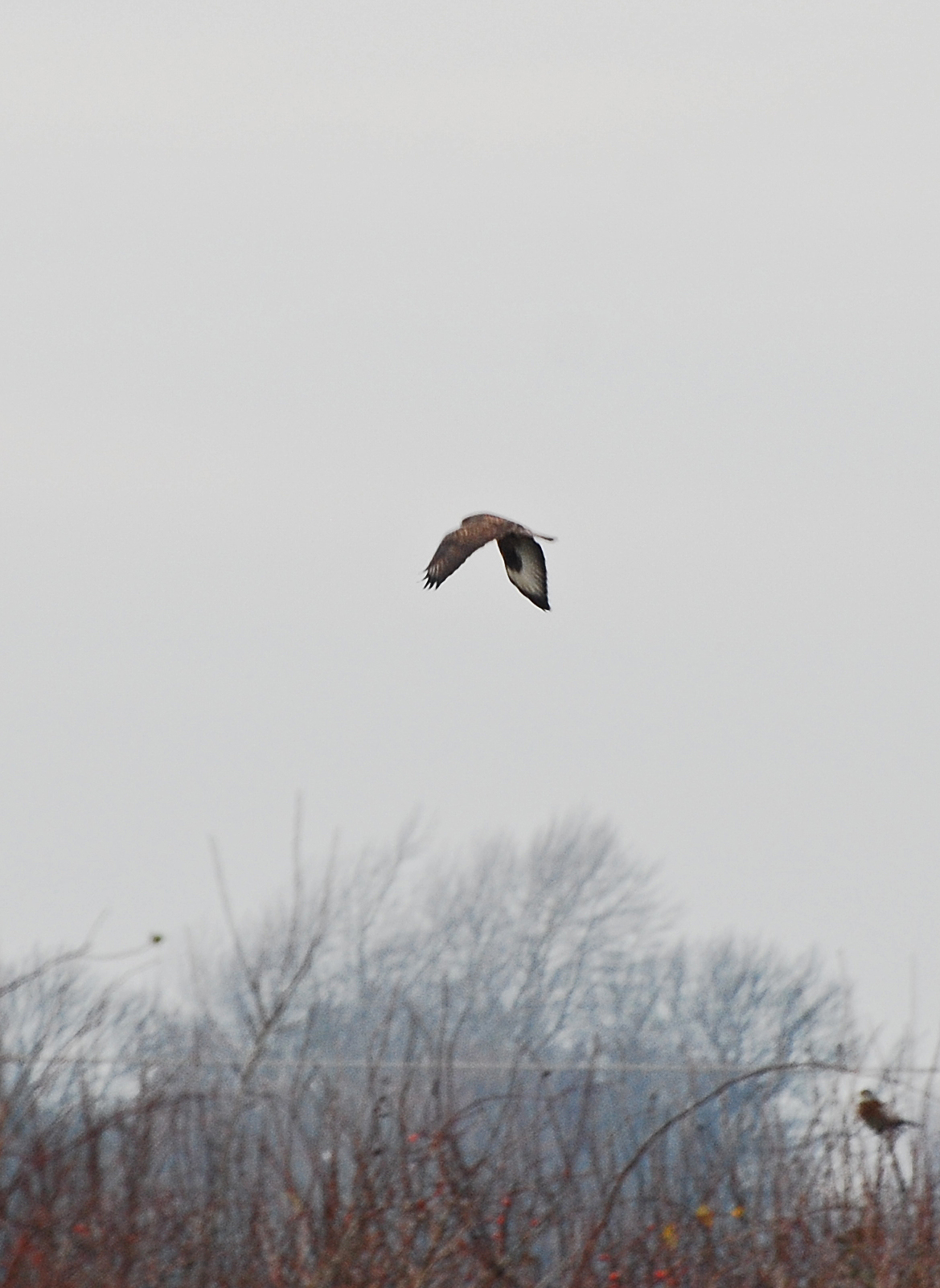
A buzzard (Buteo buteo) has also been in the vicinity at least since New Years Day when it flew low over the meadow heading east and was spotted again on the 3rd perched in a tree further north along the Lane. I spent several minutes slowly working my way along the hedge to get into position for a photograph when a pair of  mountain bikes coming the other way flushed it out. I’ll have to wait for my shot of a perching buzzard.

…so here it is making its exit with a fieldfare lurking in the bush bottom right

The most exciting encounter with a bird prey occurred on New Years Day whilst heading back from walking the dog in the Histon Fields. An orchard opposite my house has been home to flocks of redwing (Turdus iliacus) and fieldfare (Turdus  pilaris) for most of the Christmas holiday. Approaching home at the end of our walk  a female sparrowhawk (Accipiter nisus) approached at very high speed around 8 feet from the ground entering the orchard like a feathery Exocet! To be followed a split second later by a chorus of alarm calls as what seemed like hundreds of redwing scattered in all directions. I couldn’t see if she was rewarded with a meal.

Bullfinch (Pyrrhula pyrrhula) continue to maintain a presence on the lane, three individuals consisting of two males and a female provided a splash of colour in the tree tops on a grey day last week, and I flushed out a pair low down from a hedge further along the Lane. Flocks of long tailed tits (Aegithalos caudatus) are often chasing each other along the hedge and several days ago were accompanied by either a goldcrest (Regulus regulus) or firecrest (Regulus ignicapilla).  It was most likely a goldcrest as firecrest are considerably more scarce and goldcrest are often found amongst flocks of tits. It was too close to focus binoculars on and the light was too murky to see the colours properly, so I couldn’t confirm the identity, but I’ll be keeping my eyes peeled in the hope of seeing it again.

Other species I see on most of my trips along the lane include a pair of green woodpecker (Picus viridis) , song thrush (Turdus philomelus), mistle thrush (Turdus viscivorus), redwing, fielfare and blackbird (Turdus merula)- five Turdus species which on several occasions have all been in the meadow at the same time.

Fieldfare in the top of a tree on Guns Lane

Waxwing (Bombycilla garrulus) continue to grace us with there presence. I’ve had a report from a colleague of a flock feeding on rowan berries on Kings Hedges Road, Cambridge, and my sister told me of a ‘treefull’ she’d spotted in a supermarket carpark in Kettering. Although a quick look in Garden Walk in Histon, where I saw them last week, suggested they may have moved on as there were none around and the trees and bushes had been virtually stripped clean of berries.

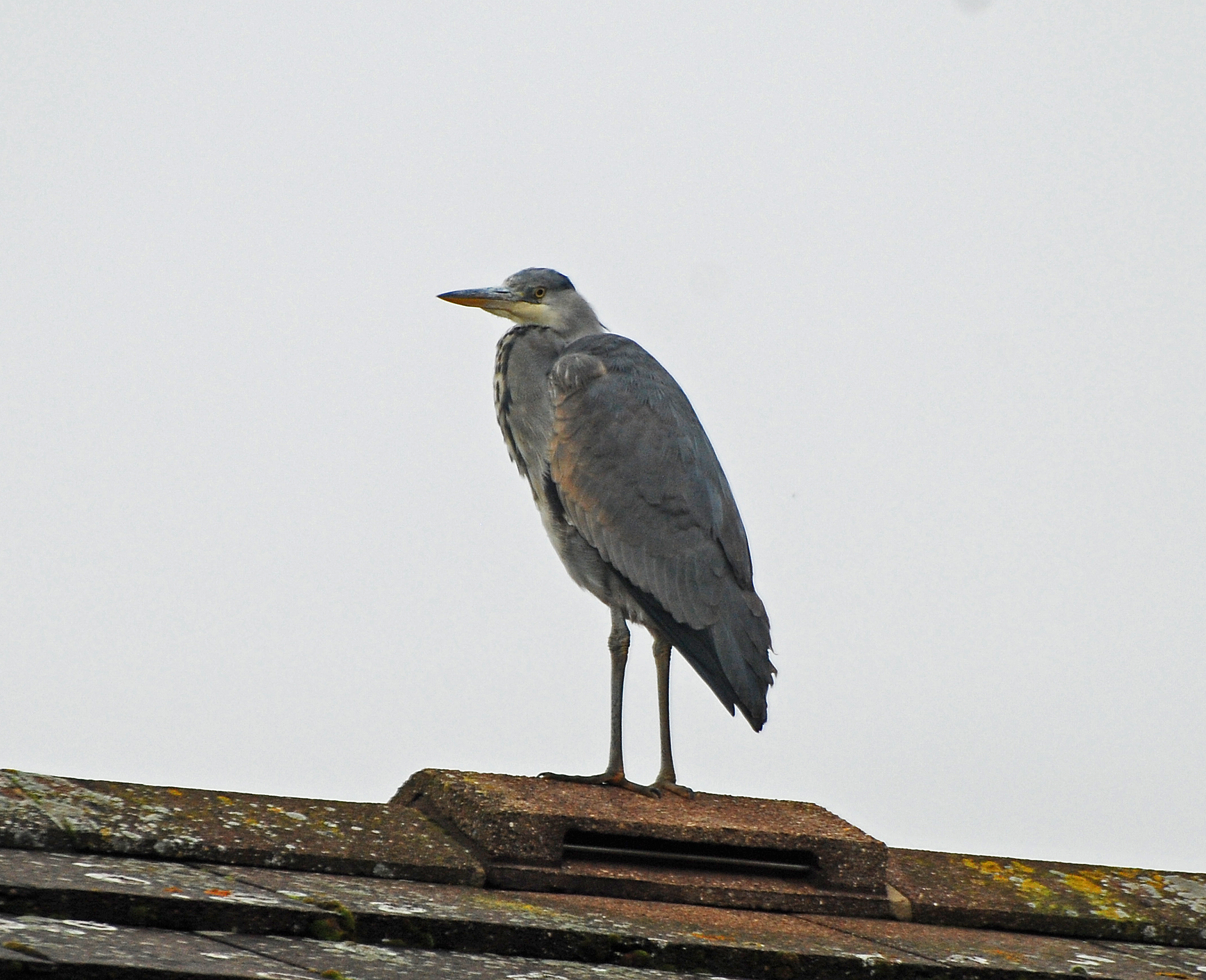
The heron (Ardea cinerea) is spotted around the north of Histon on a frequent basis, flying over and perched on numerous rooves including one behind my house which just happens to have a fishpond in the garden:

Grey heron sizing up a fishpond for an early morning raid in Normanton Way, Histon

It has some primary flight feathers missing on its left wing identifying it as the same one I posted about previously, feeding on pollock in my friends garden, then tapping on his window to ask for more.

Another friend of mine has reported sightings of blackcap (Sylvia atricapilla) and redpoll (Carduelis cabaret) in his garden in the last couple of weeks too. So there is a splendid variety of birdlife of all shapes and sizes to be seen now in a garden near you.

Winter garden birds

The prevailing weather conditions have made me ponder what this post should be about, but a glance out the window made it immediately obvious that the numerous bird species in and around my garden would be a perfect subject. As I’ve mentioned previously, I feed the birds through the winter and as this one has been particularly prolonged and cold, and it’s still only Christmas time, my hanging and ground feeders have been kept topped up with mixed seed, niger seed, peanuts, sultanas and fat balls. There are numerous wild bird food suppliers out there and the one I prefer to use is Vine House Farm in Lincolnshire. The quality of the feed is always good and they take a proactive approach to managing their farm to encourage wildlife. Consequently the food isn’t always the cheapest but I’m happy to pay a little extra to support them.

The variety and numbers of birds visiting the gardens in my vicinity has been remarkable. Within the last week there have been numerous tits – blue tit (Cyanistes caeruleus), great tit (Parus major), coal tit (Periparus ater) and long tailed tit (Aegithalos caudatus).


Great tit male eyeing up a meal of seed on a bitterly cold morning

Long tailed tits usually appear over the space of 30 seconds or so, gorge on the fat balls and as rapidly disappear into a nearby tree. Coal tits appear on their own, take a seed and sit in the buddleia bush whilst they shell the seed and eat the contents and then usually fly away.  They occasionally stay for more than one seed, but not often. Blue tit and great tit behave quite differently, they are omnipresent and there can be up to 3 or 4 visiting  at any one time. Great tits are usually fairly nervous, they take a seed and sit at the back of the buddleia making maximum possible use of the available cover. Blue tits are much less neurotic and whereas they will take a seed and fly off to eat it, they sit in much more exposed locations. They are also happy to take on the resident robin (Erithacus rubecula). He’s a feisty little chap and he takes up position on a plant pot on the edge of the undergrowth and chases off all the other snall birds from his patch, particularly dunnock.

The resident robin guarding his territory on the flat feeder

The robin also stands on the flat feeder repelling all comers, but the blue tits have devised a technique to deal with this. They hang upside down on the edge of the feeder while the robin is on top and then flip over the top, grab a seed, and vacate quick-sharp to the buddleia bush giving the robin no time to attack.

Finches have also been conspicuous, up to half a dozen chaffinch are omnipresent in both front and rear gardens feeding on the ground. Before replenishing the flat feeder I sprinkle the remaining seed on the grass and under adjacent shrubs for chaffinch (Fringilla coelebs), dunnock (Prunella modularis), robin, wood pigeon (Columba palombus) and collared dove (Streptopelia decaocto) to graze on. There are always several chaffinch of both genders brightening things up:

Cock chaffinch resplendent in the freezing rime

Goldfinch (Carduelis carduelis) show up every day to feed on niger seed and in the last couple of days an immature greenfinch (Carduelis chloris) has appeared. Other regular visitors include blackbird (Turdus merula), dunnock, collared dove and wood pigeon which feed either on the ground or on the flat feeder and starling (Sturnus vulgaris) which gorge on the fat balls along with blue tit and long tailed tit. Less frequent visitors include wren (Troglodytes troglodytes), rook (Corvis frugilegus), carrion crow (Corvus corone), magpie (Pica pica) and pied wagtail (Motacilla alba).


Pied wagtail visiting during the coldest, snowiest, part of the recent cold snap

On several days over Christmas a flock of gulls consisting predominantly of black headed gulls (Larus ridibundus) has been swooping low over my front garden and the lawns on the other side of the road. I don’t know what’s attracting them but they’re a welcome addition to the roll of birds visiting my garden.


Black headed gull in winter plumage perched on a telegraph pole on Cottenham Road

As well as our resident birds there are lots of Scandin-avian visitors too. Opposite my house is an orchard-garden with lots of fruit trees and taller trees immediately adjacent. Since Christmas Day have been full of redwing (Turdus iliacus) and fieldfare (Turdus pilaris). It’s entertaining to watch when the fieldfare flock are feeding on fruit on the ground and someone walks along the pavement, within a couple of seconds the whole place comes alive with hundreds of birds heading for the perceived security of the taller trees.


Fieldfare heading to the orchard floor for a fruit feast

Redwing are feeding on the bright red berries of an enormous bush whose identity is unknown to me. There are many tens of them and they have been in situ for the last three days in such numbers. The pale face stripes and red patch around the leading edge of the wing are very pronounced and distinguish them from the songthrush which is similarly sized but lacks the stripes and the red patch:


Redwing – one of the sizeable flock surviving the winter in the garden opposite mine

And the other Scandinavian visitor which has descended on the UK in large numbers this winter due to the particularly dreadful weather in Norway is the waxwing. I posted on waxwing (Bombycilla garrulus) a few weeks ago after seeing them for the first time in Brimley Road, Cambridge. There have been several reports of waxwing sightings in Histon on the Cambridge Bird Club ‘What’s about’ blog in the last couple of weeks but despite keeping a look out I hadn’t seen any  myself… until yesterday. I took a walk to Narrow Close in Histon with my daughter, Sophie, where we found three waxwing in the top of a tree which were feeding on haw berries. We positioned ourselves behind a road sign and watched them for half an hour flitting between the top of the tree on one side of the road and a hawthorn hedge on the other:


Waxwing sitting in a hawthorn hedge

I think waxwing are absolutely exquisite and I’m immensely pleased they have descended on Histon, within a couple of hundred meters of my house. I planted a rowan tree in my garden three years ago to try to attract winter visitors such as waxwing but after a year or two of weak flowering and fruiting it keeled over and died. I don’t know why it failed but after a succession of very cold winters culminating in a ‘waxwing winter‘ the thought they could potentially visit is making me think I should try again. I took another walk to Narrow Close early this morning where there were 8 waxwing feeding on haw berries in adjacent hedgerows.


Another waxwing harvesting haw berries

A green woodpecker (Picus viridis), sparrowhawk (Accipiter nisus) and grey heron (Ardea cinerea) have also passed overhead in the last two weeks. The best thing about the wintry weather is the abundance of wildlife that can be seen by simply putting food out on a regular basis. Most of the photographs in this post were taken in my back garden, and all of them are within 200m of home.

Favourite wildlife moments of 2010

As we rush pell mell towards 2011 I thought I’d compile a list of my top 10 wildlife moments of 2010. I decided a little over a year ago that I was going to start a blog but it took until September of this year to actually get on the case and do it. But now it is up and running I’ve realised it’s one of the best things I’ve ever done. I’ve always derived a huge amount of pleasure from watching wildlife wherever I’ve travelled, in the UK and to more exotic locations. From snorkelling with green turtles over the coral reefs of the Seychelles to kayaking with orcas in the Canadian Pacific Ocean… and sitting in my dining room in Histon watching numerous species of small songbird frequenting my garden in the freezing winter weather.

But in 2010 these have been my favourite wildlife events (mostly within around 2 miles of where I live!):

10. Starting ‘The Naturephile’ and realising there are people out there who want to read it.

9. Garden spider: my garden was full of these little predators in September and October, filling my garden with webs such that negotiating the gauntlet to put the bins out became my job. Non-negotiable. I posted on them in October (post entitled ‘Araneus diadematus‘) when I got a great series of pictures of Shelob consuming a much smaller male just outside my back door:

That’s him wrapped up in the parcel of silk. Lunch.

8. Swifts in Histon: My photographic skills aren’t up to capturing good photographs of swifts but there were numerous individuals in the air all over the village in 2010. They were screeching up Station Road in Impington as I cycled home from work and 20-30 were regularly hunting insects over the fields north of Histon. There was a period in mid summer when every time a window or door was opened at home they could be heard overhead.  I hope they return here in the same numbers next year when I’ll try harder to get some pictures to share with you.

7. Marsh harrier in Histon: It’s very exciting to see big, rare birds of prey, particularly when they’re not expected. After the harvest this year there was a spell of several weeks where virtually all the birds seemed to have disappeared from my normal walking route. And one morning whilst mooching across the field lamenting the fact, a BIG bird hoved into view, low and approximately a quarter of a mile away. So calling the dog to heel, we sat down and waited. It flew to the opposite side of the field and quartered the long grass the full length of the field right in front of me – around 150-200m away – it was an immature male marsh harrier:

Marsh harrier hunting on the edge of Histon


After failing to find prey he ascended to approximately treetop height and disappeared over Histon to the south heading towards Cambridge.

6. Bullfinch: unlike fruit farmers I love bullfinch – they’re exquisite. When I was a child at home they were regular winter visitors but since then they have become exceedingly uncommon. I saw two in a tree near Girton a couple of months ago whilst walking with my ornithologist friend, David, and since then have seen them in and around Guns Lane in Histon several times. On one ocasion there were four, so I’ve gone from seeing on average one every 3-4 years to seeing 3-4 individuals at one time. A cock bullfinch flying over low against a royal blue sky is a sight to behold! Alas, I’ve no photographs yet, but hopefully this time next year…

5. Waxwing: My encounter with waxwing was described in a recent post simply entitled ‘The Waxwing‘. Myself and my friend Joe spent a freezing cold hour lurking under rowan trees on Brimley Road in north Cambridge and were very adequately rewarded with the presence of seven waxwing, which as well as being wonderfully photogenic were also highly amenable to being photographed. Consequently I managed to get a few nice pictures despite the filthy weather and low light:


Waxwing – Bombycilla garrulus – what a beauty!

There have since seen reports that there are waxwing in Histon. And this week I saw two starling-sized birds with crests amongst a flock of 20 redwing which were flying around near Cottenham Road which could have been waxwing. So far unconfirmed, but will keep looking.

4. Dragonflies: Dragonflies are amazing creatures, and this year I have discovered that a fallow field on the edge of Histon is alive with them from May through to September/October and they offer excellent photographic opportunities. If at rest they seem to be relatively fearless unless I make any sudden or threatening movements:


The blue body of the male broad bodied chaser (Libellula depressa) in my garden, above and the yellow body of the female in a hedgerow, below:


On a sunny day in the countryside, especially near a river or lake, it’s difficult to avoid dragonflies and damselflies. And they’re very entertaining to watch.


Common blue damselfly at Milton Country Park, Cambridge

My Dad told me he was once sitting in the sun in my Grandmothers fruit garden in Denmark when a dragonfly landed on his thumb. He managed not to flinch as it landed so it remained in situ for a couple of minutes before flying off. It returned a short time later carrying a fly and sat on the Old Mans’ thumb and completely devoured its meal.

3. Histon Heron: The shenanigans with the heron were described in my post from last week – ‘Hungry Heron‘ so you can read the story and see the photographs there,  or follow the link to the video clip from here.

The Histon heron – a finely honed fishing machine

The story has moved on a tad since I posted. My friend Chris, whose garden is hosting the heron, emailed to say he had a second bird visiting which managed to negotiate the intricate system of wires comprising the anti-heron device around the pond and steal some fish. And more alarmingly was caught fighting with heron number one who is obviously keen to protect his interest in the supply of fresh fish available in Chris’s garden. I shall report developments as they occur.

2. Butterflies in Histon: this one came about after reading about the Big Butterfly Count in August. There were numerous butterfly species in and around Histon so my daughter, Sophie, and myself went into the fields and counted numbers of species for the requisite 15 minutes. The number of species and the number of individuals was amazing. We saw peacock, red admiral, painted lady, gatekeeper, large white, small white, green veined white, small copper, brown argus, common blue, and ringlet!

Brown argus

Common blue

Gatekeeper

There were also small heath, comma, speckled wood and holly blue in the vicinity which we didn’t count during our 15 minute slot. We’ll continue to do the survey in future years and report the findings here.

1. Seeing a wild badger with Sophie: no photographs from this trip, alas, but it was a great moment. We ventured into Knapwell Wood in Cambridgeshire with my friend, Woody, late in the evening, just before dusk, and staying downwind and as quiet as possible all the way, we managed to get very close to the badger set. We then waited… and waited, and we heard the badgers crashing around in the undergrowth. No animals appeared in view so Sophie crouched down and fell asleep squatting on her haunches…, to be woken up after 20 minutes or so as a young badger ambled up the path towards us. He must have caught our smell as he suddenly stopped 6-7m away and sniffed the air for a minute or two before turning tail and disappearing back down the track. Sophie was very excited but managed to keep quiet until we had emerged from the wood. Listening to an ancient wood prepare for the night with some creatures bedding down whilst others are waking up is a magical way to spend an evening. And Sophie seeing wild badgers for the first time in the middle of the wood made this my favourite moment of 2010.

Have a great Christmas and I’m really looking forward to sharing my posts with you in 2011.

Best wishes

Finn

Rookes, Crowes and Choughes

‘If men had wings and black feathers, few of them would ever be clever enough to be crows’

Henry Ward Beecher
Clergyman, wit and abolitionist

I’m incarcerated at home at the moment, having been laid low with a seasonal Yuletide dose of coughing and spluttering so I haven’t been out observing, photographing and recording. Consequently, this is an ‘armchair post’ using old photographs, and constructed in the warmth of my dining room.

It has been inspired by the superb book ‘Corvus‘ by Esther Woolfson which describes living with many different birds including a rook and a magpie. If you haven’t yet read ‘Corvus‘, insist on a copy as a stocking filler this Christmas. It’s a beautiful book and is beautifully observed and written, one of the best nature books I’ve ever read. It’s very informative, funny and thought provoking and has led me to ponder the enduring relationship between humans and our wild creatures.

Jackdaw (Corvus monedula) sitting on a fence at the top of one of Bempton Cliffs in East Yorkshire

The title of this post ‘Rookes, Crowes and Choughes‘ uses archaic (Tudor) names for three of the Corvids (crow family), ‘choughs’ at that time also included jackdaws, as used in one of the most unpleasant pieces of legislation this country ever promulgated, viz, ‘Destruction of Crows, etc. Act 1532’. This act was passed under Henry VIII and was extended under the reign of Elizabeth I with promulgation of the ‘Preservation of grain Act, 1566’. Together known as the ‘Vermin Acts’, they established a legal framework for the destruction of animals and birds of all descriptions which were deemed a threat to food supplies:

‘…to doo and cause to be don as moche as hym or theym reasonably shall or may be to kill and utterly destroye all manner of Choughs, Crowes and Rookes comyng, abyding, bedying or hauntying (their property) upon peyne of grevous amerciaments to be levied by distress of the goodes and catalles of the Offendours.’

Landowners and workers were thereby legally compelled to actively destroy corvids and communities could be fined up to 20 shillings for failing to meet every year with the court appointed functionary to agree methods to achieve this goal. Along with corvids; kingfisher (believe it or not!) dipper, woodpecker, shag, hedgehog, mole, polecat, fox, rat, badger, weasel, stoat, otter, wild cat and pine marten were all slated for destruction. Kites and ravens fetched remuneration of one penny, a badger or fox, 1 shilling, on presentation of a head as proof of its demise. There was therefore a real financial gain to be made by killing these creatures. (It’s interesting to note how many of the proscribed species are currently the subject of protection legislation and conservation programs.)

Henry VIII didn’t stop there, he also passed the ‘Sumptuary Law’ of 1510, to be updated several times under Elizabeth I and known collectively as ‘The Statutes of Apparel’, which governed what could be worn by which social strata thus establishing a dress code regarding furs. Royalty could wear ermine and substrata of nobility could wear fox, otter etc… . Open season was thus declared on all furry animals.

However, and it is a big however, it is very easy to sit in the comfort of our centrally heated houses with our cars and our convenience stores, and pass glib judgement on people of those times. In the 16th century many harvests failed, early death from disease was a ubiquitous presence in the lives of all people, rich and poor, and one way to stave off such a fate was to eat healthily. Anything which threatened the food supply was therefore deemed vermin to be exterminated.

Religious factors also played a part, e.g. the otter’s diet was predominantly fish so their flesh was deemed by the church to be sufficiently fishy to be eaten for religious reasons instead of fish. God help the otter.

Carrion crow (Corvus corone) foraging for insects

The Vermin Acts were repealed in the mid 18th century but the practices they enforced only started to abate in the early to mid 20th century. That reflects a blood lust in humans which is anachronistic and indicative of a deeply unpleasant side of human nature that in our more enlightened times one may hope would find an outlet in other, more civilised, pursuits. So it is infinitely less problematic to pass judgement on the contemporary activities of hare coursers, badger baiters, egg collectors and misguided land stewards who still trap, poison and shoot red kites… or hen harriers etc., etc..

Back to crows, I have never subscribed to the point of view that members of the crow family are malevolent, wantonly destructive, or the harbingers of doom, as popular culture has historically portrayed them.  And they certainly didn’t merit the attempts at wholesale extermination decreed for them in Tudor times.

I have often watched a couple of hundred rooks assemble in the mornings over Histon church amidst much cawing and general hubbub prior to disappearing en masse either as one, or in several smaller groups to feed in the local fields. I’ve also watched them wheeling in the air, playing tag, and indulging in what can best be described as pure devilment with their fellows and with other species of birds. They seem to possess a keen intelligence probably essential for a creature which lives socially in very close proximity to hundreds of others. The habit of all members of the corvid clan of caching food items, and then re-caching an item if they know they were watched first time round, indicates they have self awareness, awareness of others and coherent notions of the intent of others, and the ability to plan accordingly. And of course a very impressive memory.


Some of the Histon churchyard rooks (Corvus fruglilegus) taking to the air over a field to the north of Histon…
…and a single member of the mob on the ground looking for leatherjackets

It has also been demonstrated from a neuroanatomical standpoint that corvids have a high ‘encephalisation quotient’ – ratio of brain to body size – which renders them capable of higher levels of brain activity and I think that is adequately demonstrated by just watching them for a short time – 10 minutes observation has been enough to convince me on some occasions. ‘Bird brains’ they certainly aren’t!

The key point, it seems to me, is that scientific elucidation of relative intelligence levels between species is a somewhat redundant enterprise in many ways except than as part of an effort to change human perception, and hopefully educate people that random massacre of wild animals is not acceptable. I find it bizarre and shameful that it has ever been considered a reasonable occupation by humans to slaughter billions of animals for no particularly good reason. It is incumbent on all species to share our surroundings with each other in order to maintain a functioning and healthy place which we can justly claim to have managed in a sustainable way.

Blimey, there we are. Nothing like a dose of flu to catalyse a bit of pre-Christmas moralising. But I think if everyone were to read Esther Woolfsons ‘Corvus‘ it may impart a deeper understanding and respect for our fellow creatures in many more people. I think attitudes to other creatures are changing as the enormous amount of available information is accessed by people all over the world, but preserving wildlife will be a perpetual process as wildlife is squeezed into smaller and smaller pockets of true wilderness. I hope we can find a working balance.


Hungry Heron

The current beautiful but brutally cold weather we are experiencing is lethal for many tiny creatures but also larger birds including our grey heron (Ardea cinerea). Cold spells such as the current one can result in the death of a large proportion of our heron population as they are unable to fish for their normal food supply when water courses freeze over.

Statuesque grey heron on Cambridge Science Park
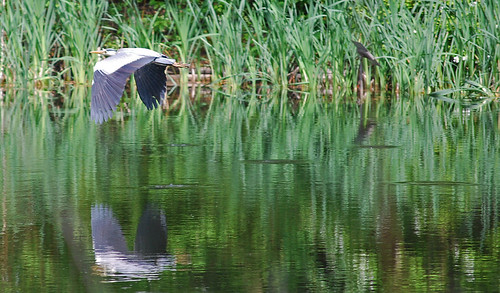
The grey heron is a member of the family containing  bitterns and egrets and aswell as being the largest European heron is one of the largest UK birds.  They stand almost a metre tall with an average wingspan approximately 185cm and feed predominantly on fish and other creatures, in or close to water, such as frogs and other amphibians, but have been known to take small mammals, reptiles and insects.

Herons are considered to be among the more intelligent birds due to their ability to hunt and catch such a wide range of prey. One individual in Histon has recently exemplified this intelligence in an unusual and amusing way. It arrived in my friends garden looking very sorry for itself a few weeks ago at the start of the winter weather. My friend, being a thoroughly decent sort, gave it some fish from his freezer after which the heron decided to loiter. After several free and very easy meals of frozen pollock it took up residence in the garden and when the stipulated mealtime was not observed to its full satisfaction would sidle along to the door and tap on the glass with it’s bill to summon the next course.


The Histon heron
Waiting for a snack…

…and tucking in to a pollock fillet…
…then retired to a nearby vantage point for some post-prandial relaxation

As well as being sizeable birds heron can be stealthy and are extremely efficient fishermen. They catch smaller fish and eels in their bill but as you can see from the photographs the bill is a fearsome weapon and is used to spear larger prey. I once encountered a heron pecking at a prey item on the bank of the Lode at Wicken Fen, as I approached the heron flew away and I found an enormous pike on the riverbank, approximately 2 feet long (I don’t know if a heron would be capable of catching and killing such a big fish) and it had made a surgical incision running from top to bottom immediately behind the gill and had been busy extracting the entrails.

Heron are not migrants to or from the UK but they have been known to cross the English Channel and turn up in France and the Iberian peninsula. They have various common names including the ‘hernshaw’ in Lincolnshire, the ‘marshmens harnser’ in Norfolk and a ‘shiterow’ or ‘shiteheron’ thought to originate from the herons habit of defecating when disturbed prior to take off!

So if your pond is overstocked with fish in the freezing cold weather and could use  some thinning out why not spare a thought for the struggling heron and break the ice so he can refuel and stave off the cold.


The Waxwing

At this time of year a look at the ‘What’s About‘ blog page of the Cambridgeshire Bird Club (CBC) website to see if there are any interesting avian visitors in the locale is well worth while. On Monday this week (29th November 2010) there was a posting on the CBC site recording a sighting of waxwing in Brimley Road, Arbury, north Cambridge. They were spotted feeding on the berries of the many rowan trees in this street. Having never seen a waxwing and having marvelled at the spectacular pictures I’d seen of them I went there at lunchtime to have a look for myself. Alas, there were no waxwing to be seen but I persevered and went there again on Wednesday lunchtime with my friend and fellow wildlife enthusiast, Joe. Again to no avail. So we decided to make an early morning trip on Thursday, reasoning that the waxwing would be more likely to be there at breakfast time.

Thursday morning was snowy and absolutely freezing cold but I set off at 7.45 with my camera. On this occasion it was third time lucky:

Five of the seven waxwing frequenting Brimley
Road last Thursday

The trip was definitely worthwhile! It was a murky, grey, cold morning and until I got within around 30m of the birds I thought they were starlings. But as I got closer the crest became evident and then the colours… and they were absolutely stunning. A blaze of colour brightening up an otherwise grim morning.

The scientific name for waxwing is ‘Bombycilla garrulus‘ which means ‘chattering silk tail’. They are predominantly resident in conifer forests in Scandinavia and are partial winter migrants to the UK. I.e. some of the population head south in winter – known as an ‘irruption‘ – when food supplies in the north which consist of a variety of fruit and berries including crab apple, rowan, cotoneaster and mistletoe, are insufficient to support the whole population. An article in todays edition of the ‘Chronicle and Echo‘, the local newpaper in Northampton, reported that that current weather conditions in Scandinavia are really atrocious so record numbers of waxwing are migrating south giving rise to a ‘waxwing winter‘.

Waxwing feed in flocks, perching in the top of a tree and making occasional forays en masse to nearby fruit trees where they go into a ‘feeding frenzy’ for a few minutes before returning to their perch. This behaviour was observed on Brimley Road, the 7 birds there were sitting in the top of a crab apple tree and moving to an adjacent tree which looked like a rowan with white berries, to feed. There are species of rowan from China which have white berries so I guess this tree was a Chinese variety. We watched them for approximately 45 minutes during which time they appeared almost completely unfazed by our presence or the constant hubbub prevailing in a suburban street just before the school bell.

They are approximately the size of starling and at a distance can be mistaken for starling, as I did. They are 18cm long with a 34cm wingspan and they make a call like someone quietly ringing a small porcelain bell. There are up to approximately 200,000 pairs in Europe and it’s conservation status is green.

I don’t normally go twitching, especially in places as public as this, and I thought people would think we were a tad bonkers. But it was a pleasant surprise how many people stopped to ask us what we were looking at and showed a real interest in the birds. One chap even stopped his van in the middle of the road for a chat, only moving when the traffic behind honked the horn.

A great way to spend an hour before work, despite the freezing weather!


Guns Lane

As I mentioned in my previous post, Guns Lane links the north of Histon with Willingham and Ely, and provided the raw materials for my winter warmer, sloe gin. Due to the profusion of heavily laden trees and bushes – hawthorn, dog rose etc., providing food and cover for the resident wildlife, it is a great place to go birdspotting too.

My first stroll up there this winter was three weekends ago, 13th November 2010) and the profusion of birdlife on display was spectacular. Shortly after entering Guns Lane from Cottenham Road under a copse of tall trees several chaffinch were flitting around at the top. Closer inspection revealed the sumptuous pink breast and black cap of a cock bullfinch who exited the tree accompanied by three others. That was only the second time I’ve seen more than one bullfinch since I was at school. And the first time was the weekend before in Girton. Bullfinch feed on the buds of fruit trees in springtime and have been accredited with decimating fruit crops and I believe it is still legal to trap them in some parts of the UK. Consequently, their numbers dropped dramatically in recent decades so it’s great to see them in threes and fours.

Further on a wren appeared at around eye height craning on a tall grass stem to see me. It didn’t appear overly perturbed by my presence and followed me along the path for 30-40m. Simultaneously, several goldfinch were patrolling the top of the hawthorn trees on the other side of the lane until a visit by a kestrel frightened all the smaller birds away.

N.b. You can find full list of my sightings by clicking on this link to my wildlife diary.

All along the walk numerous small birds such as blue tit, great tit, a flock of long tailed tits, chaffinch and goldfinch appeared and redwing and large flocks of fieldfare are now regular fixtures.


Looking north along Guns Lane on the edge of Histon. These bushes are a hotspot for blue tit, great tit, long tailed tit and magpie

On another walk there had been very little birdlife to see until approaching a bend a little further on from the spot in the photo above, there was a commotion going on which I thought was due to my presence. As I approached blue tit, chaffinch, blackbird and even a green woodpecker took to the air all alarm calling and as I rounded the bend a buzzard emerged from a bush close by and glided up the lane away from me for 50-60m before turning off into a field. That all happened within 30 feet of where I stood and I don’t often get to see a buzzard that close – all very exciting!

Blue tit feeding in a bush on Guns Lane
Fieldfare – this one was difficult to photograph due to the position in the top of a tree and the bright white sky behind – I aim to get some better pictures as soon as possible!

Adjoining the lane at the Histon end of the lane is a field of scrub, which I call Church Field, and is always full of birds, with regular sightings of green woodpecker, chaffinch, greenfinch, latterly bullfinch, kestrel and the occasional sparrowhawk, among various others.


Looking north east across Church Field – it’s a good mixture of old established trees, young scrub and grass

The weather this weekend past (27th and 28th November 2010) was freezing:

and during an early morning foray into Church Field last Sunday (28th November 2010) a kestrel was perched on the uppermost branch of a tree with his feathers ruffled as protection against the cold:

Male kestrel trying to stay warm on a fiercely cold morning

It’s unusual to be able to get close and take photographs of most birds including birds of prey, so I was very grateful to this one for sitting tight for so long. He kept a watchful eye on me as I slowly sidled round the bottom of his tree which gave me time to capture a few decent shots. I particularly like this one looking down the lens with his feathers all ruffled up. On my way back through the field a couple of hours later a cock bullfinch flew right over my head, his colours against the bright blue sky were vibrant.

The section of the lane approaching the Oakington to Cottenham road is different habitat consisting of old, thick hedgerows which are frequented by big flocks of fieldfare and flat open fields which this weekend were hosting small flocks of lapwing (~20) and larger flocks of golden plover (at least 40) in the midst of which a heron landed and sat catching its breath until after I was out of sight. The hedges bordering the fields here are also home to many small birds such as chaffinch, goldfinch and dunnock.


Part of a small flock of 22 lapwing in a field off Guns Lane

And part of a larger flock of golden plover

The end of a walk on Gun Lane can also be the best part and I usually linger right by the Cottenham Road end where trees overhang the lane on both sides. These trees and bushes are usually full of birds including blackbird, chaffinch, blue tit, great tit, coal tit, house sparrow, dunnock, goldfinch and sometimes they’re all on parade at the same time.


House sparrow male in a hawthorn tree at the Cottenham Road end of the lane

And this brave squirrel sat watching me as I was photographing the birds

As you can hopefully see, this is a really good place to go for a stroll and see lots of really good wildlife. All the pictures and observations in this post were collected in just three walks. I’ll post again soon to tell you about my next outings on Guns Lane.


Natures harvest – sloe gin

Guns Lane is an ancient right of way linking Histon with Willingham and then Ely. It has survived the centuries without being turned into a road or the hedgerows being ripped out and ploughed over. Consequently it is lined for much of its length, at least stretches of the part between Histon and Westwick, with numerous species of trees and bushes.

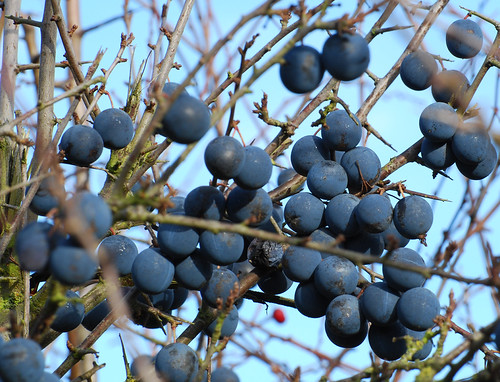
One bush to be found in good numbers is the blackthorn (Prunus spinosa) which at this time of year is festooned with sloe berries. Three weekends ago I interrupted my walk on Guns Lane to collect a box full of sloes and when I got home I made a bottle of sloe gin, which should be ready just in time for Christmas. To the uninitiated imbiber I can heartily recommend sloe gin. The fruit are free and readily available in a hedgerow near you, it’s very easy to make, and the end result is delicious.


Guns Lane Histon – the yellow leaved bush on the right is blackthorn

If anyone has tasted a sloe berry, inadvertently or otherwise, you’ll know that sloes are totally unfit for human consumption. They have an astringency in my experience unrivalled – apart from perhaps a quince. I don’t know if any other creatures can eat them but no one I’ve asked has heard of any animals feasting on them. Which may explain why there are so many in the hedgerows deep into winter.


Sloe berries in late summer…

… and in winter.

In some parts local wisdom suggests picking the sloes after the first frost. I think the reason for that is so the skins are split, or at least permeable, and the gin can soak in and dissolve the good stuff from the berries. It can be made with berries harvested before the first frost but then you simply need to prick them with a knife or put them in the freezer for a day or two prior to use.

Actually making the sloe gin is very straightforward. You need a 75cl bottle of gin (it doesn’t have to be good quality – any cheap and cheerful gin will suffice). Clean a teacup full of sloes and prick them or freeze them if required, empty the gin bottle and place the sloes and a teacup full of sugar  into it. Top it up with gin, put the cap on, lay it down, leave it for 6 weeks remembering to turn it to give it a gentle mix once a day. And that’s it. Six weeks later you’ll have a deliciously fruity and splendidly alcoholic winter warmer, perfect for a frosty walk in the countryside or standing on the terraces watching a match.

The finished product… what a gorgeous colour!
And it tastes lovely too.

This year I was going to experiment and flavour my gin with a little vanilla but I didn’t have a vanilla pod to hand when I made it so I stuck to tradition. After six weeks strain the gin through a clean muslin and it’s ready to drink as a digestif, just because it’s delicious.  If you have a really cheap and nasty bottle of red wine of the kind someone who doesn’t like you very much may have left behind after a party, steep the used sloe berries in the wine for 1-2 days then enjoy with a slab of mature stilton.

Happy days!