Tag Archives: falco tinnunculus

A quick stroll round the meadow

Yesterday evening I accompanied the dog on a very quick circuit around Rowleys Meadow. I didn’t take my camera because I didn’t expect to be gone for very long, but fortunately I did pick up my binoculars.

Venturing along Guns Lane to the gap in the hedge which serves as the entrance to the Meadow I could hear a blackcap uttering its call in the undergrowth. As I was about to go through the gap it flew past me just in front and alighted in the bramble a few feet away and continued calling. It then circled around me for a minute or so as I entered the Meadow and sat singing in the trees and brambles while I stood in the hedge and watched. I didn’t linger for long as I guessed it was probably guarding a nearby nest. If only I’d had my camera with me!
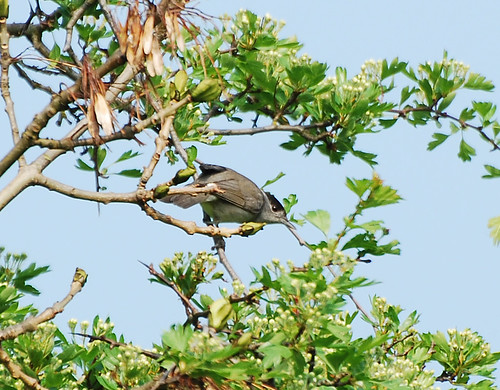

Blackcap male  – from a previous foray into the meadow

I’ve never spent so long so close to a blackcap, and it was lovely to see. There are a good number of them in the Meadow, and at least one nest, and they’re present in the hedgerows around the more open fields to the east of here too.

Moving on around the Meadow, chiffchaff were on parade in their customary locations and common whitethroat were singing on top of the brambles and in the low scrub.
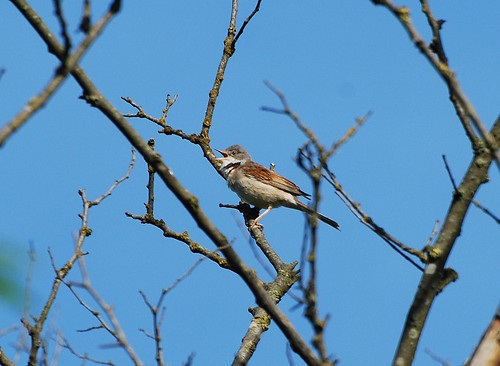

Common whitethroat male proclaiming his territory

There are numerous common whitethroat in and around the Meadow which can be heard singing all through the day and many of the bramble thickets are home to their nests.
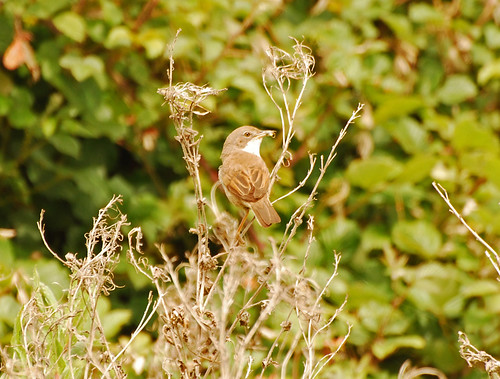
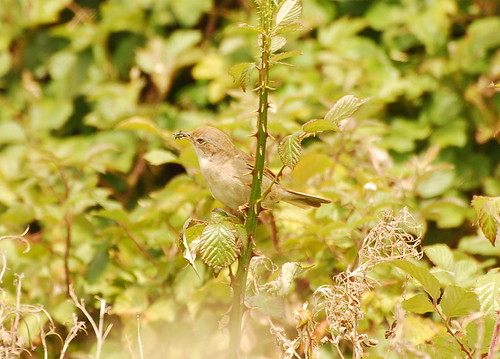
This female common whitethroat was waiting for me to move on before heading for the nest. I crouched down and hid in the long grass just long enough to get these photographs

When seen close up the female whitethroat is quite different to the male both in demeanour and plumage. She isn’t as bold in proclaiming her presence and her colours are more subdued, she doesn’t have the blue grey head of the male.

A kestrel was hovering over the Meadow at various heights for the duration of our walk, diving down into the undergrowth in pursuit of unwary rodents, but he didn’t seem to catch any. But next to the path there was evidence of another predator kill – the empty carcass from a sparrowhawk meal. The brown feathers remaining suggested it was a starling chick but it could also have been a blackbird or song thrush. There was insufficient forensic left to allow an unambiguous identification. Nature at its most brutal, but sparrowhawks have chicks to feed too. On the subject of our local birds of prey, a young buzzard was learning to fly over the Meadow today, it’s plumage was ragged and it was a less than competent aeronaut, and it’s great that they’re breeding in the area.

The other highlight of my quick stroll last night was the number of green woodpeckers. I counted seven, including two sightings of two together, one pair of which were squabbling on the ground. It’s quite possible, even likely, that I counted at least one of them twice, but I think there must have been at least 4-5 individuals.
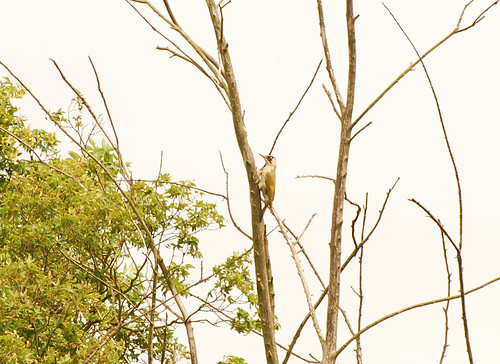

A green woodpecker that I flushed out the grass

There’s lots of birdlife around at the moment and they all seem to be breeding successfully, including the local starling population.

And before I finish, I want to share this wild flower with you:
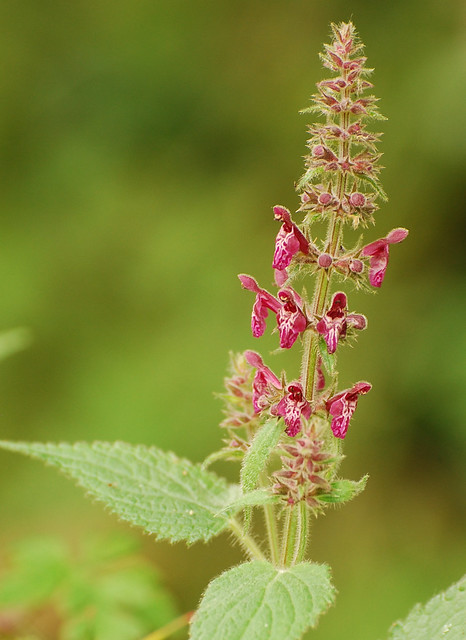
How gorgeous is that?!

It’s the flowerhead of hedge woundwort (Stachys sylvatica) which has just started blossoming in the hedgerows along Guns Lane in Histon. It contains an antiseptic oil which was utilised in days of yore in wound dressings, hence the name. Absolutely exquisite.
Guns Lane bird walk 2nd April 2011

I acquired a voice recorder last week. It’s tiny – not much bigger than a  cigarette lighter – and it means I can record what I see alot more accurately as I don’t need to rely on memory. Which is a good thing as my memory is not brilliant. The weather was glorious on Saturday and Sunday morning so the timing of my acquisition was pretty good because there was an awful lot to record when I was out and about.  The birds are very busy right now building nests and in the last couple of weeks blackbirds have been collecting strands of hay ejected from the rabbit hutch in my garden and I’ve seen various other species with beaks full of grass, twigs and moss.

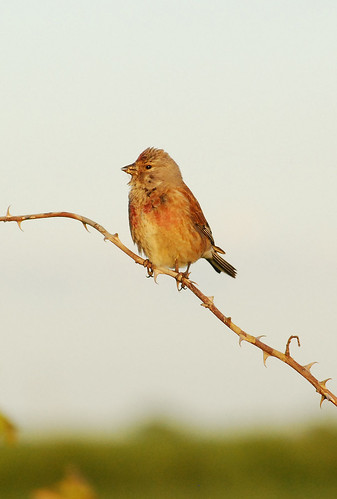
Apart from enjoying the sunshine I saw two species of bird for the first time this year – blackcap and linnet. A pair of linnet appeared to be in residence in a bramble at the southeastern end of Rowleys Meadow, Histon. (On the map, Rowleys Meadow is the area of green scrub in the middle.)

Linnet perched on top of a bramble

The blackcap were in the northwestern hedge row at the opposite end of the field to the linnet and perched, tantalisingly, directly over my head, so my photographs are all of the underside. I saw one pair together and two individuals on this walk which is almost as many as I’ve seen in Histon in total in the last three years.

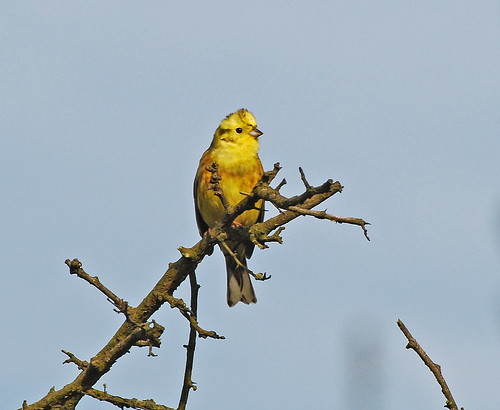
Also in the same hedge along the northwest periphery were several yellowhammer and in the bright sunshine the colours were amazing:


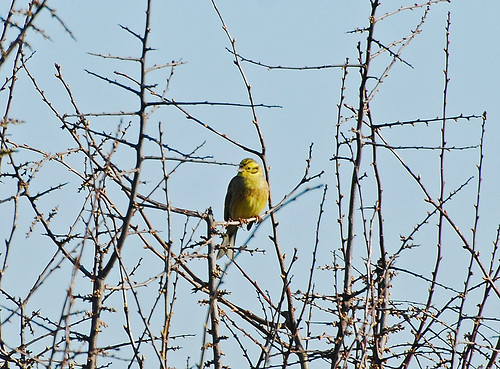
Yellowhammer male sitting atop a branch beautifully lit by the early morning sun

Yellowhammer are a species of bunting that are resident in the UK so can be seen all year round and breed here. They feed predominantly on seeds but also on insects which they harvest from the ground. I often see them perched on top of hedgerows and they fly to the ground when flushed where, despite their colour, are often next to impossible to see. The female has similar markings to the male but  is much less yellow.

Pair of yellowhammer, male  on the left and female to the right – I was very pleased to get this picture as they’re normally so difficult to see on the ground
Yellowhammer are currently on the red list due to the decline in numbers over recent years, although there seem to be good numbers in my locality and I’ve even had one feeding in my garden!

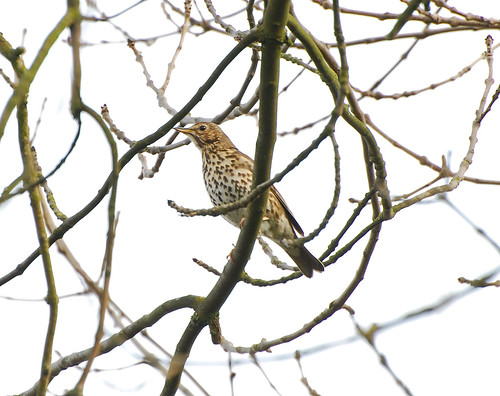
Many species of birds were busy this weekend, including a buzzard, a pair of sparrowhawk wheeling around way up high, and a pair of kestrel. Closer to the ground, blacdbird, chaffinch, greenfinch, long tailed tit and songthrush were all very much in evidence.


The unmistakably speckled underside of a songthrush

Butterflies are also starting to emerge in the warm weather and a couple of red admirals and two others which I couldn’t see close enough to identify were floating along the brambles.

A good photograaph of a blackcap eluded me this weekend as I only managed to shoot it from directly underneath so the cap wasn’t visible, but I shall have another look this weekend and hopefully post a ;picture next time.

Springtime song

The weather this  Saturday was glorious – no wind, blue sky and warm sunshine. Perfect for a stroll around the countryside. So I set off around 8am and apart from the warmth, the first thing I noticed was the air laden with the  fragrances of spring blossom.

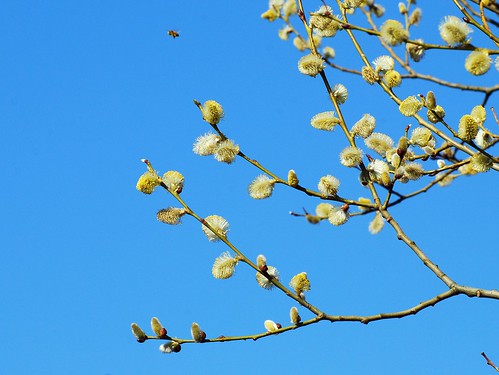
In the last week the spring weather has caused trees and flowers including the willow to blossom…


Pussy willow – the furry catkin of the willow tree against a gorgeous blue sky, and a lone honeybee

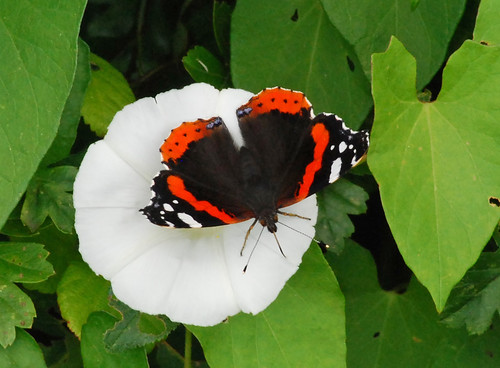
Butterflies are waking up after hibernation. A red admiral (Vanessa atalanta) flew through my garden last week and a friend told me he saw a brimstone in his garden and another wended its way gently past a window at work today.

Red admiral on a bindweed flower
Red admiral feeding on a convulvulus flower

Red admiral are resident and can be seen all year round when weather permits. Brimstone (Gonepteryx rhamni) are also resident and hibernate over the winter but they are now out and about aroused by the warm weather. Bumble bees have also become more abundant in the last few weeks and I now see them on most days.

The birds are all singing and a walk through parks and fields is accompanied by the song of greenfinch, blue tit, great tit, dunnock and robin, most noticeably. And on my hike across the fields abundant yellowhammer, reed bunting and corn bunting, three Emberiza species, were all in full voice:


E.citrinella – one of many yellowhammer, this one is a male, patrolling the hedgerows

E.schoeniclus – reed bunting male

E.calandra – corn bunting making its very distinctive call

Yellowhammer, reed bunting and corn bunting perch in hedgerows and  make feeding forays to the ground in the neighbouring fields where they feast on seeds and during the breeding season and  summer will eat invertebrates. I pass one location where there has been a mixed group of 20-30 reed bunting and yellowhammer present regularly over the last month. Corn bunting have made a recent comeback to the fields around Histon, they disappear at harvest time, middle to end of August, and reappear in the Spring when they can be seen perched on top of brambles, bushes and short trees making their very characteristic song.

Skylark were also singing constantly. Farmland species such as these have seen their habitat severely depleted in recent times, consequently their numbers are reduced as a result.

A red fox and a small group of roe deer put in appearances, the fox was heading a cross the fields to Landbeach heading away from a place I photographed cubs last year, so I hope they are breeding here again this year.


Roe deer – Capreolus capreolus – the leader on the right is sporting native antlers

A pair of crows chased off a buzzard which thermalled over the fields before disappearing into the haze towards Waterbeach and a flock of several hundred black headed gulls squawked noisily over the fields. I observed them for several minutes with binoculars and I think they were all black heads, but there could have been a few individuals of other species mixed in. A sparrowhawk flew at very high speed from the Linnet Hedge across South Bean Field before rising up and passing through a gap in the treeline, causing mayhem with the birdlife in the gardens beyond and a female kestrel was looking for rodents in the South Fallow Field. It was the first time I’d seen birds of prey here for several months so it was great to see three species on one walk.

Fen Drayton nature reserve

Before I tell you about my outing to Fen Drayton here’s a short update on the forest sell off. After denying they are backtracking, the Government has said they may reduce the amount of forest they are getting rid of. Plans to lose 15% of the 258,000 hectares of publicly owned forest are on hold whilst the government ‘re-examine the criteria‘ for the sale. I’m hoping this is government style smoke-and-mirror speak for ‘we’re deciding whether we should proceed at all‘. Time will tell. I think any reexamination is good news and maybe a sufficiently loud public outcry will force the powers that be to sit up and take notice of the vox populi on this issue, and maybe a few others too.

I didn’t manage a wildlife post last week, other events overtook me including the weather, which was blowing a gale at the weekend so I was struggling to see anything through binoculars and photography was completely out the question! So apologies for the omission. There were a few highlights from last weekend though: in a tree in the middle of a field behind Abbey Farm north of Histon I saw a pair of kestrels copulating – which is a fairly unusual sight but it’s good to know the local kestrel population should be increasing this year. Further round towards the Girton road was a big mixed flock of around 50 starling, a similar number of redwing and around 200 fieldfare feeding on the ground and as I was counting these a little egret passed over. I’d been told by a dog walker a couple of weeks ago there was one in that area but this was the first time I’d seen it for myself. Egrets are a comparatively recent addition to the fauna in the UK and they are slowly finding their way northwards in England. The first time I saw them was in the fish market in the middle of Victoria, the capital of the Seychelles, so they have very exotic associations for me and it’s great to see them so close to home.

I set off fairly early in the morning yesterday with my friend to head for Fen Drayton nature reserve which lies between Cambridge and St Ives. It’s a former gravel pit consisting of twelve lakes and ponds which is currently managed by the RSPB. There is a big area of water here interspersed with grassland, scrub woodland, some older more established trees and plenty of reedbeds. So it has a diverse range of habitats that are managed for wildlife and is therefore a good place to see birds.


Far Fen lake showing the varies habitat at Fen Drayton

Despite raining on the way up the A14, by the time we got to the reserve the rain had stopped, leaving complete cloud cover, so the light was very grey as you can see from the landscape shot above. Otherwise the conditions were good: mild, gentle breeze and the occasional, albeit brief, moment of sunshine.

The omens were good too when on the way to Fen Drayton we saw a hare running across a field, and on the approach to the reserve three bullfinch including at least two males were flitting along the hedge just in front of the car. When we were getting out of the car in the car park we could here a cetti’s warbler singing and three green woodpeckers rose up off the ground in quick succession just in front of us.

As we stopped to look at a group of tufted duck on the small pond north of Holywell Lake a jay which we had watched fly across the field appeared in some dead trees on an island in the pond and started stripping big chunks of bark from the tree, possibly looking for food it had stashed there previously. Jays are amazingly good at stashing and are aware that their fellow jays do the same and so will keep a look out to see if they are being watched. If they see another jay paying attention to their activities they will pretend to stashe and then fly off and hide the swag somewhere else.


Four tufted duck – one female and three males on the pond north of Holywell Lake. Note the piercing yellow eyes and the crest

Tufted duck are resident on lakes and we also get migrants visiting in the winter when they stop over on rivers and estuaries too. They’re omnivores and feed by diving to the bottom to sift food from the mud. I think they’re handsome birds especially when they turn their yellow eye to look at you.

Constant companions throughout our walk were chaffinch and great tit. They were present in numbers in almost every tree or bush I looked in.


Chaffinch male in a tree singing for a mate

There were a plethora of other small birds including blue tit, wren, dunnock, robin, goldfinch and long tailed tit. On a bright day it’s now a good time of year to look for and photograph birds because they are actively seeking mates and there are no leaves on the trees to conceal them.


One of a flock of around 7 long tailed tits whizzing through the trees – they’re fiendishly difficult to photograph like that so this is as good as it got!

There was almost a full house of the five common crows – jay, carrion crow, rook – but no jackdaw. There were quite a few magpies though:


This chap was bouncing around the car park

Coot abounded on all the lakes but the stars of the day were the ducks of which there were many species including our common or garden mallard, shoveller, tufted duck, gadwall and wigeon…


A single male wigeon on Oxholme Lake

… but the real star of the show was the goldeneye. There were displaying male goldeneye on Far Fen Lake but alas they were much too far away to get a photograph. They are also resident breeders with migrants arriving in the winter months too.

Mute swan were present on several of the lakes and a couple came over in flight too:


The A380 of the avian world…

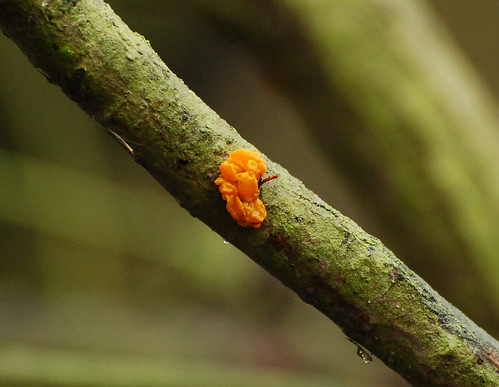
And as with all good nature reserves the wildlife wasn’t solely ornithological. This beautiful little fungus was on a stem next to the path.


Dacrymyces chrysospermum – unfortunately I couldn’t find a common name for this resupinate fungus but its sumptuous colour against the green lichen on the tree stem is striking.

All in all Fen Drayton was a great venue for a Saturday morning wildlife adventure and I’ll be posting from here again before too long.

Buntings abound: 29th and 30th January 2011

This weekend my meanderings took me to the open fields Histon and Cottenham, an area I haven’t properly explored for quite a long time. As I set off early on Saturday morning the weather was murky and very cold and consequently I was feeling pessimistic about encountering the local wild creatures.

Fortunately I was mistaken. The wild creatures were there aplenty. Flocks of mixed gulls, rooks, Corvus frugilegus, (N.b. I’m planning to make a taxonomic index of Latin names for the species on an adjacent page so I can avoid writing them here), and in particular, wood pigeon, Columba palumbus. Wood pigeon can often be seen in flocks but on this occasion there were many flocks, the  largest containing thousands of individuals. They are a farmers curse as they can devastate fields of new shoots, hence the sound of shotgun fire punctuating my progress. My father told me stories of my grandmother being given wood pigeon during World War II – a valuable source of free meat – and when opened up the crops liteally exploded as they were stuffed completely full of fresh green shoots. Multiply that up by several thousand birds and the damage they can do to crops is obvious. Still, they’re impressive to watch in those kind of numbers.

My aforementioned pessimism was tempered by the sight of hazel trees, Corylus avellana, covered in catkins, the first suggestion of approaching Spring time.
Hazel saplings festooned with the first catkins of 2011 – Spring is imminent!

And indeed, a friend told me on Monday morning she had seen daffodils shooting in the village. So I reckon that makes it official. In the same hedgerow as the catkins – the Merlin Hedge – (click here for a sketch map of my walk route), were a flock of greenfinch, Carduelis chloris, and a small group of fieldfare, Turdus pilaris, feeding on the ground. The greenfinch were manic, chasing each other as a flock around the fields either side of the hedgerow.

Turning right at the end of the hedge heading past the Yellowhammer Hedge – which didn’t contain any yellowhammers, or indeed any other birdlife – a big fox, Vulpes vulpes, was standing in the middle of the field beyond watching me and the dog:


A fox taking a keen interest in what me and the dog were doing

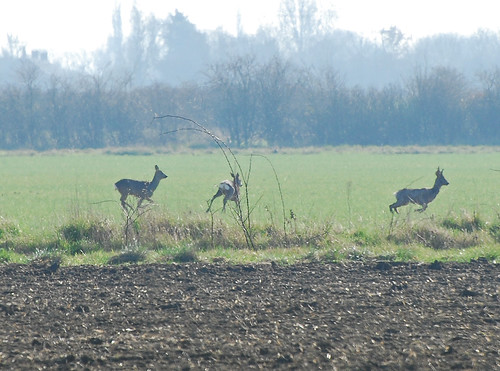
The fox was around 300m away and the quality of the image gives a good idea of the murky grey weather condiitions. Doesn’t convey how cold it was though! This one has a distinctly grey coat and I’ve seen foxes in this area before with similar coloration, so it could be the same one or one of his offspring. He’s close to where foxes reared a litter of cubs last year so he could be one of that family.  After the excitement of seeing the fox, I was scanning the adjacent field for any other signs of life and spotted a second fox – it could have been the same one but he’d have had to move very fast to get to the second location. And as it disappeared through a hedge a group of three roe deer, Capreolus capreolus, entered the same field.


Roe deer bounding across a field – and a bird taking to the air somewhere between me and them

The dog spotted the deer as soon as I did and immediately pricked his ears up, he was around 25m away from me and in order to avoid any dog/deer interaction I called him and the deer instantly turned to look even though they were around 300m away. They have incredibly acute hearing.

Between us and the deer were a flock of skylark, Alauda arvensis, on the ground (it could be one of them taking off in the photograph). It was impossible to count them accurately as they were whizzing around at very high speed close to the ground where their camouflage rendered them almost invisible, but I estimate there were between 10 and 20.

I’d been hoping to see yellowhammer, Emberiza citrinella, and I’d spent some time peering at the Yellowhammer Hedge and the surrounding fields but without seeing many birds at all. Then as I approached the end of the hedgerow leading to the Owl Shed I could see a flock of small birds flitting between the hedge and the Fallow Field and they turned out to be a mixture of reed bunting, Emberiza schoeniclus, and yellowhammer:


Mixed group of reed bunting and yellowhammer


Female yellowhammer
…and a male of the species. What a glorious colour!

Both species were numerous and could be seen flying around the hedge all the way along to the Owl Shed and dropping down onto the ground to look for food and to hide from me.


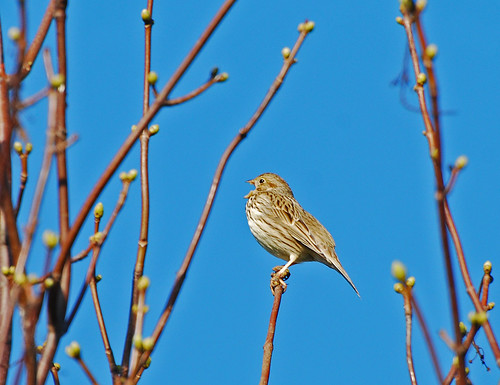
Reed bunting male

Young male reed bunting

The remainder of my Saturday morning sojourn was not quite so lively but numerous fieldfare, redwing (Turdus iliaca), chaffinch (Fringilla coelebs) and a kestrel (Falco tinunculus) were busy around the pig farm.

On Sunday 30th January the weather was brighter and more mild so I set off again towards the Owl Shed to try to get some more photographs. Despite the improved weather there was nowhere near the amount of wildlife around I’d seen the day before, although a hare (Lepus europaeus) appeared in the field where I first saw the fox. And fortunately the reed bunting and yellowhammer were still in the end of the hedgerow where I’d left them on Saturday, although not in the same numbers. So I got my pictures and then had to rush home to get off to my nephews 18th birthday party.

A very enjoyable weekend all round, and in particular the Emberiza species congregated in the Owl Shed Hedge.

New Year Nature

The most spectacular natural phenomenon to occur over the New Year period was, in my opinion, the partial eclipse on the morning of Tuesday 4th January. It commenced before daybreak in the orient and by the time the sun rose in the UK it was well underway. A very early-morning glance through the curtains in Histon suggested the cloud cover would scupper any attempts to view it from here. The eclipse was due to complete around 9.30am and with an immense stroke of good fortune the clouds parted to reveal a blazing sun low in the eastern sky at 9.05 so I ran around the house trying to find a suitable eye shield to view it through. Grabbing the chance of a breakfast time chocolate feast my daughter suggested cellophane wrappers peeled from some leftover Christmas confectionery, a stroke of genius on two levels. Alas, by the time there were sufficient to enable safe viewing, the image was so blurred as to be useless. So I rapidly retrieved some old photographic negatives from the attic and several  layers of these provided an excellent filter for the purpose. We saw the partially occluded sun and I even managed to fire off a couple of photographs, so here’s the best one:


Partial solar eclipse at 9.15am on Tuesday 4th
January 2011
from Cambridge UK.

In terms of wildlife there have been a few highlights in the last week. I spent most of my walking time around Guns Lane and Abbey Farm north of Histon and the field to the west of the Lane, lying between it and Abbey Farm, known locally as ‘Rowleys Meadow’, is turning out to be a real treasure trove. A pair of kestrels (Falco tinnunculus) are in residence, usually found in the top of a tree which appeared in my ‘Guns Lane‘ post from the end of November last year.

Kestrel pair are regularly seen at the top of this particular
tree. The top one is a male and the lower individual a female.

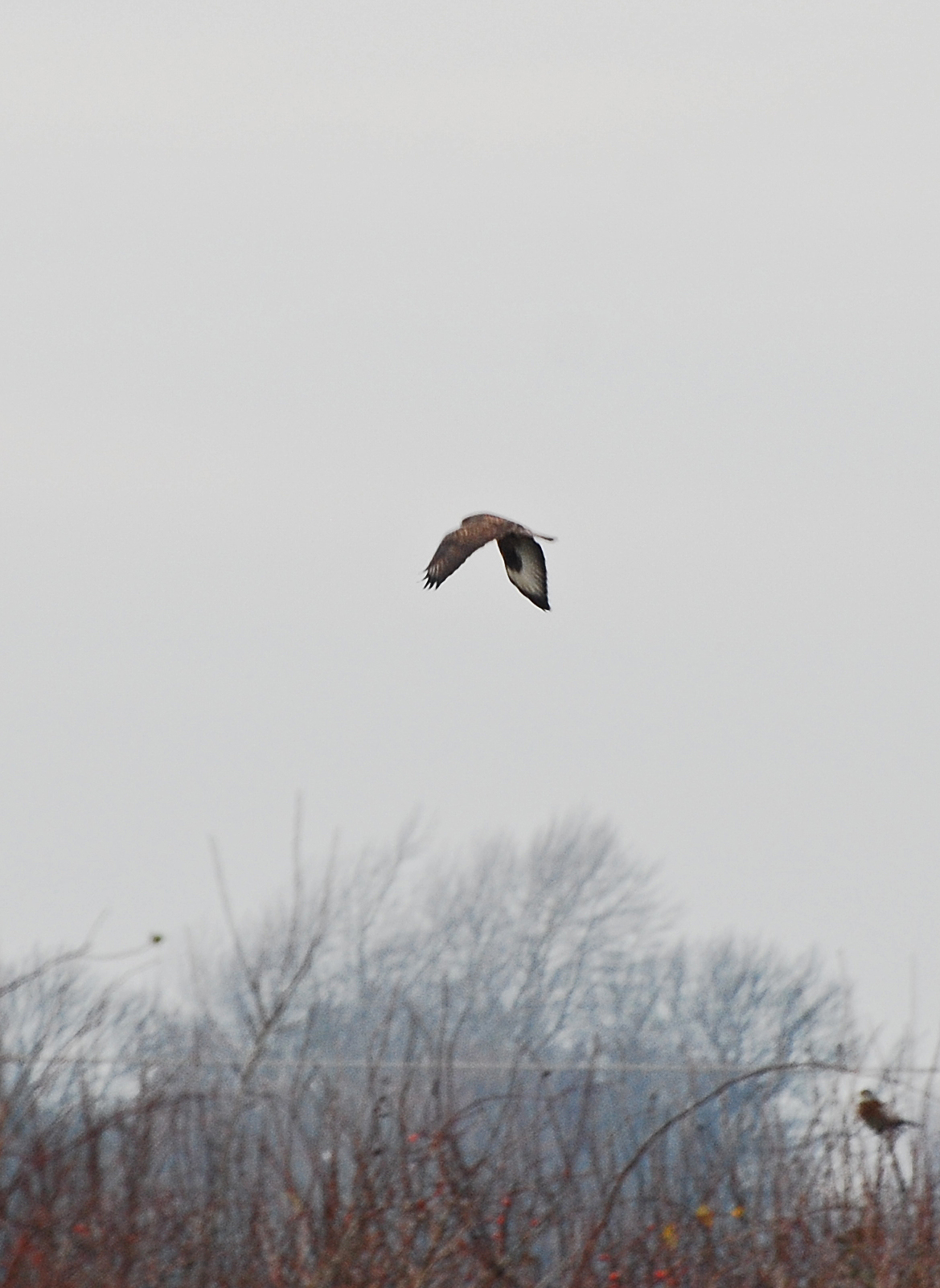
A buzzard (Buteo buteo) has also been in the vicinity at least since New Years Day when it flew low over the meadow heading east and was spotted again on the 3rd perched in a tree further north along the Lane. I spent several minutes slowly working my way along the hedge to get into position for a photograph when a pair of  mountain bikes coming the other way flushed it out. I’ll have to wait for my shot of a perching buzzard.

…so here it is making its exit with a fieldfare lurking in the bush bottom right

The most exciting encounter with a bird prey occurred on New Years Day whilst heading back from walking the dog in the Histon Fields. An orchard opposite my house has been home to flocks of redwing (Turdus iliacus) and fieldfare (Turdus  pilaris) for most of the Christmas holiday. Approaching home at the end of our walk  a female sparrowhawk (Accipiter nisus) approached at very high speed around 8 feet from the ground entering the orchard like a feathery Exocet! To be followed a split second later by a chorus of alarm calls as what seemed like hundreds of redwing scattered in all directions. I couldn’t see if she was rewarded with a meal.

Bullfinch (Pyrrhula pyrrhula) continue to maintain a presence on the lane, three individuals consisting of two males and a female provided a splash of colour in the tree tops on a grey day last week, and I flushed out a pair low down from a hedge further along the Lane. Flocks of long tailed tits (Aegithalos caudatus) are often chasing each other along the hedge and several days ago were accompanied by either a goldcrest (Regulus regulus) or firecrest (Regulus ignicapilla).  It was most likely a goldcrest as firecrest are considerably more scarce and goldcrest are often found amongst flocks of tits. It was too close to focus binoculars on and the light was too murky to see the colours properly, so I couldn’t confirm the identity, but I’ll be keeping my eyes peeled in the hope of seeing it again.

Other species I see on most of my trips along the lane include a pair of green woodpecker (Picus viridis) , song thrush (Turdus philomelus), mistle thrush (Turdus viscivorus), redwing, fielfare and blackbird (Turdus merula)- five Turdus species which on several occasions have all been in the meadow at the same time.

Fieldfare in the top of a tree on Guns Lane

Waxwing (Bombycilla garrulus) continue to grace us with there presence. I’ve had a report from a colleague of a flock feeding on rowan berries on Kings Hedges Road, Cambridge, and my sister told me of a ‘treefull’ she’d spotted in a supermarket carpark in Kettering. Although a quick look in Garden Walk in Histon, where I saw them last week, suggested they may have moved on as there were none around and the trees and bushes had been virtually stripped clean of berries.

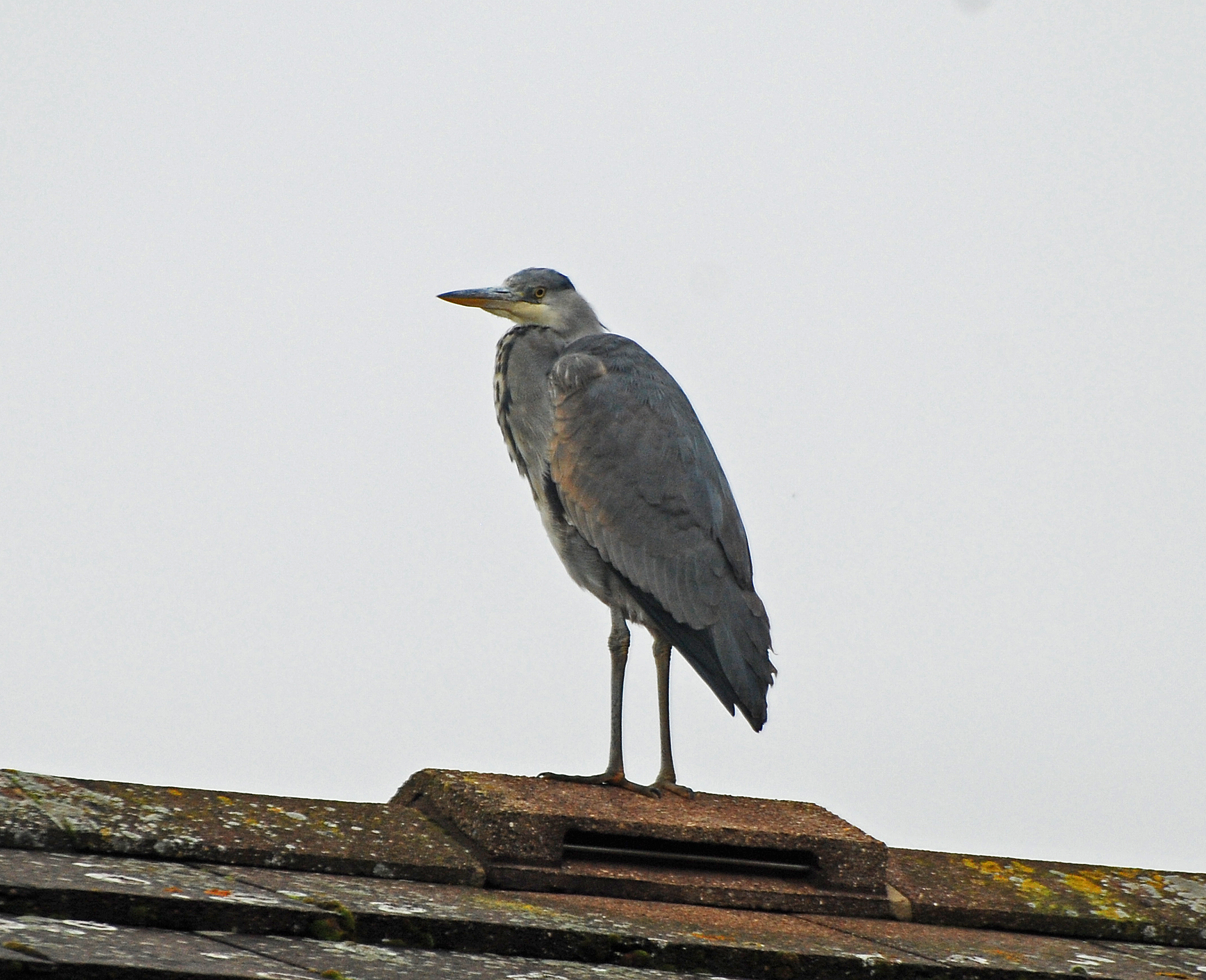
The heron (Ardea cinerea) is spotted around the north of Histon on a frequent basis, flying over and perched on numerous rooves including one behind my house which just happens to have a fishpond in the garden:

Grey heron sizing up a fishpond for an early morning raid in Normanton Way, Histon

It has some primary flight feathers missing on its left wing identifying it as the same one I posted about previously, feeding on pollock in my friends garden, then tapping on his window to ask for more.

Another friend of mine has reported sightings of blackcap (Sylvia atricapilla) and redpoll (Carduelis cabaret) in his garden in the last couple of weeks too. So there is a splendid variety of birdlife of all shapes and sizes to be seen now in a garden near you.