Tag Archives: histon

Histon forays, weekend 5th – 6th March 2011

This weekend I’ve been out and about on my regular walks north of Histon. (Click here for a sketch map of the locality). Yesterday I was out around the fields to the north between Histon and Cottenham. It was a cold grey morning and it was noteworthy for several reasons.

The birdlife was plentiful. (Click here for my wildlife diary where I’ve listed all sightings). Just a few minutes after telling my friend, David, that I hadn’t seen a corn bunting for around 6 months but that they frequent that area in numbers during the summer and disappear very quickly after the harvest, we saw one sitting in a bramble:

It was the first one this year and the first of several we spotted yesterday. It was a good morning for buntings in general. Last time I was here, around three weeks ago a mixed flock of reed bunting and yellowhammer were  in the east end of the Owl Shed Hedge (see post from 29th Jan entitled “Buntings abound: 29th and 30th January 2011). They were there again on Saturday and reed bunting were present in most of the hedges and ditches we peered into. Skylark were present in large numbers too, singing up high and darting around low. A look  on the floor of the Old Water Pump, which has a platform for barn owls to roost and breed, revealed numerous owl pellets most of which were very old, but some of them looked fresher, possibly from within the last 6 months.

One of the ‘Pump House’ barn owls from three years ago

This is a very good thing as barn owls haven’t bred there since 2008 and I haven’t seen one in the vicinity since last year, and then only a couple of sightings all year.

Other appearances which livened up the walk were a muntjac deer, Muntiacus reevesi, introduced from China to the UK in the first half of the 20th century, which was rooting around at the back of the gardens of the houses on Cottenham Road, and a stock dove was sitting in the trees in the same area. I may have seen these before and mistaken them for wood pigeon, but David’s expert knowledge put me straight on the differences. They don’t have the white neck and wing bands of the wood pigeon and they have a dark eye which is diagnostic – that of the wood pigeon is lighter.

I set off in the other direction this morning to head out of Histon north west towards Oakington along Guns Lane and into Rowleys Meadow. I took a slow walk and was very adequately rewarded. Right at the start of the Lane where it joins Cottenham Road blue tit, great tit, greenfinch, chaffinch, starling and song thrush were present and finches were singing constantly,


Greenfinch male singing for a mate in the top of a tree on Guns Lane

…and a chaffinch male displaying his gorgeous black and white tail in a fan. I’ve posted a few photographs of chaffinch lately, even though they’re common I think they’re spectacular!

A couple of surprises today, firstly the number of bullfinch; I saw a single male in Rowleys Meadow which may have had a female with it but I couldn’t see it well enough to confirm, and another pair of males flew along Guns Lane hopping from hedge to hedge infront of me for 50-100m. And secondly, the number of dunnock. They were present in every bush and bramble in the Meadow and on the Lane singing constantly – if you haven’t heard dunnock song, have a listen here, it’s lovely.


Dunnock sitting on a bramble singing

Dunnock have a rather interesting approach to breeding. They don’t pair off as most birds do, a female will be mated by at least two males who will stimulate the females to eject a rivals sperm from the cloaca with their beak. DNA analysis has shown young in the same clutch can have more than one father. I like dunnock, they look boringly grey/brown when seen flitting around the undergrowth, but when they catch the light they are certainly not drab. And their song and their antics at breeding time are anything but boring!

Just as I was about to leave the countryside and head home I noticed a pair of starling sitting on top of a hedge checking out me and the dog. As I turned to point my camera at them they didn’t fly away but simply kept an eye on me so I could get this picture:

The glorious plumage of the starling!

Spring is well underway now and the activities of the wildlife are reflecting that. It’s a great time to be poking around in the woods and hedgerows.

Fen Drayton nature reserve

Before I tell you about my outing to Fen Drayton here’s a short update on the forest sell off. After denying they are backtracking, the Government has said they may reduce the amount of forest they are getting rid of. Plans to lose 15% of the 258,000 hectares of publicly owned forest are on hold whilst the government ‘re-examine the criteria‘ for the sale. I’m hoping this is government style smoke-and-mirror speak for ‘we’re deciding whether we should proceed at all‘. Time will tell. I think any reexamination is good news and maybe a sufficiently loud public outcry will force the powers that be to sit up and take notice of the vox populi on this issue, and maybe a few others too.

I didn’t manage a wildlife post last week, other events overtook me including the weather, which was blowing a gale at the weekend so I was struggling to see anything through binoculars and photography was completely out the question! So apologies for the omission. There were a few highlights from last weekend though: in a tree in the middle of a field behind Abbey Farm north of Histon I saw a pair of kestrels copulating – which is a fairly unusual sight but it’s good to know the local kestrel population should be increasing this year. Further round towards the Girton road was a big mixed flock of around 50 starling, a similar number of redwing and around 200 fieldfare feeding on the ground and as I was counting these a little egret passed over. I’d been told by a dog walker a couple of weeks ago there was one in that area but this was the first time I’d seen it for myself. Egrets are a comparatively recent addition to the fauna in the UK and they are slowly finding their way northwards in England. The first time I saw them was in the fish market in the middle of Victoria, the capital of the Seychelles, so they have very exotic associations for me and it’s great to see them so close to home.

I set off fairly early in the morning yesterday with my friend to head for Fen Drayton nature reserve which lies between Cambridge and St Ives. It’s a former gravel pit consisting of twelve lakes and ponds which is currently managed by the RSPB. There is a big area of water here interspersed with grassland, scrub woodland, some older more established trees and plenty of reedbeds. So it has a diverse range of habitats that are managed for wildlife and is therefore a good place to see birds.


Far Fen lake showing the varies habitat at Fen Drayton

Despite raining on the way up the A14, by the time we got to the reserve the rain had stopped, leaving complete cloud cover, so the light was very grey as you can see from the landscape shot above. Otherwise the conditions were good: mild, gentle breeze and the occasional, albeit brief, moment of sunshine.

The omens were good too when on the way to Fen Drayton we saw a hare running across a field, and on the approach to the reserve three bullfinch including at least two males were flitting along the hedge just in front of the car. When we were getting out of the car in the car park we could here a cetti’s warbler singing and three green woodpeckers rose up off the ground in quick succession just in front of us.

As we stopped to look at a group of tufted duck on the small pond north of Holywell Lake a jay which we had watched fly across the field appeared in some dead trees on an island in the pond and started stripping big chunks of bark from the tree, possibly looking for food it had stashed there previously. Jays are amazingly good at stashing and are aware that their fellow jays do the same and so will keep a look out to see if they are being watched. If they see another jay paying attention to their activities they will pretend to stashe and then fly off and hide the swag somewhere else.


Four tufted duck – one female and three males on the pond north of Holywell Lake. Note the piercing yellow eyes and the crest

Tufted duck are resident on lakes and we also get migrants visiting in the winter when they stop over on rivers and estuaries too. They’re omnivores and feed by diving to the bottom to sift food from the mud. I think they’re handsome birds especially when they turn their yellow eye to look at you.

Constant companions throughout our walk were chaffinch and great tit. They were present in numbers in almost every tree or bush I looked in.


Chaffinch male in a tree singing for a mate

There were a plethora of other small birds including blue tit, wren, dunnock, robin, goldfinch and long tailed tit. On a bright day it’s now a good time of year to look for and photograph birds because they are actively seeking mates and there are no leaves on the trees to conceal them.


One of a flock of around 7 long tailed tits whizzing through the trees – they’re fiendishly difficult to photograph like that so this is as good as it got!

There was almost a full house of the five common crows – jay, carrion crow, rook – but no jackdaw. There were quite a few magpies though:


This chap was bouncing around the car park

Coot abounded on all the lakes but the stars of the day were the ducks of which there were many species including our common or garden mallard, shoveller, tufted duck, gadwall and wigeon…


A single male wigeon on Oxholme Lake

… but the real star of the show was the goldeneye. There were displaying male goldeneye on Far Fen Lake but alas they were much too far away to get a photograph. They are also resident breeders with migrants arriving in the winter months too.

Mute swan were present on several of the lakes and a couple came over in flight too:


The A380 of the avian world…

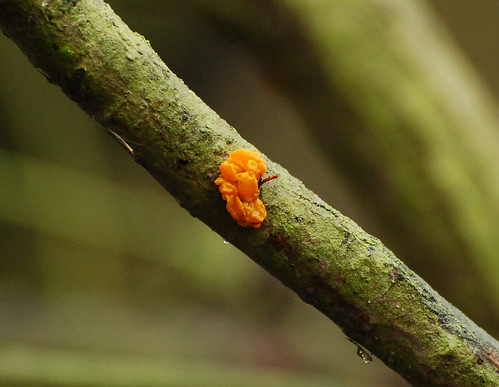
And as with all good nature reserves the wildlife wasn’t solely ornithological. This beautiful little fungus was on a stem next to the path.


Dacrymyces chrysospermum – unfortunately I couldn’t find a common name for this resupinate fungus but its sumptuous colour against the green lichen on the tree stem is striking.

All in all Fen Drayton was a great venue for a Saturday morning wildlife adventure and I’ll be posting from here again before too long.

Buntings abound: 29th and 30th January 2011

This weekend my meanderings took me to the open fields Histon and Cottenham, an area I haven’t properly explored for quite a long time. As I set off early on Saturday morning the weather was murky and very cold and consequently I was feeling pessimistic about encountering the local wild creatures.

Fortunately I was mistaken. The wild creatures were there aplenty. Flocks of mixed gulls, rooks, Corvus frugilegus, (N.b. I’m planning to make a taxonomic index of Latin names for the species on an adjacent page so I can avoid writing them here), and in particular, wood pigeon, Columba palumbus. Wood pigeon can often be seen in flocks but on this occasion there were many flocks, the  largest containing thousands of individuals. They are a farmers curse as they can devastate fields of new shoots, hence the sound of shotgun fire punctuating my progress. My father told me stories of my grandmother being given wood pigeon during World War II – a valuable source of free meat – and when opened up the crops liteally exploded as they were stuffed completely full of fresh green shoots. Multiply that up by several thousand birds and the damage they can do to crops is obvious. Still, they’re impressive to watch in those kind of numbers.

My aforementioned pessimism was tempered by the sight of hazel trees, Corylus avellana, covered in catkins, the first suggestion of approaching Spring time.
Hazel saplings festooned with the first catkins of 2011 – Spring is imminent!

And indeed, a friend told me on Monday morning she had seen daffodils shooting in the village. So I reckon that makes it official. In the same hedgerow as the catkins – the Merlin Hedge – (click here for a sketch map of my walk route), were a flock of greenfinch, Carduelis chloris, and a small group of fieldfare, Turdus pilaris, feeding on the ground. The greenfinch were manic, chasing each other as a flock around the fields either side of the hedgerow.

Turning right at the end of the hedge heading past the Yellowhammer Hedge – which didn’t contain any yellowhammers, or indeed any other birdlife – a big fox, Vulpes vulpes, was standing in the middle of the field beyond watching me and the dog:


A fox taking a keen interest in what me and the dog were doing

The fox was around 300m away and the quality of the image gives a good idea of the murky grey weather condiitions. Doesn’t convey how cold it was though! This one has a distinctly grey coat and I’ve seen foxes in this area before with similar coloration, so it could be the same one or one of his offspring. He’s close to where foxes reared a litter of cubs last year so he could be one of that family.  After the excitement of seeing the fox, I was scanning the adjacent field for any other signs of life and spotted a second fox – it could have been the same one but he’d have had to move very fast to get to the second location. And as it disappeared through a hedge a group of three roe deer, Capreolus capreolus, entered the same field.


Roe deer bounding across a field – and a bird taking to the air somewhere between me and them

The dog spotted the deer as soon as I did and immediately pricked his ears up, he was around 25m away from me and in order to avoid any dog/deer interaction I called him and the deer instantly turned to look even though they were around 300m away. They have incredibly acute hearing.

Between us and the deer were a flock of skylark, Alauda arvensis, on the ground (it could be one of them taking off in the photograph). It was impossible to count them accurately as they were whizzing around at very high speed close to the ground where their camouflage rendered them almost invisible, but I estimate there were between 10 and 20.

I’d been hoping to see yellowhammer, Emberiza citrinella, and I’d spent some time peering at the Yellowhammer Hedge and the surrounding fields but without seeing many birds at all. Then as I approached the end of the hedgerow leading to the Owl Shed I could see a flock of small birds flitting between the hedge and the Fallow Field and they turned out to be a mixture of reed bunting, Emberiza schoeniclus, and yellowhammer:


Mixed group of reed bunting and yellowhammer


Female yellowhammer
…and a male of the species. What a glorious colour!

Both species were numerous and could be seen flying around the hedge all the way along to the Owl Shed and dropping down onto the ground to look for food and to hide from me.


Reed bunting male

Young male reed bunting

The remainder of my Saturday morning sojourn was not quite so lively but numerous fieldfare, redwing (Turdus iliaca), chaffinch (Fringilla coelebs) and a kestrel (Falco tinunculus) were busy around the pig farm.

On Sunday 30th January the weather was brighter and more mild so I set off again towards the Owl Shed to try to get some more photographs. Despite the improved weather there was nowhere near the amount of wildlife around I’d seen the day before, although a hare (Lepus europaeus) appeared in the field where I first saw the fox. And fortunately the reed bunting and yellowhammer were still in the end of the hedgerow where I’d left them on Saturday, although not in the same numbers. So I got my pictures and then had to rush home to get off to my nephews 18th birthday party.

A very enjoyable weekend all round, and in particular the Emberiza species congregated in the Owl Shed Hedge.

Winter garden birds

The prevailing weather conditions have made me ponder what this post should be about, but a glance out the window made it immediately obvious that the numerous bird species in and around my garden would be a perfect subject. As I’ve mentioned previously, I feed the birds through the winter and as this one has been particularly prolonged and cold, and it’s still only Christmas time, my hanging and ground feeders have been kept topped up with mixed seed, niger seed, peanuts, sultanas and fat balls. There are numerous wild bird food suppliers out there and the one I prefer to use is Vine House Farm in Lincolnshire. The quality of the feed is always good and they take a proactive approach to managing their farm to encourage wildlife. Consequently the food isn’t always the cheapest but I’m happy to pay a little extra to support them.

The variety and numbers of birds visiting the gardens in my vicinity has been remarkable. Within the last week there have been numerous tits – blue tit (Cyanistes caeruleus), great tit (Parus major), coal tit (Periparus ater) and long tailed tit (Aegithalos caudatus).


Great tit male eyeing up a meal of seed on a bitterly cold morning

Long tailed tits usually appear over the space of 30 seconds or so, gorge on the fat balls and as rapidly disappear into a nearby tree. Coal tits appear on their own, take a seed and sit in the buddleia bush whilst they shell the seed and eat the contents and then usually fly away.  They occasionally stay for more than one seed, but not often. Blue tit and great tit behave quite differently, they are omnipresent and there can be up to 3 or 4 visiting  at any one time. Great tits are usually fairly nervous, they take a seed and sit at the back of the buddleia making maximum possible use of the available cover. Blue tits are much less neurotic and whereas they will take a seed and fly off to eat it, they sit in much more exposed locations. They are also happy to take on the resident robin (Erithacus rubecula). He’s a feisty little chap and he takes up position on a plant pot on the edge of the undergrowth and chases off all the other snall birds from his patch, particularly dunnock.

The resident robin guarding his territory on the flat feeder

The robin also stands on the flat feeder repelling all comers, but the blue tits have devised a technique to deal with this. They hang upside down on the edge of the feeder while the robin is on top and then flip over the top, grab a seed, and vacate quick-sharp to the buddleia bush giving the robin no time to attack.

Finches have also been conspicuous, up to half a dozen chaffinch are omnipresent in both front and rear gardens feeding on the ground. Before replenishing the flat feeder I sprinkle the remaining seed on the grass and under adjacent shrubs for chaffinch (Fringilla coelebs), dunnock (Prunella modularis), robin, wood pigeon (Columba palombus) and collared dove (Streptopelia decaocto) to graze on. There are always several chaffinch of both genders brightening things up:

Cock chaffinch resplendent in the freezing rime

Goldfinch (Carduelis carduelis) show up every day to feed on niger seed and in the last couple of days an immature greenfinch (Carduelis chloris) has appeared. Other regular visitors include blackbird (Turdus merula), dunnock, collared dove and wood pigeon which feed either on the ground or on the flat feeder and starling (Sturnus vulgaris) which gorge on the fat balls along with blue tit and long tailed tit. Less frequent visitors include wren (Troglodytes troglodytes), rook (Corvis frugilegus), carrion crow (Corvus corone), magpie (Pica pica) and pied wagtail (Motacilla alba).


Pied wagtail visiting during the coldest, snowiest, part of the recent cold snap

On several days over Christmas a flock of gulls consisting predominantly of black headed gulls (Larus ridibundus) has been swooping low over my front garden and the lawns on the other side of the road. I don’t know what’s attracting them but they’re a welcome addition to the roll of birds visiting my garden.


Black headed gull in winter plumage perched on a telegraph pole on Cottenham Road

As well as our resident birds there are lots of Scandin-avian visitors too. Opposite my house is an orchard-garden with lots of fruit trees and taller trees immediately adjacent. Since Christmas Day have been full of redwing (Turdus iliacus) and fieldfare (Turdus pilaris). It’s entertaining to watch when the fieldfare flock are feeding on fruit on the ground and someone walks along the pavement, within a couple of seconds the whole place comes alive with hundreds of birds heading for the perceived security of the taller trees.


Fieldfare heading to the orchard floor for a fruit feast

Redwing are feeding on the bright red berries of an enormous bush whose identity is unknown to me. There are many tens of them and they have been in situ for the last three days in such numbers. The pale face stripes and red patch around the leading edge of the wing are very pronounced and distinguish them from the songthrush which is similarly sized but lacks the stripes and the red patch:


Redwing – one of the sizeable flock surviving the winter in the garden opposite mine

And the other Scandinavian visitor which has descended on the UK in large numbers this winter due to the particularly dreadful weather in Norway is the waxwing. I posted on waxwing (Bombycilla garrulus) a few weeks ago after seeing them for the first time in Brimley Road, Cambridge. There have been several reports of waxwing sightings in Histon on the Cambridge Bird Club ‘What’s about’ blog in the last couple of weeks but despite keeping a look out I hadn’t seen any  myself… until yesterday. I took a walk to Narrow Close in Histon with my daughter, Sophie, where we found three waxwing in the top of a tree which were feeding on haw berries. We positioned ourselves behind a road sign and watched them for half an hour flitting between the top of the tree on one side of the road and a hawthorn hedge on the other:


Waxwing sitting in a hawthorn hedge

I think waxwing are absolutely exquisite and I’m immensely pleased they have descended on Histon, within a couple of hundred meters of my house. I planted a rowan tree in my garden three years ago to try to attract winter visitors such as waxwing but after a year or two of weak flowering and fruiting it keeled over and died. I don’t know why it failed but after a succession of very cold winters culminating in a ‘waxwing winter‘ the thought they could potentially visit is making me think I should try again. I took another walk to Narrow Close early this morning where there were 8 waxwing feeding on haw berries in adjacent hedgerows.


Another waxwing harvesting haw berries

A green woodpecker (Picus viridis), sparrowhawk (Accipiter nisus) and grey heron (Ardea cinerea) have also passed overhead in the last two weeks. The best thing about the wintry weather is the abundance of wildlife that can be seen by simply putting food out on a regular basis. Most of the photographs in this post were taken in my back garden, and all of them are within 200m of home.

Favourite wildlife moments of 2010

As we rush pell mell towards 2011 I thought I’d compile a list of my top 10 wildlife moments of 2010. I decided a little over a year ago that I was going to start a blog but it took until September of this year to actually get on the case and do it. But now it is up and running I’ve realised it’s one of the best things I’ve ever done. I’ve always derived a huge amount of pleasure from watching wildlife wherever I’ve travelled, in the UK and to more exotic locations. From snorkelling with green turtles over the coral reefs of the Seychelles to kayaking with orcas in the Canadian Pacific Ocean… and sitting in my dining room in Histon watching numerous species of small songbird frequenting my garden in the freezing winter weather.

But in 2010 these have been my favourite wildlife events (mostly within around 2 miles of where I live!):

10. Starting ‘The Naturephile’ and realising there are people out there who want to read it.

9. Garden spider: my garden was full of these little predators in September and October, filling my garden with webs such that negotiating the gauntlet to put the bins out became my job. Non-negotiable. I posted on them in October (post entitled ‘Araneus diadematus‘) when I got a great series of pictures of Shelob consuming a much smaller male just outside my back door:

That’s him wrapped up in the parcel of silk. Lunch.

8. Swifts in Histon: My photographic skills aren’t up to capturing good photographs of swifts but there were numerous individuals in the air all over the village in 2010. They were screeching up Station Road in Impington as I cycled home from work and 20-30 were regularly hunting insects over the fields north of Histon. There was a period in mid summer when every time a window or door was opened at home they could be heard overhead.  I hope they return here in the same numbers next year when I’ll try harder to get some pictures to share with you.

7. Marsh harrier in Histon: It’s very exciting to see big, rare birds of prey, particularly when they’re not expected. After the harvest this year there was a spell of several weeks where virtually all the birds seemed to have disappeared from my normal walking route. And one morning whilst mooching across the field lamenting the fact, a BIG bird hoved into view, low and approximately a quarter of a mile away. So calling the dog to heel, we sat down and waited. It flew to the opposite side of the field and quartered the long grass the full length of the field right in front of me – around 150-200m away – it was an immature male marsh harrier:

Marsh harrier hunting on the edge of Histon


After failing to find prey he ascended to approximately treetop height and disappeared over Histon to the south heading towards Cambridge.

6. Bullfinch: unlike fruit farmers I love bullfinch – they’re exquisite. When I was a child at home they were regular winter visitors but since then they have become exceedingly uncommon. I saw two in a tree near Girton a couple of months ago whilst walking with my ornithologist friend, David, and since then have seen them in and around Guns Lane in Histon several times. On one ocasion there were four, so I’ve gone from seeing on average one every 3-4 years to seeing 3-4 individuals at one time. A cock bullfinch flying over low against a royal blue sky is a sight to behold! Alas, I’ve no photographs yet, but hopefully this time next year…

5. Waxwing: My encounter with waxwing was described in a recent post simply entitled ‘The Waxwing‘. Myself and my friend Joe spent a freezing cold hour lurking under rowan trees on Brimley Road in north Cambridge and were very adequately rewarded with the presence of seven waxwing, which as well as being wonderfully photogenic were also highly amenable to being photographed. Consequently I managed to get a few nice pictures despite the filthy weather and low light:


Waxwing – Bombycilla garrulus – what a beauty!

There have since seen reports that there are waxwing in Histon. And this week I saw two starling-sized birds with crests amongst a flock of 20 redwing which were flying around near Cottenham Road which could have been waxwing. So far unconfirmed, but will keep looking.

4. Dragonflies: Dragonflies are amazing creatures, and this year I have discovered that a fallow field on the edge of Histon is alive with them from May through to September/October and they offer excellent photographic opportunities. If at rest they seem to be relatively fearless unless I make any sudden or threatening movements:


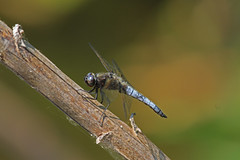
The blue body of the male broad bodied chaser (Libellula depressa) in my garden, above and the yellow body of the female in a hedgerow, below:


On a sunny day in the countryside, especially near a river or lake, it’s difficult to avoid dragonflies and damselflies. And they’re very entertaining to watch.


Common blue damselfly at Milton Country Park, Cambridge

My Dad told me he was once sitting in the sun in my Grandmothers fruit garden in Denmark when a dragonfly landed on his thumb. He managed not to flinch as it landed so it remained in situ for a couple of minutes before flying off. It returned a short time later carrying a fly and sat on the Old Mans’ thumb and completely devoured its meal.

3. Histon Heron: The shenanigans with the heron were described in my post from last week – ‘Hungry Heron‘ so you can read the story and see the photographs there,  or follow the link to the video clip from here.

The Histon heron – a finely honed fishing machine

The story has moved on a tad since I posted. My friend Chris, whose garden is hosting the heron, emailed to say he had a second bird visiting which managed to negotiate the intricate system of wires comprising the anti-heron device around the pond and steal some fish. And more alarmingly was caught fighting with heron number one who is obviously keen to protect his interest in the supply of fresh fish available in Chris’s garden. I shall report developments as they occur.

2. Butterflies in Histon: this one came about after reading about the Big Butterfly Count in August. There were numerous butterfly species in and around Histon so my daughter, Sophie, and myself went into the fields and counted numbers of species for the requisite 15 minutes. The number of species and the number of individuals was amazing. We saw peacock, red admiral, painted lady, gatekeeper, large white, small white, green veined white, small copper, brown argus, common blue, and ringlet!

Brown argus

Common blue

Gatekeeper

There were also small heath, comma, speckled wood and holly blue in the vicinity which we didn’t count during our 15 minute slot. We’ll continue to do the survey in future years and report the findings here.

1. Seeing a wild badger with Sophie: no photographs from this trip, alas, but it was a great moment. We ventured into Knapwell Wood in Cambridgeshire with my friend, Woody, late in the evening, just before dusk, and staying downwind and as quiet as possible all the way, we managed to get very close to the badger set. We then waited… and waited, and we heard the badgers crashing around in the undergrowth. No animals appeared in view so Sophie crouched down and fell asleep squatting on her haunches…, to be woken up after 20 minutes or so as a young badger ambled up the path towards us. He must have caught our smell as he suddenly stopped 6-7m away and sniffed the air for a minute or two before turning tail and disappearing back down the track. Sophie was very excited but managed to keep quiet until we had emerged from the wood. Listening to an ancient wood prepare for the night with some creatures bedding down whilst others are waking up is a magical way to spend an evening. And Sophie seeing wild badgers for the first time in the middle of the wood made this my favourite moment of 2010.

Have a great Christmas and I’m really looking forward to sharing my posts with you in 2011.

Best wishes

Finn

Guns Lane

As I mentioned in my previous post, Guns Lane links the north of Histon with Willingham and Ely, and provided the raw materials for my winter warmer, sloe gin. Due to the profusion of heavily laden trees and bushes – hawthorn, dog rose etc., providing food and cover for the resident wildlife, it is a great place to go birdspotting too.

My first stroll up there this winter was three weekends ago, 13th November 2010) and the profusion of birdlife on display was spectacular. Shortly after entering Guns Lane from Cottenham Road under a copse of tall trees several chaffinch were flitting around at the top. Closer inspection revealed the sumptuous pink breast and black cap of a cock bullfinch who exited the tree accompanied by three others. That was only the second time I’ve seen more than one bullfinch since I was at school. And the first time was the weekend before in Girton. Bullfinch feed on the buds of fruit trees in springtime and have been accredited with decimating fruit crops and I believe it is still legal to trap them in some parts of the UK. Consequently, their numbers dropped dramatically in recent decades so it’s great to see them in threes and fours.

Further on a wren appeared at around eye height craning on a tall grass stem to see me. It didn’t appear overly perturbed by my presence and followed me along the path for 30-40m. Simultaneously, several goldfinch were patrolling the top of the hawthorn trees on the other side of the lane until a visit by a kestrel frightened all the smaller birds away.

N.b. You can find full list of my sightings by clicking on this link to my wildlife diary.

All along the walk numerous small birds such as blue tit, great tit, a flock of long tailed tits, chaffinch and goldfinch appeared and redwing and large flocks of fieldfare are now regular fixtures.


Looking north along Guns Lane on the edge of Histon. These bushes are a hotspot for blue tit, great tit, long tailed tit and magpie

On another walk there had been very little birdlife to see until approaching a bend a little further on from the spot in the photo above, there was a commotion going on which I thought was due to my presence. As I approached blue tit, chaffinch, blackbird and even a green woodpecker took to the air all alarm calling and as I rounded the bend a buzzard emerged from a bush close by and glided up the lane away from me for 50-60m before turning off into a field. That all happened within 30 feet of where I stood and I don’t often get to see a buzzard that close – all very exciting!

Blue tit feeding in a bush on Guns Lane
Fieldfare – this one was difficult to photograph due to the position in the top of a tree and the bright white sky behind – I aim to get some better pictures as soon as possible!

Adjoining the lane at the Histon end of the lane is a field of scrub, which I call Church Field, and is always full of birds, with regular sightings of green woodpecker, chaffinch, greenfinch, latterly bullfinch, kestrel and the occasional sparrowhawk, among various others.


Looking north east across Church Field – it’s a good mixture of old established trees, young scrub and grass

The weather this weekend past (27th and 28th November 2010) was freezing:

and during an early morning foray into Church Field last Sunday (28th November 2010) a kestrel was perched on the uppermost branch of a tree with his feathers ruffled as protection against the cold:

Male kestrel trying to stay warm on a fiercely cold morning

It’s unusual to be able to get close and take photographs of most birds including birds of prey, so I was very grateful to this one for sitting tight for so long. He kept a watchful eye on me as I slowly sidled round the bottom of his tree which gave me time to capture a few decent shots. I particularly like this one looking down the lens with his feathers all ruffled up. On my way back through the field a couple of hours later a cock bullfinch flew right over my head, his colours against the bright blue sky were vibrant.

The section of the lane approaching the Oakington to Cottenham road is different habitat consisting of old, thick hedgerows which are frequented by big flocks of fieldfare and flat open fields which this weekend were hosting small flocks of lapwing (~20) and larger flocks of golden plover (at least 40) in the midst of which a heron landed and sat catching its breath until after I was out of sight. The hedges bordering the fields here are also home to many small birds such as chaffinch, goldfinch and dunnock.


Part of a small flock of 22 lapwing in a field off Guns Lane

And part of a larger flock of golden plover

The end of a walk on Gun Lane can also be the best part and I usually linger right by the Cottenham Road end where trees overhang the lane on both sides. These trees and bushes are usually full of birds including blackbird, chaffinch, blue tit, great tit, coal tit, house sparrow, dunnock, goldfinch and sometimes they’re all on parade at the same time.


House sparrow male in a hawthorn tree at the Cottenham Road end of the lane

And this brave squirrel sat watching me as I was photographing the birds

As you can hopefully see, this is a really good place to go for a stroll and see lots of really good wildlife. All the pictures and observations in this post were collected in just three walks. I’ll post again soon to tell you about my next outings on Guns Lane.


North Histon field walk

Most of my meanderings are across fields adjoining Histon on the northen edge of Cambridge, UK. Farmland here stretches almost unbroken, with the exception of the Cottenham to Landbeach road, and a few minor lanes, for 6-7 miles to the Wilburton to Streatham Road and is interspersed with scrub and plenty of mature trees offering shelter and food for the local wildlife. I’ve been keeping a wildlife diary since the middle of 2009. The 2010 edition is here and I’ve drawn a map of the Histon north fields area which is a little bit ‘Lord of the Rings’ style but it shows where all the locations mentioned in the diary are in relation to each other. Of course, all the location names are figments of my imagination from two years ago, so none of them would be found on an official map!

The photographs below will hopefully help you visualise the places and habitats I’m describing.  I have lots of pictures of the landscape features taken at various times of year, but all the pictures below were taken late in the afternoon, 3-4.30pm, last Sunday  (7th November, 2010) and I’m using these because the sun was low in the southwestern sky making the colours wonderfully vivid. There are no animals or birds in these shots, unless you’ve zoomed in and have spotted some that I haven’t. So if you wanted to see animals I apologise, and if you find any please let me know! The pictures start and finish with my favourite poplar tree and get progressively darker, and the light more blue, as the sun dipped below the western horizon:

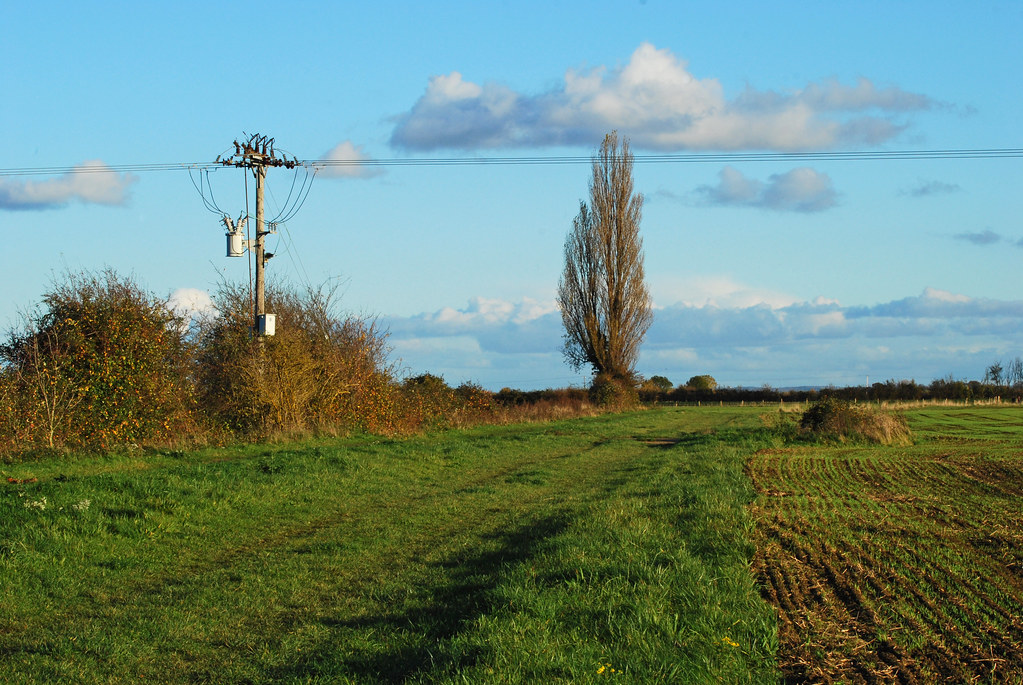
Linnet Hedge heading towards the Poplar with South Bean Field on the left

Entering the fields from the B1049 I walk along the Linnet Hedge where in the summer numerous linnet appear most days perching on the power lines and feeding in the fields immediately adjacent to it. Not just linnet though, there are dunnock, house sparrow, blue tit, great tit, chaffinch, greenfinch, goldfinch, blackbird, wren, whitethroat, yellowhammer, blackcap and kestrel regularly sighted in or around it.

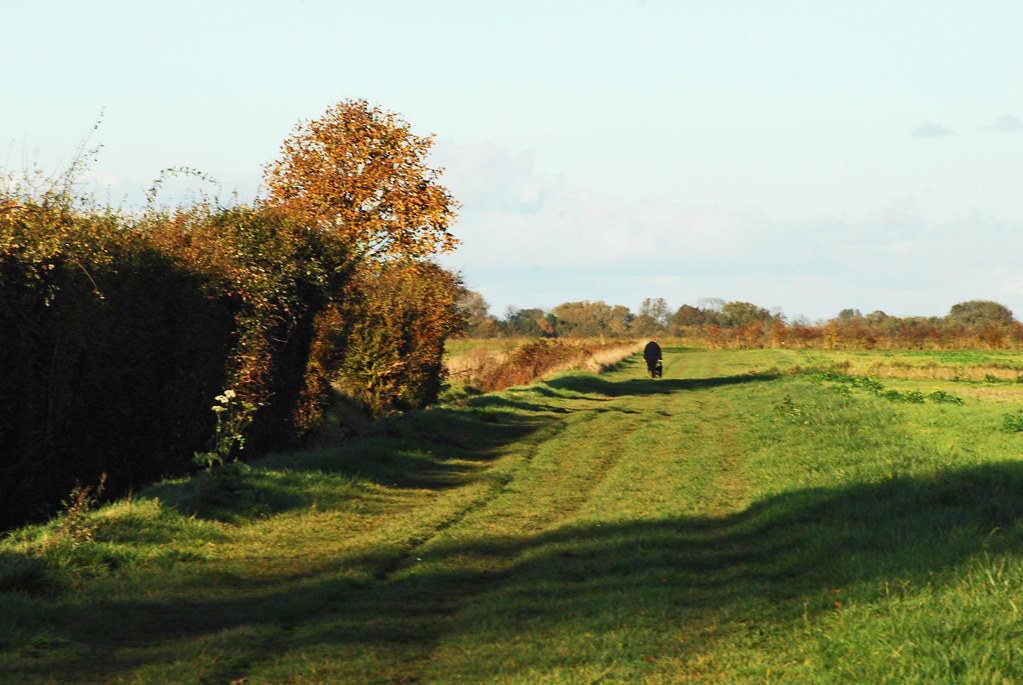
Heading east-south-east towards the Poplar Tree I turn left and head towards the sycamore tree at Hedge End along West Ditch  to the Merlin Hedge.


Poplar Hedge on the left leading to the small sycamore at Hedge End where it becomes the West Ditch, Middle and North Bean Fields on the right, Merlin Hedge at the end of the track. Lone dog walker in the distance.

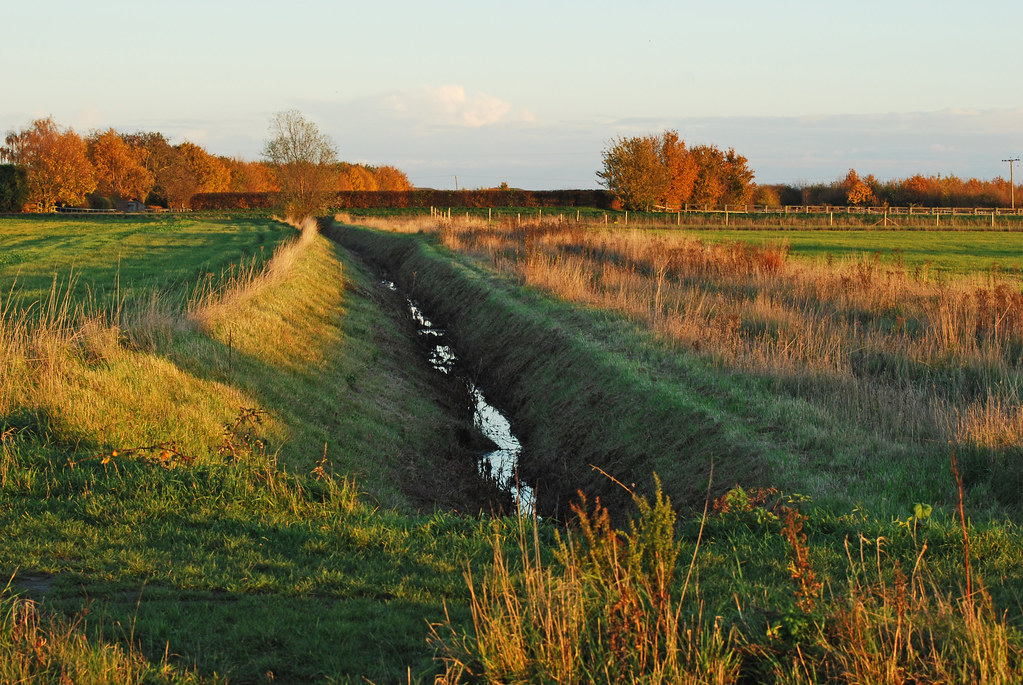
West Ditch is a great place to see all kinds of wildlife. Apart from being full of many wild flowers from Spring through to Winter, it is full of birds too, such as wren, linnet, goldfinch, reed bunting and corn bunting.  One evening this summer at the far end of the West Ditch I was distracted by the buzzing of an insect which turned out to be a privet hawk moth. Alas, it was too dark for a photo, but they are black and pink and up to 12cm wingspan, so an impressive sight. Common darter dragonflies also patrol up and down here.


Ditch running northwest to southeast between the sycamore tree at Hedge End and the farm

The Merlin Hedge is so called because not long after I started walking there I was half way along it when a merlin approached at quite incredible speed flying 2m off the ground and as it crossed the hedge, 10m in front of where I stood, it dived to catch a swallow which proved too elusive so it veered back on course and went on its way. All that lasted just 15-20 seconds or so but it was immensely exciting to watch.


Merlin Hedge running southeast towards the Bonfire and a machine store

At the end of the  Merlin Hedge I usually double back round the wooden post down the other side of the West Ditch towards the sycamore tree, turning right down the southern edge of the Beet Field:


Southern edge of Beet Field looking west to the back of the gardens of the B1049

At the end of this track a left turn takes me along the back of the gardens, allotments and horse paddocks to the South Fallow Field at the far end of which  I cross the B1049 and head for home. But I can’t finish without including this picture of the Poplar Tree across the PX Field:


Poplar tree in the late afternoon sun. I love the colours in the sky!

Dragonfly discoveries

Dragonflies are amazing insects which it seems can be seen just about anywhere. In 2010 I’ve even spotted them over my garden in Histon. It occurred to me I should put some effort into photographing and learning about them as I sat with my family eating a picnic on a bench overlooking the fountain in the Cambridge University Botanical Gardens. Numerous small, magnificently bright red, individuals were whizzing around the pond, and a few big blue ones a short distance away from the pond (the small red ones were a species of darter, and the big blue ones were hawkers – probably migrant hawkers). I attempted to photograph these for subsequent identification but alas my photographic skills were’t up to the job on that occasion. Despite that I looked up some information and lots of great pictures at http://www.dragonflysoc.org.uk/home.html. This is a great website and started me off on a journey of discovery which is now pretty much finished this year but which I plan to resume as soon as possible next year.

Subsequent walks around Milton Country Park and the fields north of Histon provided lots of opportunities to see many species of dragonflies and damselflies:


Female brown hawker sunbathing on a birdbox at Milton Country Park

Migrant hawker male. The yellow ‘golf tee’ on segment S2 is diagnostic 

Dragonflies originate from species which fossil records date to the Carboniferous period, around 300 million years ago, and could have a wingspan up to 70cm! They comprise the taxonomic sub-order known as ‘Anisoptera‘ and are part of the order ‘Odonata‘ which also includes damselflies (Zygoptera) and another group which is virtually extinct called ‘Anisozygoptera‘. There are now around 5300 species of dragonflies of which approximately 40 reside in the UK.

Dragonflies lay eggs underwater either loose, protected by a hygroscopic gel, or inside plants. The eggs of some species can lie dormant over winter and resume development when temperatures rise in springtime. Time to hatching is temperature dependent but is usually around 2-5 weeks and the larvae develop in water, all British species overwinter once as larvae but time to adulthood can be up to 5 years. Metamorphosis from larva to adult is triggered by increasing day length and temperature in spring, and includes the transition to breathing air and growth of their incredible compound eyes. Each eye is made up of around 29000 individual elements called ‘ommatidia‘. They also possess three addtional ‘simple eyes’ call ‘ocelli‘ which are sensitive to light intensity and assist in controlling flight via direct nerve connections to the flight muscles. Dragonflies have excellent colour vision and can also see ultra violet light. It makes me wonder what the neural activity behind all that optical prowess is capable of: are dragonflies merely responding directly to visual stimuli via reflex arcs, or is there more sophisticated image processing going on?


Common darter, immature male

Common darter, female. Note the compound eye.

Dragonfly larvae are ambush predators feeding on moving prey including other insect larvae, snails, small fish and tadpoles. Adults catch other insects in flight, holding their legs out in front like a bread basket to scoop prey from the air such as flies, flying ants, mosquitoes and even other, smaller, dragon flies.

Newly emergent dragonflies are powerful fliers and disperse widely. They are often seen a long way from water and can even cross seas. They reach maturity after a few days to a few weeks, a process also controlled by temperature, when the males will congregate at vantage points near water where females come to oviposit. The male will grasp the female around the head with his anal appendages and attempt to mate with the female by swinging her round to form the ‘copulatory wheel’ enabling him to pass a packet of sperm from the secondary male sexual organs located on his second abdominal segment to the female sex organs located on her eighth abdominal segment. After mating, sometimes under the guard of the male, to ensure his sperm is not displaced by another male, the female will oviposit underwater. And so the cycle begins again.


Broad bodied chaser – female

Weekend field walks 9th and 10th October 2010

This Saturday (9th October,2010) I was lucky enough to be accompanied by my friend David on a long walk around the Histon countryside. David is a zoologist and knows considerably more about the wildlife than myself, consequently it was a terrific walk and something of an education.

We set off around 8.15am and the weather was mild but very grey with 100% low cloud cover. Very soon after entering the fields we heard a jay making alot of noise in some trees bordering gardens at the back of the main road.  As we passed a small sycamore tree a possible meadow pipit passed overhead and we heard a second flying past later on in our walk. Shortly after that a large flock of golden plover flew over at high speed and several groups varying in size from approximately 5-10 up to 70-80 were spotted in the air and on the ground in several other fields. Many evenings whilst walking at night last winter I heard birds on the ground making a short whistle consisting of a single  note and had no idea which species was responsible. Our golden plovers in the air were making exactly the same noise so the mystery of the night time whistlers was solved too. A kestrel and a sparrowhawk made solitary appearances and a peer into an old tumbledown barn revealed a little owl – a good day for birds of prey.

The mild damp conditions of late have been ideal for fungi. Gorgeous bright yellow heads of the yellow fieldcap mushroom (Bolbitius vitellinus) lined the walk, all at various stages of growth from recently sprouted, just a couple of centimeteres tall with very rounded unopened caps, to old and nibbled specimens around 10cm tall and the caps more dull in colour and 4-5cm in diameter:


Recently emerged yellow fieldcap mushrooms


Older yellow fieldcap


A cluster of four mature yellow fieldcaps

We also found a ‘substance’ which preliminary inspection suggested the most likely identity was dog vomit! It occurred every few paces for several hundered metres wrapped around grass stems – suggesting a very poorly dog. When it was gently disturbed at the edge it had a powdery consistency and blew away in the breeze like dry Ready Brek. It varied in colour from grey/white to pale buttery yellow, so we concluded it must have been some kind of mould:


Mucilago crustacea – a slime mould. This stuff can move slowly to new food. Only at a snails pace, but don’t stand still for too long!

Toward the end of our outing as we headed back to the village a small flock of gulls consisting of a lone herring gull, a black headed gull and around 30 lesser black backed gull were beautifully contrasted against the dark ground in a ploughed field. Despite the grey weather it was a great day for wildlife.

After the nature fest on Saturday followed by just one or two small drinks with some good friends in the evening, I contemplated a shorter stroll this morning to blow away the cobwebs. But the weather was absolutely glorious and the profusion of birdlife resulted in another whole morning spent in the countryside. I heard six green woodpecker, one of which was exiting an old oak tree at high speed having been flushed out by a buzzard. A second buzzard appeared over the farmhouse with a sparrowhawk shadowing it right overhead but at much greater height. The buzzard quartered the fields and then headed off south west over Histon:


The unmistakeable shape of a buzzard. I love watching
big birds of prey so seeing two buzzards in one walk
was very special

Despite the weather no swallows were around today, I saw small numbers (less than 10) on Saturday and Sunday last weekend but we’re now heading towards mid-October so the last stragglers must be heading for Africa.

Many songbirds put in an appearance today which has been an unusual event since the harvest got underway at the beginning of August. Two yellowhammer, two corn bunting, numerous reed bunting, dunnock, blue tit, robin and a pied wagtail were all spotted today.


A corn bunting on the right and a male reed bunting sitting together and as I watched a female reed bunting arrived. Marvellous!

Yellowhammer

I was particularly pleased to see the wagtail, it’s the first one I’ve seen in the fields this year, whereas last year they were on display almost every day. I hope that’s not a nationwide phenomenon.

A lone kestrel and two sparrowhawks were up and about today so another good day for birds of prey. Also as yesterday, many skylark were extremely active playing tag and because of the lovely weather they were singing up high. I managed to go one better with the pipits of yesterday as I watched one fly up out of a small bush when disturbed by me landing in another one about 30m away in full view. The local churchyard rooks were omnipresent, digging out invertebrates in most of the fields accompanied by countless wood pigeon and carrion crows.

It was difficult to choose a highlight from this weekend, but as I sat on a tractor trailer in the sunshine making some notes a common darter dragonfly buzzed past and settled on an old plough to sun itself. It’s late in the year for dragonflies so that was good to see.


Mature male common darter warming up in the morning sunshine sat on an old plough

I shall post again soon about our local birds and hopefully next time I shall have seen the first winter immigrants such as fieldfare and redwing. Fingers crossed.

Two wild walks at the end of September

This weekend of 25th-26th September was one of two halves – Saturday was mostly sunny, warm and bright if a little breezy, and Sunday was foul. Cold northerly wind, 100% low cloud cover and plenty of rain were the order of the day, so my two outings to the countryside were rather different. 

On Saturday I spent a couple of hours wandering around Milton Country Park which is a great place to see wildlife of all types. There were lots of mushroom species on open grassy areas and others in the leaf litter and some splendid brackets sprouting out of fallen trees. Many trees and bushes were providing support for enormous growths of old mans beard and brambles with tons of blackberries, so my fingers were purple when I got back to the car. 

 
Trees at Milton Country Park covered in old mans beard

My main aim this weekend was to photograph birds such as mute swans, coots, moorhen, mallard, canada geese and great crested grebe. All these were present in numbers this weekend so I got a chance to take lots of photo’s.  

Male mute swans are fiercely protective where cygnets are involved and this magnificent chap was reacting with alot of aggression toward another swan which got too close to his offspring. He chased it off at high speed, paddling so hard I could hear him moving through the water.

There were lots of people in the park so woodland birds were staying in the tops of the trees. Consequently I caught plenty of fleeting glimpses of small brown things flitting around up high but they were impossible to identify. At least by me!

 In direct contrast there were darter dragonflies everywhere, hunting low to the ground round the bottom of bushes. They were all keen not to land so I gave up trying to photograph them. 

Due to the foul weather on Sunday it wasn’t a particularly good day to see birds, but in the fields north of Histon the flock of around 200 rooks rooks which I call the Churchyard Posse were on the ground feeding and indulging in the kind of devilment that members of the crow family are famous for:  


Rooks – the Churchyard Posse – around 10% of it

 A small flock of around 25 lesser black backed gulls were mingling with the rooks along with hundreds of wood pigeon which seem to have had a good breeding season this year. Most of the fields have now been ploughed but in those with cover skylarks have returned after the harvest. In one small corner I counted ten rising out the scrub, chasing and wheeling at low level. Others were constantly rising up in small groups of two, three and four, apparently playing tag before disappearing rapidly into the grass again. The hedgerows were mostly silent and the only songbirds to be seen were reed bunting. Because of the poor light they were extremely difficult to photograph, so this picture is one I shot a couple of days before, she sat proud on top of the hedge and allowed me to approach to within 30 feet and capture a reasonable shot:    


Reed bunting in Histon

It’s now getting dark before I can get out walking in the countryside so until about March 2011 my meanderings will be mainly in the morning, but I’m looking forward to seeing our winter visitors such as redwing and fieldfare arriving in the next month or so.