Tag Archives: lapwing

Rotten borough, wonderful wildlife

I spent the last two days in Dunwich on the Suffolk coast. Dunwich and its surrounding countryside is a very interesting place from a political and natural history viewpoint. A paragraph about the political history first:

Until the Great Reform Act of 1832 Dunwich was classed as a ‘rotten borough‘, this was a parliamentary constituency with a very small number of voters for which the parliamentary seat could be bought and sold by wealthy patrons. Prior to 1286 Dunwich was the capital of East Anglia and a thriving sea port but in that year the first of several great tidal surges destroyed a large part of the town, sweeping it into the sea, reducing it to a small number of houses and therefore residents and voters. As a result of its earlier preeminence Dunwich had two parliamentary seats and despite it’s sudden demise retained these seats, with a very small number of voters, until the Great Reform Act was passed, (interestingly, it was his opposition to parliamentary reform which ended the premiership of the Duke of Wellington after he lost a vote of no confidence in November 1830). In the early 18th century the seat was held by Sir George Downing, 3rd baronet, whose grandfather (1st baronet) had built Downing Street in London. He was succeeded by his cousin, Sir Jacob Downing, who died childless and whose fortune was used to found Downing College, Cambridge, in 1800. An awful lot of history for a tiny village on the Suffolk coast.

Moving on to current natural history, the weather on the first day there was horrendous, rendering nature watching pretty much impossible. But on the second day the weather changed completely and was warm and sunny. The woods around the ruined friary were looking delightfully spring-like with snowdrops (Galanthus nivalis) covering the ground.


Snowdrops growing in profusion amongst moss covered dead wood from fallen branches around Greyfriars at Dunwich.

A pair of goldcrests were very busy feeding in a bush at the edge of the wood which was good to see as they are not a common sight during my regular walks around Cambridge. Heading to the beach to the north of the Friary a pied wagtail (Motacilla alba)  was bathing in a puddle:

And a flight of four mute swans (Cygnus olor) flew by, heading south towards the lakes at Minsmere RSPB reserve:

Later in the morning a walk in Dunwich Forest was eerie. It started in a pine plantation which was all but silent, no birds were singing and there were few other signs of wildlife. Leaving the plantation behind I entered mixed woodland which was still quiet but  more diverse, with a mixture of predominantly pine and silver birch trees (Betula pendula). Birds were singing here but not in the profusion I’d hope for. Many of the pines were exuding aromatic sap:


Sap oozing from a wound in the bark of a pine tree. This stuff was extremely sticky but had a gorgeously delicate scent of pine resin.

The exudate was running down the trunks for several feet and in some cases from multiple places on their trunks, the aroma on a warm spring morning was lovely. A mixture of the earthy smell of well rotted compost and pine trees. Gorse bushes (Ulex europaea) were in flower here too, adding the scent of mild coconut into the mix.
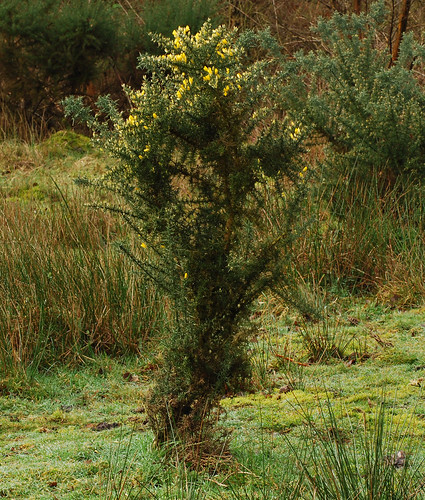
Gorse bush in flower

The ground under the trees was littered with dead wood and moss and numerous fungi including puffballs, parasitic birch brackets growing on live trees and other brackets growing on dead branches, most of which defy identification by anyone who doesn’t possess the requisite expert knowledge. Which, alas,  includes myself.

After the forest I ventured to Dunwich Heath, parking by the lighthouse at the top of the cliff where gangs of black headed gulls (Larus ridibundus) were wheeling around the carpark and magpies (Pica pica) were bouncing along the ground around the cars scavenging scraps discarded by picnicers making the most of the glorious spring weather.


Black headed gull looking for leftover crumbs in the carpark at Dunwich Heath lighthouse…

… and a magpie using a signpost as a vantage point.

Leaving the carpark I headed down towards the reedbeds which I skirted for several hundred metres. The habitat here is varied with the reedbeds, scrub woodland, heath and waterways.


Looking east over reedbeds at the sourthern edge of Dunwich Heath between the heath and RSPB Minsmere, the sea is a thin grey line in the distance.

Consequently I was hoping to see a diverse range of wildlife. There was evidence that otters are in residence and sheets of corrugated iron had been placed on cropped bracken presumably to provide shelter for reptiles such as adders, grass snakes and lizards. The sun was shining and I was  sheltered from the wind so the conditions for a stroll were nigh on perfect for a February afternoon and plenty of birdlife was to be seen. Wrens (Troglodytes troglodytes) were hopping around the undergrowth and a flock of around 40 lapwing (Vanellus vanellus) passed overhead whilst numerous blue tits (Cyanistes caerulius), great tits (Parus major) and chaffinch (Fringilla coelebs) were busy in the trees lining the path.


Cock chaffinch sitting high in a tree singing for a mate.

A single long tailed tit (Aegithalos caudatus) also flew by and landed very close allowing me to take some photographs:


Long tailed tit providing a rare opportunity to take some close-up pictures.

The area around Dunwich is a great place to see all kinds of wildlife, the Dingle reedbeds running north to Walberswick are the largest in England and there are large areas of heath and woodland and the salt water lagoons at Minsmere to the south all providing a huge area of diverse habitat. It is also ideally located for migrants from mainland Europe in the winter.

And right in the middle is The Ship Inn where you can get a pint of Adnams  beer to slake the thirst after a days walking. Dunwich is very high on my list of favourite places to explore.


Early morning duck walk 22/01/2011

Before I sally forth on my intended theme for this post, and continuing the astronomical precedent from my earlier post where I included a picture of the recent partial solar eclipse, I want to share a picture of the moon I took last week. At this time of year opportunities for wildlife photography in the evenings are severely limited. But on Tuesday and Wednesday (18th and  19th January) the moon looked spectacular early in the evening when it was low in the eastern sky,  and also very early in the morning, around dawn, when it was low in the western sky. So on Tuesday I rushed home from work, grabbed my camera and headed out the door with the dog in tow to try some lunar photography. I think the moon is an amazing thing and I can’t resist the opportunity to photograph it, and this is what I got:

Full moon low in the eastern sky 180111
Full moon low in the eastern sky around 6pm on 18th January, 2011 (f5.6, 1/800, ISO 800, 300mm)

After my lunar digression, and as alluded to in my post ‘Avian East Anglia’ I have been out taking a look at the bird life at Milton Country Park. I set off with my friend just after 8am on a very cold grey Saturday morning, which became progressively colder, greyer and rainy as time went by. Consequently I was less than hopeful of seeing much in the way of wildlife.

My fears of a fruitless walk at the Country Park were unfounded. As we entered the park a great spotted woodpecker (Dendrocopos major) was making plenty of noise high in a tree and during the walk we saw two and heard at least two others. I don’t usually use a spotting scope but my friend, David, has one and it really does enable some terrific close up views of  distant creatures. We viewed a great spotted woodpecker at the top of a tall tree a good 100m away and the scope brought it right up close. I may add one to my next Christmas list.

A distant great spotted woodpecker – if only I could digiscope! This one wasn’t taken on Saturday… but it was at Milton Country Park

A cock bullfinch (Pyrrhula pyrrhula) was busy feeding in some bushes at the edge of a lake and plenty of blue tits (Cyanistes caerulius) and great tits (Parus major) were to be seen. A brood of six last years mute swan cygnets (Cygnus olor) were communing  in a quiet corner of a lake:

One of six mute swan cygnets

And a pair of adult mute swans were on the slipway into an adjacent lake. A flock of mixed gulls consisting predominantly of black headed gulls (Larus ridibundus) with a single common gull (Larus canus) in their midst shared a flooded field on the edge of the Park with a flock of 57 lapwing. The lapwing would take to the air periodically and fly circuits round the Park before settling down again and each time they rose there seemed to be more of them, but a final count on the ground came to 57. I was pleased to see this number as I rarely see flocks of lapwing greater than 20  individuals.

Coot (Fulica atra), cormorant (Phalacrocorax carbo), a moorhen (Gallinula chloropus) and a lone kingfisher (Alcedo atthis) made appearances but the stars of the day were the various duck species. I like ducks and it’s always good to see more than just mallard:


Male tufted duck resplendent against the oleaginous steely grey-blue of the water in the early morning

Note the prominent tuft and the yellow eye of the tufted duck (Aythya fuligula) above. It was tricky to get good quality images due to the low light of the murky early morning. I opened up my lens (Nikon 70-300mm VR2 zoom) to f5.6 and was using a shutter speed of 1/80s at 300mm zoom. The ISO was set to 800 to cope with the light hence the slightly grainy look.

A flock of approximately 20-30 shoveler (Anas clypeata) were feeding on the same lake as the tufted duck:


Small group of shoveler – see the splendid beak of the male in the background (top) and in the foreground (lower)

Shoveler diet consists of small insects, molluscs, crustaceans, seeds etc. which they filter from the water with huge spatulate beaks by sweeping the beak from side to side with their whole head underwater whilst swimming round in tight circles. They come up for air only very briefly which meant I had to take quite a few pictures before getting one with the beak visible. Beatiful birds, I like these.

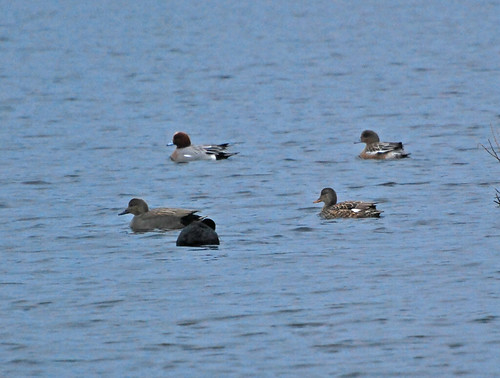
Several small groups of wigeon (Anas penelope) and gadwall (Anas strepera) mingled with the other water birds such as the numerous coot, gulls and cormorant.


A coot in the foregound with a pair of gadwall close by and a pair of wigeon in the background

By the end of our walk I was frozen but it was well worth braving the cold to see such a diverse range of birdlife. I shall return there on a sunny morning to try and get some less grainy photographs!


Guns Lane

As I mentioned in my previous post, Guns Lane links the north of Histon with Willingham and Ely, and provided the raw materials for my winter warmer, sloe gin. Due to the profusion of heavily laden trees and bushes – hawthorn, dog rose etc., providing food and cover for the resident wildlife, it is a great place to go birdspotting too.

My first stroll up there this winter was three weekends ago, 13th November 2010) and the profusion of birdlife on display was spectacular. Shortly after entering Guns Lane from Cottenham Road under a copse of tall trees several chaffinch were flitting around at the top. Closer inspection revealed the sumptuous pink breast and black cap of a cock bullfinch who exited the tree accompanied by three others. That was only the second time I’ve seen more than one bullfinch since I was at school. And the first time was the weekend before in Girton. Bullfinch feed on the buds of fruit trees in springtime and have been accredited with decimating fruit crops and I believe it is still legal to trap them in some parts of the UK. Consequently, their numbers dropped dramatically in recent decades so it’s great to see them in threes and fours.

Further on a wren appeared at around eye height craning on a tall grass stem to see me. It didn’t appear overly perturbed by my presence and followed me along the path for 30-40m. Simultaneously, several goldfinch were patrolling the top of the hawthorn trees on the other side of the lane until a visit by a kestrel frightened all the smaller birds away.

N.b. You can find full list of my sightings by clicking on this link to my wildlife diary.

All along the walk numerous small birds such as blue tit, great tit, a flock of long tailed tits, chaffinch and goldfinch appeared and redwing and large flocks of fieldfare are now regular fixtures.


Looking north along Guns Lane on the edge of Histon. These bushes are a hotspot for blue tit, great tit, long tailed tit and magpie

On another walk there had been very little birdlife to see until approaching a bend a little further on from the spot in the photo above, there was a commotion going on which I thought was due to my presence. As I approached blue tit, chaffinch, blackbird and even a green woodpecker took to the air all alarm calling and as I rounded the bend a buzzard emerged from a bush close by and glided up the lane away from me for 50-60m before turning off into a field. That all happened within 30 feet of where I stood and I don’t often get to see a buzzard that close – all very exciting!

Blue tit feeding in a bush on Guns Lane
Fieldfare – this one was difficult to photograph due to the position in the top of a tree and the bright white sky behind – I aim to get some better pictures as soon as possible!

Adjoining the lane at the Histon end of the lane is a field of scrub, which I call Church Field, and is always full of birds, with regular sightings of green woodpecker, chaffinch, greenfinch, latterly bullfinch, kestrel and the occasional sparrowhawk, among various others.


Looking north east across Church Field – it’s a good mixture of old established trees, young scrub and grass

The weather this weekend past (27th and 28th November 2010) was freezing:

and during an early morning foray into Church Field last Sunday (28th November 2010) a kestrel was perched on the uppermost branch of a tree with his feathers ruffled as protection against the cold:

Male kestrel trying to stay warm on a fiercely cold morning

It’s unusual to be able to get close and take photographs of most birds including birds of prey, so I was very grateful to this one for sitting tight for so long. He kept a watchful eye on me as I slowly sidled round the bottom of his tree which gave me time to capture a few decent shots. I particularly like this one looking down the lens with his feathers all ruffled up. On my way back through the field a couple of hours later a cock bullfinch flew right over my head, his colours against the bright blue sky were vibrant.

The section of the lane approaching the Oakington to Cottenham road is different habitat consisting of old, thick hedgerows which are frequented by big flocks of fieldfare and flat open fields which this weekend were hosting small flocks of lapwing (~20) and larger flocks of golden plover (at least 40) in the midst of which a heron landed and sat catching its breath until after I was out of sight. The hedges bordering the fields here are also home to many small birds such as chaffinch, goldfinch and dunnock.


Part of a small flock of 22 lapwing in a field off Guns Lane

And part of a larger flock of golden plover

The end of a walk on Gun Lane can also be the best part and I usually linger right by the Cottenham Road end where trees overhang the lane on both sides. These trees and bushes are usually full of birds including blackbird, chaffinch, blue tit, great tit, coal tit, house sparrow, dunnock, goldfinch and sometimes they’re all on parade at the same time.


House sparrow male in a hawthorn tree at the Cottenham Road end of the lane

And this brave squirrel sat watching me as I was photographing the birds

As you can hopefully see, this is a really good place to go for a stroll and see lots of really good wildlife. All the pictures and observations in this post were collected in just three walks. I’ll post again soon to tell you about my next outings on Guns Lane.