Tag Archives: Nature

The wild flowers are blooming

A combination of the recent rains and the rising temperatures we’re getting now is creating ideal conditions for wild flowers. Any piece of uncultivated land is starting to bursting forth with flora which in turn is providing food and cover for flies, bees, beetles, butteflies and a plethora of other insect life. Which is also good for the birds, small mammals and other predators, and so on up the food chain. And on top of that it’s lovely to look at. So here’s a selection of flora currently blossoming in my patch of East Anglia:
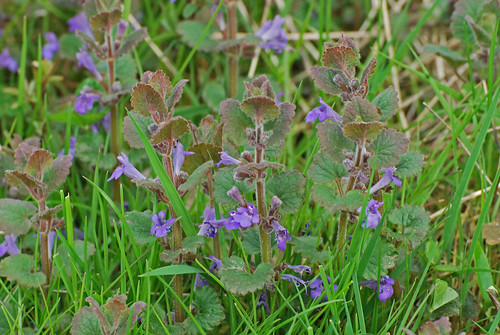

Ground ivy – Glechoma hederacea

I like ground ivy because it occurs early in the year, first appearing in March, but like many other phenological phenomena it may now be happening earlier. It creeps across the ground, like ivy, forming carpets of blue flowers and with the green and red leaves it adds lots of colour to the undergrowth. It has numerous names and here are a few from the Royal Horticultural Society website: Devils candlestick, creeping charlie, crows guts, wild snakeroot, hens and chickens, gill-go-by-the- street, and my favourite: ale gill.

Another creeper which grows across the ground and in hedgerows and which has lovely blue flowers is the periwinkle. There are two types of periwinkle, the lesser (Vinca minor) which may have been introduced to the UK and the greater (Vinca major), which was introduced (both according to my wild flower guide).


The greater periwinkle

I’m a tad confused by this flower because they are meant to have 5 petals but this one only has 4. It is also known as creeping myrtle, cut-finger, flower of death (!), grave myrtle, and sorcerer’s violet, among others.

Sprouting next to this periwinkle flower was a nascent white deadnettle, Lamium album. It normally has white flowers which haven’t yet arrived, but the closed buds are visible below the crown. Everything is very green at the moment because of all the rain and looks beautiful against the red wing cases of the ladybird .


White deadnettle about to burst into bloom
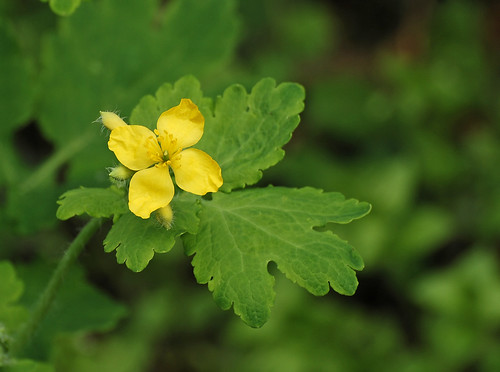

Greater celandine, Chelidonium majus

It is thought the greater celandine is named after the swallow (‘khelidon’ is Greek for swallow) and it’s a member of the poppy family. When the stems are broken they ooze a latex sap which is as yellow as the flowers, and the colour can be as deep as orange. It contains a host of alkaloids which confer therapeutic properties but it can also be toxic. It is also known as cocks foot, sight wort and wart wort as the sap has been applied as a treatment for warts. I’m not sure where ‘sight wort‘ comes from, but if it burns off warts I wouldn’t want it anywhere near my eyes!
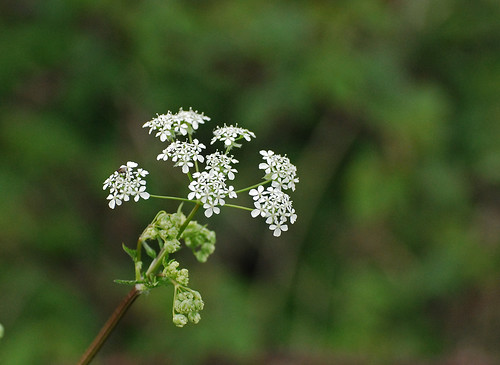

Cow parsley – Anthriscus sylvestris

As far as I know cow parsley doesn’t have medicinal properties and according to Wiki it’s not pleasant to eat. But I think the flowers are lovely and they bring back childhood memories of running through the woods in springtime when the cow parsley or ‘keck‘, as it was referred to by my Dad, was as tall as me. There’s nothing quite like a forest floor which is full of cow parsley, in it’s own way it’s as iconic as blue bells. It’s also known as wild chervil and Queen Anne’s Lace.
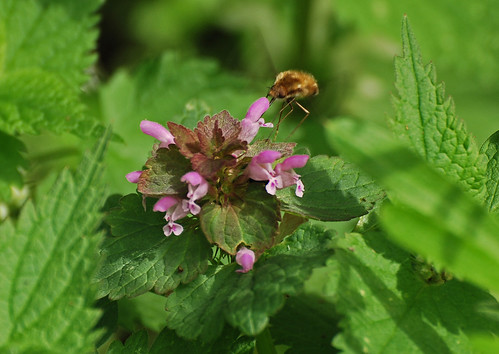

Beefly – Bombylius major

At the end of my flower finding mission I was looking for a ground ivy flower head and I found this little beauty, and just as I was just about to open the shutter a beefly zoomed in to sip the nectar. Flower pictures can benefit from some insect action and I like beeflies, so this was a highly serendipitous encounter!

Erratum: Maggie from http://www.intouchwithnature.co.uk‘ has pointed out that the last flower with the beefly on is in fact red deadnettle  – not ground ivy. So a big thankyou to Maggie for keeping me honest with my plant identification 🙂
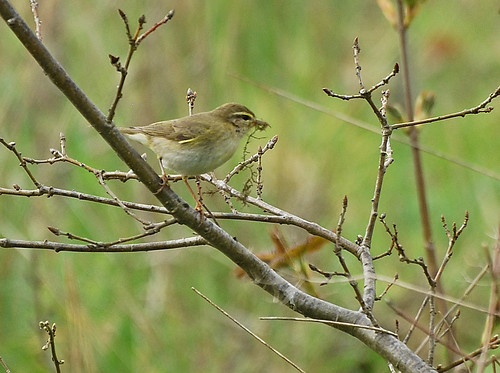
The chiffchaff and the willow warbler

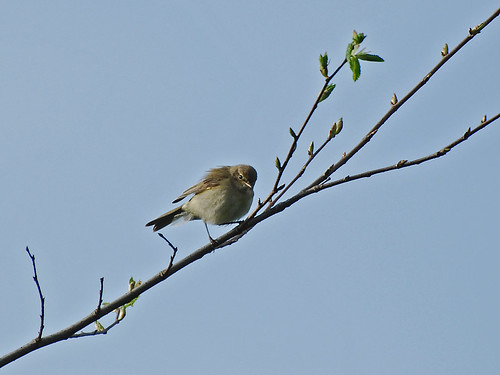
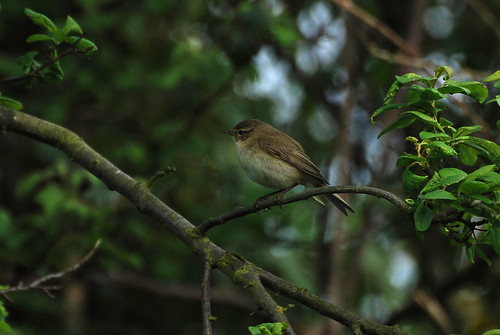
The chiffchaff and the willow warbler both members of the warbler or ‘Sylviidae‘ family. There are 63 members of the Sylviidae of which 14 species breed in the UK. They’re very similar to look at and can be pretty tricky to tell apart. Last week in my local meadow I came across both species in photographable locations so I  thought I’d try to show the differences. Both species are summer migrants to the UK having overwintered in Africa, the chiffchaff goes to the Mediterranean and some head south of the Sahara, and the willow warblers all  go down to tropical sub-Saharan Africa.

This publication from Birdlife International tells us that the global population of willow warblers is estimated to be between 300 million and 1.2 billion individuals, and a fact that blew my socks off was that the northern Siberian population overwinters in southern Africa, which is a journey of over 7000 miles or 11000 km… and back! And they’re only 19cm long and weigh 10g, so they may be tiny, but they’re incredibly tough. The chiffchaff is also a scarce winter visitor to the UK.

Willow warbler (Phylloscopus trochilus, Dansk: løvsanger) collecting nesting materialWillow warbler showing off her pink legs, bright supercilium and pale ear coverts

The willow warbler has longer primaries and the light stripe over the eye, the ‘supercilium‘ is brighter and more pronounced than that of the chiffchaff, and the ear coverts of the willow warbler (the patch under the eye) are a pale olive colour. The other visual diagnostic feature which is probably easiest to see at a glance is the leg colour, the willow warbler has pinkish brown legs whilst those of the chiffchaff are much darker, almost black.

Chiffchaff showing off its more subdued facial markings and overall colour scheme and the dark coloured legs

In the absence of a clear sighting the easiest way to differentiate between these two species is by their song: click here to hear the chiffchaff song, and here for the willow warbler song.

The conservation status of the chiffchaff is green and in 2000 there were around three quarters of a million territories in the UK, but the willow warbler is amber due to a decline in the breeding population, but despite that there were still two milion territories in 2000.

Returning songbirds

There’s a particular spot in my local meadow where there are some large clumps of brambles which are home to numerous species of bird including songthrush, blackbird, linnet and house sparrow. And in the summer chiffchaff, willow warbler, blackcap and common whitethroat are all there too. Chiffchaff have been here for a couple of months now, and willow warbler almost as long but I hadn’t yet seen a whitethroat, so I set off last Monday in the hope of seeing the first one of the year.

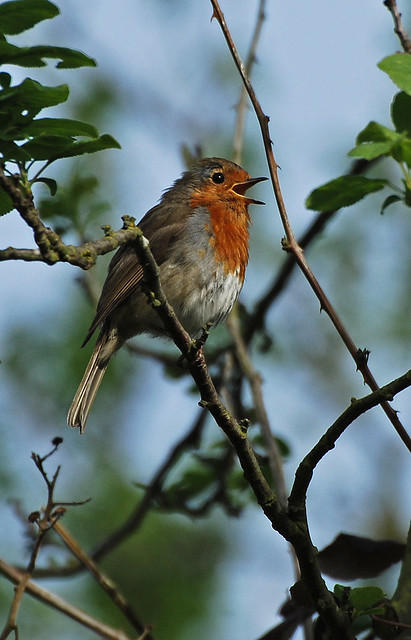
A cock robin singing to the ladies

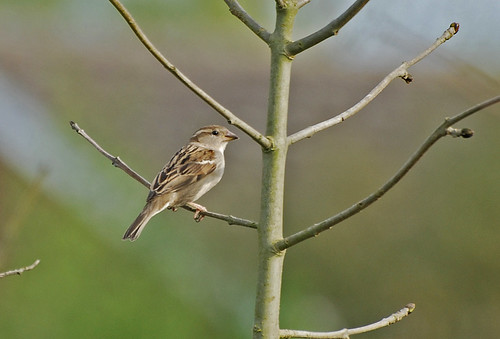
There were many species of songbird in the meadow including the robin (Erithacus rubecula: Dansk: rødhals) and the house sparrow (Passer domesticus, Dansk: gråspurv) and the air was alive with the song of all these species.


House sparrow female

Robin and house sparrow are resident species in the meadow and I see them all year round there, but not the chiffchaff:

The chiffchaff (Phylloscopus collybita Dansk: gransanger), which is a warbler, and willow warbler (Phylloscopus trochilus, Dansk: løvsanger) can be very difficult to tell apart if only seen at a glance, but they can be distinguished by their song, of which more in the next post. This chiffchaff was one of a pair which were calling to each other and flitting around the bushes passing within a few feet of me on several occasions and seemingly unfazed by my presence.

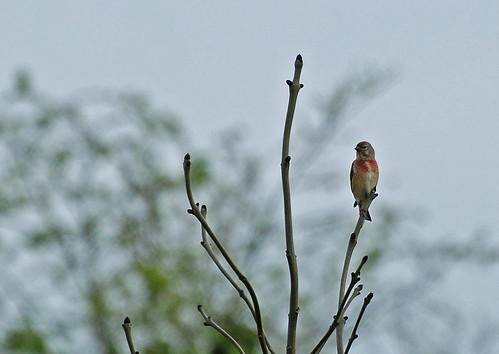
Cock linnet

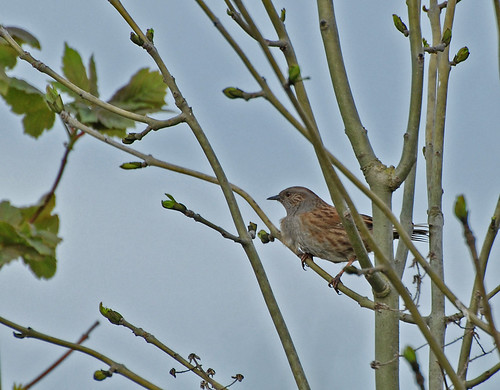
Resident in the UK is the linnet (Carduelis cannabina, Dansk: tornirisk), they disappear from the fields around Histon in the Autumn, presumably to congregate at a winter feeding ground, and they reappear in the Spring. And they have recently turned up in the meadow. Also resident, and present all year round, is the dunnock…


Dunnock, Prunella modularis, Dansk: jernspurv

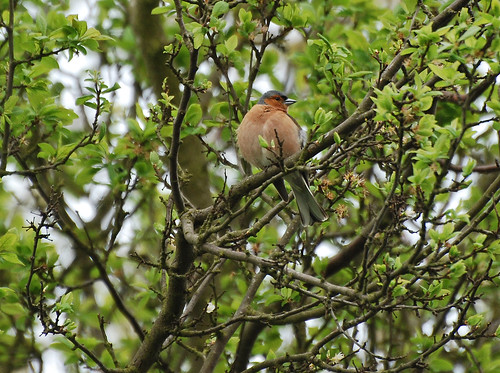
… and the chaffinch:

Cock chaffinch, Fringilla coelebs, Dansk: bogfinke

There were no whitethroat back in the meadow last Monday but as you can see there were plenty of other birds. In the last week I’ve also seen kestrel, sparrowhawk and buzzard, blackcap, green woodpecker, jay and magpie.

I recce’d the meadow again this weekend and the whitethroat are now back from wintering in Africa. They are very distinctive and both sexes are easily identified by their strikingly white throat, and the males display by singing from the top of a bramble thicket or a sapling and flit 4-5m vertically into the air and then descend to land in the same spot. They’re lovely little birds, with a very distinctive song, and I’ll hopefully have some pictures to show you in the near future.

Wild Geese

At the same time I was experimenting with ISO and coots at Milton Country Park there were geese in the vicinity too. A small flock of greylag geese (Anser anser, Dansk: grågås) were grazing in a field  immediately adjacent to the park.

There is another flock of greylags I encounter every day on my way to and from work. There are around 20-30 that have taken up residence in a field that is on my cycle route. The field is adjacent to a lake and the cycle path passes between them and every morning I pass by there are numerous heads poking up above the crop. I’m surprised the farmer puts up with this because the field now has a number of large threadbare patches as a result of the goose activity. But the geese have been there for a couple of months now and so far he hasn’t shot them so I imagine he probably doesn’t plan to. Which I’m rather pleased about.


Five of a small group of greylags ensconced in a field immediately adjacent to Milton Country Park

The RSPB website tells us that the greylag is the ancestor of domestic geese and is one of the largest and bulkiest geese native to the UK. It also describes it as ‘uninspiring‘. However, a few weeks ago on my way to work the flock of greylags were spooked and flushed up into the air. They headed for the safety of the lake which was only around 75m away so they didn’t need to gain height and one of them veered around and was heading straight for me at headheight. We simultaneously computed that if we continued on our current trajectories the end result would be an ugly collision twixt self and goose! So I braked and the goose wheeled, and it duly arrived at the lake unscathed, passing a few metres in front of me. My adrenaline levels were significantly elevated for the remainder of my journey to work and I can attest to the fact that this particular greylag was indeed very large and very bulky. And anything but uninspiring.

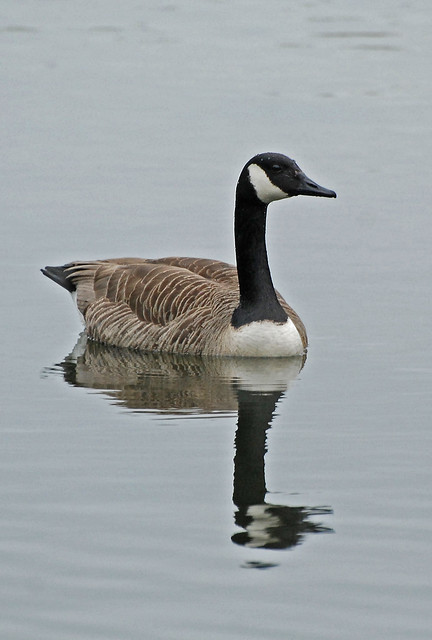
A lone canada goose – I like the symmetry of the reflection

The canada goose (Branta canadensis, Dansk: canadagĂĄs) was introduced to the UK and is now a resident breeder here and can be seen all over the UK apart from northern Scotland, and like the greylag it feeds on vegetation. I think it’s a handsome bird.

Carduelis (or Chloris) chloris

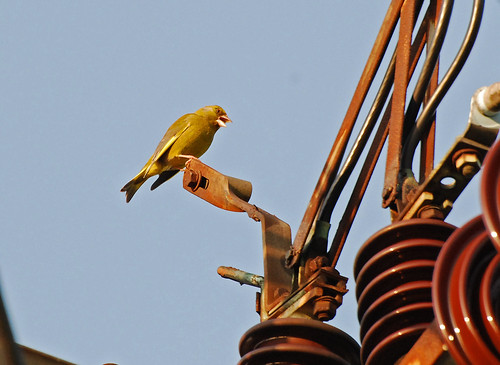
A sound I hear frequently at the moment when I open a door or a window which stands out from all other birdcalls is the call of the male greenfinch. It’s quite variable in tone from fairly high pitched, as in the recording here, to lower pitched where it almost sounds like a whirring mechanical toy.

The bird in these pictures has a reddish hue to it because it was being lit by the evening sun as it was getting lower in the sky, and also from the reflected light of the rusty ironwork and insulators of the electricity supply cables:


Greenfinch male calling from the top of a telegraph pole

The female greenfinch is similar to the male but her colours are much more drab, she is darker grey/brown without the vibrant green of the male.

The greenfinch is a resident breeder in the UK and can be found in gardens and parks at all times of the year feeding on bigger seeds and sometimes insects when rearing youngsters. It has a chunky beak which is typical of finches and is custom built for cracking open seeds.

The taxonomic name for the greenfinch is listed in some references as ‘Carduelis chloris‘, as in my RSPB ‘Complete Birds of Britain and Europe’ by Rob Hume published in 2002, (RSPB – Royal Society for the protection of Birds) ISBN 0751373540, and also in the RSPB Bird Identifier website. But in the BTO BirdFacts website (BTO – British Trust for Ornithology) and in my Collins Bird Guide 2nd edition from 2010, ISBN 978 0 00 726726 2, it is listed as ‘Chloris chloris‘ (Dansk: grønirisk). Somewhat confusingly the BTO entry goes on to explain that the name derives from ‘carduelis‘ meaning ‘goldfinch’ and the Greek ‘khloros‘ meaning ‘green’. So it appears that the two names may be interchangeable. Incidentally, the chemical element chlorine also derives its name from khloros as it exists as a green gas.

He’s turned round to keep on eye on me – his seed-cracking beak clearly visible

The poor old greenfinch has taken a bit of a battering in the last few years since 2005 from the trichomonad parasite which causes a disease called trichomonosis. This microscopic parasite lives in the upper digestive tracts of several birds species including other finches, house sparrows (Passer domesticus, Dansk:  grĂĄspurv) and pigeons and doves. I’ve heard that feeders may become contaminated by pigeons from where it infects the smaller birds. It’s particularly unpleasant (as are most parasitic infestations!) because it causes the throat to swell to the point where the birds can’t swallow so they eventually die of starvation.

Fortunately I’ve never seen any evidence of infected birds but if you think you may have a problem you can click here for the RSPB advice sheet which has details on how to identify the problem and how best to deal with it.

Animal Rescue – Newsflash 28/04/2012

A couple of weeks ago I posted about a fox cub my mother rescued after we found out the vixen had been killed. I promised you an update on her progress and I spoke to the lady who took her in last week so here’s the latest.

At first she weighed between 300-400g and was a little dehydrated but put on 100g in 3 days after becoming fully hydrated and taking immediately to a diet of fresh meat.

Hard to believe this little sweetie will turn into our apex predator!

She had a couple of tics and was infested with worms and fleas, which she generously passed on to her carers (just the fleas!), but was otherwise in good health. After a course of parasite treatment she came on in leaps and bounds and began to show signs of hunting behaviour by fighting with an old sock.

After a week and a half with her original benefactors she was passed on to a rescue centre near Kings Lynn in Norfolk where she was introduced to another orphaned cub. They had a good old scrap during which the pecking order was established and after that they knew their respective places and got along well. So everything is now being put in place for a release date in August, which is when a wild fox cub would be venturing out on its own.

So everything is looking good for a return to the wild for this little lady and I’ll hopefully get another progress report in about a months time.  I’ll try to find out if it will be possible to photograph her eventual release and I’ll share updates and photographs as and when.

Misplaced mallard

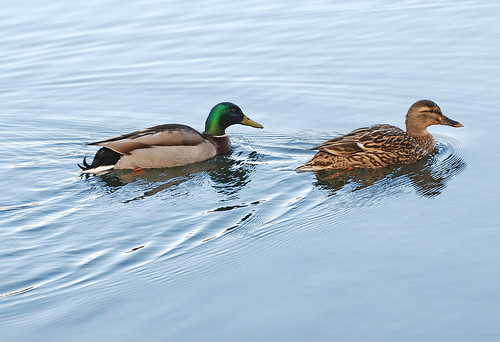
This pair of mallard weren’t misplaced at all, they were on a lake at Milton Country Park doing exactly what you’d expect mallard to do,

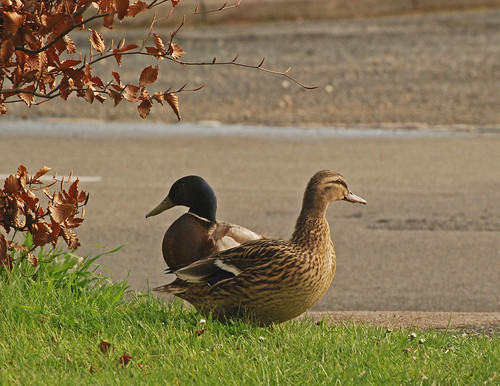
But this pair were very misplaced:

Romeo and Juliet

They appeared in my garden, relaxing under the crab apple tree, a couple of days ago, they disappear early in the morning and return in the afternoon. They’ve repeated this for the last three days now and they were here at dusk today sitting on the grass under the tree.

They seem completely unfazed by most interruptions including cats, humans and me flying past on my bike when I didn’t realise they were in situ. There is no water within half a mile so I don’t know why they are here, but it’s the first time we’ve had ducks in the garden and the children are very excited by their presence, so they’re welcome to stay as long as they want.

Blog plug

I just found these two blogs which I think are really good and well worth a look:

http://cerisnaturalworld.blogspot.com

This one caught my attention because of the adders, a creature I’ve never seen in the wild yet but I’m on a mission to find them.

And this one has lots of high quality photographs of British moths:

http://weedworld.blogspot.com

The birds and the bees (and the flowers)

As our warmest and driest Spring on record turns into what is shaping up to be a warm and dry Summer, nature’s great events are occurring apace to exploit the prevailing climatic conditions.

The first swifts were seen over Histon 3 weeks ago (by me at least) after their heroic journey back to their breeding sites from overwintering in Africa. To celebrate this event I’ve spent several hours sitting in the garden of the Castle pub on Castle Hill in Cambridge enjoying a few convivial sharpeners and watching the swifts shrieking through the sky like an avian aerobatic team. I can heartily recommend both activities!

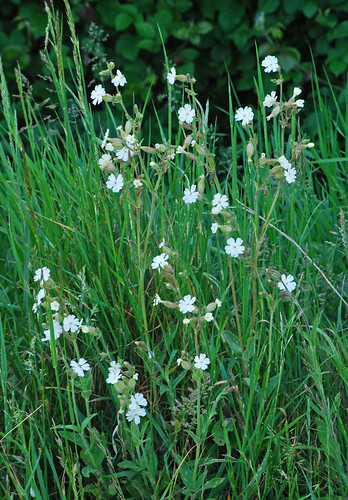
Wild flowers, including one of my favourites, white campion, are now in bloom:

White campion, Silene latifolia, decorating ditches and hedgerows

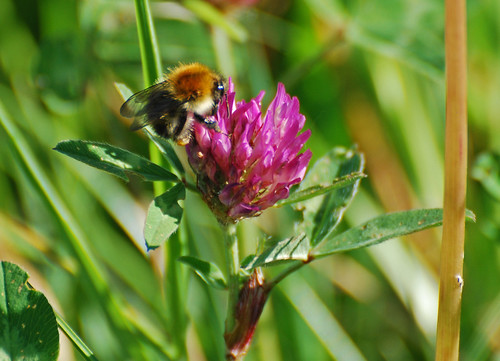
White campion is a dioecious plant which means the male and female reproductive machinery are on separate flowers. It grows in well drained earth and flowers from Spring to Autumn and is now delineating my walks across the open countryside. Another one of my favourite wild flowers is red clover (Trifolium pratense) which is a gorgeous colour and provides nourishment for bumble bees:


Red clover flower being harvested for pollen and nectar by a common carder bee (Bombus pascuorum). This is the national flower of Denmark.

And of course the local birdlife has been very busy breeding and raising chicks. Alot of species started this process earlier this year due to the unusually warm weather in Spring. I have a pair of blue tits raising a brood in the nestbox in my crab apple tree and my friend told me of a family of song thrushes which fledged from his garden a month ago. Which is very early.

A pair of great tit have been feeding their chicks on crushed peanuts which I put out on my bird feeder over the last month and last week they fledged and the whole family were feeding in my garden for just a day or two before they ventured further afield. (If you put nuts out for the birds during the breeding season please make sure you use crushed nuts as inexperienced parents can try to feed whole nuts to chicks and this can have fatal consequences). Great tits have over 70 different vocalisations which I think is remarkable, almost simple language! And on my explorations along the fields and hedgerows around Histon last weekend (21st May, 2011) I saw more great tit, blackcap and whitethroat all feeding gangs of fledglings:


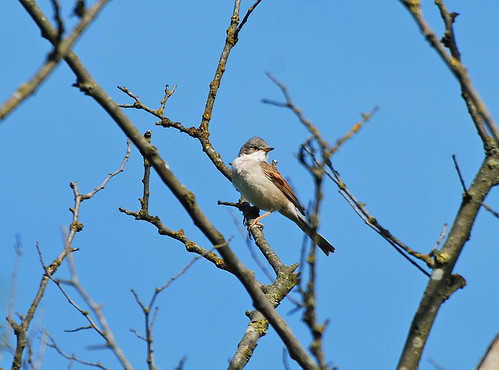
Common whitethroat male, Sylvia communis

There are two species of whitethroat to be found locally, the common and the lesser (Sylvia curruca). They are distinguished by their song, which I won’t try to describe because I’ve never yet read a book which gives the remotest idea of what birdsong actually sounds like by a written description! But if you want to compare them try here for the common whitethroat, and here for the lesser whitethroat.


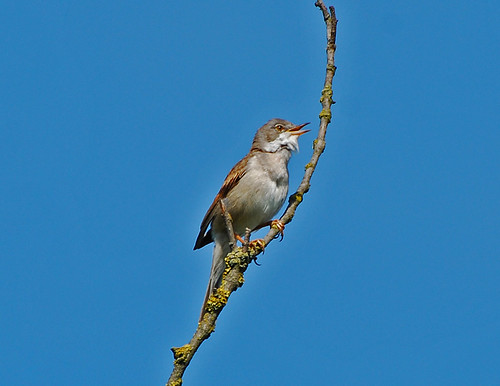
And another male whitethroat, this chap was singing long and loud, punctuated with characteristic jerky flights straight up in the air and back to the same spot

There are a good number of common whitethroat in the hedgerows north of Cambridge, lesser whitethroat are also here but are not so numerous. There are other distinguishing features between the two species, the lesser, as the name suggests is smaller (~11cm long compared to ~13 for the common), and is generally more grey with a pale grey head and noticeably darker grey ‘ear’ patches. It also has dark grey legs. Both species overwinter in sub-Saharan Africa, the common in central Africa and the lesser in eastern Africa.

Linnet can be regularly seen flying around the bramble thickets on the edges of the village and perching and singing on top of them. On Saturday early in the morning a fracas was going on in an elderbery tree in Rowleys Meadow in Histon which ended when a jay was chased out of the tree by a family of linnet and a family of whitethroat. The jay alighted on an adjacent shed to suss out the lie of the land and contemplate another raid whilst the indignant songbirds dispersed into some scrub to hide. Eventually the jay decided to keep his powder dry and disappeared into a nearby wood. Jays, like other members of the crow family, will raid nests of smaller birds for eggs and chicks, so it’s a perilous business being a small bird with a family to rear.


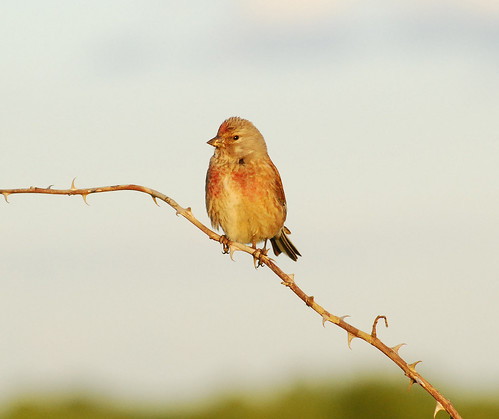
A linnet male perching on a bramble. When they’re not protecting a nest I’ve managed to sneak within 15 feet of linnet perched like this.

Linnet, Carduelis cannabina, are abundant resident and migrant breeders, although their numbers, as with many of our songbirds, are declining, and they are also passage and winter visitors. Due to their declining numbers over the past 40 years or so their conservation status is red, indicating they are globally threatened. They are finches which live in open country and farmland and feed on seeds.

Many species of moths, butterflies, bees, flowers and a plethora of other creatures are all appearing as trhe seasons are progressing and there’s something new to see every week!

Orange tip

I am of course referring to the butterfly, not an unsightly medical condition. I’ve spent plenty of time chasing them along hedgerows waiting for one to settle on a flower, but in vain, and you may recall that in a previous post I said that the orange tip was extremely difficult to photograph because they rarely settled.

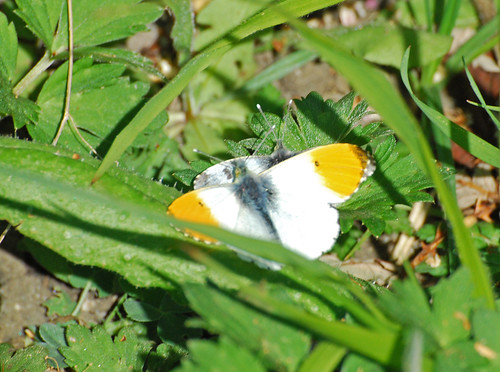
That was until last weekend when, the weather was sunny, warm and calm so I went for a walk on Guns Lane to the north of Histon. I was rewarded fairly soon into my walk by a male orange tip settling on a plant on the edge of the pathway and allowing me to encroach within just a few inches:


Male orange tip. I think his underwings are exquisite, and it’s perfect camouflage when he’s perched on a cow parsley flower head.

This fellow was a good omen. Several hundred metres further along the path where the dense hedgerow thinned out into more open territory lined with cow parsley there were many male and female orange tips and they were all intent on mating on this particular morning.


Another male orange tip, this time with his wings open. And the colours on top are gorgeous too.

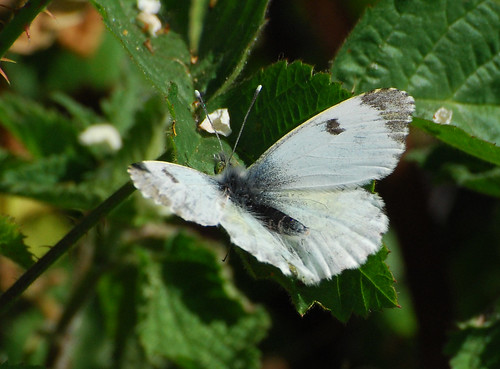
The female of the species doesn’t have the orange tips but is still distinctive from the other white butterflies:

Female orange tip. She is aware of the presence of males and is pointing her tail in the air in preparation for mating…

…and a few seconds later a male flew within a few centimetres and her reproductive organs are clearly visible opening up here in response to his presence.

The female above didn’t mate in this instance, but:

This pair were mating on the ground close by

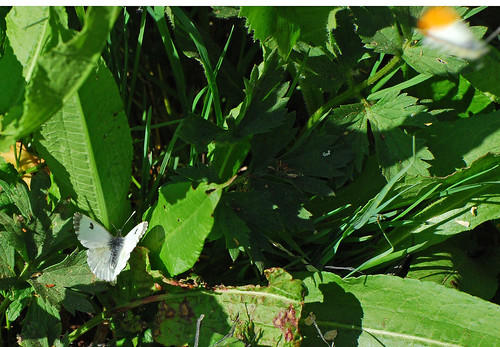
And another female sits on a leaf as the male beats a post-coital retreat top right

I promised some pictures a few weeks ago of orange tips in the post ‘Local Lepidoptera’ so I was very pleased to capture this series of the mating behaviour so soon after.