Tag Archives: ornithology

Carduelis (or Chloris) chloris

A sound I hear frequently at the moment when I open a door or a window which stands out from all other birdcalls is the call of the male greenfinch. It’s quite variable in tone from fairly high pitched, as in the recording here, to lower pitched where it almost sounds like a whirring mechanical toy.

The bird in these pictures has a reddish hue to it because it was being lit by the evening sun as it was getting lower in the sky, and also from the reflected light of the rusty ironwork and insulators of the electricity supply cables:
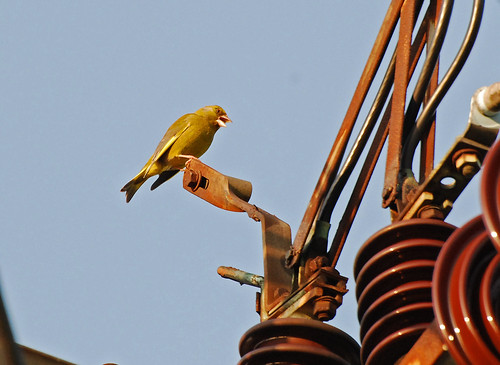

Greenfinch male calling from the top of a telegraph pole

The female greenfinch is similar to the male but her colours are much more drab, she is darker grey/brown without the vibrant green of the male.

The greenfinch is a resident breeder in the UK and can be found in gardens and parks at all times of the year feeding on bigger seeds and sometimes insects when rearing youngsters. It has a chunky beak which is typical of finches and is custom built for cracking open seeds.

The taxonomic name for the greenfinch is listed in some references as ‘Carduelis chloris‘, as in my RSPB ‘Complete Birds of Britain and Europe’ by Rob Hume published in 2002, (RSPB – Royal Society for the protection of Birds) ISBN 0751373540, and also in the RSPB Bird Identifier website. But in the BTO BirdFacts website (BTO – British Trust for Ornithology) and in my Collins Bird Guide 2nd edition from 2010, ISBN 978 0 00 726726 2, it is listed as ‘Chloris chloris‘ (Dansk: grønirisk). Somewhat confusingly the BTO entry goes on to explain that the name derives from ‘carduelis‘ meaning ‘goldfinch’ and the Greek ‘khloros‘ meaning ‘green’. So it appears that the two names may be interchangeable. Incidentally, the chemical element chlorine also derives its name from khloros as it exists as a green gas.

He’s turned round to keep on eye on me – his seed-cracking beak clearly visible

The poor old greenfinch has taken a bit of a battering in the last few years since 2005 from the trichomonad parasite which causes a disease called trichomonosis. This microscopic parasite lives in the upper digestive tracts of several birds species including other finches, house sparrows (Passer domesticus, Dansk:  gråspurv) and pigeons and doves. I’ve heard that feeders may become contaminated by pigeons from where it infects the smaller birds. It’s particularly unpleasant (as are most parasitic infestations!) because it causes the throat to swell to the point where the birds can’t swallow so they eventually die of starvation.

Fortunately I’ve never seen any evidence of infected birds but if you think you may have a problem you can click here for the RSPB advice sheet which has details on how to identify the problem and how best to deal with it.
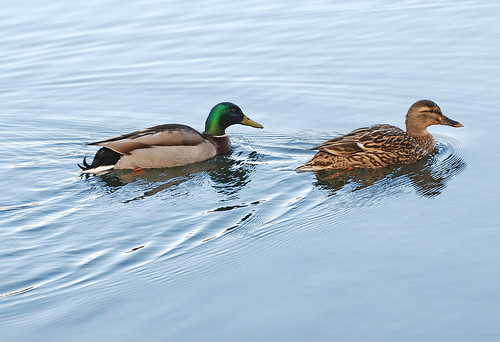
Misplaced mallard

This pair of mallard weren’t misplaced at all, they were on a lake at Milton Country Park doing exactly what you’d expect mallard to do,

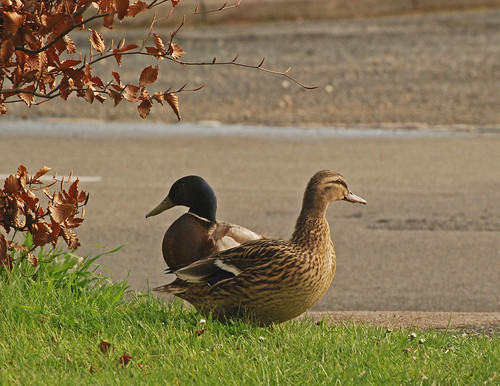
But this pair were very misplaced:

Romeo and Juliet

They appeared in my garden, relaxing under the crab apple tree, a couple of days ago, they disappear early in the morning and return in the afternoon. They’ve repeated this for the last three days now and they were here at dusk today sitting on the grass under the tree.

They seem completely unfazed by most interruptions including cats, humans and me flying past on my bike when I didn’t realise they were in situ. There is no water within half a mile so I don’t know why they are here, but it’s the first time we’ve had ducks in the garden and the children are very excited by their presence, so they’re welcome to stay as long as they want.

Bullfinch revival?

Anyone who has followed some of my recent posts may well have picked up that I love the bullfinch (Pyrrhula pyrrhula, Dansk: dompap). Both the male and female of the species have beautiful plumage and because of their scarcity I consider it a real bonus to see one. Apart from the very occasional sighting, i.e. one every 5 years or so, I simply didn’t encounter them between childhood and around 2 years ago.

Since then I’ve seen them on numerous occasions out and about on my wanderings around Cambridgeshire, both around Histon and at nature reserves such as RSPB Fowlmere and Fen Drayton, and to my immense pleasure a group has been resident in a patch of scrub close to where I live for the past 2-3 weeks. On one occasion over Christmas I saw eight in one go, and I can’t ever remember seeing that before.

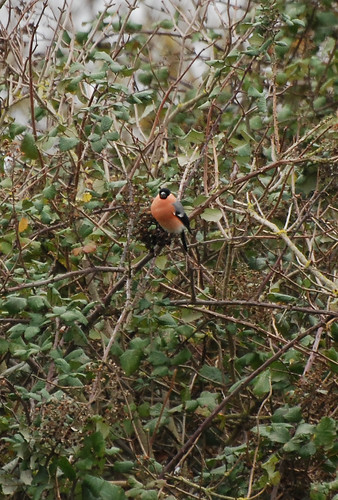
A group flew over my head, too fast to photograph, but this lone male alighted on a bramble around 30m from me and let me edge to within 20m, shutter whirring all the way:


Male bullfinch – the tailend charlie perched on the brambles

He was very busy gorging on the brambles pausing to look at me when he was aware of my movements and when I stopped he carried on feeding. Many bullfinch pictures are of the male, resplendent in his sumptuous orange/pink waistcoat and I don’t mind that, but I was pleased to get the picture below as he flipped through 180 degrees to get to his bramble shoots:


Upside down bullfinch showing his dark grey back and tail, jet black primary flight feathers and white rump. No other bird could be mistaken for him.

The song of the bullfinch is also very distinctive. They make a fairly inobtrusive ‘cheep cheep‘ call which is unmistakeable when a group fly overhead.

My lone male replete after his feast sizing me up immediately prior to his departure

Flocks of bullfinch can decimate fruit crops by eating the shoots from the trees and were therefore heavily persecuted in tis country which led to a catastrophic decline in the numbers through the 1970’s and 80’s but I read in a recent report that they fared well as a result of the mild year we experienced in 2011, so I’m hoping there has been a general increase in their numbers and my small local flock will stay on and possibly expand. Fingers crossed.

If that comes to pass I should be able to post more shots of both the male and female bullfinch in the near future. At the moment I only have one photograph of a female as they seem to be generally more wary than the males. I’m also saving up to invest in more powerful optics so I should be able to bring you some better close up portrait shots of bullfinch, and lots of other species in the not too distant future. Watch this space.

Water birds at Milton Country Park

As I mentioned in my previous post, when I was at Milton country Park on a dragonfly hunt there were lots of birds about too, So between photographing the darters and hawkers I managed to capture some water birds:

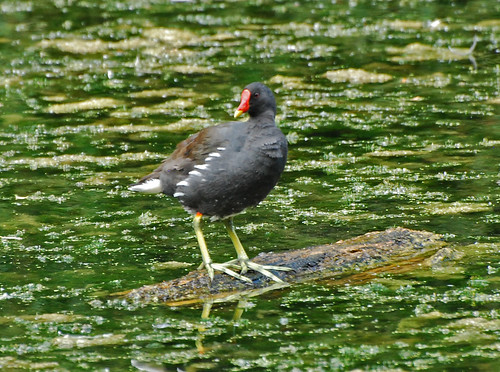
Moorhen, Gallinula chloropus, preening on a log in a lake
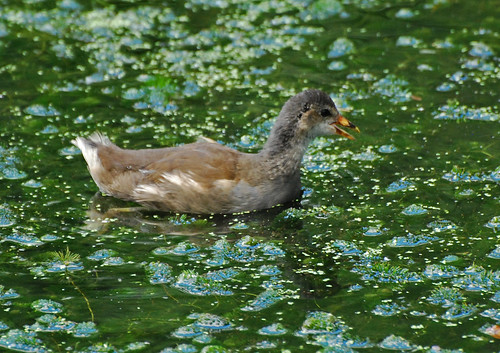
Moorhen chick

Moorhens are common water birds seen on rivers and lakes, they can be secretive but are often seen out of the water on grassland. They are resident breeders and winter visitors in the UK with approximately a quarter of a million individuals. They are omnivores and are one of the few British birds which practice cooperative breeding where youngsters will assist in rearing subsequent broods. Their red beak and very long yellow legs and toes are distinctive and peculiar to the moorhen. The taxonomic name ‘Gallinula chloropus‘ translates as ‘little green footed hen’. For my international readership, the Danish name is ‘Grønbenet rørhøne‘ – according to the BTO. (If you actually call it something different or have a local name please let me know).


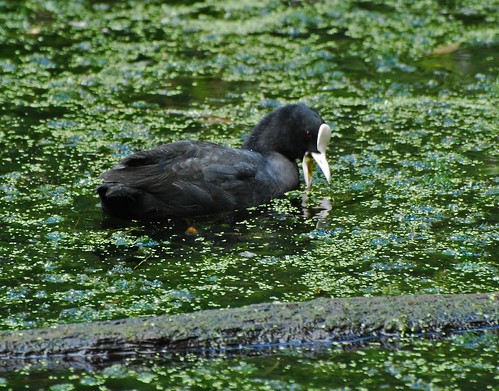
This coot (Fulica atra) was one of a group of moorhens and coots, including the moorhen above

I find coots amusing to watch as they have splendidly bad attitude and defend their patch against all comers, even members of their own species, and will aggressively charge other birds. They inhabit the same territories as moorhens and are also resident breeders and winter visitors. (In Danish – blishøne).

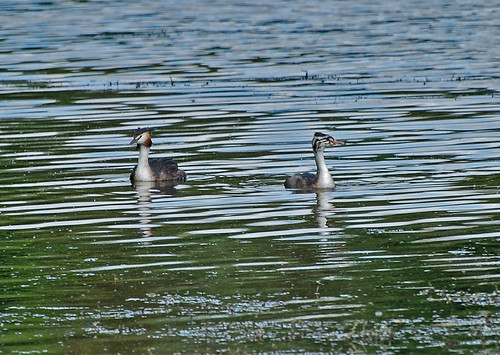
Great crested grebe with youngster

My favourite water bird (apart from the kingfisher, of course) is the great crested grebe (Podiceps cristatus). They can regularly be seen on open lakes and have been persecuted in the past because of their dense plumage which was used in place of fur. They have distinctive crested head plumage and an amazing courtship display. During the foot and mouth crisis in 2001 I watched a pair for a long time performing on a lake in Leicestershire – one of the few pieces of countryside where access wasn’t forbidden at the time. They would swim away from each other in a straight line for 20m or so and then turn and with beaks low on the water swim towards each other at high speed, raising up when they reached each other forming their necks into a heart shape. All terribly romantic! It’s a beautiful display and one of these days I’ll hopefully see it when I’ve got my camera handy. (By the way, in Danish these are ‘toppet lappedykker‘). Great crested grebe are also resident breeders and winter visitors but the numbers are much less than moorhen or coot, with 8000 adults here in the summer. Despite the lesser abundance their conservation status is green.