Yearly Archives: 2013

The owl and the woodpecker

As I started to write this post there was some interesting robin behaviour going on in the garden. Robins (Erithacus rubecula, Dansk: rødhals) are fiercely territorial and will kill each other to defend their patch and I often see them chasing off not just other robins but any bird smaller than a blackbird (Turdus merula, Dansk: solsort)! But just now there was a pair being relatively nice to each other and even sharing the same feeder. So I’m wondering if these two were a pair beginning to contemplate the imminent breeding season, as early as January the 12th. The weather has been much warmer than the previous three winters so maybe they are already thinking of making up for lost time.

But I began with a digression, so now to get back on message. I’ve been dithering about writing this post for a few days but I was finally inspired to start when I saw some recent posts on the blog of a good blogging friend, Gary, from ‘Krikitarts‘ (if you haven’t seen Krikarts yet make sure you check it out, it’s very, very, good!). Gary’s posts included pictures of skies and rainbows which were digitally reproduced form the original slides. And seeing these spectacular images spurred me on to get this post written to show you some evening skies from Cambridgshire in summertime.

But before I get on to the sky, on this particular evening from July 2013, green woodpeckers, which breed successfully close by, had their most recent brood of fledglings and were out and about learning how to dig up termites:

A pair of green woodpeckers flying away from me, they’re skittish creatures (Picus viridis, Dansk: grønspætte )

Whilst many bird species have been on the decline, the green woodpecker seems to be thriving, at least in my part of the world. I see them around the village, in the trees and on the ground around work, and on the way to work too, and I’ve heard they are generally doing OK. They’re handsone, colourful, creatures and it’s good to see them coping well with all the insults humans throw at them.

A greenie keeping an eye on me and the dog

This particular evening was a very warm and sunny one and as I meandered across the fields the sun got lower and lower, and bigger and bigger, in the sky:


And as the sun got lower and plunged us into the crepuscular phase twixt day and night, a barn owl (Tyto alba, Dansk: slørugle) was quartering the fields looking for rodents. Barn owls were hit really hard by the previous three bitterly cold winters and then by the brutal wet and cold weather last spring. But we had at least two breeding pairs in Histon and this individual was half of one of those pairs. Bearing in mind the precipitous decline in barn owl numbers in the UK and beyond, I think that makes Histon an important place for them. I don’t know how many chicks were fledged but I’m hoping some survive the cold weather holds off this year and we get more breeding pairs in 2014.

Barn owls are great to watch. I know the routes they take in the fields local to here and when I see them coming I can crouch down and often, but not always, they fly slowly right over my head, around 10-15 feet up, and sometimes we eyeball each other and I wonder what they’re thnking. Of which more in another post in the near future.

And as I meandered home from watching the owl, the sun disappeared below the horizon leaving these magnificent colours hanging in the sky which slowly turned into dark blue-grey and then the black of night

Not a bad way to spend an evening!
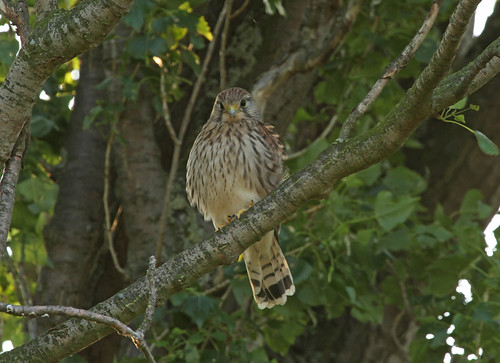
Down on the farm in July

Summer was late arriving in  2013. The weather was cold and wintry up until June and that had a profound effect on the wildlife. Breeding seasons were knocked out of kilter by it, and the numbers of many species have suffered as a result. But it seemed that once summer did arrive the wildlife got very busy very quickly to make up for lost time.

The skyline on my regular dog walking route is dominated by a magnificent poplar tree which makes a wonderful sound when the wind blows. It’s right on the pathway where many walkers pass every day and there is a bench underneath it which folk sit on occasionally. But despite all the human activity in such close proximity a pair of kestrels (Falco tinnunculus, Dansk: tårnfalk) were brave enough to build a nest in it about 20-25 feet up.

Kestrel fledgling taking it easy and apparently unfazed by me pointing a telephoto lens at it

I posted about the adults taking up residence in the poplar in August last year. Their decision to nest in this exposed location paid off in spades as the kestrel pair fledged three youngsters who could be seen in around the poplar into the later months of 2013.

And a pair of the fledglings sheltering in the poplar

I made a point of not lingering too long around the poplar to avoid disturbing the birds, but because of the constant human presence there I think they were relaxed about me taking pictures as long as I didn’t try to stay too close for too long.

All the pictures in this post were taken on one summers evening stroll in July, and as well as the kestrels there was lots of other wildlife.

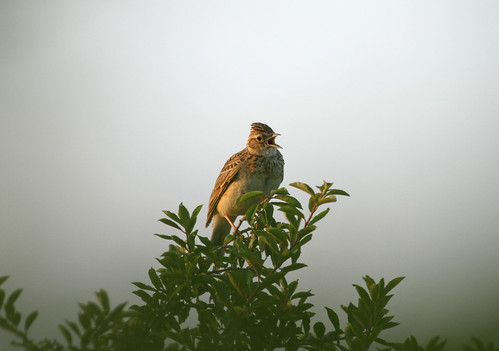
Also breeding in the field adjacent to the poplar tree were numerous skylark (Alauda arvensis, Dansk: sanglærke). I’ve been trying unsuccessfully to get photographs of skylarks for a long time but on this particular evening this one perched on top of a low bush and sang for England. I called the dog to heel and using an adjacent bramble as a shield I crawled as close as I could, which was less than 10m in the end, and poking my lens though the bramble I finally got some pictures:

A singing skylark lit by the low, late evening sun

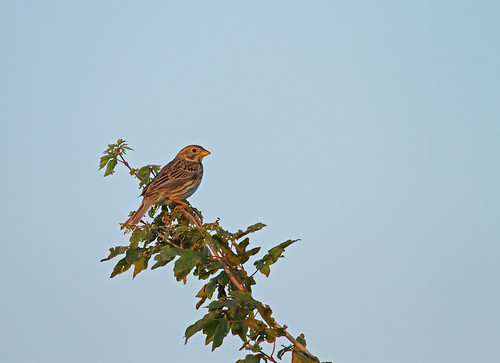
The resident corn buntings (Emberiza calandra, Dansk: bomlærke ) usually vacate the fields around Histon with the harvest at the beginning of August, but in 2013 they stayed much later. I don’t know if that was coincidence, because there was still cover in one of the fields, or if it was a result of the enforced delay in the breeding cycle due to the cold spring weather. But they were here in much greater numbers and much later in the year than normal. According to the British Trust for Ornithology the corn bunting is so sedentary that individulas only 30km apart sing in different dialects, but I’d love to know how that was discovered.

Corn bunting on a regular perch in the late evening sunshine

Corn bunting are red listed in the UK due to rapid decline in numbers as a result of habitat destruction for agriculture. Despite that, and decreasing numbers in Central Europe for the same reason, it’s not considered under threat as a species in mainland Europe… yet.

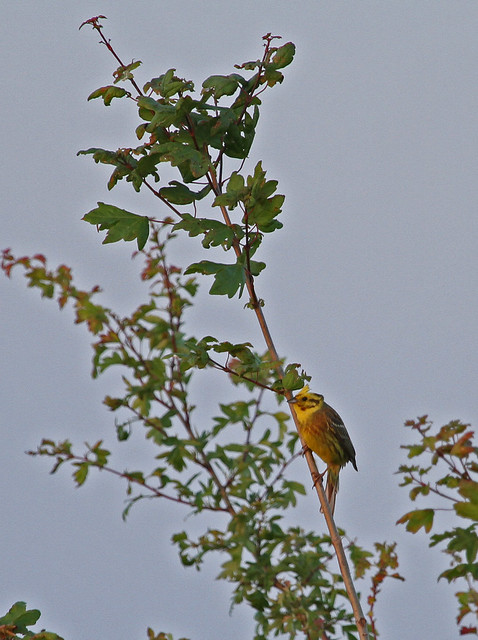
Another songbird which is also red listed in the UK, also as result of rapidly declining numbers, is the yellowhammer (emberiza citrinella, Dansk: gulspurv).

Male yellowhammer with his striking yellow head plumage

The yellowhammer has suffered catastrophic decline in numbers over the last few decades and over the last 2-3 years I’ve noticed the numbers in my locality seem to be on the wane too. I think it hasn’t been helped here by the farmer who recently took a flail to all the hedgerows and a lot of the drainage ditches and stripped most of the winter cover and food away. I just don’t see the sense it that – it wasn’t impinging on the crops or impeding access to farm machinery. Seems completely pointless to me.

Yellowhammer and corn bunting are both species of bunting and prefer arable farmland, but due to the intensive nature of arable agriculture and the resulting lack of seed, either natural or crop, both species are under dire threat in the UK. I’ve seen evidence to show that rates of decline can be slowed by changes in farmland management such as set aside or organic cropping, but I think attempts to conserve need to be applied in more holistic fashion to ensure survival of the wildlife.

One species which appeared to be abundant last summer was the hare. They’ve been ever present on any summers evening stroll across the fields in 2013. And I’m still seeing them through the winter too.

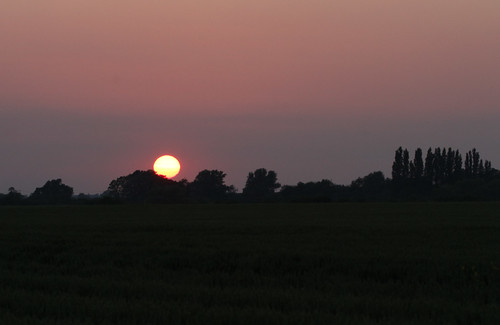
And as I headed home there was a spectacular sunset:

…one of many through the summer of last year.

Life in the kiln

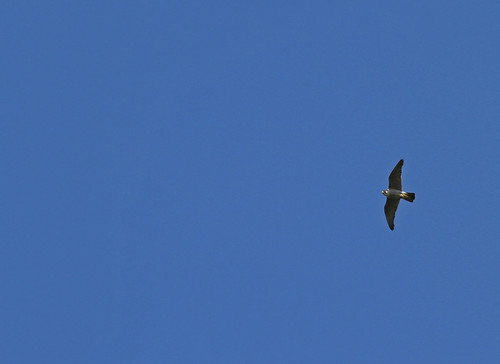
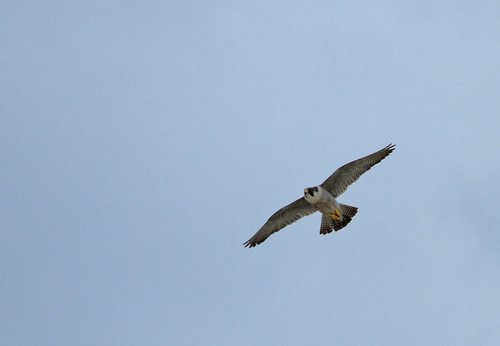
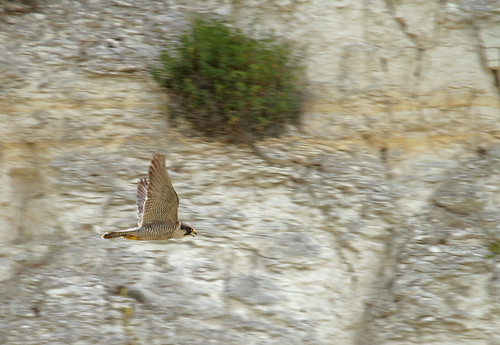
After a lengthy absence from the blogosphere I’m rushing to squeeze a last post in in 2013. It won’t be topical so I’m harping back to a visit to the Lime Kiln in Cherry Hinton, on the southern edge of Cambridge, from back in July. I posted from here earlier in the year about the resident peregrine falcons.

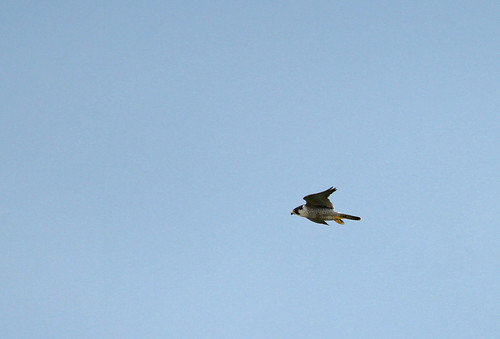
The main reason for this visit to the Lime Kiln was to see if the peregrines were still in residence. One of them appeared overhead and gave chase to a pigeon, but it was in level flight not in  a stoop so the pigeon made good its escape. It was more like a juvenile practice run than a serious attempt to make a kill. It seemed that the family group had dissipated and were no longer spending the whole day at the Lime Kiln.

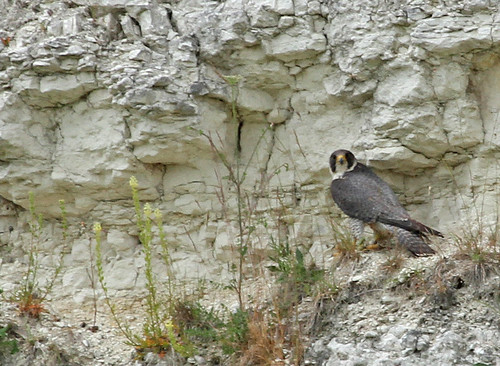
A single peregrine falcon – Falco peregrinus – quatering the Lime Kiln

The peregrine is the worlds fastest bird, but only in a stoop, which is gravity assisted and more a controlled fall than real flying. In level flight it is comparatively cumbersome and not the fastest, that accolade goes to a species of swift called the ‘white throated needletail‘ (Hirundapus caudacutus) with recorded level flight speeds of around 70mph (112km/h).

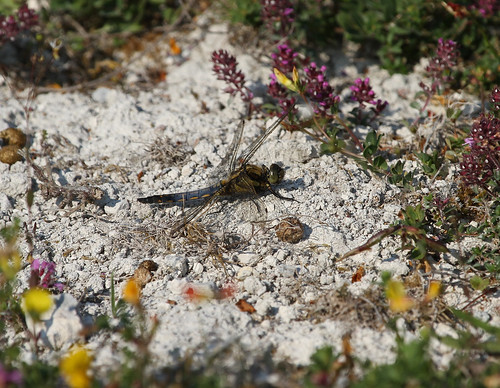
Black tailed skimmer – Orthetrum cancellatum

The black tailed skimmer dragonfly was perched on the chalky ground and this is characteristic behaviour of the species. As the temperature rises above the mid 20’s Celsius he will perch on low vegetation instead. This one is an adult male, his blue abdomen is diagnostic and can only be confused with the male scarce chaser, but he lacks the dark patches at the proximal end of the wings which distinguish the scarce chaser.

The female and the immature skimmer have yellow bodies instead of the blue of the male:

Black tailed skimmer female

I’m not entirely certain whether this skimmer is a female or a juvenile, the juvenile has pale green eyes and the female has darker grey/brown eyes so I think this one is a female. Interestingly, this species is associated with water and males will fiercely defend a bankside territory against other competing males. But as far as I know there is no water in the Lime Kiln so the male above may be a non-territory holding male, and females do spend time away fom water. The black tailed skimmer feeds on a variety of prey and can show a preference for bigger prey species such as butterflies and grasshoppers. They’re ferocious, albeit short lived,  predators!

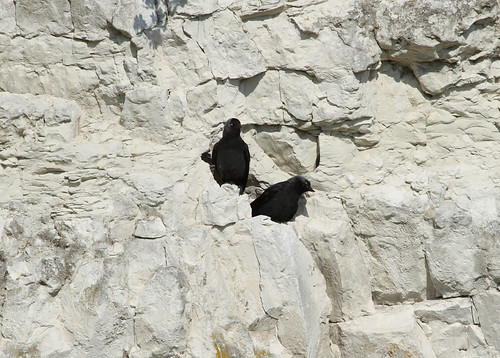
A pair of jackdaws, Corvus monedula

There were very few birds to be seen on this trip, it was at lunchtime on a very hot day (mid to high 20’s Celsius) so I think they may have been hunkering down in the shade, but I could hear a male whitethroat singing and a family of jackdaws were playing around on the white chalk cliff face.

Because of the relatively young age of the Lime Kiln, and possibly as a result of the unusual nature of the terrain, large areas of the floor are bare chalk and there are less plant species than there may be in a more conventional habitat.

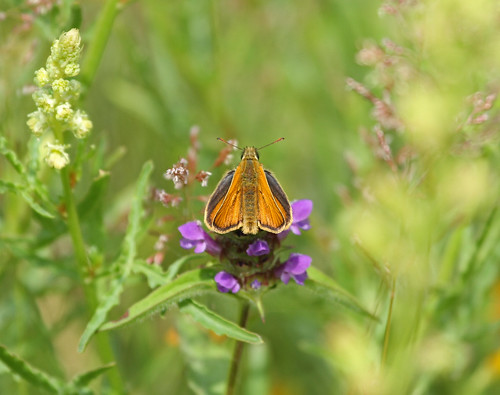
Either a small skipper (Thymelicus sylvestris) or an Essex skipper (Thymelicus lineola) sipping nectar from a self heal flower

One of the wild flowers growing there is self heal (Prunella vulgaris). This skipper butterfly was perched on a self heal flower head but I’m not sure if it’s an Essex skipper or a small skipper, they are very similar in size, shape and colour, and alas I’m not sufficiently expert to unambiguously identify them.

I didn’t manage to publish this post in 2013 so it’s now my first post of 2014. So Happy New Year to everyone, may the next 12 months bring you health and happiness!

When the sun stood still

The plane through the centre of the earth and the sun is called the ‘ecliptic‘ and it describes the apparent path of the sun around the earth. And the plane through the centre of the earth – on the earth’s equator – is called the ‘celestial equator‘. There is an angle between these two planes of 23.4o and this angle is known as the ‘obliquity of the ecliptic‘.

It is the obliquity of the ecliptic which gives rise to our seasons, because as the earth moves around the sun a point on the surface will be closer to the sun in summer and further away in winter. The mid winter and mid summer solstices are the midpoints of those two seasons and at the  midsummer solstice the perceived height of the sun in the sky is at its maximum ‘declination‘ – the angle between the ecliptic and the orbital plane. So whereas the solstices occur when the angle is at its maximum  23.4o, the vernal and autumnal equinoxes occur when the angle between the two planes is at its minimum, i.e. 0o, or when the celestial equator intersects with the ecliptic.

The summer solstice occurs in the northern hemisphere on June 21st and on this years solstice I found myself walking in the countryside late into the evening. It was a proper midusmmer day; sunny, warm and sultry, and the fields were full of wild flowers.

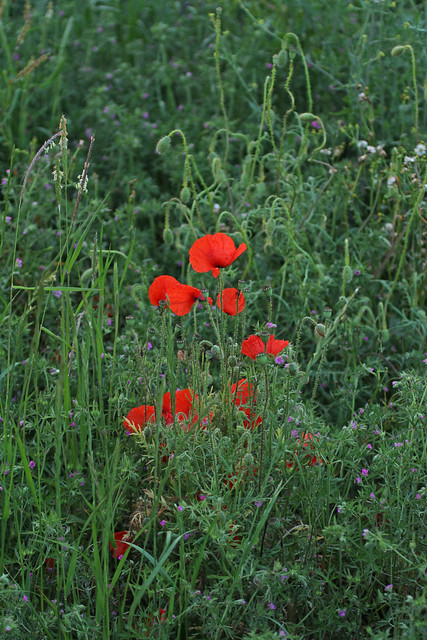
Field poppy – papaver rhoeas -my all time favourite wild flower. There’s nothing quite so spectacular as a field full of red poppies!

The field poppy is also known as the ‘Flanders poppy’ from the battle fields of WW1 – which seems wholely appropriate as I’m writing this on Remembrance Sunday. I find it difficult to photograph poppies and get the colours just right, but I really like these flowers against the green background. They were snapped in the field below, which was a riot of floral colour throughout the summer:

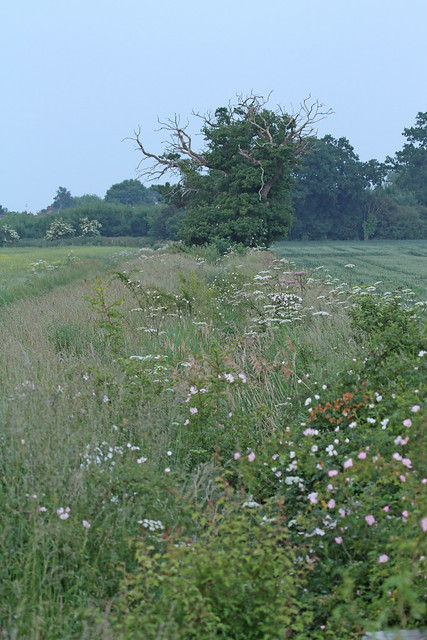
Looking along the drainage ditch which divides two arable fields

The old oak tree in this picture was home to a barn owl nest this year and I spent several evenings sitting in the undergrowth watching the toing and froing of the adults bringing prey to the nest. I didn’t get to see the fledglings but I’m hoping they were successful and return next year. And it was along this stretch of ditch where I photographed the yellowhammer, linnet and whitethroat I posted recently.

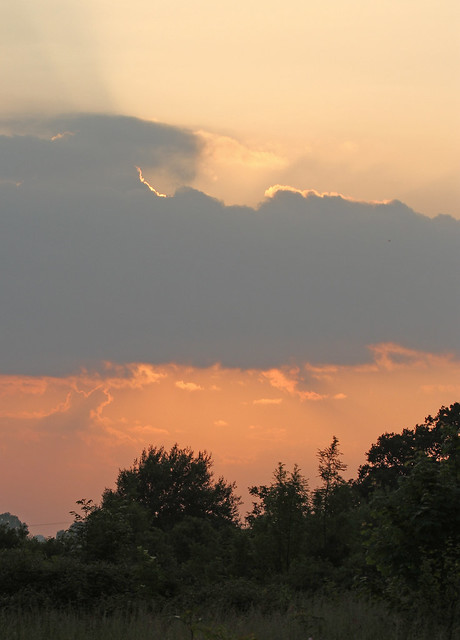
Not quite sunset, but the colours were breathtaking

And of course at that time of year, late in the day when the sun is getting low in the sky, the skyscapes can be magnificent .

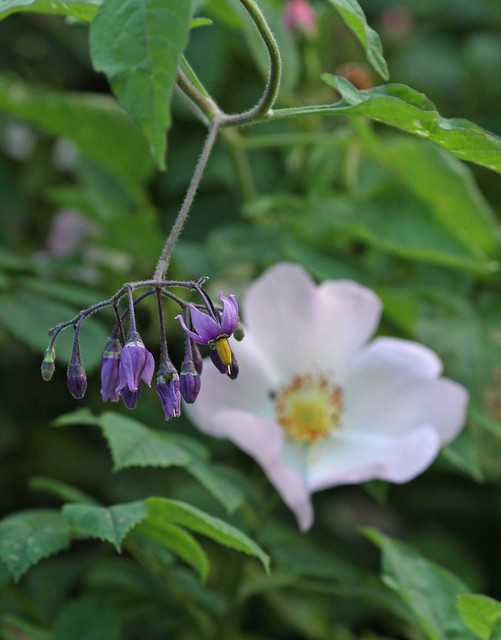
Another flower which was sprouting in the hedgerows was woody nightshade, Solanum dulcamara, which is closely related to deadly nightshade, and the potato which is rather less toxic than it’s relatives – unless the potatos are green when they contain the same toxin. So don’t eat the green ones (or nightshade berries)!

Woody nightshade flowers with a dog rose in the background

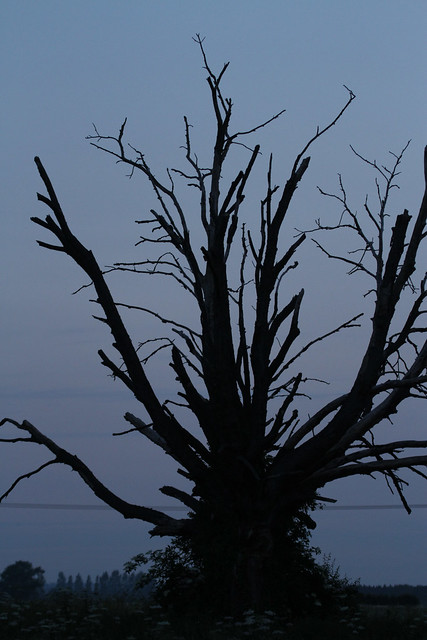
Toward the end of my stroll it was getting darker and in the midst of a line of imposing horse chestnut trees is this dead one silhouetted against the crepuscular blueness of the western sky after sunset.


On another dead tree stump adjacent to this one was a kestrel eating its prey and it let me stand close by and watch it for several minutes which was remarkable in itself, but to give you an idea of how close I was I could actually hear it tearing the flesh off the bone! He must have been very hungry.

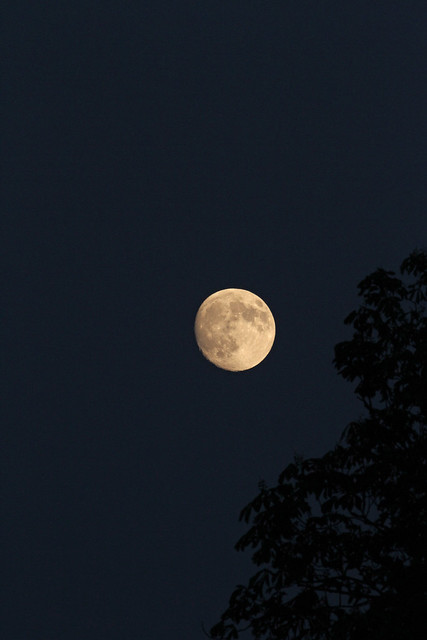
The moon emerging from behind a horse chestnut tree

And right at the end of the walk it was night time proper, and on midsummers day this year there was also a full moon.

The word ‘solstice‘ is derived from the Latin for ‘the sun stands still’ because the sun has stopped rising in the sky and begins it’s journey back across the ecliptic to bring summer to the southern hemisphere, leaving winter for us in the north. But I wasn’t thinking about that as I soaked up the summer warmth on midsummers day.

Impington Lane

In the summer I posted about the desire of our local council to build houses on the green spaces around our village. One of those green spaces is a small area on Impington Lane which is between 5-6 acres in area, and a friend of mine who lives adjacent to this unassuming piece of scrub told me there were reptiles on the site which would be evicted if the proposed construction took place.

So with my campaigning hat on I set off very early one Sunday morning to try to capture some photographs of the resident reptilia to promote the argument that this diminutive fragment of green belt should remain unmolested.

Hedge woundwort – Stachys sylvatica

The reptiles were staying under cover but there were wild flowers in abundance along with the accompanying insects. Hedge woundwort, as the name suggests, has medicinal properties and was used to staunch bleeding.

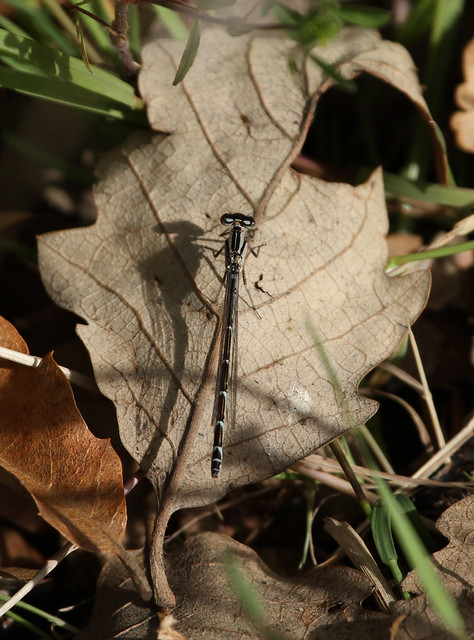
At 6am the sun was rising and it was already warm so damselfies were basking in the early morning sunshine to warm their bodies to enable them to go hunting. I found two species of damselfly:

Common blue damselfly – Enallagma cyathigerum

Variable damselfly – Coenagrium pulchellum

(I’m not totally confident of my damselfy identifications so if you spot a mistake please let me know).  The undergrowth in the field was waist high in most of it and it was full of these particular flowers:

Carder bumble bee landing to feed

It’s very similar in size and shape to another wild flower called jack-go-to-bed-at-noon which is yellow (Tragopogon pratensis). But all these flowers varied from pale pastel purple to rich dark purple. I don’t know what species these flowers are, or if they’re related to jack-go-to-bed-at-noon, or whether they are wild or escapees from gardens, but they are very pretty and the bees like them.

Fluttering amongst the stems of all the wild flowers were numerous examples of this handsome creature, which I first thought was a butterfly:


Subsequent research revealed that it’s not a butterfly at all, it’s a latticed heath moth, Chiasmia clathrata, and is one the moth species that is active by day in May and June in this part of the UK. They were fiendishly difficult to photograph as they were skittish and hunkered down close to the ground on the stems of the flowers, and any slight gust of wind rendered any photography impossible. But fortunately the wind abated for long enough to get one half decent portrait.

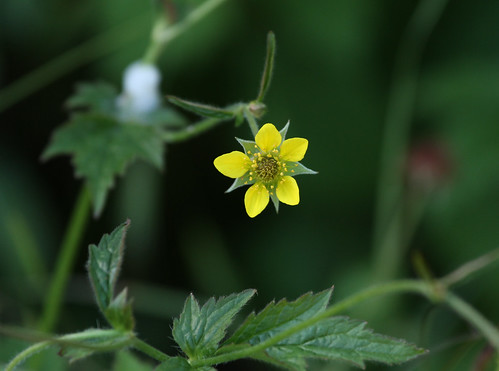
Herb bennet – Geum urbanum

Herb bennet, also known as wood avens, is a very pretty flower which prefers to grow in the shade and was lurking at the edge of the field out of direct sunlight.

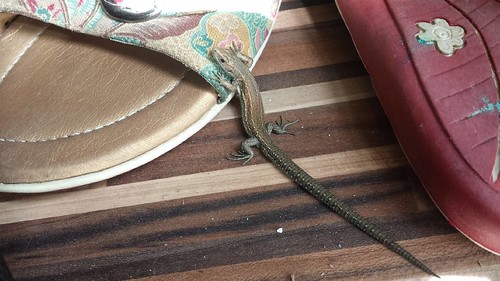
Despite all the flora and insectivora, no reptilia put in an appearance on this outing. But in the weeks after my exploration my friend told me of two separate occasions where reptiles ventured into houses which are on the edge of this field, and as luck would have it both times someone managed to photograph the intrepid creatures and were good enough to send copies to me:

Common lizard – Zootoca vivipara

Despite the fact I very rarely see a common lizard they’re the UK’s most common reptile and can be found in most habitats including heathland, woodland,  grassland and gardens, from March to October. At my last house a quince bush grew around my front door and I found common lizards in there on a couple of occasions, showing that they can coexist with humans where suitable habitat and a lack of interference prevail.

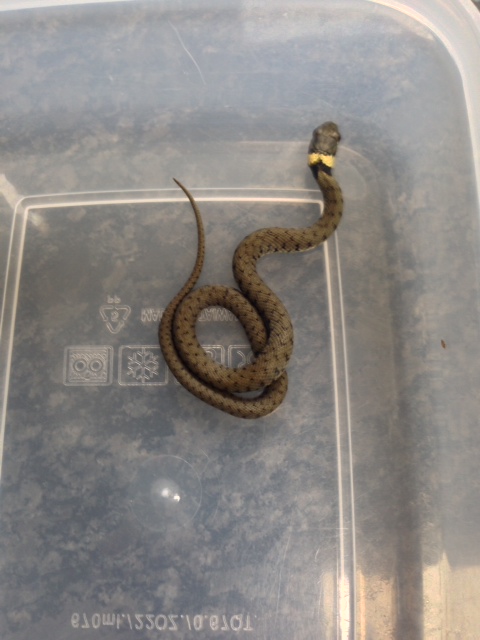
Grass snake – Natrix natrix – rescued in a sandwich box and restored to the wild

It’s not common to find reptiles in the UK and it’s extremely rare to find them in ones house! So the second invader, which I’m told caused much consternation, was a grass snake.  Grass snakes like to frequent damp recesses, they are proficient swimmers and feed mainly on amphibians.

My favourite grass snake story occurred some years ago when another friend of mine lived in Kent and had an enormous back garden with two small lakes in it. On a visit there I was helping declutter the edge of a lake by removing the offending undergrowth with a grass rake. And on shaking the rake to remove a big clump of weed a sizeable bright yellow snake fell off the bottom. I jumped out my skin and may even have uttered an involuntary yell (in fact it was probably more of a squeal), because I reasoned we don’t have big yellow snakes in the UK, and if it’s a foreigner it may well be less benign than Natrix natrix, and be unhappy at this unwanted intrusion. But a somewhat digruntled grass snake uncoiled itself, flipped the right way up and, glided into the lake and swam across to the opposite bank to take cover where the undergrowth was still undisturbed! I’m not sure who was most taken aback, me or the serpent.

Both the reptile species here are listed as priority species by the UK Biodiversity Action Plan (BAP). So I hope this will be taken into consideration when decisions are being made whether or not to destroy the green lungs of our village!

The fastest falcon

In fact, not just the fastest falcon, the fastest creature on the planet. Under its own steam, with a little assistance from gravity, the peregrine falcon (Falco peregrinus, Dansk: vandrefalk) can reach up to 150mph (240km/hr) in a stoop. And that is a staggering number!

Cherry Hinton lies on the southern edge of Cambridge, and on the southern edge of Cherry Hinton is an ancient chalk pit known as the ‘Lime Kiln’. The Lime Kiln is a very interesting place, it’s a very large hole in the ground where the chalk has been quarried for millenia and converted to lime for building and agriculture. It’s lined with white chalk cliffs and it’s now a nature reserve managed by the local Wildlife Trust, and there’s nothing quite like it within a radius of many miles of Cambridge.


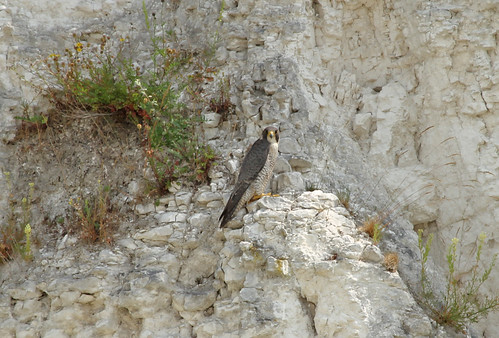
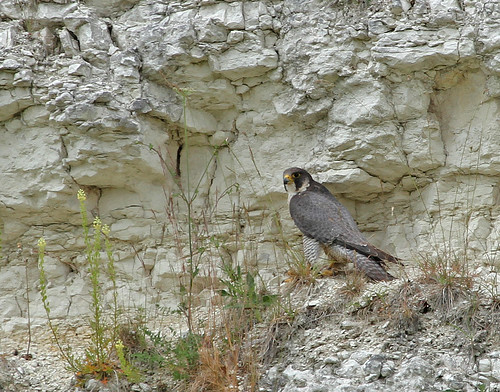
In June I had heard a rumour that a pair of peregrine falcons were nesting in the Lime Kiln. This was big news because until very recently I only saw them on the more wild and woolly parts of the UK coast where they hunt pigeons and seabirds. But in the last few years I’ve seen them fairly regularly, if infrequently, over the fields and fens of Cambridgeshire. I think the Lime Kiln must be the only rock face resembling the peregrine’s natural habitat within a 50 mile radius, which makes it even more remarkable that they found it and nested there.


To have a pair actually nesting on the edge of Cambridge was very exciting, so I paid a visit to the Lime Kiln to see if I could see them for myself. I’d been advised by a friend of the approximate location so it was fairly easy to find them sitting on the chalk face in full view, making occasional sorties into the air.

The peregrine is the fastest creature when it stoops on its prey, but it is not the fastest bird in level flight. That accolade goes to the wonderfully named ‘white throated needletail’ (Hirundapus caudacutus), which is a species of swift and can reach speeds of up to around 70mph (112km/hr) on the flat.


The peregrine’s wingspan is around 1m and the female weighs up to 1.1kg. So a bird colliding with a 1.1kg attacker travelling at 150mph is invariably going to come off second best. These awesome predators have other adaptations to protect themselves during high speed descents onto prey including a membrane which covers the eyes and baffles in the nostrils to prevent very high speed air flow from damaging their lungs.


The pair at the Lime Kiln have apparently nested there for the last three years and I believe that in their first year they raised one chick, the second year they got three away and this year they only managed one due to the dreadful weather through the springtime. But five chicks in three years is a fine tally.


I saw them over the Lime Kiln on several visits and watched them scaring the bejeezus out of the local pigeons, not during a a serious hunt, just a high speed chase on the flat, but the pigeons took it seriously and showed a surprising turn of speed too. I also saw a falcon in a stoop and another with prey in its talons which it passed to its beak whilst on the wing, which is behaviour more normally associated with the hobby.


These birds are magnificent and I’m hoping they return again to breed next year, and if they do I won’t be able to stop myself sharing some more pictures with you!

The busiest burdock

In my last post I wrote about the wildlife to the north of Histon. This post is about the wildlife to the west of the village. The two areas are divided by a main road and they are quite different in character. The north is very open with big open fields lined with ditches and hedgerows and the west has more trees and scrub.

In mid June I ventured there to compare the birdlife with that to the north, because I normally see less farmland birds like skylark, corn bunting and yellowhammer here, but more finches and migrant warblers like chiffchaff, willow warbler and whitethroat.

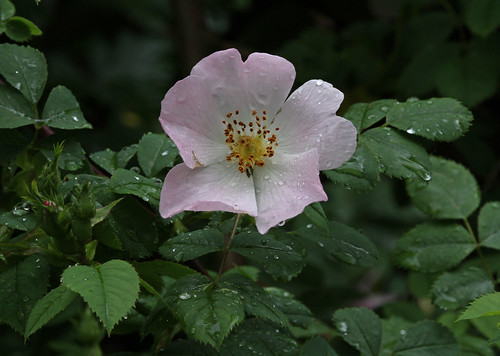
Dog rose (Rosa canina) bejewelled with raindrops

There had been a refreshing shower shortly before I set out which had left the flowers on a rose bush bejewelled with raindrops. It was a good time of year for the wild flowers as the ground had not dried out and there was plenty of sunshine. And of course, if the wild flowers are in good shape, there’s plenty of food for insects and therefore abundant sustenance for birds too.

(And on the subject of insects there was a news report from the BBC today regarding the short-haired bumblebee (Bombus subterraneus) which became extinct in the UK in 2000, but was reintroduced to an RSPB reserve at Dungeness in Kent and is now successfully breeding. Great news!)

But I digress. The dog rose flower was in the local meadow, but passing through there to the farmland beyond there is a field which is lined with drainage ditches, hedgerows and wide unmown borders which support a wealth of wildlife including wild flowers, bumble bees, dragon flies and birds. One of the wild flowers there is the burdock, Arctium minus, which has enormous spiky leaves and big burs which get stuck to your clothes, and on this walk there was a burdock patch that was full of songbirds:

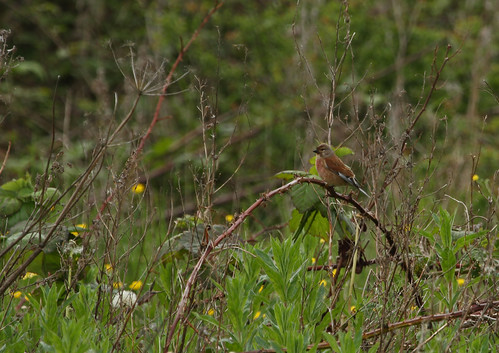
A cock linnet resplendent in his sumptuous breeding regalia: the crimson bindi and rosy breast

The linnet (Carduelis cannabina, Dansk: tornirisk) were omnipresent here throughout the summer, and occasionally a yellowhammer (Emberiza citrinella, Dansk: gulspurv) appeared too. It’s easy to find yellowhammers if they’re in residence because of their characteristic song (a-little-bit-of-bread-with-no-cheese).

The striking colour of the male yellowhammer

And the yellowhammer song carries on the wind for hundreds of metres and because they are so colourful they’re easy to spot with a pair of binoculars.

A male whitethroat watching an adult linnet feeding a fledgling

At least one pair of whitethroat (Sylvia communis, Dansk: tornsanger) were nesting on the edge of this field too. The whitethroat are amber listed and the conservation status of the linnet and the yellowhammer is red list due to decline in their numbers. And in a very old oak tree just a few metres from here was a pair of barn owls (Tyto alba, Dansk: slørugle) nesting, and their status is also amber, but more about those in a later post.

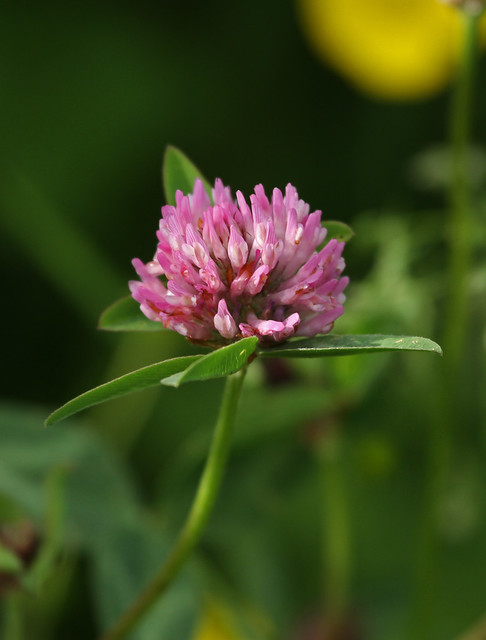
Red clover – Trifolium pratense – the national flower of Denmark

The birds were twittering, and so am I

When the summer eventually arrived this year it arrived with a bang and three months of glorious sunshine ensued which finally came to an end last weekend (but I’m still hoping we have an Indian summer). In early to mid June I spent a lot of time catching up with the local migrants, and all the other wild creatures around the village. I saw more swifts, swallows and house martins over Histon than I’ve ever seen and migrant numbers seemed healthy. This maybe because I was out and about and able to see them, or, hopefully, because more of them arrived and bred successfully this year.

The pictures here were taken one weekend in early June when I ventured across the farmland to the north of my village. Because of the wet spring followed by proper sunshine the verges, hedgerows and meadows were verdant and laden with fruit and flowers.

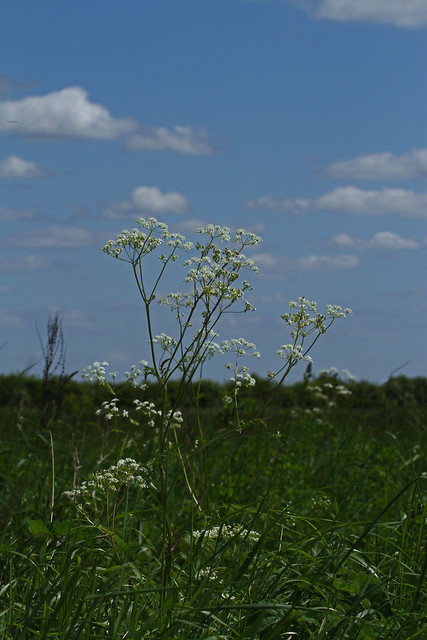
Cow parsley in the meadow against a summer sky

Many of my walks in these fields included lots of sightings of brown hare. I see occasional hares here so it’s no surprise, but what was surprising this year was the sheer numbers.

Brown hares (Lepus europaeus) – males chasing off rivals for the attentions of the ladies

There are four hares in shot here but there were more in the field to the left and more in the same field to the right. It wasn’t unusual to see ten or more on one of these excursions; they also seemed to be enjoying the hot summer. Fingers crossed they had a successful breeding season too.

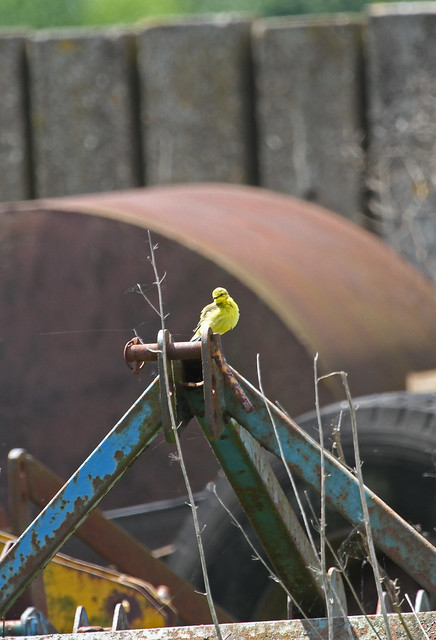
One of the migrants I’ve been hoping to see for the last three years, and which hadn’t put in an appearance was the yellow wagtail (Motacilla flava, Dansk: gul vipstjert). These little birds are spectacular and completely unmistakeable, and despite being a species of least concern in mainland Europe it is red listed here with only 15000 territories recorded in the UK in 2009.

Yellow wagtail perched on an old farm machine

This handsome chap was my only sighting of a yellow wagtail this year. They are one of those amazing small creatures, like the swallow, which spend the summer here in the UK but overwinter in South Africa. When they’re here they tend to frequent fields with livestock where they feed on the accompanying insects. Whilst there are no adjacent cattle or sheep here there is an enormous pile of manure which also attracts clouds of insects. I’ve seen wagtails here before but not for a several years, so it was good to see one again.

Cock linnet (Carduelis cannabina, Dansk: tornirisk)

And another red listed bird, which I’ve also posted about recently, is the linnet. Unlike the yellow wagtail, despite their red listing, I see linnet in the fields every year, and the occasional flock of several hundred in the winter. They get their specific name from their like of cannabis. Not for it’s pharmaceutical properties (at least as far as I’m aware) but because in the old days when hemp was grown to make rope they fed on the seeds.

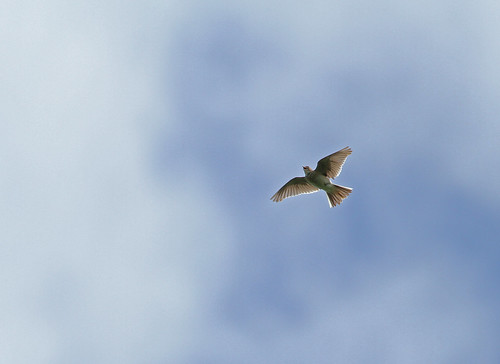
The wildlife on this weekend was abundant with a few rarities, so very high quality, but from a photographic point of view it was rather less auspicious. But I hope this skylark (Alauda arvensis, Dansk: sanglærke) makes up for that:

Skylark singing in the sky above my head

Skylark are not easy to capture because they’re ususally too high in the sky, or  moving too fast, or in a sky which is just too bright for good photography. But on this occasion the lark was very accomodating and there is just enough light to give the plumage a diaphanous quality which I really like, without overexposing it. The skylark is also red listed due to collapse in its numbers as a result of intensive arable agriculture, but there is a healthy population of them round here and there are often too many to count on a warm sunny morning!

By the way, I’ve just linked my blog to a Twitter account which you can have a look at here: @Thenaturephile. There’s not much in it yet as I only set it up at the weekend, but if you fancy taking a look please let me know what you think.

Meadow warblers

Our migrant warblers were all back from Africa and nesting by the beginning of June. There are four species which normally frequent my local countryside, the blackcap (Sylvia atricapilla, Dansk: munk), chiffchaff (Phylloscopus collybita, Dansk: gransanger), willow warbler (Phylloscopus trochilus, Dansk: løvsanger) and the whitethroat (Sylvia communis, Dansk: tornsanger).

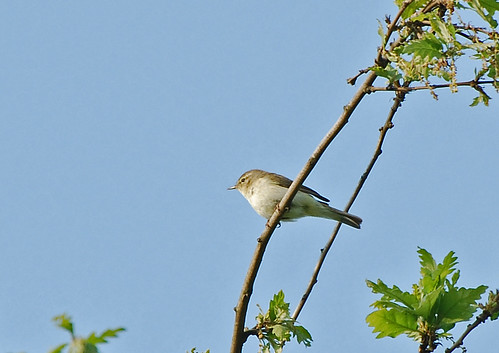
The blackcap have been conspicuous by their absence this summer. The central European winter population, of which a pair took up residence in the garden last winter, disappeared in the spring and that was the last time I saw one. Chiffchaff were, as always, the first winter visitor I noticed returning because of their characteristic song calling out from the trees. There are several other birds singing in the background here but the call of the chiffchaff is clear above the others, and it’s easy to see where it gets its name from.

Chiffchaff male declaring his availability in early spring

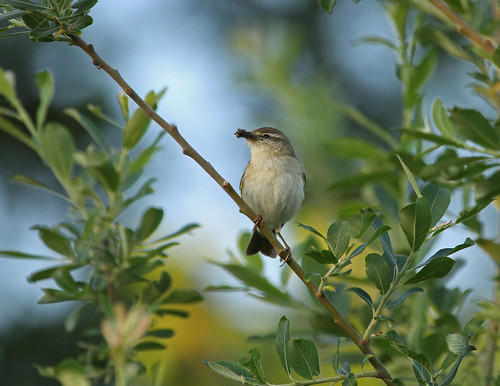
It’s now at the start of September and I haven’t seen a chiffchaff for a while, but through the summer I regularly saw willow warblers which were nesting in a bramble thicket that I passed when I was out walking the dog. Willow warblers are very easy to mistake for chiffchaff by sight but willow warbler song is quite different.

Willow warbler parent with a beak full of insects heading for the nest

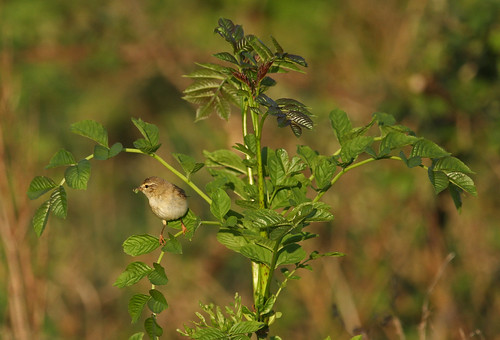
The song isn’t the only diagnostic differentiator between these two species, there are a couple of others but they are more subtle. The most noticeable is the colour of the legs, chiffchaff have dark, almost black, legs and the willow warblers are red brown. Differences in plumage of the willow warbler are the brighter stripe over the eye (the ‘supercilium‘), a more promounced dark eyestripe and the patch under the eye (the ‘ear covert’) is olive grey with a pale patch immediately below the eye, compared to the more uniform dark grey colour of the chiffchaff. So if you get a good look through binoculars it’s not too difficult to tell them apart, but the song is the easiest way.

Another foray to collect flies for the chicks

Pausing to check up on me before heading into the nest

For a couple of weeks there was a spot in the field where I could stand close to the nest and watch the comings and goings of the adult willow warblers bringing food for the youngsters, and they seemed cautious but otherwise content for me to be there if I stood still.

Whitethroat male – my best ever bird portrait!
My favourite warbler is the whitethroat. They are easy to tell at a distance, even without optical assistance, and this is my favourite picture of one. The male whitethroat has a jingly jangly song and when he’s advertising for ladies he perches on top of a bush and flies repeatedly in a jerky motion straight up and then flutters back down to the same spot.

And while I was busy photographing the warblers I was being serenaded night after night by this chap:

A male songthrush (Turdus philomelos, Dansk: sangdrossel) filling the meadow with song

A tad incongruous in a post about warblers, I grant you, but he was there all the time and his songwas magnificent! As with the chiffchaff there are several other birds calling too, but the thrush is easily distinguishable from the noise. This is the first time I’ve posted a link to my own (amateurish!) sound recording, but I think it’s OK. Let me know what you think.

Garden guests

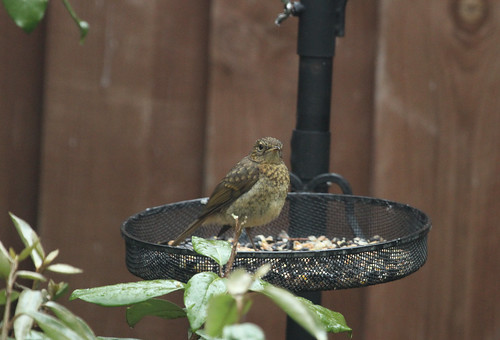
It was in June that fledgling birds finally started to appear in the garden. With so many natural phenomena being late this year due to the delayed onset of spring and the warm weather, the birds were no exception. The first one that I noticed was this robin chick who appeared on its own every morning for quite a few days feeding on seeds and nuts from the tray feeder. I placed an old kettle in a bush near the feeders a couple of years ago hoping that robins would find it a suitable nest site, but they haven’t been tempted so far so I think it may be too close to all the other avian activity. I’m going to find a less disturbed location for it for next years breeding season when I’ll hopefully see a few more of these:

Robin fledgling gathering its strength before striking out on its own

The robin (Erithacus rubecula, Dansk: rødhals) is a feisty little bird which I’ve often found hopping round my feet looking for the insects that get turned over as I dig the garden, or sitting on a feeder within inches of me, completely unfazed as I’m working,  as long as I don’t do anything overtly threatening. Often I don’t know it’s there until I glance up and see it sitting on the fence peering at me, and if I ignore it and carry on working it will go about its business unconcerned by my presence. They are iconic garden birds and according to the British Trust for Ornithology our unofficial national bird.

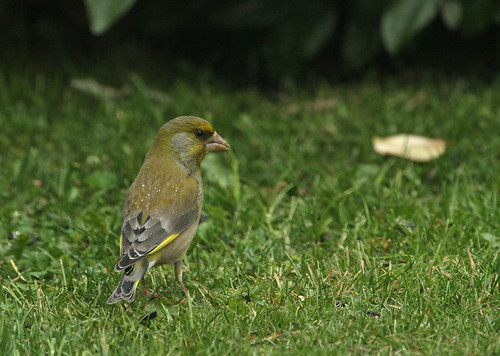
A less frequent visitor to my garden is the greenfinch. I hear the males calling almost every day through the summer from the top of a tall fir tree in a nearby garden. They don’t often venture into my garden outside the breeding season, but this year both the male and female and then the fledglings would feed here, and this is the male:

The male greenfinch clearing up seed fallen from a hanging feeder

The shape of the pointed, chunky, beak of the greenfinch (Chloris chloris, Dansk: grønirisk) clearly marks it out as a seed eating member of the finch family although they also hunt invertebrates to feed the chicks to give them a rapid calorie boost.

The geenfinch showing off his seed cracking beak and sumptuous plumage

From a distance the greenfinch can look fairly dull, but in full breeding condition and good light the males have magnificent plumage. This one is also decorated by tiny drops of rain on its back.

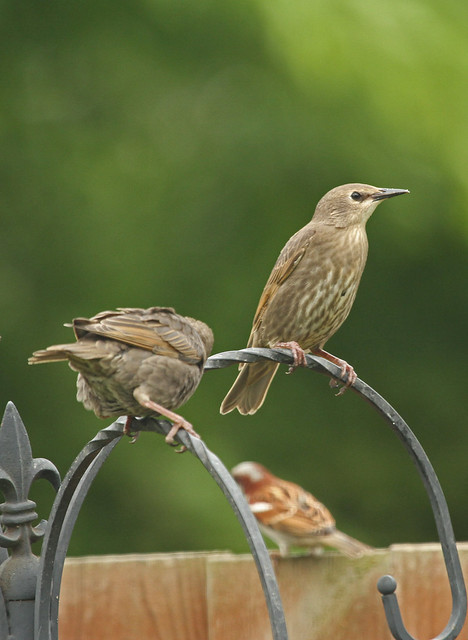
This year the starlings were numerous and entertaining, another feisty visitor, especially when they bowl in mob-handed complete with sizable broods of unruly youngsters. For several weeks, families of starlings (Sturnus vulgaris, Dansk: stær) with many fledglings invaded the garden and fed mainly on the fat balls. There were often 20+ individuals making a right old cacophany and emptying both the fat ball feeders every day. It was good fun to watch, and as the starling is red listed in the UK due to huge population decline it was good to see so many fledglings.

Starling fledgling on the right begging for food from the parent

Two more fledglings waiting to be fed, they haven’t yet grown the dark irridescent feathers of the adults

Taking matters into its own hands and being seen off by the adult. Note the fat ball feeder is nearly empty

The biggest and most colourful guest this year was the jay:

The jay, Garrulus glandarius, Dansk: skovskade

Jays are extremely infrequent visitors to my garden but this one appeared every morning and throughout the day over a week at the end of May beginning of June. It was taking seed from the tray feeder and I’m guessing it had a nest close by. (The ‘decorated’ wood of my fence really isn’t the most attractive backdrop for a nature picture so I’ve since moved the bird feeders to a new location infront of some foliage!). The jay is by far the most colourful of the crow family, most of which have almost entirely black plumage, except the magpie which is black and white. As you can see it’s the size of a small crow but the colours are magnificent. This one was brave too. I was sitting on a bench just 6-7m away and it was quite happy for me to sit that close and photograph it.

Jays feed mainly on seed and in the autumn they cache acorns by burying them in the ground for retrieval when things get tough through the winter. I’ve heard that a single jay can bury up to 5000 acorns… and remember where they all are! But I’ve also heard that jays are very good at propagating oak woodland, so maybe they do forget where some of their treasure is buried.