Monthly Archives: May 2023

More bird diversity from RSPB Titchwell

RSPB Titchwell has a ‘linear’ layout encompassing various habitats and that make it a good place to see a diverse range of bird species. Following on from my last post here are few more waders, wildfowl and geese that were in residence when I was last there in November last year.

Shoveler pair – Spatula clypeata

The shoveler inhabits shallow lakes and marshland where there is open water and it can be seen all year round in the UK. It breeds in the UK before heading south for the winter when the breeding population is replaced by visitors migrating south from Scandinavia and eastern Europe. The size of the UK breeding population is around 1100 pairs.

Brent geese – Branta bernicla

The distribution of brent geese in the UK is interesting because their are three separate overwintering groups which migrate here to the UK. They come from Canada, Svalbard and Russia and overwinter primarily in Strangford Lough in Ulster, Lindisfarne in the UK and the rest of the UK respectively. There are 100-110,000 birds recorded annually in the UK but in the case of the Canadian and Svalbard visitors it’s easy to see how human activity could profoundly affect those very local populations. As these individuals were seen in Norfolk I guess they from the Russian cohort.

A flock of lapwing – Vanellus vanellus and golden plover – Pluvialis apricaria

Golden plover have a distinctive black face and breast stretching down to its legs in the summer but which fades to pale brown to white in the winter so the birds in this group all have their winter plumage which I would expect as this was in mid-November. The golden plover is resident all year in the UK with 33,000 breeding pairs in 2016 according the BTO and 410,000 individuals recorded in the winter of 2006-7 as the population swells in autumn as migrants arrive from the north.

The lapwing is for me an iconic bird and a sign of summer and I remember seeing big flocks of them over the farmland close to where I grew up in Northamptonshire. It’s now rare to see such flocks inland although I still see mixed flocks of lapwing and golden plover over the Cambridgeshire fens in the winter time. And that is refected in this mixed flock on the ground at Titchwell and it’s interesting to see the species separation on the ground.

RSPB Titchwell is a great place for a day out to see lots of wildlife in summer and winter. There is always something wonderful to see including migrants at the right times of year and I consider myself very lucky to live close enough to it to be able to make day trips there.

Coastal waders at Titchwell Marsh

RSPB Titchwell Marsh is a reserve I’ve posted about several times before and it’s a great place to get close to a lot of bird species. It’s on the north Norfolk coast and it includes various habitats from woodland scrub to fresh water lakes, reedbeds, salt marsh and the BIG beaches that make that part of the country so spectacular. It’s home to bearded tits, which I didn’t see on this visit in November last year, but I saw many other species of goose, duck, wader etc.

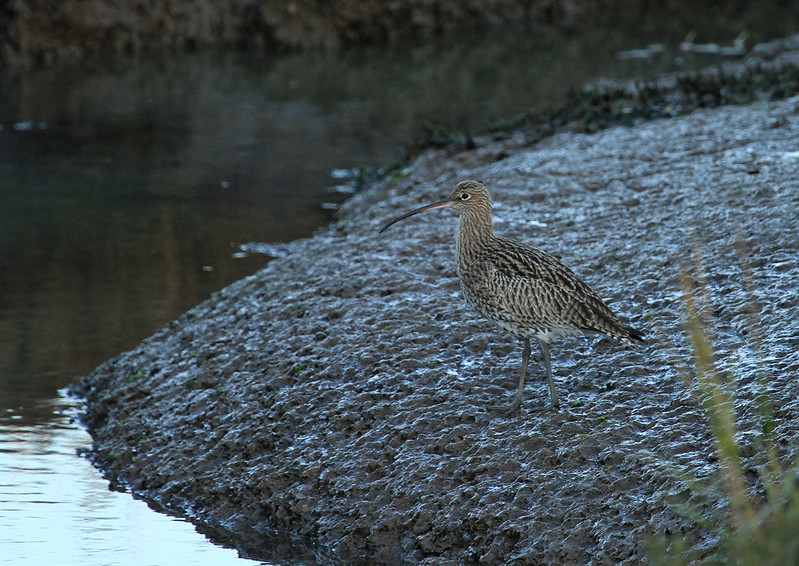
The increasingly elusive curlew – Numenius arquata

The curlew is Europe’s biggest wader, with it’s very long downturned beak and distinctive call it’s easy to recognise. Alas, as with so many other species it’s endangered in the UK with big losses in numbers, approximately 80% decline in the last 50 years or so, due to habitat loss. The east coast of the UK is a globally important feeding and overwintering station for migrating birds, and there’s increasing realisation of the importance of protecting it as climate change threatens to encroach and flood low lying coastal areas. To mitigate against that, there are initiatives underway in East Anglia to allow the sea to reclaim tidal land which will provide a buffer against the potentially catastrophic flooding that rising sea levels could bring, as well as providing huge amounts of habitat for the creatures that rely on these tidal mudflats. I hope that projects like the one to create habitat using the spoil from the London Crossrail development at Wallasea Island in Essex will help to redress the balance and enable stabilisaton and even increases in populations of the visitors that rely on it for sustenance during their arduous journeys.


Another wader which was present in numbers at Titchwell was the bar tailed godwit:

Bar tailed godwit – Limosa lapponica showing it’s magnificently long beak

The bar tailed godwit, like the curlew, is also one of the bigger waders with a very long beak, but in the case of the godwit the beak isn’t curved downwards and it has a pink root extending a long way along it’s length. The tip of a godwits beak is also prehensile, enabling it to better find it’s prey of shellfish, snails and worms buried deep in the mud of it’s coastal habitat. They breed in the summer in the high Arctic and head south in the autumn to feeding grounds that include the UK coasts and the British Trust for Ornithology estimate a population of 30,000 individuals.

A pair of bar tailed godwit

The bar tailed godwit is an amazing bird and in 2020 a youngster broke the record for the longest recorded non-stop flight when it migrated from Alaska to New Zealand in one hop – a flight of approximately 12,200km (7,625 miles)! It’s well adapted for long distance travel, with long, pointed wings and the ability to store a lot of energy and the whole journey took 11 days at speeds up to 88km/hr (55mph). It’s a phenomenal feat of endurance and navigation.

A very welcome return

When I was a kid and we holidayed every year in Denmark, the stork was an iconic bird and one we never saw in the UK, and we would take trips down to Ribe in southern Jylland – the Danish mainland – to see storks nesting on church towers, thatched rooves and wagon wheels the locals had mounted on tall poles for that purpose.

In recent years a successful reintroduction program undertaken on the Knepp estate in Sussex with birds from Warsaw zoo has resulted in storks breeding again in England. The last recorded breeding in the UK happened in 1416 so it’s been a very long time coming!

Yesterday I went for a walk around Burwell Fen and Wicken Fen and the spring weather was perfect for nature watching; and birds, butteflies and mammals were out in abundance. But the star of the show was a stork sitting atop the Tower Hide at Wicken Fen. I’d been tipped off by another person enjoying a walk in the spring sunshine that it was there, but I was a tad sceptical until I rounded the bend and there it was. The first time I’d seen one outside Denmark or central Europe. Suffice to say I was beside myself.

White stork – Ciconia ciconia – perched on the Tower Hide at Wicken Fen in Cambridgeshire

The stork is a migrant to Europe after overwintering in Africa and is up to 1.1m tall with a wingspan of around 1.8m. It’s a big bird and nests in small colonies on spectacular nests made out of sticks and I hope they start building them in Cambridgeshire again in the not too distant future.

I’d deliberately left my camera in the car to just enjoy the scenery and of course I half regretted that, so I took these images with my phone. Not the best quality photo’s of a stork but I’m very pleased with them and they record a very special sighting for me.

After taking flight from the hide it soared higher and higher over the Fen for probably 10-15 minutes or so before disappearing.

Apart from the stork, the Fens were alive with othe creatures and even though I don’t like lists this time it’s worth sharing a selection of what I saw and heard:

Hare, roe deer, orange tip butterflies, peacock (butterflies), speckled wood, brimstone, oystercatcher, lapwing, shelduck, swift (the first I’ve seen – and heard – this year), swallow, kestrel, sparrowhawk, marsh harrier, hobby, peregrine falcon, buzzard, cetti’s warbler, sedge warbler, grasshopper warbler – and all of these whilst being constantly serenaded by wrens and cuckoos.

If only I’d taken my camera 🙂