Category Archives: Insects

Insects and molluscs

Over the last couple of weeks I’ve been out and about photographing wild flowers, and of course the raison d’etre of flowers is to produce the reproductive cells of the plant in order to ensure survival. And as plants are immobile they rely on other vectors to connect the male and female parts, that can be the wind and the rain but many flowers are exquisitely evolved to attract one or more species of insect to carry the pollen to the ovum and effect fertilisation.

So in the course of photographing the flowers some of them were hosting a pollinator or two:

Tree bumble bee – Bombus hypnorum

This tree bumle bee was sipping nectar from the flower of the white deadnettle. It’s one of the insects that is strong enough to get to the back of the flower and take the nectar. Flowers have evolved in this way such that the insects have to pass the stamen, which is where the pollen, or plant sperm, is produced. The stamen is made up of the filament and the anther, and foraging insects brush against the anther picking up pollen which they carry to the next flower where it is deposited on the female part of the plant – the ‘carpel’, and fertilisation ensues.

There are various species of bees in the UK but only around half a dozen common ones. Bees are in trouble in this country and no one seems to know why, both honey bees, which live in colonies, and solitary bumble bees are dying out at an alarming rate.

Buff tailed bumble bee – Bombus terrestris

The buff tail above was in a particularly poorly condition and had tiny mites crawling on it’s body so I imagine it didn’t do much more pollinating.

Soldier beetle – Cantharis rustica

The soldier beetles are related to the fireflies and they get their common generic name from one species which is bright red and is therefore named after the ‘redcoats‘ – English soldiers from days of yore. The larvae and the adults are carnivorous, the larvae feeding on insect eggs and caterpillars and the adults on aphids. They also feed on nectar and can therefore pollinate too.


Black slug – Arion ater

Alot of people have an aversion to slugs because of the damage they can do to fruit and vegetables, but this chap was out in the field making a meal out of a couple of dandelion seedheads. I don’t think they contribute much to pollination and they are predated by frogs and toads and also hedgehogs. Although I’ve heard that if too much of a hedgehog’s diet consists of slugs, parasitic worms living in the slugs can get into the lungs of the hedghog and kill it because its lungs fill up with fluid. Which sounds pretty unpleasant but I guess it’s not the fault of the poor old slug!


Brimstone moth – Opisthograptis luteolata

The brimstone moth is a splendid creature with a wingspan of 32-37 mm. It’s common and widespread across the UK. In the warmer climes of  the southern UK there can be three generations in a year but in the north there is only one brood per annum, and adults can be seen on the wing between April and October. The caterpillars feed on various trees and bushes including hawthorn and blackthorn.

A couple of weeks ago after days of rainfall which had moistened everything I found a 50m stretch of verge which was crawling, literally, with hundreds of yellow and brown snails.


Brown lipped snails – Ceppaea nemoralis. Just a few of the hundreds that were making the most of the damp conditions

The ‘lip‘ of the snails in their name is the front edge of the shell which can be seen in the next two pictures and is lighter brown on the yellow one and a much darker brown on the brown one:

Snails are predated by songthrushes. They pick up the snail by the fleshy part and crack the shell on a handy stone. Some years ago I was sitting at home on my own reading a book and everything was very quiet. I heard ‘tap tap tap’ on the front door, but when I went to answer it their was no one there. So I went back to my book. A few mintes later I heard the same tapping and again there was no one there, so I opened the door to have a look up the street and rather than a visitor there was a collection of broken snail shells on my front doorstep. It transpires the tapping I’d heard was a songthrush using my front doorstep as an anvil to swing the snails against and hammer open the shells!

The wild flowers are blooming

A combination of the recent rains and the rising temperatures we’re getting now is creating ideal conditions for wild flowers. Any piece of uncultivated land is starting to bursting forth with flora which in turn is providing food and cover for flies, bees, beetles, butteflies and a plethora of other insect life. Which is also good for the birds, small mammals and other predators, and so on up the food chain. And on top of that it’s lovely to look at. So here’s a selection of flora currently blossoming in my patch of East Anglia:


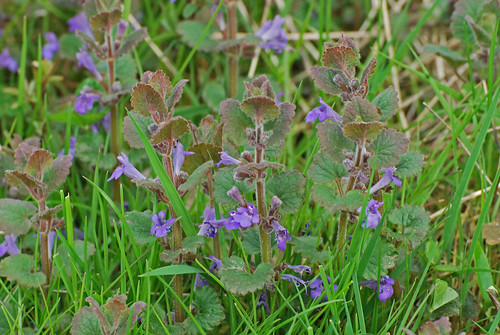
Ground ivy – Glechoma hederacea

I like ground ivy because it occurs early in the year, first appearing in March, but like many other phenological phenomena it may now be happening earlier. It creeps across the ground, like ivy, forming carpets of blue flowers and with the green and red leaves it adds lots of colour to the undergrowth. It has numerous names and here are a few from the Royal Horticultural Society website: Devils candlestick, creeping charlie, crows guts, wild snakeroot, hens and chickens, gill-go-by-the- street, and my favourite: ale gill.

Another creeper which grows across the ground and in hedgerows and which has lovely blue flowers is the periwinkle. There are two types of periwinkle, the lesser (Vinca minor) which may have been introduced to the UK and the greater (Vinca major), which was introduced (both according to my wild flower guide).


The greater periwinkle

I’m a tad confused by this flower because they are meant to have 5 petals but this one only has 4. It is also known as creeping myrtle, cut-finger, flower of death (!), grave myrtle, and sorcerer’s violet, among others.

Sprouting next to this periwinkle flower was a nascent white deadnettle, Lamium album. It normally has white flowers which haven’t yet arrived, but the closed buds are visible below the crown. Everything is very green at the moment because of all the rain and looks beautiful against the red wing cases of the ladybird .


White deadnettle about to burst into bloom


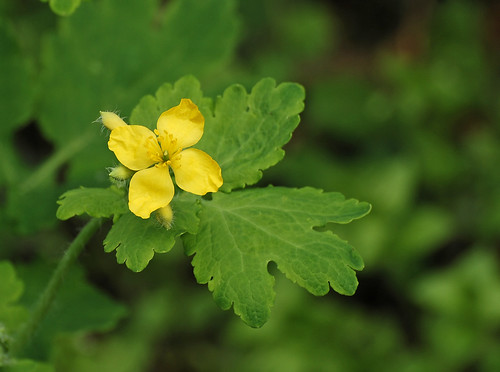
Greater celandine, Chelidonium majus

It is thought the greater celandine is named after the swallow (‘khelidon’ is Greek for swallow) and it’s a member of the poppy family. When the stems are broken they ooze a latex sap which is as yellow as the flowers, and the colour can be as deep as orange. It contains a host of alkaloids which confer therapeutic properties but it can also be toxic. It is also known as cocks foot, sight wort and wart wort as the sap has been applied as a treatment for warts. I’m not sure where ‘sight wort‘ comes from, but if it burns off warts I wouldn’t want it anywhere near my eyes!


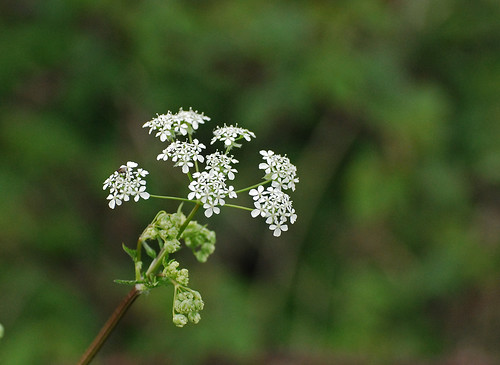
Cow parsley – Anthriscus sylvestris

As far as I know cow parsley doesn’t have medicinal properties and according to Wiki it’s not pleasant to eat. But I think the flowers are lovely and they bring back childhood memories of running through the woods in springtime when the cow parsley or ‘keck‘, as it was referred to by my Dad, was as tall as me. There’s nothing quite like a forest floor which is full of cow parsley, in it’s own way it’s as iconic as blue bells. It’s also known as wild chervil and Queen Anne’s Lace.


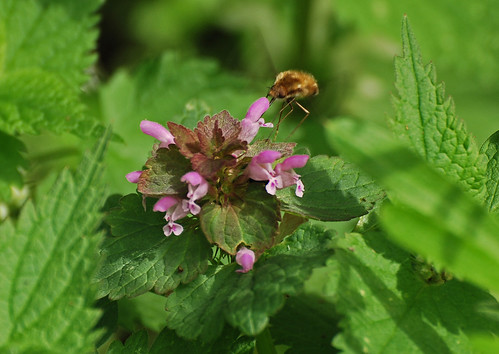
Beefly – Bombylius major

At the end of my flower finding mission I was looking for a ground ivy flower head and I found this little beauty, and just as I was just about to open the shutter a beefly zoomed in to sip the nectar. Flower pictures can benefit from some insect action and I like beeflies, so this was a highly serendipitous encounter!

Erratum: Maggie from http://www.intouchwithnature.co.uk‘ has pointed out that the last flower with the beefly on is in fact red deadnettle  – not ground ivy. So a big thankyou to Maggie for keeping me honest with my plant identification 🙂

Turn of the century

After 20 months of posting this is the 100th episode of The Naturephile. The original plan was to post once a week wherever possible and I’ve averaged around five a month, so that stayed roughly on track. I thought I may struggle to find enough subject material and to acquire sufficient photographs of the necessary quality to post as often as I wanted too, but that hasn’t been a problem, so far.

When I started off writing The Naturephile, the idea I may reach a hundred posts never entered my mind, so to mark the moment I’ve trawled back through the archive to find my favourite posts to give them another airing. I’d anticipated it would be a straightforward venture but of course I’d rather underestimated the amount of subjects/species and photographs I’ve written about. But the number of posts was eventually whittled  down to 14.

1) At the end of September 2010 one of natures more brutal rituals was played out right outside my back door involving garden spider courtship. Like other spiders this can easily end up in the death of the male as it did in this case. ‘Araneus diadematus‘ posted on 2nd October 2010:


I really love you… . Male on the left, Shelob on the right

2) A little farther afield are dragon flies, the most common species I encounter are common darters and migrant hawkers. This Common darter appeared in a post on 19th October 2010. I like the symmetry of the fly and the seedhead and the red colour of this male darter against the brown grass.

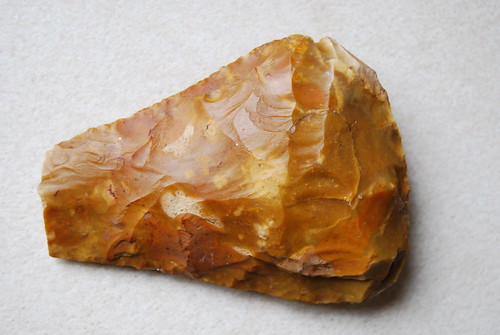
3) A few years ago when my sister lived in a house (she lives in a kennel now. Only joking, she lives on a narrow boat ;-)) they were digging the garden and this piece of rock turned up. It’s an Acheulian hand axe made from flint and the marks on it are where it was worked with a deer antler. It dates from around 400,000 years ago which means it could have been made by a pre Homo sapiens hominid! It fits beautifully into the palm of my hand and after that many years the edges are still sharp. Even if I was blogging about topiary or book binding I’d have to find a way to slot this in.

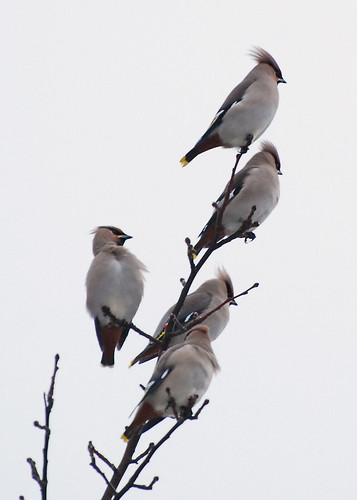
4) The winter of 2010/11 was known as a ‘waxwing winter‘. Every winter a  few waxwing (Bombycilla garrulus, Dansk: silkehale) migrate to our shores from Scandinavia to overwinter. But occasionally the weather up there is fearsome so the waxwing migrate in large numbers and we then have a ‘waxwing winter’. And I hope you’ll agree the waxwing is a beatiful  bird:

A group of waxwing perched at the top of a rowan tree in north Cambridge

5) Another consequence of the bitterly cold winter of 2010/11 was that most stretches  of open water were frozen over and our herons (Ardea cinerea, Dansk: fiskehejre) were starving because they couldn’t access their normal food supplies. During this winter  a hungry heron appeared in my friends garden and taking pity on its plight he fed it some fish. And of course one fish supper turned into rather more than one so the heron came to expect it, and if dinner was late it came and tapped on the window to complain to the management.

6) Sea mammals of any description are always a delight to see and photograph and one of my favourite places on the planet for doing that is the Farne Isles situated just off the Northumberland coast.


Atlantic grey seal in the North Sea off the Northumberland coast

Our holiday last year was to Northumberland and I can’t go there without taking in a boat trip to the Farnes where hundreds of Atlantic grey seal were basking on the rocks and generally taking life easy in the water.

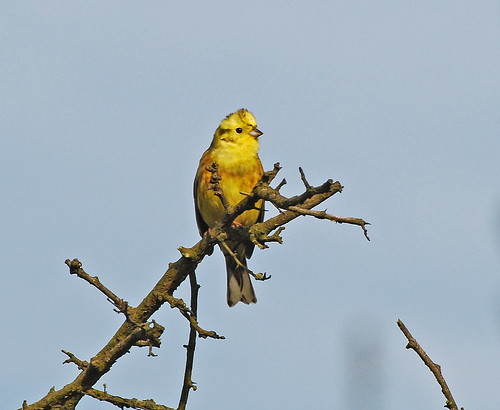
7) Closer to home, April last year was hot and sunny and a great time to see songbirds in the countryside. One of my favourite birds is the yellowhammer (Emberiza citrinella, Dansk: gulspurv) and they’re regulars in the hedgerows around Cambridge.


Yellowhammer male  – what a gorgeous colour!

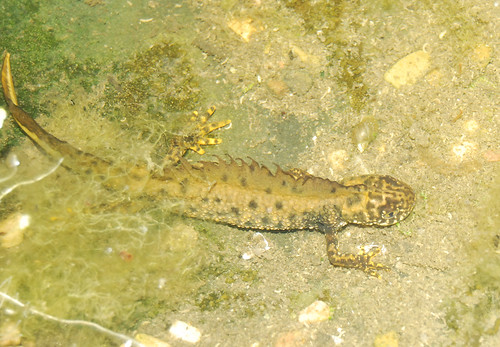
8) A creature I’d never encountered before last year was the great crested newt. My friend told me of a place where they could be found so we ensconced ourselves in the nearest pub in preparation for a nocturnal newt hunt after closing time.

It was a very successful trip, a few pints followed by finding  not only the great crested newt but the other two species of UK newt, palmate and smooth newts.

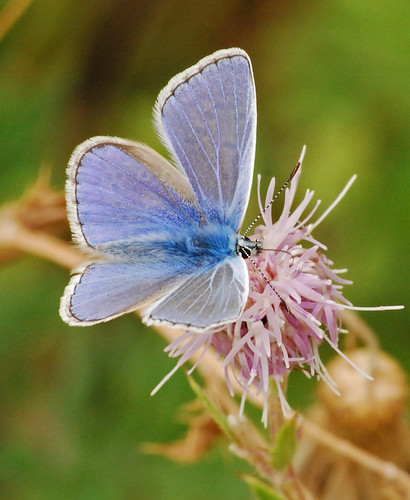
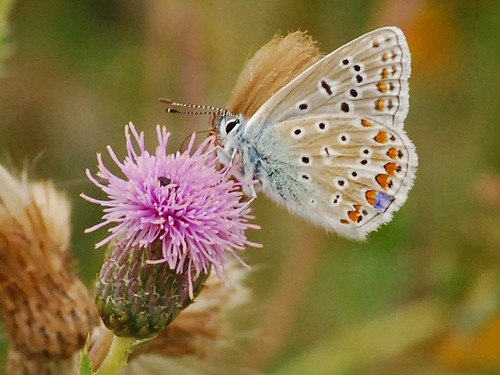
9) As the year rushes headlong into summer and the butterfly season really gets underway I can spend many an hour chasing our Lepidopterans round the fields trying to get that perfect picture. One of my favourites is the common blue and this is about the closest I got to that perfect picture:

Common blue male sipping nectar – one of the best photographs I’ve ever taken

10) As well as being a top location for marine mammals the Northumberland coast is also home to huge numbers of seabirds so it’s a very happy hunting ground for me!

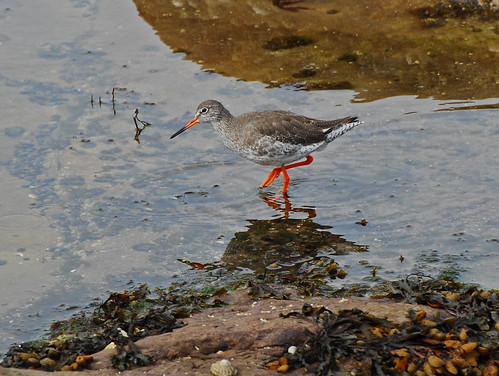
Just poking your head over the seawall at Seahouses can reveal lots of seabirds including oystercatcher (Haematopus ostralegus, Dansk: strandskade), knot (Calidris canutus, Dansk: islandsk ryle), eider (Somateria mollissima, Dansk: ederfugl), turnstone (Arenaria interpres, Dansk: stenvender) and this  redshank (Tringa totanus, Dansk: rødben).

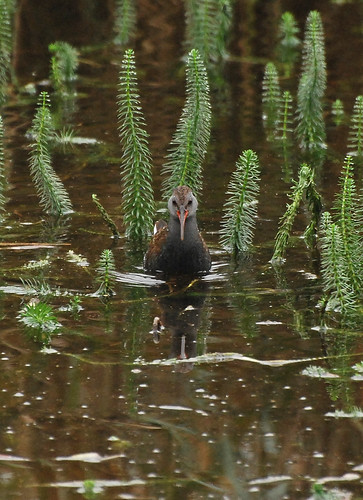
11) RSPB Fowlmere, to the west of Cambridge is famous for its water rail. On a trip there in December 2011 I was tipped off by a local that a particular hide was good for water rail (Rallus aquaticus, Dansk: vandrikse) and one had been seen there that morning, so off I went to try and see it.


My informant was correct. There was just the one bird there, but it scoured the mudflats in front of us for a whole hour before disappearing into the reeds, giving me plenty of good photo opportunities. I was very pleased with the primeval feel of this image with the bird face on infront of the horsetails.

12) In January this year the weather was absolutely freezing causing a small group of red-legged partridge at Tubney Fen, east of Cambridge, to seek the warmth generated by a mountain of dung:


13) My favourite bird of prey is the kestrel (Falco tinnunculus, Dansk: tårnfalk) and they are always to be seen hovering in the skies over the fields around Histon. I love watching the highly specialised hunting techniques all birds of prey in action, but the kestrel beats them all in my opinion:


A male kestrel showing off all his hunting hardware: talons, flight feathers, eyes and aquiline beak

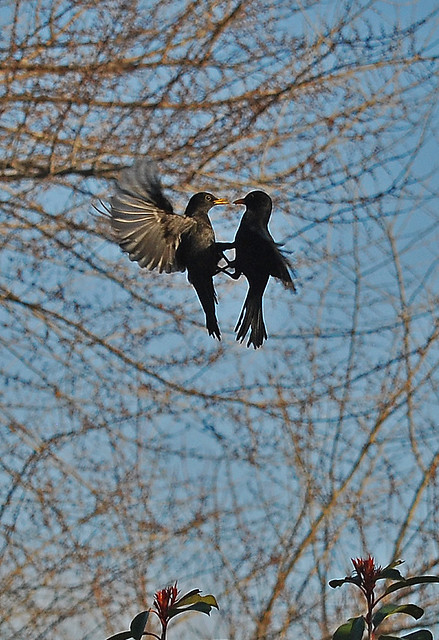
14) And lastly, I couldn’t write a post like this without including my battling blackbirds. Of all the bird species that visit my garden these are the ones that provide the most entertainment:

My garden gladiators locked in aerial combat

These were a few of my favourite posts, favourite for various reasons: the stories attached, the rarity of the sighting or simply the exquisite natural beauty of the subjects. I hope you like them!

And lastly, I’ve been stunned by the numbers of people from all round the world who read The Naturephile and like it enough to follow it or click the ‘Like’ button. Thanks to everyone for stopping by and enjoying a read, I love sharing the nature from my corner of Cambridgeshire with you!

Birds and bee(flie)s

The day after the cold weather put paid to my snake hunting exploits I decided to take the dog for a quick run in the afternoon. He had just had a small tumour removed from his back leg and so he had a lampshade on his head to stop him chewing his stitches and consequently this walk was only meant to be a short one, and I wasn’t even going to take my camera. But on the way out the door I decided because it was very sunny and very warm I would take my camera. And I’m glad I did because there was wildlife in abundance.

Peacock butterfly, Inachis io, sunning itself on the path

The air was abuzz with insects including butterflies. I really like photographing butterflies and peacocks are good because they present a medium sized challenge. If you approach with stealth and don’t cast a shadow on them they let you get to within a few feet. The peacock is a species that can be seen at any time through the winter as it can wake in response to warmer weather, but they emerge in spring around the end of March/beginning of April, so the timing for this one was spot on.  As I was photographing the peacock a sparrowhawk (Accipiter nisus, Dansk: spurvehøg) flew past at high speed, much too fast to enable a usable photograph, it’s always good to see a bird of prey because I think it suggests the prey species are in good order too.


Long tailed tit, Aegithalos caudatus, Dansk: halemejse

The field where I found the peacock butterfly has a corner which faces south west and it was sheltered from the wind and bathed in spring sunshine. It was really warm when I arrived there, so I stood still and watched and listened while the dog went off to explore, and the trees around were full of birds including the long tailed tit, above, and a song thrush, below.

Songthrush, Turdus philomelos, Dansk: sangdrossel

While the birds were capturing my attention in the trees, butterflies weren’t the only insects there. In my corner there were also beeflies buzzing around. I was keen to try to photograph them in flight which is a tad more challenging as they would hover for a few seconds before darting off at very high speed in zig zag lines. But they were making the most of the shelter from any breeze that prevailed in this sheltered spot and I spent a good hour trying to photograph them.


Beefly, Bombylius major

The beefly, as the name suggests is a bee mimic. It has a very prominent proboscis which is used to extract nectar, and the fur is part of the bee disguise. It is a very good pollinator but is detrimental to other pollinators.

It is detrimental because it parasitises other bees and beetles. And the way it achieves that is another of those bizarre evolutionary adaptations that even the most imaginative science fiction writer wouldn’t dream of. It mimics bees in order to get close to their burrows where using its legs the female will flick her eggs into the hole where it hatches and attaches itself to the host. Then the gruesome bit: it lies dormant until the host commences pupation and then becomes an ‘ectoparasite‘ which means it remains on the outside of its host but extracts the body fluids to fuel its own growth. After draining its host dry it reaches the pupal stage which can vary hugely in length and they have been known to overwinter before emerging as an adult the following year.

Beeflies have appeared in several blogs in the last week or so and there are some more very fine images here:

http://www.leavesnbloom.com/2012/04/bombylius-major-bee-fly-aerodynamics.html

Rosie from ‘leavesnbloom’ has a wonderful collection of images of Bombylius major and Harlan from ‘The Roused Bear’ has also captured one in Iowa in the U.S.:

http://therousedbear.wordpress.com/2012/04/07/a-fuzzy-bee-fly/

They can be found across the whole planet except Australasia.

More birds which appeared in the trees around while I was chasing beefly were the common or garden greenfinch and chaffinch:


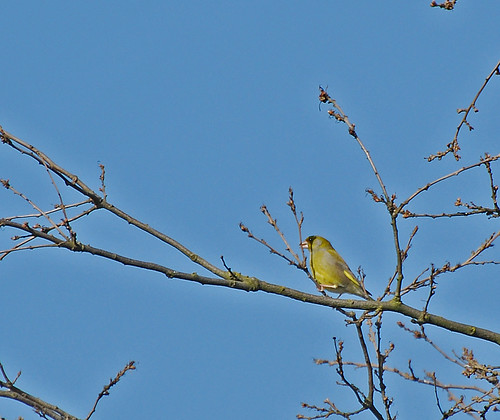
Greenfinch male pecking at a twig
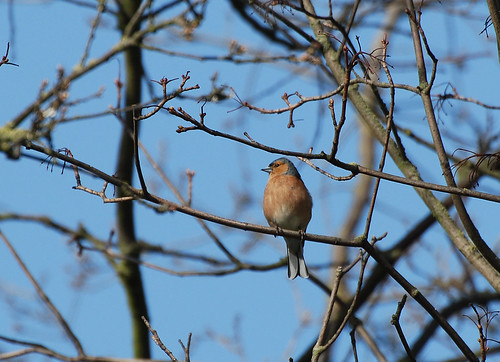
Chaffinch male just taking it easy

Both greenfinch (Carduelis chloris, Dansk: grønirisk) and chaffinch (Fringilla coelebs, Dansk: bogfinke) are common or garden, but are both beautiful birds, and they can be seen here in the U.K. all year round. But a species that isn’t here all year round and returns after its winter migration to north Africa is the chiffchaff (Phylloscopus collybita, Dansk: gransanger):

The chiffchaff, named after its characteristic song, is a warbler and despite being a small bird they are tough. Their migration takes them south across mainland Europe, across the Mediterranean Sea and into north Africa, to retrace their flight four or five months later in the spring. And despite the hardships associated with such a gruelling endeavour, according to the British Trust for Ornithology (BTO), there are around three quarters of a million territories in the UK. They are one of the first migrants to arrive back in the U.K. and can be heard singing as early as late February. But this my first one in Cambridge on the first weekend in April.

The curse of the cabbage patch – and other beauties

The last post on this blog, ‘The Frozen Fen‘, had a decidedly wintry feel, and because of that, combined with the fact that I didn’t manage to get out and about and get any interesting pictures last weekend, I feel like brightening things up with some colourful butterfly pictures which I didn’t get a chance to publish in 2011 because of the dire shortage of butterflies.

I mentioned in a post last year that 2011 was a very bad year for butterflies, and that was a result of the mild Spring and very hot April which kick started the proceative processes. But after April the rest of the Summer was dreadful – cold and wet – and that resulted in catastrophic depletion of butterfly numbers. This winter has been mild so far (which is why I have had almost no birds in my garden compared to other years) and I’m hoping it stays that way and our Lepidopterans have a chance to recover their numbers this year.

So here are a few of the butterflies which I hope will put in appearances in and around the village this summer:


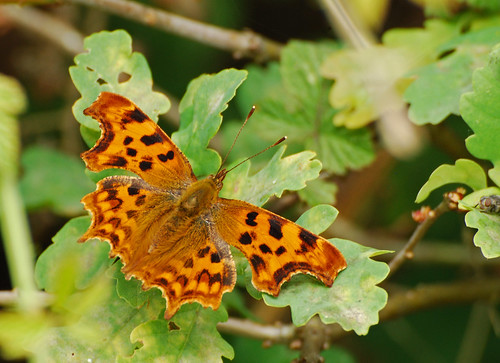
A comma (Polygonia c-album) soaking up some rays from a cluster of oak leaves

The comma is a member of the Nymphalidae family and is primarily a woodland butterfly which gets its name from its only white marking which is on the underside of the wings and is shaped like a comma. Bizarre that such a distinctive butterfly is named after such a tiny part of it’s anatomy, a bit like calling a tiger a ‘full stop’ because of the black spot behind its ear!  They are also seen in gardens (including mine) in the late summer where they stock up on nectar to replenish their body fat reserves prior to hibernation. Until fairly recently they were restricted to the west of England but have now spread to cover virtually all of England and Wales with sightings in Scotland and Ireland too.

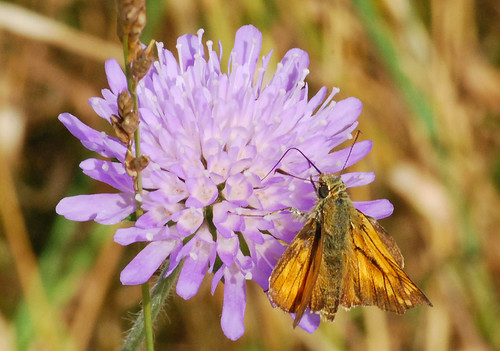
Large skipper (Ochlodes faunus)

I like the large skipper, it is a butterfly of open grassland and I often see them feeding on field scabius flowers, as this one is, and the colour combination is sumptuous, set against the green and brown of the grass stems. I like the geometry too – it reminds of a hornet (as in the McDonnel Douglas F18 hornet – the American navy fighter plane) – but I’d rather have the skipper flying around Histon!

Small copper (Lycaena phlaeas)

The small copper is a handsome little butterfly who frequents open grassland, heathland, wasteland, verges and woodland rides and is distributed throughout Great Britain. I see it here because it likes to feed on ragwort, yarrow, thistles and red clover which are all abundant in the fields close to Histon. They also feed on daisy, dandelion and buttercups which are common throughout the UK too. Despite their dietary promiscuity I don’t see them very often so I was pleased to get this picture.


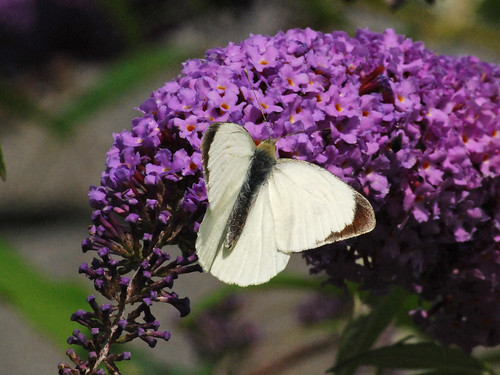
Large white (Pieris brassicae)

The curse of the cabbage patch! The large and small white are collectively known as ‘cabbage whites’ due to the devastation their caterpillars can wreak on the fruits of the labours of hapless allotment owners. The one pictured here is a male and he is easily distinguished from the female because she has two black spots on her forewings and another small black streak where the wings join and the male has no spots or streaks. As a species they are easily distinguished from other whites because they are noticeably bigger. The cabbage whites are also two of our most common butterflies which renders them additionally unpopular amongst the vegetable growing fraternity. Which is a pity really, because a field full of whites on a hot summer day mixed in with browns, blues and all the other butterflies is a spectacular sight.

2011 – That was the year that was

Every month of the year has different conditions which create environmental niches that favour different flora, fauna and stages of life cycles. So as 2011 rushes headlong to its wintry conclusion, for my last post of the year I was going to select a single photograph to represent the month to month changes in our wildlife throughout the year. And that was of course impossible for a number of reasons, mainly because it was impossible to represent any one month with a single image, and also because I have lots of images that I like and I want to share. I eventually managed to whittle the number down to an average of two per month which include a wide range of our native creatures in the UK including birds (migrants and natives), butterflies, moths, flowers, amphibians and fungi. I hope you like them!

January

Every autumn  lots of bird species vacate our shores to head to warmer parts of the world while we endure the cold of winter, and they’re replaced by other species which come from the north to the relative warmth of the UK in winter. Last year the autumn and winter weather in Scandinavia was ferocious and consequently many birds arrived here in larger numbers than usual, including the gorgeous waxwing. Along with the waxwing, redwing and fieldfare came too, as they do every year, and remained until the spring, providing some welcome colour.

On a bright cold January day a lone fieldfare perched in a tree

February

February was cold and the middle of the month saw us taking the children to the coast for our annual spring half term excursion, and this year we headed to the Suffolk coast at Dunwich. Dunwich is a really interesting place for lots of reasons, not least because the wildlife there is rich and varied. One of the harbingers of springtime which I look forward to every year is the flowering of snowdrops, and the woods on the edge of Dunwich were covered in them:


A carpet of snowdrops in the woods at Dunwich Greyfriars

March

By March many flowers were blooming and the fauna was turning it’s thoughts to matters procreational. And this dunnock was no exception:


A dunnock serenading the ladies from a bramble stem on Cambridge Science Park

Dunnocks have a rather to-the-point approach to the art of regeneration. They don’t get together in pairs as most birds do, they form small groups and mate with multiple partners and the males go as far as to remove packets of sperm from the cloaca of females who have been inseminated by rivals prior to passing on their own DNA. No nonsense!


A robin singing for a mate in an alder tree, also on Cambridge Science Park

And of course the birds aren’t the only creatures to get the urge in March. For the past 2-3 years a guided busway has been built between St Ives and Cambridge and as it approaches Cambridge Science Park it passes alongside a lake that is a spawning ground for thousands of toads which live in the adjacent woods and fields. The busway has therefore cut off the toads from the lake and, driven by the unstoppable instinct to reproduce, this pair were trying unsuccessfully to negotiate the sheer walls of the track. For a week in March I would get off my bike every morning on the way to work to help as many of them across as I could find.


The male toad is hitching a lift on the back of the much larger female on the way to the water to spawn

The male toad locks onto the back of the female with his front claws around her chest and he’s not at all keen to relinquish his grip until they’ve reached the water and he’s fertilised her eggs. After which armies of lone toads can be seen heading back the other way.

Fortunately for the toads Cambridge City Council funded the installation of toad tunnels under the busway so next year they should be able to negotitate the track and avoid the carnage which would otherwise have ensued. Hats off to the Council!

April

This month was a real wildlife fest and many types of creature allowed me to take some great photographs. The trees now have shooting leaves so everywhere has that lovely green colour from all the fresh growth.


Windswept male yellowhammer in the top of a hawthorn tree

The yellowhammer is a species which has become less and less common in recent decades as a result of hedgerow destruction and other modern farming methods, but we’re lucky to have plenty of hedgerows still in situ on the outskirts of Histon, and consequently, good numbers of these lovely yellow buntings. The hedgerow this one is on is mature and has old oak and ash trees in so it plays host to alot of bird species including blackcap, chiffchaff, dunnock, common whitethroat and green woodpecker, to name but a few.

Whilst sitting watching TV late one evening in March, what I initially thought was a bat emerged from behind the sofa I was sitting on with my wife. There had been no prior warning of its presence and myself and my wife both levitated off the sofa uttering something along the lines of “What the heck was that!?”. It fluttered into a lampshade where it staid long enough to get a photograph, and it turned out to be an emperor moth:


Our emperor moth inside a lamp. I though creatures like that only lived in tropical rainforests!

Unfortunately, a couple of days later I found her dead (she was the female of the species) still inside the lampshade. I extricated her and measured her and she was 7cm wingtip to wingtip. A magnificent beast.


A willow warbler beautifully framed by new leaves and blossom of the blackthorn tree

These little warblers which weigh on average around 9g have just arrived from southern Africa. I think bird migration is one of the most amazing natural phemonena – how does such a tiny creature navigate and survive a flight across the Sahara and then the Mediterranean? It’s absolutely incredible.


A pair of great crested newts getting ready to mate in a shallow pond – male on the left, more slender female to the right

The great crested newt was probably the highlight of my year. I’d never seen a newt before and in this pond there were great crested, palmate and smooth newts. I turned the flash power down and used an 18-55mm lens and got some reasonably good photographs of the newts underwater. And that at 1am after a few hours in the pub!

May

I’ve spent many a fruitless hour chasing orange spot butterflies up and down the hedgerows of Cambridgeshire, but they never seemed to settle for long enough to get a photograph. But one morning in May I must have timed it just right, they were in the mating mood.
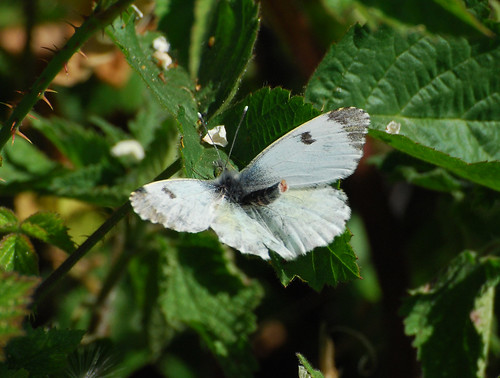

Female orange spot announcing her availability in somewhat unambiguous fashion to a passing male who was just out of shot


Common whitethroat – these warblers also migrate to the UK from sub-Saharan Africa

The common whitethroat breeds in my local fields in good numbers. It’s easy to identify by its song and the way it perches on brambles and low scrub and then flits almost vertically up into the air to alight a few seconds later close to where it took off from and continue singing. This one is a male, he has a blue/grey head whereas the female has a brown head. As well as avian migrants from warmer climes, at this time of year many species of dragonfly are emerging:


Scarce chaser dragonfly at Milton Country Park

I like dragonflies. In the days of the dinosaurs there were dragonflies with a 75cm wingspan! They are fun to photograph (and often, not too difficult) they look awesome, and they have very interesting life cycles. My scarce chaser sat on a seed head for several minutes whilst I stood a few feet away photographing other dragons and damsels, occassionally he took off to circle the pond before returning to the same spot where he let me get to within around 50cm to capture his portrait.

June

In a normal year the weather will be warming up  nicely by June and flowers and insects and birds should be in abundance. But 2011 wasn’t a normal year, April was unseasonally warm which kick started everything, but the rest of spring and summer were cold and this had dire consequences for many butterflies and other species. One of the few that I did see in reasonable  numbers this year, although not as many as last year, was the large skipper.


Large skipper feasting on the nectar of a thistle

The marsh woundwort is so called because it has been applied to wounds to assist the healing process. I don’t know what the medical basis for that is, maybe it has antispetic properties. It  has a beautiful flowerhead and is one a good number of wild flowers growing in the drainage dikes on the local farmland around Cambridge.

Marsh woundwort poking it’s lovely head out of a drainage ditch which is full of various wild flowers every year

July

I found this splendid looking cricket lurking in the grass in a field on the edge of Histon. I first thought it was a very green grasshopper until I looked more closely at the photograph, and it turned out to be a Roesels bush cricket. It is an introduced species from mainland Europe which until recently was only found in the most southerly parts of England. There are two varieties and this is the long winged one which can colonise further afield faster than its short winged cousin, and is now as far north as Cambridgeshire and beyond.


Long winged Roesels bush cricket

This was the first of its kind that I’d seen and a few days later another one appeared on a blind in my house, so I guess thay can’t be that uncommon in this region now.

A pair of juvenile linnets

Before I got out walking in my local countryside around Histon I can’t remember the last time I saw a linnet, but they breed here in good numbers and in the winter flocks of many tens to hundreds can be seen on farmland around and about Histon. Linnet are finches which feed on seeds and the adult males are splendid with a cerise breast and a crimson spot on their foreheads.

August

When I was at school, many years ago, my Dad would feed the birds in the garden and it wasn’t particularly unusual to see the occasional bullfinch.  But mainly as a result of persecution their numbers declined dramatically through the 1970’s and 80’s and I didn’t see one for years. The males are beautiful birds and I’ve been after a good photograph of one for a long time. And finally…


A male bullfinch crunching seeds at RSPB Fen Drayton

I love this picture – so far it’s the first and only half decent one I’ve managed. Hopefully I’ll get a few more to share with you in 2012.

Later in August, we were on holiday in Northumberland, and amongst the many gulls and other seabirds on the beach at Seahouses was this redshank. I think it’s nature at it’s aesthetic best!


A lone redshank looking for nourishment in the rockpools at Seahouses

September

The biggest garden spider I’ve ever seen – she was around 4cm across

Another of natures harbingers, this time of autumn. My garden fills up with these polyocular purveyors of terror in September, and this lady was huge. She was 4cm across and was big enough to distract my son from a telling off. ‘Dad, there’s a big spider in my window‘ was an imaginative and very effective way to divert my attention from the misdemeanour of the moment. I ran to get my camera and I had to lay horizontally out of the bedroom window to take this photograph, as a result of which I couldn’t stay still for more than a few seconds!

October

After the coldest summer for 18 years we then had a mild autumn which meant that many creatures could be found out and about long after they have normally  migrated or hibernated, or died off. Swallows and swifts were still being seen into October and a bumblebee flew past my lab window one day last week. During a visit to Milton Country Park, on the northern edge of Cambridge, on 28th October, to see what winter wildfowl had arrived, there were some winter visitors including tufted duck, gadwall and widgeon. But the pontoon I was stood on had around half a dozen common darter dragonflies on it along with several species of damselfly in the surrounding reedbed and a lone migrant hawker patrolling the air which took a common darter and butchered it on the wing right over my head. Dragonflies can be seen late in the year when the weather permits, but even so I was surprised to see so many at the end of October.

A pair of common darters mating in the late autumn sunshine

November

One of my November excursions took me to RSPB Fowlmere, between Cambridge and Royston, which is renowned for its water rails. I don’t think I’d ever seen one before but I was tipped off by a fellow naturalist that there was one in front of a particular hide, so I headed off there and there it was, busy foraging in the pond for the whole hour I sat there. It was very murky so the photographic conditions were difficult, but I managed to get a couple of decent pictures and I particularly like this one:

A water rail in the primeval swamps of Cambridgeshire!

And another of my trips in November was to Norsey Wood in Essex which is a very different ecosystem to Fowlmere, consisting of ancient oak, beech and birch wood. So in autumn the forest floor is a really good location for fungi and this fly agaric was one of a large group growing out of the leaf litter.


Fly agaric mushroom amongst the fallen beech leaves of Norsey Wood

December

And finally, a wildlife success story is the long tailed tit. Until the last 10-15 years I only saw these occasionally but they now seem to be common, in direct contrast to so many other species of bird whose numbers are declining. I regularly see flocks of long tailed tits on the feeders in my garden and in the hedgerows and woods around Histon. They’re gorgeous little birds and I love watching a flock of them follow each other one after the other along a hedgerow before bunching together when they have found a food  source and then heading off again in line astern.

A long tailed tit in the hedges along Guns Lane in Histon

I stood quietly for several minutes watching the flock of around 15 birds that this one belonged to and they didn’t seem at all bothered by me as they picked insects from the trees.

So there you have it. 2011 in pictures. If you had the stamina to get this far, thankyou and I hope you enjoyed it.

Best wishes for a very happy Christmas and a peaceful and successful New Year from The Naturephile!

Butterflies, and all that jazz

Ronnie Scott’s Jazz Club isn’t where I would expect to find subjects for wildlife photography. And, along with the inside of various other hostelries around the City of London, so it proved. That’s where I found myself this weekend and consequently I didn’t manage to take any photographs. So as the weather is so dull and foggy I thought I’d try to brighten things up with some butterfly pictures which were captured at another, less crepuscular, time of year.

Last year I went to a place called Fermyn Wood near Kettering in Northamtonshire with a friend of mine, to look for purple emperors. For the more ornithological among you, particularly if you like birds of prey, this was one of the original release sites for red kites (Milvus milvus, Dansk: rød glente) , and they are still there in abundance. And sure enough one appeared very low overhead before lazily flapping off across the treetops.


This splendid creature is a white admiral (Limenitis camilla), feeding on the nectar from bramble flowers at Fermyn

We set off early to arrive around 8am because at that time of day the butterflies are sunning themsleves on the ground and taking in salts. They get salts from various sources including animal droppings, carrion, sap runs on trees, and sweat. My friend has a photograph of a purple emperor sipping sweat from his sock by inserting its proboscis through the eyehole of his trainer! We encountered a few emperors but they were all whizzing past higher up in the tree canopy. They live in deciduous woods where they spend most of their time feeding on aphid honeydew, apart from this one who sat obligingly on the path and let us take photographs:


Purple emperor (Apatura iris) taking on salts from the substrata

He was sufficiently obliging to unable us to take pictures of the underside of his wings, which are themselves spectacular, but he wasn’t willing to reveal the full irridescent splendour of the top side, which is where their name derives from.  They are big, with an average wingspan of around 8cm, and the males are the most gorgeous deep purple. Alas for the female of the species, she is a rather less dramatic brown colour. I was therefore on a mission to get pictures of the upper side of the wings in 2011 but they are only around for 1-2 weeks of the year and it wasn’t when I could get there. But that’s fine, it gives me something to look forward to next year… or the year after.

On the ground close by the purple emperor was a small tortoiseshell, which are considerable more common and can be found on buddleia bushes up and down the country, but are also amazingly colourful.


Small tortoiseshell (Aglais urticae)

I don’t usually like full on portraits of butterflies, but I like this one because set against the parched earth the flamboyant colours of the butterfly are a sight to behold, all the tiny cells of the different colours in the blue and white peripheral spots are clearly visible. It’s a stunner!


Autumnal Anisopterans

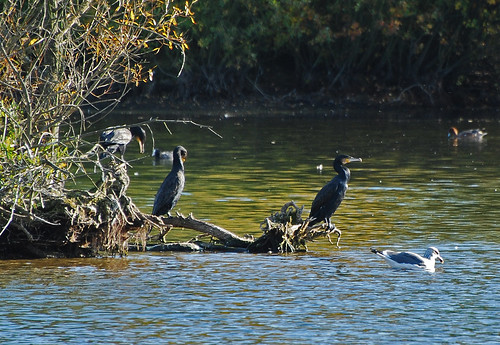
Yesterday, 28th October, was one of those glorious sunny autumnal days where the air was fresh but the temperature was raised by bright sunshine, and I’d heard that the winter migrants were arriving on the lakes at Milton Country Park on the northern edge of Cambridge. So I took my camera to work and headed there for a stroll at lunchtime in the hope of snapping a teal or wigeon or perhaps a more unusual visitor. Several waterbirds were on parade including these cormorants:

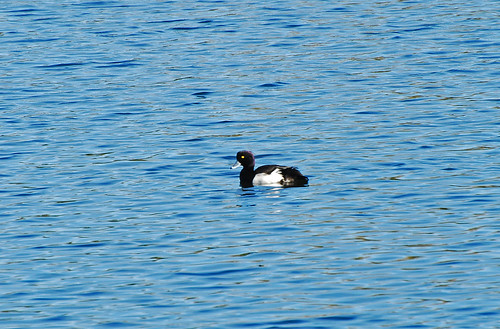
Several migrant duck species were there too, including wigeon (Anas penelope, Dansk: pibeand), the duck with the chestnut head in the background of the cormorant picture is a male wigeon, tufted duck (Aythya fuligula, Dansk: troldand):


A male tufted duck resplendent in his pied plumage and bright yellow eye

…and gadwall (Anas strepera, Dansk: knarand).

What I didn’t expect to see though, certainly not in the kind of numbers present, were dragonflies. It’s  nearly November and the weather has started to get more autumnal but the warm weather up to now must have suited these airborne predators. In particular common darters (Sympetrium striolatum) were conspicuous, six at one time including two mating pairs. It’s always a treat to watch dragonflies but especially on a sunny day at the end of October, living uo to their name and darting about making a loud low frequency buzzzing noise .

Stunning symmetry of a pair of mating common darters

The darters were sunning themselves on the fence lining a viewing jetty on the edge of a lake and while they were busy warming and copulating a migrant hawker (Aeshna mixta) was patrolling the adjacent reedbeds. All the dragons were pretty much oblivious to my presence unless I ventured too close then they would rise into the air, the copulating couple in tandem, only to return to pretty much the same spot with 30 seconds or so.


Migrant hawker

Every so often one or more of the common darters would chase the hawker away until it lived to its name and plucked one of them out of the air and butchered it whilst flying around our heads, scattering the inedible parts around us. After its aerial snack it headed up into the treetops and disappeared.


The hawker missed a trick. It went to alot of effort catching its darter on the wing when it could have had twice as much protein if it had spotted this pair. But I’m glad it didn’t!

Unseasonal Lepidoptera

I was walking in the countryside last Saturday morning around 8am and the weather was bright and sunny. It was also freezing and the grass was glistening  with the first frost of the Autumn. Despite the temperature it was a beautiful morning, enhanced by a deep blue, cloudless, sky and a three quarter moon, and as I wandered along a hedgerow a red admiral butterfly fluttered past.


Red admiral – not the one that fluttered by on Saturday, this one is from earlier in the year.

The colours of the red admiral are gorgeous. It was only when I studied a photograph of one that I really noticed the electric blue spots at the back of the wings and lining the tip of the forewings, and I wonder if the red circle is meant to resemble a fearsome Cyclopean eye to deter potential predators. Whatever the biological rationale they look stunning against the green foliage.

The appearance of the red admiral surprised me for two reasons, firstly because it was so cold, and secondly because in my part of the world all butterfly numbers seem to have been massively reduced compared to last year.

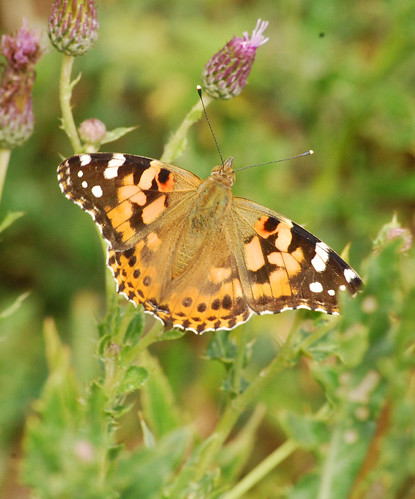
Last year was a really good year for butterflies and in early August, on a hot summer day, myself and my daughter went to a close-by fallow field and did the Big Butterfly Count organised by Butterfly Conservation (http://butterfly-conservation.org). We counted 9 species in our 15 minute survey window, including painted ladies which migrate to the UK for the summer from as far afield as Africa.

Painted lady

I think intercontinental migration is an astonishing feat of endurance for any creature, but for one as delicate and ephemeral as a butterfly it’s totally awe-inspiring. The odds stacked against any individual surviving such a journey must be mightily slim!

Conversely, it was very noticeable that the weather in 2011 was alot colder (it was the coldest summer since 1993 apparently) and butterfly numbers were significantly down compared to last year, in particular the common blue:

The aptly and, this year, inaptly named common blue. This one, with his wings wide open, is a male…

…and with his wings closed


Bizarrely, the female common blue is actually brown

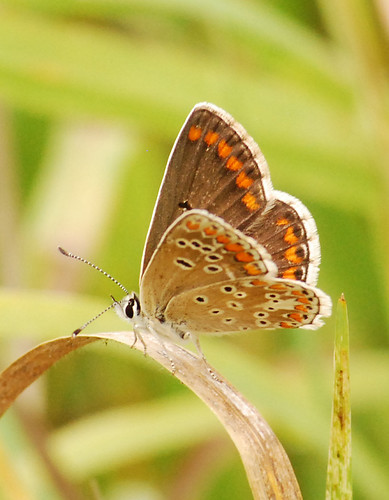
She is looking ragged after a hard summer of mating and egg laying necessary to secure next years population. Common blues and brown argus butterflies can commonly be seen together, they are closely related and the brown argus and female common blue can be tricky to tell apart. She is distinguishable from the brown argus by her overall shape which is very similar to the male above, the white around the orange spots on the hindwing, the blue along the wingroots and the lack of a black cell spot on the forewing, all of which are not observed on the brown argus:


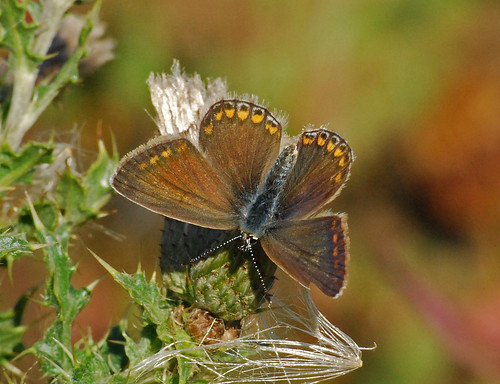
Brown argus sipping nectar from ragwort flowers above. And below revealing the slight differences in the spot pattern compared to the common blue female:


The brown argus can have a blue irridescent sheen when it catches sunlight at the right angle and the wing veins extend through the white wing border, which they don’t in the female common blue.

During a walk through our field at the start of August last year I would see tens of common blue, both male and female, but on the same walk at the same time this year I was lucky to see more than 2 or 3. The results from this years Big Butterfly Count corroborated my unscientific observations and it reports that common blue numbers were down by 61% in this years survey. I’m hoping we get a milder winter this year and a warmer summer next year so the numbers of these beautiful creatures can recover.

I took lots of cool butterfly pictures last year, but as it was before I started writing the Naturephile I was hoping to post them this year. But it didn’t quite come to pass so I’ll try to sneak some of them out under spurious pretexts to brighten up this winter!

Cragside

Whilst exploring Northumberland in August we ventured into  Bamburgh Castle which is well worth a visit not least because it houses a museum dedicated to the Victorian engineering genius and arms manufacturer, William Armstrong. Armstrong used a portion of his colossal wealth to build a remarkable house at Cragside near Rothbury, which is also well worth a visit because it is set in some pretty amazing countryside which is teeming with wildlife. It’s also remarkable because it’s the first house on the planet to be lit by hydroelectricity. So the man who amassed wealth beyond belief by producing arms which were responsible for the deaths of an awful lot of people also set the stage for renewable energy. And that’s a dichotomy which, in my book, makes him a very interesting man.

So… on the way home from Northumberland we decided to avoid the A1 as far as we could which involved going close to Rothbury, and when, completely serendipitously,  we passed a road sign for Cragside (and having joined the National Trust whilst on the Farne Islands) we rapidly decided a visit there was on the days agenda.

And that was a good decision. The house itself would take a long time to explore so we stuck our heads in the front door and decided to explore the surroundings instead. It was a cold and windy day threatening rain, but despite that the gardens were full of flowers attracting bumble bees and butterflies, particularly red admirals. The wooded slopes were full of birds, particularly tits, and most particularly coal tits (Periparus ater, Dansk: sortmejse).

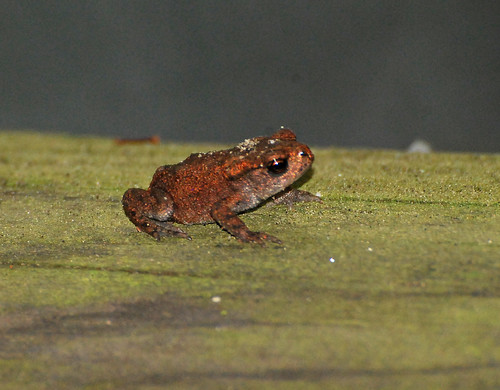
My son spotted a baby toad in the long grass but I didn’t want to disturb it too much so I didn’t get a photograph, but I was rewarded shortly after when I found this little chap walking along the woodwork of a bridge over a stream:


This nascent toad, Bufo bufo, was smaller than a 50p piece and slipped  into the water whilst crossing the bridge, but he sat still for just long enough

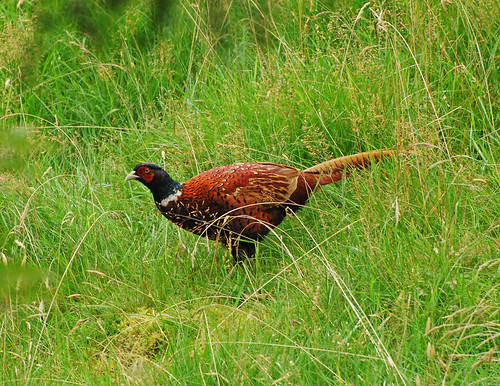
And as we were chasing toads a handsome cock pheasant appeared in the adjacent field,


Pheasant male, Phasianus colchicus (Dansk: fasan) showing off his magnificent plumage

The pheasant was introduced to the UK from Asia, where it’s native range extends from the Caucasus to China, around 1000 years ago. It is extensively hunted, which probably explains why it has been introduced to so many countries!

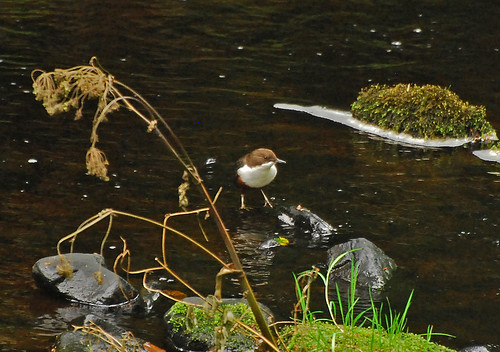
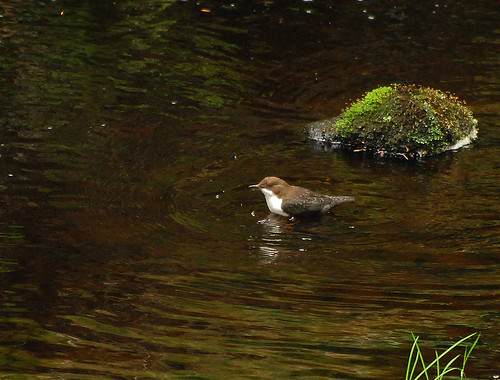
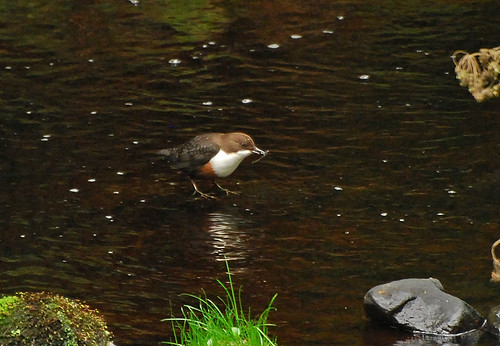
But the ornithological highlight of the visit to Cragside was the dipper (Cinclus cinclus, Dansk: vandstær). It flew past me at high speed low over the stream before landing on a rock which it used as a springboard to hunt insects underwater. I thought it is called a ‘dipper’ because of it’s diving prowess, but while it was perched on terra firma it flexed its legs resulting in a dipping motion of it’s head – so maybe it’s this action that gives it its name. I was wondering why it did the dipping and thought it may enable it to see small prey items underwater more easily.


Dipper perched on a rock contemplating a snack…


Hunting in the stream…


And with a catch – I think it has landed a damselfly

Dippers are unique in that they can swim underwater and even walk on the bottom as a result of having solid bones.

Photographically the dipper posed some interesting problems. It’s mostly a dark coloured bird and was in a dark coloured stream under tall trees on a cloudy morning so there was very little spare light, and it didn’t stay still for very long. Consequently I had to use ISO 800, f5.6 and 160th sec exposure and cross my fingers! Fortunately I was able to focus on the white breast and managed to get a few good shots. It’s a charming little bird and I was very pleased to be able to share some pictures with you.