Category Archives: Migrants

The iconic avocet

‘Iconic’ is a word that is overused, but in the case of the avocet it is entirely appropriate. Those of you from the UK – and possibly some of you from further afield – may know that in the UK the avocet is the emblem of the Royal Society for the Protection of Birds – the RSPB.

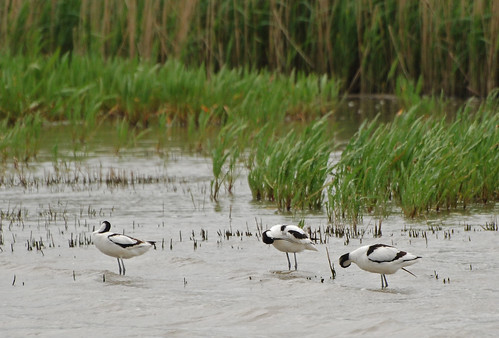
A trio of avocet feeding on the water at RSPB Titchwell as a pair of swift hunt winged insects just overhead

The avocet (Recurvirostra avosetta, Dansk: klyde) had all but died out – in fact it may have totally died out – in the UK in the 19th century, but in the 1940’s a breeding population from the European mainland re-established itself when the coastal mudflats along the east coast of England were flooded as a defensive measure against a possible German invasion. So there you go, just occasionally something good can result from a war!

Avocet can be seen breeding on the east coast of England in the summer, and they are resident in the southwest during the winter, they are also winter and passage visitors. It is therefore an early symbol of conservation success and it was originally adopted by the RSPB in 1955 as the their symbol to adorn the new RSPB tie. Its continued success led it to be adopted as the RSPB logo in 1970. They are beautiful birds and they can be pretty feisty when it comes to guarding their territory.

The long upturned beak of the avocet, from which it gets it’s generic name, ‘Recurvirostra’, along with its black and white plumage makes it completely unmistakable. I have seen avocet before but not in such numbers and not so close and it was only on this trip that I realised they have very distinctive pale blue legs. So all in all it’s a very striking bird.

The upturned bill has a functional aspect too. It is the upper mandible which is curved and the avocet use it to stir up the sediment by sweeping it across the surface from side to side dislodging crustaceans, insects and worms which they detect by touch. The one below had captured a meal and the dark shadow just in front of its beak is a cloud of sediment churned up by the scything beak.

As with just about every species on the planet, including humans, the main threat to the avocet comes from inconsiderate human activity including reclamation of wetlands, depletion of water levels in rivers, infrastructure development and pollution by polychlorinated biphenyls (PCB’s), insecticides and heavy metals. Despite that, the global population is estimated to be between 210-460,000 individuals. It’s unclear if those numbers are stable, but as some populations decline others are increasing. So hopefully they’re OK for the time being.

I’ve been up to my eyeballs in non-blogging stuff in the last month so I’ve been struggling to keep up to date with all your blogs. The pace is unlikely to let up before September but I’ll try to visit as many as I can in the meantime. I will be back!

Apodidae – the swift

Last month I spent a day at the RSPB reserve at Titchwell near Hunstanton on the north Norfolk coast. It’s a particularly dramatic bit of coastline and is home to a very impressive array of birdlife which is concentrated here on the reserve. As well as all the waders and other water birds squadrons of swifts were wheeling and zooming low over the water plucking insects out of the air.


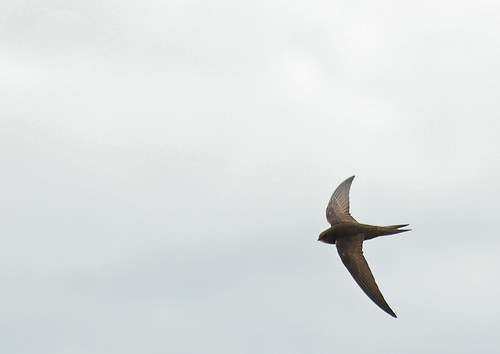
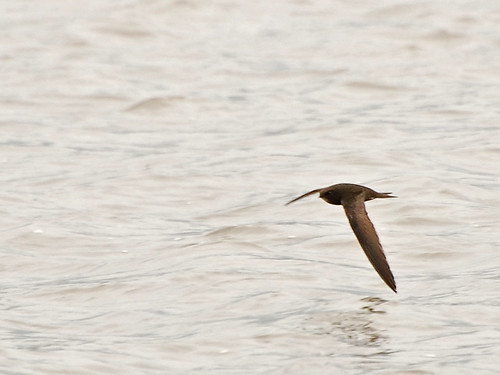
Swift – Apus apus. Dansk – mursejler

Swifts have been declining in numbers and their conservation status is amber, but it was difficult to believe they’re struggling! There seem to be good numbers of them in the skies around Cambridge too. I love it in the summer when I open a window and the sound of shrieking swifts filters down from on high.

Insects beware, bandits at 6 o’clock!

Photographing swifts in flight is challenging to say the least and something I’ve never before had much success with, but there were so many of them at Titchwell and they were flying close to the ground so I gave it a go. They seemed to have preferred routes which I guess were dictated by where the insects were flying and that made getting pictures a little less tricky as their flight paths were more predictable. And here are the results.

Swifts are members of the Apodidae family and on ther face of it appear fairly similar to swallows and martins. But my oft ill-remembered scchoolboy Latin leads me to believe that ‘apodidae‘ means ‘lacking feet‘ whereas swallows and martins are passerines which means they have feet adapted for perching. Swifts do have feet but they are tiny and adapted for clasping and not perching, all four of their toes pointing forward. One thing that the three species do have in common is that they are all awesome aeronauts. A juvenile swift can spend up to three years aloft after fledging and it will spend most of its life on the wing: eating, sleeping, gathering nesting material and even copulating in the sky.

According to the British Trust for Ornithology swifts shut down their brains one side at a time in order to maintain stable flight. But I’d like to know how they found that out – I can’t think of an experimental design that would enable this conclusion!

The swift is a summer migrant to UK shores and they spend their winters in South Africa, and I suspect the journey doesn’t take too long, covering a thousand miles in a couple of days!

My day at Titchwell was gorgeous, it was during the foul wet weather we’ve been having but shortly after we arrived the sun emerged and stayed with us for the whole day. I took nearly a thousand photographs and I’m going to post the best of them in batches in the next few weeks, interspersed with some other local wildlife. I hope you like them!

Serendipity II – The charismatic cuckoo

I don’t recall having seen a cuckoo before, even though I’ve heard their unique call many times. But on my sojourn over to Wicken Fen a couple of weeks ago there were lots of them. ‘Lots‘ is a relative term because cuckoos are becoming increasingly scarce, their conservation status is red due to recent declines in the breeding population and in 2000 there were 9.6-19000 breeding pairs in the UK. But on this trip we heard and saw at least 5 and possibly several  more.

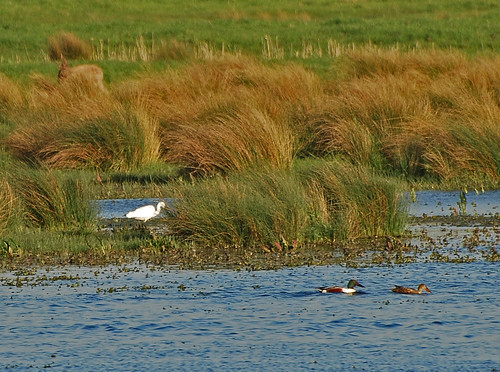
Just before I spotted the first cuckoo I glanced across the lake and this was the view:


A pair of shoveler in the foreground, a little egret behind and a roe deer just beyond the reeds

I really like this picture because of the colours of the reeds and the water in the evening sunshine, but also because it contains three interesting species. Apart from rabbits, any wild mammal is exciting to see in this country, so the roe deer was a pleasing encounter. The little egret (Egretta garzetta, Dansk: silkehejre) is a member of the heron family which is now resident in the UK, presumably as a result of climate change. I associate them with warmer places because that’s where I saw them before 2000, but nowadays they’re not particularly uncommon here. And in the forefround are two shoveler (Anas clypeata, Dansk: skeand) which are migrant visitors to the UK, but this pair obviously liked it enough to linger and are still here in the middle of May, long after they would normally have left.

And then there were the cuckoos:


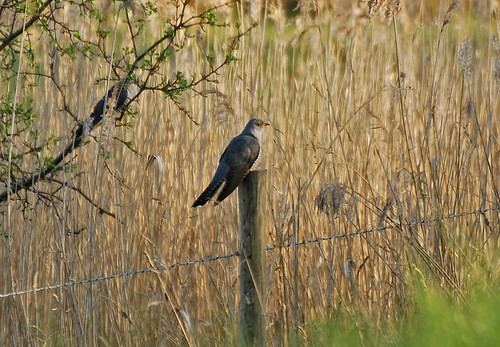
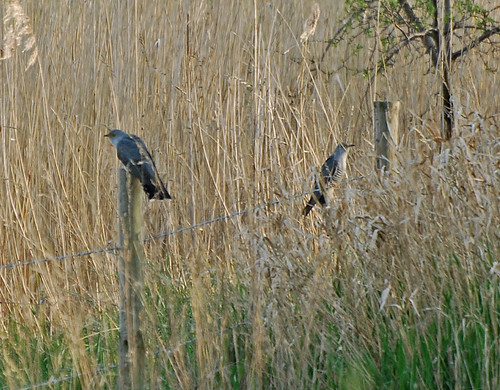
A pair of cuckoo, Cuculus canorus, Dansk: gøg

The cuckoo is an incredible bird and until very recently it was poorly understood. Last year the British Trust for Ornithology (BTO) managed to tag five male cuckoos with tiny satellite tracking devices and found out that they headed to the tropical sub-Saharan rainforests of Cameroon and the Democratic Republic of Congo. The cuckoo arrives back in England from Africa in late March or April and departs in July or August. It leaves earlier than other species because its parasitic breeding strategy removes the need for chick rearing. That means the cuckoo spends a minimum of 8 months a year in Africa so to call it a British bird is, I suppose, less than accurate, even though it breeds here.


The classic hanging wings pose which I always associate with the cuckoo

The tagged birds were all fitted with solar powered devices which transmit location data once every 48hr. The tracking data revealed that all five birds headed south over France and across the Mediterranean before heading down across Africa to Cameroon and DRC. All five made it. One of the birds died in Cameroon and two more died on the way back, but two of the five made it back to East Anglia this year. I believe the BTO plan to tag more birds including females and I’m very keen to see the results of that experiment.

The cuckoo is an iconic bird in the UK and it’s call is very distinctive. The call is generally recognised as a signal that Spring has arrived and there are local traditions around the UK based on the cuckoo. It is said in Worcestershire that the cuckoo is never heard before Tenbury Fair on April 21st or after Pershore Fair on June 26th. The song actually changes in June from the characteristic ‘cuck-coo‘ song to a shortened ‘cuck‘, and there is a rhyme about this:

In April I open my bill
In May I sing night and day
In June I change my tune
In July far far I fly
In August away I must

My Dad remembers a similar rhyme he used to sing when he was a kid in the 1940’s which was essentially the same but with some local Northamptonshire words substituted in.

I’m not quite sure what these two were doing but they were acting as a pair, and every minute or two one of them would dive off into the adjacent reedbeds to return a minute or so later. As I mentioned above, cuckoos are parasites and they could have been looking for nests to parasitise. There breeding strategy is unique, at least as far as I know. They lay their eggs in the nests of one of three other small songbird species: the reed warbler, the meadow pippit and the dunnock. All of these are the size of a sparrow (ish) so are much smaller than the cuckoo which is dove-sized, which I guess guarantees that the cuckoo chick will be much bigger than its ‘siblings’ and it won’t be threatened. The cuckoo chick then ejects the other chicks from the nest to die and the parents assume it is one of their own and feed it until it fledges. I’ve seen film of a cuckoo chick turfing out the other chicks and it’s a remarkable process, and not particularly pleasant to watch!

Despite their unsavoury procreation habits they are spectacular and charismatic birds and I hope the BTO research can find ways to guarantee their continued return here to brighten up the Spring and Summer.

The chiffchaff and the willow warbler

The chiffchaff and the willow warbler both members of the warbler or ‘Sylviidae‘ family. There are 63 members of the Sylviidae of which 14 species breed in the UK. They’re very similar to look at and can be pretty tricky to tell apart. Last week in my local meadow I came across both species in photographable locations so I  thought I’d try to show the differences. Both species are summer migrants to the UK having overwintered in Africa, the chiffchaff goes to the Mediterranean and some head south of the Sahara, and the willow warblers all  go down to tropical sub-Saharan Africa.

This publication from Birdlife International tells us that the global population of willow warblers is estimated to be between 300 million and 1.2 billion individuals, and a fact that blew my socks off was that the northern Siberian population overwinters in southern Africa, which is a journey of over 7000 miles or 11000 km… and back! And they’re only 19cm long and weigh 10g, so they may be tiny, but they’re incredibly tough. The chiffchaff is also a scarce winter visitor to the UK.

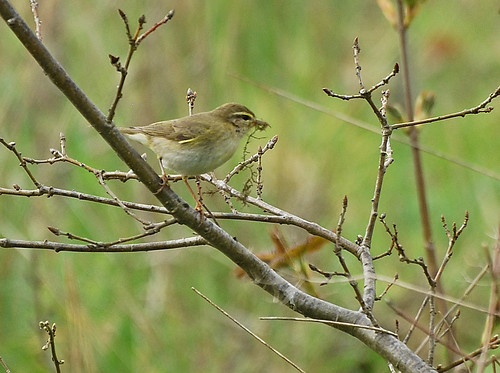
Willow warbler (Phylloscopus trochilus, Dansk: løvsanger) collecting nesting materialWillow warbler showing off her pink legs, bright supercilium and pale ear coverts

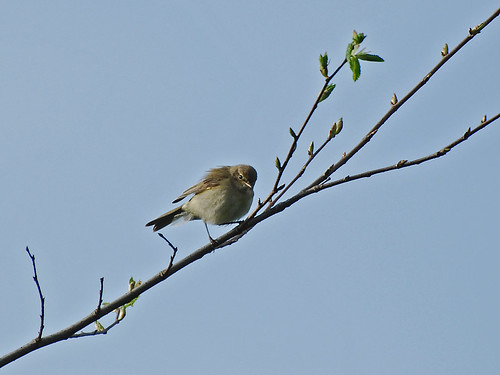
The willow warbler has longer primaries and the light stripe over the eye, the ‘supercilium‘ is brighter and more pronounced than that of the chiffchaff, and the ear coverts of the willow warbler (the patch under the eye) are a pale olive colour. The other visual diagnostic feature which is probably easiest to see at a glance is the leg colour, the willow warbler has pinkish brown legs whilst those of the chiffchaff are much darker, almost black.

Chiffchaff showing off its more subdued facial markings and overall colour scheme and the dark coloured legs

In the absence of a clear sighting the easiest way to differentiate between these two species is by their song: click here to hear the chiffchaff song, and here for the willow warbler song.

The conservation status of the chiffchaff is green and in 2000 there were around three quarters of a million territories in the UK, but the willow warbler is amber due to a decline in the breeding population, but despite that there were still two milion territories in 2000.

Returning songbirds

There’s a particular spot in my local meadow where there are some large clumps of brambles which are home to numerous species of bird including songthrush, blackbird, linnet and house sparrow. And in the summer chiffchaff, willow warbler, blackcap and common whitethroat are all there too. Chiffchaff have been here for a couple of months now, and willow warbler almost as long but I hadn’t yet seen a whitethroat, so I set off last Monday in the hope of seeing the first one of the year.

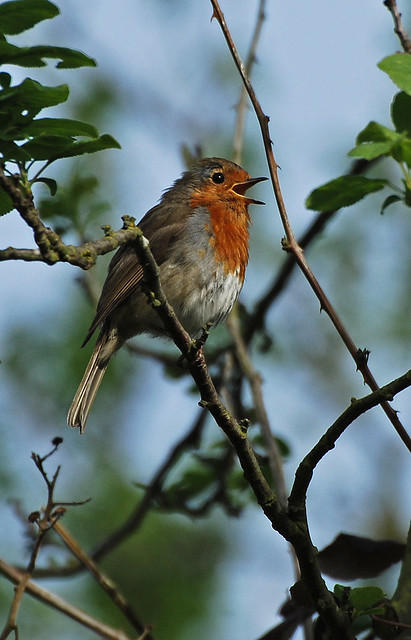
A cock robin singing to the ladies

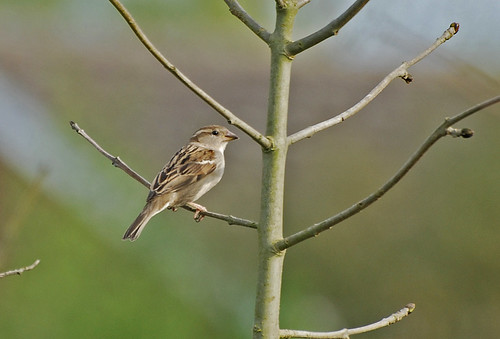
There were many species of songbird in the meadow including the robin (Erithacus rubecula: Dansk: rødhals) and the house sparrow (Passer domesticus, Dansk: gråspurv) and the air was alive with the song of all these species.


House sparrow female

Robin and house sparrow are resident species in the meadow and I see them all year round there, but not the chiffchaff:

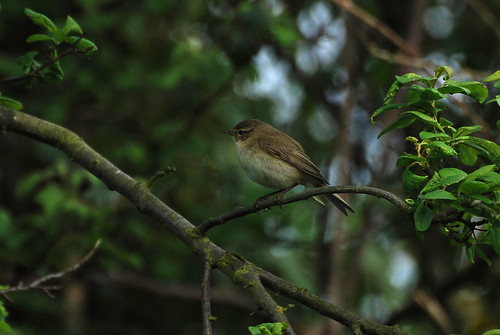
The chiffchaff (Phylloscopus collybita Dansk: gransanger), which is a warbler, and willow warbler (Phylloscopus trochilus, Dansk: løvsanger) can be very difficult to tell apart if only seen at a glance, but they can be distinguished by their song, of which more in the next post. This chiffchaff was one of a pair which were calling to each other and flitting around the bushes passing within a few feet of me on several occasions and seemingly unfazed by my presence.

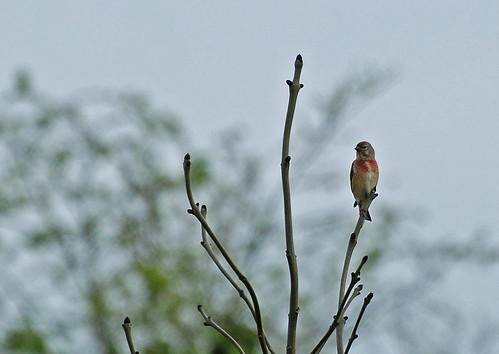
Cock linnet

Resident in the UK is the linnet (Carduelis cannabina, Dansk: tornirisk), they disappear from the fields around Histon in the Autumn, presumably to congregate at a winter feeding ground, and they reappear in the Spring. And they have recently turned up in the meadow. Also resident, and present all year round, is the dunnock…


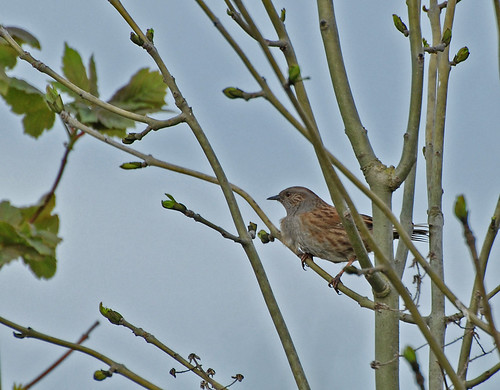
Dunnock, Prunella modularis, Dansk: jernspurv

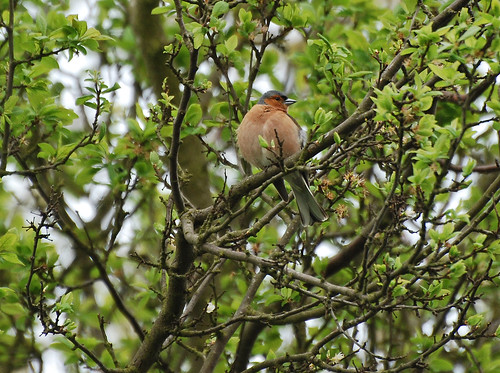
… and the chaffinch:

Cock chaffinch, Fringilla coelebs, Dansk: bogfinke

There were no whitethroat back in the meadow last Monday but as you can see there were plenty of other birds. In the last week I’ve also seen kestrel, sparrowhawk and buzzard, blackcap, green woodpecker, jay and magpie.

I recce’d the meadow again this weekend and the whitethroat are now back from wintering in Africa. They are very distinctive and both sexes are easily identified by their strikingly white throat, and the males display by singing from the top of a bramble thicket or a sapling and flit 4-5m vertically into the air and then descend to land in the same spot. They’re lovely little birds, with a very distinctive song, and I’ll hopefully have some pictures to show you in the near future.

Returning migrants and lots more besides

Occasionally, but fairly infrequently, it’s a struggle to find enough interesting nature to put together a post, and then every now and again so much happens that it’s difficult to fit it all in. Last weekend was one of the latter.

It started to get interesting as I was cycling to work on Friday morning, a bird caught my eye in a hedge outside work and first off I thought it was a bullfinch, which I’ve never seen on Cambridge Science Park before. But then I got a better look at it and it was immediately apparent it wasn’t a bullfinch, it had similar colours but in a different pattern, so I did a quick U-turn to get a better look. It turned out to be a black redstart male in full breeding regalia (Phoenicurus ochruros, Dansk: husrødstjert). He was magnificent but alas, because I was heading to work I was camera-less, so if you’ve never seen one, dig out a bird reference book and check him out, it’s worth the effort.

I went back to work on Saturday morning with my camera to see if he was still there but there was no sign of him so I carried on to Milton Country Park, on the northern edge of Cambridge. It was a bright sunny morning and I arrived there just after 8.30 and it was already warm. And it augured well because it turned into a real bird fest. I was hoping to see some returning migrants and as I got out the car I could hear chiffchaff (Phylloscopus collybita, Dansk: gransanger) calling in the trees around the carpark. The first migrant I actually saw was completely unexpected and turned out to be a pair of sand martins (Riparia riparia, Dansk: digesvale) which I haven’t seen for years. There were also swallows (Hirundo rustica, Dansk:  land svale) flying low over a lake and this is roughly the same time I saw the first swallow last year. Like swallows, sand martins also over winter in South Africa, but unlike swallows they nest in burrows which they excavate in sandy banks. There are some man made burrows for the sand martins at the country park but so far they’ve been ignored by the martins, but the occassional kingfisher pair have availed themselves of the opportunity.

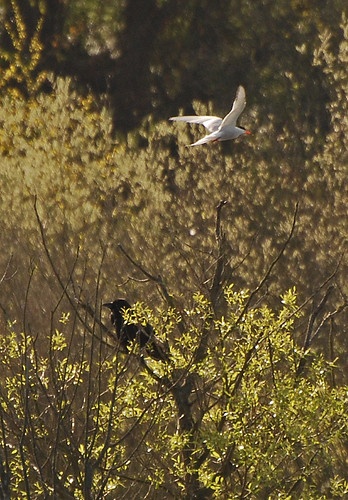
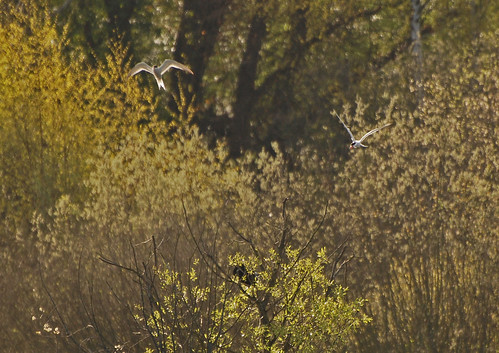
Close to where the swallow was hunting is a small island with a tree on it where cormorants (Phalacrocorax carbo, Dansk: skarv) can often be seen perched. This time there was a carrion crow (Corvus corone, Dansk: sortkrage) sat on top and a pair of common terns (Sterna hirundo, Dansk: fjordterne) were taking exception to its presence and were working as a team to dive bomb it:

A singleton…


… and in tandem

I almost felt a little sorry for the crow, but I’ve watched them terrorise so many birds, especially buzzards and other birds of prey, in a similar fashion that the sympathy was a tad less enthusiastic than it may otherwise have been.

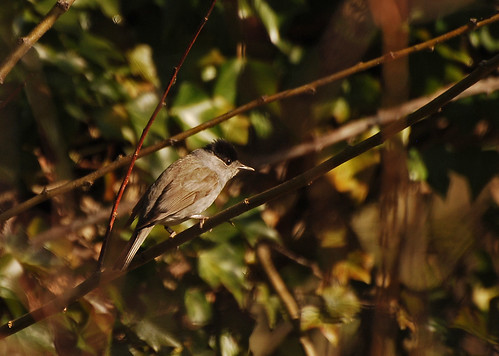
A migrant which was present all over the country park was the blackcap (Sylvia atricapilla, Dansk: munk), in one bush there were a minimum of four and possibly six or even more. They were squabbling away in the  bush presumably in the midst of a territorial dispute. I saw the first blackcap of 2012 a few weeks ago at Danbury Common in Essex during my unsuccessful mission to look for adders.


Blackcap male, the female is similar but easily distinguished because her cap is a rusty brown colour.

As well as the migrants the trees and bushes were full of the song of more familiar resident species such as the robin, blue tit, great tit, blackbird and wren. All were energetically vociferous, filling the air with a wonderful cacophany. And amongst these I caught a tantalising glimpse of a much less common species, the treecreeper (Certhia familiaris, Dansk:  træløber). Treecreepers are very aptly named and are fun to watch as they hunt insects in the crevices of tree trunks, spiralling upwards in a corkscrew pattern. A pair of sparrowhawk and a pair of buzzard were also busy performing their aerial courtship routines.

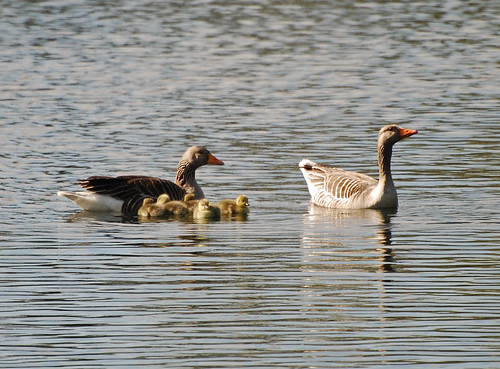
There were none of the winter ducks such as tufted duck (Aythya fuligula, Dansk: troldand), pochard (Aythya ferina, Dansk: taffeland), gadwall (Anas strepera, Dansk: knarand), teal (Anas crecca, Dansk: krikand) or widgeon (Anas penelope, Dansk: pibeand) on the water, they had all headed off north to their breeding grounds. But several birds including coot (Fulica atra, Dansk: blishøne) and greylag geese (Anser anser, Dansk: grågås) had chicks on the water:


Greylag geese with six chicks

I paused to try to get a shot of a great crested grebe (Podiceps cristatus, Dansk: toppet lappedykker), all now in full brown breeding plumage:

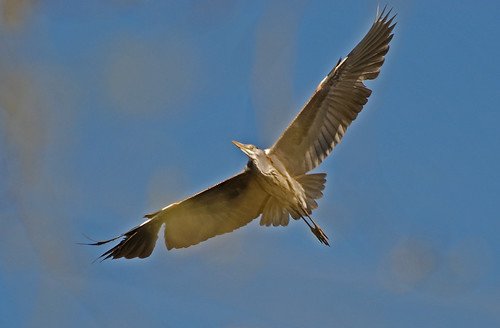
And as I stretched over the water, trying hard to get a clean shot of the grebe, and even harder not to pitch headlong into the lake, a grey heron (Ardea cinerea, Dansk: fiskehejre) flew low overhead:

It was so low I thought it must have pitched up very close to where I was but on an adjacent lake, and a quick scan revealed it sat in the top of a tree being pestered by the common tern that had earlier been harrassing the carrion crow:

The terns were deeply unhappy with any potential predator, although they were less keen to buzz a pair of sparrowhawks which were in the air above the same stretch of water!

Turn of the century

After 20 months of posting this is the 100th episode of The Naturephile. The original plan was to post once a week wherever possible and I’ve averaged around five a month, so that stayed roughly on track. I thought I may struggle to find enough subject material and to acquire sufficient photographs of the necessary quality to post as often as I wanted too, but that hasn’t been a problem, so far.

When I started off writing The Naturephile, the idea I may reach a hundred posts never entered my mind, so to mark the moment I’ve trawled back through the archive to find my favourite posts to give them another airing. I’d anticipated it would be a straightforward venture but of course I’d rather underestimated the amount of subjects/species and photographs I’ve written about. But the number of posts was eventually whittled  down to 14.

1) At the end of September 2010 one of natures more brutal rituals was played out right outside my back door involving garden spider courtship. Like other spiders this can easily end up in the death of the male as it did in this case. ‘Araneus diadematus‘ posted on 2nd October 2010:


I really love you… . Male on the left, Shelob on the right

2) A little farther afield are dragon flies, the most common species I encounter are common darters and migrant hawkers. This Common darter appeared in a post on 19th October 2010. I like the symmetry of the fly and the seedhead and the red colour of this male darter against the brown grass.

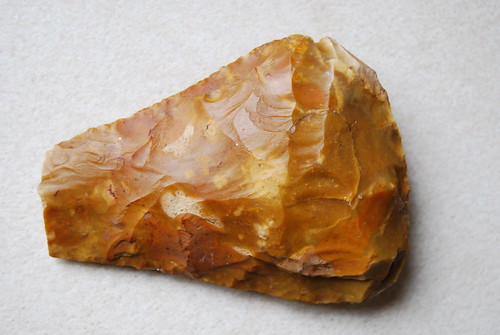
3) A few years ago when my sister lived in a house (she lives in a kennel now. Only joking, she lives on a narrow boat ;-)) they were digging the garden and this piece of rock turned up. It’s an Acheulian hand axe made from flint and the marks on it are where it was worked with a deer antler. It dates from around 400,000 years ago which means it could have been made by a pre Homo sapiens hominid! It fits beautifully into the palm of my hand and after that many years the edges are still sharp. Even if I was blogging about topiary or book binding I’d have to find a way to slot this in.

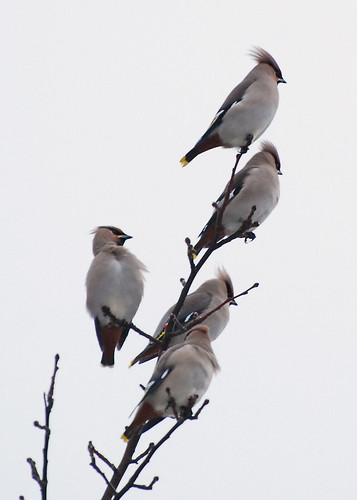
4) The winter of 2010/11 was known as a ‘waxwing winter‘. Every winter a  few waxwing (Bombycilla garrulus, Dansk: silkehale) migrate to our shores from Scandinavia to overwinter. But occasionally the weather up there is fearsome so the waxwing migrate in large numbers and we then have a ‘waxwing winter’. And I hope you’ll agree the waxwing is a beatiful  bird:

A group of waxwing perched at the top of a rowan tree in north Cambridge

5) Another consequence of the bitterly cold winter of 2010/11 was that most stretches  of open water were frozen over and our herons (Ardea cinerea, Dansk: fiskehejre) were starving because they couldn’t access their normal food supplies. During this winter  a hungry heron appeared in my friends garden and taking pity on its plight he fed it some fish. And of course one fish supper turned into rather more than one so the heron came to expect it, and if dinner was late it came and tapped on the window to complain to the management.

6) Sea mammals of any description are always a delight to see and photograph and one of my favourite places on the planet for doing that is the Farne Isles situated just off the Northumberland coast.


Atlantic grey seal in the North Sea off the Northumberland coast

Our holiday last year was to Northumberland and I can’t go there without taking in a boat trip to the Farnes where hundreds of Atlantic grey seal were basking on the rocks and generally taking life easy in the water.

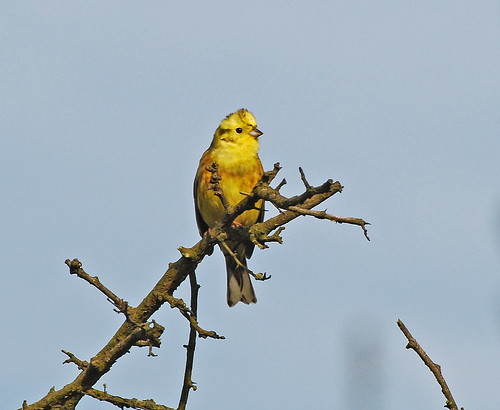
7) Closer to home, April last year was hot and sunny and a great time to see songbirds in the countryside. One of my favourite birds is the yellowhammer (Emberiza citrinella, Dansk: gulspurv) and they’re regulars in the hedgerows around Cambridge.


Yellowhammer male  – what a gorgeous colour!

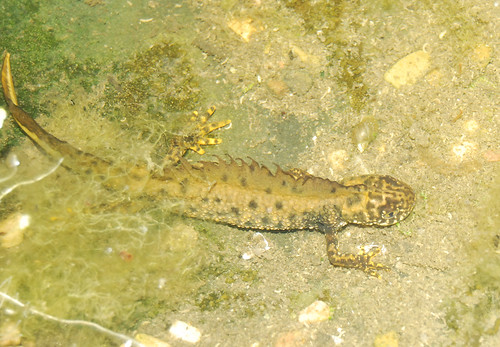
8) A creature I’d never encountered before last year was the great crested newt. My friend told me of a place where they could be found so we ensconced ourselves in the nearest pub in preparation for a nocturnal newt hunt after closing time.

It was a very successful trip, a few pints followed by finding  not only the great crested newt but the other two species of UK newt, palmate and smooth newts.

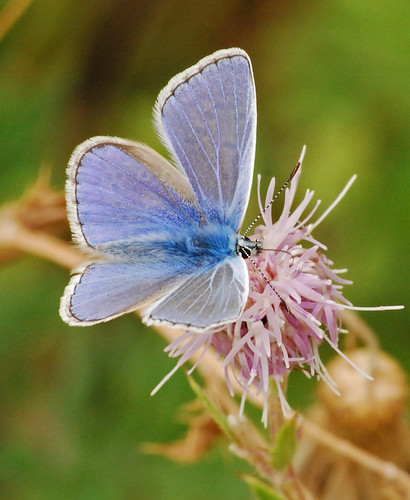
9) As the year rushes headlong into summer and the butterfly season really gets underway I can spend many an hour chasing our Lepidopterans round the fields trying to get that perfect picture. One of my favourites is the common blue and this is about the closest I got to that perfect picture:

Common blue male sipping nectar – one of the best photographs I’ve ever taken

10) As well as being a top location for marine mammals the Northumberland coast is also home to huge numbers of seabirds so it’s a very happy hunting ground for me!

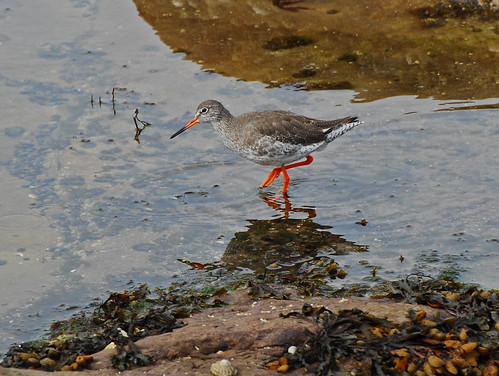
Just poking your head over the seawall at Seahouses can reveal lots of seabirds including oystercatcher (Haematopus ostralegus, Dansk: strandskade), knot (Calidris canutus, Dansk: islandsk ryle), eider (Somateria mollissima, Dansk: ederfugl), turnstone (Arenaria interpres, Dansk: stenvender) and this  redshank (Tringa totanus, Dansk: rødben).

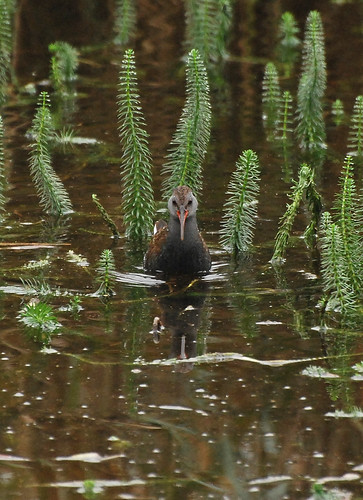
11) RSPB Fowlmere, to the west of Cambridge is famous for its water rail. On a trip there in December 2011 I was tipped off by a local that a particular hide was good for water rail (Rallus aquaticus, Dansk: vandrikse) and one had been seen there that morning, so off I went to try and see it.


My informant was correct. There was just the one bird there, but it scoured the mudflats in front of us for a whole hour before disappearing into the reeds, giving me plenty of good photo opportunities. I was very pleased with the primeval feel of this image with the bird face on infront of the horsetails.

12) In January this year the weather was absolutely freezing causing a small group of red-legged partridge at Tubney Fen, east of Cambridge, to seek the warmth generated by a mountain of dung:


13) My favourite bird of prey is the kestrel (Falco tinnunculus, Dansk: tårnfalk) and they are always to be seen hovering in the skies over the fields around Histon. I love watching the highly specialised hunting techniques all birds of prey in action, but the kestrel beats them all in my opinion:


A male kestrel showing off all his hunting hardware: talons, flight feathers, eyes and aquiline beak

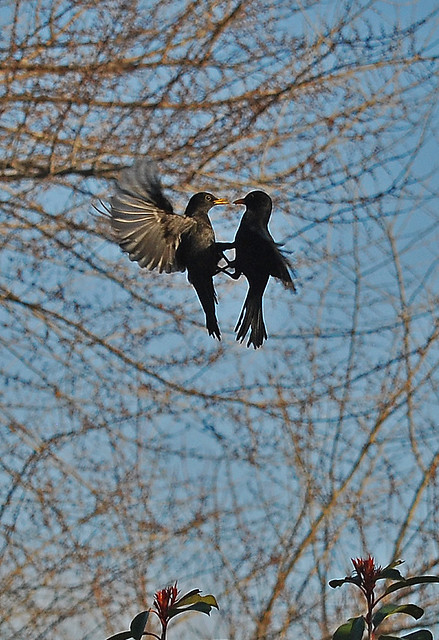
14) And lastly, I couldn’t write a post like this without including my battling blackbirds. Of all the bird species that visit my garden these are the ones that provide the most entertainment:

My garden gladiators locked in aerial combat

These were a few of my favourite posts, favourite for various reasons: the stories attached, the rarity of the sighting or simply the exquisite natural beauty of the subjects. I hope you like them!

And lastly, I’ve been stunned by the numbers of people from all round the world who read The Naturephile and like it enough to follow it or click the ‘Like’ button. Thanks to everyone for stopping by and enjoying a read, I love sharing the nature from my corner of Cambridgeshire with you!

Birds and bee(flie)s

The day after the cold weather put paid to my snake hunting exploits I decided to take the dog for a quick run in the afternoon. He had just had a small tumour removed from his back leg and so he had a lampshade on his head to stop him chewing his stitches and consequently this walk was only meant to be a short one, and I wasn’t even going to take my camera. But on the way out the door I decided because it was very sunny and very warm I would take my camera. And I’m glad I did because there was wildlife in abundance.
Peacock butterfly, Inachis io, sunning itself on the path

The air was abuzz with insects including butterflies. I really like photographing butterflies and peacocks are good because they present a medium sized challenge. If you approach with stealth and don’t cast a shadow on them they let you get to within a few feet. The peacock is a species that can be seen at any time through the winter as it can wake in response to warmer weather, but they emerge in spring around the end of March/beginning of April, so the timing for this one was spot on.  As I was photographing the peacock a sparrowhawk (Accipiter nisus, Dansk: spurvehøg) flew past at high speed, much too fast to enable a usable photograph, it’s always good to see a bird of prey because I think it suggests the prey species are in good order too.


Long tailed tit, Aegithalos caudatus, Dansk: halemejse

The field where I found the peacock butterfly has a corner which faces south west and it was sheltered from the wind and bathed in spring sunshine. It was really warm when I arrived there, so I stood still and watched and listened while the dog went off to explore, and the trees around were full of birds including the long tailed tit, above, and a song thrush, below.

Songthrush, Turdus philomelos, Dansk: sangdrossel

While the birds were capturing my attention in the trees, butterflies weren’t the only insects there. In my corner there were also beeflies buzzing around. I was keen to try to photograph them in flight which is a tad more challenging as they would hover for a few seconds before darting off at very high speed in zig zag lines. But they were making the most of the shelter from any breeze that prevailed in this sheltered spot and I spent a good hour trying to photograph them.


Beefly, Bombylius major

The beefly, as the name suggests is a bee mimic. It has a very prominent proboscis which is used to extract nectar, and the fur is part of the bee disguise. It is a very good pollinator but is detrimental to other pollinators.

It is detrimental because it parasitises other bees and beetles. And the way it achieves that is another of those bizarre evolutionary adaptations that even the most imaginative science fiction writer wouldn’t dream of. It mimics bees in order to get close to their burrows where using its legs the female will flick her eggs into the hole where it hatches and attaches itself to the host. Then the gruesome bit: it lies dormant until the host commences pupation and then becomes an ‘ectoparasite‘ which means it remains on the outside of its host but extracts the body fluids to fuel its own growth. After draining its host dry it reaches the pupal stage which can vary hugely in length and they have been known to overwinter before emerging as an adult the following year.

Beeflies have appeared in several blogs in the last week or so and there are some more very fine images here:

http://www.leavesnbloom.com/2012/04/bombylius-major-bee-fly-aerodynamics.html

Rosie from ‘leavesnbloom’ has a wonderful collection of images of Bombylius major and Harlan from ‘The Roused Bear’ has also captured one in Iowa in the U.S.:

http://therousedbear.wordpress.com/2012/04/07/a-fuzzy-bee-fly/

They can be found across the whole planet except Australasia.

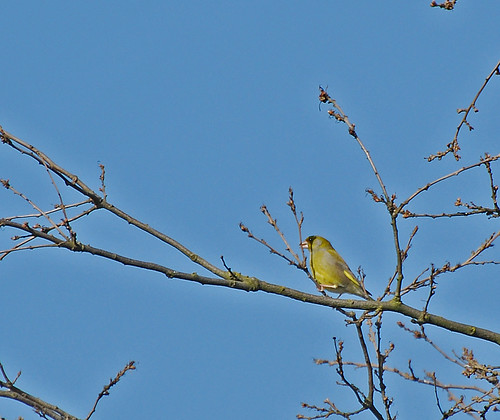
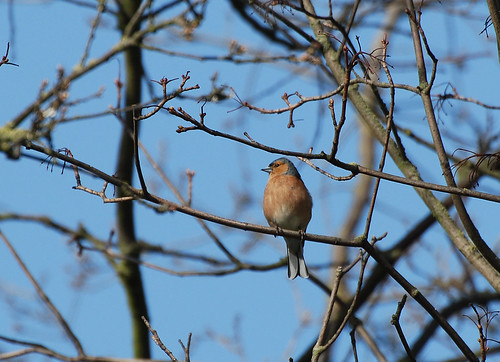
More birds which appeared in the trees around while I was chasing beefly were the common or garden greenfinch and chaffinch:


Greenfinch male pecking at a twig
Chaffinch male just taking it easy

Both greenfinch (Carduelis chloris, Dansk: grønirisk) and chaffinch (Fringilla coelebs, Dansk: bogfinke) are common or garden, but are both beautiful birds, and they can be seen here in the U.K. all year round. But a species that isn’t here all year round and returns after its winter migration to north Africa is the chiffchaff (Phylloscopus collybita, Dansk: gransanger):

The chiffchaff, named after its characteristic song, is a warbler and despite being a small bird they are tough. Their migration takes them south across mainland Europe, across the Mediterranean Sea and into north Africa, to retrace their flight four or five months later in the spring. And despite the hardships associated with such a gruelling endeavour, according to the British Trust for Ornithology (BTO), there are around three quarters of a million territories in the UK. They are one of the first migrants to arrive back in the U.K. and can be heard singing as early as late February. But this my first one in Cambridge on the first weekend in April.