Category Archives: Ornithology

Wee brown birdies

In the brief intervals between howling gales and torrential rain in these parts we’ve had the occasional glimpse of sunshine, and in those moments I’ve managed to grab a few pictures of some small birds; those little ones that look small and brown at a distance and can defy attempts at identification.

I’ve been a little concerned at the small numbers of certain migrants which have returned to my local patch, in particular blackcap, yellow wagtail and whitethroat.
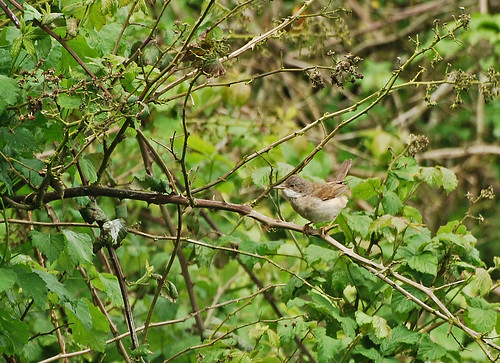

Common whitethroat – Sylvia communis, one of the few to return to the Meadow in 2012

Last year at this time I would expect to see 5-10 whitethroat during a circumnavigation of the Meadow but this year I hadn’t seen any until I spotted this one and his mate, last week, bringing food to the nest. I also found another pair which I think are nesting in a tree on the other side of the track to this pair, but I’m yet to confirm that. And I still haven’t seen a single blackcap or yellow wagtail in 2012. Hopefully they made a successful migration back here and are just elsewhere, but I do miss ’em, they liven up my walks with the dog.
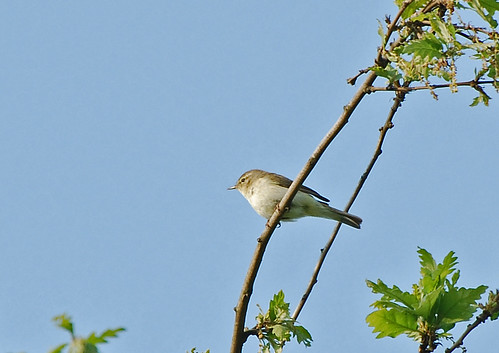

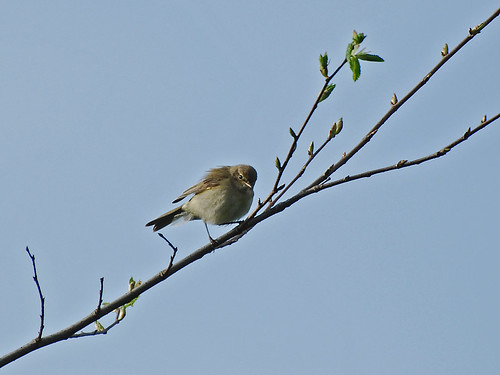
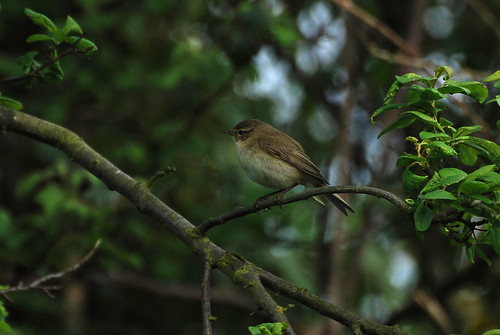
Chiffchaff – Phylloscopus collybita

A wandering warbler which has returned in numbers is the chiffchaff, and I hear them singing almost everywhere I go. This one was in a field here in Histon, and let me get close enough to take this picture, which is my favourite chiffchaff shot.

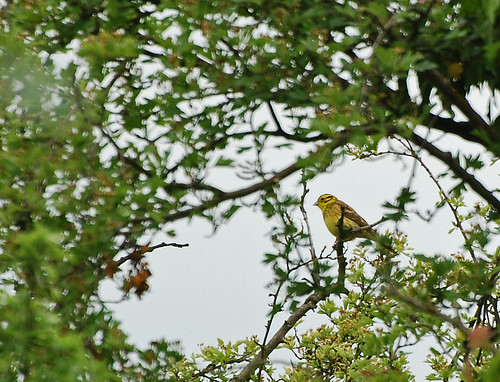
The rest of the birds in this posts are not migrants in the UK and I see them all year round. The yellowhammer is a bunting that has a very distinctive song, described in numerous field guides as ‘a-little-bit-of-bread-with-no-cheese‘. Which is a very good example of the pitfalls of trying to over-interpret birdsong! I was with my daughter when we saw (and heard) this one calling, and after telling her about the ‘little-bit-of-bread…’ thing we spent the rest of the walk thinking up alternatives. My favourite was ‘I’m-going-down-the-pub-for-a-beer‘.
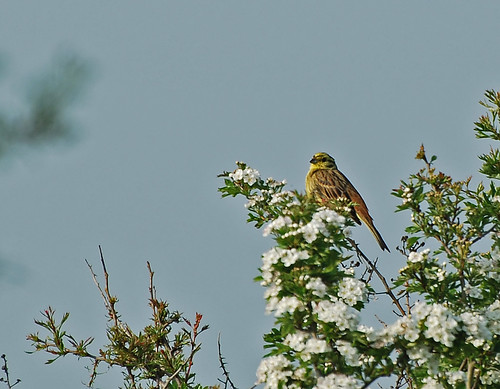
Yellowhammers – Emberiza citrinella

I was particularly pleased with the second yellowhammer picture because I like the out-of-focus foliage surrounding the focussed bird. I recently upgraded my DSLR to one with more sophisticated focussing capabilities than my ageing Nikon D40x, which all my pictures up to now have been taken with. And one of the main reasons was so I could focus more quickly on small birds in bushes, such as this one, where the foliage was moving around in the breeze causing the camera to struggle to find focus. This picture was taken with my D40x and I was surprised by how well it turned out, so maybe I’d have delayed upgrading if I’d captured this image first!
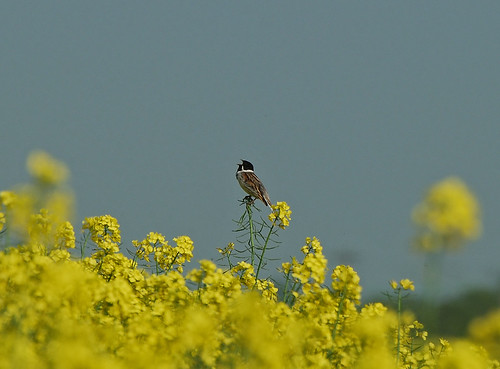

Reed bunting – Emberiza schoeniclus

Reed buntings are present in the local fields and hedgerows all year round and this little chap, for he is indeed a male, was singing long and loud perched on the top of the rape flowers. A circuit around this field is an ornothological treat, on one lap I’d expect to see several reed buntings, at least one or two corn bunting, lots of skylark and occasionally linnet and goldfinch. And on Saturday (9th June) there were two bullfinch, an adult male, resplendent in his black cap and peach breast, and a male youngster, the same colours but a tad smaller and with more muted colours, perched in a tree together on the edge of the field.


Dunnock – Prunella modularis
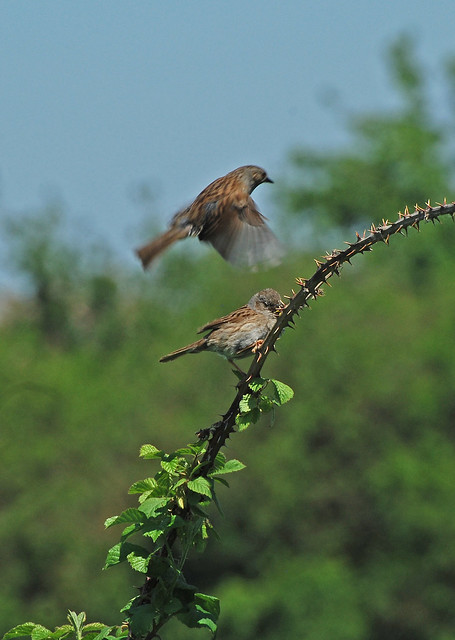
And my favourite little brown bird is the dunnock, which are also here all year round, and in the winter are regular visitors to my garden. These two were transporting food to the youngsters in the nest in the midst of a bramble thicket. Fortunately, despite the low numbers of migrants in my locality there are still enough birds around to liven up a walk in the countryside.
Serendipity II – The charismatic cuckoo

I don’t recall having seen a cuckoo before, even though I’ve heard their unique call many times. But on my sojourn over to Wicken Fen a couple of weeks ago there were lots of them. ‘Lots‘ is a relative term because cuckoos are becoming increasingly scarce, their conservation status is red due to recent declines in the breeding population and in 2000 there were 9.6-19000 breeding pairs in the UK. But on this trip we heard and saw at least 5 and possibly several  more.

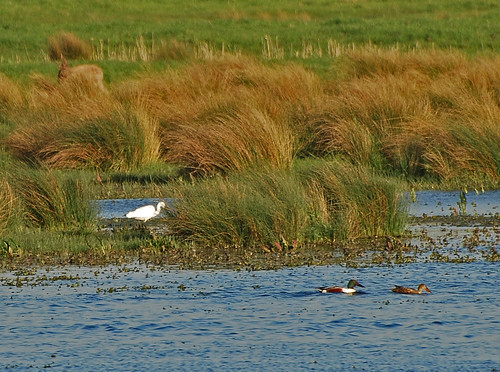
Just before I spotted the first cuckoo I glanced across the lake and this was the view:


A pair of shoveler in the foreground, a little egret behind and a roe deer just beyond the reeds

I really like this picture because of the colours of the reeds and the water in the evening sunshine, but also because it contains three interesting species. Apart from rabbits, any wild mammal is exciting to see in this country, so the roe deer was a pleasing encounter. The little egret (Egretta garzetta, Dansk: silkehejre) is a member of the heron family which is now resident in the UK, presumably as a result of climate change. I associate them with warmer places because that’s where I saw them before 2000, but nowadays they’re not particularly uncommon here. And in the forefround are two shoveler (Anas clypeata, Dansk: skeand) which are migrant visitors to the UK, but this pair obviously liked it enough to linger and are still here in the middle of May, long after they would normally have left.

And then there were the cuckoos:


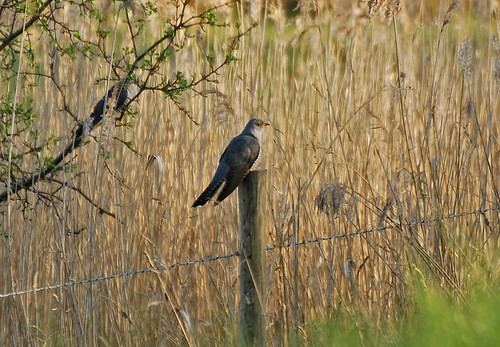
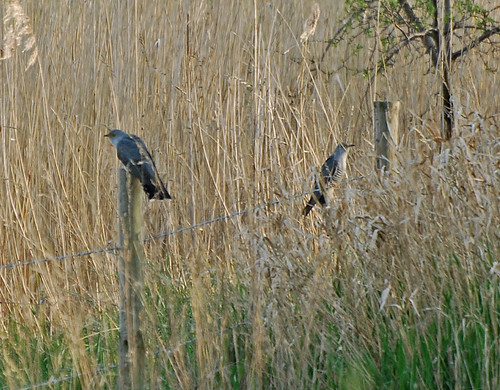
A pair of cuckoo, Cuculus canorus, Dansk: gøg

The cuckoo is an incredible bird and until very recently it was poorly understood. Last year the British Trust for Ornithology (BTO) managed to tag five male cuckoos with tiny satellite tracking devices and found out that they headed to the tropical sub-Saharan rainforests of Cameroon and the Democratic Republic of Congo. The cuckoo arrives back in England from Africa in late March or April and departs in July or August. It leaves earlier than other species because its parasitic breeding strategy removes the need for chick rearing. That means the cuckoo spends a minimum of 8 months a year in Africa so to call it a British bird is, I suppose, less than accurate, even though it breeds here.


The classic hanging wings pose which I always associate with the cuckoo

The tagged birds were all fitted with solar powered devices which transmit location data once every 48hr. The tracking data revealed that all five birds headed south over France and across the Mediterranean before heading down across Africa to Cameroon and DRC. All five made it. One of the birds died in Cameroon and two more died on the way back, but two of the five made it back to East Anglia this year. I believe the BTO plan to tag more birds including females and I’m very keen to see the results of that experiment.

The cuckoo is an iconic bird in the UK and it’s call is very distinctive. The call is generally recognised as a signal that Spring has arrived and there are local traditions around the UK based on the cuckoo. It is said in Worcestershire that the cuckoo is never heard before Tenbury Fair on April 21st or after Pershore Fair on June 26th. The song actually changes in June from the characteristic ‘cuck-coo‘ song to a shortened ‘cuck‘, and there is a rhyme about this:

In April I open my bill
In May I sing night and day
In June I change my tune
In July far far I fly
In August away I must

My Dad remembers a similar rhyme he used to sing when he was a kid in the 1940’s which was essentially the same but with some local Northamptonshire words substituted in.

I’m not quite sure what these two were doing but they were acting as a pair, and every minute or two one of them would dive off into the adjacent reedbeds to return a minute or so later. As I mentioned above, cuckoos are parasites and they could have been looking for nests to parasitise. There breeding strategy is unique, at least as far as I know. They lay their eggs in the nests of one of three other small songbird species: the reed warbler, the meadow pippit and the dunnock. All of these are the size of a sparrow (ish) so are much smaller than the cuckoo which is dove-sized, which I guess guarantees that the cuckoo chick will be much bigger than its ‘siblings’ and it won’t be threatened. The cuckoo chick then ejects the other chicks from the nest to die and the parents assume it is one of their own and feed it until it fledges. I’ve seen film of a cuckoo chick turfing out the other chicks and it’s a remarkable process, and not particularly pleasant to watch!

Despite their unsavoury procreation habits they are spectacular and charismatic birds and I hope the BTO research can find ways to guarantee their continued return here to brighten up the Spring and Summer.

Serendipity I – The Short Eared Owl

Serendipity struck on Sunday a couple of weeks ago. I’d fixed up to go for a stroll with an old friend who I hadn’t seen for a few years to Wicken Fen. That was on the 20th May, but he got his Sundays confused and we ended up going on the 13th.

It was serendipitous because the weather had been grim leading up to that weekend but on the evening of the 13th it was perfect: sunny, warm, calm and we couldn’t have wished for better conditions. And on top of that there was wildlife in abundance. As we got out the car the air was full of swifts screeching overhead – lots and lots of them – along with swallows and house martins. Various species of geese and ducks and great crested grebes (Podiceps cristatus, Dansk: toppet lappedykker) were on the lakes, and we were serenaded by cettis warbler (Cettia cetti, Dansk: cettisanger), grasshopper warbler (Locustella naevia, Dansk: græshoppesanger) and other songbirds in the undergrowth, and a snipe drummed in the reed bed. Snipe (Gallinago gallinago, Dansk: dobbeltbekkasin) make this sound by spreading their tail feathers and the wind generates the piping sound by making them vibrate.

Wicken fen is a really good place to see birds of prey too: marsh harrier (Circus aeruginosus, Dansk: rørhøg), hobby (Falco subbuteo, Dansk: lærkefalk), kestrel (Falco tinunculus, Dansk: tårnfalk), sparrowhawk (Accipiter nisus, Dansk: spurvehøg) and assorted owls can all be seen there. We had been commenting how the birds of prey were conspicuous by their absence and a few minutes later we spotted a hobby perched on a fence post. As we wallowed in our good fortune I spotted an owl behind a tree which emerged right in front of us and it turned out to be a short eared owl:


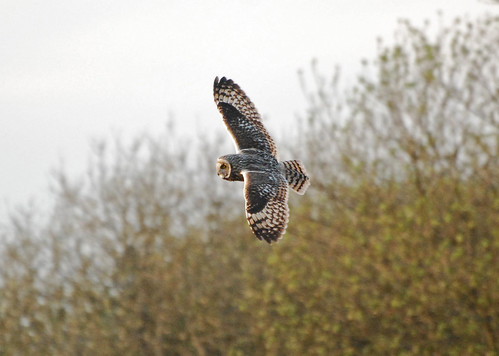
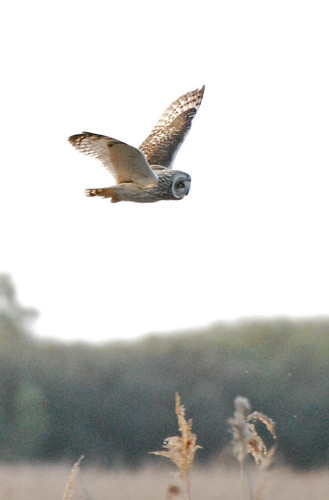
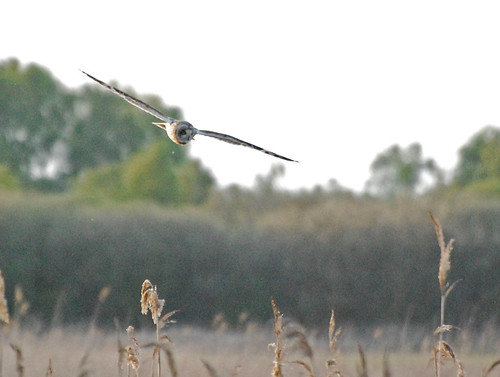
Short eared owl, Asio flammeus (Dansk: mosehornugle)

I thought our short eared owls were winter visitors, migrating to the relative warmth of the UK from the frozen icefields of Scandinavia and returning in the Spring. But it transpires they are also resident breeders in the east and north of England and the east of Scotland so can be seen here all year round.

This one treated us to several minutes worth of hunting, flying to and fro and diving down into the reeds in search of rodents.

I last saw short eared owls at Burwell Fen, east of Cambridge, several months ago when there was a large number of Scandinavian visitors in residence. While we were there we chatted to a BBC camerman who was there to film them for a TV nature series. I think he would have got some good footage on that day but I’m sure he would have been pleased to get this close to one!

Like all owls, it’s a hunter which is supremely evolved for its particular function.

And then on the journey home, continuing the owl theme, there was a barn owl taking the lazy approach to rodent hunting:

Barn owl numbers have been on the decline for a long time and the exceptionally cold winters of 2009 and 2010 badly affected them. We didn’t see one at Wicken which surprised me because I usually see at least one when I’m there at that time of the evening, so it was good to find this one perched on an advertising hoarding alongside the road home.

I’m a firm believer in serendipity playing her part in human endeavour and she adequately rewarded us on this excursion!

My tame wood pigeon

Several posts ago I mentioned the wood pigeons that were frequenting my garden. For the last 2-3 weeks there has just been one, but he has been very regular, dropping in and mooching around the back lawn and vacuuming up the spilled from the feeders, even though he’s fairly adept at balancing on there and helping himself. I’m calling him a he because I’m imaging it is the same one and that if he were a female he’d be busy incubating eggs and rearing chicks.


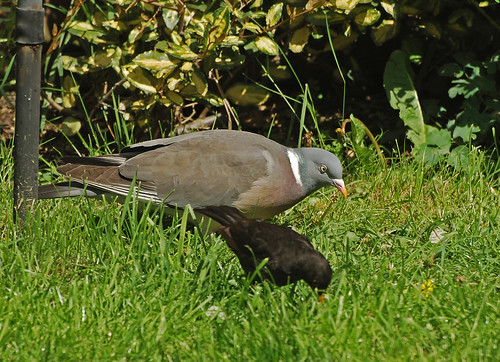
Tidying up the garden with one of the local blackbirds

This particular pigeon seemed very relaxed in the garden, he would fly in and spend alot of time just wandering around and feeding on seeds and a couple of weeks ago I happened to glance out the window and he was still on the ground. I watched him for a couple of minutes and he didn’t move so I went off to get my camera but by the time I got back he had disappeared.


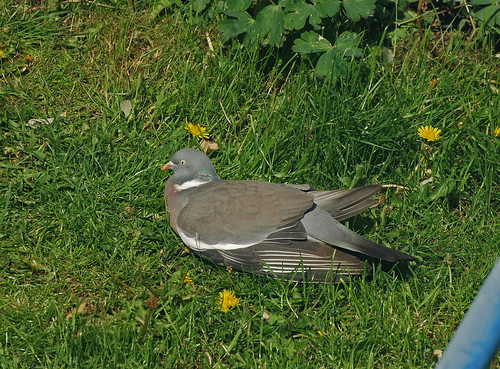
Enjoying the sunshine

Then several hours later he was back and doing the same thing again. He was hunkered down on the ground with his wings extended. I’ve never seen wood pigeons do this before but I can only assume that he felt sufficiently secure to relax and enjoy the sunshine! He was there for several minutes before he was disturbed by another bird and then he wandered around for a few more minutes before flying away.


Columba palumbus (Dansk: ringdue)

And in my humble opinion he is a very handsome bird. This evening as I write this there are three wood pigeons sitting on my garden fence, so maybe he’s told the wife and kids about it too. I’ll have to put out more seed and nuts than usual tomorrow.

The chiffchaff and the willow warbler

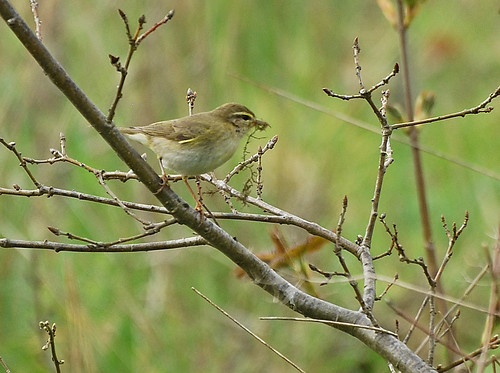
The chiffchaff and the willow warbler both members of the warbler or ‘Sylviidae‘ family. There are 63 members of the Sylviidae of which 14 species breed in the UK. They’re very similar to look at and can be pretty tricky to tell apart. Last week in my local meadow I came across both species in photographable locations so I  thought I’d try to show the differences. Both species are summer migrants to the UK having overwintered in Africa, the chiffchaff goes to the Mediterranean and some head south of the Sahara, and the willow warblers all  go down to tropical sub-Saharan Africa.

This publication from Birdlife International tells us that the global population of willow warblers is estimated to be between 300 million and 1.2 billion individuals, and a fact that blew my socks off was that the northern Siberian population overwinters in southern Africa, which is a journey of over 7000 miles or 11000 km… and back! And they’re only 19cm long and weigh 10g, so they may be tiny, but they’re incredibly tough. The chiffchaff is also a scarce winter visitor to the UK.

Willow warbler (Phylloscopus trochilus, Dansk: løvsanger) collecting nesting materialWillow warbler showing off her pink legs, bright supercilium and pale ear coverts

The willow warbler has longer primaries and the light stripe over the eye, the ‘supercilium‘ is brighter and more pronounced than that of the chiffchaff, and the ear coverts of the willow warbler (the patch under the eye) are a pale olive colour. The other visual diagnostic feature which is probably easiest to see at a glance is the leg colour, the willow warbler has pinkish brown legs whilst those of the chiffchaff are much darker, almost black.

Chiffchaff showing off its more subdued facial markings and overall colour scheme and the dark coloured legs

In the absence of a clear sighting the easiest way to differentiate between these two species is by their song: click here to hear the chiffchaff song, and here for the willow warbler song.

The conservation status of the chiffchaff is green and in 2000 there were around three quarters of a million territories in the UK, but the willow warbler is amber due to a decline in the breeding population, but despite that there were still two milion territories in 2000.

Returning songbirds

There’s a particular spot in my local meadow where there are some large clumps of brambles which are home to numerous species of bird including songthrush, blackbird, linnet and house sparrow. And in the summer chiffchaff, willow warbler, blackcap and common whitethroat are all there too. Chiffchaff have been here for a couple of months now, and willow warbler almost as long but I hadn’t yet seen a whitethroat, so I set off last Monday in the hope of seeing the first one of the year.

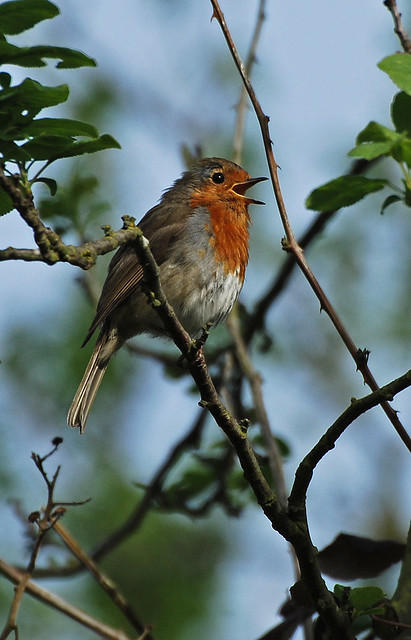
A cock robin singing to the ladies

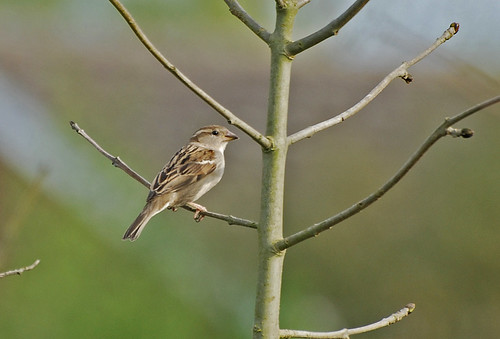
There were many species of songbird in the meadow including the robin (Erithacus rubecula: Dansk: rødhals) and the house sparrow (Passer domesticus, Dansk: gråspurv) and the air was alive with the song of all these species.


House sparrow female

Robin and house sparrow are resident species in the meadow and I see them all year round there, but not the chiffchaff:

The chiffchaff (Phylloscopus collybita Dansk: gransanger), which is a warbler, and willow warbler (Phylloscopus trochilus, Dansk: løvsanger) can be very difficult to tell apart if only seen at a glance, but they can be distinguished by their song, of which more in the next post. This chiffchaff was one of a pair which were calling to each other and flitting around the bushes passing within a few feet of me on several occasions and seemingly unfazed by my presence.

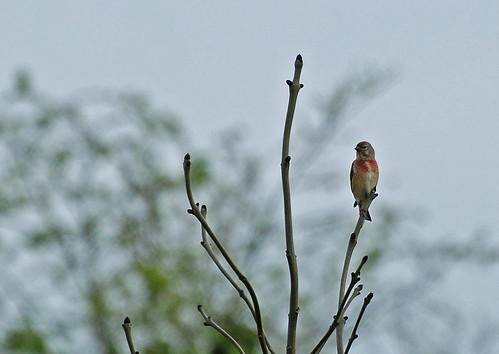
Cock linnet

Resident in the UK is the linnet (Carduelis cannabina, Dansk: tornirisk), they disappear from the fields around Histon in the Autumn, presumably to congregate at a winter feeding ground, and they reappear in the Spring. And they have recently turned up in the meadow. Also resident, and present all year round, is the dunnock…


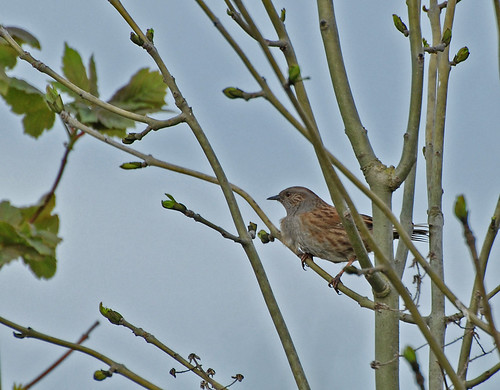
Dunnock, Prunella modularis, Dansk: jernspurv

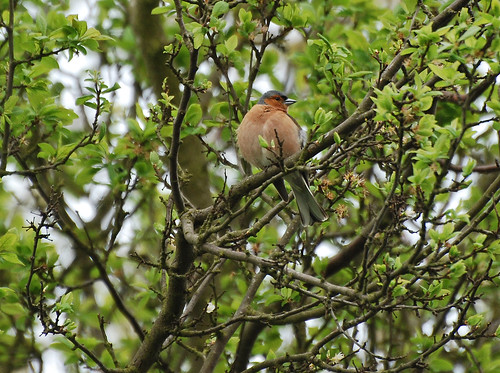
… and the chaffinch:

Cock chaffinch, Fringilla coelebs, Dansk: bogfinke

There were no whitethroat back in the meadow last Monday but as you can see there were plenty of other birds. In the last week I’ve also seen kestrel, sparrowhawk and buzzard, blackcap, green woodpecker, jay and magpie.

I recce’d the meadow again this weekend and the whitethroat are now back from wintering in Africa. They are very distinctive and both sexes are easily identified by their strikingly white throat, and the males display by singing from the top of a bramble thicket or a sapling and flit 4-5m vertically into the air and then descend to land in the same spot. They’re lovely little birds, with a very distinctive song, and I’ll hopefully have some pictures to show you in the near future.

Wild Geese

At the same time I was experimenting with ISO and coots at Milton Country Park there were geese in the vicinity too. A small flock of greylag geese (Anser anser, Dansk: grågås) were grazing in a field  immediately adjacent to the park.

There is another flock of greylags I encounter every day on my way to and from work. There are around 20-30 that have taken up residence in a field that is on my cycle route. The field is adjacent to a lake and the cycle path passes between them and every morning I pass by there are numerous heads poking up above the crop. I’m surprised the farmer puts up with this because the field now has a number of large threadbare patches as a result of the goose activity. But the geese have been there for a couple of months now and so far he hasn’t shot them so I imagine he probably doesn’t plan to. Which I’m rather pleased about.


Five of a small group of greylags ensconced in a field immediately adjacent to Milton Country Park

The RSPB website tells us that the greylag is the ancestor of domestic geese and is one of the largest and bulkiest geese native to the UK. It also describes it as ‘uninspiring‘. However, a few weeks ago on my way to work the flock of greylags were spooked and flushed up into the air. They headed for the safety of the lake which was only around 75m away so they didn’t need to gain height and one of them veered around and was heading straight for me at headheight. We simultaneously computed that if we continued on our current trajectories the end result would be an ugly collision twixt self and goose! So I braked and the goose wheeled, and it duly arrived at the lake unscathed, passing a few metres in front of me. My adrenaline levels were significantly elevated for the remainder of my journey to work and I can attest to the fact that this particular greylag was indeed very large and very bulky. And anything but uninspiring.

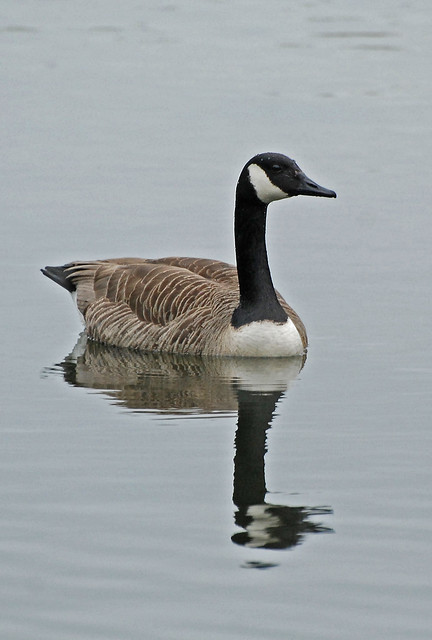
A lone canada goose – I like the symmetry of the reflection

The canada goose (Branta canadensis, Dansk: canadagås) was introduced to the UK and is now a resident breeder here and can be seen all over the UK apart from northern Scotland, and like the greylag it feeds on vegetation. I think it’s a handsome bird.

The indomitable coot

The coot (Fulica atra, Dansk: blishøne) is a common water bird found on lakes and rivers in all of the UK apart from north west Scotland. They are related to the rails and crakes, they are extremely aggressive and will see off bigger birds who are sufficiently unwise to encroach on their territory.

Whilst wandering around the lakes at Milton Country Park on Saturday it was early in the morning and the light was really murky, so I experimented with the ISO settings to try and extract some half decent images from the gloom, and in these two images the ISO was 1600 or higher. The high ISO has given the pictures a slightly grainy feel, but that’s to be expected, and I like the colours:

The coot was diving repeatedly and resurfacing with beaks full of weed

I like the colours and the reflection of the beak

Apparently the baldness as in ‘bald as a coot’ comes from the white saddle above the beak, which I think is a tad strange because the chicks really are bald.

Coots are omnivores and their innate aggression extends to their chicks which when food is short they discourage from begging by biting them, sometimes so hard it kills them. It’s a tough existence being a coot chick, they are also regular prey items for other creatures such as herons. On a busy lake with other species of birds the coots are good fun to watch as they chase off allcomers.

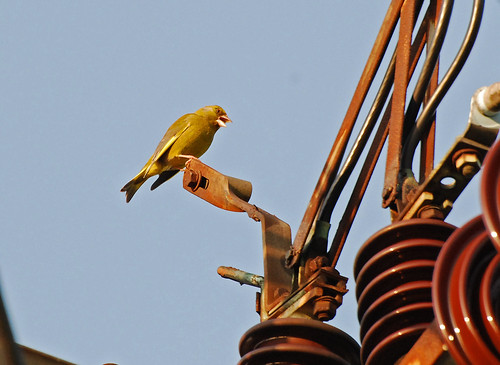
Carduelis (or Chloris) chloris

A sound I hear frequently at the moment when I open a door or a window which stands out from all other birdcalls is the call of the male greenfinch. It’s quite variable in tone from fairly high pitched, as in the recording here, to lower pitched where it almost sounds like a whirring mechanical toy.

The bird in these pictures has a reddish hue to it because it was being lit by the evening sun as it was getting lower in the sky, and also from the reflected light of the rusty ironwork and insulators of the electricity supply cables:


Greenfinch male calling from the top of a telegraph pole

The female greenfinch is similar to the male but her colours are much more drab, she is darker grey/brown without the vibrant green of the male.

The greenfinch is a resident breeder in the UK and can be found in gardens and parks at all times of the year feeding on bigger seeds and sometimes insects when rearing youngsters. It has a chunky beak which is typical of finches and is custom built for cracking open seeds.

The taxonomic name for the greenfinch is listed in some references as ‘Carduelis chloris‘, as in my RSPB ‘Complete Birds of Britain and Europe’ by Rob Hume published in 2002, (RSPB – Royal Society for the protection of Birds) ISBN 0751373540, and also in the RSPB Bird Identifier website. But in the BTO BirdFacts website (BTO – British Trust for Ornithology) and in my Collins Bird Guide 2nd edition from 2010, ISBN 978 0 00 726726 2, it is listed as ‘Chloris chloris‘ (Dansk: grønirisk). Somewhat confusingly the BTO entry goes on to explain that the name derives from ‘carduelis‘ meaning ‘goldfinch’ and the Greek ‘khloros‘ meaning ‘green’. So it appears that the two names may be interchangeable. Incidentally, the chemical element chlorine also derives its name from khloros as it exists as a green gas.

He’s turned round to keep on eye on me – his seed-cracking beak clearly visible

The poor old greenfinch has taken a bit of a battering in the last few years since 2005 from the trichomonad parasite which causes a disease called trichomonosis. This microscopic parasite lives in the upper digestive tracts of several birds species including other finches, house sparrows (Passer domesticus, Dansk:  gråspurv) and pigeons and doves. I’ve heard that feeders may become contaminated by pigeons from where it infects the smaller birds. It’s particularly unpleasant (as are most parasitic infestations!) because it causes the throat to swell to the point where the birds can’t swallow so they eventually die of starvation.

Fortunately I’ve never seen any evidence of infected birds but if you think you may have a problem you can click here for the RSPB advice sheet which has details on how to identify the problem and how best to deal with it.

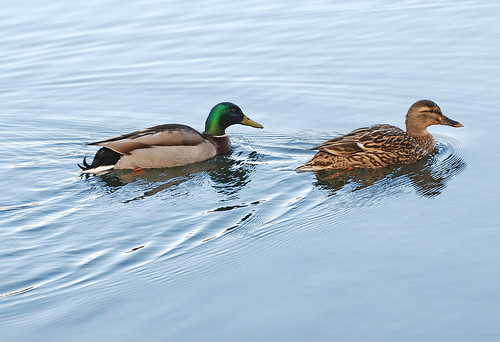
Misplaced mallard

This pair of mallard weren’t misplaced at all, they were on a lake at Milton Country Park doing exactly what you’d expect mallard to do,

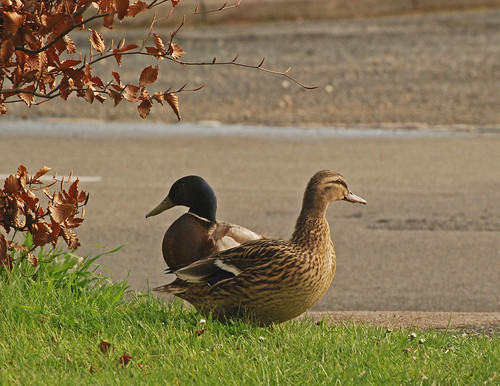
But this pair were very misplaced:

Romeo and Juliet

They appeared in my garden, relaxing under the crab apple tree, a couple of days ago, they disappear early in the morning and return in the afternoon. They’ve repeated this for the last three days now and they were here at dusk today sitting on the grass under the tree.

They seem completely unfazed by most interruptions including cats, humans and me flying past on my bike when I didn’t realise they were in situ. There is no water within half a mile so I don’t know why they are here, but it’s the first time we’ve had ducks in the garden and the children are very excited by their presence, so they’re welcome to stay as long as they want.