Category Archives: Ornithology

The Motorway falcon

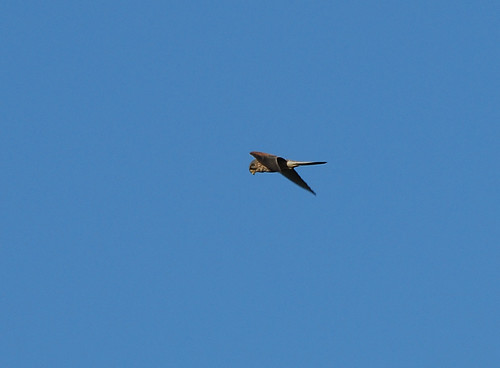
The kestrel (Falco tinnunculus, Dansk: tårnfalk) is so called because it is commonly seen hovering or perched on a branch next to the road side. This phenomenon led to the perception that the kestrel was widespread but unfortunately that’s not entirely accurate. In recent decades the eradication of all species other than the desired crop from agricultural land has left these highly specialised predators with limited options for hunting their regular prey of small rodents. But motorway verges present large areas of relatively untouched grassland with a healthy supply of mice and voles so they’ve become regular hunting grounds for the kestrel.

The individual in the photographs below was perched beautifully and I’d just got it framed when an unseen dog flushed it from it’s perch:


A male kestrel taking to the air

A hunting kestrel is immediately recognisable by it’s hovering flight which provides a stable platform for the onboard weapons system of phenomenal eyesight to spot the prey and talons to despatch it and carry it away. Technically kestrels don’t hover in the way that helicopters do, they fly directly into the wind at the same speed as the wind so they don’t move forward. It’s well worth taking a close look at a ‘hovering’ kestrel through binoculars or a telescope where all the fine and rapid adjustments of the control surfaces necessary to maintain a stable position in space can be seen.

The kestrel has another trick up its sleeve which enables it to hunt small, well camouflaged, rodents scurrrying through dense undergrowth. Rodents such as voles urinate constantly and they use this to delineate their territory and to communicate information to other voles. Rodent urine contains compounds which reflect UV light and kestrels are able to see near UV and thereby track the rodents down to the end of the urine trail.

Incidentally, the reason humans can’t see UV is because it is filtered out by the lens and some people who have had their cataracts dealt with by the insertion of artificial lenses, can see UV. I found this video clip at http://birdchaser.blogspot.com. which contains some interesting information about various creatures’ use of UV light 

I think the one below may be the same individual. It was perched in exactly the same spot a week later and I’ve seen a male there several times during that week. This time it was me that flushed it, but it didn’t zoom away in typical falcon fashion, it alighted on the ground between it’s tree and me and didn’t appear particularly bothered by me or the dog.

I see kestrels either just perched in a tree or hunting most days but I never get tired of photographing them, or just watching them doing what they do.

2011 – That was the year that was

Every month of the year has different conditions which create environmental niches that favour different flora, fauna and stages of life cycles. So as 2011 rushes headlong to its wintry conclusion, for my last post of the year I was going to select a single photograph to represent the month to month changes in our wildlife throughout the year. And that was of course impossible for a number of reasons, mainly because it was impossible to represent any one month with a single image, and also because I have lots of images that I like and I want to share. I eventually managed to whittle the number down to an average of two per month which include a wide range of our native creatures in the UK including birds (migrants and natives), butterflies, moths, flowers, amphibians and fungi. I hope you like them!

January

Every autumn  lots of bird species vacate our shores to head to warmer parts of the world while we endure the cold of winter, and they’re replaced by other species which come from the north to the relative warmth of the UK in winter. Last year the autumn and winter weather in Scandinavia was ferocious and consequently many birds arrived here in larger numbers than usual, including the gorgeous waxwing. Along with the waxwing, redwing and fieldfare came too, as they do every year, and remained until the spring, providing some welcome colour.

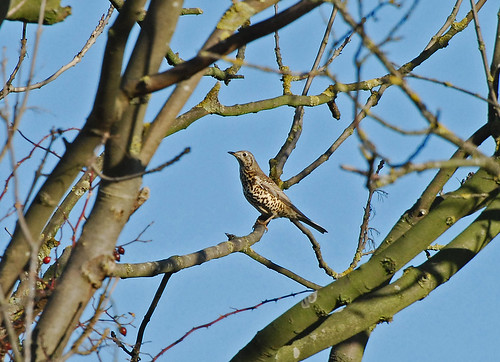
On a bright cold January day a lone fieldfare perched in a tree

February

February was cold and the middle of the month saw us taking the children to the coast for our annual spring half term excursion, and this year we headed to the Suffolk coast at Dunwich. Dunwich is a really interesting place for lots of reasons, not least because the wildlife there is rich and varied. One of the harbingers of springtime which I look forward to every year is the flowering of snowdrops, and the woods on the edge of Dunwich were covered in them:


A carpet of snowdrops in the woods at Dunwich Greyfriars

March

By March many flowers were blooming and the fauna was turning it’s thoughts to matters procreational. And this dunnock was no exception:


A dunnock serenading the ladies from a bramble stem on Cambridge Science Park

Dunnocks have a rather to-the-point approach to the art of regeneration. They don’t get together in pairs as most birds do, they form small groups and mate with multiple partners and the males go as far as to remove packets of sperm from the cloaca of females who have been inseminated by rivals prior to passing on their own DNA. No nonsense!


A robin singing for a mate in an alder tree, also on Cambridge Science Park

And of course the birds aren’t the only creatures to get the urge in March. For the past 2-3 years a guided busway has been built between St Ives and Cambridge and as it approaches Cambridge Science Park it passes alongside a lake that is a spawning ground for thousands of toads which live in the adjacent woods and fields. The busway has therefore cut off the toads from the lake and, driven by the unstoppable instinct to reproduce, this pair were trying unsuccessfully to negotiate the sheer walls of the track. For a week in March I would get off my bike every morning on the way to work to help as many of them across as I could find.


The male toad is hitching a lift on the back of the much larger female on the way to the water to spawn

The male toad locks onto the back of the female with his front claws around her chest and he’s not at all keen to relinquish his grip until they’ve reached the water and he’s fertilised her eggs. After which armies of lone toads can be seen heading back the other way.

Fortunately for the toads Cambridge City Council funded the installation of toad tunnels under the busway so next year they should be able to negotitate the track and avoid the carnage which would otherwise have ensued. Hats off to the Council!

April

This month was a real wildlife fest and many types of creature allowed me to take some great photographs. The trees now have shooting leaves so everywhere has that lovely green colour from all the fresh growth.


Windswept male yellowhammer in the top of a hawthorn tree

The yellowhammer is a species which has become less and less common in recent decades as a result of hedgerow destruction and other modern farming methods, but we’re lucky to have plenty of hedgerows still in situ on the outskirts of Histon, and consequently, good numbers of these lovely yellow buntings. The hedgerow this one is on is mature and has old oak and ash trees in so it plays host to alot of bird species including blackcap, chiffchaff, dunnock, common whitethroat and green woodpecker, to name but a few.

Whilst sitting watching TV late one evening in March, what I initially thought was a bat emerged from behind the sofa I was sitting on with my wife. There had been no prior warning of its presence and myself and my wife both levitated off the sofa uttering something along the lines of “What the heck was that!?”. It fluttered into a lampshade where it staid long enough to get a photograph, and it turned out to be an emperor moth:


Our emperor moth inside a lamp. I though creatures like that only lived in tropical rainforests!

Unfortunately, a couple of days later I found her dead (she was the female of the species) still inside the lampshade. I extricated her and measured her and she was 7cm wingtip to wingtip. A magnificent beast.


A willow warbler beautifully framed by new leaves and blossom of the blackthorn tree

These little warblers which weigh on average around 9g have just arrived from southern Africa. I think bird migration is one of the most amazing natural phemonena – how does such a tiny creature navigate and survive a flight across the Sahara and then the Mediterranean? It’s absolutely incredible.


A pair of great crested newts getting ready to mate in a shallow pond – male on the left, more slender female to the right

The great crested newt was probably the highlight of my year. I’d never seen a newt before and in this pond there were great crested, palmate and smooth newts. I turned the flash power down and used an 18-55mm lens and got some reasonably good photographs of the newts underwater. And that at 1am after a few hours in the pub!

May

I’ve spent many a fruitless hour chasing orange spot butterflies up and down the hedgerows of Cambridgeshire, but they never seemed to settle for long enough to get a photograph. But one morning in May I must have timed it just right, they were in the mating mood.
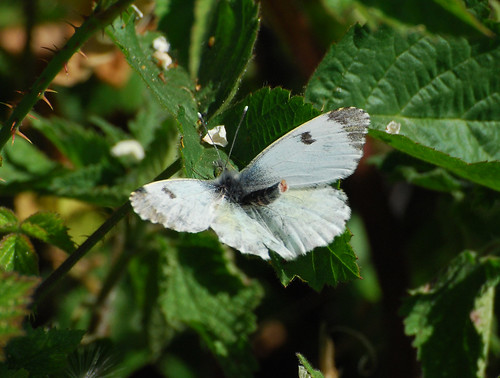

Female orange spot announcing her availability in somewhat unambiguous fashion to a passing male who was just out of shot


Common whitethroat – these warblers also migrate to the UK from sub-Saharan Africa

The common whitethroat breeds in my local fields in good numbers. It’s easy to identify by its song and the way it perches on brambles and low scrub and then flits almost vertically up into the air to alight a few seconds later close to where it took off from and continue singing. This one is a male, he has a blue/grey head whereas the female has a brown head. As well as avian migrants from warmer climes, at this time of year many species of dragonfly are emerging:


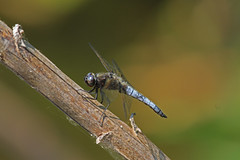
Scarce chaser dragonfly at Milton Country Park

I like dragonflies. In the days of the dinosaurs there were dragonflies with a 75cm wingspan! They are fun to photograph (and often, not too difficult) they look awesome, and they have very interesting life cycles. My scarce chaser sat on a seed head for several minutes whilst I stood a few feet away photographing other dragons and damsels, occassionally he took off to circle the pond before returning to the same spot where he let me get to within around 50cm to capture his portrait.

June

In a normal year the weather will be warming up  nicely by June and flowers and insects and birds should be in abundance. But 2011 wasn’t a normal year, April was unseasonally warm which kick started everything, but the rest of spring and summer were cold and this had dire consequences for many butterflies and other species. One of the few that I did see in reasonable  numbers this year, although not as many as last year, was the large skipper.


Large skipper feasting on the nectar of a thistle

The marsh woundwort is so called because it has been applied to wounds to assist the healing process. I don’t know what the medical basis for that is, maybe it has antispetic properties. It  has a beautiful flowerhead and is one a good number of wild flowers growing in the drainage dikes on the local farmland around Cambridge.

Marsh woundwort poking it’s lovely head out of a drainage ditch which is full of various wild flowers every year

July

I found this splendid looking cricket lurking in the grass in a field on the edge of Histon. I first thought it was a very green grasshopper until I looked more closely at the photograph, and it turned out to be a Roesels bush cricket. It is an introduced species from mainland Europe which until recently was only found in the most southerly parts of England. There are two varieties and this is the long winged one which can colonise further afield faster than its short winged cousin, and is now as far north as Cambridgeshire and beyond.


Long winged Roesels bush cricket

This was the first of its kind that I’d seen and a few days later another one appeared on a blind in my house, so I guess thay can’t be that uncommon in this region now.

A pair of juvenile linnets

Before I got out walking in my local countryside around Histon I can’t remember the last time I saw a linnet, but they breed here in good numbers and in the winter flocks of many tens to hundreds can be seen on farmland around and about Histon. Linnet are finches which feed on seeds and the adult males are splendid with a cerise breast and a crimson spot on their foreheads.

August

When I was at school, many years ago, my Dad would feed the birds in the garden and it wasn’t particularly unusual to see the occasional bullfinch.  But mainly as a result of persecution their numbers declined dramatically through the 1970’s and 80’s and I didn’t see one for years. The males are beautiful birds and I’ve been after a good photograph of one for a long time. And finally…


A male bullfinch crunching seeds at RSPB Fen Drayton

I love this picture – so far it’s the first and only half decent one I’ve managed. Hopefully I’ll get a few more to share with you in 2012.

Later in August, we were on holiday in Northumberland, and amongst the many gulls and other seabirds on the beach at Seahouses was this redshank. I think it’s nature at it’s aesthetic best!


A lone redshank looking for nourishment in the rockpools at Seahouses

September

The biggest garden spider I’ve ever seen – she was around 4cm across

Another of natures harbingers, this time of autumn. My garden fills up with these polyocular purveyors of terror in September, and this lady was huge. She was 4cm across and was big enough to distract my son from a telling off. ‘Dad, there’s a big spider in my window‘ was an imaginative and very effective way to divert my attention from the misdemeanour of the moment. I ran to get my camera and I had to lay horizontally out of the bedroom window to take this photograph, as a result of which I couldn’t stay still for more than a few seconds!

October

After the coldest summer for 18 years we then had a mild autumn which meant that many creatures could be found out and about long after they have normally  migrated or hibernated, or died off. Swallows and swifts were still being seen into October and a bumblebee flew past my lab window one day last week. During a visit to Milton Country Park, on the northern edge of Cambridge, on 28th October, to see what winter wildfowl had arrived, there were some winter visitors including tufted duck, gadwall and widgeon. But the pontoon I was stood on had around half a dozen common darter dragonflies on it along with several species of damselfly in the surrounding reedbed and a lone migrant hawker patrolling the air which took a common darter and butchered it on the wing right over my head. Dragonflies can be seen late in the year when the weather permits, but even so I was surprised to see so many at the end of October.

A pair of common darters mating in the late autumn sunshine

November

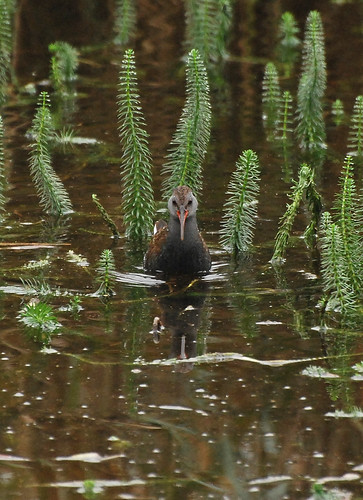
One of my November excursions took me to RSPB Fowlmere, between Cambridge and Royston, which is renowned for its water rails. I don’t think I’d ever seen one before but I was tipped off by a fellow naturalist that there was one in front of a particular hide, so I headed off there and there it was, busy foraging in the pond for the whole hour I sat there. It was very murky so the photographic conditions were difficult, but I managed to get a couple of decent pictures and I particularly like this one:

A water rail in the primeval swamps of Cambridgeshire!

And another of my trips in November was to Norsey Wood in Essex which is a very different ecosystem to Fowlmere, consisting of ancient oak, beech and birch wood. So in autumn the forest floor is a really good location for fungi and this fly agaric was one of a large group growing out of the leaf litter.


Fly agaric mushroom amongst the fallen beech leaves of Norsey Wood

December

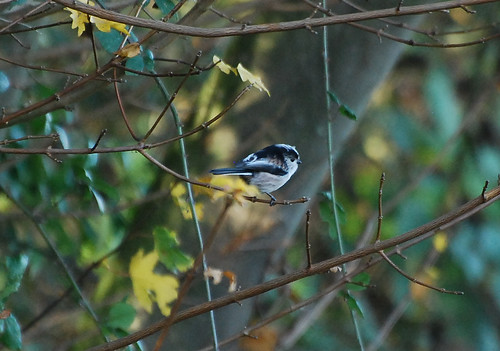
And finally, a wildlife success story is the long tailed tit. Until the last 10-15 years I only saw these occasionally but they now seem to be common, in direct contrast to so many other species of bird whose numbers are declining. I regularly see flocks of long tailed tits on the feeders in my garden and in the hedgerows and woods around Histon. They’re gorgeous little birds and I love watching a flock of them follow each other one after the other along a hedgerow before bunching together when they have found a food  source and then heading off again in line astern.

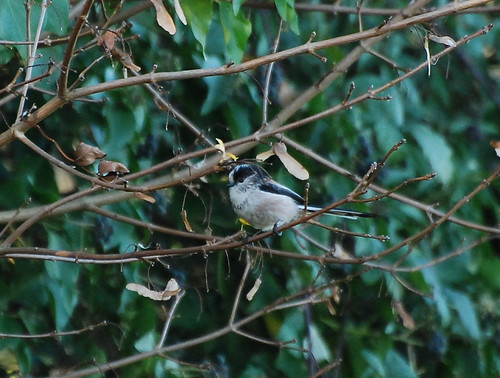
A long tailed tit in the hedges along Guns Lane in Histon

I stood quietly for several minutes watching the flock of around 15 birds that this one belonged to and they didn’t seem at all bothered by me as they picked insects from the trees.

So there you have it. 2011 in pictures. If you had the stamina to get this far, thankyou and I hope you enjoyed it.

Best wishes for a very happy Christmas and a peaceful and successful New Year from The Naturephile!

Where have all the birds gone?

There are virtually no birds in my garden at the moment, and they have been conspicuous by their absence all through the autumn. This appears to be a more widely observed phenomenon as reported on BBC’s Countryfile, and the RSPB have been seeking to reassure people who are concerned by the apparent dearth of birdlife visiting their gardens that it’s simply due to the abundance of suitable food still accessible in the countryside, and whenever possible that’s where the birds prefer to be.

I can vouch for the disappearance of the small birds from gardens. Apart from the occasional blackbird and blue tit  (and a jay last week – the first one I’ve ever seen in my garden!) very few birds are availing themselves of my feeders. If this is happening in your garden the best thing to do is to keep your feeders clean and put a small amount of feed in so any passing birds recognise your garden as a source of food and can stop to refill if they need to. But it looks as thought the cold weather is starting to arrive here in Cambridgeshire so garden bird numbers may well increase in the near future.

So last weekend I ventured to the fields on the edge of Histon to see if they are still in residence. The hedges and fields were well populated with goldfinch (Carduelis carduelis, Dansk: stillits) and chaffinch (Fringilla coelebs, Dansk: bogfinke), great tit (Parus major, Dansk: musvit) and long tailed tit (Aegithalos caudatus, Dansk: halemejse) and green woodpeckers were abundant too. I don’t know if the numbers of green woodpecker (Picus viridis, Dansk: grønspætte) I see are representative of national trends but they seem to be numerous here in Histon, also where I work on Cambridge Science Park and today I was at the RSPB reserve at Fen Drayton near St Ives and there were good numbers there too. Two birds that I haven’t seen recently in the numbers I’d expect are dunnock and greenfinch – I hope that’s because they’re out in the countryside and it doesn’t reflect a decline in overall numbers.

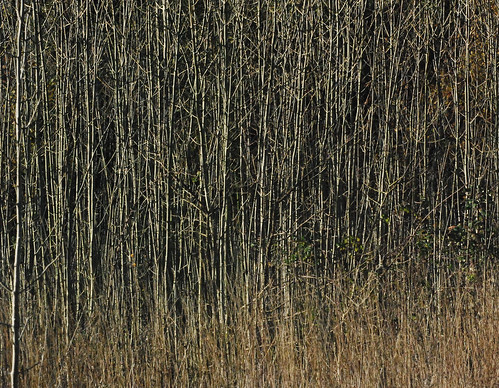
I talked in my post a couple of weeks ago, Forests and Fungi, about how I’ve been inspired to look for other ways of photographing nature rather than simply taking traditional portrait shots. Rowleys Meadow which is on the edge of Histon, has mature ash trees (Fraxinus excelsior) on the periphery which are laden with ash keys and as a result there are thousands of young ash saplings:


Brown grass stems merge with the taller, thicker, silver stems of the ash saplings

And this presented a good opportunity to capture some abstract nature images. I like the way the low, bright sunlight creates a vertical pattern of silver and shadow as it illuminates hundreds of young ash trees

Back to birds, as well as our regular winter residents migrants from Scandinavia are much in evidence, redwing (Turdus iliacus, Dansk: vindrossel), and fieldfare (Turdus pilaris, Dansk: sjagger):


A lone fieldfare perched in a tree after gorging on a blackthorn bush laden with sloe berries

Small flocks of fieldfare can be seen and heard making there distinctive and diagnostic call, and the flocks will get bigger if the weather does turn wintry. Last winter, which was brutally cold here and in Scandinavia, huge numbers of waxwing (Bombycilla garrulus, Dansk: silkehale) arrived in the UK from Norway, but due to the much warmer weather I don’t think we’ll see them here in quite such abundance this year, which is a real shame because they are indeed spectacular:


Waxwing – it’s around the size of a starling and the colours are amazing

Histon has a resident rook colony (Corvus frugilegus, Dansk: sibirisk allike) who have their rookery in the tall trees adjacent to the church and are a constant source of aerial entertainment. They were feeding in a field along Guns Lane, which runs from Histon to Ely, as I wandered along it and this one took exception to my presence and flew over squawking at me as it went,

I took the hint and moved on, heading home. But a little further along Guns Lane I paused when I heard the quiet and delicate song of a flock of long tailed tits. So I stood still and they went about their routine in trees about 10m away. I really like these diminutive, gregarious, birds and I love trying to photograph them, which can be challenging as they are very small and they never settle in any one place for very long. But I managed to get this series of shots which I’m rather pleased with:

Even though the weather is pleasantly mild at the moment, I prefer winter when it’s cold, so I’m hoping it will start to behave as it should and these delightful little birds come back to feed in my garden!

All those flocking waders

The Cambridgeshire Fens can be a bleak and windswept part of the world as the winter months descend, and today it was very bleak and very windswept, but it’s a great location for getting out and seeing some exciting and scarce wildlife.


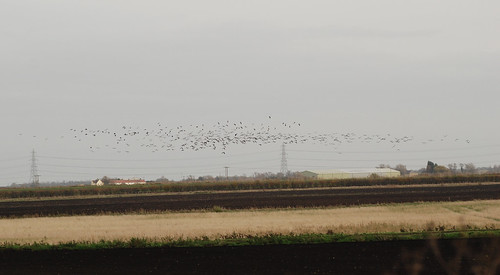
A small flock of lapwing and golden plover over Burwell Fen

For those of you who don’t know the Fens they’re characterised by wide open flatness and big skies. They were originally under water but were drained by Dutch engineers in the 17th and 18th centuries to leave high quality arable land. The soil is extremely rich in organic material which gives the soil the rich black colour evident in the picture above.

I set off there on Saturday with my friend David because there had been a report on the Cambridge Bird Club website of short eared owls (Asio flammeus, Dansk: mosehornugle) in the vicinity. After wending our way through Swaffham Prior and Reach we rocked up at Tubney Fen where we sat in a new National Trust hide overlooking a new pond with new reed beds which had four coots (Aythya fuligula, Dansk: blishøne) and a pair of mute swans (Cygnus olor, Dansk: knopsvane) paddling on it. And no other signs of life whatsoever.

As we watched, the mute swans took off and looped round low right in front of us and landed back on the water. At least one of them landed on the water in the spectacular and graceful way that mute swans do. The other one crash landed on the ground just short of the water and after regaining its equilibrium stood looking highly indignant but managed to retain it’s dignity in a way that only a mute swan could in those circumstances. We hoped it wasn’t injured but it looked to be suffering from little more than damaged pride.

After another five minutes sat in the hide the lack of further activity and the low temperature caused us to move on, and on the way back to the car we spotted eight whooper swans in a field several hundred meters away. The whooper (Cygnus cygnus, Dansk: sangsvane) is a winter migrant to the UK and a very scarce breeder, usually less than ten pairs a year will breed here. It’s a similar size to the mute swan but it’s neck is straighter and the beak is straight with a black tip and pale yellow base. Their breeding territory is in the high Arctic and they migrate south as far as Africa for the winter.


A family unit of eight whooper swans – two adults with white plumage and the charateristic yellow beak and six cygnets with pale grey/white plumage and without the yellow beak

We decided to move on to Burwell Fen from Tubney Fen and on the way we were considerably closer to the swans so we stopped for another look. And as we looked David noticed that a pale brown stripe in an adjacent field was in fact a flock of golden plovers (Pluvialis apricaria, Dansk: hjejle) and lapwings (Vanellus vanellus, Dansk:  vibe). When I was a kid I spent a fair amount of time out and about exploring the countryside and huge flocks of lapwing consisting of hundreds and possibly thousands of birds were a fairly common sight. But their numbers have been dwindling for decades and these days I’m pleased if I see more than twenty. A carrion crow was getting agitated in the tree beyond the plovers because a buzzard (Buteo buteo, Dansk: musvåge) was perched there too, but the crow wouldn’t get too close and the buzzard just sat tight and ignored it. There turned out to be 243 lapwing in this flock and for me that alone justified the trip.


Around 10% of the lapwing in our flock of 243

There were also several hundred golden plover. As we watched another even bigger flock joined them and when they were flushed into the air we could see another flock as big again in the middle distance and beyond that another that was enormous. So we estimated that between these flocks there were several thousand birds. It was a amazing sight.

The flocks of waders eventually settled so we made off further into the Fen, pausing to gaze at a group of roe deer (Capreolus capreolus) relaxing in a field:


These very well camouflaged roe deer didn’t seem at all perturbed by our presence

As we watched the deer, a sparrowhawk (Accipiter nisus, Dansk: spurvehøg) quartered the field and then a peregrine falcon (Falco peregrinus, Dansk: vandrefalk) swooped past car, travelling with the customary haste that species is renowned for.

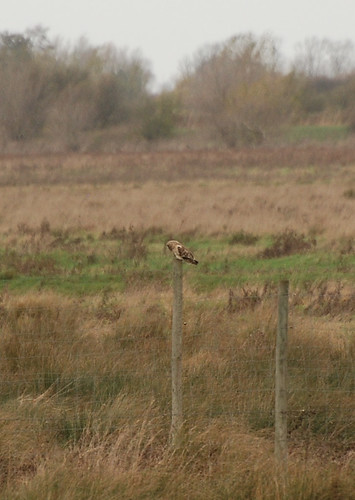
Arriving eventually at a car park, we continued on foot over a bridge where several kestrels (Falco tinnunculus, Dansk: tårnfalk) were quartering all the fields around and almost immediately spotted a short eared owl. It was perched on a fence post in the middle of the adjacent field and I initially mistook it for a little owl because I was looking at it from front-on and I could only see the top half, but when we saw it through David’s spotting scope we could clearly see it was of the short eared variety.

Short eared owl hunting rodents the easy way, not wasting any energy

As a result of the inclement weather, low light and strong wind, and only having a 300mm lens I couldn’t get any good photographs, but it’s unmistakeably a short eared owl, so I’m happy.

We saw various small songbirds such as chaffinch (Fringilla coelebs,  Dansk: bogfinke) and goldfinch (Carduelis carduelis, Dansk: stillits), five bird of prey species, whooper swans, and countless thousands of golden plover and lapwing. So despite the cold it was fine way to spend a Saturday morning.

Butterflies, and all that jazz

Ronnie Scott’s Jazz Club isn’t where I would expect to find subjects for wildlife photography. And, along with the inside of various other hostelries around the City of London, so it proved. That’s where I found myself this weekend and consequently I didn’t manage to take any photographs. So as the weather is so dull and foggy I thought I’d try to brighten things up with some butterfly pictures which were captured at another, less crepuscular, time of year.

Last year I went to a place called Fermyn Wood near Kettering in Northamtonshire with a friend of mine, to look for purple emperors. For the more ornithological among you, particularly if you like birds of prey, this was one of the original release sites for red kites (Milvus milvus, Dansk: rød glente) , and they are still there in abundance. And sure enough one appeared very low overhead before lazily flapping off across the treetops.


This splendid creature is a white admiral (Limenitis camilla), feeding on the nectar from bramble flowers at Fermyn

We set off early to arrive around 8am because at that time of day the butterflies are sunning themsleves on the ground and taking in salts. They get salts from various sources including animal droppings, carrion, sap runs on trees, and sweat. My friend has a photograph of a purple emperor sipping sweat from his sock by inserting its proboscis through the eyehole of his trainer! We encountered a few emperors but they were all whizzing past higher up in the tree canopy. They live in deciduous woods where they spend most of their time feeding on aphid honeydew, apart from this one who sat obligingly on the path and let us take photographs:


Purple emperor (Apatura iris) taking on salts from the substrata

He was sufficiently obliging to unable us to take pictures of the underside of his wings, which are themselves spectacular, but he wasn’t willing to reveal the full irridescent splendour of the top side, which is where their name derives from.  They are big, with an average wingspan of around 8cm, and the males are the most gorgeous deep purple. Alas for the female of the species, she is a rather less dramatic brown colour. I was therefore on a mission to get pictures of the upper side of the wings in 2011 but they are only around for 1-2 weeks of the year and it wasn’t when I could get there. But that’s fine, it gives me something to look forward to next year… or the year after.

On the ground close by the purple emperor was a small tortoiseshell, which are considerable more common and can be found on buddleia bushes up and down the country, but are also amazingly colourful.


Small tortoiseshell (Aglais urticae)

I don’t usually like full on portraits of butterflies, but I like this one because set against the parched earth the flamboyant colours of the butterfly are a sight to behold, all the tiny cells of the different colours in the blue and white peripheral spots are clearly visible. It’s a stunner!


The balance of nature

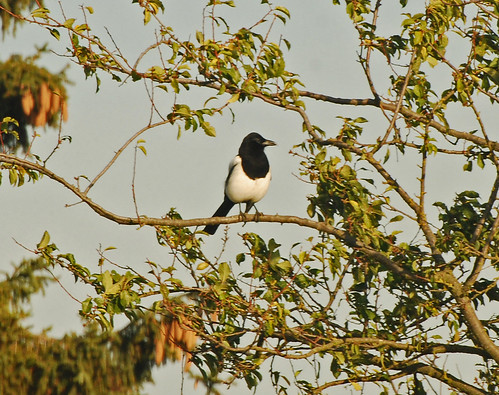
At the end of May this year the BBC screened an episode of Countryfile in which John Craven interviewed a member of the scientific staff at the Game and Wildlife Conservation Trust (GWCT). Taking things literally I’d assumed the this was a trust who’s aim was the conservation of game and wildlife. However, as the interview progressed I began to question this assumption as the discussion centred around a study to be carried out by the GWCT in which magpies were to be eradicated from a specified test area to assess the local effect on songbird populations. I don’t think that removal of a native species such as the magpie by trapping and killing them is an ethical way to study predator/prey relationships. But is it scientific?

The magpie – villain of the piece – apparently

The interviewee from the GWCT, Dr Jeremy Stoate, justified the cull on scientific grounds suggesting that increased predator numbers result in significant reductions of prey populations and the species they identified as being largely responsible was the magpie.

Magpies are bold, brassy, ubiquitous, and are generally percieved as being a tad raffish. They undoubtedly predate songbird nests, but I struggled to understand how this could justify slaughtering them. Numerous other species of bird and mammal such as sparrowhawk, kestrel, owls, great spotted woodpeckers, rats, stoats and probably the biggest killer of small birds, domestic cats, all predate songbirds and some raid nests to poach eggs and chicks.

So why was it only magpies that were to be exterminated?

The action was being justified on a scientific basis, and whilst I’m no ecologist, I am a scientist, and the whole thing seemed unscientific, so I decided to do a little research of my own on the subject. Interestingly, since I did my initial research in June, it appears that references to the study on the GWCT website have been taken down. At least, I couldn’t find any.

However, what I did find out was that the study was commissioned and financed by another ‘conservation’ organisation called Songbird Survival. Whilst I believe that GWCT do have a genuine interest in the countryside as a whole, the same cannot be said for Songbird Survival. It is a registered UK charity whose statement of activities on UK Charity Commission website is this:

THE PRINCIPAL OBJECTIVE OF THE CHARITY IS TO IMPROVE, PROTECT AND PRESERVE FOR THE BENEFIT OF THE PUBLIC THE POPULATION OF SONG AND OTHER SMALL BIRDS BY THE CONSERVATION AND RECREATION OF HABITATS, BY SUITABLE EDUCATION OF THE PUBLIC AND LOBBYING MP’S AND THE HOUSE OF LORDS, TO EFFECT CHANGES IN THE LAW WHERE WE FEEL IT IS NECESSARY.

However, the details on the Charity Commission website also list the trustees, and that makes interesting reading too…

LORD COKE, MR CLIVE PATRICK SHERWOOD, MR FRED VALENTINE INGRAMS, MR JOHN RICHARD PUGH, LORD MICHAEL RICHARD RANKEILLOUR, MR ROBERT JOHN MIDDLEDITCH, MR DAVID GRIFFITH, MR NICK FORDE, LORD JOHN HADDINGTON, MR HUGH VAN CUTSEM, MR COLIN STRANG STEEL

All of these trustees are big landowners, or relatives of landowners, some with shooting estates, and they all support hunting and shooting. Lord Coke is the owner of Holkham Hall in Norfolk and he and several of his gamekeepers have been prosecuted for killing birds of prey by shooting and poisoning. So I’m struggling to believe that these people really have the best interests of songbirds at heart when they are funding ‘scientific’ destruction of a single predator species which has been implicated in taking gamebirds. And via the titled gentlemen listed as trustees they would be ideally placed to carry out their stated aim of ‘lobbying MP’s and the House of Lords‘.

Back to the science though. I recently attended a lecture in which Dr Mike Toms of the British Trust for Ornithology (BTO) talked about garden birds and how gardens are becoming an increasingly important sanctuary for increasing numbers of songbirds, and therefore predators, such as magpies, great spotted woodpeckers and sparrowhawks. In the course of his lecture Dr Toms talked about the decrease in songbird numbers and how magpies were being blamed but said that magpie predation was not the cause of the decline in numbers but habitat destruction and current agricultural practices were the primary reasons. I emailed Dr Toms and he was kind enough to send me several links to published work by the BTO into bird predation. This list included this publication: ‘Population changes of avian predators and grey squirrels in England: is there evidence for an impact on avian prey populations? Journal of Applied Ecology 47: 244- 252‘ describing a collaborative study between the BTO, GWCT and the University of St Andrews in which the impact of 2 groups of predators, those which predate adult birds and fledglings and those which predate nests (including the magpie) were analysed for 29 prey populations. Quoting directly from this paper:

For 22 avian prey species, there is no evidence that increases in common avian predators and grey squirrels are associated with large-scale depression of prey abundance or population declines‘.

Then:

Unexpected was a large number of positive (my italics) associations between predators and prey, particularly for native avian nest predators, which largely exonerates these predators as driving declines in passerine numbers

And:

Analyses of large-scale and extensive national monitoring data provide little underlying evidence for large-scale impacts of widespread avian predators and grey squirrels on avian prey populations…

The paper also describes negative correlations between the remaining seven prey species and predator numbers, and accepts that some of these may be causally related. Although e.g. the relationship between sparrowhawk and tree sparrow is probably significant, that between buzzard and goldfinch almost certainly isn’t. However, in an email from Dr Toms to me he indicates that the GWCT study showed negative causal relations on  a local level but, crucially, not at a population level.

This last point is key to the argument. In a study of population dynamics, if conclusions are to be drawn about overall depletion of numbers in response to a specific influence small local studies cannot be extrapolated to enable conclusions for the population as a whole, and to do so is erroneous at best, misleading at worst.

Incidentally, I also found a publication on the website of Songbird Survival entitled ‘Detecting an impact of predation on bird populations depends on the methods used to assess the predators’, (Methods in Ecology and Evolution (2010),1,300-310, Nicoll M., Norris K.). This is an interesting paper because rather than analysing actual population data it investigates the methods used to analyse the data. And in the summary the last point recommends: ‘…the findings for studies which use opportunistic data, for a limited number of predator species, should be treated with caution and that future studies employ bespoke census techniques to monitor predator abundance for an appropriate suite of predators.’

This is interesting because it argues that the methods used to analyse opportunistic, observational data must be carefully optimised to ensure that conclusions drawn from the data adequately reflect the observations.

None of the publications suggest that slaughtering the predators is a rational scientific way to assess the negative impact on prey species. And I’m inclined to think that culling is poor science, particularly as the latest evidence suggests predator numbers don’t reflect negatively on songbird populations and in some instances there is actually a positive correlation between predator and prey, presumably because the predators remove the sick and the slow before they can add their DNA to the genepool.

I think the notion that predators destroy prey populations is bizarre because I was taught, and importantly, I believe it to be the case, that prey abundance determines predator numbers, not vice versa. If prey numbers decline then shortly afterwards so do predator numbers. Taking the reverse of this theory to it’s logical conclusion, if predator numbers determine prey numbers, all prey species would eventually become extinct and then the predators would also become extinct and the balance of nature which has prevailed for the last few billion years would be turned on its head. Which is absurd.

So population studies which are centred around the slaughter of predators seem to me to fly in the face of all current theory and are therefore morally indefensible aswell as being scientifically unsound, especially when commissioned and financed by such obvious vested interests as Songbird Survival.

Robins and rails

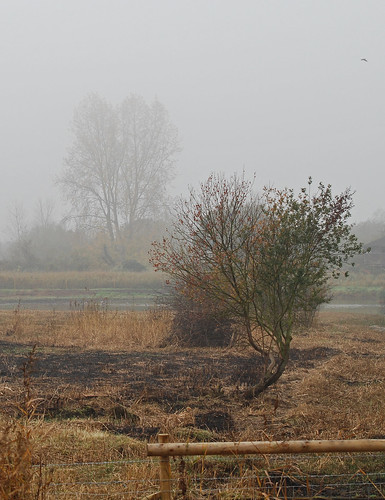
I headed down to the RSPB reserve at Fowlmere south west of Cambridge early yesterday morning (Saturday 5th November, 2011) with my friend and fellow wildlife enthusiast, David, where I was hoping to catch sight of a merlin or a kingfisher or another water bird which I don’t see in my regular haunts. It was a murky, grey morning and the air was holding so much moisture it felt damp. Consequently, conditions for photography were challenging,

Looking across the reedbeds at Fowlmere, distant trees looming out of the mist

Probably due to the weather it wasn’t easy to see the resident birdlife. We heard a great spotted woodpecker (Dendrocopos major, Dansk: stor flagspætte) from the car park but once we entered the reserve it was really quiet, apart from the faint roar of the traffic on the A10 and the occasional jet heading into Stansted airport. But of birds, there was not too much evidence. We heard some redwing (Turdus iliacus, Dansk: vindrossel) and fieldfare (Turdus pilarus, Dansk: sjagger) as they passed overhead unseen, and as we got close to the Reedbed hide a robin (Dansk: rødhals) and a songthrush (Turdus philomelos, Dansk: sangdrossel) were lurking in the bushes near the entrance and a stoat scampered across the bottom of the steps into the hide. From inside the hide we could see 15-20 mallard (Anas platyrhynchos, Dansk: gråand) on the water, and perched on a fencepost on the opposite side of the water was a kingfisher (Alcedo atthis, Dansk: isfugl).

I like the segmentation in this picture and the physical delineation by the fence of the cut and uncut reedbeds. And of course, the tiny spark of blue and orange of the kingfisher sitting in the middle.

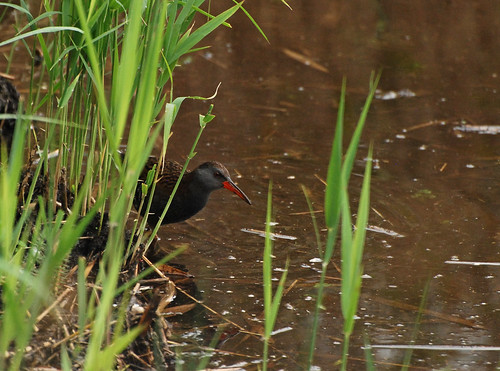
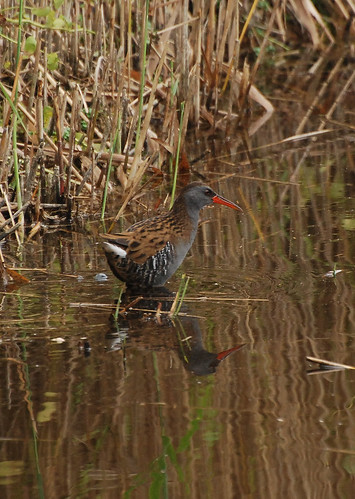
Also on the lake was a heron (Ardea cinerea, Dansk: fiskehejre) fishing in the shallows and half a dozen teal (Anas crecca, Dansk: krikand), and a muntjac deer wandered by. The kingfisher subsequently vacated and no further avian visitors appeared so we vacated too and made our way to the Drewer hide where we’d been told a water rail (Rallus aquaticus, Dansk: vandrikse) was busy feeding. And it didn’t let us down.

The water rail is from the same family as coots, gallinules (moorhens) and crakes and lives and feeds in and around shallow water predominantly on animals but also some plant material.


Water rail emerging from the reeds…


…looking for invertebrates in the mud


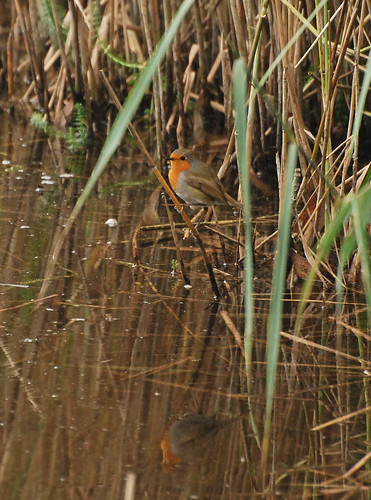
And whilst this charming waterbird was busy captivating my attention a robin was flitting between a nearby hawthorn bush and the reeds:

The robin seemed a tad out of place in the reeds, but a lovely dash of colour on a grey morning with its reflection in the pond


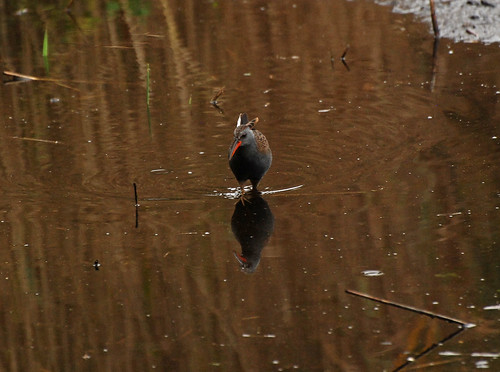
From the front it’s apparent that the water rail is a very slim bird facilitating easy movement between the stems in the reedbeds. I can’t remember the last time I saw one so it was a treat to see this one so close and it loitered for getting on for an hour, until after we left.

Autumnal Anisopterans

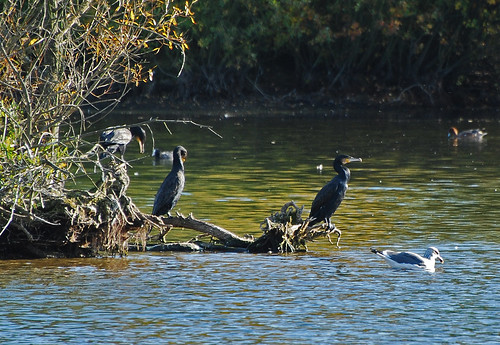
Yesterday, 28th October, was one of those glorious sunny autumnal days where the air was fresh but the temperature was raised by bright sunshine, and I’d heard that the winter migrants were arriving on the lakes at Milton Country Park on the northern edge of Cambridge. So I took my camera to work and headed there for a stroll at lunchtime in the hope of snapping a teal or wigeon or perhaps a more unusual visitor. Several waterbirds were on parade including these cormorants:

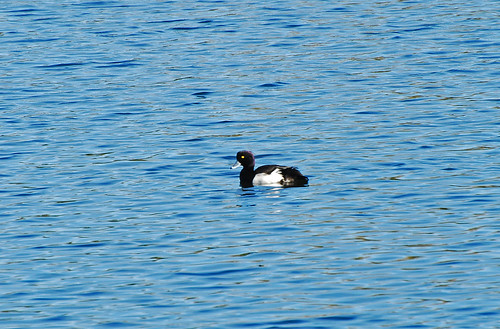
Several migrant duck species were there too, including wigeon (Anas penelope, Dansk: pibeand), the duck with the chestnut head in the background of the cormorant picture is a male wigeon, tufted duck (Aythya fuligula, Dansk: troldand):


A male tufted duck resplendent in his pied plumage and bright yellow eye

…and gadwall (Anas strepera, Dansk: knarand).

What I didn’t expect to see though, certainly not in the kind of numbers present, were dragonflies. It’s  nearly November and the weather has started to get more autumnal but the warm weather up to now must have suited these airborne predators. In particular common darters (Sympetrium striolatum) were conspicuous, six at one time including two mating pairs. It’s always a treat to watch dragonflies but especially on a sunny day at the end of October, living uo to their name and darting about making a loud low frequency buzzzing noise .

Stunning symmetry of a pair of mating common darters

The darters were sunning themselves on the fence lining a viewing jetty on the edge of a lake and while they were busy warming and copulating a migrant hawker (Aeshna mixta) was patrolling the adjacent reedbeds. All the dragons were pretty much oblivious to my presence unless I ventured too close then they would rise into the air, the copulating couple in tandem, only to return to pretty much the same spot with 30 seconds or so.


Migrant hawker

Every so often one or more of the common darters would chase the hawker away until it lived to its name and plucked one of them out of the air and butchered it whilst flying around our heads, scattering the inedible parts around us. After its aerial snack it headed up into the treetops and disappeared.


The hawker missed a trick. It went to alot of effort catching its darter on the wing when it could have had twice as much protein if it had spotted this pair. But I’m glad it didn’t!

Colourful Corvids

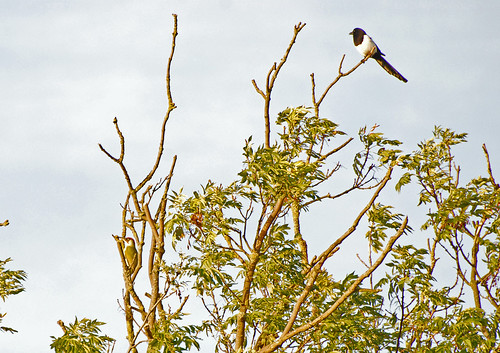
Rooks, crows and jackdaws are the most commonly seen and easily identified ‘crows’. They’re all black and they are widespread across the UK. But they’re not the only members of the crow or ‘Corvid‘ family. Ravens and choughs are also black members of the crow family, although the chough has bright red beak and legs, but both these species are fairly uncommon and seen mostly at or near the coast. There are two common and more colourful crows, the magpie (Pica pica, Dansk: husskade) and the jay (Garrulus glandarius, Dansk: skovskade).


Magpies can be seen everywhere, this one was in a tree opposite my garden

Magpies have an unfortunate reputation on two counts. They are considered to be inveterate thieves, having a particular fondness for shiny objects and they are generally reviled for their feeding habits during nesting of raiding other birds nests and predating the chicks. Of which more in another post. It seems to me they are handsome birds which are much maligned, they simply do what all wild creatures do, i.e. whatever is required to survive and propagate the species. While I watched this one I could hear several green woodpeckers (Picus viridis, Dansk: grønspætte) yaffling around the field and eventually one chased this magpie away from the top of the tree:


The woodpecker, bottom left, was extremely unhappy with the presence of the magpie and voiced it’s discontent with lots of shrieking as it flew aggressively into the tree

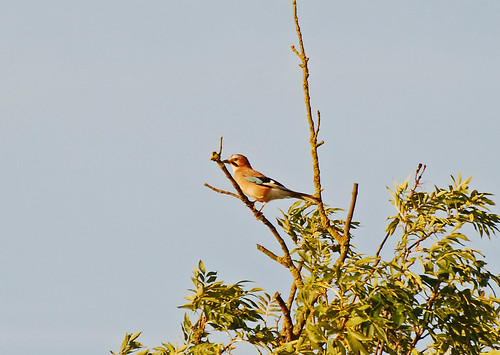
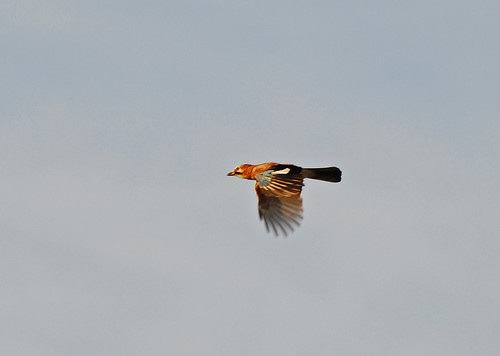
Jays are less frequently observed than magpies, predominantly dwelling in wooded areas in the countryside, but they are also seen in towns and villages where there are wooded areas. I’ve seen them along the Backs in Cambridge, and my friend who lives in a less wooded part of Cambridge has photographed them in his back garden. I encounter the occasional jay brightening up the day when I’m out walking around Histon, but last Sunday I had eight sightings, which is completely unprecedented. There were at least five individuals, one pair appeared together in the fields followed by a separate one a few seconds later, and another pair were busy burying acorns in the orchard opposite my garden. And they are spectacularly colourful, not at all what one might expect from a crow:


The splendid plumage of the jay!

Several jays and magpies came and went from this spot at the top of the tree in the space of a few minutes.


And when in flight the electric blue flash on the wing-bend opens up into a fan


As well as having an eye for sparkly trinkets jays are accomplished stashers and hoarders, and I’ve heard that a single jay can stash as many as 5000 acorns. They also show higher levels of intelligence whilst stashing, if they become aware they are being watched they will pretend to stash and then move away and hide their acorn somewhere else. I think that’s remarkable behaviour; moving away and hiding food elsewhere is one thing, but awareness of what another creatures intentions may be, and reacting to that by subterfuge suggests  a level of underdstanding and reasoning not commonly associated with creatures other than humans.


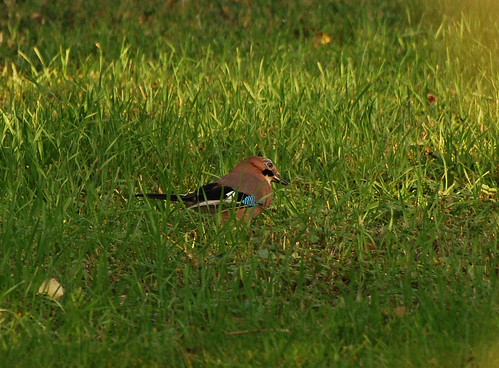
On the ground with an acorn in its beak looking for a suitable burial site, and checking its handywork :

As I watched this pair of jays at work, one of them put it’s acorn down and picked up a short stick, probably around 10cm long, and used it to make holes to bury the acorns in. So as well as the other tricks this jay used a tool to make bigger holes in the ground than it could manage with it’s beak in order to secrete its winter food supplies.

They’re remarkable birds, the Corvid family, and half an hour spent watching any crow species is entertaining and more than a little thought provoking.

Cragside

Whilst exploring Northumberland in August we ventured into  Bamburgh Castle which is well worth a visit not least because it houses a museum dedicated to the Victorian engineering genius and arms manufacturer, William Armstrong. Armstrong used a portion of his colossal wealth to build a remarkable house at Cragside near Rothbury, which is also well worth a visit because it is set in some pretty amazing countryside which is teeming with wildlife. It’s also remarkable because it’s the first house on the planet to be lit by hydroelectricity. So the man who amassed wealth beyond belief by producing arms which were responsible for the deaths of an awful lot of people also set the stage for renewable energy. And that’s a dichotomy which, in my book, makes him a very interesting man.

So… on the way home from Northumberland we decided to avoid the A1 as far as we could which involved going close to Rothbury, and when, completely serendipitously,  we passed a road sign for Cragside (and having joined the National Trust whilst on the Farne Islands) we rapidly decided a visit there was on the days agenda.

And that was a good decision. The house itself would take a long time to explore so we stuck our heads in the front door and decided to explore the surroundings instead. It was a cold and windy day threatening rain, but despite that the gardens were full of flowers attracting bumble bees and butterflies, particularly red admirals. The wooded slopes were full of birds, particularly tits, and most particularly coal tits (Periparus ater, Dansk: sortmejse).

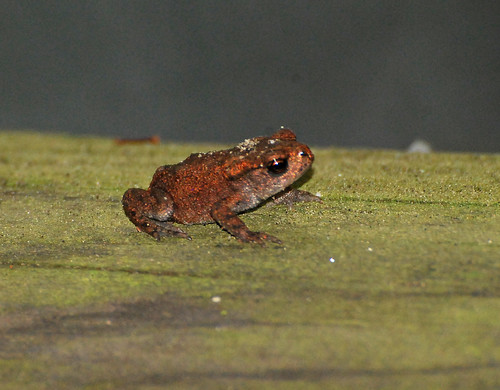
My son spotted a baby toad in the long grass but I didn’t want to disturb it too much so I didn’t get a photograph, but I was rewarded shortly after when I found this little chap walking along the woodwork of a bridge over a stream:


This nascent toad, Bufo bufo, was smaller than a 50p piece and slipped  into the water whilst crossing the bridge, but he sat still for just long enough

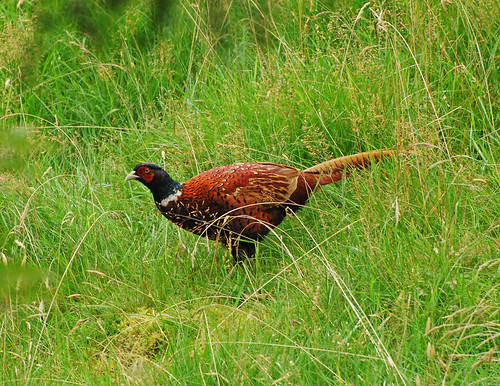
And as we were chasing toads a handsome cock pheasant appeared in the adjacent field,


Pheasant male, Phasianus colchicus (Dansk: fasan) showing off his magnificent plumage

The pheasant was introduced to the UK from Asia, where it’s native range extends from the Caucasus to China, around 1000 years ago. It is extensively hunted, which probably explains why it has been introduced to so many countries!

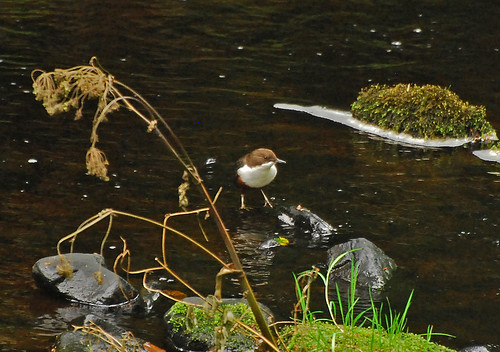
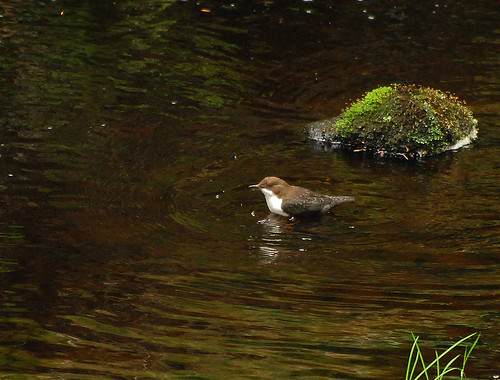
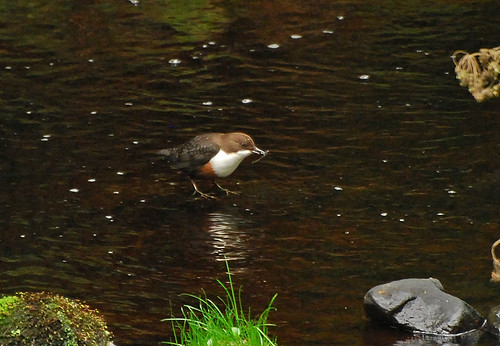
But the ornithological highlight of the visit to Cragside was the dipper (Cinclus cinclus, Dansk: vandstær). It flew past me at high speed low over the stream before landing on a rock which it used as a springboard to hunt insects underwater. I thought it is called a ‘dipper’ because of it’s diving prowess, but while it was perched on terra firma it flexed its legs resulting in a dipping motion of it’s head – so maybe it’s this action that gives it its name. I was wondering why it did the dipping and thought it may enable it to see small prey items underwater more easily.


Dipper perched on a rock contemplating a snack…


Hunting in the stream…


And with a catch – I think it has landed a damselfly

Dippers are unique in that they can swim underwater and even walk on the bottom as a result of having solid bones.

Photographically the dipper posed some interesting problems. It’s mostly a dark coloured bird and was in a dark coloured stream under tall trees on a cloudy morning so there was very little spare light, and it didn’t stay still for very long. Consequently I had to use ISO 800, f5.6 and 160th sec exposure and cross my fingers! Fortunately I was able to focus on the white breast and managed to get a few good shots. It’s a charming little bird and I was very pleased to be able to share some pictures with you.