Category Archives: UK wildlife

Returning migrants and lots more besides

Occasionally, but fairly infrequently, it’s a struggle to find enough interesting nature to put together a post, and then every now and again so much happens that it’s difficult to fit it all in. Last weekend was one of the latter.

It started to get interesting as I was cycling to work on Friday morning, a bird caught my eye in a hedge outside work and first off I thought it was a bullfinch, which I’ve never seen on Cambridge Science Park before. But then I got a better look at it and it was immediately apparent it wasn’t a bullfinch, it had similar colours but in a different pattern, so I did a quick U-turn to get a better look. It turned out to be a black redstart male in full breeding regalia (Phoenicurus ochruros, Dansk: husrødstjert). He was magnificent but alas, because I was heading to work I was camera-less, so if you’ve never seen one, dig out a bird reference book and check him out, it’s worth the effort.

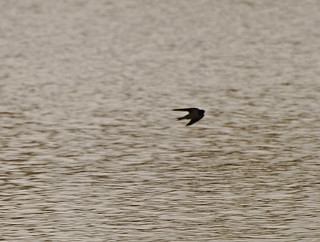
I went back to work on Saturday morning with my camera to see if he was still there but there was no sign of him so I carried on to Milton Country Park, on the northern edge of Cambridge. It was a bright sunny morning and I arrived there just after 8.30 and it was already warm. And it augured well because it turned into a real bird fest. I was hoping to see some returning migrants and as I got out the car I could hear chiffchaff (Phylloscopus collybita, Dansk: gransanger) calling in the trees around the carpark. The first migrant I actually saw was completely unexpected and turned out to be a pair of sand martins (Riparia riparia, Dansk: digesvale) which I haven’t seen for years. There were also swallows (Hirundo rustica, Dansk:  land svale) flying low over a lake and this is roughly the same time I saw the first swallow last year. Like swallows, sand martins also over winter in South Africa, but unlike swallows they nest in burrows which they excavate in sandy banks. There are some man made burrows for the sand martins at the country park but so far they’ve been ignored by the martins, but the occassional kingfisher pair have availed themselves of the opportunity.
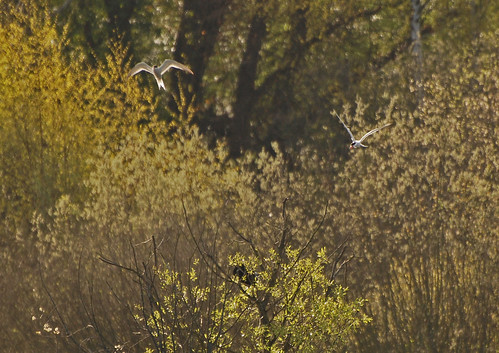
Close to where the swallow was hunting is a small island with a tree on it where cormorants (Phalacrocorax carbo, Dansk: skarv) can often be seen perched. This time there was a carrion crow (Corvus corone, Dansk: sortkrage) sat on top and a pair of common terns (Sterna hirundo, Dansk: fjordterne) were taking exception to its presence and were working as a team to dive bomb it:
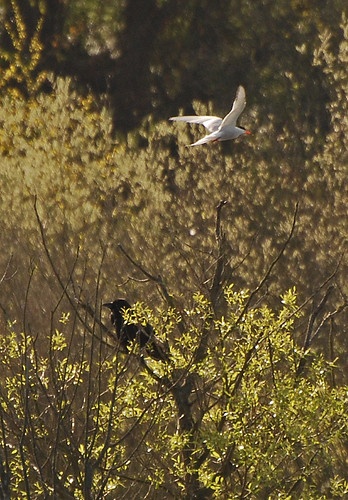
A singleton…


… and in tandem

I almost felt a little sorry for the crow, but I’ve watched them terrorise so many birds, especially buzzards and other birds of prey, in a similar fashion that the sympathy was a tad less enthusiastic than it may otherwise have been.

A migrant which was present all over the country park was the blackcap (Sylvia atricapilla, Dansk: munk), in one bush there were a minimum of four and possibly six or even more. They were squabbling away in the  bush presumably in the midst of a territorial dispute. I saw the first blackcap of 2012 a few weeks ago at Danbury Common in Essex during my unsuccessful mission to look for adders.
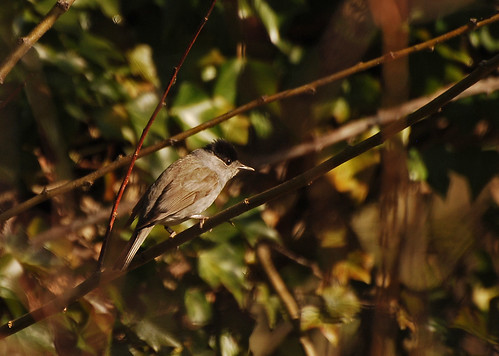

Blackcap male, the female is similar but easily distinguished because her cap is a rusty brown colour.

As well as the migrants the trees and bushes were full of the song of more familiar resident species such as the robin, blue tit, great tit, blackbird and wren. All were energetically vociferous, filling the air with a wonderful cacophany. And amongst these I caught a tantalising glimpse of a much less common species, the treecreeper (Certhia familiaris, Dansk:  træløber). Treecreepers are very aptly named and are fun to watch as they hunt insects in the crevices of tree trunks, spiralling upwards in a corkscrew pattern. A pair of sparrowhawk and a pair of buzzard were also busy performing their aerial courtship routines.

There were none of the winter ducks such as tufted duck (Aythya fuligula, Dansk: troldand), pochard (Aythya ferina, Dansk: taffeland), gadwall (Anas strepera, Dansk: knarand), teal (Anas crecca, Dansk: krikand) or widgeon (Anas penelope, Dansk: pibeand) on the water, they had all headed off north to their breeding grounds. But several birds including coot (Fulica atra, Dansk: blishøne) and greylag geese (Anser anser, Dansk: grågås) had chicks on the water:
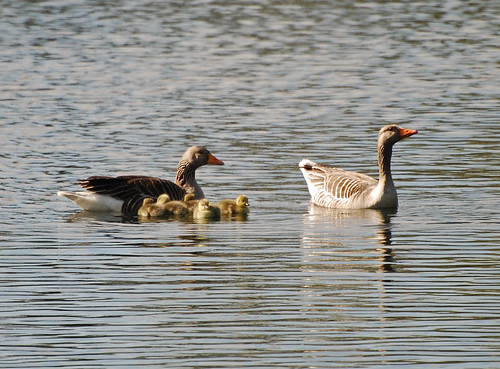

Greylag geese with six chicks

I paused to try to get a shot of a great crested grebe (Podiceps cristatus, Dansk: toppet lappedykker), all now in full brown breeding plumage:

And as I stretched over the water, trying hard to get a clean shot of the grebe, and even harder not to pitch headlong into the lake, a grey heron (Ardea cinerea, Dansk: fiskehejre) flew low overhead:
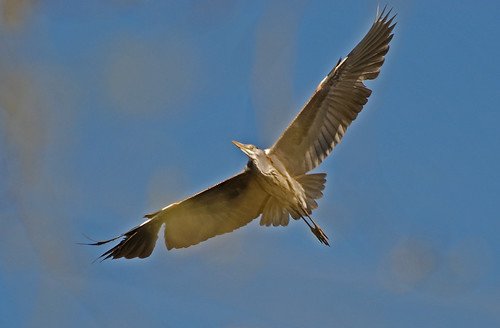
It was so low I thought it must have pitched up very close to where I was but on an adjacent lake, and a quick scan revealed it sat in the top of a tree being pestered by the common tern that had earlier been harrassing the carrion crow:

The terns were deeply unhappy with any potential predator, although they were less keen to buzz a pair of sparrowhawks which were in the air above the same stretch of water!
Animal Rescue

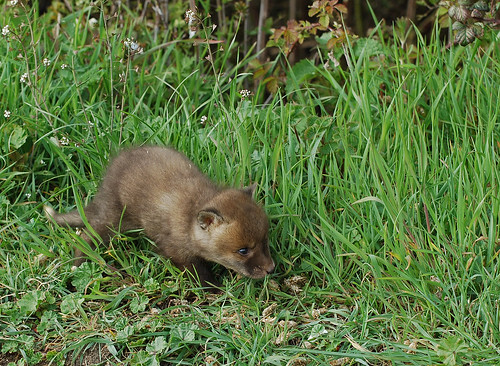
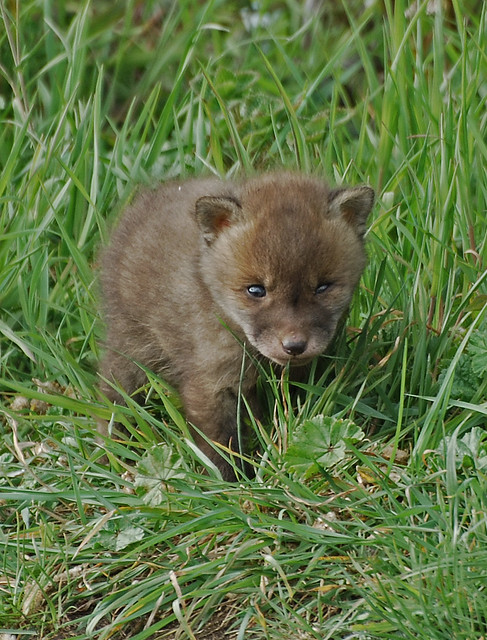
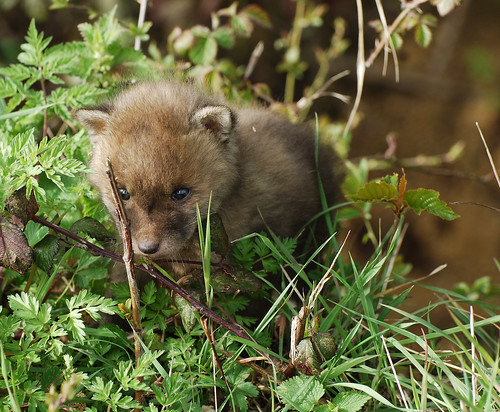
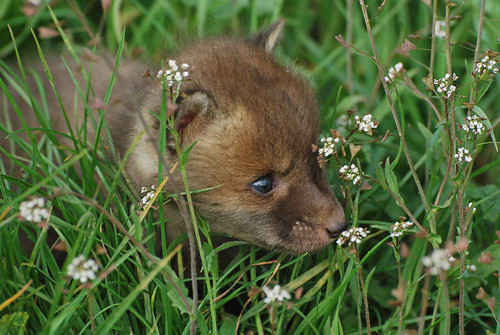
It was Easter last weekend and my parents were visiting. On Saturday I had walked the dog in the fields north of Histon and shortly after entering the field another dog walker told me there was a fox cub (Vulpes vulpes, Dansk: rød ræv) in the undergrowth I had just walked past. So I retraced my steps and sure enough there was this adorable little creature exploring the parapet of the ditch:

It’s body was only 6-7 inches long and I guessed it was the boldest of a litter which had taken the opportunity to wander whilst the mother was out hunting. So I took a few photographs and left it to it’s own devices, and when I completed my loop it was no longer there so I assumed it had returned to the den.

The following day my mother accompanied us for a walk in the hope it was still there, and indeed there it was in exactly the same place, but this time it seemed considerably emboldened and I was extremely concerned that a pet dog may kill it as this was right on a very popular dog walking route. My mother decided that my father should see it and she was going to return and fetch him, so I carried on to walk the dog.

When I got back my mother had been told by someone who lives close by that the vixen had been killed and the cub was orphaned so she rescued it and when I got back it was in a box on top of the piano. Which left me with a dilemma: what does one do with an orphaned fox cub at 4pm on Easter Sunday? It proved to be tricky to find somewhere that took wild animals, so in the end I rang up Wood Green Animal Shelter at Godmanchester, which is only about 12  miles from here, in the hope they would know somewhere that would take the little orphan. And luck was with us, they made some enquiries and gave me the phone number of a lady who lived fairly close by who had reared orphaned fox cubs in the past and was prepared to take ours. So self, mother, the children and the boxed up fox cub were bundled into the car and off we went, and an hour later our little cub was in the hands of someone who was skilled in the art of looking after wild foxes. Result!

It turned out to be a 3-4 week old vixen, who apart from being dehydrated seemed to be in reasonably good shape. She was expected not only to survive but was to be passed on to a wildlife sanctuary for eventual release into the wild. My fingers are crossed that this happens and she has at least one litter of her own cubs. I’m going to try to find out how she does and if I can get an update I’ll let you know.

Turn of the century

After 20 months of posting this is the 100th episode of The Naturephile. The original plan was to post once a week wherever possible and I’ve averaged around five a month, so that stayed roughly on track. I thought I may struggle to find enough subject material and to acquire sufficient photographs of the necessary quality to post as often as I wanted too, but that hasn’t been a problem, so far.

When I started off writing The Naturephile, the idea I may reach a hundred posts never entered my mind, so to mark the moment I’ve trawled back through the archive to find my favourite posts to give them another airing. I’d anticipated it would be a straightforward venture but of course I’d rather underestimated the amount of subjects/species and photographs I’ve written about. But the number of posts was eventually whittled  down to 14.

1) At the end of September 2010 one of natures more brutal rituals was played out right outside my back door involving garden spider courtship. Like other spiders this can easily end up in the death of the male as it did in this case. ‘Araneus diadematus‘ posted on 2nd October 2010:


I really love you… . Male on the left, Shelob on the right

2) A little farther afield are dragon flies, the most common species I encounter are common darters and migrant hawkers. This Common darter appeared in a post on 19th October 2010. I like the symmetry of the fly and the seedhead and the red colour of this male darter against the brown grass.

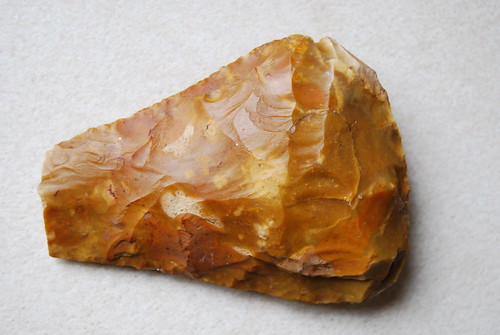
3) A few years ago when my sister lived in a house (she lives in a kennel now. Only joking, she lives on a narrow boat ;-)) they were digging the garden and this piece of rock turned up. It’s an Acheulian hand axe made from flint and the marks on it are where it was worked with a deer antler. It dates from around 400,000 years ago which means it could have been made by a pre Homo sapiens hominid! It fits beautifully into the palm of my hand and after that many years the edges are still sharp. Even if I was blogging about topiary or book binding I’d have to find a way to slot this in.

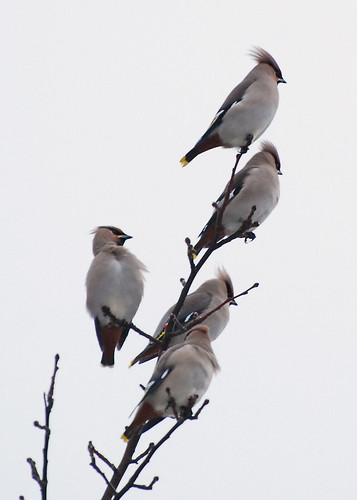
4) The winter of 2010/11 was known as a ‘waxwing winter‘. Every winter a  few waxwing (Bombycilla garrulus, Dansk: silkehale) migrate to our shores from Scandinavia to overwinter. But occasionally the weather up there is fearsome so the waxwing migrate in large numbers and we then have a ‘waxwing winter’. And I hope you’ll agree the waxwing is a beatiful  bird:

A group of waxwing perched at the top of a rowan tree in north Cambridge

5) Another consequence of the bitterly cold winter of 2010/11 was that most stretches  of open water were frozen over and our herons (Ardea cinerea, Dansk: fiskehejre) were starving because they couldn’t access their normal food supplies. During this winter  a hungry heron appeared in my friends garden and taking pity on its plight he fed it some fish. And of course one fish supper turned into rather more than one so the heron came to expect it, and if dinner was late it came and tapped on the window to complain to the management.

6) Sea mammals of any description are always a delight to see and photograph and one of my favourite places on the planet for doing that is the Farne Isles situated just off the Northumberland coast.


Atlantic grey seal in the North Sea off the Northumberland coast

Our holiday last year was to Northumberland and I can’t go there without taking in a boat trip to the Farnes where hundreds of Atlantic grey seal were basking on the rocks and generally taking life easy in the water.

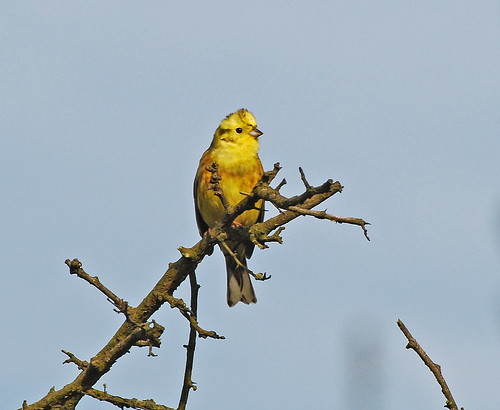
7) Closer to home, April last year was hot and sunny and a great time to see songbirds in the countryside. One of my favourite birds is the yellowhammer (Emberiza citrinella, Dansk: gulspurv) and they’re regulars in the hedgerows around Cambridge.


Yellowhammer male  – what a gorgeous colour!

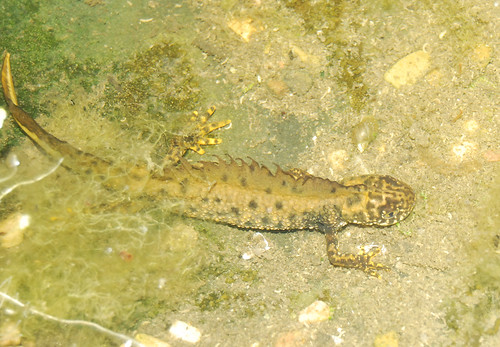
8) A creature I’d never encountered before last year was the great crested newt. My friend told me of a place where they could be found so we ensconced ourselves in the nearest pub in preparation for a nocturnal newt hunt after closing time.

It was a very successful trip, a few pints followed by finding  not only the great crested newt but the other two species of UK newt, palmate and smooth newts.

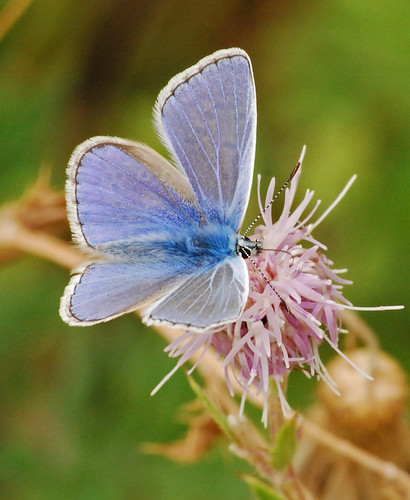
9) As the year rushes headlong into summer and the butterfly season really gets underway I can spend many an hour chasing our Lepidopterans round the fields trying to get that perfect picture. One of my favourites is the common blue and this is about the closest I got to that perfect picture:

Common blue male sipping nectar – one of the best photographs I’ve ever taken

10) As well as being a top location for marine mammals the Northumberland coast is also home to huge numbers of seabirds so it’s a very happy hunting ground for me!

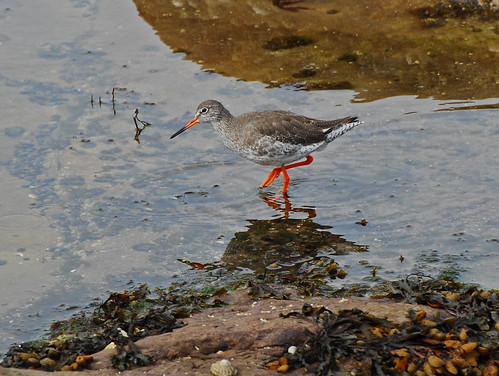
Just poking your head over the seawall at Seahouses can reveal lots of seabirds including oystercatcher (Haematopus ostralegus, Dansk: strandskade), knot (Calidris canutus, Dansk: islandsk ryle), eider (Somateria mollissima, Dansk: ederfugl), turnstone (Arenaria interpres, Dansk: stenvender) and this  redshank (Tringa totanus, Dansk: rødben).

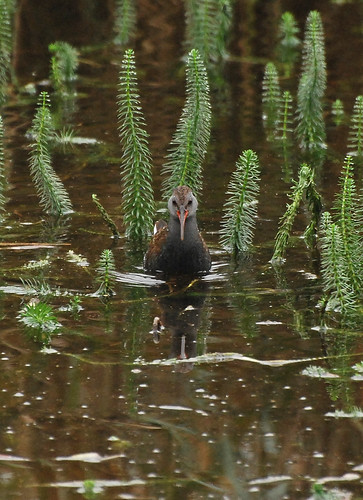
11) RSPB Fowlmere, to the west of Cambridge is famous for its water rail. On a trip there in December 2011 I was tipped off by a local that a particular hide was good for water rail (Rallus aquaticus, Dansk: vandrikse) and one had been seen there that morning, so off I went to try and see it.


My informant was correct. There was just the one bird there, but it scoured the mudflats in front of us for a whole hour before disappearing into the reeds, giving me plenty of good photo opportunities. I was very pleased with the primeval feel of this image with the bird face on infront of the horsetails.

12) In January this year the weather was absolutely freezing causing a small group of red-legged partridge at Tubney Fen, east of Cambridge, to seek the warmth generated by a mountain of dung:


13) My favourite bird of prey is the kestrel (Falco tinnunculus, Dansk: tårnfalk) and they are always to be seen hovering in the skies over the fields around Histon. I love watching the highly specialised hunting techniques all birds of prey in action, but the kestrel beats them all in my opinion:


A male kestrel showing off all his hunting hardware: talons, flight feathers, eyes and aquiline beak

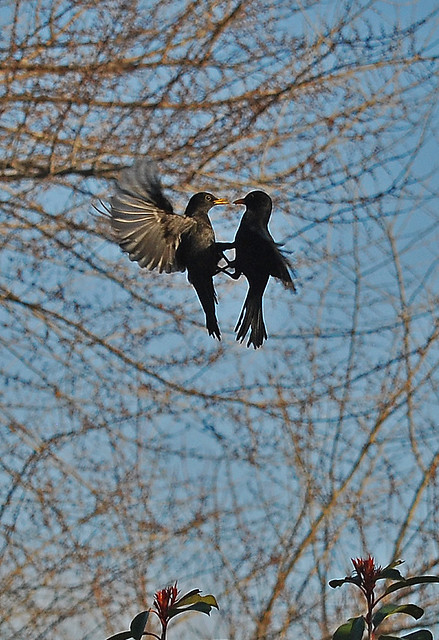
14) And lastly, I couldn’t write a post like this without including my battling blackbirds. Of all the bird species that visit my garden these are the ones that provide the most entertainment:

My garden gladiators locked in aerial combat

These were a few of my favourite posts, favourite for various reasons: the stories attached, the rarity of the sighting or simply the exquisite natural beauty of the subjects. I hope you like them!

And lastly, I’ve been stunned by the numbers of people from all round the world who read The Naturephile and like it enough to follow it or click the ‘Like’ button. Thanks to everyone for stopping by and enjoying a read, I love sharing the nature from my corner of Cambridgeshire with you!

Birds and bee(flie)s

The day after the cold weather put paid to my snake hunting exploits I decided to take the dog for a quick run in the afternoon. He had just had a small tumour removed from his back leg and so he had a lampshade on his head to stop him chewing his stitches and consequently this walk was only meant to be a short one, and I wasn’t even going to take my camera. But on the way out the door I decided because it was very sunny and very warm I would take my camera. And I’m glad I did because there was wildlife in abundance.

Peacock butterfly, Inachis io, sunning itself on the path

The air was abuzz with insects including butterflies. I really like photographing butterflies and peacocks are good because they present a medium sized challenge. If you approach with stealth and don’t cast a shadow on them they let you get to within a few feet. The peacock is a species that can be seen at any time through the winter as it can wake in response to warmer weather, but they emerge in spring around the end of March/beginning of April, so the timing for this one was spot on.  As I was photographing the peacock a sparrowhawk (Accipiter nisus, Dansk: spurvehøg) flew past at high speed, much too fast to enable a usable photograph, it’s always good to see a bird of prey because I think it suggests the prey species are in good order too.


Long tailed tit, Aegithalos caudatus, Dansk: halemejse

The field where I found the peacock butterfly has a corner which faces south west and it was sheltered from the wind and bathed in spring sunshine. It was really warm when I arrived there, so I stood still and watched and listened while the dog went off to explore, and the trees around were full of birds including the long tailed tit, above, and a song thrush, below.

Songthrush, Turdus philomelos, Dansk: sangdrossel

While the birds were capturing my attention in the trees, butterflies weren’t the only insects there. In my corner there were also beeflies buzzing around. I was keen to try to photograph them in flight which is a tad more challenging as they would hover for a few seconds before darting off at very high speed in zig zag lines. But they were making the most of the shelter from any breeze that prevailed in this sheltered spot and I spent a good hour trying to photograph them.


Beefly, Bombylius major

The beefly, as the name suggests is a bee mimic. It has a very prominent proboscis which is used to extract nectar, and the fur is part of the bee disguise. It is a very good pollinator but is detrimental to other pollinators.

It is detrimental because it parasitises other bees and beetles. And the way it achieves that is another of those bizarre evolutionary adaptations that even the most imaginative science fiction writer wouldn’t dream of. It mimics bees in order to get close to their burrows where using its legs the female will flick her eggs into the hole where it hatches and attaches itself to the host. Then the gruesome bit: it lies dormant until the host commences pupation and then becomes an ‘ectoparasite‘ which means it remains on the outside of its host but extracts the body fluids to fuel its own growth. After draining its host dry it reaches the pupal stage which can vary hugely in length and they have been known to overwinter before emerging as an adult the following year.

Beeflies have appeared in several blogs in the last week or so and there are some more very fine images here:

http://www.leavesnbloom.com/2012/04/bombylius-major-bee-fly-aerodynamics.html

Rosie from ‘leavesnbloom’ has a wonderful collection of images of Bombylius major and Harlan from ‘The Roused Bear’ has also captured one in Iowa in the U.S.:

http://therousedbear.wordpress.com/2012/04/07/a-fuzzy-bee-fly/

They can be found across the whole planet except Australasia.

More birds which appeared in the trees around while I was chasing beefly were the common or garden greenfinch and chaffinch:


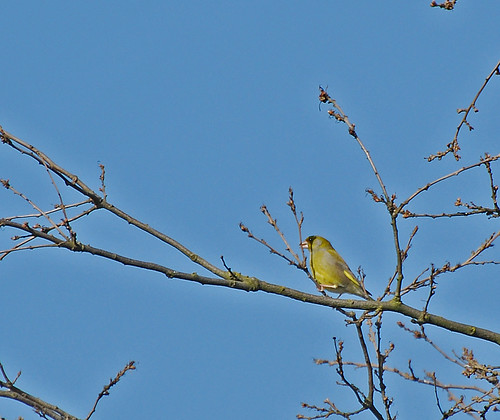
Greenfinch male pecking at a twig
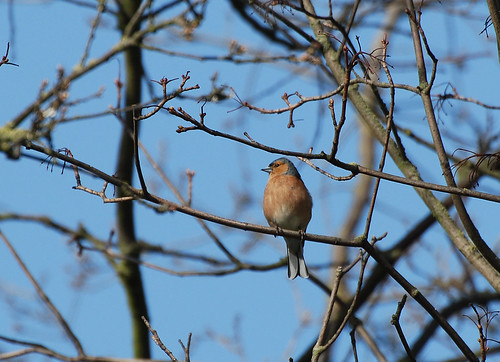
Chaffinch male just taking it easy

Both greenfinch (Carduelis chloris, Dansk: grønirisk) and chaffinch (Fringilla coelebs, Dansk: bogfinke) are common or garden, but are both beautiful birds, and they can be seen here in the U.K. all year round. But a species that isn’t here all year round and returns after its winter migration to north Africa is the chiffchaff (Phylloscopus collybita, Dansk: gransanger):

The chiffchaff, named after its characteristic song, is a warbler and despite being a small bird they are tough. Their migration takes them south across mainland Europe, across the Mediterranean Sea and into north Africa, to retrace their flight four or five months later in the spring. And despite the hardships associated with such a gruelling endeavour, according to the British Trust for Ornithology (BTO), there are around three quarters of a million territories in the UK. They are one of the first migrants to arrive back in the U.K. and can be heard singing as early as late February. But this my first one in Cambridge on the first weekend in April.

Blakes Wood

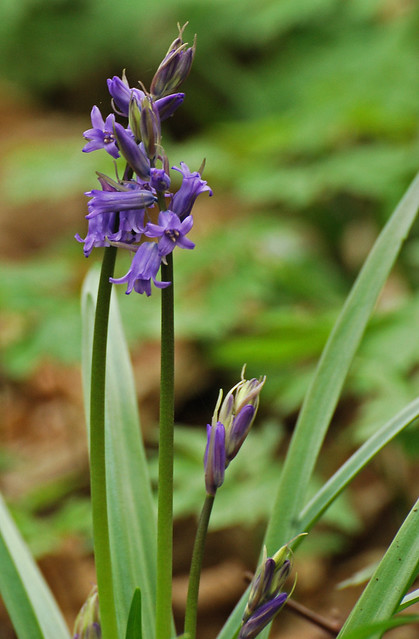
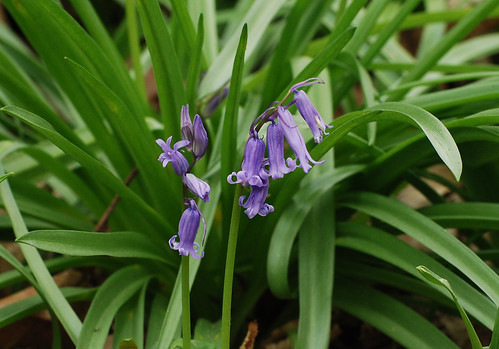
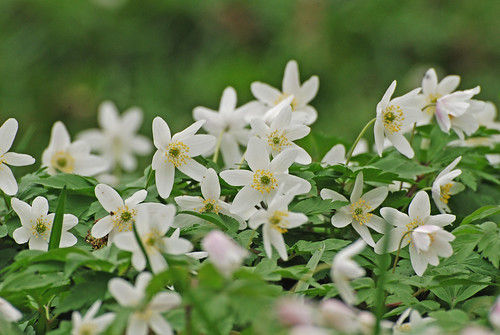
In my last post I visited Danbury Common in Essex. After getting over the disappointment of not seeeing snakes we headed to Blakes Wood which is another National Trust site situated on the opposite side of Danbury to the Common. It’s an area of ancient woodland, predominantly hornbeam and sweet chestnut under which the ground was covered in withered chestnut husks emptied of their contents long ago by squirrels or mice, and in the springtime wood anemones (Anemone nemorosa) and bluebells (Hyacinthoides non-scripta) carpet the forest floor.

Bluebells have been voted Britains favourite flower and they normally reach their flowering peak in mid May.


Bluebells are delightful flowers when there is only one plant, but when they stretch across a forest floor as far as the eye can see they’re absolutely magical. I didn’t expect to see any at the weekend, it still being March, but they are starting to flower already.

The Natural History Museum is conducting a survey of bluebell flowering times as a means of monitoring climate change. A quick glance at the data is starting to get alarming, the earliest flowering time seems to be getting earlier, from first flowerings in Essex in May in 2010, moving to the middle of March in 2012, in just three years since the study commenced. I don’t know what the long term ramifications of climate change will be for our native flora and fauna, we’ll have to wait and see but I hope the bluebell woods survive.


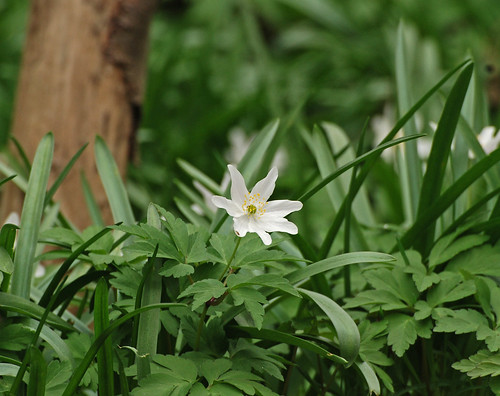
A single wood anemone protruding through the bluebell leaves

The wood anemones are as beautiful as the bluebells even if they don’t have the same level of ‘Wow‘ factor. The forest at Blakes Wood was liberally bespattered with carpets of wood anemones and I got down in the undergrowth to try to fill the frame with flowers:

I was keen to capture a shot with both anemones and bluebells in the same frame and that turned out to be tricky because of the sparsity of the bluebells, but I eventually found this one:


Spanish bluebell bulbs have been sold in garden centres but they are a different species, Hyacinthoides hispanica, to our UK bluebells. Flytipping of garden waste has resulted in the Spanish variety getting into our woods and cross breeding with the native species. This is a real problem because it is anticipated the hybrids may eventually take over from the natives, but I console myself that the invaders and hybrids are lovely to look at too. I can’t wait to visit the woods again in May when the bluebells are in full bloom, and when I do I’ll share the results with you.

Essex adder challenge

Danbury Common near Chelmsford in Essex is a National Trust site that is a mixture of woodland and heathland and is renowned for reptiles, in particular teh European adder (Vipera berus). The weather for the last 2-3 weeks has been ideal for resurrecting hibernating reptiles so myself and my friend, Dave, who is a very accomplished nature photographer, went along to try to get some pictures of adders. They are the only venomous reptile native to the UK and their preferred habitat is heathland. Dave originates from Essex and is familiar with Danbury Common and assured me that we would definitely see adders, so I was rather excited as I’ve never seen a wild one before.


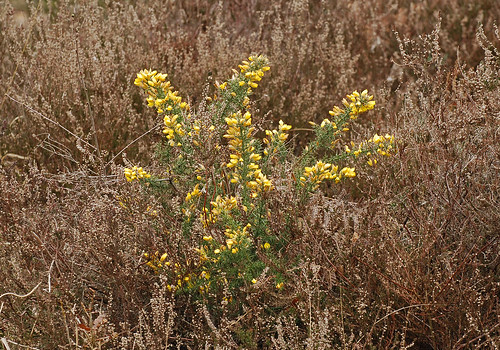
The heathland terrain was perfect reptile territory, there are substantial areas of gorse and heather intermingled with bracken

Unfortunately two events conspired against us: the weather on Saturday morning was the coldest it has been for weeks and with 100% cloud cover there was little warmth to entice the adders out of their burrows, and secondly there had been an accidental fire right over the main hibernaculum, all of which resulted in the total absence of adders and any other reptiles!

Despite that, the Common is a great place for wildlife so we wandered around to see what else was in residence and were rewarded by the first blackcap (Sylvia atricapilla, Dansk: munk) and chiffchaff (Phylloscopus collybita, Dansk: gransanger) sightings of the year for me.


A male blackcap, one of a pair

Until recently blackcap were considered to be summer migrants to the UK, spending there winters in sub Saharan Africa and as far down as South Africa.  More recently they have been winter residents too and it is thought this is the result of westward migration of birds from eastern Europe and also from the Low Countries, not our summer residents staying put. They disappear from my regular haunts around Histon in the winter, but my friend who lives on the other side of the village, just half a mile away, has been hearing them sporadically through the winter.

I heard several chiffchaff and saw a couple too, but they didn’t come close enough to photograph, but the woods were full of great tit (Parus major, Dansk: sortemejse) which were more amenable to pose for a portrait:


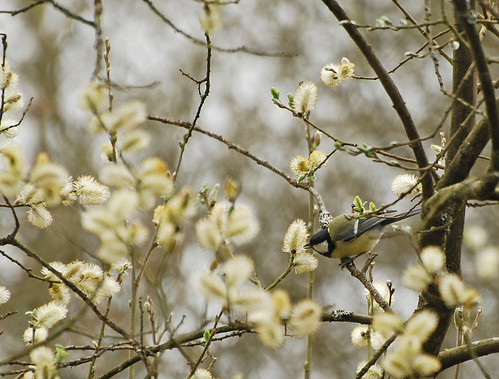
Male great tit feeding on pussy willow. The tree was busy with at least four great tit, a pair of blue tit and a long tailed tit

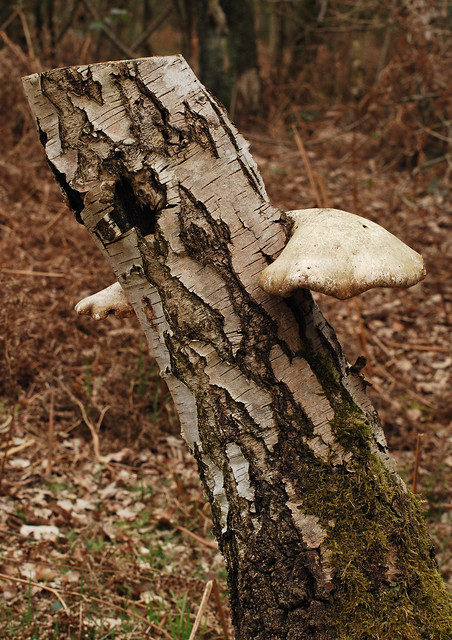
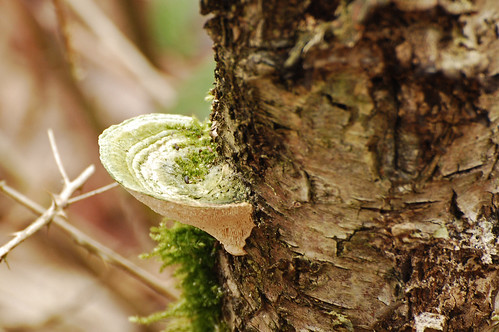
Backwarden nature reserve and Danbury Common are bisected by a road and Backwarden is an area of woodland containing sycamore, oak, birch and willow similar to that on the Common. Many of the trees were hosting various fungi including moulds and these brackets growing out of the stumps of felled trees:


…and this amazing mass of gelatinous psychedelic slime mould which I thought resembled candle wax:


I’ve never seen anything quite like this before but it appeared the sap had welled up out of the felled tree and the sugar rich solution was providing a glut of nourishment to opportunistic fungi.

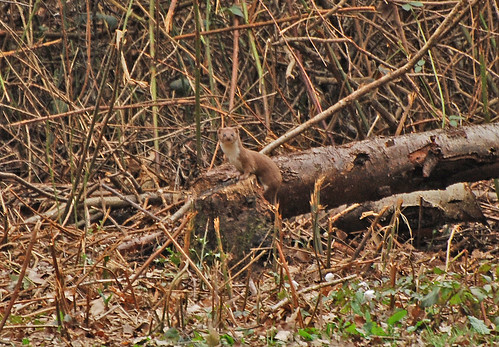
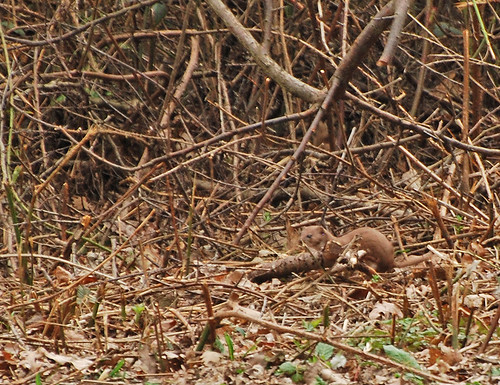
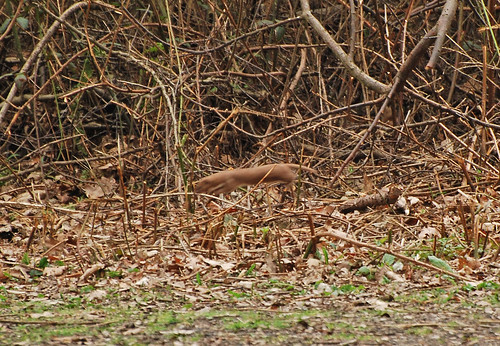
The highlight of the trip, in the absence of snakes, was a weasel (Mustela nivalis) which bounded across the path and stopped to scrutinise us for long enough to take a couple of photographs. It’s years since I’ve seen weasel and we had to zoom in on the pictures to decide whether it was a weasel or a stoat (Mustela erminea). The stoat is around 30cm long so is bigger than the weasel which is around 20cm, and the stoat has a black tip to its tail which our little creature didn’t. Stoats go completely white in the winter except for the black tip of their tails and it is the pelts of the winter stoat which are used to make the ermine gowns of members of the UK House of lords.


Momentarily distracted by our presence

Then probably a potential prey item. Ready…

Set…

Go!

And he was off, like a brown furry exocet, at quite phenomenal speed. The pictures aren’t very good quality, but you can clearly see what he is and it may be a good few years before I get to photograph another! I’ll try to get to Danbury again over the summer and if I manage to take some pictures of an adder I’ll post them here.

Buds and blooms

Many fellow bloggers out there have been posting some lovely images of spring events and as this time of year is an exciting one from a nature perspective I felt inspired to get out and get some pictures of vernal regeneration in my part of the world.

I didn’t have to wander too far, the apple and hazel trees and the beech hedge in my garden are showing signs of waking up from the winter slumber:


Nascent apple blossom about to burst into life

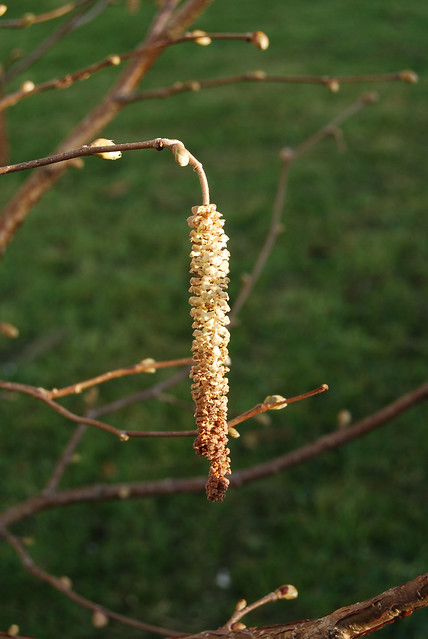
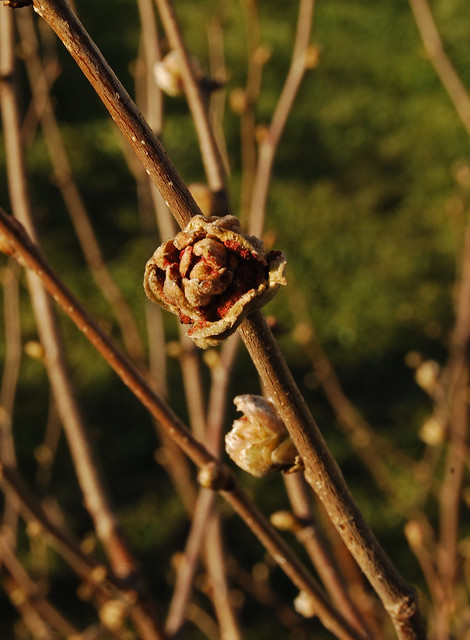
A catkin – the flower of the hazel tree, above. And below, the diminutive inflorescence that will eventually become a hazelnut.

Hazel trees (Corylus avellana) produce catkins early in the year which are monoecious, which means they are either male or female, the one above is a male one, the females being tiny and hidden in the buds and the pollen is wind dispersed.  They provide not only nuts but if left to their own devices hazel ‘poles’ sprout from the ground which grow tall and straight and are coppiced to make fencing, and in the days when wattle and daub was used for building  walls the poles were used to make the wattle on which mud was plastered to provide the daub.

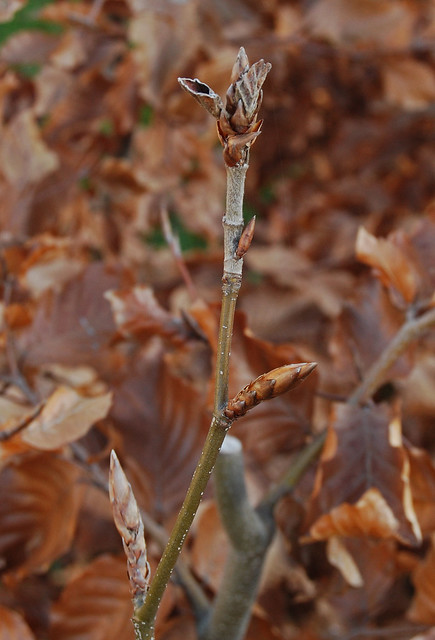
Beech leaves sprouting from the apical buds at the top of a hedge


A couple of hundred metres along the road on the grass verge was this cluster of lesser celandines (Ranunculus ficaria)

According to the font af all wisdom that is Wiki, lesser celandine used to be known as ‘pilewort’ because it was thought of as a remedy for haemorrhoids. I like this cluster because all the flowers are in different stages of opening, from a tightly closed green bud to a fully open flower.

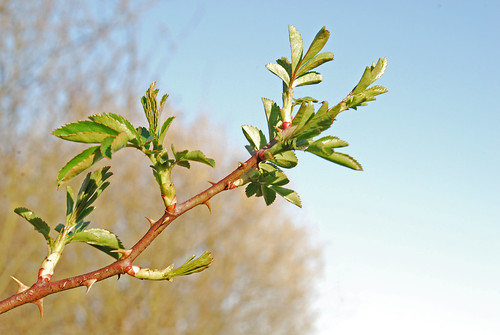
Once into the fields the hedgerows were lined with the thorny stems and freshly shooting leaves of the bramble:

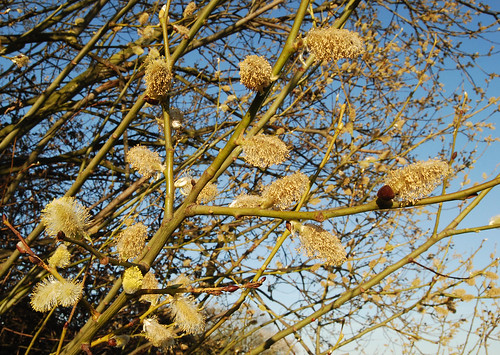
Lining the drainage ditches which delineate the field margins in this part of the world are willow trees (Salix cinerea) which need the water that drains from the fields and in the spring are covered in the furry catkins which give the tree its common name of ‘pussy willow’:

Willow catkin – unlike the hazel the catkins of the willow are dioecious, containing both male and female reproductive machinery in the same catkin

The wood of another species of willow tree (white willow, Salix alba) is very light and very strong and is used to make cricket bats and the bark of the willow contains a compound called salicylic acid which is the chemical precursor of aspirin. The analgesic properties of willow bark have been known of for centuries and have been maximised by acetylating salicylic acid to make aspirin. As well as analgesia, aspirin is now used as an anticoagulant to reduce the risk of heart attack and stroke and recent studies suggest it may have anti-carcinogenic activity too.

The plants in this post are a random selection from the garden, roadside verge and the countryside within 200 of my house and all of them provide us with something useful. The beech is structural and is ideal for hedging. Apple, bramble and hazel all have edible fruits. Lesser celandine may shrink your chalfonts* and the willow provides drugs to treat pain, heart disease and cancer (not forgetting cricket bats).

* Chalfonts = ‘Chalfont St Giles’ (I’m sure you can work it out)

A short bluesy interlude

Last Saturday found me in Cambridge with my daughter, and on our meanderings through town we dived into Fopp, which is probably my favourite shop of them all because not only does it sell CD’s (terribly 20th century, I know), but it also has a fair vinyl selection! The upshot of that was that I left for home a good few pounds lighter and a few discs heavier, and one of those discs consisted of the entire recorded output of the original Chicago blues man, Robert Johnson.

So as soon as we got home I inserted said Mr Johnson into the CD player and lost myself in the blues, and whilst I was in my blues-fueled reverie I noticed there was alot of avian activity going on in the garden so I grabbed my camera and spent a few minutes photographing them, so here is a selection of my visitors:

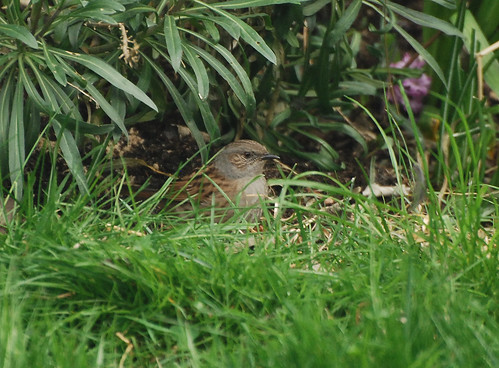
My favourite garden visitor is the dunnock (Prunella modularis, Dansk: jernspurv). He hunkered down in the border and watched me taking photographs

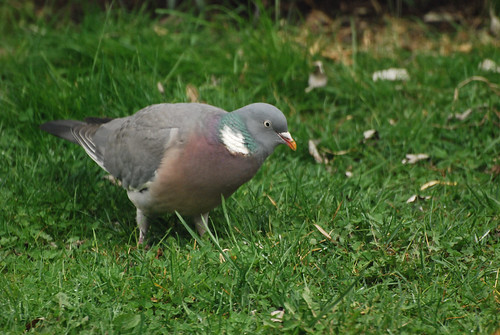
Another species which is appearing more and more often in gardens is the wood pigeon (Columba palumbus, Dansk: ringdue). Wood pigeon are a much maligned species in my opinion, they seem to be universally despised by country folk and shot out of the skies in huge numbers. Having said that, there are huge numbers of them, and I often see flocks of many hundreds or even thousands in Histon and one of these flocks can decimate a fields of sprouting crops in a very short space of time. So it’s understandable that they are not at the top of the farmers’ christmas card list.


Much disliked the wood pigeon may be, but they are handsome birds and more than welcome to refuel in my backyard!

And then who should appear, but my resident blackbirds. The gladiatorial action is long past now and they have settled down to the business of reproduction. I can’t confirm it yet but I think they may have built a nest in one of my bushes. I hope so.


The blackbird male in his new found larder

My wife and daughter created this new flowerbed at the weekend and he spent a good few minutes meticulously turning over the surface on a quest for an insect feast. He’d just finished working his way from one end to the other when the female entered from the left and sent him packing  in short order.


The blackbird female mopping up the insects disturbed by the male

The romance is over now and they’re into the serious business of begetting and raising young. Lots of bird species are currently using my garden so I’ll try to post some more pictures of them in the near future, hopefully including fledglings.

The North Fields

If you’ve been reading my recent posts you’ll know they’ve mainly been from the part of my village (Histon, Cambridgeshire) called Rowleys Meadow. I have two routes out of the village, the Meadow and what I call the North Fields, and the terrain is very different. The Meadow isn’t farmed and has many hedges, thickets and trees and is therefore better for birds in the Winter because it has a much higher density of numbers and species. But now it’s officially Spring, after the Equinox on March 20th/21st, I decided to visit the North Fields which are all under the plough. I’ve been over there on a few evenings at dusk and after dark in the last few weeks and heard golden plover (Pluvialis apricaria, Dansk: hjejle) and skylark on the ground but I haven’t been over there in daytime for a while.

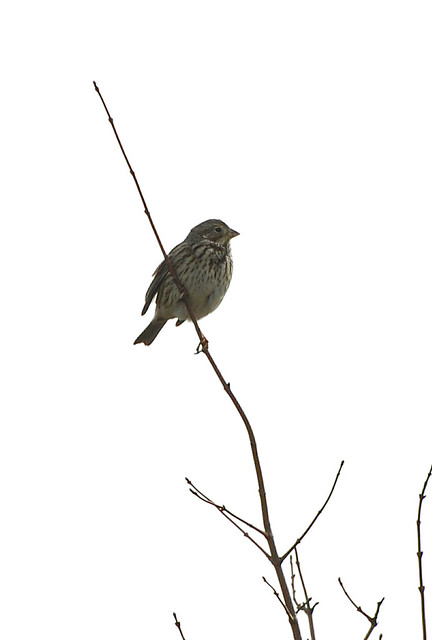
The main reason I headed over there was because I wanted to find out if the large numbers of linnet and corn bunting which disappear from the fields every year at harvest time had returned. My first impression on entering the fields was that I should have gone to the Meadow, there was virtually no movement of any kind, but I stuck to my guns and that turned out to be a good decision. I didn’t expect to see corn bunting, which are becoming increasingly scarce on our farms, yet, but I had only gone half a mile or so before I heard the unmistakeable sound of a male calling. I heard him long before I saw him but I knew where he would be perched from where his song was coming from, it is a favourite perch all the time they are in residence:

Corn bunting (Emberiza calandra, Dansk: bomlærke) sitting in a favourite place and singing loud

It’s not the best picture of a corn bunting because the sun was still low in the sky directly behind with a thin layer of high white cloud inbetween. Consequently it was impossible to get anything other than a silhouettte without overexposing the shot, so that’s what I did so his colors can be seen. He wasn’t the only one I saw, there were three altogether, so I hope there’ll be a good few more in the next few weeks.

Another bunting which put in an appearance was a male reed bunting. There were several of these too, and just along the ditch from here was a flock of between 10-20 yellowhammers alternating between a hedgerow and the ground where they were feeding.


Reed bunting male (Emberiza schoeniclus, Dansk: rørspurv)

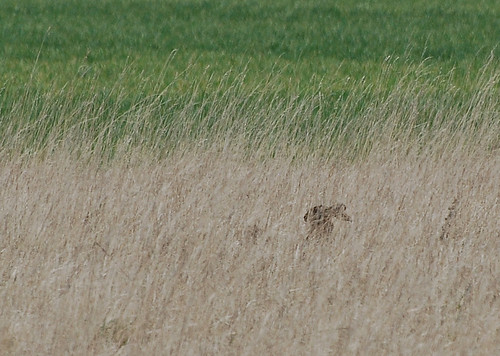
I didn’t go close enough to photograph the yellowhammers because I didn’t want to disturb them. Well, partly that, but also because I’d been distracted by a pair of hares (Lepus europaeus) chasing each other around in the long grass:

I couldn’t get close enough to get a picture of the whole hare, they were too wary of me and the dog, who’s a lurcher, so their timidity was well justified! But I like the way their ears poked up above the grass with the characteristic black tips.


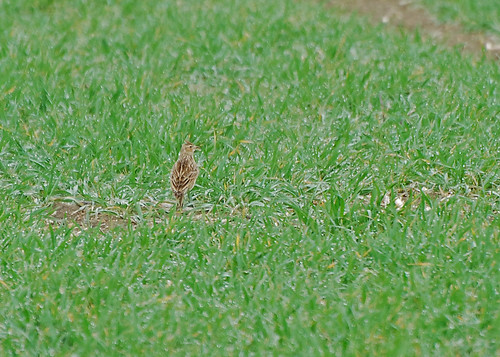
Skylark waiting on the ground between high speed aerial duels with other larks

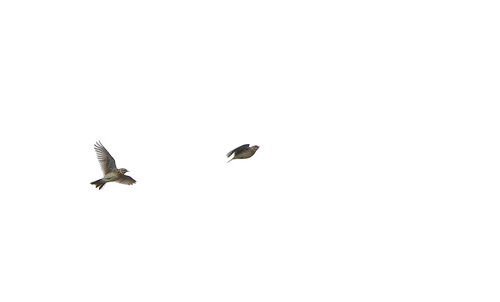
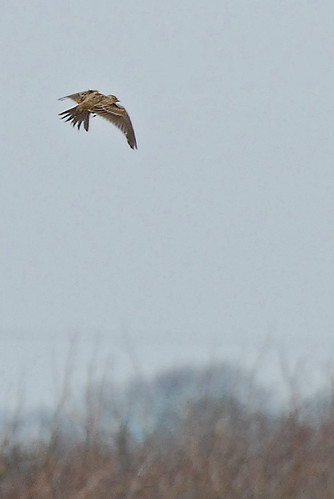
The other bird which was present in large numbers was the skylark (Alauda arvensis, Dansk: sanglærke). I stopped counting when I got to 30, and I wasn’t yet half way around my walk. They were on the ground, up high singing the amazing song that is is so much part of a British summer, and chasing each other around just above the ground at high speed in groups of up to around half a dozen.

I saw a TV show some years ago in which skylark song had been hugely slowed down and deconstructed, and they claimed the music of some classical composers (including I think, Beethoven) was based on the same structure. I was left sceptical, not least because Ludwig V was deaf and may therefore have struggled to analyse skylark song. But even so, it was fascinating!


Low level dogfight


High level chase

And singing his heart out

One of my other fascinations is etymology. I think that may originate from speaking two languages, and the first one I spoke, Danish, is one of the precursors of the current one, English, so a large number of English words have their derivation in Danish thanks to our Viking invaders all those centuries ago. The expression ‘larking about’ (and ‘lark’ may well be from the Danish ‘lærke’) originates from falconry. In days of yore, the men would go hunting with their peregrine falcons and the ladies would only be allowed to use the much smaller merlin which couldn’t catch birds bigger than larks. Hence ‘larking about’ became a term of derision based on the size of your falcon.

But I digress. The corn bunting are back, the sky was full of larks and the hares were getting frisky. I’ll keep you posted when the linnet and other summer visitors arrive.

More signs of Spring

The weekend before last, the 3rd/4th of March, was generally pretty murky and grey and generally not very pleasant, but a stroll around the fields and meadows of Histon showed up some encouraging signs of Springtime. To start with, several birds including blackbirds and house sparrows were plucking nesting material out of the shrubbery in my garden.

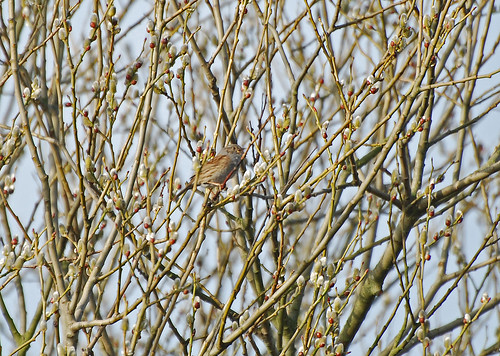
And in the meadow the buds of the willow, ‘pussy willow‘, were bursting out

…and amongst the buds was this little dunnock singing his head off. Dunnock (Prunella modularis, Dansk: jernspurv) make a big sound for such a small bird. You can here the song here.

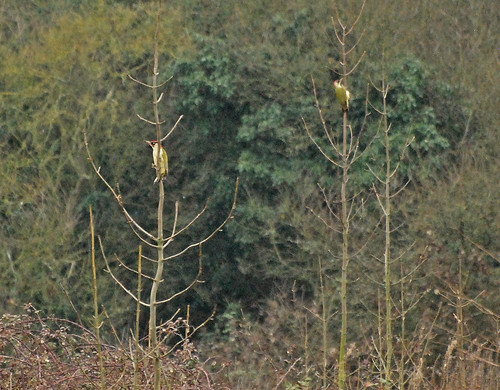
And other birds which are all adding to the avian orchestra around here at the moment are the green woodpecker (Picus viridis, Dansk: grønspætte) whose striking call I posted a link to a short while ago:


Not just one green woodpecker, but a pair. There are lots of these in the meadow but it’s seldom I see two together, and even more seldom they let me photograph them!

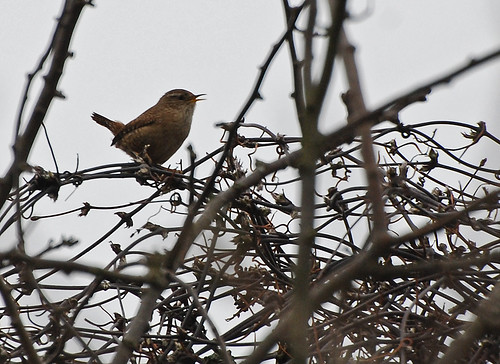
And this delightful wren who sat high and sung loud

I was very pleased with my wren picture because I rarely see them in a suitable place and they’re usually flitting in and out the undergrowth and don’t stay still for long enough to photograph. And even though it was very murky that morning and I had to use ISO 400, I like this shot. Like dunnock, wrens also make an amazing sound for such a small bird. And wrens (Troglodytes troglodytes, Dansk: gærdesmutte) really are tiny, they are 4-5cm long and weigh approximately 10g but they make a huge sound which is easily recognisable as it’s punctuated by short stretches of ‘whirring’ which differentiates it from other small bird song.

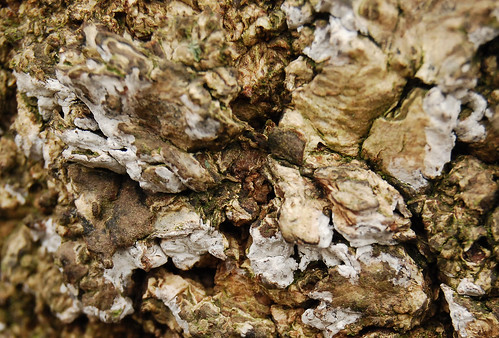
And the last thing to catch my eye on this trip was this tree bark. I couldn’t tell what type of tree it is so I’m waiting for the leaves to open so I can give it it’s proper name, but it has some wonderfully textured bark which is covered in a white mould:


I had to get down and crawl through the leaf litter to get to the base of the tree

Lots of early Springtime phenomena were going on, from pairs of green woodpeckers to singing wrens and blackbirds collecting nesting material. More Springtime firsts next post.