Category Archives: UK wildlife

Local Histon Lichens

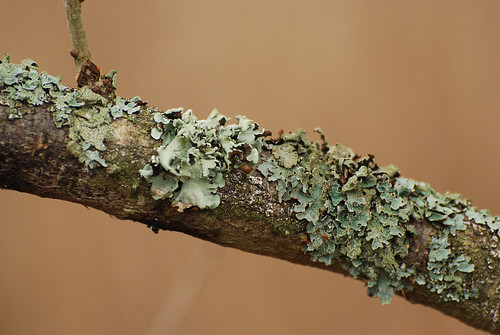
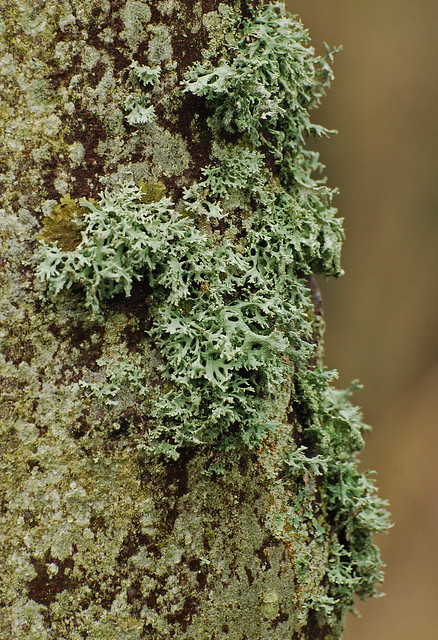
A closer look at the trees and branches, live and otherwise, in my local meadow which I posted about recently, revealed large quantities of lichen. I’d seen it there before but never really paid it sufficient attention so a couple of weekends ago I decided to rectify this shabby state of affairs.

To my highly untrained eye there didn’t seem to be more than 4-5 species but the ones that were there were present in abundance. There are four basic  morphologies of lichens: they are crustose – the flat ones which form very thin layers, foliose – form leaf like structures but where the leaves lie flat and don’t protrude far from the surface of the substrate, fruticose – have longer branched structures and can look like small shrubs and lastly squamulose –  have horizontal, scaly, overlapping lobes and look rather like some fungi I’ve seen growing on dead wood.


A grey/green crustose species and a fruticose species, the yellow one.

Lichens can be extremely sensitive to pollutants, and as a rule of thumb the foliose species are generally more sensitive and are only found in places where the environment is clean and free of fumes and other chemical pollutants. Consequently the species I find in my local patch, being close to a big town, are of the crustose and fruticose varieties. Sensitivity to pollutants can cut both ways though, those susceptible to acid pollution will obviously suffer in a low pH environment, but others which have a high demand for nitrogen can really benefit from pollution by agricultural fertilisers.

The ones I found were all growing on the surface of live deciduous trees and dead branches and the trees in the meadow are predominantly ash and oak. I’m not going to try to identify the different species here because I don’t have the requisite expert knowledge to unambiguously name lichens, but I plan to do some reading and observing and I’ll post again if I find out what they are. Even though I don’t know the species I think their colours and structures render them particularly photogenic.

The ‘thallus‘ (main body) of the yellow lichen above has the leafy structures of a fruticose species surrounding round saucer shaped structures which are called ‘apothecia‘ and are the reproductive machinery of this lichen. Within the apothecia are tiny structures called ‘paraphyses‘ and these surround the ‘asci‘ from which the fungal spores are generated. Masses of this yellow species covered many trees and fallen branches in the meadow.


Another fruticose lichen which has the leafy structures but no reproductive apothecia – I’m assuming it’s another species and not a different stage in the life cycle of the yellow one


The grey/green species here is definitely a different one. It has some erect leafy and spiky parts and it appears to have apothecia which are more cup shaped

The fungal spores produced from the asci are microspcopic and dispersed on the wind and it is a matter of conjecture how they manage to settle on the requisite species of alga to form a new lichen.

Some species can reproduce both the fungal and the algal part simultaneously by growing structures called ‘lobules‘ or ‘isidia‘ which basically consist of outgrowths of the thallus of crustose or foliose lichens which break off and are dispersed by wind and water. Or there are structures calles ‘soredia‘ which are algal cells enmeshed in a bundle of fungal ‘hyphae‘ (threadlike structures of fungal cells) which are similar to the middle part of the body, the ‘medulla‘.

If anyone out there knows the names of these lichens or has any other snippets of lichen related information please leave a comment as I’d be very interested to hear them.
A stroll through the Meadow

Last Sunday I spent a glorious couple of hours in the piece of scrub near my house where me and the dog while away significant chunks of our time. He chases rabbits, cats, pheasants and generally enjoys doing what dogs do, and I marvel at all the wildlife to be found in my local bit of wilderness. It’s probably about 300m x 150m and it’s called ‘Rowleys Meadow’ even though it’s not a meadow, and it lies on the northern edge of the village with houses lining it’s southern periphery. On the east, west and north side are old hedgerows and some wonderful old trees and in the middle are stands of young ash trees, grassy areas and large clumps of brambles.

It plays host to an astonishing variety of wildlife which in the winter and early spring is mainly birds, although a peacock butterfly fluttered by last Sunday and on several warmer days since Christmas I’ve seen bumble bees flying around there . But on this particular day it was the birds that stole the show (click here for a full list of all my sightings on this outing on February 26th).

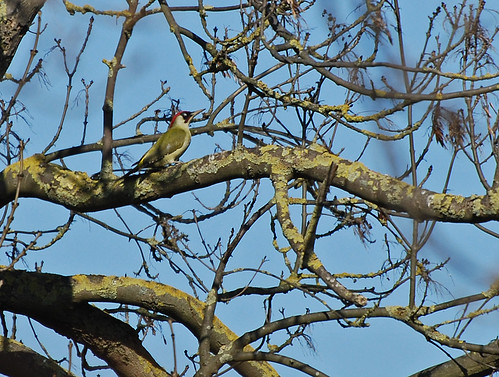
There are very healthy numbers of green woodpecker here due to the trees and the grassland where they can find there favourite food of ant and termites. They’re tricky to photograph in the Meadow because they’re hidden in the grass and they’re very skittish, so it’s difficult to get close enough when they’re on the ground or in the trees.

Green woodpecker with his black eyepatch and scarlet military policemans cap. This one did let me get close enough… just

There are regularly 5-10 green woodpeckers (Picus viridis, Dansk: grønspætte) to be found as I circumnavigate the Meadow. It’s easy to spot them, both the colours and the low bouncing flight, often no more than 15 feet from the ground, are very distinctive. And of course it’s call is like no other creature, if you’ve never heard it listen here. Scroll down to the entry from Lars Krogh from Lindet Skov in Denmark dated 19/04/2011 where there is a very good recording of a male greenie yaffling and drumming.

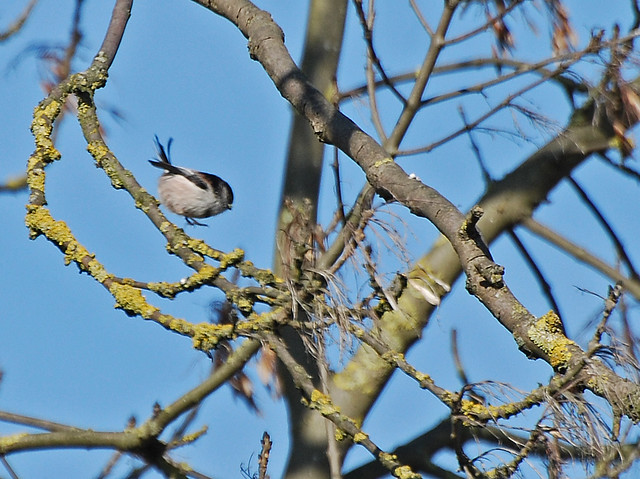
Another bird which I almost always see in the Meadow is the long tailed tit (Aegithalos caudatus, Dansk: halemajse). But for the tail, they’re tiny: the adults weigh 7-8g with a wingspan of 18cm. The long tailed tit is one of those creatures that make we wonder how such tiny ones can survive a long freezing winter. They can also be very difficult to photograph as they never stay still for more than a few seconds.


On final approach…

But when you are lucky enough to capture them they make delightful pictures!


Touchdown!

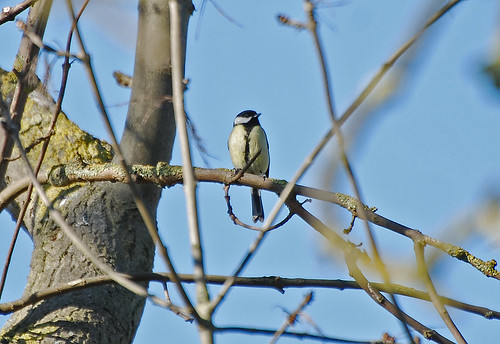
You may have noticed the lichens on the branches, I’ll share some photographs of those in the next post. In another tree adjacent to the one with the long tailed tits was a pair of great tits (Parus major, Dansk: sortemejse), among others. I like great tits, they’re handsome birds and they’re entertaining to watch feeding in my garden, especially when there is a family of them. The pair here are a male and a female:
Male great tit, his black stripe stretches all the way across his chest from toe to toe, making him very desirable indeed. I think the ‘A’ indicates he is the alpha male

The stripe of the female is much narrower:


Great tit female

And very shortly after I took the pictures of the great tits, a female sparrowhawk circled slowly overhead. The trees and hedges suddenly went very quiet as all the small birds concealed themselves from this fearsome predator. I’m not sure if she was hunting as I spotted a second, possibly a male, sparrowhawk circling much higher up. She was probably not more than a hundred feet up, but the male was several hundred feet up. I watched a pair of sparrowhawks do this over my garden once before, where the male was much higher, and I think it may be part of the courtship routine. (If anyone can confirm or refute that please drop me a line and let me know).


A female sparrowhawk circling over the hedges at the north end of the Meadow

All in all it was a very enjoyable and rewarding trip in bright warm sunshine and the  birdlife was there in spades.

All quiet on the Histon Front

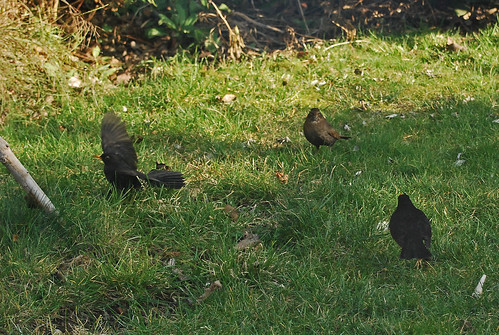
Last weekend I posted about the blackbird war that was taking place in my garden on Saturday morning. By Sunday things appeared to be quiet first thing until two female blackbirds appeared and commenced battling for breeding rights.


One of the feisty females scanning her territory for possible competition

The females chased each other round for about half an hour when who should show up…


Blacktip

Hard on the heels of Blacktip came The Arch Rival, and as soon as the females established their pecking order, battle commenced. At the close of hostilities on Saturday the apparent winner was Blacktip but on Sunday the female appeared to have switched her allegiance and teamed up with The Arch Rival and both of them now joined forces to chase off Blacktip:


The Arch Rival gaining the upper hand


And Blacktip making a tactical withdrawal after some protracted aerial exchanges and succumbing to numerical advantage

Things cooled off considerably after Sunday but minor skirmishes took place until Tuesday with The Arch Rival and his moll the seeming victors. But ever since then the garden has been frequented by various blackbirds including Blacktip. So even if he lost the insemination rights he has still retained access to his feeding territory.

Fascinating stuff!

Minsmere in wintertime

My meanderings around Suffolk in February inevitably led me to RSPB Minsmere. I’d heard there were bittern (Botaurus stellaris, Dansk: rørdrum), which I’ve never seen before, and smew (Mergellus albellus, Dansk: lille skallesluger) which I’ve also never seen, in residence there. Indeed, theere had been an influx of bittern from Holland due to the fierce winter weather there and numbers were up, so I felt a little twitching was in order.

For those of you unfamiliar with the geography, Minsmere is characterised by woodland on the inland side to the north and east with a network of reedbeds and lakes behind a sand and shingle bank running along the coast. It lies between Dunwich Heath and the Coastguard Cottages to the north, and Sizewell to the south. It is a haven for numerous species of bird and my friend told me that on a morning trip there with a dawn start he spotted over 100 species of birds by lunchtime. And I reckon that’s an impressive tally. Many mammals also live and visit here including red deer, fox and otter.

As it is an RSPB reserve there are hides for observing the wildlife and as I set off along the bank which forms the sea defences to find one various gulls and great crested grebes (Podiceps cristatus, Dansk: toppet lappedykker) were on the sea. I paused to watch a marsh harrier (Circus aeruginosus, Dansk: rørhøg) quartering the reedbeds, and then headed on to an open hide where I installed myself to see what was in residence.


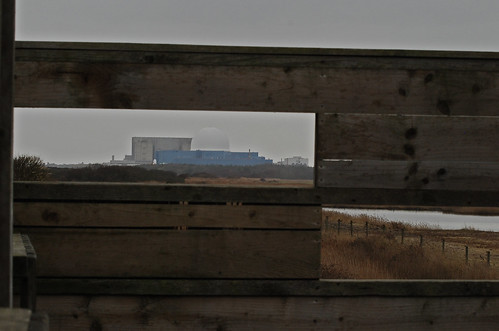
The view from the south end of the hide

From the lower right hand window of the hide are the reedbeds of the reserve and from the upper left window is the reactor dome of Sizewell nuclear power station. The power station reminds me that I’m very grateful for havens such as Minsmere but I also wonder why on earth does it have to be just there, the juxtaposition offends me somewhat. But there it is, so I contented myself with looking out the front of the hide and here are some of the birds I could see:


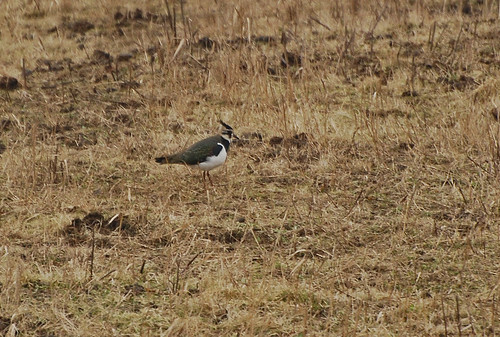
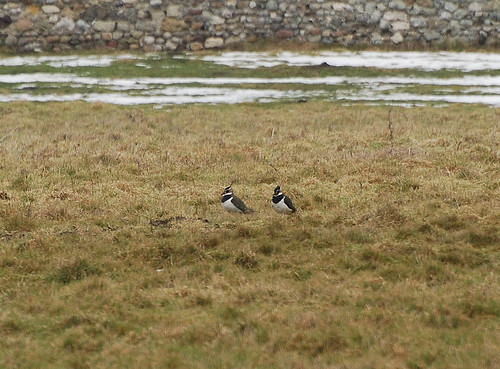
A lone lapwing foraging for sustenance

Immediately in front of my hide, in which I was the only occupant, was a water filled channel separated from the lakes just beyond by a thin strip of reeds, and immediately to the fore was a single lapwing (Vanellus vanellus, Dansk vibe). Low grassy islands in the lakes were home to various species of duck, the most numerous being…


Teal, two males and a female (Anas crecca, Dansk: krikand)


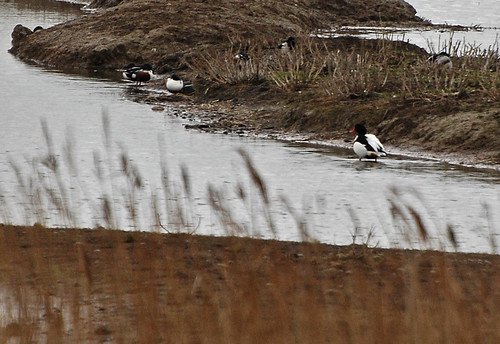
Shelduck (Tadorna tadorna, Dansk: gravand), and lurking in the background is a shoveler (Anas clypeata, Dansk: skeand)

All of these ducks are resident or nigrant breeders and winter visitors and where I am I only see them in winter. According to the BTO the teal is unusual in that it has no other names in the UK, which is an interesting little factlet which obviously needs to be challenged. If anyone knows of a local name for the teal please let me know. Another amusing piece of nomenclature is the shoveler, so named presumably for its shovel like beak and in Danish is known as the ‘skeand‘, which translates into English as the ‘spoon duck’. It uses it’s magnificent beak to filter small molluscs and crustaceans from the beds of shallow water by sweeping it across the surface and sifting the food from the disturbed sediment.

Alas, most of the birds were just too far away for my 300mm lens, but I plan to upgrade my optics this year so next time I post from Minsmere I’ll hopefully have lots of high quality close ups too.

Suffolk Symbionts

During our trip to the east coast a couple of weeks ago a fair chunk of our time was spent wandering around churchyards and woodland and scrubby heathland. Because the air is so clean in that part of the world the gravestones and the trees, and any dead and rotting wood hosts numerous species of lichen.

A robin watching over the lichen encrusted gravestones in Dunwich St Andrews graveyard

I think lichens are highly under-represented in the annals of popular natural history, but having said that I’ve seen some superb posts from fellow natural history bloggers in the recent past, most notably from  ‘btweenblinks‘ and ‘Montana Outdoors

There have not been so many from this side of the Atlantic though so here’s my attempt to showcase some of my local lichens. Lichens are a symbiosis between a fungus and an alga where the fungus gathers nutrients from the substrata and the alga provides the photosynthetic apparatus. I’ve read that there are around 1800 species of lichen in the UK alone and up to 20000 globally. They provide homes for spiders and small insects, and have provided various dyes for colouring cloth and the active ingredient of litmus pH indicator is derived from a lichen. And they make great pictures:


Oak  moss or antler lichen, Pseudevernia furfuracea

Lichens are difficult to identify without a microscope and reagents for analysing them and the substrata they are growing on, so the identifications in this post are from this guide from the Natural History Museum.

I found the antler lichen growing on a deciduous tree at Dunwich Friary and I think there are probabaly another three species of lichen in this photograph, including the common green shield lichen, Flavoparmelia caperata. I took the picture by standing back a couple of metres and using ISO 400, F/8.0 and shutter speed 1/60s, and there was just sufficient light to make it work. The trees were reverberating with the song of great tits and robins while I was on my lichen hunt making it a very enjoyable couple of hours.


Pleurosticta acetabulum

Pleurosticta acetabulum doesn’t have a common name in my NHM guide. I really like the colours in this image, the background is the reedbeds of Minsmere and the diffuse red/brown of the defocussed reeds accentuates the greens, greys and browns of the lichen.

Leafy xanthoria, Xanthoria polycarpa

The leafy xanthoria was ubiquitous in this part of the world, many of the trees were festooned with it. This one was also at RSPB Minsmere with the reedbeds in the background and I like the warm colours especially as this was on a very cold, grey morning.

Garden Gladiators

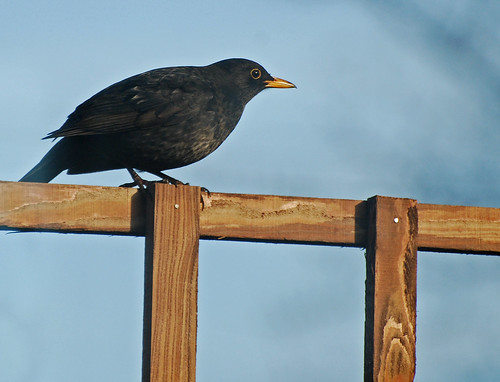
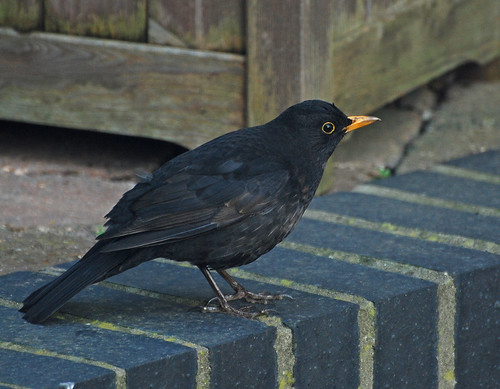
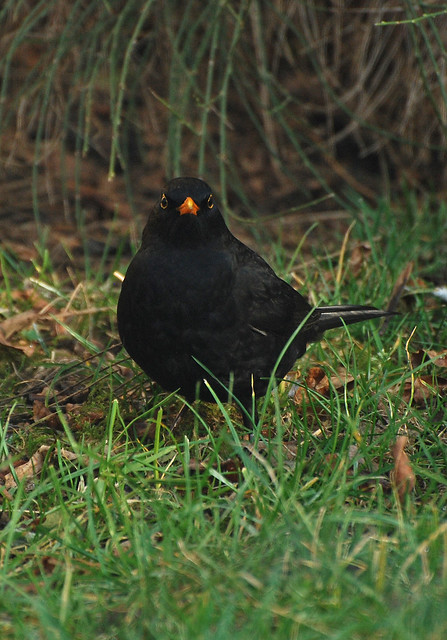
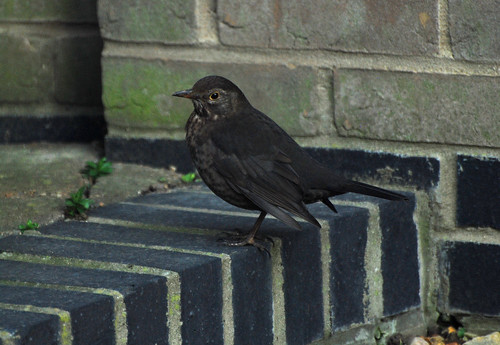
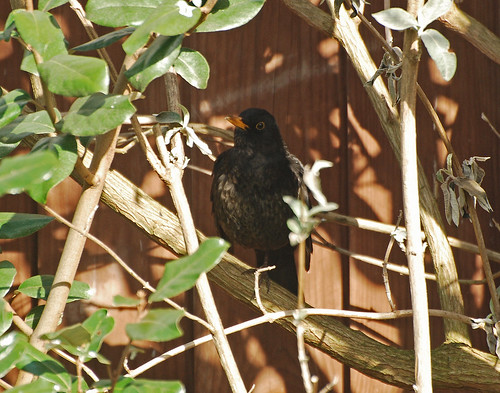
For the last three mornings my garden has been frequented by numerous blackbirds (Turdus merula, Dansk: solsort), at least four; two males, two females and possibly others. I couldn’t tell the females apart because they looked very similar but the males were identifiable. One was a typical black blackbird with a striking yellow beak and the other was very slightly smaller, slightly more brown and had a dark tinge to the end of his beak so he has been named ‘Blacktip’.


Blacktip

The second male blackbird, henceforth referred to as ‘The Arch Rival’


And one of the ladies

The initial skirmishes of the Histon Blackbird Wars started in my garden on Friday but I didn’t have a chance to study it what with getting the children to school and myself to work. The real gladiatorial action took place yesterday morning and commenced with the males and the two females chasing each other around at high speed on the ground and in the air. I’ve never noticed before but when blackbirds compete on the ground they actually run rather than hop, which from the human perspective lends the whole drama a comic angle. I imagine they can move alot faster when running and are therefore more intimidating to any rivals.

The Arch Rival perched threateningly atop the rabbit run

The females departed fairly early on in the proceedings leaving the two boys to battle it out, and it turned into an amazing spectacle which was very entertaining to watch. The Arch Rival occupied a battle station on top of the rabbit run from where he would walk round the edge and look down at Blacktip on the ground, and from where he would launch the occasional strike and chase Blacktip  around for a minute or two before resuming his vantage point on the rabbit run. This behaviour led me to think the The Arch Rival was possibly the dominant male as he seemed to hold the advantage all along and it went on for probably half an hour or so before the real battle commenced:

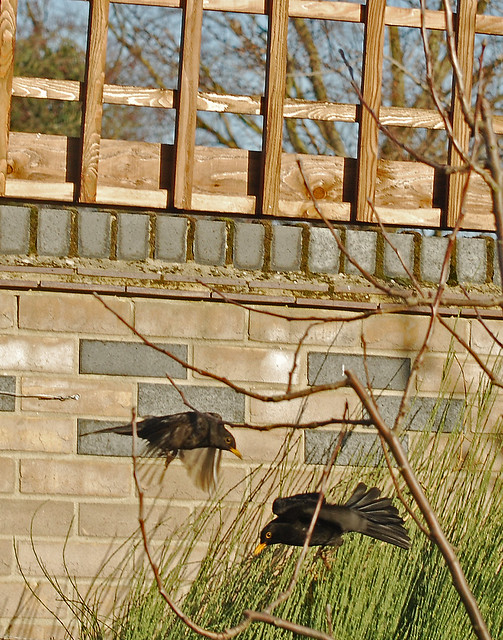
Aerial hostilities break out
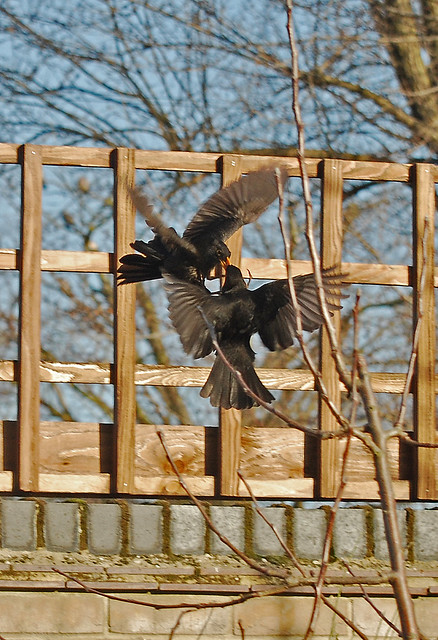
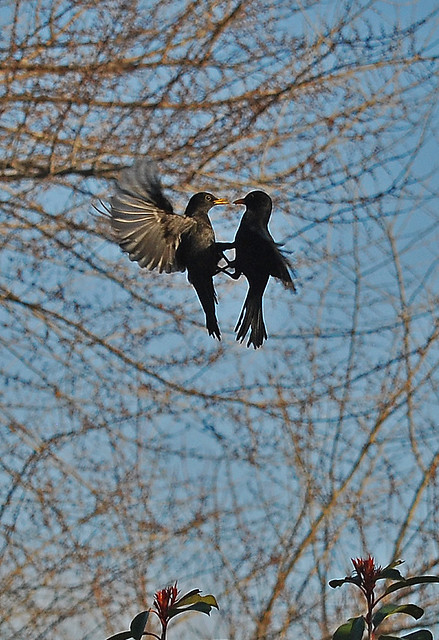
The dogfight slowly gains more and more altitude, toe to toe and beak to beak
Higher still, now around 4-5m off the ground
And then they separated and descended to draw breath in the wisteria.

This was followed by The Arch Rival resuming his place on the rabbit run which he circled around for several minutes before dropping to the ground and walking and running around the same route for a further few minutes whilst Blacktip remained on the ground. this cycle of events was repeated several times over the next hour.


The Arch Rival back on the rabbit run, Blacktip was lurking on the ground

This activity eventually petered out and Blacktip was left on his own to recuperate under cover of the buddleia bush. Leaving me to think that he was the apparent victor…


Blacktip in the cover of the buddleia foliage

…Or was he?

This morning Blacktip appeared with a lady and seemed to be performing a courtship ritual where he was running around on the ground calling and she was following. That went on for around half an hour and they seemed to be getting along famously. And then The Arch Rival arrived back on the scene and 20 minutes or so of aerial combat ensued. the dynamic was different this time though. The female and Blacktip seemed to be chasing The Arch Rival, not Blacktip on his own.

As I go to press the action has ceased and all the blackbirds have disappeared although both the males have made short forays back into the garden looking for some breakfast, but the female hasn’t returned. Incidentally while this was taking place, all the other birds: goldfinch, dunnock, house sparrow, blue tit, great tit, starling, collared dove and wood pigeon were using the feeders as normal, completely unperturbed by the battle taking place. My back window is like a 75 inch 3D HD TV showing nature documentaries all day, to which I can add my own commentary. As I write a pair of fieldfare are flying over and the blackbirds have been replaced by three dunnock.

And now… all three blackbirds are back and fighting again, so I’m going to sign off and watch them and I’ll report back with further developments.

Springtime sojourn to the Suffolk coast

Last week we headed off to to the seaside for a few days and our chosen detination was Dunwich, a tiny village on the Suffolk coast which in medieval times was the capital of the region and a thriving, wealthy port for moving cargo and people between East Anglia and the European mainland. It’s an amazing place with very interesting history which I wrote about in a post last year.

We stayed in my favourite inn called The Ship which has panoramic views over the Dingle Marshes which stretch several miles north to Walberswick, which is renowned for it’s annual crabbing champi0nship. It is also where the king of art nouveau, Charles Rennie Mackintosh moved to after he had abandoned architecture to become a watercolourist and where the series of flowers known as the ‘Walberswick collection’ was painted.

The marshes along this part of the coast are full of wildlife, including rare birds such as harriers and bittern, mammals such as otters as well as a host of marsh and heathland plants and the associated fauna. It’s a wonderful place. The view from our window at The Ship was generally dominated by low grey cloud which occasionally saw fit to rain on us, but even so the wildlife was much in evidence without even leaving the inn:


The tree opposite our window played host to numerous small birds including this house sparrow (Passer domesticus, Dansk: gråspurv) and blue tit (Cyanistes caerulius, Dansk: blåmejse)
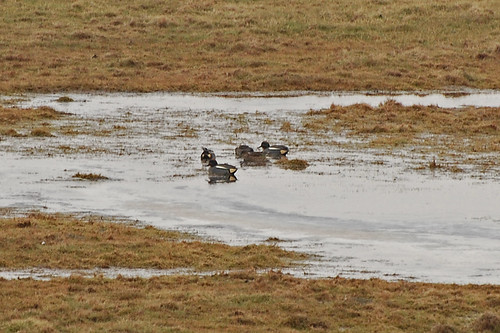
And a couple of hundred metres beyond the tree were some pools of rainwater where lapwing and these teal were on parade each morningAnd beyond that was a ditch where a little egret (Egretta garzetta, Dansk: silkehejre) was hunting every day

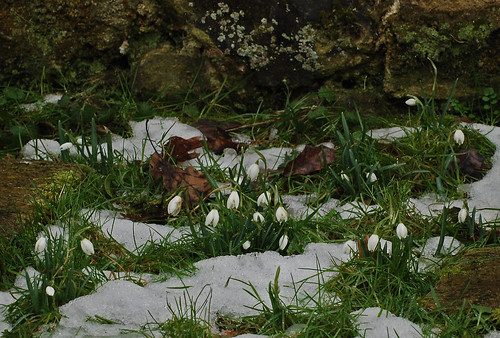
So, as you can imagine, it wasn’t so easy to haul myself away from my nice centrally heated room and my cup of tea and go out into the wintry mornings, when I could sit by the window and see all this! But I eventually extricated myself and walked a circuit of the village taking in the local church and graveyard, the remains of the Franciscan Friary and the woods inbetween, and was very adequately rewarded. The local church has the remains of a medieval leper hospital in its grounds which is a fascinating place historically, but is now inhabited solely by sheep and snowdrops (Galanthus nivalis). There were no sheep while we were in there but the snowdrops were growing out between the melting snow.


Snowdrops infront of the be-lichened walls of the ancient leper hospital in the grounds of St James church


A lapwing pair pausing in the Friary between displays of breathtaking aerobatic excellence

The Friary is long deserted by the Franciscan brethren and is now a ruin, but it still plays host to the local wildlife. As well as the lapwing (Vanellus vanellus, Dansk: vibe) , there was a songthrush (Turdus philomelos, Dansk: sangdrossel) foraging amongst the  grassy tufts and robins (Erithacus rubecula, Dansk: rødhals) singing from the trees beyond.

A deciduous tree adjacent to the Friary was completely covered in lichen

I don’t know which species the lichens are on the tree trunk but I think there are at least four. The flat resupinates can be seen on old wood and even brick walls in towns and villages, but the feathery species are much more susceptible to atmospheric pollution and therefore only exist where the air is clean.

Beyond Dunwich to the south is the gorse covered heathland of Dunwich Heath which is owned and managed by the National Trust, and beyond that is the RSPB reserve at Minsmere where I watched a marsh harrier quartering the reedbeds and where another walker told me he had seen smew and a bittern in one of the lakes on the reserve. I went to look there but I didn’t see either, but I did see other birds, and some splendid lichens. Of which more in a later post.

More hungry garden birds

When the snows arrived a couple of weeks ago my garden immediately became host to all the species of garden birds that normally feed there and which had been absent for the whole of this winter. So I couldn’t resist taking some photographs, a few of which appeared a couple of posts ago, and the rest are here…


A hen blackbird was one of several trying to prise worms from the icy ground


A female great tit taking peanuts from the seed tray


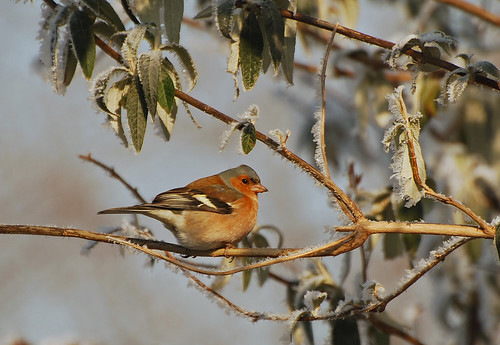
Cock chaffinch eyeing up the seed scattered on the ground under the frosty buddleia

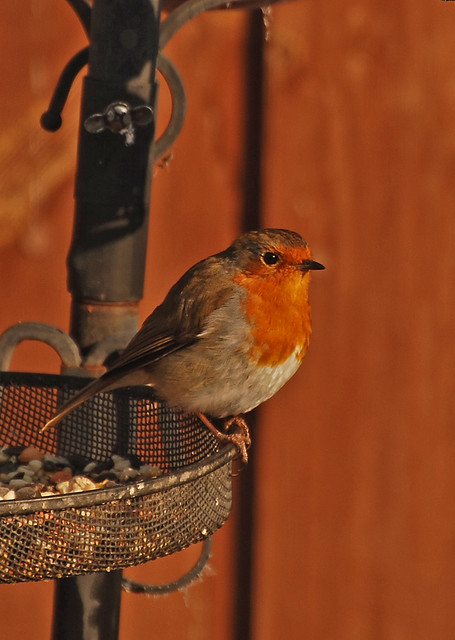
One of my resident robins perched on the seed tray after a feast


A blue tit waiting in the buddleia bush for a chance to get on the feeders

The sun came out early which made photography considerably easier, but it was tricky to ge the exposure right when a bird was stood on snow reflecting sunlight:


A dunnock pecking seed from the grass. They have gorgeous colours when illuminated by the sun


This starling was distracted by me and stared straight at the camera

And finally a goldfinch perched in the buddleia before the sun broke through the clouds hence the high ISO and grainy look.

A dearth of information in this post but I hope you like the pictures as much as I enjoyed taking them!

Guns Lane Raptors

Last Saturday before the snow came I went for a hike along Guns Lane heading north from Histon up to Rampton. It was an unusual walk because there was very little wildlife of any sort, and apart from small numbers of the usual birds such as chaffinch, blackbird and blue tit, and a small flock of 19 lapwing which flew over, there were also very few birds.

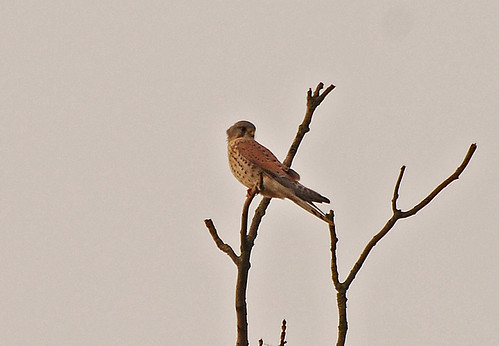
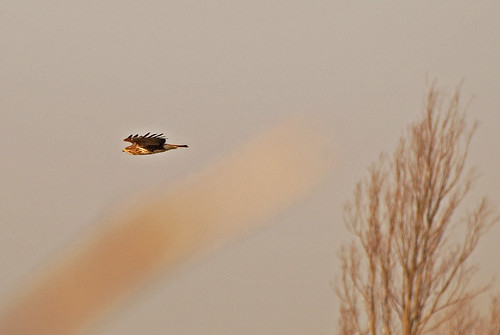
Two birds that were around were several kestrels (Falco tinnunculus, Dansk tårnfalk) and a lone buzzard (Buteo buteo, Dansk: musvåge). Kestrels are one of my favourite birds, I never tire of watching them. They are compact birds, 34cm long with a 76cm wingspan, and their plumage is very attractive, which can be seen in the pictures below, and their flying skills combined with their UV vision and agile talons make them a superbly well designed weapons platform. So of course, as well as watching them, I try to photograph them.
This handsome male bird sat in the top of a tree carefully watching me as I got closer:

And decided I was too close as I got to the bottom of his tree:


Kestrel exiting the top of an ash tree showing of his talons and array of flight feathers

A bird that I never saw in this country until I was at least post-grad age was the buzzard. I saw them when I was on holiday in Denmark as a kid, but not here until I started holidaying in the south west and I’d see the occasional one in Cornwall, Devon and Pembrokeshire.


Like the kestrel, this buzzard was keeping a keen eye on my activities

But from the early 1990’s buzzards have spread to recolonise most of the rest of the country and are regularly seen them gliding overhead around home and perched on fence posts and telegraph poles by the side of the roads. The buzzard is a resident breeder in the UK and is a bird of open heath and farmland, its preferred prey is small mammals but will also take birds and reptiles, and when times are hard insects and earthworms can find their way onto the menu.

Buzzards are big birds with wingspan around 1.2 m and are unmistakeable when either down low like this one:


Also like the kestrel, exiting its perch when my unwanted attentions were deemed too intrusive…

…and gliding away to another less public location

…or when thermalling up high, minimising the effort required to stay aloft.

Meandering away on a non raptor related tangent, as I’m writing this post I’m looking out my window and there are blue tit, great tit, robin, dunnock, chaffinch, blackbird, long tailed tit and starling in my back garden. And goldfinch, and they’re the first ones to visit since last summer. As I posted about last time, the birds are being driven into gardens by the bitterly cold weather. It was -12C first thing this morning and it is now bright and sunny at 1pm, but the temperature is still only -3C. By the way, if you feed the birds try to put some food out the night before if you can, because the smaller songbirds such as blue tit and wren can die very quickly if they don’t find food soon after dawn when the weather is so cold.

The Songbirds Return

Up until February we’ve had an unusually mild winter and it was noticed across the country that songbirds were not frequenting gardens simply because there was abundant food in the countryside so they didn’t need to avail themselves of our feeders. The RSPB were advising people to clean their feeders and place a small amount of feed in so that passing birds would recognise it as a source of nourishment if times got tough. So a couple of weeks ago I topped my feeders up in anticipation of some cold weather and saw nothing apart from my resident cock blackbird who likes to dig worms out of my lawn.

And then the times did indeed get tough. The snow came last Saturday, lots of it, and on Sunday morning the transformation in my garden was immediate and the place came alive with hungry squabbling birds. Hen and cock chaffinch brought welcome splashes of colour:

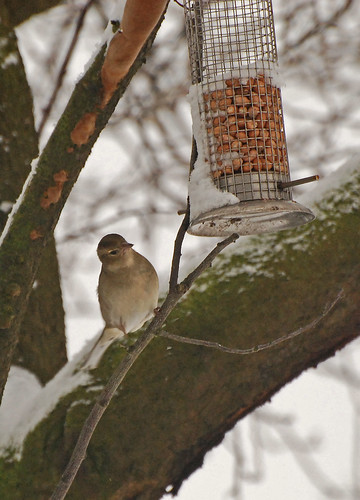
Chaffinch are normally ground feeders so I’m not sure if this lady was confused by the contraption or the snow covering the hole.

(There’s a fungus there too on the branch of my plum tree which I must put some effort into identifying).

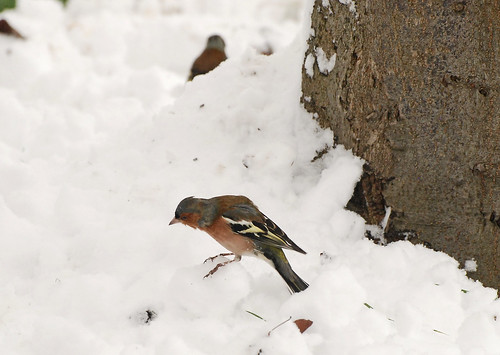
The sky was completely white and murky with total low cloud cover after the snow, so all the colours of the birds were muted and photography was challenging. Even the colours of this cock chaffinch, which was looking for seeds on the ground (more customary chaffinch behaviour), proved difficult to capture:


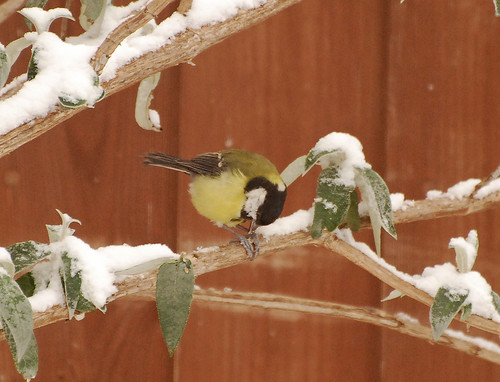
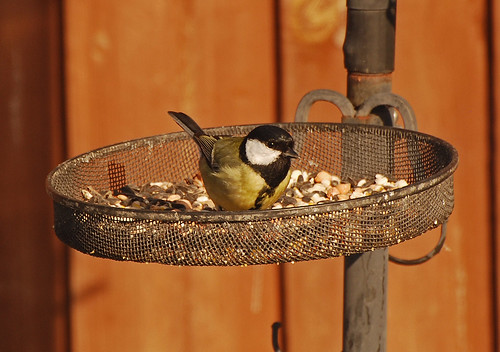
As well as chaffinch, dunnock, robin, blue tit, long tailed tit, collared dove, wood pigeon and blackbirds were all availing themselves of the platter. All the birds are welcome but the collared dove and particularly the wood pigeon can completely clean up in a matter of minutes, leaving very little for the other birds, so this time I put enough food out for all the visitors. A pair of great tit were gorging on some chopped peanuts, they are cautious birds and would visit the seed tray, pick up a piece of nut or seed:


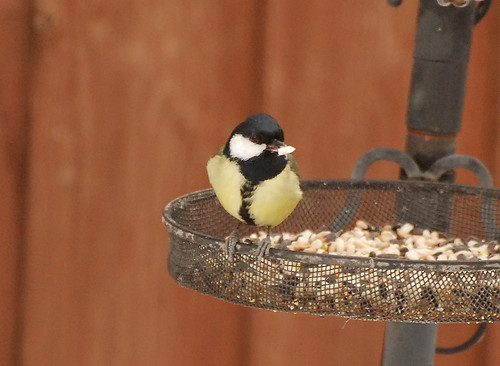
Parus major – great tit, the male of the species

…and carry it off to the adjacent buddleia where it clamped the nut between it’s claws and pecked at it until it was gone, and then fetched another. If they’re not disturbed they can carry on flitting to and fro many times.


Female great tit demonstrating classic great tit feeding behaviour

I was shown how to easily differentiate between the male and female great tit by some bird ringers at Wicken Fen. They had caught a male in their net and the way to tell is by the width of the black stripe down the breast. The female has a thin stripe and that of the male is much thicker and can broaden as it descends widening to fill the gap between the legs. The broader the stripe the more attractive he is to the ladies.


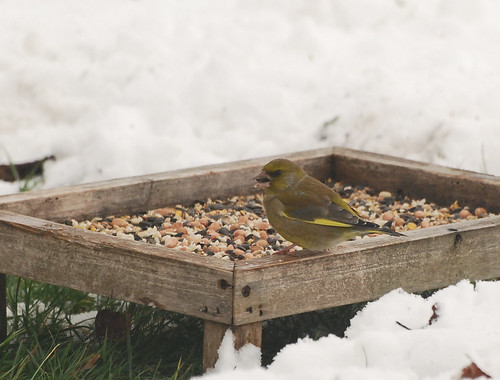
Greenfinch – the first one I’ve seen in my garden since last winter

I often see, and hear, greenfinch in the trees where I walk and also the ones around where I work on Cambridge Science Park, but unless the weather is particularly inclement they don’t often venture into my garden, so this one was a welcome visitor.

Male house sparrow looking for a top up

None of my garden visitors were particularly unusual but it was lovely to see so many at once and to discover they were still out there. So I shall keep feeding them until the weather warms up and they move back to countryside.