Category Archives: UK wildlife

The Farne Isles

An absolute must for me when I go to the northeast of England is a boat trip to the Farne Islands. The Farnes are a group of small low islands lying a couple of miles off the coast between Bamburgh and Seahouses.
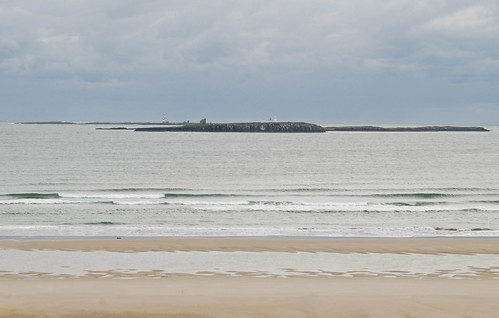
The Farne Islands from the Northumberland coast

The islands were immortalised in 1838 by the heroic actions of Grace Darling, the 23 year old daughter of the Longstone lighthouse keeper. When a shipwreck was spotted during a North Sea storm on Big Harcar, a small rocky island nearby, Grace and her father crewed a 21 foot rowing boat to rescue the stranded passengers from the SS Forfarshire. Grace was 23 at the time of the rescue, which she survived only to be carried off by tuberculosis 3 years later. Which seems downright unfair to me.
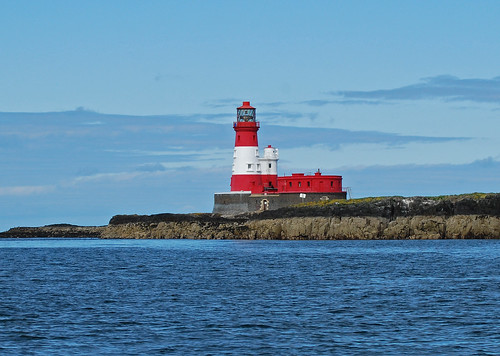

The Longstone lighthouse from where the Darlings’ rescue mission was launched

The islands are currently owned by the National Trust and they are famous for enormous numbers of seabirds including guillemots (Uria aalge, Dansk: lomvie), razorbills (Alca torda, Dansk: alk), kittiwakes (Rissa tridactyla, Dansk: ride), puffins (Fratercula arctica, Dansk: lunde), terns, cormorants (Phalacrocorax carbo, Dansk: skarv), shags (Phalacrocorax aristotelis, Dansk: topskarv) and assorted gulls. During the breeding season there are many tens of thousands of numerous species nesting there.
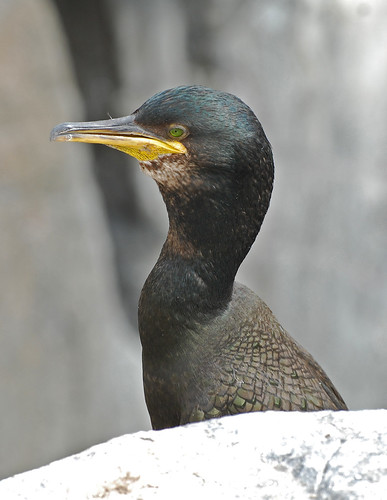

The shags on the Farnes were very relaxed and this one let me approach within 15 feet or so and didn’t seem remotely perturbed. Its yellow mandible and green eye are very distinctive. A few metres along the cliff top were this pair of downy youngsters :
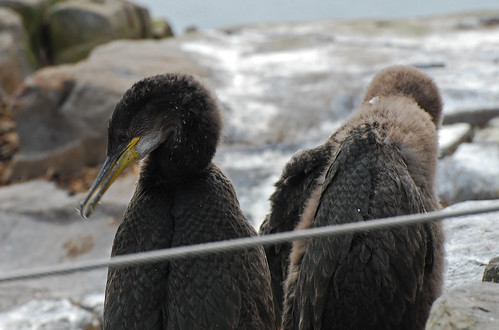
…busy preening out the down and nurturing the nascent flight feathers. It’s remarkable how in such a short space of time nature provides these young fishermen with a full set of plumage capable of withstanding the rigours of these semi-aquatic hunters underwater feeding technique.

There were one or two turnstone patrolling the rocky shorelines of the islands but the vast majority of the seabirds were completely absent. However, one which did make numerous welcome appearances throughout the course of our trip was the gannet (Morus bassanus, Dansk: sule). They are our largest seabird and can be spotted from afar due to the titanium whiteness of their plumage and their black wingtips. They seemed to be simply passing through that day, all heading north, and none of them paused to dive for fish, which was a pity because it’s spectacular to watch. They were predominantly in family groups of 3-6 birds with adults and patchy darker coloured youngsters.
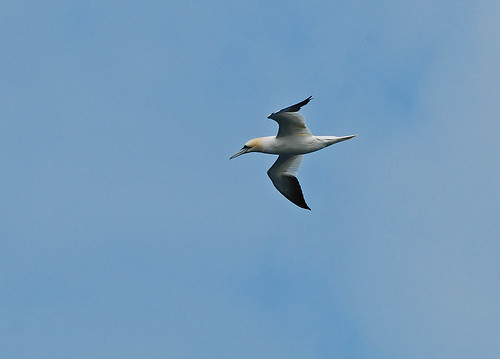

An adult gannet resplendent in its brilliant white plumage and pale yellow head
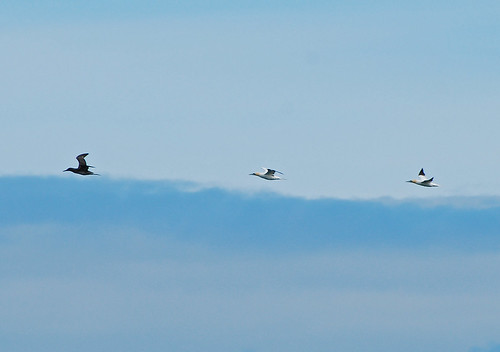

…and a family group of three being led by a dark coloured juvenile

The other creature for which the Farne Islands is renowned is the seal. Specifically the  Atlantic grey seal. All the islands I saw had large groups of them consisting of territory conscious bulls and numerous smaller females and calves. The bulls were highly vocal, rearing up into threatening postures to intimidate any others that unwisely ventured too close. No more physical aggression was required but from the face of the male below they are quite capable of a proper fight resulting in scar tissue. Although I imagine that is most likely to happen during the more serious business of a competition for the attentions of the ladies.
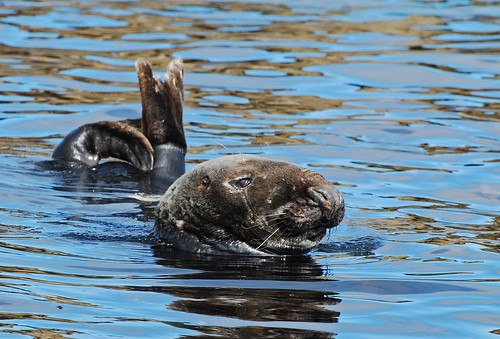

A big bull Atlantic grey seal basking in calm waters
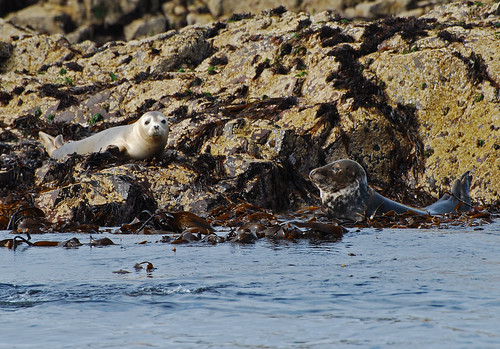
The seal on the right is a female minding her calf on the left
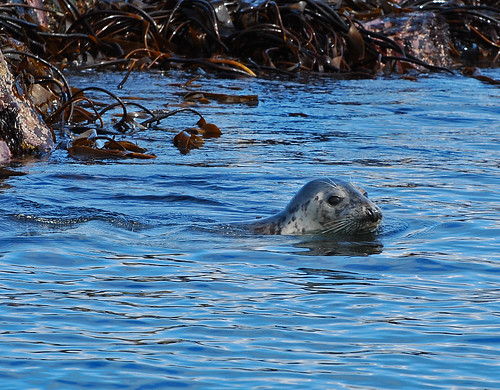
And another female launching herself into the sea from the rocks
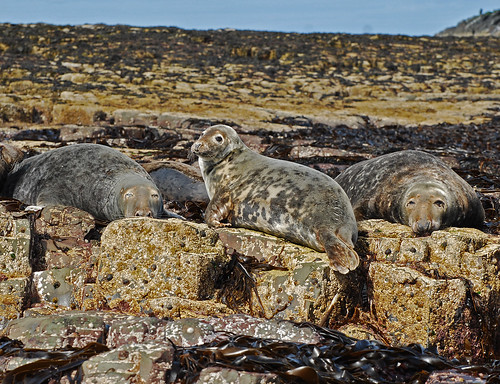
Several members of a bigger group basking in the sunshine

The rocks and the water was full of seals, most were simply basking in the sunshine, the females were minding the youngsters and the males were being generally grumpy. They would hang in the water peering at our boat and some of them were asleep in that position, standing on their tails with their heads poking out of the water. The waters looked crystal clear and it gave me a hankering to explore the islands in kayak and do some snorkelling. But that will have to wait until the next trip.

Seahouses Seabirds

Seahouses, on the Northumberland coast, has proved a fertile hunting ground for birdlife in the past and my most recent visit in August was no exception. It has a  sheltered harbour which plays host to numerous gulls, ducks and other seabirds and to the north are miles of beaches interspersed with rocky outcrops and some great rockpools which keep the kids (and me, of course) entertained for hours. I accidentally slipped into a bed of seaweed whilst leaping around between rockpools, my foot disappeared up to the knee making a glutinous squelching sound as it went, and when I pulled it out it was a rather fetching greenish brown and the stench was worse than the inside of a packet of dry roasted peanuts! But that aside, the wildlife was spectacular.

I’d never seen goosander before (Mergus merganser) then I spotted this trio of females standing at the edge of the water in the harbour. I think they are handsome birds, they nest in holes in trees and have a hooked and serrated beak which is designed to catch and hold onto their main prey item which is fish, thus they are also referred to as ‘sawtooths’.


Three female goosander (Dansk: stor skallesluger) relaxing on the shoreline in Seahouses harbour

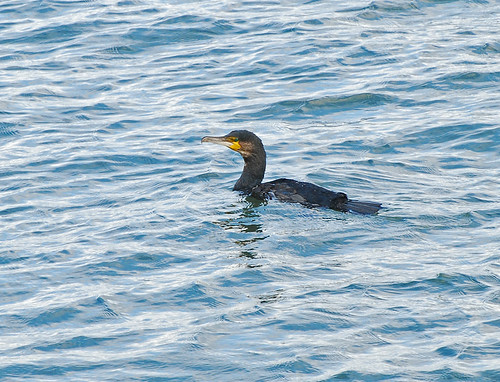
Shags frequently patrol the harbour diving for fish, they were plentiful both in the sea and perched on rocks and seawalls. They were the only seabird other than gulls that I saw on the Farne Islands, but more of that in a subsequent post.

The shag (Dansk: topskarv) could only really be confused with a cormorant (Phalacrocorax carbo), but the shag is alot smaller with a wingspan of 95-110cm compared to the  120-150cm wingspan of the cormorant, and it doesn’t have the white patch behind the lower mandible. The prominent yellow patch on the shag above indicates this is a  juvenile. On the water cormorants swim with a straight neck and their beak pointing up in the air and will leap up into a dive, and in flight they have a longer neck with a pronounced kink in it.

Cormorants are now regularly resident inland. About 20 years ago I was walking along the Woodford Valley to the north of Salisbury and was somewhat taken aback by the sight of a cormorant in a tree. I’d never seen that before and I think it was around this time they were starting to encroach inland. They’re now a fairly common site around our inland waterways, there are several which overwinter on a lake here in Histon – the first one arrived here about a week ago – and there is a flock of a few tens of bachelor males resident at Wicken Fen nature reserve a few miles from here. I think anglers take a rather jaundiced view of their fondness for fish, but I regard them as a welcome addition to our local fauna.

Another common site in the waters around the Northumberland coast was the eider (Somateria mollissima, Dansk: ederfugl):


Juvenile eider trying to dislodge a foreign body from its wing.

This youngster could be confused with an adult female but it lacks the white beak tip and white edges to the covert feathers. The pale stripe over the eye suggests it’s a male. I first saw a male eider in full breeding rig when I was at Skagen on the northern tip of Denmark and they are magnificent birds:


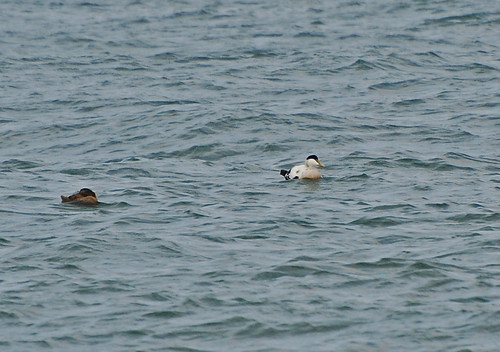
Male eider on the right, distinctive in his white breeding plumage with black cap, flanks and tail, and malachite green nape. Alas he didn’t come any closer!

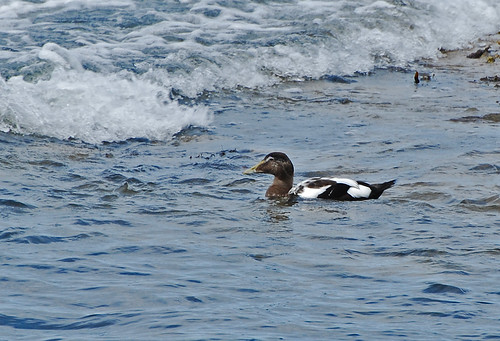
At the end of the summer male eiders malt, during which time they can’t fly. Because they can’t fly the malting plumage needs to provide camouflage and is known as ‘eclipse‘ plumage. They can become almost black during this period.


From the distribution of the white patches I think this one is a second year male undergoing his malt

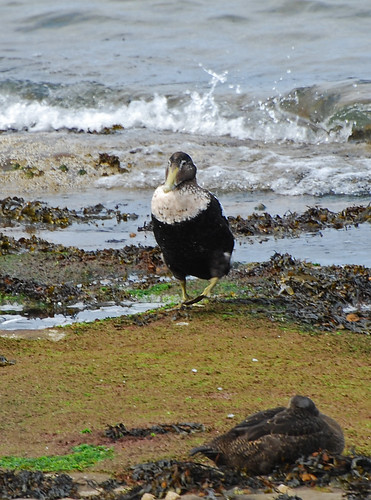
And this is him emerging from the water with another juvenile in the foreground

Eider nest close to the water where the female sits tight. They feed on crustaceans and molluscs, predominantly mussels, which they open with their powerful beaks. They overwinter all around the UK coast but are only resident in the north and Scotland.


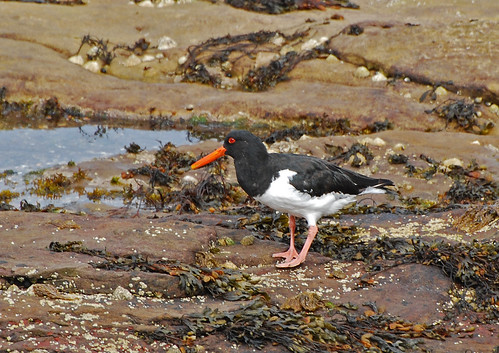
One of my favourite birds – the oystercatcher

Oystercatcher (Haematopus ostralegus, Dansk: strandskade) can be found all around the coast of the UK, at least all the parts that I’ve visited, and I think they’re splendid. That awesome flame-red beak is vertically flattened and blunt and is adeptly used for opening cockles and other shellfish, digging for worms and probing between rocks for insects.


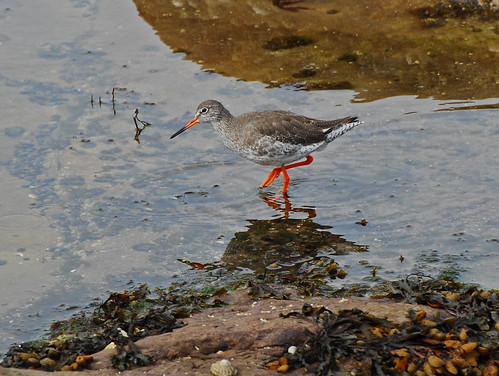
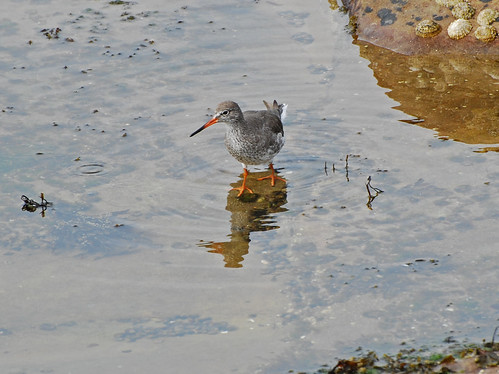
The redshank – I think this bird is exquisite, the colours are beautiful and the shape is perfect, nature at its aesthetic best!

The redshank (Tringa totanus) is a resident breeder and migrant visitor which feeds on worms, crustaceans and molluscs. It’s Danish name is ‘rødben‘ which translates literally as ‘redshank’ and it is also known as ‘the sentinel of the marshes’ from being the first species to take to the air when flushed whilst making an awful lot of noise.

All the photographs here in this post were taken in Seahouses, so hopefully it’s easy to see what a great place it is for wildlife, and birds in particular.

Bamburgh birdlife

I spent the last week of August on holiday in Northumberland. I like it up there for a number of reasons, the main one being the great variety of wildlife. I was based in Bamburgh, which apart from having a spectacular castle, is right on the coast with miles of huge beaches which are thronged with birdlife.

A young knot, one of a mixed flock of knot (Dansk: Islandsk ryle) and turnstone on the beach at Bamburgh. The peachy brown colour on its breast gives it away as a youngster.


…and a turnstone (Arenaria interpres)

These two species were numerous on all the beaches and flew low over our heads in small flocks as we were bodysurfing the waves. The Danish name for a turnstone is a ‘stenvender‘ which translates directly as ‘turnstone‘, so it’s tempting to think that our Nordic ancestors brought the name with them when they arrived here over a millenium ago!

The turnstone is exclusively coastal and is very aptly named as it flips stones of all sizes in its search for insects and other invertebrates lurking beneath. It is also a scavenger and its entry in the British Trust for Ornithology (BTO) Birdfacts reveals it has been known to feed on corpses! It breeds in the high Arctic and is a passage and winter visitor to UK shores and is one the worlds longest migrators, turning up as far south as South Africa. Consequently it can be seen in many parts of the world as it overwinters in Africa, South America, southern Asia and Australia.

Knot, Calidris canutus, are also coastal passage or winter visitors in the UK. They breed in Greenland and Siberia where there habitat is wide open tundra. They feed on insects and plants in the summer and in wintertime on molluscs from the intertidal area of beaches, from which it’s specific taxonomic name ‘canutus‘ is derived from the name of the Norse king Canute, so this species has a definite Viking link (Danish ‘Islandsk ryle‘). Outside the breeding season they can flock together in enormous numbers, 100,000+ (I’m not quite sure how they’re counted though!)


This pair of knot are living up to their name, running through the surf

The beaches were home to lots of waders in Bamburgh but the rest of the village was also home to non-marine species, most notably swallow, house martin, pied wagtail and linnet.


A swallow stretching its wings on the garden fence. A couple of weeks later it will be heading south and then on to South Africa

Our garden played host to flocks of swallow and house martin who were busy hunting insects over the adjacent meadow, and pied wagtail (Dansk: hvid vipstjert) which are resident in the UK and are ubiquitous in parks and gardens picking invertebrates from the grass.


A pied wagtail youngster, above, and an adult…
The adult has a white face and black cap and breast which the youngster hasn’t yet acquired

A walk around Bamburgh Castle and the playing field at the foot of the castle was accompanied by lots of linnet. Linnet are resident in the UK but their conservation status is red due to decline in the breeding population so it was good to see them in such numbers:


Linnet male looking for grass seeds on the cricket pitch under Bamburgh Castle

There was a family of linnet on top of the castle walls with the adults feeding the fledglings and on the playing field beneath this imposing superstructure was a mixture of numerous wagtails and linnet.

I think the chap in the photograph has some unusual colouration. He has the fading pink breast and red forehead spot of a cock linnet approaching Autumn, but the greater covert feathers on the wings (the ones at the top of the black primary flight feathers) are dark brown. I’d expect them to be the same lighter brown colour as higher up the wing and back. Maybe that happens at this time of year too.

Other highlights around Bamburgh were a flock of approximately 100 lapwing over the fields between bamburgh and Seahouses and on another day a flock of around 50 curlew (Danish ‘storspove‘). And to the north of Bamburgh lies Budle Bay which when the tide is out plays host to large nubers of waders, gulls and other seabirds.


A curlew (Numenius arquata) on the tidal mudflats of Budle Bay

As well as curlew there were oystercatcher, black headed gull, redshank, knot, turnstone and mute swan all visible from the side of the road. I was guilty of one of my more scatterbrained moments on this trip as I forgot to pack my binoculars. I’m fairly sure that with some ocular assistance I’d have found alot more species out there.


A pair of mute swans on Budle Bay after the tide has come in

Subbuteo

Falco subbuteo, (lærkefalk in Danish), after which the table football game is named (it was the games creators favourite bird apparently), is a summer visitor to our shores. It is a migrant breeder and passage visitor, spending the winter in Africa and despite being widespread throughout Europe, there are only around 2000 pairs in the UK which are predominantly confined to the south and east below a line from the Severn to the Humber estuaries.

They breed in nests abandoned by other birds, often those of crows, and they feed on insects and birds which they take out the air in flight. To do that they need to be fast, and they are extremely fast, taking dragonflies and small birds by utilising their amazing speed either in level flight or in a stoop. They have a slate grey back and are white with black speckles underneath with dark, grey/black head, eye patches and moustaches similar to a small peregrine falcon (vandrefalk), and I find the easiest visual differentiator is the red thighs and underside of the tail.
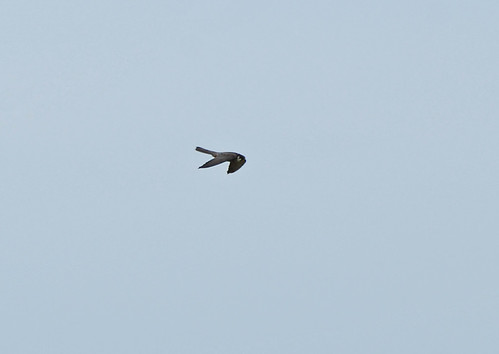
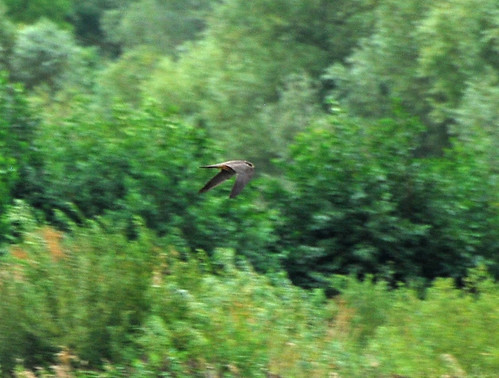
Whilst I was at Fen Drayton nature reserve last weekend I watched one hunting and I managed to get some pictures, which aren’t the best quality, but I hope convey some of the drama of their high velocity hunting technique:

Beginning the approach:

…homing on the target:

…and pulling up with empty talons:

The red thighs are visible in the second and third photographs above, and are diagnostic for the hobby.

It’s exhilarating watching a wild predator hunting, especially at the speed these guys do it. And it presents an interesting photographic challenge too, one which I’m yet to perfect as the high speed flight of the hobby requires high speed panning. I’m looking forward to the next chance I get to practice.

Pyrrhula pyrrhula

Without wishing to appear melodramatic, I’ve been waiting for decades to get a photo of a bullfinch, Pyrrhula pyrrhula (in Danish, ‘dompap‘). My parents have been feeding the garden birds since I was a kid and I can remember seeing bullfinch in the garden back in the 1970’s. But then over a few short years they seemed to all but disappear. They were legally persecuted by farmers because of their ability to strip fruit trees of all their fresh shoots in record time, and were therefore blamed for financial misfortune in the market garden sector and condemned to slaughter.

I think extermination is far too high a price to pay, but destruction of these magnificent birds is, alas, what ensued. So in the intervening years, twixt the 70’s and very recently, my sightings of bullfinch were restricted to an occasional glimpse, and that seemed to occur on average once every 5-10 years.

Maybe I just didn’t go looking in the right place, but since I’ve been exploring around Histon over the last 3 years or so the number of sightings has increased significantly. There is a good supply of scrub round here which is providing cover and sustenance so they are now a fairly frequent occurrence. Despite that, I still feel a deep flush of excitement and satisfaction when I see the flash of black and pinky/orange pass overhead, especially if it’s set against a deep blue sky. It’s a beautiful sight.

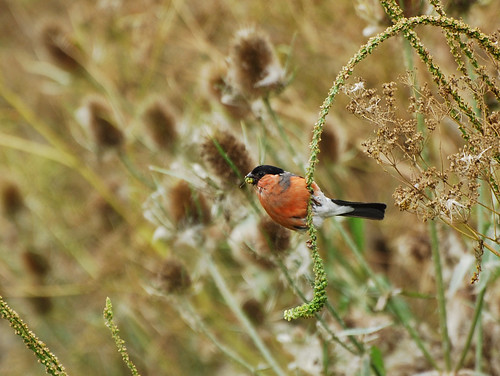
Even though I see them reasonably often now, I hadn’t managed to get a photograph of one until last weekend when I was at Fen Drayton nature reserve near St Ives in Cambridgeshire. I’d seen a pair together and heard several more calling in the hedgerows and then whilst leaning on a gate this chap appeared on the ground and hopped along for just long enough to get a picture:


A male bullfinch on the ground. Alas he always seemed to be behind a tuft of grass

I saw and heard at least a dozen during my walk but this was the best shot I got so I resolved not to leave until I had got a better one. As I approached the car park I saw another male fly into a hole in a bush so I waited for a few minutes but he didn’t reappear. So I went through the hedge to have a look on the other side, disturbing an elderly couple enjoying a glass of wine (now there’s an angle to nature watching I feel I should explore in more detail!). And then after a few seconds he appeared on a frond and began stripping seeds from it:


…and he stayed for long enough for me to fire off two shots of which this is one

And that, my friends, of the tens of thousands of nature photographs I’ve ever taken, is my favourite!

Hawkers and darters

A lunchtime visit to Milton Country Park on the northern periphery of Cambridge this week to look for dragonflies turned out to be an hour well spent. For the first 10 minutes they were conspicuous by their absence but then a brown hawker appeared over a small pond, very distinctive with it’s rufous wings shimmering in the sunlight. I tried to photograph it in flight but it proved beyond my talents. Even though there were three or four whizzing around the pond at any one time  I moved to a place under a tree which was overhanging the water and knelt down and waited. Within a couple of minutes a female brown hawker alighted on a log floating in the water and started ovipositing:

She seemed to be completely unfazed by my presence and busily worked her way along the log probing below and above the waterline for a suitable crevice to secrete her eggs.

She was there for around 10-15 minutes in total and every so often she took off but seemed to always to return either to her log or to a spot on the pond bank 5-6 feet from me. Even when my friend, Joe, came to see she still went about her business taking little notice of us.


She eventually departed along with all the other hawkers so we strolled along to a different location which was a wooden jetty protruding into another of the lakes. It’s surrounded all the way by dense rushes and has previously been a good place to see dragons. And that didn’t let us down either. We saw only two species, a pair of blue tailed damselfy and numerous common darters. All males. The males of this species are easily distinguished from the female as they are a glorious red and gold compared to the less vibrant green of the female.

The male of the species…

…and the lady:

There were several male common darters perched along the wooden jetty (the female above was snapped in Histon a couple of weeks ago), they were also happy to let us get up close and would occasionally dart away suddenly to chase a prey insect before returning to the same spot.


The compound eyes of the common darter – I like the depth of field in this picture rendering just the dragon in focus

When I was out for a stroll with my friend, David, who’s a bit of a dragonfly expert, last weekend, we found a dead migrant hawker dragonfly. We were marvelling at the complexity of the compound eye and he told me that a chap in the States had counted the facets in the eye of an American species, and apparently he got up to around 28000! He must have had a string of long winter evenings to fill. But dragonflies are amazing creatures and I can see how they inspired him to want to do it.

I also took a couple of nice bird photo’s on this trip but I’ll save those until next time.

A bit of a tern

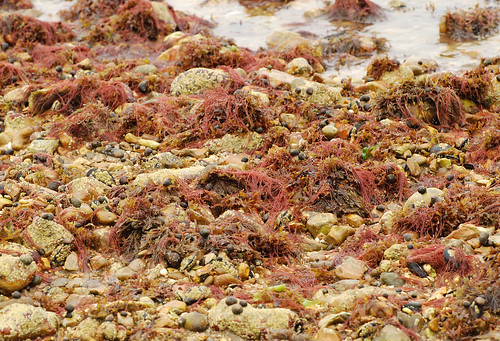
In my last post I talked about the highlights of my trip south to  Hampshire, but I didn’t mention our excursion to the beach at Lee on Solent. On a warm but very cloudy day but we took a punt on the weather so the children could go for a swim in the sea. The tide was out and revealed an extremely colourful shoreline festooned with different seaweeds, snails, limpets and sundry other shore dwellers.


The diverse array of life forms revealed by the receding tide

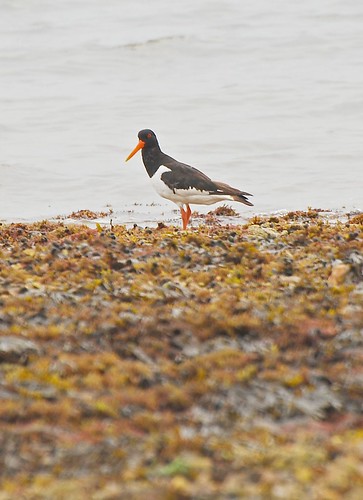
Pecking around the rocks was a lone oystercatcher who seemed to be largely unconcerned by the whooping and hollering of the kids splashing around in the shallows:

The statuesque oystercatcher.
People rave about the avocet , but I think oytercatchers are just as impressive!

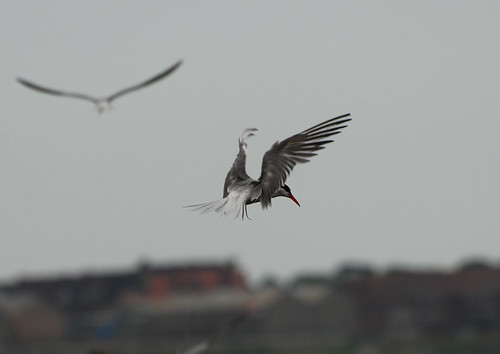
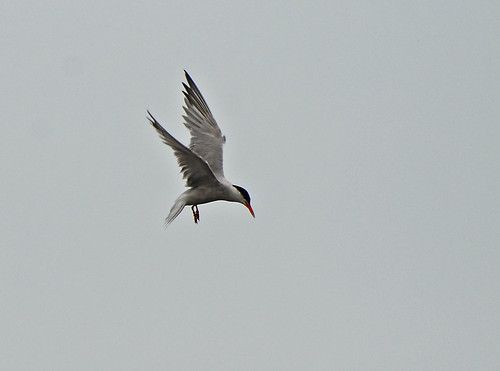
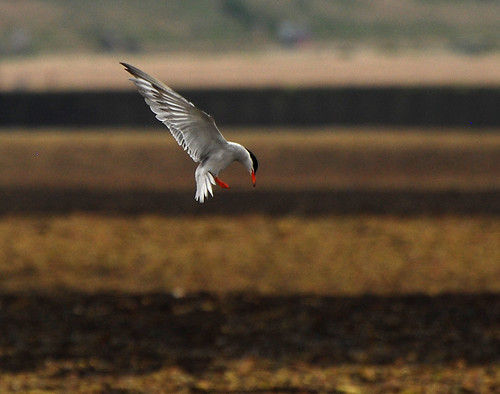
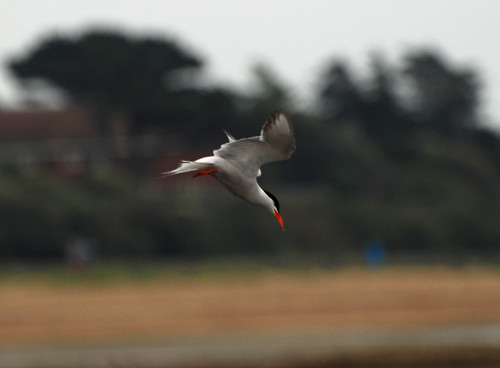
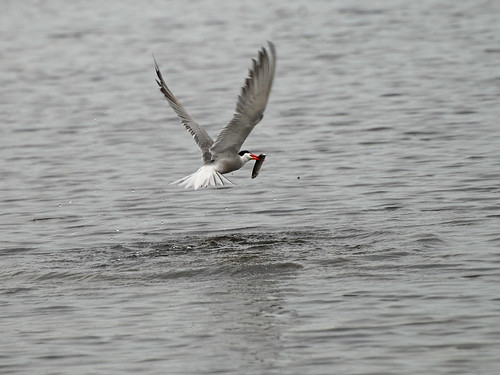
But the real stars of the show were  the arctic terns which were fishing in a small lagoon left in a dip in the beach when the tide went out. The precision aerial acrobatics of these amazing birds makes the Red Arrows look like amateurs! They are also expert at long haul, spending their summers in Europe and overwintering in southern Africa or even further afield. According to the BTO one individual was ringed in the Farne Islands in June 1982 and was next recorded in Melbourne, Australia, in October of the same year. Arctic terns return to their place of birth to breed so by the time this one saw the UK again it would have covered approximately 27500 miles over the sea!


Looking for a fish,

Manouevering into position for the dive,


Making fine adjustments…


And into the dive,


Mission accomplished.


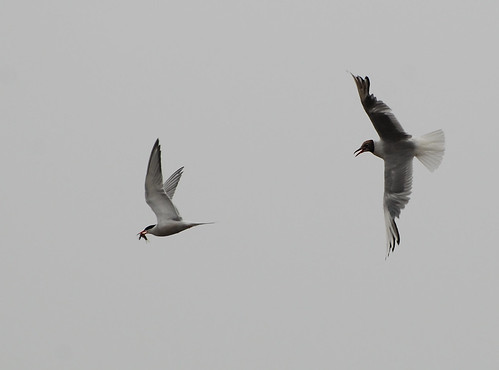
Bandits at 6 o’clock

The terns were diving down through numerous other seabirds including black headed gulls, great black backed gulls and herring gulls, so they didn’t have it all their own way. Every time a tern made off with a fish a black headed gull would be in hot pursuit, both birds squawking and shrieking. The terns seemed to invariably escape with their spoils, but the gulls never seemed to tire of harrassing them.

All that, and the children got to go for a swim, so we all went home satisfied with our afternoons achievements.

LBJ’s

I recently finished reading Simon Barnes book (he being the sports writer in The Times and nature writer) ‘How to be a bad birdwatcher’. In his book, which, if you love nature and wildlife and birds in particular, is well worth a read, he talks about the difficulties of getting to grips with all the species of small songbirds which flit through daily life largely unnoticed. He describes them as those ‘little brown jobs’ or ‘LBJ’s‘. I think that’s a good description, because until I made the effort to have a good look with binoculars they are simply little brown things which are largely unidentifiable.

However, a little time and effort spent getting to grips with them can be extremely rewarding. I mentioned in a previous post that there are alot of fledglings to be seen just now and a walk along my local hedgerows has provided lots of avian family entertainment:


A family of house sparrows. The male is on the left with the black bib and the female and three youngsters above and to the right.

House sparrows are getting more scarce although in total there are still large numbers of them, apparently there are 13.4 million at the last count according to the BTO. They have suffered from changes in farming practices but I’ve encountered reasonable numbers of them at various places around Histon this year. They’re highly gregarious and garrulous and I often hear them before I see them.

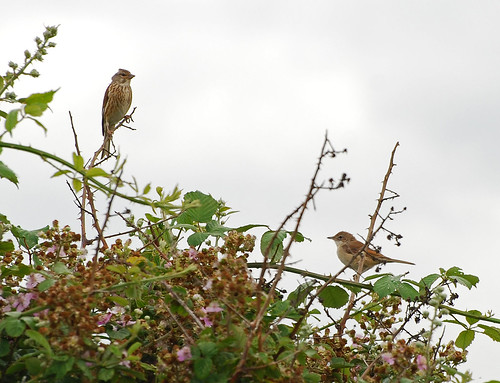
The family in the photograph are in a bramble thicket close to a substantial old hedge which every year plays host to various species of small birds, most notably linnet, blackcap, whitethroat, great tit, goldfinch and long tailed tit. A field close to here (approximately 150m away) has a good size fallow area which has various wild flowers including oats and this has provided alot of food and cover for families of whitethroat, yellowhammer and linnet this year and just this morning a small flock of 10-20 house sparrow were in that area. A fellow dog walker also told me there was a grey partridge nest there this year which had been abandoned and the eggs eaten, probably by crows. I’ve seen grey partridge in that area in previous years and they also have Red conservation status. It goes to show that even a small area of mixed vegetation can be highly beneficial for insects and birds.

And on the subject of linnet, they are also in plentiful supply this summer. They are less visible now the harvest is underway and the rape seed they were feeding on until a couple of weeks ago has now disappeared, so they have dispersed to find other food supplies.

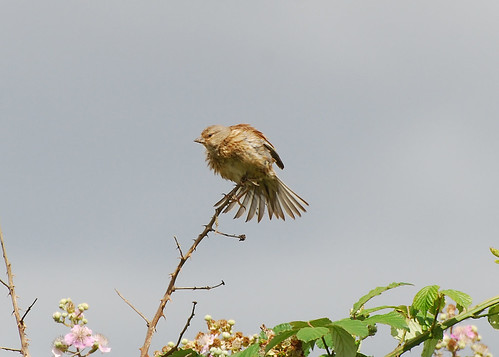
A pair of linnet younsgters perched atop a bramble bush


Another linnet youngster with a common whitethroat. This is a frequent sight at the moment, common whitethroat are abundant and often appear alongside other species in the hedgerows such as corn bunting, reed bunting and linnet


… and another one sorting it’s plumage out


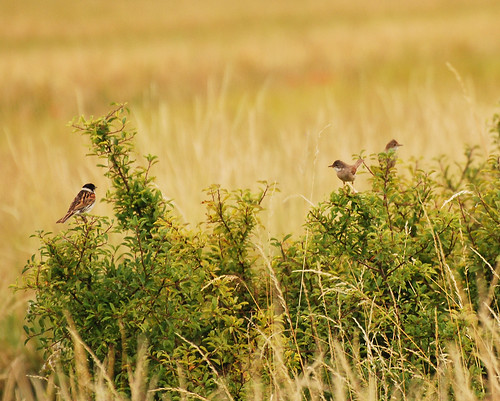
Whitehroat family with a male reed bunting…


…and the reed bunting fledgling who was just around the corner of the bush from the male above.

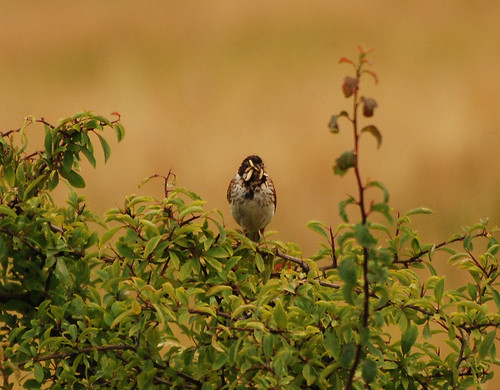
These pictures were taken in the evening when the sun was low in the western sky, which is why the colours are quite red, and a corn bunting was singing away just out of shot. More LBJ’s than I could shake a stick at!


Male yellowhammer feeding chicks on the nest

It’s also the time of year when alot of species are rearing second broods and I watched this yellowhammer with a beak full of bugs waiting for me to move on before he dropped down into the nest.

Milvus milvus

If you haven’t seen a red kite, Milvus milvus, hopefully you will soon. They are truly magnificent birds and are a remarkable success story in the annals of UK wildlife conservation. Several stages of reintroduction of Swedish and Spanish birds into northern Scotland and the Chilterns in 1989 were followed by subsequent reintroductions into other release sites in the East Midlands, Derwent Valley, Yorkshire, Dumfries and Galloway, central Scotland, Aberdeen and Ulster. The later reintroductions have used chicks from UK breeding pairs which is, I think, a good indication of the success of the longer term success of the original program.

The latest numbers I have heard for our UK population is 1700 breeding pairs, and growing. The reason I’m writing about red kites now is because 3 weeks ago I had an email from a colleague to tell me to look out the window because a red kite was flying past! I only saw the email an hour after the event so I missed that one, but another appeared a week later which I did see.

And then on Saturday as I was wandering along the road I live on, this magnificent creature was slowly quatering the gardens looking for worms, small mammals, or carrion:

The red plumage of the underside of the red kite is clearly visible. The pale patches on this one suggest it’s a juvenile

And red kites are big birds, they have a wingspan of 185cm. They weigh between 2 and 3 pounds (1 and 1.3kg), so for such a big bird they’re not heavy and are consequently not particularly strong. They feed primarily on carrion but they are unable to open the carcasses of bigger animals such as sheep so they rely on other carrion feeders such as corvids (crows) to do the initial butchering before they can feed. They don’t take live prey bigger than small mammals such as mice or voles or bird chicks, so don’t be concerned about your cat… or your children!

Whilst cycling into work yesterday morning (25th July) along the cycle path beside our new guided busway a red kite was quartering a field adjacent to that, so with 4 sightings in the last 3 weeks within a 2 mile radius, I think a juvenile may have moved into the area and is finding sufficient food to keep it here. I hope so.

Red kites are often wing tagged on the leading edges of both wings, on the left the tag reveals the location of the birds origin and on the right the year it hatched. The tags are big enough to be seen from a distance with binoculars or a scope and each location and year have a different colour. If you see a tagged bird and you want to discover its origin take a look here at RedKite.net where the tag colours are decoded.

I’ll hopefully be able to report again soon on local red kites.

Roesels bush cricket

A couple of weeks ago I was sitting at my dining table gazing out the window when I spotted this silhouette throught the blind:

So I snapped a picture and I really like the detail through the blind. It’s clearly a cricket, and a male (it lacks the long pointed ovipositor of the female which would be protruding from the back end) and its very long, very fine antennae are visible too.

So I popped around the other side of the blind to take a proper photograph, which unfortunately had to be through the window:


The markings on this creature suggest he’s a Roesels Bush Cricket

I went on to do some research on the Roesels bush cricket, Metrioptera roeseli, and it turns out it’s quite an interesting creature. It is a European species, named after the German artist and entomologist August Johann Rösel von Rosenhof, which found its way to England in the late 19th century where it established a toe hold in the far south east, in Kent and Sussex, where it remained for several decades. In the last few decades, possibly assisted by climate change, it has spread over much of south east England and the Midlands.

The migration of this species may have been assisted by the road network which could provide conduits for travelling further afield. There are two forms of this insect, the macropterous or long winged form, and a short winged form. It is reasonable to imagine that the long winged cricket would migrate further and faster, but even though Cambridgeshire appears to be towards the northern periphery of their range this short winged individual has arrived here too.

Roesels bush cricket is distinguished from all other bush crickets by the yellow/green edge to the hard cover of the thorax – the ‘pronotum‘ – and the light spots immediately behind the pronotum. One other similar species, the bog bush cricket, also has a light edge to its pronotum but it doesn’t extend all the way round as it does with Roesels bush cricket.

I’d never heard of Roesels bush cricket before I started trying to identify this individual, and then a few days later I was rooting around in the undergrowth of a field of scrub, also here in Histon, and I spotted a creature which I thought was a very green grasshopper. I managed to fire off a couple of photographs and when I uploaded the images it turned out to be a cricket not a grasshopper:


The macropterous form of Roesels bush cricket

And it was another male Roesels bush cricket but he clearly has the long wings of the macropterous form which extend well beyond his abdomen. So it appears I’ve found both forms of this colourful creature within a week. It’s amazing what can be found by poking around in the long grass!