Category Archives: Walks around Cambridge and Histon

Wildlife sightings in Cambridge

The busiest burdock

In my last post I wrote about the wildlife to the north of Histon. This post is about the wildlife to the west of the village. The two areas are divided by a main road and they are quite different in character. The north is very open with big open fields lined with ditches and hedgerows and the west has more trees and scrub.

In mid June I ventured there to compare the birdlife with that to the north, because I normally see less farmland birds like skylark, corn bunting and yellowhammer here, but more finches and migrant warblers like chiffchaff, willow warbler and whitethroat.
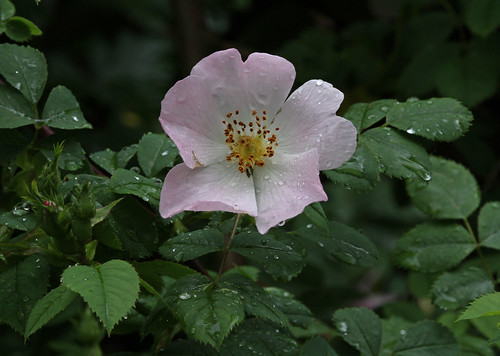
Dog rose (Rosa canina) bejewelled with raindrops

There had been a refreshing shower shortly before I set out which had left the flowers on a rose bush bejewelled with raindrops. It was a good time of year for the wild flowers as the ground had not dried out and there was plenty of sunshine. And of course, if the wild flowers are in good shape, there’s plenty of food for insects and therefore abundant sustenance for birds too.

(And on the subject of insects there was a news report from the BBC today regarding the short-haired bumblebee (Bombus subterraneus) which became extinct in the UK in 2000, but was reintroduced to an RSPB reserve at Dungeness in Kent and is now successfully breeding. Great news!)

But I digress. The dog rose flower was in the local meadow, but passing through there to the farmland beyond there is a field which is lined with drainage ditches, hedgerows and wide unmown borders which support a wealth of wildlife including wild flowers, bumble bees, dragon flies and birds. One of the wild flowers there is the burdock, Arctium minus, which has enormous spiky leaves and big burs which get stuck to your clothes, and on this walk there was a burdock patch that was full of songbirds:

A cock linnet resplendent in his sumptuous breeding regalia: the crimson bindi and rosy breast

The linnet (Carduelis cannabina, Dansk: tornirisk) were omnipresent here throughout the summer, and occasionally a yellowhammer (Emberiza citrinella, Dansk: gulspurv) appeared too. It’s easy to find yellowhammers if they’re in residence because of their characteristic song (a-little-bit-of-bread-with-no-cheese).

The striking colour of the male yellowhammer

And the yellowhammer song carries on the wind for hundreds of metres and because they are so colourful they’re easy to spot with a pair of binoculars.

A male whitethroat watching an adult linnet feeding a fledgling

At least one pair of whitethroat (Sylvia communis, Dansk: tornsanger) were nesting on the edge of this field too. The whitethroat are amber listed and the conservation status of the linnet and the yellowhammer is red list due to decline in their numbers. And in a very old oak tree just a few metres from here was a pair of barn owls (Tyto alba, Dansk: slørugle) nesting, and their status is also amber, but more about those in a later post.
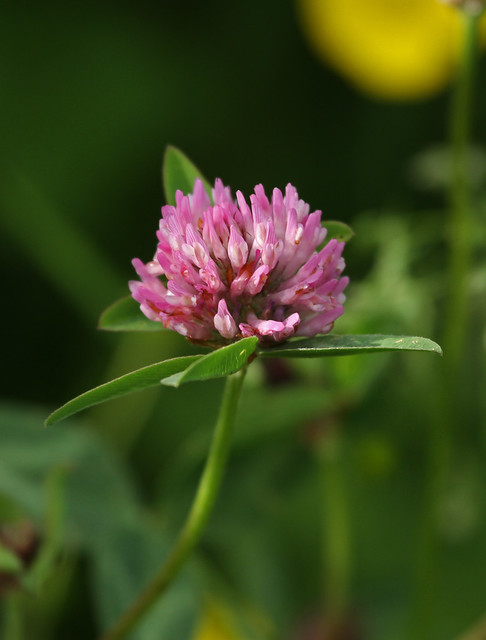
Red clover – Trifolium pratense – the national flower of Denmark
The birds were twittering, and so am I

When the summer eventually arrived this year it arrived with a bang and three months of glorious sunshine ensued which finally came to an end last weekend (but I’m still hoping we have an Indian summer). In early to mid June I spent a lot of time catching up with the local migrants, and all the other wild creatures around the village. I saw more swifts, swallows and house martins over Histon than I’ve ever seen and migrant numbers seemed healthy. This maybe because I was out and about and able to see them, or, hopefully, because more of them arrived and bred successfully this year.

The pictures here were taken one weekend in early June when I ventured across the farmland to the north of my village. Because of the wet spring followed by proper sunshine the verges, hedgerows and meadows were verdant and laden with fruit and flowers.

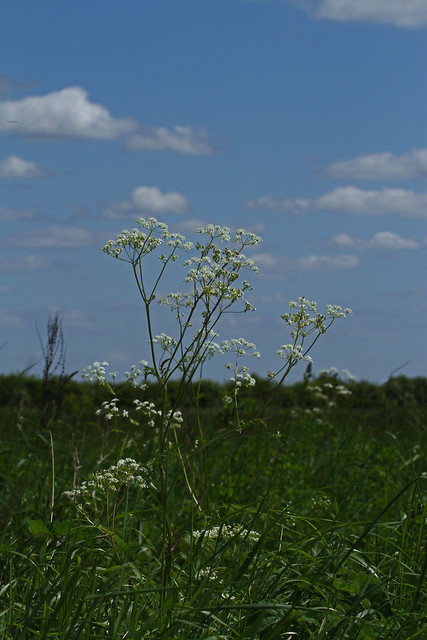
Cow parsley in the meadow against a summer sky

Many of my walks in these fields included lots of sightings of brown hare. I see occasional hares here so it’s no surprise, but what was surprising this year was the sheer numbers.

Brown hares (Lepus europaeus) – males chasing off rivals for the attentions of the ladies

There are four hares in shot here but there were more in the field to the left and more in the same field to the right. It wasn’t unusual to see ten or more on one of these excursions; they also seemed to be enjoying the hot summer. Fingers crossed they had a successful breeding season too.

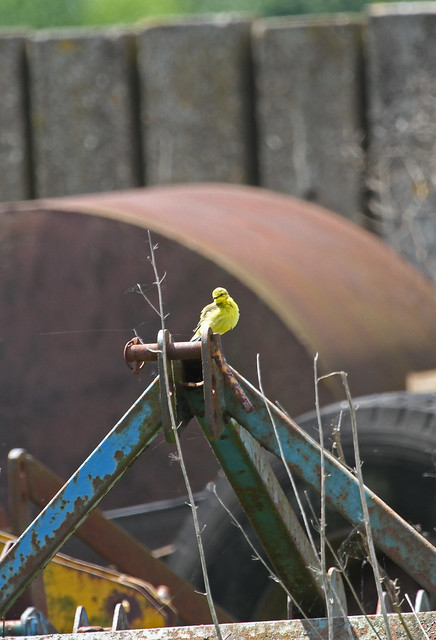
One of the migrants I’ve been hoping to see for the last three years, and which hadn’t put in an appearance was the yellow wagtail (Motacilla flava, Dansk: gul vipstjert). These little birds are spectacular and completely unmistakeable, and despite being a species of least concern in mainland Europe it is red listed here with only 15000 territories recorded in the UK in 2009.

Yellow wagtail perched on an old farm machine

This handsome chap was my only sighting of a yellow wagtail this year. They are one of those amazing small creatures, like the swallow, which spend the summer here in the UK but overwinter in South Africa. When they’re here they tend to frequent fields with livestock where they feed on the accompanying insects. Whilst there are no adjacent cattle or sheep here there is an enormous pile of manure which also attracts clouds of insects. I’ve seen wagtails here before but not for a several years, so it was good to see one again.

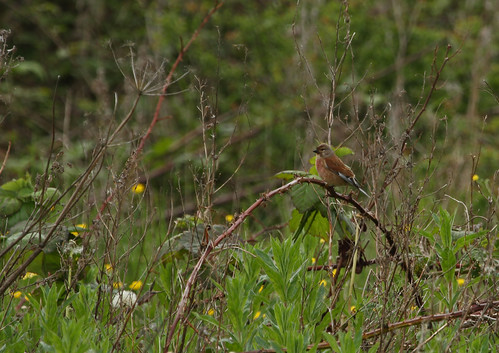
Cock linnet (Carduelis cannabina, Dansk: tornirisk)

And another red listed bird, which I’ve also posted about recently, is the linnet. Unlike the yellow wagtail, despite their red listing, I see linnet in the fields every year, and the occasional flock of several hundred in the winter. They get their specific name from their like of cannabis. Not for it’s pharmaceutical properties (at least as far as I’m aware) but because in the old days when hemp was grown to make rope they fed on the seeds.

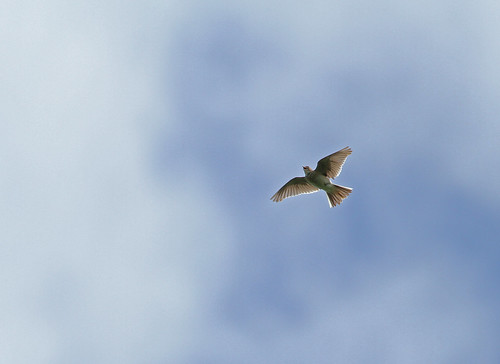
The wildlife on this weekend was abundant with a few rarities, so very high quality, but from a photographic point of view it was rather less auspicious. But I hope this skylark (Alauda arvensis, Dansk: sanglærke) makes up for that:

Skylark singing in the sky above my head

Skylark are not easy to capture because they’re ususally too high in the sky, or  moving too fast, or in a sky which is just too bright for good photography. But on this occasion the lark was very accomodating and there is just enough light to give the plumage a diaphanous quality which I really like, without overexposing it. The skylark is also red listed due to collapse in its numbers as a result of intensive arable agriculture, but there is a healthy population of them round here and there are often too many to count on a warm sunny morning!

By the way, I’ve just linked my blog to a Twitter account which you can have a look at here: @Thenaturephile. There’s not much in it yet as I only set it up at the weekend, but if you fancy taking a look please let me know what you think.

Meadow warblers

Our migrant warblers were all back from Africa and nesting by the beginning of June. There are four species which normally frequent my local countryside, the blackcap (Sylvia atricapilla, Dansk: munk), chiffchaff (Phylloscopus collybita, Dansk: gransanger), willow warbler (Phylloscopus trochilus, Dansk: løvsanger) and the whitethroat (Sylvia communis, Dansk: tornsanger).

The blackcap have been conspicuous by their absence this summer. The central European winter population, of which a pair took up residence in the garden last winter, disappeared in the spring and that was the last time I saw one. Chiffchaff were, as always, the first winter visitor I noticed returning because of their characteristic song calling out from the trees. There are several other birds singing in the background here but the call of the chiffchaff is clear above the others, and it’s easy to see where it gets its name from.

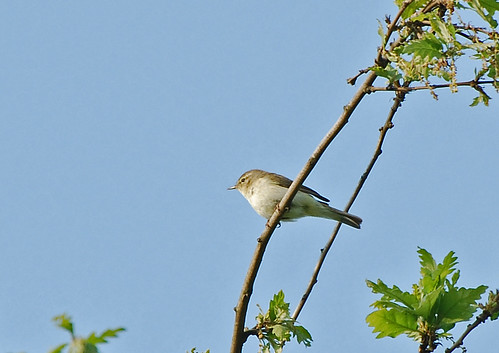
Chiffchaff male declaring his availability in early spring

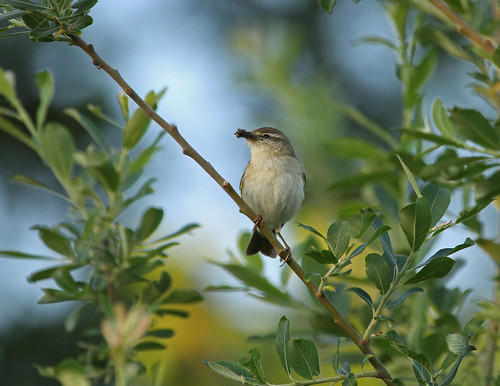
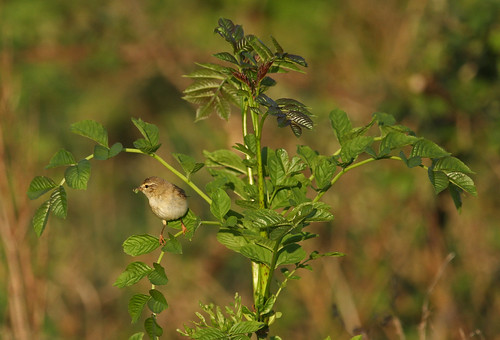
It’s now at the start of September and I haven’t seen a chiffchaff for a while, but through the summer I regularly saw willow warblers which were nesting in a bramble thicket that I passed when I was out walking the dog. Willow warblers are very easy to mistake for chiffchaff by sight but willow warbler song is quite different.

Willow warbler parent with a beak full of insects heading for the nest

The song isn’t the only diagnostic differentiator between these two species, there are a couple of others but they are more subtle. The most noticeable is the colour of the legs, chiffchaff have dark, almost black, legs and the willow warblers are red brown. Differences in plumage of the willow warbler are the brighter stripe over the eye (the ‘supercilium‘), a more promounced dark eyestripe and the patch under the eye (the ‘ear covert’) is olive grey with a pale patch immediately below the eye, compared to the more uniform dark grey colour of the chiffchaff. So if you get a good look through binoculars it’s not too difficult to tell them apart, but the song is the easiest way.

Another foray to collect flies for the chicks

Pausing to check up on me before heading into the nest

For a couple of weeks there was a spot in the field where I could stand close to the nest and watch the comings and goings of the adult willow warblers bringing food for the youngsters, and they seemed cautious but otherwise content for me to be there if I stood still.

Whitethroat male – my best ever bird portrait!

My favourite warbler is the whitethroat. They are easy to tell at a distance, even without optical assistance, and this is my favourite picture of one. The male whitethroat has a jingly jangly song and when he’s advertising for ladies he perches on top of a bush and flies repeatedly in a jerky motion straight up and then flutters back down to the same spot.

And while I was busy photographing the warblers I was being serenaded night after night by this chap:

A male songthrush (Turdus philomelos, Dansk: sangdrossel) filling the meadow with song

A tad incongruous in a post about warblers, I grant you, but he was there all the time and his songwas magnificent! As with the chiffchaff there are several other birds calling too, but the thrush is easily distinguishable from the noise. This is the first time I’ve posted a link to my own (amateurish!) sound recording, but I think it’s OK. Let me know what you think.

A pair of local red list birds

In a recent post I talked about the plans by the local council to develop our greenbelt land and our campaign to prevent it. I provided species lists of my sightings on the land to counter their claims that the proposed development would pose no danger to any of our red listed wildlife.

Here are a pair of those red list birds that I photographed this year to prove to the powers that be that they are actually there! Despite the council’s environmetal survey concluding that there are no red list species to be found, these two species nest here every summer.

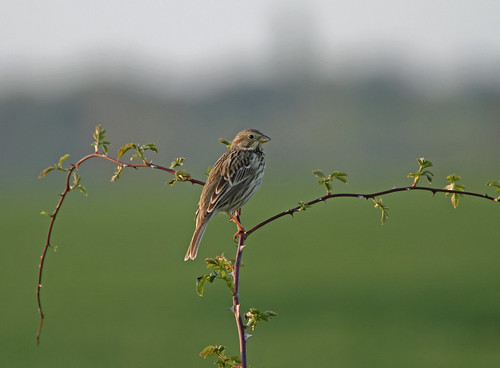
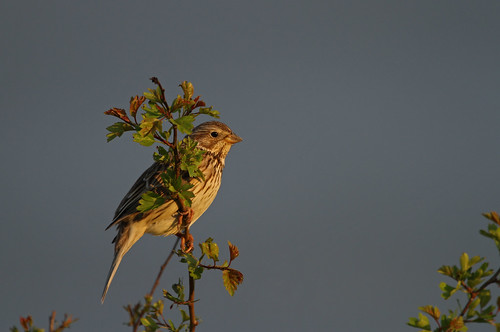
The first is the corn bunting (Emberiza calandra, Dansk: bomlærke):

This year has been a good one for corn bunting around Histon, several times I’ve counted flocks of 20+ individuals and they have been present every time I walk around the fields since they arrived in the spring. The corn bunting is red listed due to historical and more recent population declines, most likely as a result of modern farming methods. Numbers dropped by 89% between 1970 and 2003.

They live on arable farmland and feed primarily on seed and invertebrates during the summer. They also nest on the ground so overall their lifestyle is really not compatible with modern mechanised, chemical intense, farming methods. Which, as a result of the numbers I see here, makes my neighbourhood an important place for them. In the year 2000 there were 8500-12000 ‘territories’ (individuals or breeding pairs) in the UK so the several tens of my local birds are a small but important fraction of the total.

And the other red list species which I see regularly throughout the summer is the linnet (Carduelis cannabina, Dansk: tornirisk). The linnet is a finch which also feeds on seed and insects and is also red listed due to big decreases in its population, 57% between 1970 and 2008. But the good news for linnets is that although their numbers are decreasing in England and Wales they are increasing in Scotland and Northen Ireland.

A cock linnet is a handsome bird with a crimson spot on his forehead and cerise chest plates, neither of which are, alas, particularly prominent on this one:

Cock linnet

The linnet has a grey head and the pale grey spot on its cheek, which is prominent on this one, is diagnostic of the species. The linnet can be seen here in the winter in large flocks unlike the corn bunting which disappears from the Histon fields to wherever they go to in the winter after the harvest. The harvest was started here, and finished I think, last week, so I probably won’t see another corn bunting until next spring.

The linnet was immortalised in a 1920’s music hall song called ‘My old man (said foller the van)’. This song is about a family having to do a moonlight flit because they can’t pay the rent, and after they’ve filled the removal van there’s no room for the wife so she has to follow behind on foot:

My old man said “Foller the van,
And don’t dilly dallyon the way”.
Off went the van wiv me ‘ome packed in it,
I followed on wiv me old cock linnet.
But I dillied and dallied, dallied and I dillied
Lost me way and don’t know where to roam.
Well you can’t trust a special like the old time coppers
When you can’t find your way ‘ome.

Back in those days cock linnets were commonly kept as caged domestic pets because of their pleasant song, hence the mention in this ditty. Fortunately for the linnet though they are no longer held captive.

(In case you’re wondering, the ‘dillying and dallying‘ involved the poor girl stopping off in the pub, getting drunk, and then, not knowing where she was going, she got impossibly lost.)

Falco tinnunculus

It’s always good to see birds of prey and even better when they are nesting. This year has been particularly good around Histon with a kestrel nest, at least two barn owl (Tyto alba, Dansk: slørugle) nests – of which more in a later post – and at least two little owl (Athene noctua, Dansk: kirkeugle) nests. And that’s just the ones I know of, I’m fairly sure there’ll be sparrowhawks nesting in reasonably close proximity too.

Back to the kestrels though. In previous posts I’ve mentioned my favourite tree which is a really big old poplar on my (and lots of other folks) regular dog walking route. This year it played host to a family of kestrels (Falco tinnunculus, Dansk: tårnfalk). Initially I was concerned that being so close to a well-used public footpath the disturbance would be too great. Also, the nest was 7-8m up the tree and directly above a bench where the local kids sometimes hang out in the evenings, so on the face of it not the best spot for a pair of falcons to raise a brood.

The adult male kestrel standing guard over his nest site

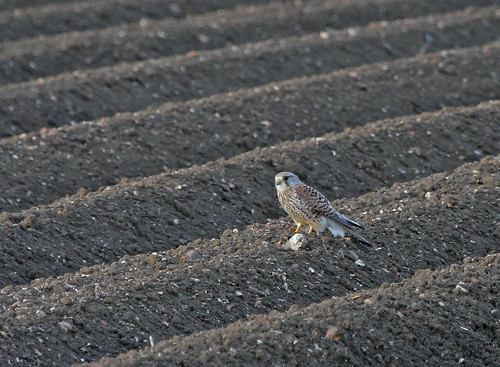
The male and the female were in constant attendance around the nest site and on this occasion both were present. As I watched the male he flew off so I walked on past to avoid causing too much disturbance. As I departed the female flew a second diversionary line out the tree in another direction, alighting on the ground around 50m from the tree, on top of a furrow which had been ploughed to take potato plants which had not yet sprouted. So she was very conspicuous but keeping an eagle eye (kestrel eye?) on myself and the dog:

In general though the kestrels adults seemed fairly relaxed about all the activity going on around their chosen nursery.

At this point in time, at the end of April, the nest would have had eggs in which are incubated for approximately 4 weeks before hatching. They produced three youngsters which I’ll update you on in a later post.

Getting more up to date, I just got back from exploring the coast on the Isle of Wight, off the south coast of England, and the birds of prey there were numerous. Buzzards were plentiful and on the cliff tops peregrine falcons were much in evidence, with four separate sightings on different days and different locations, one of them chasing a raven which was highly vocal in proclaiming its disapproval. I didn’t get any pictures of the peregrines but I’ll post some raven shots in the near future.

Cowslips and corn buntings

When spring sprung this year it sprung in style and it was quite glorious. At that time of year the migrants return from distant lands and recolonise the countryside.

One bird that also returns to the farmland around Histon, but from closer to home, is the corn bunting (Emberiza calandra, Dansk: bomlærke). The corn bunting is a resident breeder in the UK, but as with most other species local to me it disappears from the fields round here as soon as the harvest begins, usually during the first week in August, not to return until March or April.

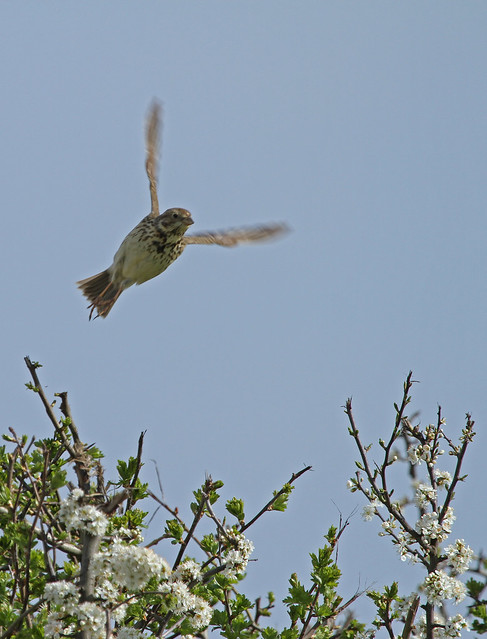
Male corn bunting taking flight from the top of the hawthorn blossom

The corn bunting is a lovely creature which is very distinctive when you know it. From a disatnce it looks like another random little brown bird, but it sits atop the wheat stems and the hedgerows calling and the call can be heard from many metres away. And like most little brown guys, when you see them close up they don’t appear quite so uninteresting.

A few months ago I got involved with a group of local people here who were working to prevent the development of this farmland for housing by our local council. The council said they had done an environmental survey and they provided us with a copy. It was an interesting insight into how these people work. The survey was commisioned by the agent the council had employed to manage the development (conflict of interest?), and it was undertaken the week after the harvest. The  conclusion in the survey was that there would be little or no damage to the local environment and no red listed or BAP (Biodiversity Action Plan) species would be affected. But I know from my recordings over the last five years that virtually all the wildlife – birds, mammals and insects – disappears as soon as the harvest starts. But my records, which I made available to the council,  also show that I have recorded 74 bird species there of which no less than 13 are red listed! Including the humble corn bunting.

The plan to develop the land was subsequently rejected and I hope my data played a part in the decision making process.

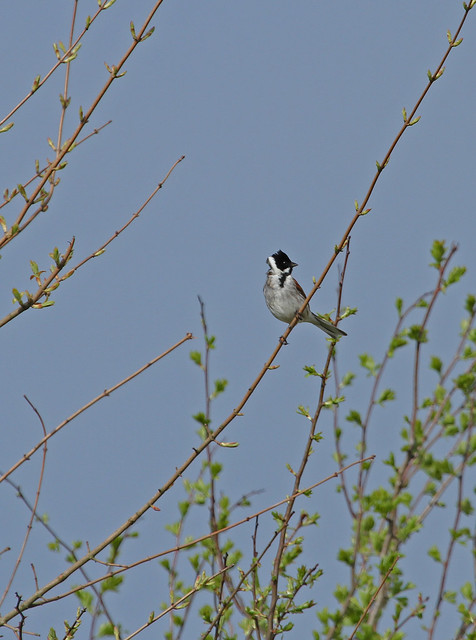
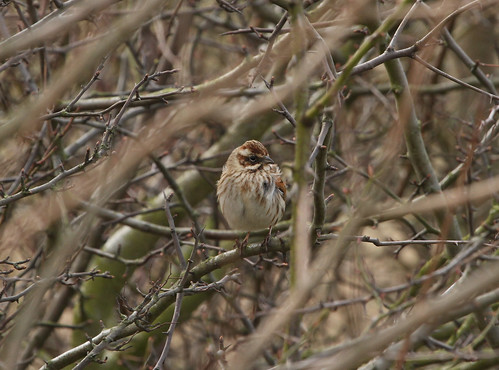
All the pictures in this post were taken on a sunny Sunday aftenoon at the end of April and another handsome bunting which frequents the drainage ditches and the hedgerows and was much in evidence was the reed bunting (Emberiza schoeniclus, Dansk: rørspurv).

Male reed bunting resplendent in his black cap and moustaches

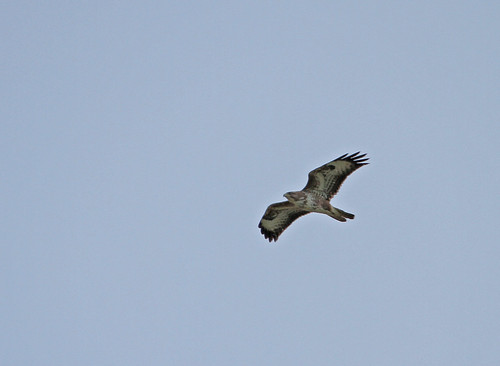
Whilst the buntings, finches and other small passerines were announcing their availability from the top of the undergrowth a buzzard patrolled the skies above looking for prey:

Buzzard, Buteo buteo, (Dansk: musvåge)

And one of my favourite harbingers of fair weather to come is the cowslip:

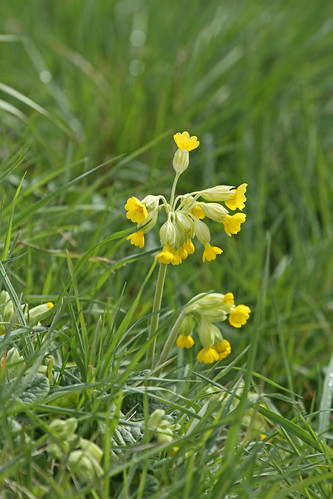
Cowslip, Primula veris

Cowslip flowers were picked in the not too distant past to make wine with, but as it is no longer common this practise has waned. Despite that, the seed is now included in commercial wild seed mix and the cowslip can be seen in large numbers on seeded motorway verges. This one is not one of those though, it is one of thousands lining a drainage ditch on a farm in Histon.

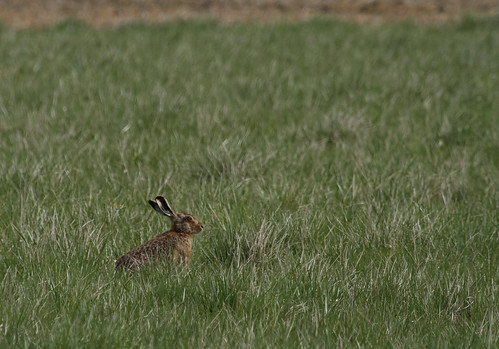
A carrion crow (Corvus corone, Dansk: sortkrage) was perched precariously on top of the hedge along the cowslip ditch and a hare was also close by and watching intently to make sure the dog kept a safe distance! The local hares seem fairly relaxed about the dog even though he’s a lurcher and can still move pretty rapidly. May be they can see that he’s too old to pose a real threat.

European or brown hare (Lepus europaeus)

This year seems to have been good for hares and I see them in many of the local fields in good numbers almost every time I venture there. There are also plenty of rabbits, but the hares are easily distinguished by their size, they are much bigger than rabbits, and the hares have very long ears with distinctive black tips which the rabbits don’t.

This was my first real sunny warm outing of the year and it gave me a good feeling that this year may turn out to be a good one for wildlife. And generally it’s living up to its billing. So far…

The way it should be

My last post showed some random weather at the end of March and in this one all the photographs were taken during the following weekend when the weather was rather more in keeping with the season, the way it should be.

Another of the great British bird of prey success stories over the last two decades has been the resurgence of the buzzard (Buteo buteo, Dansk: musvåge). Up until the mid 1990’s I’d only seen buzzards on summer holidays in Denmark and the occasional sighting on the western periphery of the UK, in south Wales or in Cornwall. But then I noticed they were creeping further eastwards up the M5, year by year, and now they can be seen all over England, and it’s not at all surprising to see them over my garden. I think a major contributory factor to the increase in raptor populations has been the ban on the use of DDT.

A buzzard soaring over the farmland on the edge of Histon.

DDT, or dichlorodiphenyltrichloroethane…

…was originally extremely effective in the control of insects but is very persistent in the biosphere, and because of its chemical properties it accumulates in the fatty tissues of apex predators such as raptors. The toxic effect was to cause thinning of the eggshells which would break before the chicks were ready to emerge. The consequences were devastating for many species inclusing sparrowhawks in the UK as well as peregrine falcons and bald eagles in the USA. The systematic use of DDT has been outlawed for many years  now, although restricted localised use for the control of malaria is still sanctioned, but here in the UK the long term benefit of the ban has been dramatic with these magnificent birds once again a relatively common site in our skies.

Other birds species were making the most of the change in the weather at the start of April too, including this female reed bunting (Emberiza schoeniclus, Dansk: rørspurv):

Reed buntings have been a common site in the fields to the north of Histon since the weather has warmed up and the males with their black and white heads cling to the top of wheat stems proclaiming their availability. The females are more reclusive but can often be seen perched in bushes

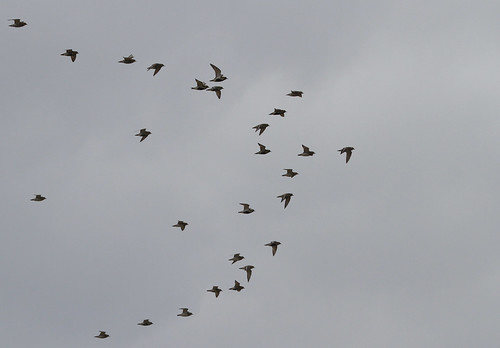
A less common visitor to the fields is the golden plover (Pluvialis apricaria, Dansk, hjejle). I love to see the plovers, because when they do arrive they come mob handed, and on this occasion there was a flock of approximately 500 birds which looped round at high speed in extended skeins which was great to watch!


Skeins of golden plovers

Golden plovers are amber listed in the UK but not of concern in Europe so I hope that means that the overall population is stable and we continue to see them over the UK. An amusing little factoid about the golden plover which I’ve unashamedly borrowed from the British Trust for Ornithology is that a question about the flight speed of the golden plover raised by a member of a shoot in Wexford, Ireland, prompted Sir Hugh Beaver to found the Guinness Book of Records in 1955.  And if you’re keen to know, the speed of the golden plover is around 60mph (100kmph).

The rook, Corvus frugilegus, Dansk: sibirisk allike

All the photographs in this post were taken during a walk in the fields adjacent to my home the weekend after the snow, except the rook. This miscreant had lifted the fatball feeder from the branch in the crab apple tree and dropped it to the floor where it commenced to single handedly empty it. But as it posed for several portraits in the process I reasoned that it earned it’s fill. I like crows and especially the rooks, they seem to have a sense of devilment akin to a childs… if not even a tad more sophisticated. Through history though, alas not everyone had such a benign attitude to the rook (and just about every other creature!), which you can read about here.

Whitethroats and Awards

The common whitethroat (Sylvia communis, Dansk: tornsanger) is a warbler which arrives here for the summer from Africa and frequents the undergrowth and bramble thickets. It used to be prevalent in my local meadow but for the last 2-3 years I’ve only seen a few there. But they have been nesting in hedgerows and drainage ditches in other fields, so it seems they are here just not in the same place. Their conservation status according to the British Trust for Ornithology is amber, indicating their numbers are declining so it may be that there just aren’t as many making it back here.


Male whitethroat (my best whitethroat picture to date!)

The males perch on top of brambles, as he’s doing here, singing their distinctive song, and they occasionally flit vertically up in the air in a very jerky pattern and drop back down again to land in the same spot, and that activity is also very disctinctive. It’s definitely summer when the whitethroat arrive in the fields!

I want to finish this minipost with a word about WordPress awards. Several fellow bloggers have been kind enough to nominate ‘The Naturephile’ for a WP award in the recent past. A couple of years ago when I received several  nominations in quick succession I found myself inundated and decided not to take part in the awards. I had insufficient time to do the award and insufficient time to write my posts, so it wasn’t through curmudgeonliness but because I think that if someone is generous enough to nominate me then I owe it to them to reciprocate accordingly, and I simply didn’t have time to do that.

So instead of accepting awards I’m going to show my appreciation by writing a post for everyone who  nominates me, so this whitethroat is for Petrel41 at the terrific blog ‘Dear Kitty. Some blog‘. Please click the link and go and have a browse, there is lots of good reading there!

Ever the optimist

The font of all wisdom in my area for what birdlife is around is the Cambridge Bird Club ‘What’s About‘ blog. A short while ago there was a report of a sighting of a bittern at one of my regular nature walks, Milton Country Park. This was an exciting development because I’ve never seen a bittern before, so on the following Saturday morning I set off before dawn to be in situ at sun up to try and see it. The bittern (Botaurus stellaris, Dansk: Rørdrum) is a small brown heron which lives in reedbeds and is so perfectly camouflaged it is almost impossible to find until it breaks cover. It’s famous for the ‘booming‘ call of the male which can be heard up to 1km away, so I set off hopeful of not only seeing one but maybe hearing it boom too. Ever the optimist!

The conservation status of the bittern in the UK is red, meaning it is scarce and under threat. Alas, the chap I was hoping to catch a glimpse of was very scarce indeed, to the point of being completely absent. Oh well, next time maybe. But every cloud and all that, even though the bittern had absconded there was other birdlife in abundance.

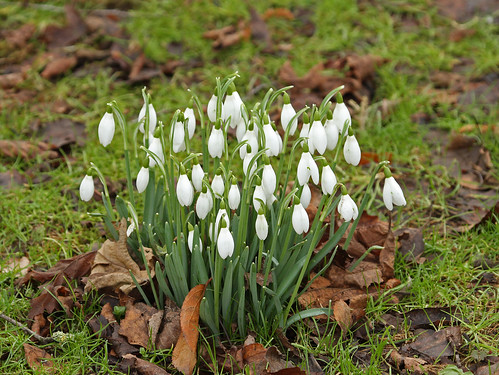
And not only birds, snowdrops were blossoming on the forest floor

The Country Park is made up of old gravel or quarry pits surrounded by a mixture of grassy scrub and mature woodland. Up in the treetops great spottted woodpeckers were hammering holes…

Great spotted woodpecker (Dendrocops major, Dansk: stor flagspætte)

I think this one is a female – the male has a red patch on the back of his neck which I think was absent on this one. The woodpeckers drumming sound results from the frequency of drilling rather than the power. They have energy absorbing tissues in the head to prevent brain damage and they strike at a frequency of 10-40 times a second which makes the tree trunk resonate, and that’s how they create their unique sound. Treecreepers were spiralling up these trees too, but they were just too quick to get a photograph.

But on the lakes there were hundreds and hundreds of water birds of all types:

Courting great crested grebes (Podiceps cristatus, Dansk: toppet lappedykker)

The full mating ritual of the great crested grebe is a wonderful sight. I’ve only ever seen it a couple of times and it involves swimming away from each other to a distance of 20-30m or so, then turning and swimming rapidly towards each other and when they meet they rise up in a vigorous display of necking before settling back into the water facing each other and creating a heart shape with their heads and necks. This is repeated mofre tha once and is utterly absorbing and delightful to watch. I was fervently hoping that my pair here were going to perform but they were content to simply preen, commune and doze. Still lovely though.

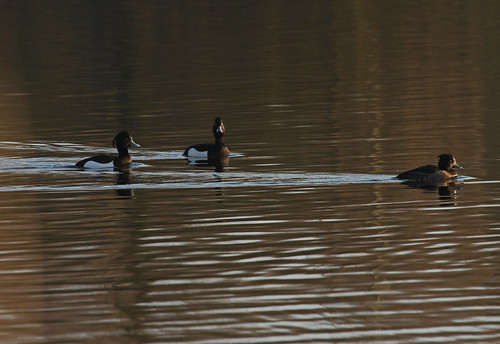
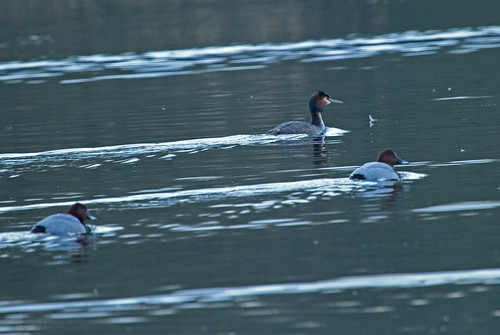
Another male great crested grebe with a pair of male pochard in hot pursuit (Aythya ferina, Dansk: taffeland)

Two male tufted ducks (Aythya fuligula, Dansk: troldand) eyeing a lady with bad intent. Love, or something, was in the air!

Both pochard and tufted duck are divers and the rapid spread of the tufted duck in the UK in the 19th century is though to be the result of colonisation of UK waterways by the zebra mussel which originates in southern Russia.

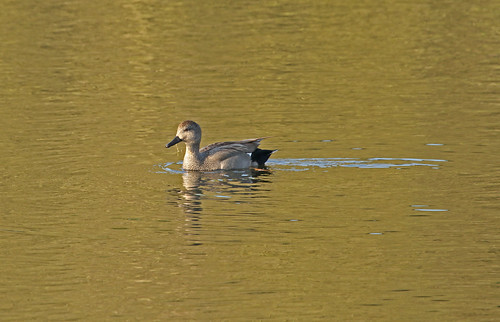
A male gadwall (Anas strepera, Dansk: knarand)

On a grey murky day the gadwall looks like a dull grey/brown duck but when the sun shines on them they are quite handsome birds, easily recognised on the water by the black rump, general brown plumage and the grey/black beak.

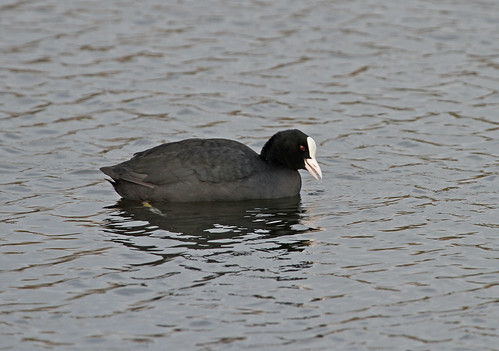
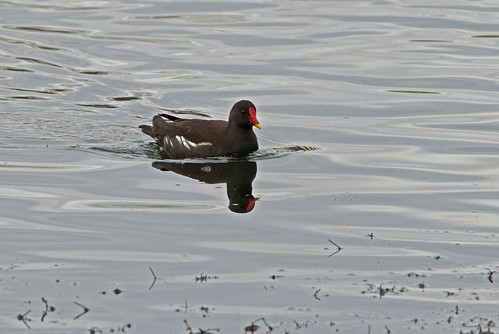
Coot and moorhen (Fulica atra, Dansk: blishøne and Gallinula chloropus, Dansk: grønbenet rørhøne, respectively) are both members of the family Rallidae along with water rail (which I saw on a previous recent visit to the Country Park, but not this one, even though I spent 10-15 minutes quietly looking where I saw one before) and crakes, which aren’t to be found in these parts.

The coot…

…and the moorhen

The male coots were in the mood for love and fighting out on the water on all the lakes, and were too numerous to count, and the occasional, more secretive and less aggressive, moorhen ventured into view from the reeds at the lake edges.


The brown heads are male wigeon, the black and white ones are male tufted duck, the two brown ones in the foreground are a pair of gadwall and out of focus at the back is another gadwall and a coot

As the sun came up the birds on the water semed to spring into life and large groups of various species busy feeding. All the pictures in this post were taken in a couple of hours or so from dawn until 10-11am and within a 300m radius. But as the sun arose and the light changed the colour of the water changed dramatically and gave some wonderfully varied backgrounds.

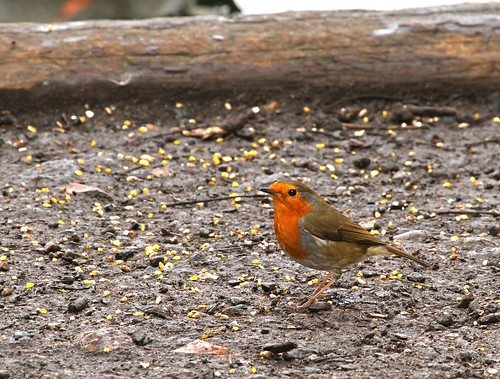
I stopped at a gap in the undergrowth to photograph the various species above and as I stood snapping the robin hopped into view between me and the water pecking at the seeds on the ground left by a benevolent walker for the ducks:

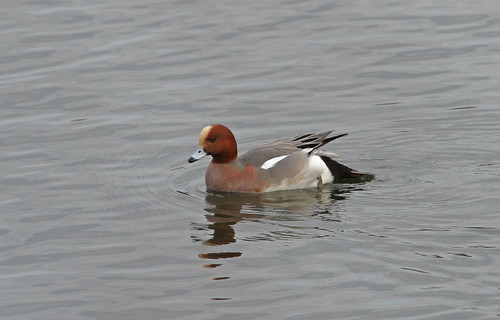
I think the most colourful, and therefore my favourite duck of that morning was the wigeon:

A pair of wigeon (Anas penelope, Dansk: pibeand), the male behind, the lady in front

The male on his own – resplendent in his psychedelic finery

The wigeon is a resident breeder in the UK and it’s conservation status is amber, which surprised me because I see plenty of them on the lakes around Cambridgeshire. They are vegetarians feeding on leaves and shoots and rhizomes, and in my view they are one of our prettiest ducks.

So no bittern on this trip but lots of other wildlife on the water and in the trees!

Mating Mutes

The sun is shining a lot now and the snow has totally disappeared. Unlike two weekends ago which was bitterly cold and the lakes at Milton Country Park were partially iced over. It’s not always easy to see all the water birds but they had been coralled into smaller areas by the ice. Ducks abounded at the park with teal (Anas crecca, Dansk: krikand), gadwall (Anas strepera, Dansk: knarand), wigeon (Anas penelope, Dansk: pibeand) and tufted duck (Aythya fuligula, Dansk: troldand) in numbers, as well as the customary mallard (Anas platyrhynchos, Dansk: gråand). There were two highlights of the trip, a goldcrest was busy hunting in a bush just a few feet away and seemed undisturbed by our presence. Goldcrest (Regulus regulus, Dansk: fuglekonge) are beautiful little birds, they are our smallest breeding species, weighing 4-7 grams, and the northern populations migrate south in winter with Scandinavian individuals crossing the North Sea to overwinter in the UK.
Mute swan pair with a male tufted duck in the background

I didn’t manage to get pictures of the goldcrest, which is a pity, but I did manage to get pictures of the second highlight, which was a pair of mute swans (Cygnus olor, Dansk: knopsvane). And if the goldcrest is our smallest breeder, the mute swan is one of the biggest (if  not thee biggest), weighing in at a hefty 10.5-12kg, and breeding is what this pair had in mind.

Mute swans pair for life and the courtship dance is delightful to watch, they gracefully circled each other, repeatedly intertwining their necks:

And the dance culminated in mating. The male climbed on board the female and grasped the back of her neck with his beak, the whole thing lasted just a few seconds, which was just as well for the lady as her head was held underwater and she actually disappeared from view.

And after mating they rose up, breast to breast out of the water and continued the necking dance:

Finally, they relaxed back into the water and finished the ritual by bobbing their heads towards each other, and apart from the mating moments the whole thing was very calm and sedate. I think mutes are simply regal, they are very big, powerful, animals and I can’t hink of any creature which is quite so pristine.

And shortly after mating the male climbed out of the water onto the ice for a post-coital stretch up to his full height and opened his wings, surrounded by a retinue of coot (Fulica atra, Dansk: blishøne) and gadwall. A fitting finale to this series of captivating natural events.