Category Archives: Wildlife locations

The iconic avocet

‘Iconic’ is a word that is overused, but in the case of the avocet it is entirely appropriate. Those of you from the UK – and possibly some of you from further afield – may know that in the UK the avocet is the emblem of the Royal Society for the Protection of Birds – the RSPB.

A trio of avocet feeding on the water at RSPB Titchwell as a pair of swift hunt winged insects just overhead

The avocet (Recurvirostra avosetta, Dansk: klyde) had all but died out – in fact it may have totally died out – in the UK in the 19th century, but in the 1940’s a breeding population from the European mainland re-established itself when the coastal mudflats along the east coast of England were flooded as a defensive measure against a possible German invasion. So there you go, just occasionally something good can result from a war!
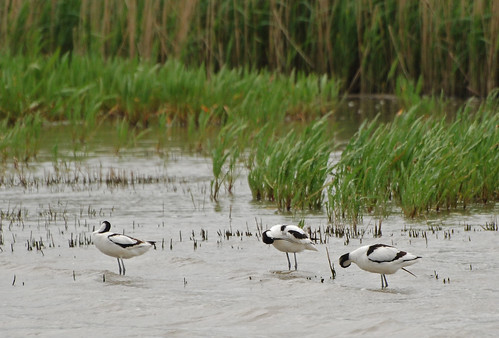
Avocet can be seen breeding on the east coast of England in the summer, and they are resident in the southwest during the winter, they are also winter and passage visitors. It is therefore an early symbol of conservation success and it was originally adopted by the RSPB in 1955 as the their symbol to adorn the new RSPB tie. Its continued success led it to be adopted as the RSPB logo in 1970. They are beautiful birds and they can be pretty feisty when it comes to guarding their territory.

The long upturned beak of the avocet, from which it gets it’s generic name, ‘Recurvirostra’, along with its black and white plumage makes it completely unmistakable. I have seen avocet before but not in such numbers and not so close and it was only on this trip that I realised they have very distinctive pale blue legs. So all in all it’s a very striking bird.

The upturned bill has a functional aspect too. It is the upper mandible which is curved and the avocet use it to stir up the sediment by sweeping it across the surface from side to side dislodging crustaceans, insects and worms which they detect by touch. The one below had captured a meal and the dark shadow just in front of its beak is a cloud of sediment churned up by the scything beak.

As with just about every species on the planet, including humans, the main threat to the avocet comes from inconsiderate human activity including reclamation of wetlands, depletion of water levels in rivers, infrastructure development and pollution by polychlorinated biphenyls (PCB’s), insecticides and heavy metals. Despite that, the global population is estimated to be between 210-460,000 individuals. It’s unclear if those numbers are stable, but as some populations decline others are increasing. So hopefully they’re OK for the time being.

I’ve been up to my eyeballs in non-blogging stuff in the last month so I’ve been struggling to keep up to date with all your blogs. The pace is unlikely to let up before September but I’ll try to visit as many as I can in the meantime. I will be back!
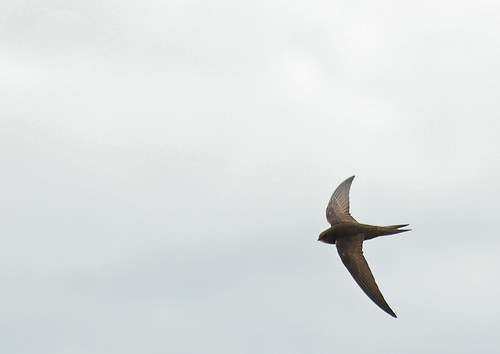
Apodidae – the swift

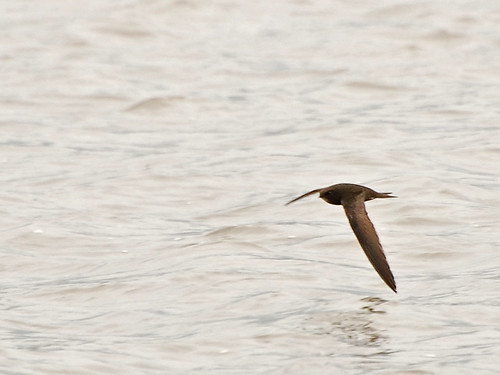
Last month I spent a day at the RSPB reserve at Titchwell near Hunstanton on the north Norfolk coast. It’s a particularly dramatic bit of coastline and is home to a very impressive array of birdlife which is concentrated here on the reserve. As well as all the waders and other water birds squadrons of swifts were wheeling and zooming low over the water plucking insects out of the air.


Swift – Apus apus. Dansk – mursejler

Swifts have been declining in numbers and their conservation status is amber, but it was difficult to believe they’re struggling! There seem to be good numbers of them in the skies around Cambridge too. I love it in the summer when I open a window and the sound of shrieking swifts filters down from on high.

Insects beware, bandits at 6 o’clock!

Photographing swifts in flight is challenging to say the least and something I’ve never before had much success with, but there were so many of them at Titchwell and they were flying close to the ground so I gave it a go. They seemed to have preferred routes which I guess were dictated by where the insects were flying and that made getting pictures a little less tricky as their flight paths were more predictable. And here are the results.

Swifts are members of the Apodidae family and on ther face of it appear fairly similar to swallows and martins. But my oft ill-remembered scchoolboy Latin leads me to believe that ‘apodidae‘ means ‘lacking feet‘ whereas swallows and martins are passerines which means they have feet adapted for perching. Swifts do have feet but they are tiny and adapted for clasping and not perching, all four of their toes pointing forward. One thing that the three species do have in common is that they are all awesome aeronauts. A juvenile swift can spend up to three years aloft after fledging and it will spend most of its life on the wing: eating, sleeping, gathering nesting material and even copulating in the sky.

According to the British Trust for Ornithology swifts shut down their brains one side at a time in order to maintain stable flight. But I’d like to know how they found that out – I can’t think of an experimental design that would enable this conclusion!

The swift is a summer migrant to UK shores and they spend their winters in South Africa, and I suspect the journey doesn’t take too long, covering a thousand miles in a couple of days!

My day at Titchwell was gorgeous, it was during the foul wet weather we’ve been having but shortly after we arrived the sun emerged and stayed with us for the whole day. I took nearly a thousand photographs and I’m going to post the best of them in batches in the next few weeks, interspersed with some other local wildlife. I hope you like them!

More wild flowers

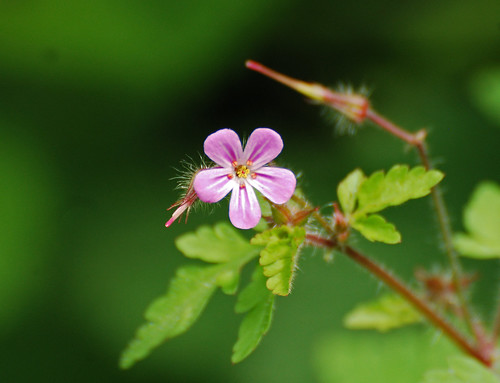
I keep seeing herb robert lining my route to work and in the hedgerows along my regular footpaths. It’s a member of the Geranium genus and is found in hedgerows, woods and on disturbed ground


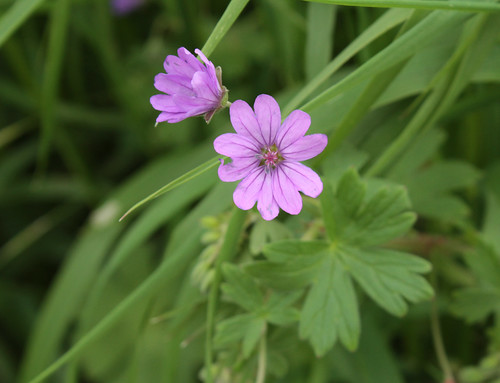
Herb robert – Geranium robertianum

I’m a tad confused by this plant because it has all the normal attributes of herb robert; the pink flowers, leaf shape, hairy buds and stems, but this one has the same bud shape as a cranesbill and a quick web search hasn’t yielded another image of herb robert with seed pods shaped like this. (So if I’ve made a taxonomic error please let me know!). Herb robert smells quite unpleasant and has been used as an insect repellant.


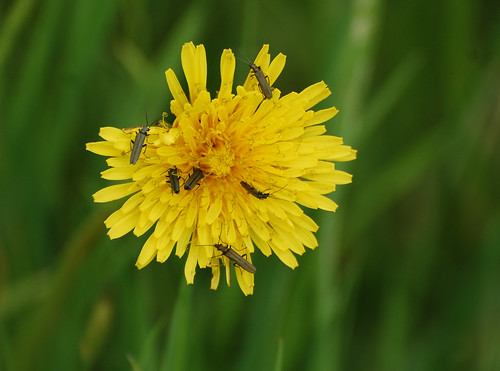
Dandelion – Taraxacum officinale

These pictures were taken a few weeks ago and at that time they were loaded with insect life, this danselion has six flower beetles (Oedemera nobilis) foraging on it, and it wasn’t at all unusual to see flowers in the meadow with this many bugs and more feeding on them.


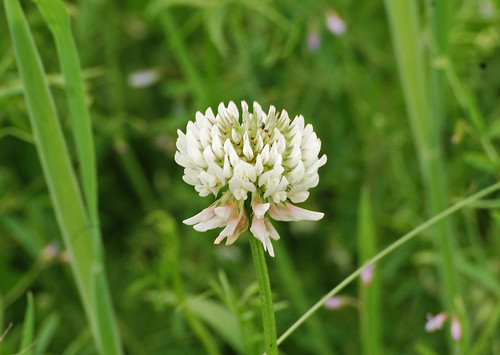
White clover – Trifolium repens

Clover grows abundantly in grassland. It is pollinated primarily by bumble bees but as bumble bee numbers decline it has become a major source of nectar for honey bees, therefore beekeepers became important people for cattle farmers who grow clover as a fodder crop for their livestock.

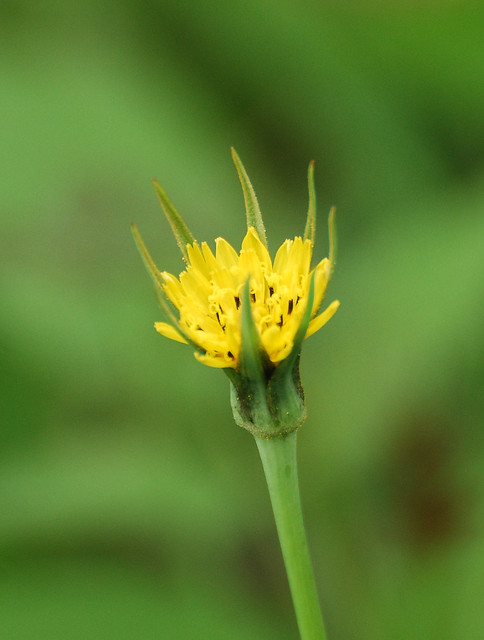
Jack go to bed at noon – Tragopogon pratensis

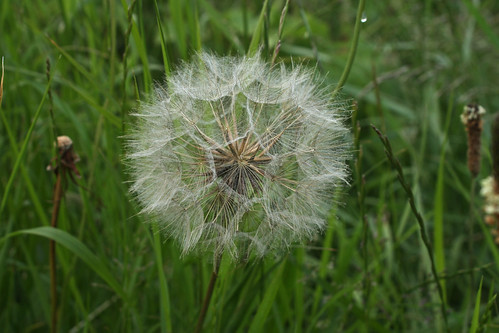
The lovely yellow star of ‘jack go to bed at noon’ is so named because the flowers open early in the morning and close up again at noon. It is also known as ‘goats beard’ and is a native annual in the UK. It has a milky latex sap which, according to Wiki, children from the countryside in Armenia make bubble gum from. It has a wonderful seedhead which is much bigger than than the dandelion and has fewer larger seeds.


Jack go to bed at noon seedhead

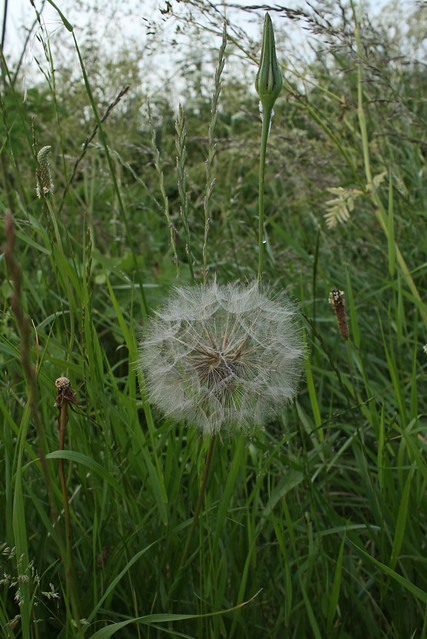
As with alot of other wild flowers, they are rampant just now because of the warm wet weather and are numerous in fallow fields and hedgerows.

A jack go to bed at noon seedhead with a closed flower behind it at the edge of a field

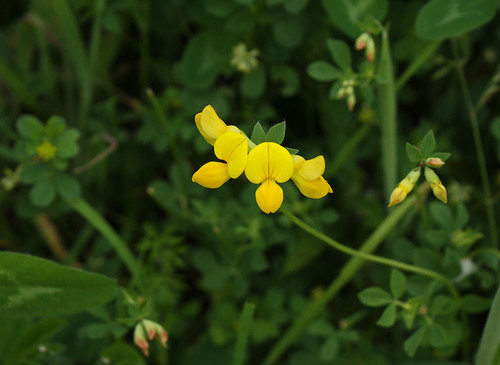
Also common around Cambridge right now is the birdsfoot trefoil. The flowers here are a gorgeous golden yellow but can also have red or orange which gives them their other common name: bacon and eggs.


Birdsfoot trefoil – Lotus corniculatus

Birdfoot trefoil is a legume which means it can actively fix nitrogen from the atmosphere. It can do this with the help of symbiotic bacteria which colonise root nodules and convert inert atmospheric nitrogen into ammonia, a form of nitrogen which plants can use. This ability makes the legumes a natural fertiliser because nitrogen is required by all plants, but unless they can fix it in this way they are reliant on alternative sources in the soil. Poor soil can be boosted by the application of other fertilisers such as good old fashioned manure, or more recently ‘NPK’ (Nitrogen/Phosphorus/Potassium, ‘K‘ being the chemical symbol for potassium). Or, when cycles of crop rotation are used, one of the crops used may be another legume, such as peas, which can help to replenish nitrogen levels in the soil naturally.

Damsels of Fen Drayton

One of the reasons for my trip to Fen Drayton a few weeks ago was to have a look to see which of our dragonflies were out and about. I went in early June and that time of year is a little early for the true dragons to have emerged, although it’s not impossible. But despite the shortage of the true dragons, the hedgerows and lake sides were abuzz with damselflies.


Male red-eyed damselfly – Erythromma najas

Dragonflies and damselfies are the two members of the taxonomic order ‘Odanata‘ or Odanates. There are two sub-orders within the Odanata: the Anisoptera – the true dragonflies, and Zygoptera – damselflies.

Azure damselfly – Coenagrion puella – the blue form of the immature female

Damselflies in the UK are approximately 4-5cm (1.5-2 inches) long and have thin abdomens and are all smaller and more delicate than the chunkier dragonflies. Having said that, the biggest living Odanate is currently a damselfly who resides in the rainforests of Central America, it has a wingspan of 19cm (7.5 inches) and the abdomen is 10cm (4 inches) long. A real whopper!

Blue tailed damselfly – Ischnura elegans – immature femaleBlue tailed damselfly – immature male – Ischnura elegans

Male and female Odanates, and immature and mature individuals, can often be distinguished by colour. The common blue female below is conspicuously brown so the species gets its name from the electric blue colour of the male. The common blue can easily be confused with the variable damselfly which is the same blue colour, but they are distinguished by the black markings on segment 2 of the abdomen which is shaped like a goblet on the variable and a club on the common blue. Also, the antehumoral stripes (on the side of the thorax) are complete on the common blue and broken on the variable. Although, as the name suggests, the variable is indeed variable and it can make distinguishing the two species a little tricky.


Common blue damselfly female – Enallagma cyathigerum – the only common blue we saw on this trip, perched on my friends finger

The black goblet on segment 2 is visible under the front of the wings on the variable damselfly below. But confusingly, it’s living up to its name because the antehumoral stripes are unbroken.

Male damselflies have two sets of paired claspers at the end of the abdomen which it uses to clasp the female on her pronotum, which is the protrusion in the middle of the back of the head. The claspers have tiny hooks on them which match grooves in the female pronotum and in order to avoid procreational mismatches the hooks and grooves are species specific.

Variable damselfly – Coenagrion pulchellum

In the picture above a variable male has clasped his lady by the pronotum. Male damselflies have primary genitalia at the end of the abdomen on the 8th segment, but in order for fertilisation to take place he needs to transfer a ‘spermatophore’ from the primary genitalia to the secondary genitalia on the second segment at the thoracic end of the abdomen. The female then curls round in to the ‘wheel’ position to transfer the sperm to her genitalia which are underneath her 8th abdominal segment.

A pair of variable damsels in the wheel position

All the Odanates are carnivores, and the larvae which hatch from eggs layed under water are ferocious carnivores, the larger ones will even take small fish! On one occasion last year while I was photographing large red damselflies (Pyrrhosoma  nymphula), a large hawker dragonfly (I think it was a migrant hawker, Aeshna mixta) which had been buzzing around higher up for several minutes suddenly dived down and caught one of my large red damsels. In a few seconds the migrant butchered it and ate it on the wing and the inedible bits of wing and leg were discarded and rained down around me.

Scarce chaser – an immature male

A lone Anisopteran, or ‘true’ dragon was spotted on this trip and it was an immature scarce chaser, Libellula fulva. He was a lovely mustard colour and he can be differentiated from the female by the colour of the thorax which is dark grey in the female, and from the male adult who is electric blue. He undergoes quite a transformation in transitioning from immature to adult.

The Magnificent Mute

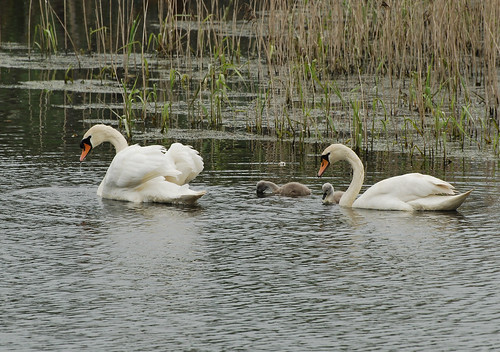
Mute swans are beautiful birds. There are few sights as impressive as a male mute, wings cocked, protecting his youngsters. The family below were on a very small lake at RSPB Fen Drayton and just before I took the pictures below, the male had launched a pre-emptive strike against a perceived threat at the other side of the lake, around 40m away. I couldn’t see who the interloper was but the sight and the sound of the big male as he raced across the lake, wings outstretched and beating on the water, must have been extremely intimidating. It was unnerving from where I was standing!


The male on the left is back with his brood after nullifying the threat. But he’s still got his wings cocked.

The mute (Cygnus olor, Dansk: knopsvane) is one of the biggest flying birds with a wingspan greater than two metres and an average weight for the male of approximately 11kg, it is a very impressive bird indeed and a group in the air flying close by is a real jaw dropper.

In the UK mute swans belong to the monarch and no one else is allowed to take them. They are marked every year, a practice that was originally identifying them  for the monarchs table, but I think Her Maj’s palate has evolved since then and eating swans is, fortunately, no longer fashionable.

It is native to the UK and a resident breeder but when things get too cold on mainland Europe winter migrants can show up here too. They tend to remain in their home territory all year round but can also form groups in the winter and move to a winter feeding ground, presumably this behaviour is driven by the temperature, availability of food and safety in numbers.

The ‘mute‘ in ‘mute swan’ is apparently derived from the fact that the mute swan is not as noisy as other swans. I’ve strayed too close to a nest before though, and at that moment mute was probably the last adjective to spring to mind as they voiced their discontent by making a violent hissing sound to warn me off. I took the hint and retreated as swiftly as possible.

Poison Parsley

Poison parsley is another name for hemlock. Hemlock originally attained notoriety around 2500 years ago when it was used to poison the Ancient Greek philosopher, Socrates. He was executed because his teachings were highly critical of the Athenian state and he was a thorn in the side of various high ranking Athenians. And in those days that tended to limit ones life expectancy.

Hemlock – Conium maculatum

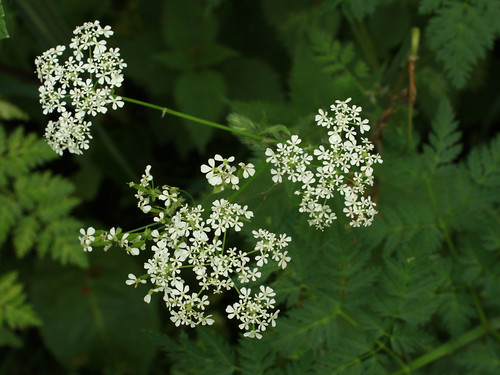
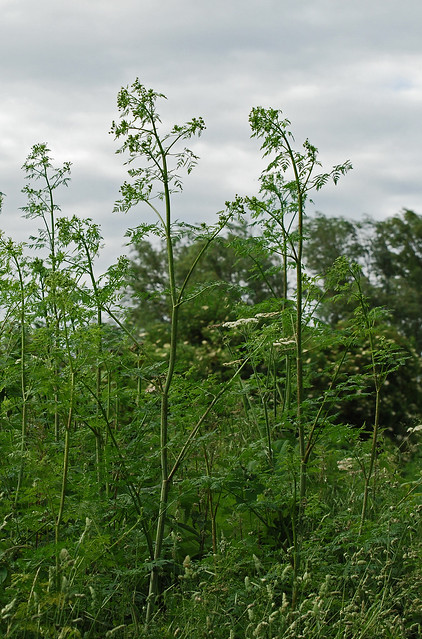
I hadn’t knowingly encountered hemlock until a couple of weekends ago when I was strolling around the RSPB reserve at Fen Drayton, where it was lining the hedgrows in some profusion. It is an imposing plant that was growing taller than me, up to around 2m, it has dark green feathery leaves and white flowers that resemble the hogweeds.


This plant was growing amongst hogweed and cow parsley, and it can appear fairly similar to both, to the uneducated eye.

A variable damselfy (Coenagrium pulchellum) warming itself in the early morning sunshine perched on a hemlock frond

The hogweeds used to provide fodder for pigs, hence the name, but giant hogweed is toxic to humans due to its sap which contains a type of chemical called a ‘furanocoumarin‘ that causes the skin to become sensitive to ultraviolet light. That can result in extremely unpleasant blistering of the skin and blindness if it gets in the eyes. Derivatives of furanocoumarins have been developed as drugs for the treatment of psoriasis.

But the hemlock toxin works in a different way. It is called ‘coniine‘ and the chemical name is 2-propylpiperidine:

I think this compound is remarkable because it is very small for a molecule which has such a specific and catastrophic effect. It exerts its effect by blocking a receptor for a neurotransmitter, acetylcholine, which resides on the membrane on the far side of nerve synapses. This results in a condition called ‘flaccid paralysis‘. Basically, the nerves which facilitate muscle contraction get blocked and stop firing. It starts in the feet and travels upwards, the muscles go floppy and that’s ultimately fatal when the effect reaches the heart and lungs. Socrates’ death was described by Plato and his last words were to his friend, Crito:

“Crito, we owe a rooster to Asclepius. Please, don’t forget to pay the debt.”

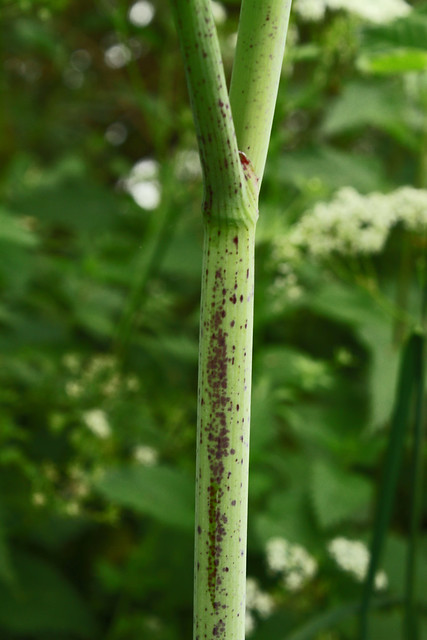
The smooth stem of the hemlock plant

The purple spots on the stem of the hemlock are diagnostic, other similar plants don’t have this, so if you see it, admire it, but don’t touch it! All parts of the plant are toxic and it doesn’t take much to have an effect.

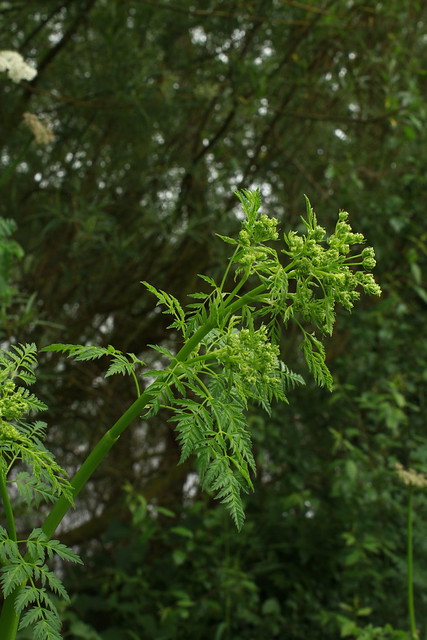
The flower head just before the white flowers emerge

Hemlock has a number of names according the the Royal Horticultural Society: California fern, cashes, herb bennet, Nebraska fern, poison hemlock, St Benedict’s herb, snakeweed, spotted hemlock, spotted parsley and winter fern. Also according to the RHS, its range is Europe only, but it has been introduced to the United States, hence the two names which include U.S. states.

Hemlock grows in damp poorly drained soils and is fed on by various insects including caterpillars and occurs in field borders and roadside verges aswell as along the lakes and ditches where I found it at Fen Drayton.

Wee brown birdies

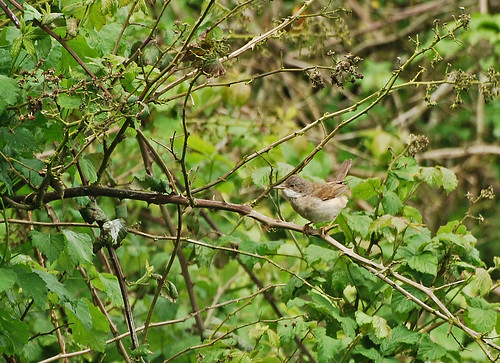
In the brief intervals between howling gales and torrential rain in these parts we’ve had the occasional glimpse of sunshine, and in those moments I’ve managed to grab a few pictures of some small birds; those little ones that look small and brown at a distance and can defy attempts at identification.

I’ve been a little concerned at the small numbers of certain migrants which have returned to my local patch, in particular blackcap, yellow wagtail and whitethroat.


Common whitethroat – Sylvia communis, one of the few to return to the Meadow in 2012

Last year at this time I would expect to see 5-10 whitethroat during a circumnavigation of the Meadow but this year I hadn’t seen any until I spotted this one and his mate, last week, bringing food to the nest. I also found another pair which I think are nesting in a tree on the other side of the track to this pair, but I’m yet to confirm that. And I still haven’t seen a single blackcap or yellow wagtail in 2012. Hopefully they made a successful migration back here and are just elsewhere, but I do miss ’em, they liven up my walks with the dog.


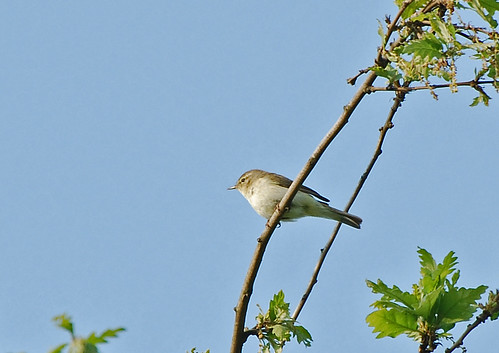
Chiffchaff – Phylloscopus collybita

A wandering warbler which has returned in numbers is the chiffchaff, and I hear them singing almost everywhere I go. This one was in a field here in Histon, and let me get close enough to take this picture, which is my favourite chiffchaff shot.

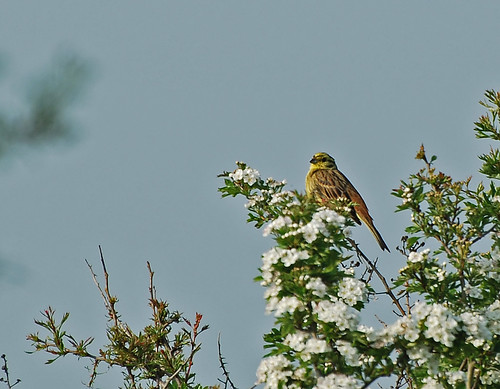
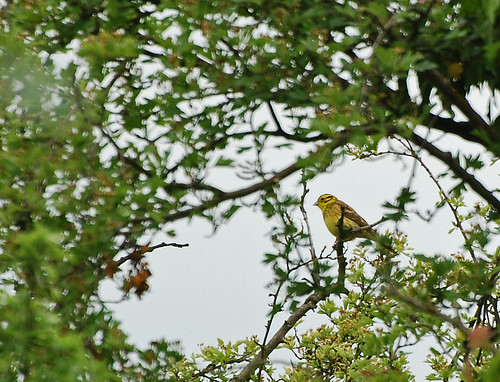
The rest of the birds in this posts are not migrants in the UK and I see them all year round. The yellowhammer is a bunting that has a very distinctive song, described in numerous field guides as ‘a-little-bit-of-bread-with-no-cheese‘. Which is a very good example of the pitfalls of trying to over-interpret birdsong! I was with my daughter when we saw (and heard) this one calling, and after telling her about the ‘little-bit-of-bread…’ thing we spent the rest of the walk thinking up alternatives. My favourite was ‘I’m-going-down-the-pub-for-a-beer‘.

Yellowhammers – Emberiza citrinella

I was particularly pleased with the second yellowhammer picture because I like the out-of-focus foliage surrounding the focussed bird. I recently upgraded my DSLR to one with more sophisticated focussing capabilities than my ageing Nikon D40x, which all my pictures up to now have been taken with. And one of the main reasons was so I could focus more quickly on small birds in bushes, such as this one, where the foliage was moving around in the breeze causing the camera to struggle to find focus. This picture was taken with my D40x and I was surprised by how well it turned out, so maybe I’d have delayed upgrading if I’d captured this image first!


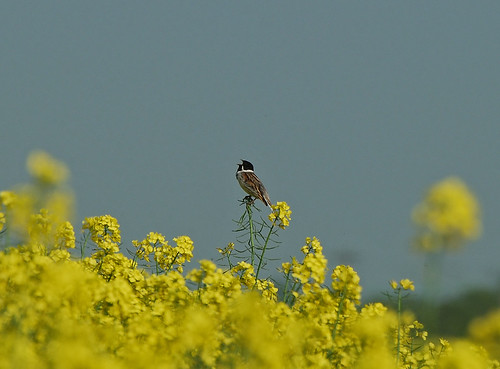
Reed bunting – Emberiza schoeniclus

Reed buntings are present in the local fields and hedgerows all year round and this little chap, for he is indeed a male, was singing long and loud perched on the top of the rape flowers. A circuit around this field is an ornothological treat, on one lap I’d expect to see several reed buntings, at least one or two corn bunting, lots of skylark and occasionally linnet and goldfinch. And on Saturday (9th June) there were two bullfinch, an adult male, resplendent in his black cap and peach breast, and a male youngster, the same colours but a tad smaller and with more muted colours, perched in a tree together on the edge of the field.


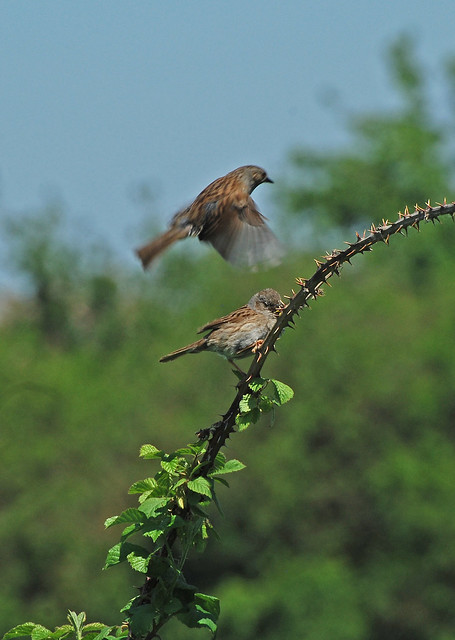
Dunnock – Prunella modularis

And my favourite little brown bird is the dunnock, which are also here all year round, and in the winter are regular visitors to my garden. These two were transporting food to the youngsters in the nest in the midst of a bramble thicket. Fortunately, despite the low numbers of migrants in my locality there are still enough birds around to liven up a walk in the countryside.

Insects and molluscs

Over the last couple of weeks I’ve been out and about photographing wild flowers, and of course the raison d’etre of flowers is to produce the reproductive cells of the plant in order to ensure survival. And as plants are immobile they rely on other vectors to connect the male and female parts, that can be the wind and the rain but many flowers are exquisitely evolved to attract one or more species of insect to carry the pollen to the ovum and effect fertilisation.

So in the course of photographing the flowers some of them were hosting a pollinator or two:

Tree bumble bee – Bombus hypnorum

This tree bumle bee was sipping nectar from the flower of the white deadnettle. It’s one of the insects that is strong enough to get to the back of the flower and take the nectar. Flowers have evolved in this way such that the insects have to pass the stamen, which is where the pollen, or plant sperm, is produced. The stamen is made up of the filament and the anther, and foraging insects brush against the anther picking up pollen which they carry to the next flower where it is deposited on the female part of the plant – the ‘carpel’, and fertilisation ensues.

There are various species of bees in the UK but only around half a dozen common ones. Bees are in trouble in this country and no one seems to know why, both honey bees, which live in colonies, and solitary bumble bees are dying out at an alarming rate.

Buff tailed bumble bee – Bombus terrestris

The buff tail above was in a particularly poorly condition and had tiny mites crawling on it’s body so I imagine it didn’t do much more pollinating.

Soldier beetle – Cantharis rustica

The soldier beetles are related to the fireflies and they get their common generic name from one species which is bright red and is therefore named after the ‘redcoats‘ – English soldiers from days of yore. The larvae and the adults are carnivorous, the larvae feeding on insect eggs and caterpillars and the adults on aphids. They also feed on nectar and can therefore pollinate too.


Black slug – Arion ater

Alot of people have an aversion to slugs because of the damage they can do to fruit and vegetables, but this chap was out in the field making a meal out of a couple of dandelion seedheads. I don’t think they contribute much to pollination and they are predated by frogs and toads and also hedgehogs. Although I’ve heard that if too much of a hedgehog’s diet consists of slugs, parasitic worms living in the slugs can get into the lungs of the hedghog and kill it because its lungs fill up with fluid. Which sounds pretty unpleasant but I guess it’s not the fault of the poor old slug!


Brimstone moth – Opisthograptis luteolata

The brimstone moth is a splendid creature with a wingspan of 32-37 mm. It’s common and widespread across the UK. In the warmer climes of  the southern UK there can be three generations in a year but in the north there is only one brood per annum, and adults can be seen on the wing between April and October. The caterpillars feed on various trees and bushes including hawthorn and blackthorn.

A couple of weeks ago after days of rainfall which had moistened everything I found a 50m stretch of verge which was crawling, literally, with hundreds of yellow and brown snails.


Brown lipped snails – Ceppaea nemoralis. Just a few of the hundreds that were making the most of the damp conditions

The ‘lip‘ of the snails in their name is the front edge of the shell which can be seen in the next two pictures and is lighter brown on the yellow one and a much darker brown on the brown one:

Snails are predated by songthrushes. They pick up the snail by the fleshy part and crack the shell on a handy stone. Some years ago I was sitting at home on my own reading a book and everything was very quiet. I heard ‘tap tap tap’ on the front door, but when I went to answer it their was no one there. So I went back to my book. A few mintes later I heard the same tapping and again there was no one there, so I opened the door to have a look up the street and rather than a visitor there was a collection of broken snail shells on my front doorstep. It transpires the tapping I’d heard was a songthrush using my front doorstep as an anvil to swing the snails against and hammer open the shells!

More blooming flowers

Hedgerows, field borders and roadside verges continue to thrive in this part of the world as a result of the recent rainy weather. Nettles are in abundance at the moment, in particular the white deadnettle (Lamium album):

The white deadnettle is, as the name suggests, not a stinger, and it’s common all over the UK, Europe and Asia. It’s white or pink flowers need to be prised open in order to reach the nectar at the back of the flower so only bulky insects such as bumble bees can reach it. It flowers from March to December so it can provide a food source for these insects for most of the year.

According to the Royal Botanic Gardens at Kew, the leaves and flowers can be eaten raw when they are young and tender and the fresh leaves can also be boiled and eaten as a vegetable. The flowers can also be boiled in water and used as a traditional herbal remedy for catarrh and dropsy, which is another name for oedema, or build up of fluid under the skin. The roots can be boiled in wine, which will extract compounds that are insoluble in water into the alcohol fraction of the wine, and the resulting concoction can be used as a remedy for kidney stones. White deadnettle is also used as a herbal treatment for benign prostate hyperplasia, which is enlargement of the prostate gland, and for gastrointestinal problems. So this humble hedgerow plant has the potential to provide a plethora of therapeutic compounds.

The white deadnettle is also known as bee nettle, blind nettle, day nettle, deaf nettle, dog nettle, snake flower and white archangel.

And the other nettle which is springing up everywhere is the much maligned stinging nettle, Urtica dioica:

The flowers of the stinger are tiny and green and grow in strings which are several centimetres long. The stinging mechanism is via hairs, or ‘trichomes‘, and each one has a bulbous end that breaks off when brushed by a passer by, leaving a sharp hollow tube. The tube acts like a tiny hypodermic needle that injects a cocktail of irritant chemicals including histamine and acetycholine which potentiate an inflammatory immune response which is the cause of the stinging sensation. The sting protects the nettle from grazers but also offers protection for other species which are resistant to the sting and the stinging nettle is therefore home to various species of insect and is an important refuge for caterpillars such as that of the peacock butterfly. Before slashing them down in your garden see if you can’t find an out-of-the-way corner to let them grow and provide a home for the butterflies.

Cooking the nettle leaves removes the sting and they are rich in vitamin C so they are used to make soup, herbal tea and, latterly, pesto and in the production of a cheese called ‘yarg‘ from Cornwall.

Charlock, Sinapis arvensis

The yellow flowers of the charlock plant, also known as carlock, corn mustard, field kale, kedlock, kerlock, kinkle, wild kale and wild mustard, have sprung up along the field-side drainage ditches and hogweed, Heracleum sphondylium, is well established too:

Hogweed flowerhead

Hogweed grows all over Europe and flowers from June to August. The flowers burst out of large pods at the top of the stems and are initially pink but fade to white. The young shoots are reputed to be good to eat with a flavour similar to asparagus and the plant gets its name because it was gathered to provide feed for pigs in times past. Hogweed is also known as cow parsnip, cadweed, clogweed, eltrot, giant parsnip, madnep and meadow parsnip.

Pansy, Viola arvensis

Lurking along the edge of the nearby rape fields, almost hidden in the undergrowth, are pansies. The name of the pansy originates from the French word ‘pensee‘ – thought. It is also know as heart’s ease, ladies’ delight and stepmother’s flower.


Hedgerow cranesbill, Geranium pyrenaicum

Hedgrow cranesbill, aka mountain cranesbill, is very common at the moment. It flowers from May to August and it gets it’s name from the shape of the seedpod in some species of geranium which is long and pointed and said to resemble the beak of the crane.

Herb bennet, Geum urbanum

According to the RHS herb bennet also has a number of colourful names: blessed herb, city avens, clove root, colewort, Indian chocolate, minarta, St Benedict’s herb, star of the earth, water flower and wood avens. This plant grows in shaded spots and flowers from May to August. It has aromatic roots which have been used to flavour ale and give off a smell of cloves so it was hung by the door to ward off evil spirits. It was also used medicinally by the Romans as a substitute for quinine.

My day job is in the pharmaceutical industry so I have a professional interest in chemicals which could have medicinal applications either on their own or as cocktails of compounds which may be contained in the same plant. So when I’m researching a post like this I wonder how many species we’ve lost due to modern agricultutal practices and how much herbal knowledge and potential drug molecules have passed into history. Many have probably been lost but there are still thousands remaining to provide us with food, herbs and spices, medicines, and to add the wonderful shapes and colours to the countryside.

Serendipity II – The charismatic cuckoo

I don’t recall having seen a cuckoo before, even though I’ve heard their unique call many times. But on my sojourn over to Wicken Fen a couple of weeks ago there were lots of them. ‘Lots‘ is a relative term because cuckoos are becoming increasingly scarce, their conservation status is red due to recent declines in the breeding population and in 2000 there were 9.6-19000 breeding pairs in the UK. But on this trip we heard and saw at least 5 and possibly several  more.

Just before I spotted the first cuckoo I glanced across the lake and this was the view:


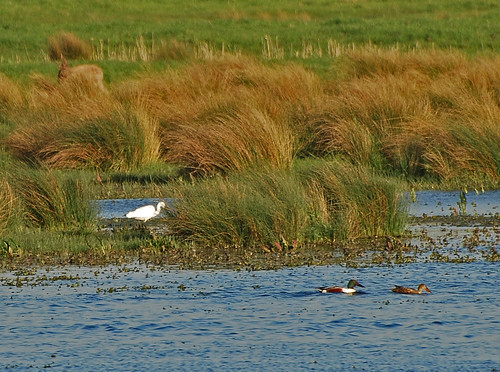
A pair of shoveler in the foreground, a little egret behind and a roe deer just beyond the reeds

I really like this picture because of the colours of the reeds and the water in the evening sunshine, but also because it contains three interesting species. Apart from rabbits, any wild mammal is exciting to see in this country, so the roe deer was a pleasing encounter. The little egret (Egretta garzetta, Dansk: silkehejre) is a member of the heron family which is now resident in the UK, presumably as a result of climate change. I associate them with warmer places because that’s where I saw them before 2000, but nowadays they’re not particularly uncommon here. And in the forefround are two shoveler (Anas clypeata, Dansk: skeand) which are migrant visitors to the UK, but this pair obviously liked it enough to linger and are still here in the middle of May, long after they would normally have left.

And then there were the cuckoos:


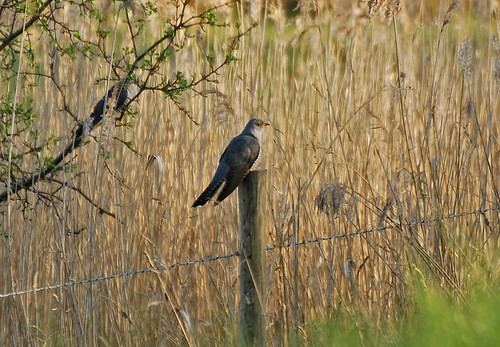
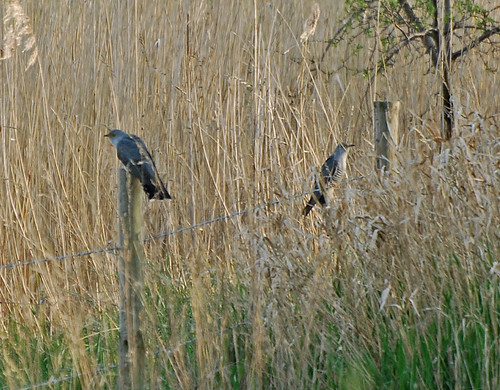
A pair of cuckoo, Cuculus canorus, Dansk: gøg

The cuckoo is an incredible bird and until very recently it was poorly understood. Last year the British Trust for Ornithology (BTO) managed to tag five male cuckoos with tiny satellite tracking devices and found out that they headed to the tropical sub-Saharan rainforests of Cameroon and the Democratic Republic of Congo. The cuckoo arrives back in England from Africa in late March or April and departs in July or August. It leaves earlier than other species because its parasitic breeding strategy removes the need for chick rearing. That means the cuckoo spends a minimum of 8 months a year in Africa so to call it a British bird is, I suppose, less than accurate, even though it breeds here.


The classic hanging wings pose which I always associate with the cuckoo

The tagged birds were all fitted with solar powered devices which transmit location data once every 48hr. The tracking data revealed that all five birds headed south over France and across the Mediterranean before heading down across Africa to Cameroon and DRC. All five made it. One of the birds died in Cameroon and two more died on the way back, but two of the five made it back to East Anglia this year. I believe the BTO plan to tag more birds including females and I’m very keen to see the results of that experiment.

The cuckoo is an iconic bird in the UK and it’s call is very distinctive. The call is generally recognised as a signal that Spring has arrived and there are local traditions around the UK based on the cuckoo. It is said in Worcestershire that the cuckoo is never heard before Tenbury Fair on April 21st or after Pershore Fair on June 26th. The song actually changes in June from the characteristic ‘cuck-coo‘ song to a shortened ‘cuck‘, and there is a rhyme about this:

In April I open my bill
In May I sing night and day
In June I change my tune
In July far far I fly
In August away I must

My Dad remembers a similar rhyme he used to sing when he was a kid in the 1940’s which was essentially the same but with some local Northamptonshire words substituted in.

I’m not quite sure what these two were doing but they were acting as a pair, and every minute or two one of them would dive off into the adjacent reedbeds to return a minute or so later. As I mentioned above, cuckoos are parasites and they could have been looking for nests to parasitise. There breeding strategy is unique, at least as far as I know. They lay their eggs in the nests of one of three other small songbird species: the reed warbler, the meadow pippit and the dunnock. All of these are the size of a sparrow (ish) so are much smaller than the cuckoo which is dove-sized, which I guess guarantees that the cuckoo chick will be much bigger than its ‘siblings’ and it won’t be threatened. The cuckoo chick then ejects the other chicks from the nest to die and the parents assume it is one of their own and feed it until it fledges. I’ve seen film of a cuckoo chick turfing out the other chicks and it’s a remarkable process, and not particularly pleasant to watch!

Despite their unsavoury procreation habits they are spectacular and charismatic birds and I hope the BTO research can find ways to guarantee their continued return here to brighten up the Spring and Summer.