Tits, tits, tits!

Coal, long tailed and great, that is, in case you were thinking the News of the World had reinvented itself in blog format! The reason I’ve dedicated a post to the tits is because they have been the most regular visitors to my feeders and on many days I’ve seen these four species there at the same time: blue tit (Cyanistes caeruleus, Dansk: blåmejse), great tit (Parus major, Dansk musvit), coal tit (Periparus ater, Dansk: sortmejse) and long tailed tit (Aegithalos caudatus, Dansk: halemejse).

Two factors combined to make photographing the songbirds in my garden considerably more challenging than is customary. Long periods of murky wet weather meant that the light was rarely optimal, and secondly, very few birds came to the garden at all up until November, and even then not in the numbers that have visited in previous years. I think the reason for that may have been the relative abundance of food in the countryside due to the mild and wet conditions that prevailed in the summer and autumn which gave rise to an abundance of blackberries, haws, sloes, hips and other berries. Then after November the birds started to reappear but the light didn’t improve so I took photographs at ISO settings of 1000-2000 to get the requisite shutter speeds, which is higher than I would normally use because of the higher background noise. Despite that I got some nice images:

Coal tit looking for a meal on a murky morningCoal tit looking for breakfast on a cold foggy morning

The coal tit is distinguishable at a glance by the prominent white stripe on the nape of its neck. They’ve been regular but infrequent visitors to my garden in other years but in the last couple of months they’ve been coming in ones and twos every day. The tits are not always easy to capture because they usually feed by grabbing a seed or nut and then flying into the cover of an adjacent bush to eat it. But just occasionally they linger for long enough, as this coal tit did. They prefer coniferous woodland in the breeding season where they feed on spiders and insects and in wintertime they are also prevalent in towns when they will also feed on seeds. Their conservation status is green, they’re resident breeders in the UK and can be found across Europe and Asia and in Africa too.

Long tailed tits disobeying the cardiologist!Two of a small flock of long tailed tits

As with coal tits, the long tailed tit is also immediately recognisable. Seeing one almost invariably means there are more close by. They fly from A to B one at a time, each following the previous one by half a second or so and are usually in small flocks of 10 or a dozen. I often hear them before I see them as they chatter to each other as they’re on the move. They like to feed on the fat balls I hang out, as do the other tits, and there can be 3 or 4 there at the same time with several more in the adjacent bushes, waiting their turn. They’re very charming little birds and I’m looking forward to them visiting on a bright sunny day so I can get some better images. Like coal tits they are also woodland birds, found across Eurasia they are resident breeders in the UK and their conservation status is green.

Great tit preparing himself to launch onto the seed tray

Great tits are probably the most regular partakers of the fare provided by my feeders, and that’s no bad thing, they’re handsome birds. There are a pair, male and female, feeding on seeds as I write, and they’ve just been joined by a pair of blue tits. The great tit is one of the birds that put the ‘song‘ in songbird, my Collins guide describes them as having a ‘rich repertoire’ and I’ve read they have around 70 different vocalisations, which suggests highly complex vocal communication for a small bird.

The male above has a chunk of peanut between his toes which he is pecking from. He is distinguishable from the female by the width of his black breast stripe which reaches as far as his legs, and the female below who has a very thin stripe which tapers downwards, is nibbling at a fat ball. In the depths of winter small birds need to spend most of the day feeding because the majority of their energy intake is used to maintain body temperature. Birds as small as a coal tit, which weighs 8-10g, therefore spend virtually all day feeding just to stay warm and they can die of hypothermia very quickly on a wintry morning if they don’t find food within a short time of waking up. So as us humans have destroyed so much natural habitat, our gardens and feeding stations are an essential lifeline for many species of birds.

Great tits also have green conservation status, numbering 2 million in summer 2000 according to the British Trust for Ornithology. Other species which have put in an appearance are the wren (Troglodytes troglodytes, Dansk: gærdesmutte), blackbird (Turdus merula, Dansk: solsort), dunnock (Prunella modularis, Dansk jernspurv) and a lone male blackcap (Sylvia atricapilla, Dansk: munk) flew through on one occasion – one of our eastern European overwintering blackcaps. Early one dark foggy morning as I was replenishing the feeders I caught a small movement out the corner of my eye so I glanced round without moving my head and a wren sat around 3 feet away watching me. When I finished I stood and watched him and he just waited for me to leave before grabbing some breakfast. I found out recently that wrens are our commonest bird, which really surprised me, but then they are adaptable and aren’t restricted to one particular habitat. It’s nice to see them flitting around the garden in their perpetual search for insects to see them through the winter.

(N.b. I source my bird feed from Vine House Farm. I wouldn’t normally do a free plug but I really like what these people do. They work together with the Wildlife Trusts and they farm the land to produce bird feed in the most wildlife-friendly way they can, and they publish a free newsletter to update on progress and news from the farm. Their feed is not always the cheapest but I’ve always found it to be very high quality.)

Anachronous insecta

A few posts ago I showed you some of the spider I encountered in the short spell of good weather we had in the late summer and early autumn. I think maybe some species were making hay whilst the sun was shining because there were also a lot of hoverflies around at that time too. And here are  three of the species I found. It’s the wrong time of year to be posting about hoverflies, hence the title of the post, but I haven’t been able to get out with my camera so I reckon a hoverfly post is better than none at all! Identifying hoverflies can be tricky because there are species which look very similar to each other and I’m no expert, so I hope my identifications are accurate but if any of you spot an error please let me know.

Eristalis tenax

Eristalis tenax is a type of hoverfly known as a ‘drone fly’, so called because they mimic honey bee drones. They are common throughout the UK and the females, which mate before overwintering and laying their eggs in the springtime, can be seen in any month of the year because they emerge from hibernation to feed when the weather warms up sufficiently. The larvae of this species are called ‘rat-tailed maggots’ and feed in sewage outflows and rotting carcasses – the more putrid it is the more they seem to like it! They are aquatic and the reason they are called ‘rat-tailed’ is that they have an extendable tube which can protrude up to around 5cm which they poke out of the water and use to breath air.

Tapered drone fly – Eristalis pertinax

The tapered drone fly is so called because the male has a tapered abdomen which is visible on this individual. It is otherwise a similar species to E. tenax and it’s larvae are also known as rat-tailed maggots. Apart from the taper it’s also distinguishable from E. tenax by it front legs which are pale.

My favourite hoverfly I found this year is this one:

The footballer – Helophilus pendulus

It’s called ‘the footballer’ because it’s colours are likened to a football shirt. It’s scientific name means ‘dangling sun lover’. The larvae of this species feed on detritus and have been found in wet manure, drains and in very wet sawdust. It’s widespread throughout the UK and can be seen throughout the summer in bright sunny locations in hedgerows. Despite the unsavoury but indispensable habits of the larvae of all of these species they transform into the most handsome adults.

I haven’t done a dedicated Christmas post this year so here’s wishing you all a very merry Christmas and a happy and healthy 2013!

Looking after the forests and the fishes Pt3

Continuing the story of todays vote by the EU Fisheries Committee on reform of the Common Fisheries Policy to end discard and prevent overfishing I’ve just received email notification that the vote was  in favour of reform by 13 votes to 10 with 2 abstentions!

Wey hey!! It just goes to show that common sense can ultimately prevail. This is what the press release from the EU had to say:

Stop overfishing: Fisheries Committee approves major reform for “Blue Europe”

PECH Fisheries − 18-12-2012 – 17:28

The EU’s Common Fisheries Policy (CFP) needs radical reform to cut fishing to sustainable stock levels, end discards, and use better long-term planning based on reliable scientific data, said Fisheries Committee MEPs on Tuesday. Overfishing is widely seen as the worst failure of the current CFP, dating from 2002. The new one is to take effect in 2014.

European Commission figures suggest 80% of Mediterranean stocks and 47% of Atlantic stocks are overfished. The proposal voted in the Fisheries Committee contains clear and strong measures to tackle this problem.

“I am very relieved that we have now cleared this difficult hurdle. I expect that the plenary will confirm our vote in February. After that we will have a strong backing to start negotiations with the Council in order to get the reform signed and sealed” said Ulrike Rodust (S&D, DE), Parliament’s rapporteur on the fisheries reform..

Stop overfishing by ending discards…

Discards – fish thrown back, usually because they are of unwanted species or size – account for almost a quarter of total EU catches. Most of the discarded species die. To end this wasteful practice, MEPs voted to oblige fishing vessels to land all catches in accordance with a timeframe setting specific dates for different fisheries, starting from 2014.

Landed catches of fish that are undersized, for example, would be restricted to uses other than human consumption. Member States must make sure fishing vessels comply with the discard ban.

…and respect maximum sustainable yield

The maximum sustainable yield (MSY) is defined as the largest catch that can be safely taken year after year and which maintains the fish population size at maximum productivity. In today’s vote, MEPs sought to ensure that fish stocks will recover, by 2020 at the latest, to above levels that are capable of producing the MSY, and thereafter to  maintain all recovered stocks at these levels. Ultimately this means more fish, better catches and, as a consequence, more jobs in the fishing industry.

Long-term planning instead of yearly quota-haggling

To achieve sustainability in fisheries, multi-annual fish stock management plans are now established as a priority. A longer term approach should bring greater predictability, and the fishing industry will be able to invest better and plan ahead. Multi-annual plans will be based on more reliable and accurate scientific data, which EU member states will be obliged to collect and make available.

Next steps

The draft resolution on the Common Fisheries Policy was approved with 13 votes in favour, 10 against and 2 abstentions, and should be put to a plenary vote in February.

And other piece of good news for the fishes was reported on the BBC website:

http://www.bbc.co.uk/news/science-environment-20709853

This is an awesome acheivement and one I hope guarantees the survival of all the shark species which live in that area.

Looking after the forests and the fishes Pt2

Following on from the previous post about the vote for reform to the EU Common Fisheries Policy tomorrow, I emailed the seven MEP’s that were listed on Chris Davies (Lib Dem MEP) website as swinging voters:

Struan Stevenson (Con, sits in ECR European Parliament Group, UK)
Marek Grobarczyk (Law and Justice, sits in ECR, Poland)
Nigel Farage (UKIP, sits in EFD, UK)
Dolores Garcia-Hierro Caraballo (Socialist, sits in S&D, Spain)
Diane Dodds (DUP, non-attached, UK)
Werner Kuhn (Christian Democrats, sits in EPP, Germany)
Jaroslaw Walesa (Civic Platform, sits in EPP, Poland)

And the other three UK MEP’s who sit on the Fisheries Committee:

Ian Hudghton (SNP)
Julie Girling (Con)
George Lyon (Lib Dem)

So far the only one who has replied is Struan Stevenson and his assistant assured me that he will be voting for the reforms and that the vote can be followed tomorrow here on the European Parliaments website.

Fingers crossed that the common good prevails over commercial interests!

Looking after the forests and the fishes

No pictures in this post but I want to show you a couple of websites which you may be interested in showing some support for.

Two of the ongoing issues which I’m passionate about are conservation of the oceans and the forests. Down in Tasmania is a very courageous and dedicated lady called Miranda Gibson whose blog I found a couple of months ago, it’s called ‘TheObservertree‘, and in it she describes her last year living at the top of a tree in a forest in Tasmania as a peaceful protest at the destruction of the native ancient forests there. I was really pleased to see this week that Miranda’s stand was highlighted on the front page of the BBC News website:

http://www.bbc.co.uk/news/world-asia-20723455

Please check out the video and visit her blog to register your support.

And the second issue which is coming up this week is a vote in the European Parliament to reform the Common Fisheries Policy which if passed will ban discard and help to rebuild dwindling fish stocks. For any non-Europeans who may be unaware of what’s happening, the EU has stipulated how much of which fish species can be caught and landed. On the face of it a good thing you may think, but in practice what this means is that all the over catches are simply dumped back into the sea, referred to as ‘discard‘. Which means that many tons of perfectly good fish are killed and then thrown overboard, which is great for short term hunger management of gulls and other fish eating creatures, but completely insane from the point of view of maintaining viable fish stocks for all species!

I’ve been getting regular updates from Chris Davies, a UK Liberal Democrat Member of the European Parliament (MEP) who sits on the Fisheries Committee, and you can follow this link to the latest communication. If you feel strongly about the destruction of the oceans please send an email to one or more of the swinging MEP’s listed who sit on the Committee and ask them to vote for the reforms.

This is the email I sent to all of them and all the other UK MEP’s who sit on the Fisheries Committee:

As an MEP sitting on the Fisheries Committee of the European Parliament I am writing to urge you to vote for the reform to the Common Fisheries Policy this Tuesday.

I believe that it is essential that the reform is passed in order to guarantee the longer term survival of viable fish stocks in order to maintain the health of not only the fish but that of the ocean as a whole. This is particularly the case as, going forward, the seas are likely to become more and more important as a food source. I believe this issue should be beyond party politics and the lobbying power of vested interests as it is much too important, and the fish stocks should not be squandered in the pursuit of short term commercial interests.

I thank you for taking the time to read my email and urge you again to please vote for the reform.

If you enjoy your fish and chips, and want to continue to do so, please send an email or two to let the MEP’s know how you wish them to vote.

The Four Spot and the Strawberry

Regular readers of The Naturephile may have noticed numerous references to the loopy weather we have experienced in this part of the world this year, in particular the wetness of the spring and the subsequent brevity of the summer. And you may also have cottoned on to the fact that I have a spider fascination.

Despite the unusual summer weather conditions, later on in the summer and into the autumn I found lots of spiders including two species which I haven’t seen here before. Common garden spider webs (Araneus diadematus) adorned every surface in my garden in the autumn and this particularly nice example was strung between two hawksbeard stems in the local meadow:

Garden spider web bejewelled with dew

One of the most intricate webs I found was that of the labyrinth orb weaver (Agelena labyrinthica), they’re amazing constructions and most of them aren’t very visible until there’s a cold morning and the webs are laden with dew, then it’s possible to see that they adorn all the hedgrows and undergrowth.

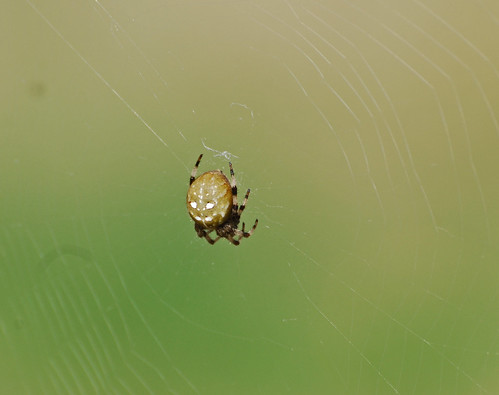
The two species I found which I hadn’t seen before were the four spot orb weaver (Araneus quadratus) and the strawberry spider (Araneus alsine, aka orange wheel weaving spider).

The green body of the four spot orb weaver

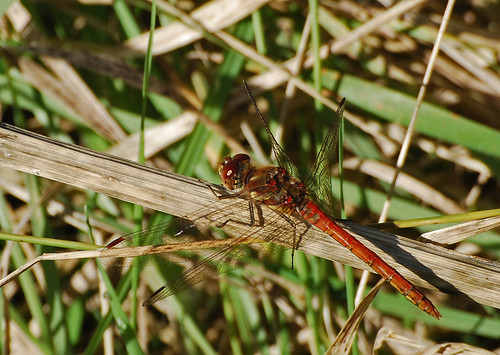
Both my initial encounters with these little beauties were a little unnerving because I was unaware that spiders with these colours were lurking in my local undergrowth. The four spot flew past me at high speed when I snagged it’s trip line when I was trying to get in position to photograph a male common darter dragonfly:

https://i0.wp.com/farm9.staticflickr.com/8066/8155314987_f0c0087b41.jpgA male common darter dragon – non-arachnid interloper in this post

And a strawberry spider dropped down a few centimetres from my eyes when I was unlocking my gate! All I saw was a bright red bulbous abdomen so my first thought was “Bloody hell, it’s a black widow!”. So I ran to get my camera before it disappeared. Both of these were females and around the same size as a regular garden spider, but as you can see the colours were very different.

The bright red body of the aptly named strawberry spider

Another spider I found in my garden this year was the missing sector spider (Zygiella x-notata). I was intrigued by the name of the missing sector spider and it transpires it comes from the design of the web. If the planar, circular web is a clockface, the part between 11 and 12 o’clock has no spiral threads, so is effectively a ‘missing sector’.

The missing sector spider making a meal out of a cranefly

This particular individual was busy securing a cranefly and it seemed to take great pains to ensure the fly was maximally envenomated. It spent a couple of minutes running around the struggling fly, inflicting multiple bites before wrapping it up in a cocoon of silk and carrying it off to be hung from the window frame and consumed at leisure.

Crabs and Compasses

As a fitting coda to our trip to the Isle of Wight we had been invited to join some friends in Lyme Regis for the weekend. As I mentioned in my Isle of Wight post the eastern half of the English south coast was tipped on its end by tectonic forces so the geological history of that part of the world is exposed for all to see. In fact, moving from east to west is literally going back in time, heading as far as the Lower Jurassic era at Lyme Regis and Bridport, which is around 183-200 million years ago.

The Jurassic rock strata of the south coast westward from the Cobb at Lyme Regis

Those of you with a cinematographic interest may recognise the sea wall at Lyme Regis, it’s known as the ‘Cobb’, and was the location for the famous scene in The French Lieutenant’s Woman where Meryl Streep stands gazing out to sea. Which incidentally, is the only thing that myself and Meryl have in common, albeit for rather different reasons.

All our activities whilst we were in Lyme were marine orientated, I even managed to spend a couple of hours sea kayaking and peering into the crystal clear waters. The clarity of the water was incredible, it’s difficult to judge depth but I reckon at the deepest point I saw it was probably 15-20 feet deep. I could clearly see the bottom and the kelp fronds waving in the current, fish were darting in and out of the kelp and jellyfish were floating at the surface. I resolved to get up early the next morning and head out on the kayak to go snorkelling off the boat. So I got up and paddled out into the bay, but overnight a swell had risen which was swirling the sand around on the seabed and there was zero visibility in the water. So I need to make a return trip in the not too distant future so I can get in the water for a snorkel.

My son Jake and his friend Sam inspecting the contents of their crabbing bucket

Glancing over the sea wall while the children were crabbing I saw this handsome compass jellyfish (Chrysaora hysoscella) gently patrolling the periphery. I’d seen several of them in the bay the day before when I was kayaking and they’re common around English shores. They can pack a nasty punch for any poor unfortunate who makes contact with the tentacles which can cause a stinging, burning sensation and red raised lesions on the skin. I don’t know if it can get worse than that but it’s apparently fairly unpleasant while it lasts.

The compass can grow up to 30cm across which is about the size of this one.

Eyeing up the progress of the crabbing exploits was a hungry herring gull (Larus argentatus). He was very interested in any potential meals the kids may catch for him and he was ready to swoop onto any escapees.

Looking eastward from the Cobb are more cliffs and the rocks here are full of fossils. We were staying in the white houses on the left and just round the corner from there lies a prime fossiling beach which alas we were cut off from by the tide. There were lots of folk busy cracking open rocks on the part that was accessible but I think most of the fossils from that spot had already been found.

The cliff on the right with the yellow patch is called ‘Golden Cap’ and is the highest point on the south coast of England, rising to 627 feet (191m).

The catch:

Shore crabs – Carcinus maena

The bait for the crabs was bacon, they’re mad for it, and there was a prize for the first crab caught, the largest crab caught and the most crabs caught. My daughter won, every time she dropped her line into the water it was a couple of minutes or less before she hoicked one out. So, much to the chagrin of the boys, she won all three prizes and was as smug as hell for the rest of the day!

And as the bucket filled with crabs the gull got braver and braver:

But he was to be disappointed. At the end of the competition our bucket of crabs was emptied into the water at the bottom of those steps and they all scuttled away to freedom.

The Isle of Wight, Part 2

My first view of the Needles, at the western tip of the Isle of Wight, was a long time ago when I flew round them in a light aircraft. The weather was much like it is below and it was quite a spectacle!

The Needles looking across to the Isle of Purbeck. Old Harry Rocks are the thin sliver of white chalk in the distance at 11 o’clock from the lighthouse

I’d heard it said that the Needles were at one time joined to the Old Harry Rocks at the southern end of Studland Bay, around 15 miles away on the Isle of Purbeck. I’d thought it entirely possible but never had it confirmed. And then just after I took this photograph I overheard a very knowledgeable old gentleman telling his companion all about the local geology, so I stood close by and earwigged the conservation.

As you can see, the Needles are made of limestone and apparently they were once a single strip of rock with a gap in the middle from which a single calcareous stack protruded, known as ‘The Needle‘. And then in the 18th century a storm caused a collapse which resulted in the Needles of today.

But before that, Old Harry and the Needles were a single limestone structure and the Isle of Wight wasn’t an Isle, and the Solent – the stretch of sea which separates the Isle of Wight from the mainland – was the River Solent. But around 4-5000 years ago a storm breached the limestone wall and the River Solent became a seaway overnight and the inhabitants of the Isle of Wight were cast adrift on a new island. And interestingly, all the rivers on the mainland from Poole Harbour in the west eastwards to Portsmouth: the Meon, Itchen, Test, Avon, Frome and Piddle all flow southward, and those on the Isle of Wight: the Eastern Yar, Western Yar, Newtown, Wootton Creek and Medina all flow northward, and they all drained into the River Solent.

Pyramidal orchid – Anacamptis pyramidalis

The terrain all around the Needles is chalk downland which has very characteristic flora and fauna, amongst which is the pyramidal orchid and this lone flower was lurking at the edge of The Needles carpark. It thrives on the chalk downs to such a degree that it has been chosen as the county flower of the Isle of Wight. In the air high over the car park was a peregrine falcon (Falco peregrinus, Dansk: vandrefalk) but I didn’t have a telephoto lens with me on this trip, so alas, no pictures. From the car park it’s about a mile to walk to The Needles themselves and on a sunny day it’s a terrific walk, the views are magnificent.

To the east, north and west the air was full of falcons, songbirds, bees and butterflies, and when we got to the very end there was a historic naval gun emplacement. In WWII the gun guarded the Solent and the strategically important ports of Poole, Southampton and Portsmouth against enemy shipping, and just over the top of the cliff from the gun emplacement was a test site for missile engines which had been hewn from the rock – a hangover from the Cold War. The whole thing was fascinating, geologically, biologically and historically!

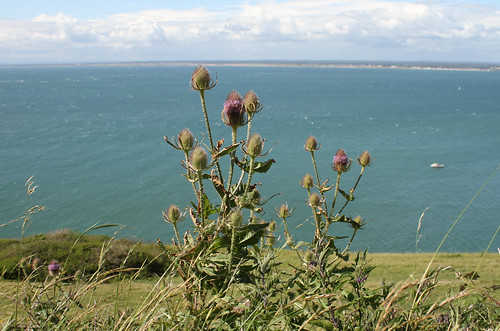
Teasels – Dipsacus fullonum

Whilst trying to photograph a stonechat which was darting around next to the path I noticed these teasels which were still sporting their downy purple flowers. I have lots of photographs of the dried out brown seedheads of teasels after they’ve flowered but but I’ve been after a good one of the flowers themselves. And I think this is the best backdrop I could have found, looking out across the Solent towards the New Forest on a sunny day.

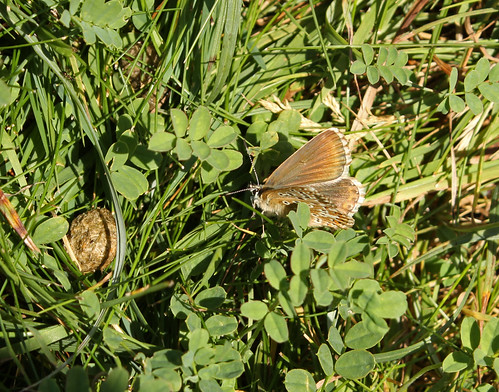
Also flitting around in the chalky grassland were hundreds of chalkhill blue butterflies. It was a very windy day and I think the butterflies may have been staying down low becausse of the wind, preferring to be stationary rather than risk being blown away. Consequently they were fairly easy to get close to:

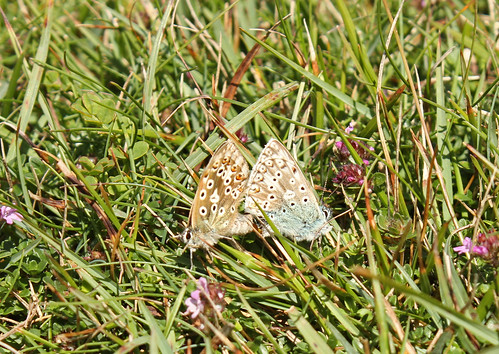
Chalkhill blue male (Lysandra coridon)

I absolutely love blue butterflies. In fact anything living and blue – insects, flowers, fish reptiles – blue seems to convey a unique beauty on a creature, so to see so many of these blues was a real pleasure. And the chalkhill blue is a big butterfly too, with a wingspan of 33-40mm.

One of the curious facts about blue butterflies is that some of them are actually brown, and with chalkhills as with common blues, the females are brown:

The female chalkhill blue. She’s brown, not blue, but still a beauty!

Chalkhill blues mating, the brown female is on the left

Apparently this year was a particularly good one for the chalkhill blue. Despite being a devastating one for most other butterfly species in the UK, there were huge numbers of breeding chalkhills recorded in their traditional territories, and in my humble opinion that’s very good news indeed.

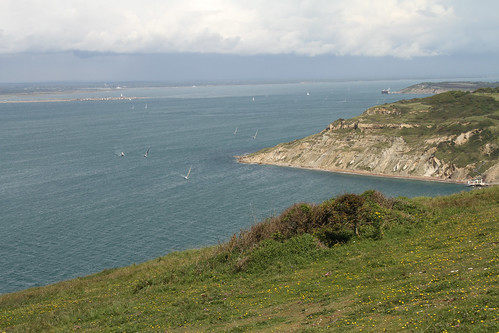
The view along the north of the island looking east towards Southampton, with yachts racing toward us

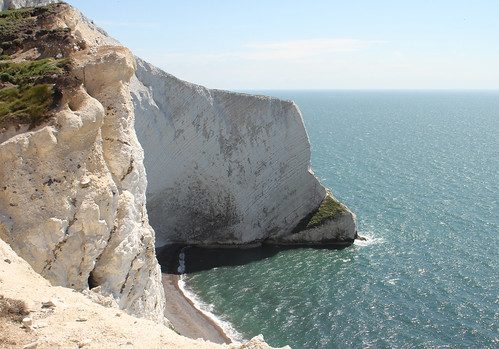
The geology of this part of the south coast is remarkable too. Limestone was formed at the bottom of oceans by the compaction of dead shellfish over millions of years, so it may seem odd to find it at the top of the cliffs. Or indeed whole cliffs made of it. There is a clue to how this happened in the cliff below, which is looking round to the southeast from The Needles, in which there are clearly delineated strata in the rock running upwards from left to right at around 45 degrees. The reason for angled strata is that in this part of the world tectonic shifts have concertinad the rock strata all the way from the east of England along the south coast as far as Dorset to the west forcing them upwards.

This folding of the rock means that in the east the rock is relatively young but the deepest, oldest, layers have been exposed in Dorset around the town of Lyme Regis. So the region around Lyme is referred to as the ‘Jurassic Coast’. Of which more in a subsequent post.

The Isle of Wight, Part 1

This summers holiday took myself and the family to the Isle of Wight. I’ve often sat on the mainland and gazed at the island wondering what it was like, but apart from a sailing weekend from Cowes some years ago I’d never been there. Prior to the trip, several folk I spoke to who had been there said, ‘It’s very nice, but very 1950’s’, implying that were a bad thing. I wasn’t entirely sure what it meant, so I set off expecting bakelite telephones, knobbly knee competitions and casual racism. But the reality was nothing like that, in fact the Isle of Wight turned out to be a lovely place, very green and full of cool wildlife.

Shanklin Bay looking over the garden of out holiday abode

Within a day of arriving at our destination at Shanklin, on the southeast corner of the island, we’d encountered a pair of ravens who were keen to share our fish and chips on the seafront, and several red squirrels running around the trees in the garden below our apartment. Red squirrels are delightful creatures and the island is one of the few places in the UK where they haven’t been ousted by the bigger and more aggressive North American grey squirrel. Unfortunately I wasn’t able to get photographs of these but there was plenty of other flora and fauna to keep me occupied.

The weather on the island during the first week in August was remarkable, it was hot and sunny virtually the whole time we were there, but that coincided with continuous heavy rain and big floods a short distance to the west in Devon and Cornwall. As well as the trees in the garden, there were flowers and butterflies basking in the glorious sunshine:

Wild pansy (Viola tricolor)

The wild pansy is a lovely little flower and has been used as a herbal remedy for eczema and asthma and it was believed it was good for the heart, hence its other name of ‘heartsease’. It’s laden with potentially beneficial chemicals including salicylates (aspirin), antibacterials and antiinflammatories and has many amusing common names such as ‘love lies bleeding’ (!), bullweed, ‘tickle my fancy’ and ‘love in idleness’.

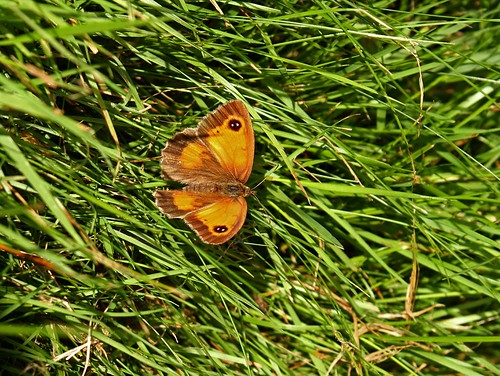
Gatekeeper

Also frequenting the garden was the equally beautifully coloured, but less poetically named, gatekeeper butterfly (Pyronia tithonus). I was pleased to see lots of butterflies here because the dreadful spring weather meant I’d seen very few around Cambridge, a horrid situation which, alas, prevailed for the rest of the summer.

Below the garden at the bottom of the cliff was lots and lots of beach with lots and lots of birds, including the ravens I mentioned earlier. And amongst them was this gull youngster. It wasn’t at all fazed by me and my son running around and seemed more curious than nervous.

A young gull – either a herring gull or a lesser black backed

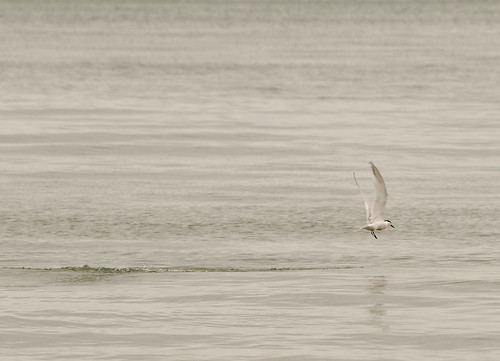
Alas, I’m not sufficiently knowledgeable about gulls to be able to differentiate the first year herring gull (Larus argentatus, Dansk: Sølvmåge) from the lesser black backed gull (Larus fuscus, Dansk: sildemåge), even with my Collins bird guide to assist. And while the gull was peering at us a sandwich tern patrolled the shallows occasionally diving into the water:

Sometimes returning to the surface with a fish… and other times not:

Sandwich tern (Sterna sandvicensis, Dansk: splitterne) fishing off Shanklin beach

From our limited explorations around the island it seemed to be quite distinctly in two halves. The eastern end, where we were based was green and agricultural with wide sandy beaches, and the western end, at least on the south side, was more chalk down rising to imposing cliffs toward the Needles at the far western tip. All the photographs in this post were from in and around Shanklin in the east and I’ve divided the IoW into two posts, so ‘Part 2’ will be from the western end.

I don’t normally do reblogging, I think it can be cheating and plagiarising other peoples’ hard work. But I’m reblogging this post because anyone who is prepared to live at the top of a tree to make such an important point deserves to be publicised as widely as possible. Please view and redistribute to ensure Miranda gets the support she needs! And if you want to read about all of her arboreal experiences look here ‘http://observertree.org/’

Organikos's avatarOrganikos

Click above for the video made by Australian environmental activist Miranda Gibson, who has been living on a platform in a Eucalyptus tree in Tasmania’s southern forest. She has vowed to stay there until the forests receive more protection from logging. She writes about it at Observertree:

Observer Tree needs your help!

I’ve been at the top of this tree for over 300 days now. I think it’s time for the world to know I’m here. The more people who find out and add their voice to the call for forest proteciton… the sooner we can save Tasmania’s forests and I can get down!

View original post 190 more words