Histon forays, weekend 5th – 6th March 2011

This weekend I’ve been out and about on my regular walks north of Histon. (Click here for a sketch map of the locality). Yesterday I was out around the fields to the north between Histon and Cottenham. It was a cold grey morning and it was noteworthy for several reasons.

The birdlife was plentiful. (Click here for my wildlife diary where I’ve listed all sightings). Just a few minutes after telling my friend, David, that I hadn’t seen a corn bunting for around 6 months but that they frequent that area in numbers during the summer and disappear very quickly after the harvest, we saw one sitting in a bramble:

It was the first one this year and the first of several we spotted yesterday. It was a good morning for buntings in general. Last time I was here, around three weeks ago a mixed flock of reed bunting and yellowhammer were  in the east end of the Owl Shed Hedge (see post from 29th Jan entitled “Buntings abound: 29th and 30th January 2011). They were there again on Saturday and reed bunting were present in most of the hedges and ditches we peered into. Skylark were present in large numbers too, singing up high and darting around low. A look  on the floor of the Old Water Pump, which has a platform for barn owls to roost and breed, revealed numerous owl pellets most of which were very old, but some of them looked fresher, possibly from within the last 6 months.

One of the ‘Pump House’ barn owls from three years ago

This is a very good thing as barn owls haven’t bred there since 2008 and I haven’t seen one in the vicinity since last year, and then only a couple of sightings all year.

Other appearances which livened up the walk were a muntjac deer, Muntiacus reevesi, introduced from China to the UK in the first half of the 20th century, which was rooting around at the back of the gardens of the houses on Cottenham Road, and a stock dove was sitting in the trees in the same area. I may have seen these before and mistaken them for wood pigeon, but David’s expert knowledge put me straight on the differences. They don’t have the white neck and wing bands of the wood pigeon and they have a dark eye which is diagnostic – that of the wood pigeon is lighter.

I set off in the other direction this morning to head out of Histon north west towards Oakington along Guns Lane and into Rowleys Meadow. I took a slow walk and was very adequately rewarded. Right at the start of the Lane where it joins Cottenham Road blue tit, great tit, greenfinch, chaffinch, starling and song thrush were present and finches were singing constantly,


Greenfinch male singing for a mate in the top of a tree on Guns Lane

…and a chaffinch male displaying his gorgeous black and white tail in a fan. I’ve posted a few photographs of chaffinch lately, even though they’re common I think they’re spectacular!

A couple of surprises today, firstly the number of bullfinch; I saw a single male in Rowleys Meadow which may have had a female with it but I couldn’t see it well enough to confirm, and another pair of males flew along Guns Lane hopping from hedge to hedge infront of me for 50-100m. And secondly, the number of dunnock. They were present in every bush and bramble in the Meadow and on the Lane singing constantly – if you haven’t heard dunnock song, have a listen here, it’s lovely.


Dunnock sitting on a bramble singing

Dunnock have a rather interesting approach to breeding. They don’t pair off as most birds do, a female will be mated by at least two males who will stimulate the females to eject a rivals sperm from the cloaca with their beak. DNA analysis has shown young in the same clutch can have more than one father. I like dunnock, they look boringly grey/brown when seen flitting around the undergrowth, but when they catch the light they are certainly not drab. And their song and their antics at breeding time are anything but boring!

Just as I was about to leave the countryside and head home I noticed a pair of starling sitting on top of a hedge checking out me and the dog. As I turned to point my camera at them they didn’t fly away but simply kept an eye on me so I could get this picture:

The glorious plumage of the starling!

Spring is well underway now and the activities of the wildlife are reflecting that. It’s a great time to be poking around in the woods and hedgerows.

Rotten borough, wonderful wildlife

I spent the last two days in Dunwich on the Suffolk coast. Dunwich and its surrounding countryside is a very interesting place from a political and natural history viewpoint. A paragraph about the political history first:

Until the Great Reform Act of 1832 Dunwich was classed as a ‘rotten borough‘, this was a parliamentary constituency with a very small number of voters for which the parliamentary seat could be bought and sold by wealthy patrons. Prior to 1286 Dunwich was the capital of East Anglia and a thriving sea port but in that year the first of several great tidal surges destroyed a large part of the town, sweeping it into the sea, reducing it to a small number of houses and therefore residents and voters. As a result of its earlier preeminence Dunwich had two parliamentary seats and despite it’s sudden demise retained these seats, with a very small number of voters, until the Great Reform Act was passed, (interestingly, it was his opposition to parliamentary reform which ended the premiership of the Duke of Wellington after he lost a vote of no confidence in November 1830). In the early 18th century the seat was held by Sir George Downing, 3rd baronet, whose grandfather (1st baronet) had built Downing Street in London. He was succeeded by his cousin, Sir Jacob Downing, who died childless and whose fortune was used to found Downing College, Cambridge, in 1800. An awful lot of history for a tiny village on the Suffolk coast.

Moving on to current natural history, the weather on the first day there was horrendous, rendering nature watching pretty much impossible. But on the second day the weather changed completely and was warm and sunny. The woods around the ruined friary were looking delightfully spring-like with snowdrops (Galanthus nivalis) covering the ground.


Snowdrops growing in profusion amongst moss covered dead wood from fallen branches around Greyfriars at Dunwich.

A pair of goldcrests were very busy feeding in a bush at the edge of the wood which was good to see as they are not a common sight during my regular walks around Cambridge. Heading to the beach to the north of the Friary a pied wagtail (Motacilla alba)  was bathing in a puddle:

And a flight of four mute swans (Cygnus olor) flew by, heading south towards the lakes at Minsmere RSPB reserve:

Later in the morning a walk in Dunwich Forest was eerie. It started in a pine plantation which was all but silent, no birds were singing and there were few other signs of wildlife. Leaving the plantation behind I entered mixed woodland which was still quiet but  more diverse, with a mixture of predominantly pine and silver birch trees (Betula pendula). Birds were singing here but not in the profusion I’d hope for. Many of the pines were exuding aromatic sap:


Sap oozing from a wound in the bark of a pine tree. This stuff was extremely sticky but had a gorgeously delicate scent of pine resin.

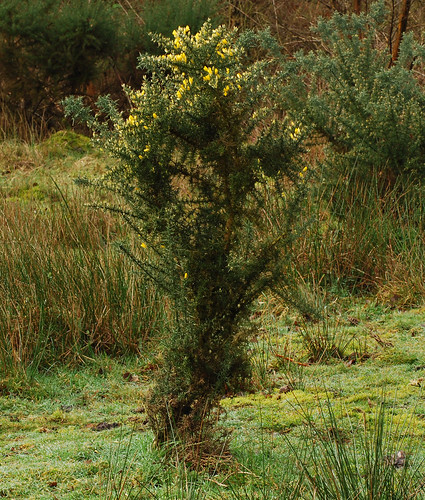
The exudate was running down the trunks for several feet and in some cases from multiple places on their trunks, the aroma on a warm spring morning was lovely. A mixture of the earthy smell of well rotted compost and pine trees. Gorse bushes (Ulex europaea) were in flower here too, adding the scent of mild coconut into the mix.

Gorse bush in flower

The ground under the trees was littered with dead wood and moss and numerous fungi including puffballs, parasitic birch brackets growing on live trees and other brackets growing on dead branches, most of which defy identification by anyone who doesn’t possess the requisite expert knowledge. Which, alas,  includes myself.

After the forest I ventured to Dunwich Heath, parking by the lighthouse at the top of the cliff where gangs of black headed gulls (Larus ridibundus) were wheeling around the carpark and magpies (Pica pica) were bouncing along the ground around the cars scavenging scraps discarded by picnicers making the most of the glorious spring weather.


Black headed gull looking for leftover crumbs in the carpark at Dunwich Heath lighthouse…

… and a magpie using a signpost as a vantage point.

Leaving the carpark I headed down towards the reedbeds which I skirted for several hundred metres. The habitat here is varied with the reedbeds, scrub woodland, heath and waterways.


Looking east over reedbeds at the sourthern edge of Dunwich Heath between the heath and RSPB Minsmere, the sea is a thin grey line in the distance.

Consequently I was hoping to see a diverse range of wildlife. There was evidence that otters are in residence and sheets of corrugated iron had been placed on cropped bracken presumably to provide shelter for reptiles such as adders, grass snakes and lizards. The sun was shining and I was  sheltered from the wind so the conditions for a stroll were nigh on perfect for a February afternoon and plenty of birdlife was to be seen. Wrens (Troglodytes troglodytes) were hopping around the undergrowth and a flock of around 40 lapwing (Vanellus vanellus) passed overhead whilst numerous blue tits (Cyanistes caerulius), great tits (Parus major) and chaffinch (Fringilla coelebs) were busy in the trees lining the path.


Cock chaffinch sitting high in a tree singing for a mate.

A single long tailed tit (Aegithalos caudatus) also flew by and landed very close allowing me to take some photographs:


Long tailed tit providing a rare opportunity to take some close-up pictures.

The area around Dunwich is a great place to see all kinds of wildlife, the Dingle reedbeds running north to Walberswick are the largest in England and there are large areas of heath and woodland and the salt water lagoons at Minsmere to the south all providing a huge area of diverse habitat. It is also ideally located for migrants from mainland Europe in the winter.

And right in the middle is The Ship Inn where you can get a pint of Adnams  beer to slake the thirst after a days walking. Dunwich is very high on my list of favourite places to explore.


Hook nosed sea pig

Radio silence has been a tad prolonged this time, so apologies for that. I wasn’t able to get out and about last weekend so I’ve delved into the archive to write about the grey seal. The Latin name for this one of our native seal species – the other being the common seal (Phoca vitulaina) – is Halichoerus grypa – or ‘hook nosed sea pig. Which is a wonderfully descriptive piece of taxonomic nomenclature! It is the only seal to be classified in the Halichoerus genus.

Grey seal relaxing in the Menai Strait between
Anglesey and
North Wales

The grey seal is almost twice the size of the common seal and is immediately distinguishable by the long ‘hooked nose’ compared to the stubby rounded snout of the common seal. Males are around 2.1m in length and females 1.8m, weighing approximately 230kg and 150kg respectively, the female is therefore much smaller than the male.

Distribution of the grey seal is across the northern Atlantic Ocean with breeding colonies in northern Europe and North America. They are fish eaters feeding predominantly on cod and sand eels but are opportunists and will take a range of fish caught at depths down to 70m including molluscs and crustaceans and they fast during the breeding season.


Grey seal watching me watching it off the Farne Islands, Northumberland

Around two thirds of their time is spent at sea, but they will haul themselves onto rocks, usually on uninhabited islands but also on some isolated mainland sites between tides and also come ashore to breed. This occurs at various times around the UK and while the females are nursing pups the males will also come ashore to mate. At this time the males may get into territorial battles with other males resulting in scarring to their necks. The pups which are white, suckle milk that is 60% fat for approximately 3 weeks during which time they will gain 2kg per day that is mostly sequestered as a subcutaneous layer of blubber providing essential insulation when the young go to sea.

Grey seals were the first mammals to be protected by legislation – the Grey Seal Protection Act of 1914 – and since 1960 the UK population has increased to 120,000 individuals, around half the world population. They are affected by ‘seal plague’ – phocine distemper virus – although of individuals known to have succumbed to the disease only 10% were grey seals.

These delightful animals can be seen all around the UK coastline from the south west, Wales, Scotland and the east coast of England and due to the increase in numbers they have attracted the inevitable hatred of fishermen who claim that they are responsible for declining fish stocks, and they have also been implicated in damaging the nets of offshore fish farms and passing on parasites. The link with parasites is a complex one and further studies are required to establish the link between seals and transmission of parasites, or not.

Common sense prevails

The news is very good this morning.

It has been anounced that ministers are to shelve plans to sell off the 258,000 hectares of publicly owned forest. It appears that the massive volume of public protest has hit home at the higher echelons of government. That’s a great result. I heard last night in PMQ’s Ed Milliband asked David Cameron the direct question, “Can you tell us whether you are happy with your flagship policy on forestry?” Cameron replied, “The short answer to that is ‘no’.”. A very straightforward answer and probably the shortest one I’ve ever heard from any politician. He then chuckled and went on to flesh out his answer by saying the decision would be made at the end of the 12 week consultation period. Eighteen hours later it has been announced the sale is to be called off.

The Public Bodies Bill in which the proposed sale was to be passed into law is now to be amended and that will hopefully mean that this stupid idea can now be buried for a long time to come.

Another positive outcome is that a different panel of experts is to be set up to look into public access and biodiversity. I hope the experts are the right kind and can make sensible recommendations which can work in practice.

The only possible downside is that the government still plans to sell off 15% of the forest amounting to 40,000 hectares, but I hope that is the pine plantations which can be commercially exploited wiithout causing too much damage to the wildlife.

All in all, good news to start a foggy Thursday with!

Fen Drayton nature reserve

Before I tell you about my outing to Fen Drayton here’s a short update on the forest sell off. After denying they are backtracking, the Government has said they may reduce the amount of forest they are getting rid of. Plans to lose 15% of the 258,000 hectares of publicly owned forest are on hold whilst the government ‘re-examine the criteria‘ for the sale. I’m hoping this is government style smoke-and-mirror speak for ‘we’re deciding whether we should proceed at all‘. Time will tell. I think any reexamination is good news and maybe a sufficiently loud public outcry will force the powers that be to sit up and take notice of the vox populi on this issue, and maybe a few others too.

I didn’t manage a wildlife post last week, other events overtook me including the weather, which was blowing a gale at the weekend so I was struggling to see anything through binoculars and photography was completely out the question! So apologies for the omission. There were a few highlights from last weekend though: in a tree in the middle of a field behind Abbey Farm north of Histon I saw a pair of kestrels copulating – which is a fairly unusual sight but it’s good to know the local kestrel population should be increasing this year. Further round towards the Girton road was a big mixed flock of around 50 starling, a similar number of redwing and around 200 fieldfare feeding on the ground and as I was counting these a little egret passed over. I’d been told by a dog walker a couple of weeks ago there was one in that area but this was the first time I’d seen it for myself. Egrets are a comparatively recent addition to the fauna in the UK and they are slowly finding their way northwards in England. The first time I saw them was in the fish market in the middle of Victoria, the capital of the Seychelles, so they have very exotic associations for me and it’s great to see them so close to home.

I set off fairly early in the morning yesterday with my friend to head for Fen Drayton nature reserve which lies between Cambridge and St Ives. It’s a former gravel pit consisting of twelve lakes and ponds which is currently managed by the RSPB. There is a big area of water here interspersed with grassland, scrub woodland, some older more established trees and plenty of reedbeds. So it has a diverse range of habitats that are managed for wildlife and is therefore a good place to see birds.


Far Fen lake showing the varies habitat at Fen Drayton

Despite raining on the way up the A14, by the time we got to the reserve the rain had stopped, leaving complete cloud cover, so the light was very grey as you can see from the landscape shot above. Otherwise the conditions were good: mild, gentle breeze and the occasional, albeit brief, moment of sunshine.

The omens were good too when on the way to Fen Drayton we saw a hare running across a field, and on the approach to the reserve three bullfinch including at least two males were flitting along the hedge just in front of the car. When we were getting out of the car in the car park we could here a cetti’s warbler singing and three green woodpeckers rose up off the ground in quick succession just in front of us.

As we stopped to look at a group of tufted duck on the small pond north of Holywell Lake a jay which we had watched fly across the field appeared in some dead trees on an island in the pond and started stripping big chunks of bark from the tree, possibly looking for food it had stashed there previously. Jays are amazingly good at stashing and are aware that their fellow jays do the same and so will keep a look out to see if they are being watched. If they see another jay paying attention to their activities they will pretend to stashe and then fly off and hide the swag somewhere else.


Four tufted duck – one female and three males on the pond north of Holywell Lake. Note the piercing yellow eyes and the crest

Tufted duck are resident on lakes and we also get migrants visiting in the winter when they stop over on rivers and estuaries too. They’re omnivores and feed by diving to the bottom to sift food from the mud. I think they’re handsome birds especially when they turn their yellow eye to look at you.

Constant companions throughout our walk were chaffinch and great tit. They were present in numbers in almost every tree or bush I looked in.


Chaffinch male in a tree singing for a mate

There were a plethora of other small birds including blue tit, wren, dunnock, robin, goldfinch and long tailed tit. On a bright day it’s now a good time of year to look for and photograph birds because they are actively seeking mates and there are no leaves on the trees to conceal them.


One of a flock of around 7 long tailed tits whizzing through the trees – they’re fiendishly difficult to photograph like that so this is as good as it got!

There was almost a full house of the five common crows – jay, carrion crow, rook – but no jackdaw. There were quite a few magpies though:


This chap was bouncing around the car park

Coot abounded on all the lakes but the stars of the day were the ducks of which there were many species including our common or garden mallard, shoveller, tufted duck, gadwall and wigeon…


A single male wigeon on Oxholme Lake

… but the real star of the show was the goldeneye. There were displaying male goldeneye on Far Fen Lake but alas they were much too far away to get a photograph. They are also resident breeders with migrants arriving in the winter months too.

Mute swan were present on several of the lakes and a couple came over in flight too:


The A380 of the avian world…

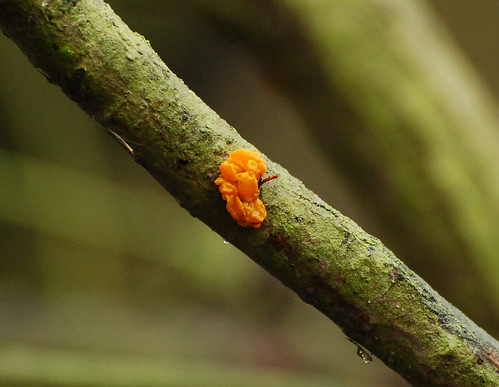
And as with all good nature reserves the wildlife wasn’t solely ornithological. This beautiful little fungus was on a stem next to the path.


Dacrymyces chrysospermum – unfortunately I couldn’t find a common name for this resupinate fungus but its sumptuous colour against the green lichen on the tree stem is striking.

All in all Fen Drayton was a great venue for a Saturday morning wildlife adventure and I’ll be posting from here again before too long.

Wildly inaccurate speculation

This is apparently what we are all guilty of if we oppose the sell-off of our forests to private investors, according to our Environment minister, Mrs Spellman. She is claiming that scare stories are being circulated such as the New Forest is to be made into a golf course and that is why we oppose the sell-off.

I don’t agree with her. The track record of this and previous administrations regarding the disposal of our national assets into the hands of people who have no right to own them has been nothing short of despicable, and has made me deeply cynical of any political claims that moves such as this are in the public interest.

It’s difficult to imagine how guarantees of public access or indeed any other guarantees will be, or can be, enforced in 10, 20 or 30 years time, regardless of promises made now. And the notion that millions of wonderful trees like the enormous horse chestnut (Aesculus hippocastanum) below, which have taken hundreds of years to evolve into mini ecosystems in their own right, will end up pulped to be made into loo paper, or even worse, The Daily Mail, is one I find profoundly upsetting


I fear we’ll lose many views like this if the forests go. What a magnificent tree!

There was mixed news on the sell-off today. The BBC were reporting that government sources had told the Politics show the plan was to be largely watered down or possibly even dropped, which is very good news if it is true. But on the other hand, the Daily Telegraph were reporting that many environmental charities will be unable to provide the financial guarantees required by the Government within the 28 day timeframe necessary to enable purchase of the forest.

This beatiful creature, a goldfinch (Carduelis carduelis), needs the trees…
…and this one too, a waxwing (Bombycilla garrulus), especially after a long and dangerous flight from north Norway

I’ve seen a document from the Forestry Commision in which the financial value of all the woodland in the east of England has been assessed. Whilst it’s depressing that everything has to be reduced to a figure on a balance sheet in order that anyone with any influence will take notice, there are some big  numbers quoted which will hopefully help people to realise the true worth of our forests to the country. Fingers crossed.

Whilst I think there are significant chunks of Forestry Commission land which have been mismanaged I think it is better that they are managing the forests for the general good. And after the current, very public, debate, if the forests are saved I hope it paves the way for more constructive dialogue on how best to maintain the forests for the benefit of all organisms that require them.

Addendum 09/02/2011

On a global level regarding forests, some good news. Golden Agri-Resources, the worlds second largest palm oil producer has teamed up with The Forest Trust, a worldwide forest conservation organisation,  to work together to find ways to prevent rainforest destruction in Indonesia. It sounds like a long uphill struggle but at least global agri-business and environmental organisations appear to be working constructively together. Long may it last.

Buntings abound: 29th and 30th January 2011

This weekend my meanderings took me to the open fields Histon and Cottenham, an area I haven’t properly explored for quite a long time. As I set off early on Saturday morning the weather was murky and very cold and consequently I was feeling pessimistic about encountering the local wild creatures.

Fortunately I was mistaken. The wild creatures were there aplenty. Flocks of mixed gulls, rooks, Corvus frugilegus, (N.b. I’m planning to make a taxonomic index of Latin names for the species on an adjacent page so I can avoid writing them here), and in particular, wood pigeon, Columba palumbus. Wood pigeon can often be seen in flocks but on this occasion there were many flocks, the  largest containing thousands of individuals. They are a farmers curse as they can devastate fields of new shoots, hence the sound of shotgun fire punctuating my progress. My father told me stories of my grandmother being given wood pigeon during World War II – a valuable source of free meat – and when opened up the crops liteally exploded as they were stuffed completely full of fresh green shoots. Multiply that up by several thousand birds and the damage they can do to crops is obvious. Still, they’re impressive to watch in those kind of numbers.

My aforementioned pessimism was tempered by the sight of hazel trees, Corylus avellana, covered in catkins, the first suggestion of approaching Spring time.
Hazel saplings festooned with the first catkins of 2011 – Spring is imminent!

And indeed, a friend told me on Monday morning she had seen daffodils shooting in the village. So I reckon that makes it official. In the same hedgerow as the catkins – the Merlin Hedge – (click here for a sketch map of my walk route), were a flock of greenfinch, Carduelis chloris, and a small group of fieldfare, Turdus pilaris, feeding on the ground. The greenfinch were manic, chasing each other as a flock around the fields either side of the hedgerow.

Turning right at the end of the hedge heading past the Yellowhammer Hedge – which didn’t contain any yellowhammers, or indeed any other birdlife – a big fox, Vulpes vulpes, was standing in the middle of the field beyond watching me and the dog:


A fox taking a keen interest in what me and the dog were doing

The fox was around 300m away and the quality of the image gives a good idea of the murky grey weather condiitions. Doesn’t convey how cold it was though! This one has a distinctly grey coat and I’ve seen foxes in this area before with similar coloration, so it could be the same one or one of his offspring. He’s close to where foxes reared a litter of cubs last year so he could be one of that family.  After the excitement of seeing the fox, I was scanning the adjacent field for any other signs of life and spotted a second fox – it could have been the same one but he’d have had to move very fast to get to the second location. And as it disappeared through a hedge a group of three roe deer, Capreolus capreolus, entered the same field.


Roe deer bounding across a field – and a bird taking to the air somewhere between me and them

The dog spotted the deer as soon as I did and immediately pricked his ears up, he was around 25m away from me and in order to avoid any dog/deer interaction I called him and the deer instantly turned to look even though they were around 300m away. They have incredibly acute hearing.

Between us and the deer were a flock of skylark, Alauda arvensis, on the ground (it could be one of them taking off in the photograph). It was impossible to count them accurately as they were whizzing around at very high speed close to the ground where their camouflage rendered them almost invisible, but I estimate there were between 10 and 20.

I’d been hoping to see yellowhammer, Emberiza citrinella, and I’d spent some time peering at the Yellowhammer Hedge and the surrounding fields but without seeing many birds at all. Then as I approached the end of the hedgerow leading to the Owl Shed I could see a flock of small birds flitting between the hedge and the Fallow Field and they turned out to be a mixture of reed bunting, Emberiza schoeniclus, and yellowhammer:


Mixed group of reed bunting and yellowhammer


Female yellowhammer
…and a male of the species. What a glorious colour!

Both species were numerous and could be seen flying around the hedge all the way along to the Owl Shed and dropping down onto the ground to look for food and to hide from me.


Reed bunting male

Young male reed bunting

The remainder of my Saturday morning sojourn was not quite so lively but numerous fieldfare, redwing (Turdus iliaca), chaffinch (Fringilla coelebs) and a kestrel (Falco tinunculus) were busy around the pig farm.

On Sunday 30th January the weather was brighter and more mild so I set off again towards the Owl Shed to try to get some more photographs. Despite the improved weather there was nowhere near the amount of wildlife around I’d seen the day before, although a hare (Lepus europaeus) appeared in the field where I first saw the fox. And fortunately the reed bunting and yellowhammer were still in the end of the hedgerow where I’d left them on Saturday, although not in the same numbers. So I got my pictures and then had to rush home to get off to my nephews 18th birthday party.

A very enjoyable weekend all round, and in particular the Emberiza species congregated in the Owl Shed Hedge.

Our forests – update

Since my post of last week about the proposed sell off of our nationally owned forests I’ve been doing  some reading to try and find out the background to the sell off. It is apparently in line with a policy document published by the government in May 2010 entitled ‘The Coalition: our programme for government‘ which sets out the stall of the current coalition (but fails to mention they plan to sell off one of our last remaining crown jewels in the form of our forests).

This is from the consultation document published by DEFRA, and in the parlance of current political imbecility:

What are the policy objectives and the intended effects? The Government is committed to shifting the balance of power from „Big Government‟ to „big society‟ and ensuring that it is intervening in forestry in England only where appropriate and necessary. Part of the policy objective is to increase profitability of commercial woodlands and reduce net costs for running local and heritage woodlands whilst at the same time increasing public benefits through greater involvement of local communities and civil society bodies. The government will seek to protect and enhance biodiversity to contribute to a network of wildlife corridors, maintain public access for recreation and leisure, ensure the continuing role of the woodlands in climate change mitigation and adaptation, and protect nationally important landscapes.

I think it significant that most of what I have read in government and Forestry Commision documents seems to stress the maximisation of profitability first and foremost before listing preservation of biodiversity and maintaining the forests for public recreation as secondary objectives. This may be my jaundiced interpretation but I can’t see how, once the forests are sold, that protecting biodiversity can be guaranteed in the long term when the primary motivation is stated to be income generation and cessation of public funding for maintenance of our forests.

As with the previous sell off of publicly owned utilities in the early 1990’s, which resulted in significant chunks of the privatised companies passing into foreign ownership, it is difficult to imagine how the same situation would not recur with our forests. A foreign logging company is unlikely to be overly concerned with maintaining biodiversity in British forests when shareholders in their own country are demanding bigger year on year dividends.

According to DEFRA’s consultation document the plan is to sell off 40,000 hectares (approximately 100,000 acres – an area equal to a third of Bedfordshire) during the period of the current spending review. In answer to a parliamentary question from Tim Farron, Lib Dem MP for Westmoreland and Lonsdale, Jim Paice, Con MP for SE Cambridgeshire and Minister for Environment, Food & Rural Affairs, replied that total income generated by the sale of 40,000 hectares of forest would be £74.5 million. It seems to me that in the economic fiasco we currently find ourselves in that is a very small amount of money indeed. The value of what we stand to lose is orders of magnitude greater.

I think it is abject folly to go down this route and once the forest is gone it is gone forever, so I hope common sense will prevail at some level of government and this piece of legislation will not be passed. If you agree and you want to add your voice to those of us who don’t want the forests to disappear into private ownership you can sign the petition to oppose this by clicking here.

Our forests need your help!

I don’t often get involved in campaigns but this one is too important to pass by. You may have read in your newspaper that the government is planning to save money by changing the law to facilitate the sale of all public forests in England. The proposal has already been rejected in Wales and Scotland and I think it’s absolutely vital we achieve that in England too.


This is what we stand to lose

The new legislation would lead to disbanding the Forestry Commission, as there would be no more public forest for it to manage, which I can only see resulting in commercial exploitation of the forests causing enormous loss of habitat for thousands of species of plants, mammals, birds fungi etc.. The other inevitable consequence of our forests passing into private ownership would be the denial of public access to these wonderful and historic parts of our countryside.

This a dreadful piece of short termism in order to raise money now, with no coherent thought to the longer term ramifications for wildlife or people, except those who stand to make an awful lot of money for themselves from the destruction of our forests. In East Anglia the areas of forest we stand to lose include Horsford, north of Norwich, seven separate sections of forest around Thetford including Thetford Forest itself and Elvedon Fosrest, and in the south east of the region Sandlings Forest which includes Rendlesham, Tunstall and Dunwich forests.

If, like me, you want to raise your voice against this latest outrage there is a campaign with a petition which already has approximately 160 000 signatures including some very high profile people and organisations including the Woodland Trust, the Confederation of Forest Industries, the RSPB, and the Ramblers. There is lots more information about the proposals and ways to oppose them, including signing the petition at the Save Englands Forests website.

You can also follow the progress of the bill (Public Bodies Bill [HL] 2010-11) through Parliament by clicking here, and a copy of the debate in the House of Lords can be read here.

You may also be interested to know that forest is free from inheritance tax.

Please add your signature to the petition and your voice to the campaign.

Early morning duck walk 22/01/2011

Before I sally forth on my intended theme for this post, and continuing the astronomical precedent from my earlier post where I included a picture of the recent partial solar eclipse, I want to share a picture of the moon I took last week. At this time of year opportunities for wildlife photography in the evenings are severely limited. But on Tuesday and Wednesday (18th and  19th January) the moon looked spectacular early in the evening when it was low in the eastern sky,  and also very early in the morning, around dawn, when it was low in the western sky. So on Tuesday I rushed home from work, grabbed my camera and headed out the door with the dog in tow to try some lunar photography. I think the moon is an amazing thing and I can’t resist the opportunity to photograph it, and this is what I got:

Full moon low in the eastern sky 180111
Full moon low in the eastern sky around 6pm on 18th January, 2011 (f5.6, 1/800, ISO 800, 300mm)

After my lunar digression, and as alluded to in my post ‘Avian East Anglia’ I have been out taking a look at the bird life at Milton Country Park. I set off with my friend just after 8am on a very cold grey Saturday morning, which became progressively colder, greyer and rainy as time went by. Consequently I was less than hopeful of seeing much in the way of wildlife.

My fears of a fruitless walk at the Country Park were unfounded. As we entered the park a great spotted woodpecker (Dendrocopos major) was making plenty of noise high in a tree and during the walk we saw two and heard at least two others. I don’t usually use a spotting scope but my friend, David, has one and it really does enable some terrific close up views of  distant creatures. We viewed a great spotted woodpecker at the top of a tall tree a good 100m away and the scope brought it right up close. I may add one to my next Christmas list.

A distant great spotted woodpecker – if only I could digiscope! This one wasn’t taken on Saturday… but it was at Milton Country Park

A cock bullfinch (Pyrrhula pyrrhula) was busy feeding in some bushes at the edge of a lake and plenty of blue tits (Cyanistes caerulius) and great tits (Parus major) were to be seen. A brood of six last years mute swan cygnets (Cygnus olor) were communing  in a quiet corner of a lake:

One of six mute swan cygnets

And a pair of adult mute swans were on the slipway into an adjacent lake. A flock of mixed gulls consisting predominantly of black headed gulls (Larus ridibundus) with a single common gull (Larus canus) in their midst shared a flooded field on the edge of the Park with a flock of 57 lapwing. The lapwing would take to the air periodically and fly circuits round the Park before settling down again and each time they rose there seemed to be more of them, but a final count on the ground came to 57. I was pleased to see this number as I rarely see flocks of lapwing greater than 20  individuals.

Coot (Fulica atra), cormorant (Phalacrocorax carbo), a moorhen (Gallinula chloropus) and a lone kingfisher (Alcedo atthis) made appearances but the stars of the day were the various duck species. I like ducks and it’s always good to see more than just mallard:


Male tufted duck resplendent against the oleaginous steely grey-blue of the water in the early morning

Note the prominent tuft and the yellow eye of the tufted duck (Aythya fuligula) above. It was tricky to get good quality images due to the low light of the murky early morning. I opened up my lens (Nikon 70-300mm VR2 zoom) to f5.6 and was using a shutter speed of 1/80s at 300mm zoom. The ISO was set to 800 to cope with the light hence the slightly grainy look.

A flock of approximately 20-30 shoveler (Anas clypeata) were feeding on the same lake as the tufted duck:


Small group of shoveler – see the splendid beak of the male in the background (top) and in the foreground (lower)

Shoveler diet consists of small insects, molluscs, crustaceans, seeds etc. which they filter from the water with huge spatulate beaks by sweeping the beak from side to side with their whole head underwater whilst swimming round in tight circles. They come up for air only very briefly which meant I had to take quite a few pictures before getting one with the beak visible. Beatiful birds, I like these.

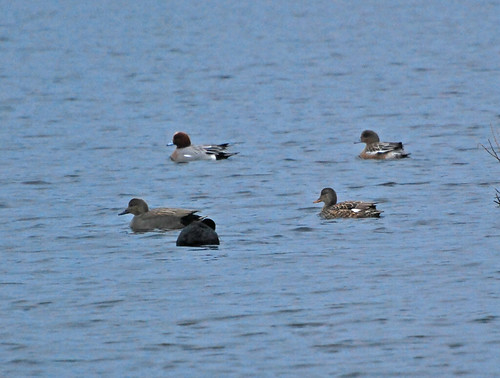
Several small groups of wigeon (Anas penelope) and gadwall (Anas strepera) mingled with the other water birds such as the numerous coot, gulls and cormorant.


A coot in the foregound with a pair of gadwall close by and a pair of wigeon in the background

By the end of our walk I was frozen but it was well worth braving the cold to see such a diverse range of birdlife. I shall return there on a sunny morning to try and get some less grainy photographs!