Tag Archives: histon

Returning songbirds

There’s a particular spot in my local meadow where there are some large clumps of brambles which are home to numerous species of bird including songthrush, blackbird, linnet and house sparrow. And in the summer chiffchaff, willow warbler, blackcap and common whitethroat are all there too. Chiffchaff have been here for a couple of months now, and willow warbler almost as long but I hadn’t yet seen a whitethroat, so I set off last Monday in the hope of seeing the first one of the year.

A cock robin singing to the ladies

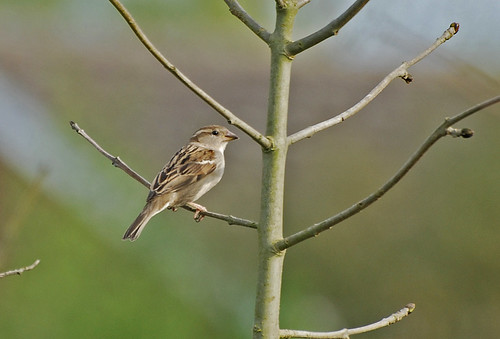
There were many species of songbird in the meadow including the robin (Erithacus rubecula: Dansk: rødhals) and the house sparrow (Passer domesticus, Dansk: gråspurv) and the air was alive with the song of all these species.


House sparrow female

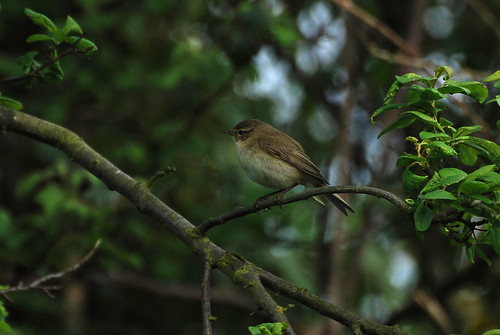
Robin and house sparrow are resident species in the meadow and I see them all year round there, but not the chiffchaff:

The chiffchaff (Phylloscopus collybita Dansk: gransanger), which is a warbler, and willow warbler (Phylloscopus trochilus, Dansk: løvsanger) can be very difficult to tell apart if only seen at a glance, but they can be distinguished by their song, of which more in the next post. This chiffchaff was one of a pair which were calling to each other and flitting around the bushes passing within a few feet of me on several occasions and seemingly unfazed by my presence.

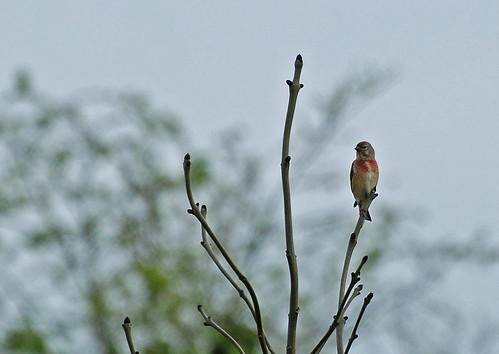
Cock linnet

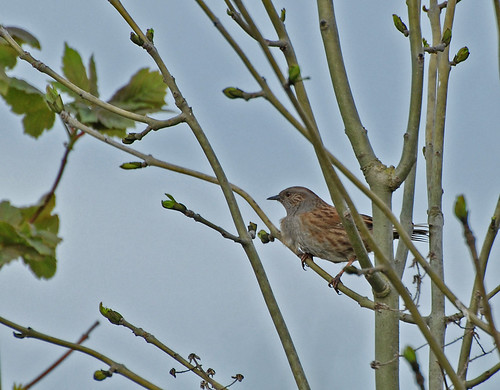
Resident in the UK is the linnet (Carduelis cannabina, Dansk: tornirisk), they disappear from the fields around Histon in the Autumn, presumably to congregate at a winter feeding ground, and they reappear in the Spring. And they have recently turned up in the meadow. Also resident, and present all year round, is the dunnock…


Dunnock, Prunella modularis, Dansk: jernspurv

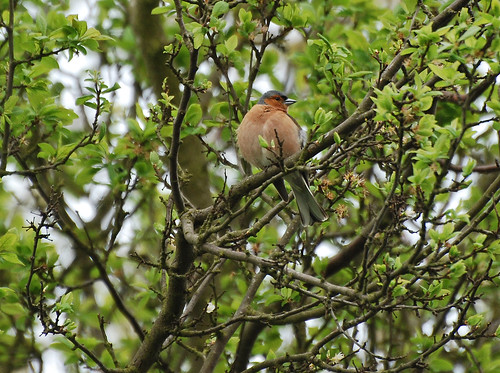
… and the chaffinch:

Cock chaffinch, Fringilla coelebs, Dansk: bogfinke

There were no whitethroat back in the meadow last Monday but as you can see there were plenty of other birds. In the last week I’ve also seen kestrel, sparrowhawk and buzzard, blackcap, green woodpecker, jay and magpie.

I recce’d the meadow again this weekend and the whitethroat are now back from wintering in Africa. They are very distinctive and both sexes are easily identified by their strikingly white throat, and the males display by singing from the top of a bramble thicket or a sapling and flit 4-5m vertically into the air and then descend to land in the same spot. They’re lovely little birds, with a very distinctive song, and I’ll hopefully have some pictures to show you in the near future.

The North Fields

If you’ve been reading my recent posts you’ll know they’ve mainly been from the part of my village (Histon, Cambridgeshire) called Rowleys Meadow. I have two routes out of the village, the Meadow and what I call the North Fields, and the terrain is very different. The Meadow isn’t farmed and has many hedges, thickets and trees and is therefore better for birds in the Winter because it has a much higher density of numbers and species. But now it’s officially Spring, after the Equinox on March 20th/21st, I decided to visit the North Fields which are all under the plough. I’ve been over there on a few evenings at dusk and after dark in the last few weeks and heard golden plover (Pluvialis apricaria, Dansk: hjejle) and skylark on the ground but I haven’t been over there in daytime for a while.

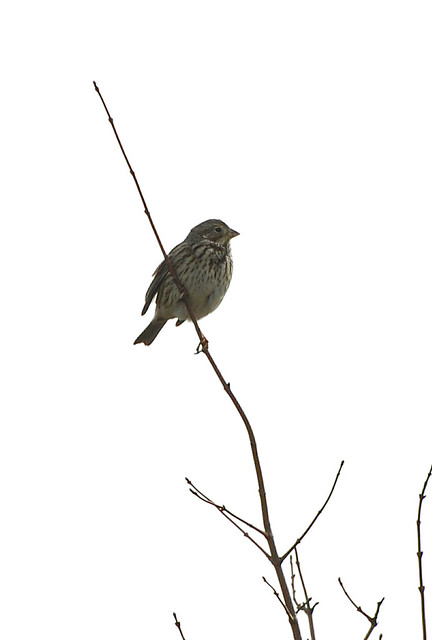
The main reason I headed over there was because I wanted to find out if the large numbers of linnet and corn bunting which disappear from the fields every year at harvest time had returned. My first impression on entering the fields was that I should have gone to the Meadow, there was virtually no movement of any kind, but I stuck to my guns and that turned out to be a good decision. I didn’t expect to see corn bunting, which are becoming increasingly scarce on our farms, yet, but I had only gone half a mile or so before I heard the unmistakeable sound of a male calling. I heard him long before I saw him but I knew where he would be perched from where his song was coming from, it is a favourite perch all the time they are in residence:

Corn bunting (Emberiza calandra, Dansk: bomlærke) sitting in a favourite place and singing loud

It’s not the best picture of a corn bunting because the sun was still low in the sky directly behind with a thin layer of high white cloud inbetween. Consequently it was impossible to get anything other than a silhouettte without overexposing the shot, so that’s what I did so his colors can be seen. He wasn’t the only one I saw, there were three altogether, so I hope there’ll be a good few more in the next few weeks.

Another bunting which put in an appearance was a male reed bunting. There were several of these too, and just along the ditch from here was a flock of between 10-20 yellowhammers alternating between a hedgerow and the ground where they were feeding.


Reed bunting male (Emberiza schoeniclus, Dansk: rørspurv)

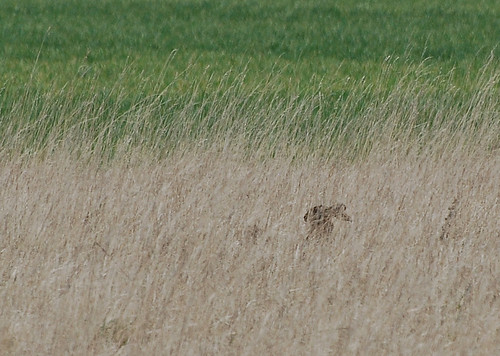
I didn’t go close enough to photograph the yellowhammers because I didn’t want to disturb them. Well, partly that, but also because I’d been distracted by a pair of hares (Lepus europaeus) chasing each other around in the long grass:

I couldn’t get close enough to get a picture of the whole hare, they were too wary of me and the dog, who’s a lurcher, so their timidity was well justified! But I like the way their ears poked up above the grass with the characteristic black tips.


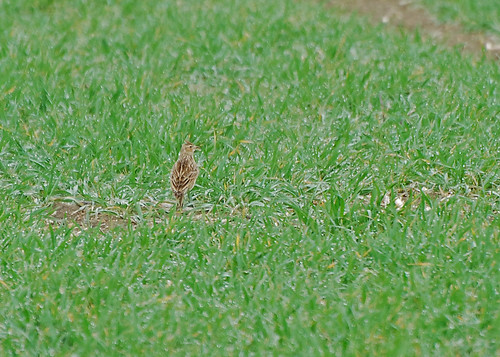
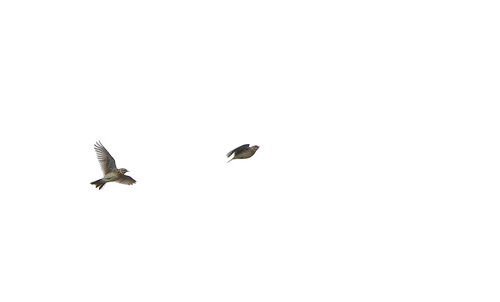
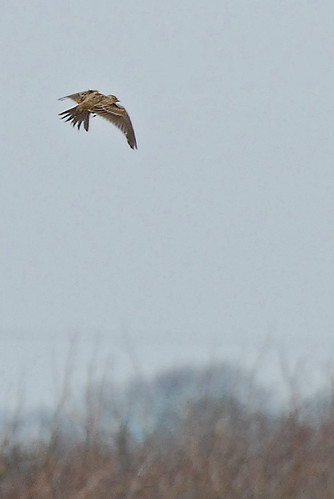
Skylark waiting on the ground between high speed aerial duels with other larks

The other bird which was present in large numbers was the skylark (Alauda arvensis, Dansk: sanglærke). I stopped counting when I got to 30, and I wasn’t yet half way around my walk. They were on the ground, up high singing the amazing song that is is so much part of a British summer, and chasing each other around just above the ground at high speed in groups of up to around half a dozen.

I saw a TV show some years ago in which skylark song had been hugely slowed down and deconstructed, and they claimed the music of some classical composers (including I think, Beethoven) was based on the same structure. I was left sceptical, not least because Ludwig V was deaf and may therefore have struggled to analyse skylark song. But even so, it was fascinating!


Low level dogfight


High level chase

And singing his heart out

One of my other fascinations is etymology. I think that may originate from speaking two languages, and the first one I spoke, Danish, is one of the precursors of the current one, English, so a large number of English words have their derivation in Danish thanks to our Viking invaders all those centuries ago. The expression ‘larking about’ (and ‘lark’ may well be from the Danish ‘lærke’) originates from falconry. In days of yore, the men would go hunting with their peregrine falcons and the ladies would only be allowed to use the much smaller merlin which couldn’t catch birds bigger than larks. Hence ‘larking about’ became a term of derision based on the size of your falcon.

But I digress. The corn bunting are back, the sky was full of larks and the hares were getting frisky. I’ll keep you posted when the linnet and other summer visitors arrive.

More signs of Spring

The weekend before last, the 3rd/4th of March, was generally pretty murky and grey and generally not very pleasant, but a stroll around the fields and meadows of Histon showed up some encouraging signs of Springtime. To start with, several birds including blackbirds and house sparrows were plucking nesting material out of the shrubbery in my garden.

And in the meadow the buds of the willow, ‘pussy willow‘, were bursting out

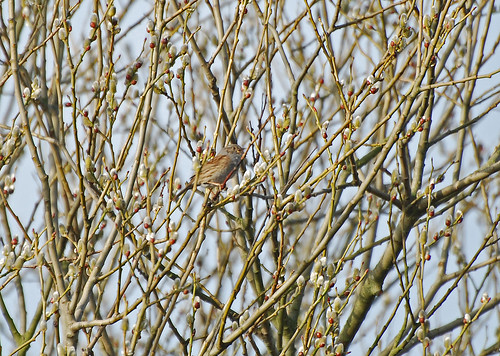
…and amongst the buds was this little dunnock singing his head off. Dunnock (Prunella modularis, Dansk: jernspurv) make a big sound for such a small bird. You can here the song here.

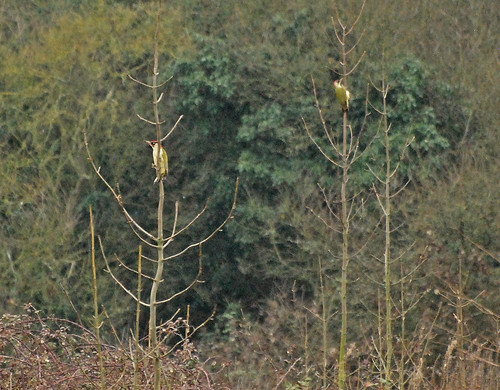
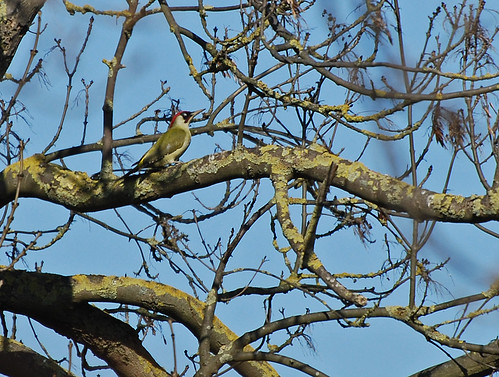
And other birds which are all adding to the avian orchestra around here at the moment are the green woodpecker (Picus viridis, Dansk: grønspætte) whose striking call I posted a link to a short while ago:


Not just one green woodpecker, but a pair. There are lots of these in the meadow but it’s seldom I see two together, and even more seldom they let me photograph them!

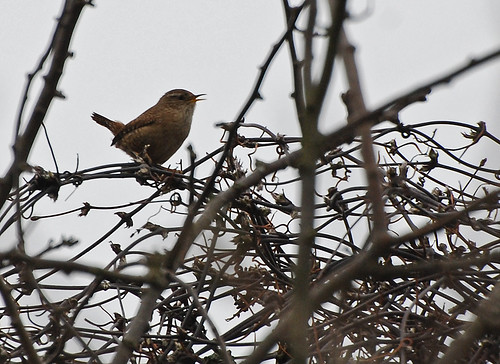
And this delightful wren who sat high and sung loud

I was very pleased with my wren picture because I rarely see them in a suitable place and they’re usually flitting in and out the undergrowth and don’t stay still for long enough to photograph. And even though it was very murky that morning and I had to use ISO 400, I like this shot. Like dunnock, wrens also make an amazing sound for such a small bird. And wrens (Troglodytes troglodytes, Dansk: gærdesmutte) really are tiny, they are 4-5cm long and weigh approximately 10g but they make a huge sound which is easily recognisable as it’s punctuated by short stretches of ‘whirring’ which differentiates it from other small bird song.

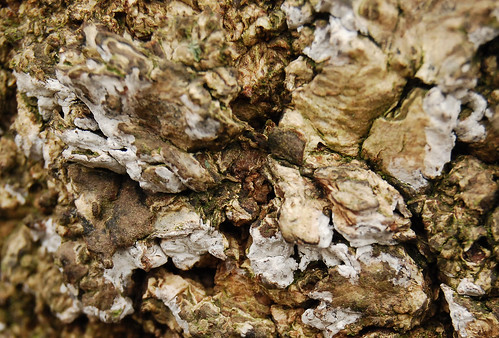
And the last thing to catch my eye on this trip was this tree bark. I couldn’t tell what type of tree it is so I’m waiting for the leaves to open so I can give it it’s proper name, but it has some wonderfully textured bark which is covered in a white mould:


I had to get down and crawl through the leaf litter to get to the base of the tree

Lots of early Springtime phenomena were going on, from pairs of green woodpeckers to singing wrens and blackbirds collecting nesting material. More Springtime firsts next post.

A stroll through the Meadow

Last Sunday I spent a glorious couple of hours in the piece of scrub near my house where me and the dog while away significant chunks of our time. He chases rabbits, cats, pheasants and generally enjoys doing what dogs do, and I marvel at all the wildlife to be found in my local bit of wilderness. It’s probably about 300m x 150m and it’s called ‘Rowleys Meadow’ even though it’s not a meadow, and it lies on the northern edge of the village with houses lining it’s southern periphery. On the east, west and north side are old hedgerows and some wonderful old trees and in the middle are stands of young ash trees, grassy areas and large clumps of brambles.

It plays host to an astonishing variety of wildlife which in the winter and early spring is mainly birds, although a peacock butterfly fluttered by last Sunday and on several warmer days since Christmas I’ve seen bumble bees flying around there . But on this particular day it was the birds that stole the show (click here for a full list of all my sightings on this outing on February 26th).

There are very healthy numbers of green woodpecker here due to the trees and the grassland where they can find there favourite food of ant and termites. They’re tricky to photograph in the Meadow because they’re hidden in the grass and they’re very skittish, so it’s difficult to get close enough when they’re on the ground or in the trees.

Green woodpecker with his black eyepatch and scarlet military policemans cap. This one did let me get close enough… just

There are regularly 5-10 green woodpeckers (Picus viridis, Dansk: grønspætte) to be found as I circumnavigate the Meadow. It’s easy to spot them, both the colours and the low bouncing flight, often no more than 15 feet from the ground, are very distinctive. And of course it’s call is like no other creature, if you’ve never heard it listen here. Scroll down to the entry from Lars Krogh from Lindet Skov in Denmark dated 19/04/2011 where there is a very good recording of a male greenie yaffling and drumming.

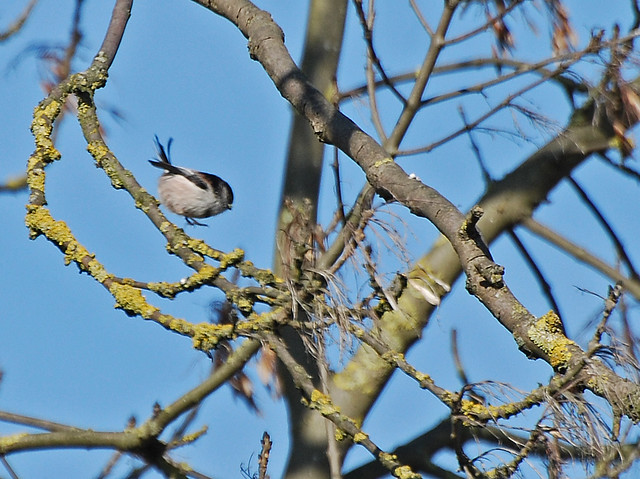
Another bird which I almost always see in the Meadow is the long tailed tit (Aegithalos caudatus, Dansk: halemajse). But for the tail, they’re tiny: the adults weigh 7-8g with a wingspan of 18cm. The long tailed tit is one of those creatures that make we wonder how such tiny ones can survive a long freezing winter. They can also be very difficult to photograph as they never stay still for more than a few seconds.


On final approach…

But when you are lucky enough to capture them they make delightful pictures!


Touchdown!

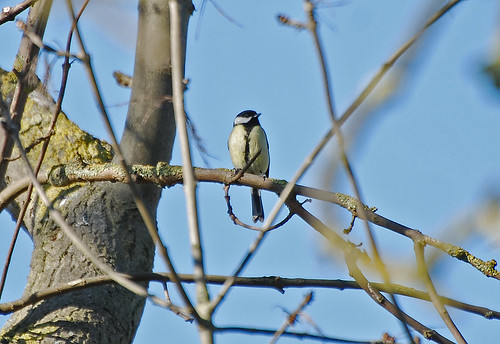
You may have noticed the lichens on the branches, I’ll share some photographs of those in the next post. In another tree adjacent to the one with the long tailed tits was a pair of great tits (Parus major, Dansk: sortemejse), among others. I like great tits, they’re handsome birds and they’re entertaining to watch feeding in my garden, especially when there is a family of them. The pair here are a male and a female:

Male great tit, his black stripe stretches all the way across his chest from toe to toe, making him very desirable indeed. I think the ‘A’ indicates he is the alpha male

The stripe of the female is much narrower:


Great tit female

And very shortly after I took the pictures of the great tits, a female sparrowhawk circled slowly overhead. The trees and hedges suddenly went very quiet as all the small birds concealed themselves from this fearsome predator. I’m not sure if she was hunting as I spotted a second, possibly a male, sparrowhawk circling much higher up. She was probably not more than a hundred feet up, but the male was several hundred feet up. I watched a pair of sparrowhawks do this over my garden once before, where the male was much higher, and I think it may be part of the courtship routine. (If anyone can confirm or refute that please drop me a line and let me know).


A female sparrowhawk circling over the hedges at the north end of the Meadow

All in all it was a very enjoyable and rewarding trip in bright warm sunshine and the  birdlife was there in spades.

Crystallised countryside

After the snow at the beginning of February, last weekend the temperatures in this part of the world plummeted to a wintry -12C creating a cold crystalline landscape.

So here are some pictures from the frost bound south Cambridgeshire countryside:

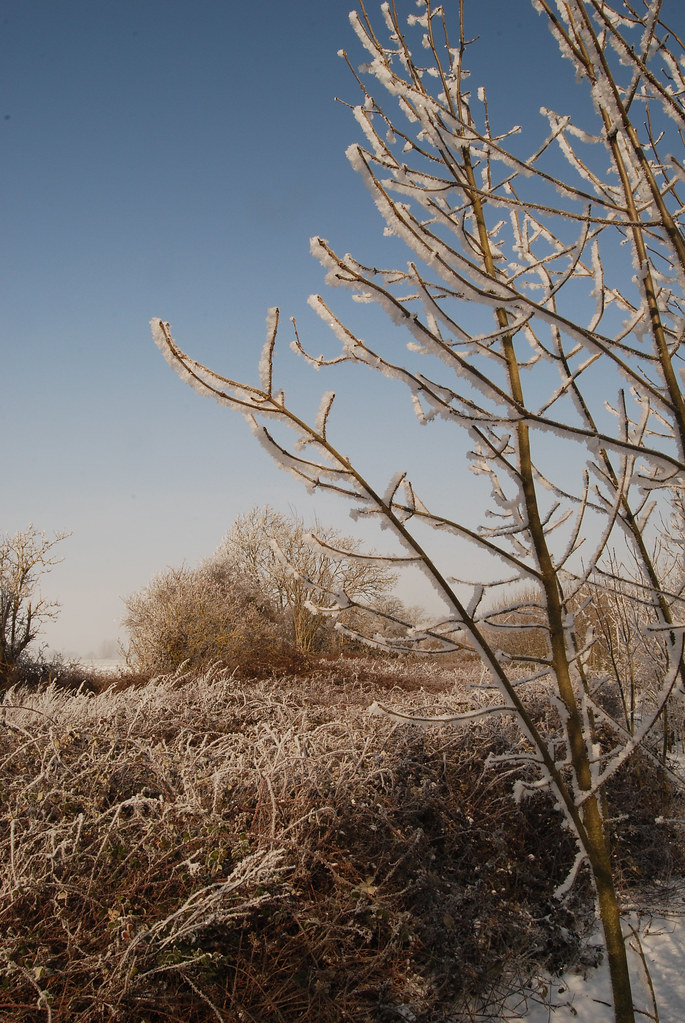
Ash saplings and brambles festooned with ice crystals on the shaded north side. The sun had already stripped the south side bare of frost

It was still early in the morning so the sun was low in the sky and created ghostly scintillations as it reflected from showers of dancing frost crystals dislodged by wafts of icy breeze.

As I walked my footsteps made loud cracking and crunching sounds but when I stood still it was completely silent. No cars, no birdsong, just the sound of the breeze. It was absolutely beautiful.

The rays of the sun couldn’t reach the grass stems so they remained coated with crystals through the day

Giant burdock

The burrs of the burdock (Arctium lappa) normally provide seeds for goldfinches to feast on but today they were twice their normal size and weighed down by a thick coating of frost.

Guns Lane Raptors

Last Saturday before the snow came I went for a hike along Guns Lane heading north from Histon up to Rampton. It was an unusual walk because there was very little wildlife of any sort, and apart from small numbers of the usual birds such as chaffinch, blackbird and blue tit, and a small flock of 19 lapwing which flew over, there were also very few birds.

Two birds that were around were several kestrels (Falco tinnunculus, Dansk tårnfalk) and a lone buzzard (Buteo buteo, Dansk: musvåge). Kestrels are one of my favourite birds, I never tire of watching them. They are compact birds, 34cm long with a 76cm wingspan, and their plumage is very attractive, which can be seen in the pictures below, and their flying skills combined with their UV vision and agile talons make them a superbly well designed weapons platform. So of course, as well as watching them, I try to photograph them.

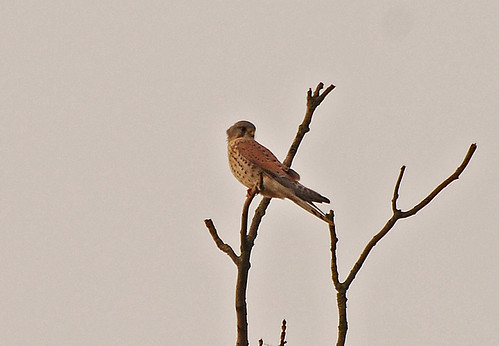
This handsome male bird sat in the top of a tree carefully watching me as I got closer:

And decided I was too close as I got to the bottom of his tree:


Kestrel exiting the top of an ash tree showing of his talons and array of flight feathers

A bird that I never saw in this country until I was at least post-grad age was the buzzard. I saw them when I was on holiday in Denmark as a kid, but not here until I started holidaying in the south west and I’d see the occasional one in Cornwall, Devon and Pembrokeshire.


Like the kestrel, this buzzard was keeping a keen eye on my activities

But from the early 1990’s buzzards have spread to recolonise most of the rest of the country and are regularly seen them gliding overhead around home and perched on fence posts and telegraph poles by the side of the roads. The buzzard is a resident breeder in the UK and is a bird of open heath and farmland, its preferred prey is small mammals but will also take birds and reptiles, and when times are hard insects and earthworms can find their way onto the menu.

Buzzards are big birds with wingspan around 1.2 m and are unmistakeable when either down low like this one:


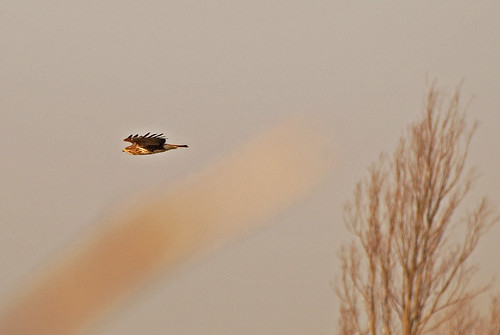
Also like the kestrel, exiting its perch when my unwanted attentions were deemed too intrusive…

…and gliding away to another less public location

…or when thermalling up high, minimising the effort required to stay aloft.

Meandering away on a non raptor related tangent, as I’m writing this post I’m looking out my window and there are blue tit, great tit, robin, dunnock, chaffinch, blackbird, long tailed tit and starling in my back garden. And goldfinch, and they’re the first ones to visit since last summer. As I posted about last time, the birds are being driven into gardens by the bitterly cold weather. It was -12C first thing this morning and it is now bright and sunny at 1pm, but the temperature is still only -3C. By the way, if you feed the birds try to put some food out the night before if you can, because the smaller songbirds such as blue tit and wren can die very quickly if they don’t find food soon after dawn when the weather is so cold.

The curse of the cabbage patch – and other beauties

The last post on this blog, ‘The Frozen Fen‘, had a decidedly wintry feel, and because of that, combined with the fact that I didn’t manage to get out and about and get any interesting pictures last weekend, I feel like brightening things up with some colourful butterfly pictures which I didn’t get a chance to publish in 2011 because of the dire shortage of butterflies.

I mentioned in a post last year that 2011 was a very bad year for butterflies, and that was a result of the mild Spring and very hot April which kick started the proceative processes. But after April the rest of the Summer was dreadful – cold and wet – and that resulted in catastrophic depletion of butterfly numbers. This winter has been mild so far (which is why I have had almost no birds in my garden compared to other years) and I’m hoping it stays that way and our Lepidopterans have a chance to recover their numbers this year.

So here are a few of the butterflies which I hope will put in appearances in and around the village this summer:


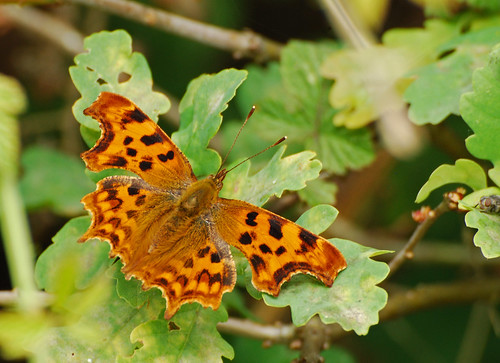
A comma (Polygonia c-album) soaking up some rays from a cluster of oak leaves

The comma is a member of the Nymphalidae family and is primarily a woodland butterfly which gets its name from its only white marking which is on the underside of the wings and is shaped like a comma. Bizarre that such a distinctive butterfly is named after such a tiny part of it’s anatomy, a bit like calling a tiger a ‘full stop’ because of the black spot behind its ear!  They are also seen in gardens (including mine) in the late summer where they stock up on nectar to replenish their body fat reserves prior to hibernation. Until fairly recently they were restricted to the west of England but have now spread to cover virtually all of England and Wales with sightings in Scotland and Ireland too.

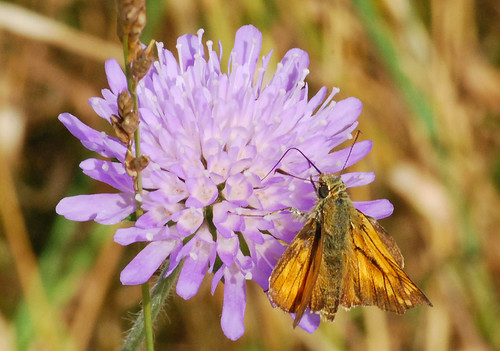
Large skipper (Ochlodes faunus)

I like the large skipper, it is a butterfly of open grassland and I often see them feeding on field scabius flowers, as this one is, and the colour combination is sumptuous, set against the green and brown of the grass stems. I like the geometry too – it reminds of a hornet (as in the McDonnel Douglas F18 hornet – the American navy fighter plane) – but I’d rather have the skipper flying around Histon!

Small copper (Lycaena phlaeas)

The small copper is a handsome little butterfly who frequents open grassland, heathland, wasteland, verges and woodland rides and is distributed throughout Great Britain. I see it here because it likes to feed on ragwort, yarrow, thistles and red clover which are all abundant in the fields close to Histon. They also feed on daisy, dandelion and buttercups which are common throughout the UK too. Despite their dietary promiscuity I don’t see them very often so I was pleased to get this picture.


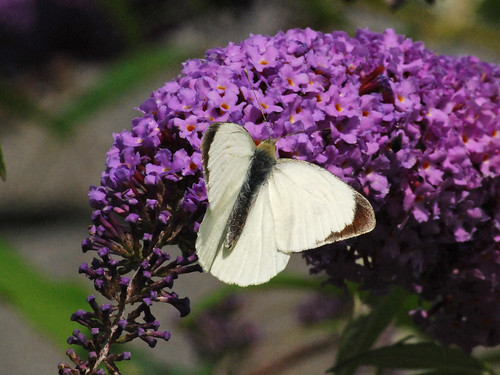
Large white (Pieris brassicae)

The curse of the cabbage patch! The large and small white are collectively known as ‘cabbage whites’ due to the devastation their caterpillars can wreak on the fruits of the labours of hapless allotment owners. The one pictured here is a male and he is easily distinguished from the female because she has two black spots on her forewings and another small black streak where the wings join and the male has no spots or streaks. As a species they are easily distinguished from other whites because they are noticeably bigger. The cabbage whites are also two of our most common butterflies which renders them additionally unpopular amongst the vegetable growing fraternity. Which is a pity really, because a field full of whites on a hot summer day mixed in with browns, blues and all the other butterflies is a spectacular sight.

Bullfinch revival?

Anyone who has followed some of my recent posts may well have picked up that I love the bullfinch (Pyrrhula pyrrhula, Dansk: dompap). Both the male and female of the species have beautiful plumage and because of their scarcity I consider it a real bonus to see one. Apart from the very occasional sighting, i.e. one every 5 years or so, I simply didn’t encounter them between childhood and around 2 years ago.

Since then I’ve seen them on numerous occasions out and about on my wanderings around Cambridgeshire, both around Histon and at nature reserves such as RSPB Fowlmere and Fen Drayton, and to my immense pleasure a group has been resident in a patch of scrub close to where I live for the past 2-3 weeks. On one occasion over Christmas I saw eight in one go, and I can’t ever remember seeing that before.

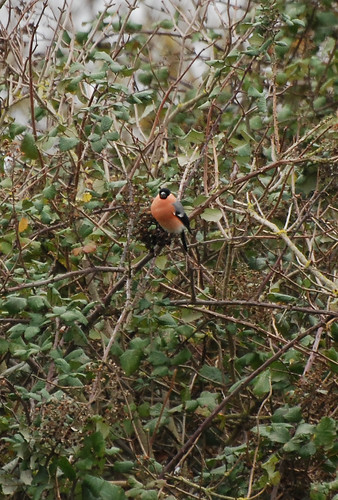
A group flew over my head, too fast to photograph, but this lone male alighted on a bramble around 30m from me and let me edge to within 20m, shutter whirring all the way:


Male bullfinch – the tailend charlie perched on the brambles

He was very busy gorging on the brambles pausing to look at me when he was aware of my movements and when I stopped he carried on feeding. Many bullfinch pictures are of the male, resplendent in his sumptuous orange/pink waistcoat and I don’t mind that, but I was pleased to get the picture below as he flipped through 180 degrees to get to his bramble shoots:


Upside down bullfinch showing his dark grey back and tail, jet black primary flight feathers and white rump. No other bird could be mistaken for him.

The song of the bullfinch is also very distinctive. They make a fairly inobtrusive ‘cheep cheep‘ call which is unmistakeable when a group fly overhead.

My lone male replete after his feast sizing me up immediately prior to his departure

Flocks of bullfinch can decimate fruit crops by eating the shoots from the trees and were therefore heavily persecuted in tis country which led to a catastrophic decline in the numbers through the 1970’s and 80’s but I read in a recent report that they fared well as a result of the mild year we experienced in 2011, so I’m hoping there has been a general increase in their numbers and my small local flock will stay on and possibly expand. Fingers crossed.

If that comes to pass I should be able to post more shots of both the male and female bullfinch in the near future. At the moment I only have one photograph of a female as they seem to be generally more wary than the males. I’m also saving up to invest in more powerful optics so I should be able to bring you some better close up portrait shots of bullfinch, and lots of other species in the not too distant future. Watch this space.

2011 – That was the year that was

Every month of the year has different conditions which create environmental niches that favour different flora, fauna and stages of life cycles. So as 2011 rushes headlong to its wintry conclusion, for my last post of the year I was going to select a single photograph to represent the month to month changes in our wildlife throughout the year. And that was of course impossible for a number of reasons, mainly because it was impossible to represent any one month with a single image, and also because I have lots of images that I like and I want to share. I eventually managed to whittle the number down to an average of two per month which include a wide range of our native creatures in the UK including birds (migrants and natives), butterflies, moths, flowers, amphibians and fungi. I hope you like them!

January

Every autumn  lots of bird species vacate our shores to head to warmer parts of the world while we endure the cold of winter, and they’re replaced by other species which come from the north to the relative warmth of the UK in winter. Last year the autumn and winter weather in Scandinavia was ferocious and consequently many birds arrived here in larger numbers than usual, including the gorgeous waxwing. Along with the waxwing, redwing and fieldfare came too, as they do every year, and remained until the spring, providing some welcome colour.

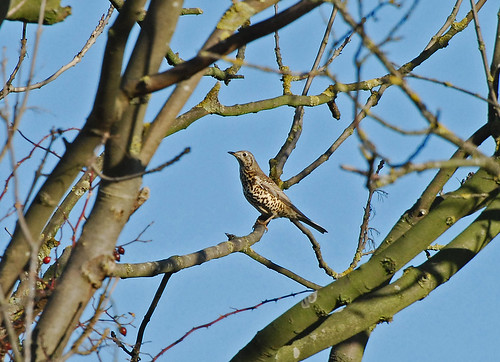
On a bright cold January day a lone fieldfare perched in a tree

February

February was cold and the middle of the month saw us taking the children to the coast for our annual spring half term excursion, and this year we headed to the Suffolk coast at Dunwich. Dunwich is a really interesting place for lots of reasons, not least because the wildlife there is rich and varied. One of the harbingers of springtime which I look forward to every year is the flowering of snowdrops, and the woods on the edge of Dunwich were covered in them:


A carpet of snowdrops in the woods at Dunwich Greyfriars

March

By March many flowers were blooming and the fauna was turning it’s thoughts to matters procreational. And this dunnock was no exception:


A dunnock serenading the ladies from a bramble stem on Cambridge Science Park

Dunnocks have a rather to-the-point approach to the art of regeneration. They don’t get together in pairs as most birds do, they form small groups and mate with multiple partners and the males go as far as to remove packets of sperm from the cloaca of females who have been inseminated by rivals prior to passing on their own DNA. No nonsense!


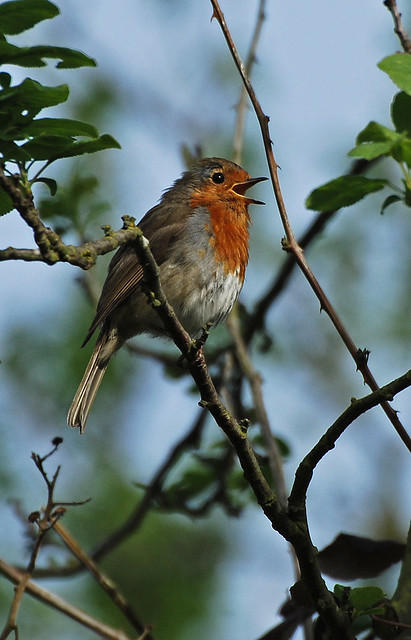
A robin singing for a mate in an alder tree, also on Cambridge Science Park

And of course the birds aren’t the only creatures to get the urge in March. For the past 2-3 years a guided busway has been built between St Ives and Cambridge and as it approaches Cambridge Science Park it passes alongside a lake that is a spawning ground for thousands of toads which live in the adjacent woods and fields. The busway has therefore cut off the toads from the lake and, driven by the unstoppable instinct to reproduce, this pair were trying unsuccessfully to negotiate the sheer walls of the track. For a week in March I would get off my bike every morning on the way to work to help as many of them across as I could find.


The male toad is hitching a lift on the back of the much larger female on the way to the water to spawn

The male toad locks onto the back of the female with his front claws around her chest and he’s not at all keen to relinquish his grip until they’ve reached the water and he’s fertilised her eggs. After which armies of lone toads can be seen heading back the other way.

Fortunately for the toads Cambridge City Council funded the installation of toad tunnels under the busway so next year they should be able to negotitate the track and avoid the carnage which would otherwise have ensued. Hats off to the Council!

April

This month was a real wildlife fest and many types of creature allowed me to take some great photographs. The trees now have shooting leaves so everywhere has that lovely green colour from all the fresh growth.


Windswept male yellowhammer in the top of a hawthorn tree

The yellowhammer is a species which has become less and less common in recent decades as a result of hedgerow destruction and other modern farming methods, but we’re lucky to have plenty of hedgerows still in situ on the outskirts of Histon, and consequently, good numbers of these lovely yellow buntings. The hedgerow this one is on is mature and has old oak and ash trees in so it plays host to alot of bird species including blackcap, chiffchaff, dunnock, common whitethroat and green woodpecker, to name but a few.

Whilst sitting watching TV late one evening in March, what I initially thought was a bat emerged from behind the sofa I was sitting on with my wife. There had been no prior warning of its presence and myself and my wife both levitated off the sofa uttering something along the lines of “What the heck was that!?”. It fluttered into a lampshade where it staid long enough to get a photograph, and it turned out to be an emperor moth:


Our emperor moth inside a lamp. I though creatures like that only lived in tropical rainforests!

Unfortunately, a couple of days later I found her dead (she was the female of the species) still inside the lampshade. I extricated her and measured her and she was 7cm wingtip to wingtip. A magnificent beast.


A willow warbler beautifully framed by new leaves and blossom of the blackthorn tree

These little warblers which weigh on average around 9g have just arrived from southern Africa. I think bird migration is one of the most amazing natural phemonena – how does such a tiny creature navigate and survive a flight across the Sahara and then the Mediterranean? It’s absolutely incredible.


A pair of great crested newts getting ready to mate in a shallow pond – male on the left, more slender female to the right

The great crested newt was probably the highlight of my year. I’d never seen a newt before and in this pond there were great crested, palmate and smooth newts. I turned the flash power down and used an 18-55mm lens and got some reasonably good photographs of the newts underwater. And that at 1am after a few hours in the pub!

May

I’ve spent many a fruitless hour chasing orange spot butterflies up and down the hedgerows of Cambridgeshire, but they never seemed to settle for long enough to get a photograph. But one morning in May I must have timed it just right, they were in the mating mood.
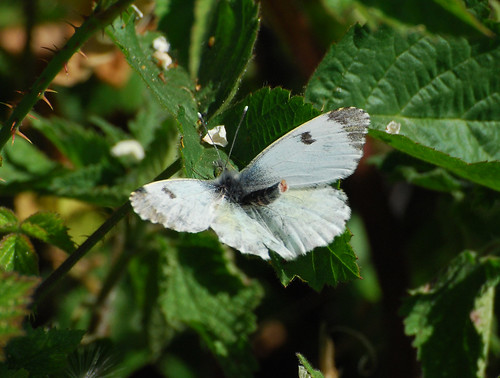

Female orange spot announcing her availability in somewhat unambiguous fashion to a passing male who was just out of shot


Common whitethroat – these warblers also migrate to the UK from sub-Saharan Africa

The common whitethroat breeds in my local fields in good numbers. It’s easy to identify by its song and the way it perches on brambles and low scrub and then flits almost vertically up into the air to alight a few seconds later close to where it took off from and continue singing. This one is a male, he has a blue/grey head whereas the female has a brown head. As well as avian migrants from warmer climes, at this time of year many species of dragonfly are emerging:


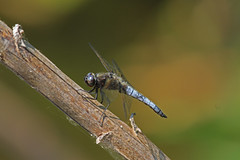
Scarce chaser dragonfly at Milton Country Park

I like dragonflies. In the days of the dinosaurs there were dragonflies with a 75cm wingspan! They are fun to photograph (and often, not too difficult) they look awesome, and they have very interesting life cycles. My scarce chaser sat on a seed head for several minutes whilst I stood a few feet away photographing other dragons and damsels, occassionally he took off to circle the pond before returning to the same spot where he let me get to within around 50cm to capture his portrait.

June

In a normal year the weather will be warming up  nicely by June and flowers and insects and birds should be in abundance. But 2011 wasn’t a normal year, April was unseasonally warm which kick started everything, but the rest of spring and summer were cold and this had dire consequences for many butterflies and other species. One of the few that I did see in reasonable  numbers this year, although not as many as last year, was the large skipper.


Large skipper feasting on the nectar of a thistle

The marsh woundwort is so called because it has been applied to wounds to assist the healing process. I don’t know what the medical basis for that is, maybe it has antispetic properties. It  has a beautiful flowerhead and is one a good number of wild flowers growing in the drainage dikes on the local farmland around Cambridge.

Marsh woundwort poking it’s lovely head out of a drainage ditch which is full of various wild flowers every year

July

I found this splendid looking cricket lurking in the grass in a field on the edge of Histon. I first thought it was a very green grasshopper until I looked more closely at the photograph, and it turned out to be a Roesels bush cricket. It is an introduced species from mainland Europe which until recently was only found in the most southerly parts of England. There are two varieties and this is the long winged one which can colonise further afield faster than its short winged cousin, and is now as far north as Cambridgeshire and beyond.


Long winged Roesels bush cricket

This was the first of its kind that I’d seen and a few days later another one appeared on a blind in my house, so I guess thay can’t be that uncommon in this region now.

A pair of juvenile linnets

Before I got out walking in my local countryside around Histon I can’t remember the last time I saw a linnet, but they breed here in good numbers and in the winter flocks of many tens to hundreds can be seen on farmland around and about Histon. Linnet are finches which feed on seeds and the adult males are splendid with a cerise breast and a crimson spot on their foreheads.

August

When I was at school, many years ago, my Dad would feed the birds in the garden and it wasn’t particularly unusual to see the occasional bullfinch.  But mainly as a result of persecution their numbers declined dramatically through the 1970’s and 80’s and I didn’t see one for years. The males are beautiful birds and I’ve been after a good photograph of one for a long time. And finally…


A male bullfinch crunching seeds at RSPB Fen Drayton

I love this picture – so far it’s the first and only half decent one I’ve managed. Hopefully I’ll get a few more to share with you in 2012.

Later in August, we were on holiday in Northumberland, and amongst the many gulls and other seabirds on the beach at Seahouses was this redshank. I think it’s nature at it’s aesthetic best!


A lone redshank looking for nourishment in the rockpools at Seahouses

September

The biggest garden spider I’ve ever seen – she was around 4cm across

Another of natures harbingers, this time of autumn. My garden fills up with these polyocular purveyors of terror in September, and this lady was huge. She was 4cm across and was big enough to distract my son from a telling off. ‘Dad, there’s a big spider in my window‘ was an imaginative and very effective way to divert my attention from the misdemeanour of the moment. I ran to get my camera and I had to lay horizontally out of the bedroom window to take this photograph, as a result of which I couldn’t stay still for more than a few seconds!

October

After the coldest summer for 18 years we then had a mild autumn which meant that many creatures could be found out and about long after they have normally  migrated or hibernated, or died off. Swallows and swifts were still being seen into October and a bumblebee flew past my lab window one day last week. During a visit to Milton Country Park, on the northern edge of Cambridge, on 28th October, to see what winter wildfowl had arrived, there were some winter visitors including tufted duck, gadwall and widgeon. But the pontoon I was stood on had around half a dozen common darter dragonflies on it along with several species of damselfly in the surrounding reedbed and a lone migrant hawker patrolling the air which took a common darter and butchered it on the wing right over my head. Dragonflies can be seen late in the year when the weather permits, but even so I was surprised to see so many at the end of October.

A pair of common darters mating in the late autumn sunshine

November

One of my November excursions took me to RSPB Fowlmere, between Cambridge and Royston, which is renowned for its water rails. I don’t think I’d ever seen one before but I was tipped off by a fellow naturalist that there was one in front of a particular hide, so I headed off there and there it was, busy foraging in the pond for the whole hour I sat there. It was very murky so the photographic conditions were difficult, but I managed to get a couple of decent pictures and I particularly like this one:

A water rail in the primeval swamps of Cambridgeshire!

And another of my trips in November was to Norsey Wood in Essex which is a very different ecosystem to Fowlmere, consisting of ancient oak, beech and birch wood. So in autumn the forest floor is a really good location for fungi and this fly agaric was one of a large group growing out of the leaf litter.


Fly agaric mushroom amongst the fallen beech leaves of Norsey Wood

December

And finally, a wildlife success story is the long tailed tit. Until the last 10-15 years I only saw these occasionally but they now seem to be common, in direct contrast to so many other species of bird whose numbers are declining. I regularly see flocks of long tailed tits on the feeders in my garden and in the hedgerows and woods around Histon. They’re gorgeous little birds and I love watching a flock of them follow each other one after the other along a hedgerow before bunching together when they have found a food  source and then heading off again in line astern.

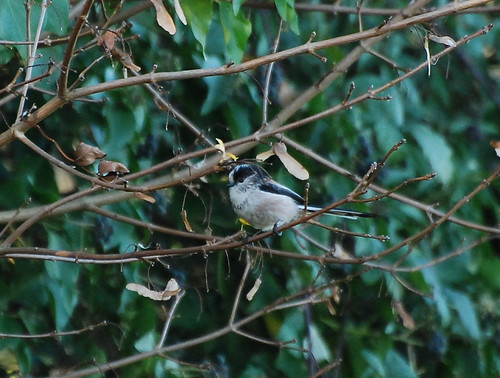
A long tailed tit in the hedges along Guns Lane in Histon

I stood quietly for several minutes watching the flock of around 15 birds that this one belonged to and they didn’t seem at all bothered by me as they picked insects from the trees.

So there you have it. 2011 in pictures. If you had the stamina to get this far, thankyou and I hope you enjoyed it.

Best wishes for a very happy Christmas and a peaceful and successful New Year from The Naturephile!

Where have all the birds gone?

There are virtually no birds in my garden at the moment, and they have been conspicuous by their absence all through the autumn. This appears to be a more widely observed phenomenon as reported on BBC’s Countryfile, and the RSPB have been seeking to reassure people who are concerned by the apparent dearth of birdlife visiting their gardens that it’s simply due to the abundance of suitable food still accessible in the countryside, and whenever possible that’s where the birds prefer to be.

I can vouch for the disappearance of the small birds from gardens. Apart from the occasional blackbird and blue tit  (and a jay last week – the first one I’ve ever seen in my garden!) very few birds are availing themselves of my feeders. If this is happening in your garden the best thing to do is to keep your feeders clean and put a small amount of feed in so any passing birds recognise your garden as a source of food and can stop to refill if they need to. But it looks as thought the cold weather is starting to arrive here in Cambridgeshire so garden bird numbers may well increase in the near future.

So last weekend I ventured to the fields on the edge of Histon to see if they are still in residence. The hedges and fields were well populated with goldfinch (Carduelis carduelis, Dansk: stillits) and chaffinch (Fringilla coelebs, Dansk: bogfinke), great tit (Parus major, Dansk: musvit) and long tailed tit (Aegithalos caudatus, Dansk: halemejse) and green woodpeckers were abundant too. I don’t know if the numbers of green woodpecker (Picus viridis, Dansk: grønspætte) I see are representative of national trends but they seem to be numerous here in Histon, also where I work on Cambridge Science Park and today I was at the RSPB reserve at Fen Drayton near St Ives and there were good numbers there too. Two birds that I haven’t seen recently in the numbers I’d expect are dunnock and greenfinch – I hope that’s because they’re out in the countryside and it doesn’t reflect a decline in overall numbers.

I talked in my post a couple of weeks ago, Forests and Fungi, about how I’ve been inspired to look for other ways of photographing nature rather than simply taking traditional portrait shots. Rowleys Meadow which is on the edge of Histon, has mature ash trees (Fraxinus excelsior) on the periphery which are laden with ash keys and as a result there are thousands of young ash saplings:


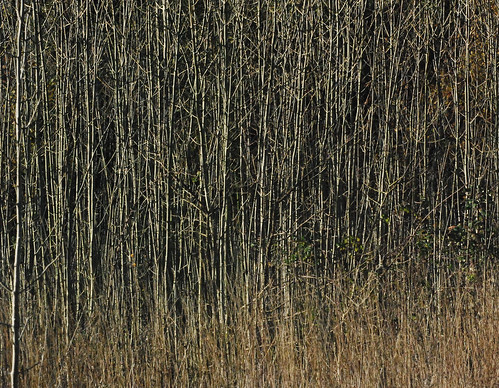
Brown grass stems merge with the taller, thicker, silver stems of the ash saplings

And this presented a good opportunity to capture some abstract nature images. I like the way the low, bright sunlight creates a vertical pattern of silver and shadow as it illuminates hundreds of young ash trees

Back to birds, as well as our regular winter residents migrants from Scandinavia are much in evidence, redwing (Turdus iliacus, Dansk: vindrossel), and fieldfare (Turdus pilaris, Dansk: sjagger):


A lone fieldfare perched in a tree after gorging on a blackthorn bush laden with sloe berries

Small flocks of fieldfare can be seen and heard making there distinctive and diagnostic call, and the flocks will get bigger if the weather does turn wintry. Last winter, which was brutally cold here and in Scandinavia, huge numbers of waxwing (Bombycilla garrulus, Dansk: silkehale) arrived in the UK from Norway, but due to the much warmer weather I don’t think we’ll see them here in quite such abundance this year, which is a real shame because they are indeed spectacular:


Waxwing – it’s around the size of a starling and the colours are amazing

Histon has a resident rook colony (Corvus frugilegus, Dansk: sibirisk allike) who have their rookery in the tall trees adjacent to the church and are a constant source of aerial entertainment. They were feeding in a field along Guns Lane, which runs from Histon to Ely, as I wandered along it and this one took exception to my presence and flew over squawking at me as it went,

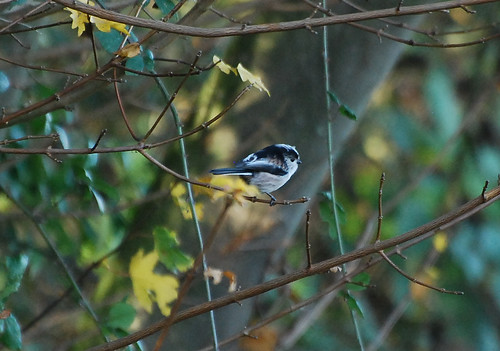
I took the hint and moved on, heading home. But a little further along Guns Lane I paused when I heard the quiet and delicate song of a flock of long tailed tits. So I stood still and they went about their routine in trees about 10m away. I really like these diminutive, gregarious, birds and I love trying to photograph them, which can be challenging as they are very small and they never settle in any one place for very long. But I managed to get this series of shots which I’m rather pleased with:

Even though the weather is pleasantly mild at the moment, I prefer winter when it’s cold, so I’m hoping it will start to behave as it should and these delightful little birds come back to feed in my garden!