Category Archives: Flora and fungi

Forests and fungi

Norsey Wood is a small oasis of ancient woodland situated on the edge of Billericay in Essex.
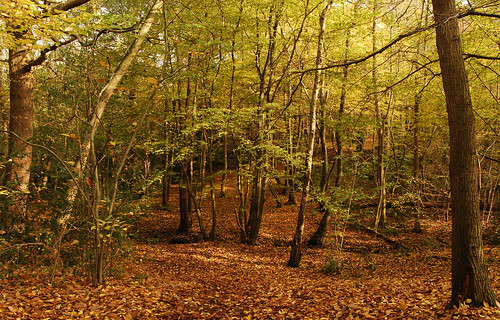

Beech and birch of Norsey Wood in Autumnal sunshine

It’s a lovely fragment of forest left over from the days when the kings of England had hunting grounds where they would hunt wild boar and red deer, and it consists predominantly of oak, beech and birch. It was devastated by the hurricane in 1987 and many of the trees are still leaning at some rather unnatural angles.
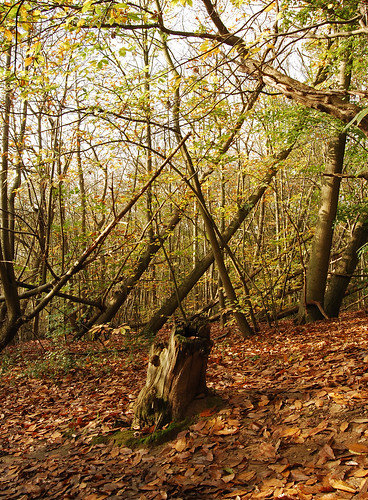
Hurricane damage

I attended a nature photography day at the Wetland and Wildlife Trust at Welney in Norfolk a couple of weeks ago where four top flight professional photographers talked about their work. I was inspired by all of them, but one in particular, a guy called David Ward, made me really think about how I take pictures. He called it ‘making‘ rather than ‘taking‘ a picture, which turned everything on it’s head for me. Previously I’d viewed photography in a rather scientific way as a means of creating a record of an exisitng phenomenon, but the concept of ‘making‘ a picture by focussing down on a small part of a subject to create something more abstract and thought provoking was a  notion which I really like. And there’s nothing like an ancient English wood in the autumn sunshine to suffuse me with paroxysms of artistic fervour!

So I tried to use a similar thought process when I was taking these photographs of the woods. I gave rather more thought to the composition, and as it was quite dark under the tree canopy with intermittent bright sunlight above it, the conditions were tricky. Technically I could have done better, but experimenting with new  thought processes was alot of fun and I hope you like the results!
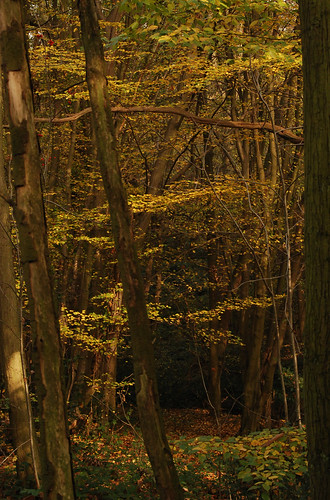
Layers of light

In the ‘hurricane damage’ picture I wanted to capture the angles of the trees that were blown over against the uprights of the undamaged trees, and in the ‘layers’ picture it was the sunlight on the four layers of yellow leaves against the mysterious darkness deep in the wood that captivated me. I think these images are OK and hopefully they convey a little of the atmosphere amongst the trees. If you agree – or indeed if you don’t – or you have  any other thoughts please post a comment and let me know.

If you’re still reading, thankyou for indulging me through my artistic interlude, but now I’ll return to the more familiar and prosaic territory of documenting my wildlife encounters. Going back alot of years to when I was sixteen and had just acquired my first SLR I took alot of ribbing about my fascination for fungi. But I still think they make great pictures and inbetween trying to shoot the trees of Norsey Wood I was capturing some of the amazing variety of fungi growing on and amongst the trees.

The floor of the wood was covered in a deep layer of multicoloured leaves which changed as the sun waxed and waned and poking through were tree stumps and dead branches plastered with bracket fungi,
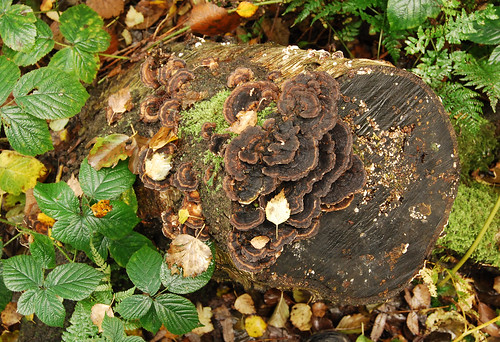
I think this bracket is an ‘oak curtain crust’ (Hymenochaete rubiginosa)
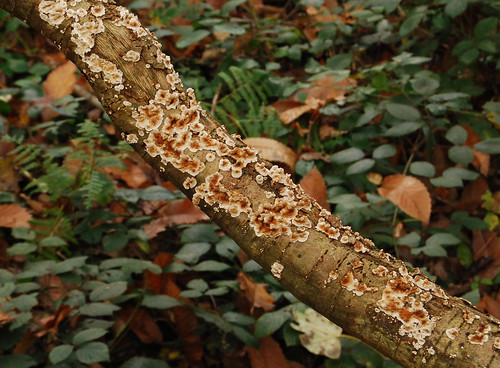
And this resupinate is the toothed crust fungus (Basidioradulum radula)

The oak curtain crust grows on other trees than oak, in this instance a silver birch stump and the toothed crust is growing on a dead birch branch. Fungi are biochemically fascinating and they specialise in extracting nutrients from wherever they grow, in this case dead wood, but it could also be live wood or even live humans, as either parasites such as athletes foot, or saprophytes which extract nutrients without harming the host, or in a symbiotic relationship where the association with another live organism is mutually beneficial.

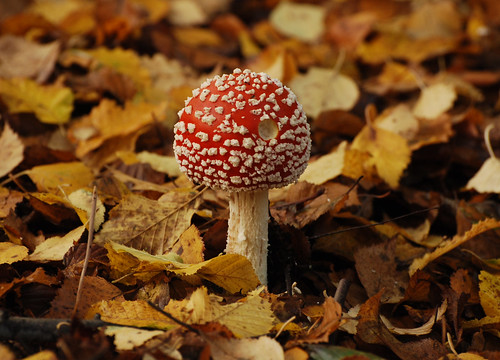
The most recognisable fungus which adorns many a Christmas card and childs drawing is the fly agaric (Amanita muscaria). So called because in days of yore in central Europe it was mixed with milk and used as an insecticide to kill flies. The specific name ‘muscaria‘ is derived from ‘musca‘ which is Latin for fly.
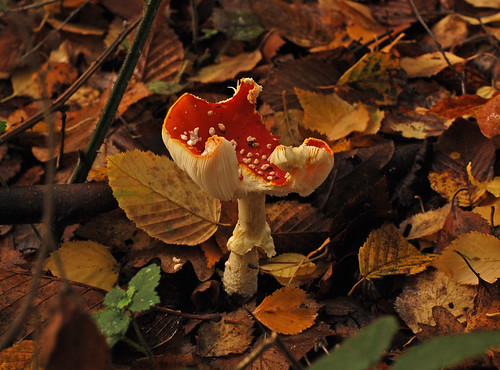

The bright red cap of the fly agaric. The gill structure, the ring on the stem and the white flecks on the cap are also diagnostic, but the flecks can be washed off by heavy rain

The fly agaric is generally considered to be poisonous due to a compound called muscimol, which also has psychoactive properties. Because of this, myths and legends have been ascribed to this mushroom including the use by the Vikings to induce the berserker rages in which they went into battle. Apparently, parboiling it deactivates the toxins and renders it edible, but I reckon if I served it up to my wife she’d suspect nefarious intant!


A group of fly agarics of various ages and sizes, and all of them have been nibbled by other inhabitants of the wood
A quick stroll round the meadow

Yesterday evening I accompanied the dog on a very quick circuit around Rowleys Meadow. I didn’t take my camera because I didn’t expect to be gone for very long, but fortunately I did pick up my binoculars.

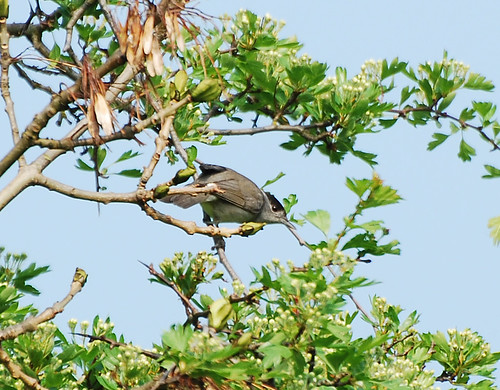
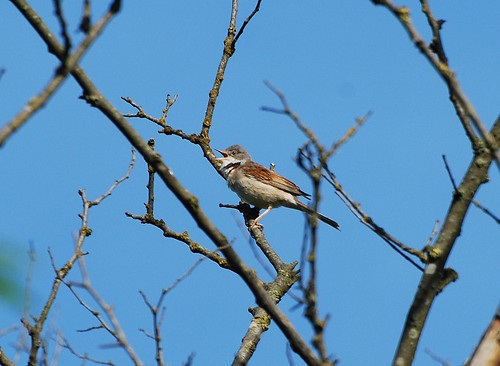
Venturing along Guns Lane to the gap in the hedge which serves as the entrance to the Meadow I could hear a blackcap uttering its call in the undergrowth. As I was about to go through the gap it flew past me just in front and alighted in the bramble a few feet away and continued calling. It then circled around me for a minute or so as I entered the Meadow and sat singing in the trees and brambles while I stood in the hedge and watched. I didn’t linger for long as I guessed it was probably guarding a nearby nest. If only I’d had my camera with me!


Blackcap male  – from a previous foray into the meadow

I’ve never spent so long so close to a blackcap, and it was lovely to see. There are a good number of them in the Meadow, and at least one nest, and they’re present in the hedgerows around the more open fields to the east of here too.

Moving on around the Meadow, chiffchaff were on parade in their customary locations and common whitethroat were singing on top of the brambles and in the low scrub.


Common whitethroat male proclaiming his territory

There are numerous common whitethroat in and around the Meadow which can be heard singing all through the day and many of the bramble thickets are home to their nests.


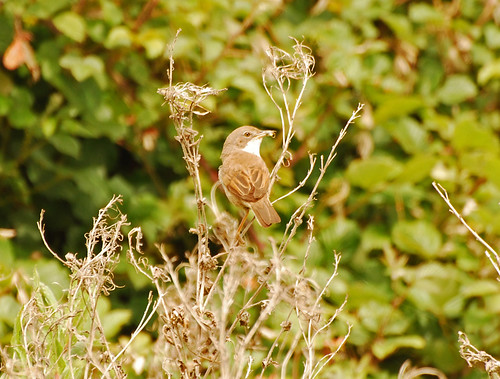
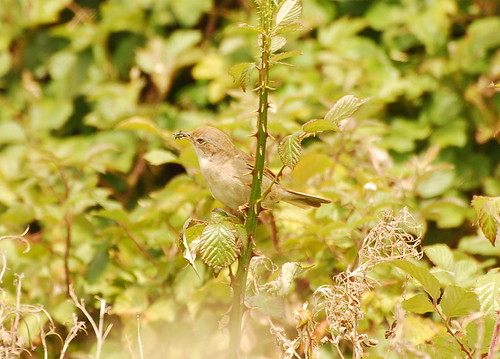
This female common whitethroat was waiting for me to move on before heading for the nest. I crouched down and hid in the long grass just long enough to get these photographs

When seen close up the female whitethroat is quite different to the male both in demeanour and plumage. She isn’t as bold in proclaiming her presence and her colours are more subdued, she doesn’t have the blue grey head of the male.

A kestrel was hovering over the Meadow at various heights for the duration of our walk, diving down into the undergrowth in pursuit of unwary rodents, but he didn’t seem to catch any. But next to the path there was evidence of another predator kill – the empty carcass from a sparrowhawk meal. The brown feathers remaining suggested it was a starling chick but it could also have been a blackbird or song thrush. There was insufficient forensic left to allow an unambiguous identification. Nature at its most brutal, but sparrowhawks have chicks to feed too. On the subject of our local birds of prey, a young buzzard was learning to fly over the Meadow today, it’s plumage was ragged and it was a less than competent aeronaut, and it’s great that they’re breeding in the area.

The other highlight of my quick stroll last night was the number of green woodpeckers. I counted seven, including two sightings of two together, one pair of which were squabbling on the ground. It’s quite possible, even likely, that I counted at least one of them twice, but I think there must have been at least 4-5 individuals.


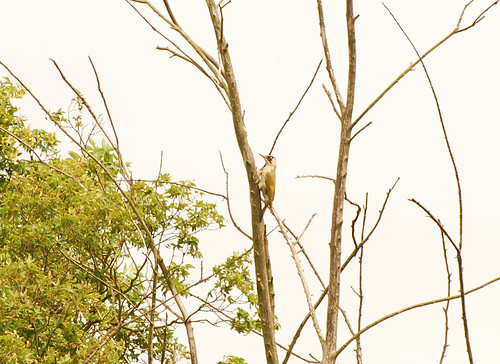
A green woodpecker that I flushed out the grass

There’s lots of birdlife around at the moment and they all seem to be breeding successfully, including the local starling population.

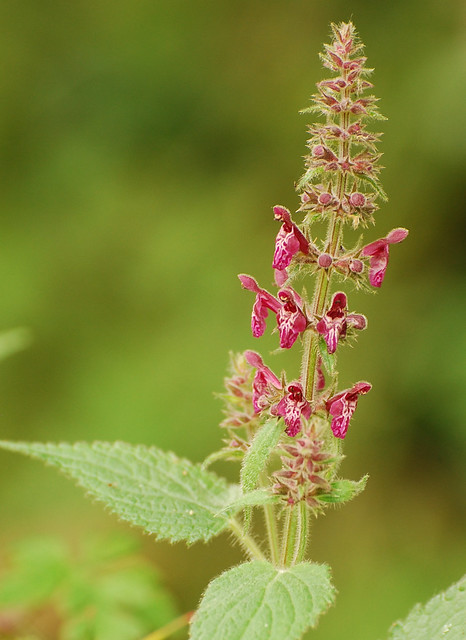
And before I finish, I want to share this wild flower with you:

How gorgeous is that?!

It’s the flowerhead of hedge woundwort (Stachys sylvatica) which has just started blossoming in the hedgerows along Guns Lane in Histon. It contains an antiseptic oil which was utilised in days of yore in wound dressings, hence the name. Absolutely exquisite.

The birds and the bees (and the flowers)

As our warmest and driest Spring on record turns into what is shaping up to be a warm and dry Summer, nature’s great events are occurring apace to exploit the prevailing climatic conditions.

The first swifts were seen over Histon 3 weeks ago (by me at least) after their heroic journey back to their breeding sites from overwintering in Africa. To celebrate this event I’ve spent several hours sitting in the garden of the Castle pub on Castle Hill in Cambridge enjoying a few convivial sharpeners and watching the swifts shrieking through the sky like an avian aerobatic team. I can heartily recommend both activities!

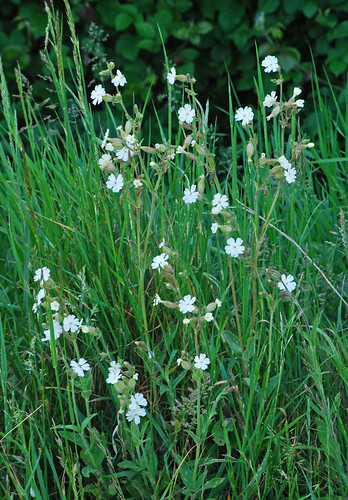
Wild flowers, including one of my favourites, white campion, are now in bloom:

White campion, Silene latifolia, decorating ditches and hedgerows

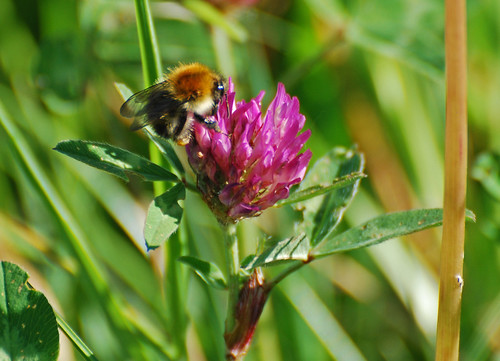
White campion is a dioecious plant which means the male and female reproductive machinery are on separate flowers. It grows in well drained earth and flowers from Spring to Autumn and is now delineating my walks across the open countryside. Another one of my favourite wild flowers is red clover (Trifolium pratense) which is a gorgeous colour and provides nourishment for bumble bees:


Red clover flower being harvested for pollen and nectar by a common carder bee (Bombus pascuorum). This is the national flower of Denmark.

And of course the local birdlife has been very busy breeding and raising chicks. Alot of species started this process earlier this year due to the unusually warm weather in Spring. I have a pair of blue tits raising a brood in the nestbox in my crab apple tree and my friend told me of a family of song thrushes which fledged from his garden a month ago. Which is very early.

A pair of great tit have been feeding their chicks on crushed peanuts which I put out on my bird feeder over the last month and last week they fledged and the whole family were feeding in my garden for just a day or two before they ventured further afield. (If you put nuts out for the birds during the breeding season please make sure you use crushed nuts as inexperienced parents can try to feed whole nuts to chicks and this can have fatal consequences). Great tits have over 70 different vocalisations which I think is remarkable, almost simple language! And on my explorations along the fields and hedgerows around Histon last weekend (21st May, 2011) I saw more great tit, blackcap and whitethroat all feeding gangs of fledglings:


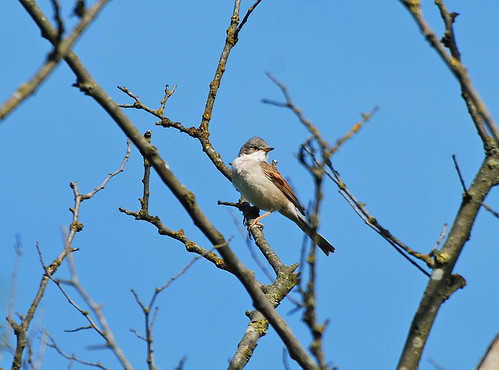
Common whitethroat male, Sylvia communis

There are two species of whitethroat to be found locally, the common and the lesser (Sylvia curruca). They are distinguished by their song, which I won’t try to describe because I’ve never yet read a book which gives the remotest idea of what birdsong actually sounds like by a written description! But if you want to compare them try here for the common whitethroat, and here for the lesser whitethroat.


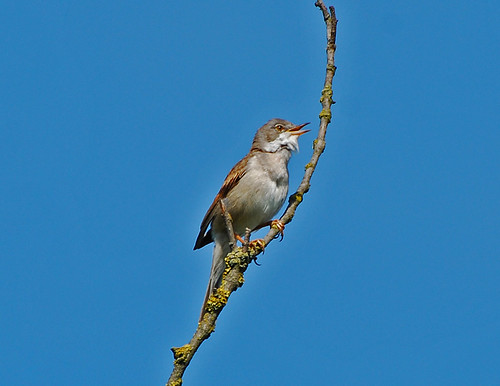
And another male whitethroat, this chap was singing long and loud, punctuated with characteristic jerky flights straight up in the air and back to the same spot

There are a good number of common whitethroat in the hedgerows north of Cambridge, lesser whitethroat are also here but are not so numerous. There are other distinguishing features between the two species, the lesser, as the name suggests is smaller (~11cm long compared to ~13 for the common), and is generally more grey with a pale grey head and noticeably darker grey ‘ear’ patches. It also has dark grey legs. Both species overwinter in sub-Saharan Africa, the common in central Africa and the lesser in eastern Africa.

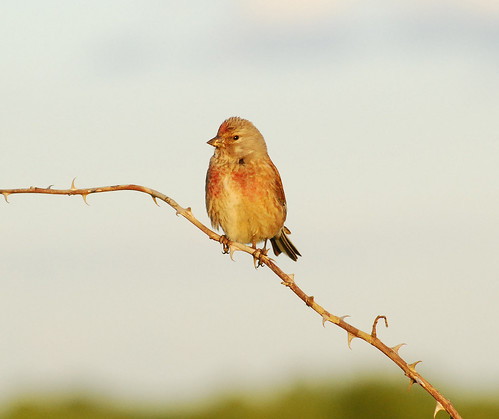
Linnet can be regularly seen flying around the bramble thickets on the edges of the village and perching and singing on top of them. On Saturday early in the morning a fracas was going on in an elderbery tree in Rowleys Meadow in Histon which ended when a jay was chased out of the tree by a family of linnet and a family of whitethroat. The jay alighted on an adjacent shed to suss out the lie of the land and contemplate another raid whilst the indignant songbirds dispersed into some scrub to hide. Eventually the jay decided to keep his powder dry and disappeared into a nearby wood. Jays, like other members of the crow family, will raid nests of smaller birds for eggs and chicks, so it’s a perilous business being a small bird with a family to rear.


A linnet male perching on a bramble. When they’re not protecting a nest I’ve managed to sneak within 15 feet of linnet perched like this.

Linnet, Carduelis cannabina, are abundant resident and migrant breeders, although their numbers, as with many of our songbirds, are declining, and they are also passage and winter visitors. Due to their declining numbers over the past 40 years or so their conservation status is red, indicating they are globally threatened. They are finches which live in open country and farmland and feed on seeds.

Many species of moths, butterflies, bees, flowers and a plethora of other creatures are all appearing as trhe seasons are progressing and there’s something new to see every week!

April birdwatch

The activities of the birds in my garden have changed significantly in the last 2-3 weeks. Until then I was seeing multiple blackbird, robin, starling, goldfinch, chaffinch, dunnock, blue tit, great tit, collared dove and house sparrow with less frequent visits by long tailed tit. Since then a pair of wood pigeon have virtually taken up residence in my back garden and hoover up all the bird food before the smaller species get a look in. There is still the occasional dunnock and blackbird on the ground and much less frequent visits by blue tit, robin, starling and chaffinch but the goldfinch have all but vacated. This is interesting because when I’m outside I regularly see and hear groups of goldfinch in the trees around the garden but something seems to be keeping them away from my feeder.

My friend Chris told me he had a songthrush rearing chicks in a nest in a tree in his garden and she fledged four youngsters last week, which is very early in the year, so hopefully she’ll fit in another brood this year. But his garden has been subject to the attentions of a sparrowhawk in recent months so he was worried it would catch the fledglings, but clever use of carefully placed hanging bamboo canes has successfully deterred the hawk and all four fledglings seem to have successfully flown the coop. Songthrush 4, sparrowhawk nil.

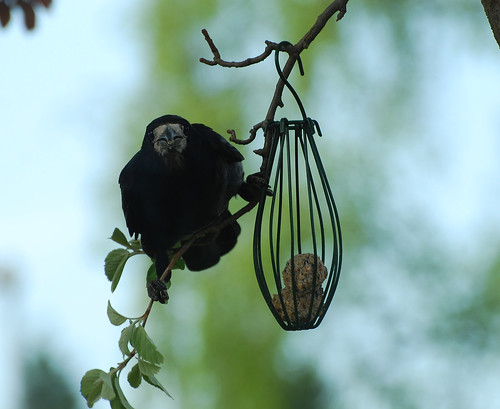
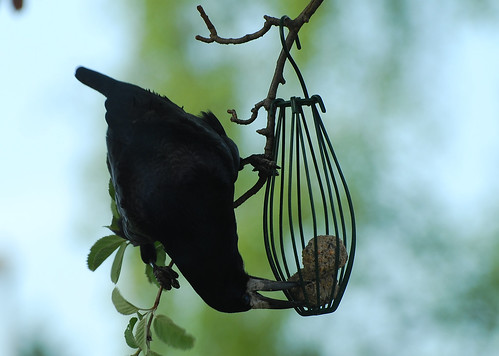
Continuing with garden birds, last week it occurred to me that the fat balls hanging in my front garden were requiring replenishment rather more frequently than usual so I guessed the nesting birds were feeding more often. The reason turned out to be rather more amusing:


One of the local rooks has worked out that these are edible…

…and that it can reach them. And it takes alot of fat ball to fill a hungry rook!

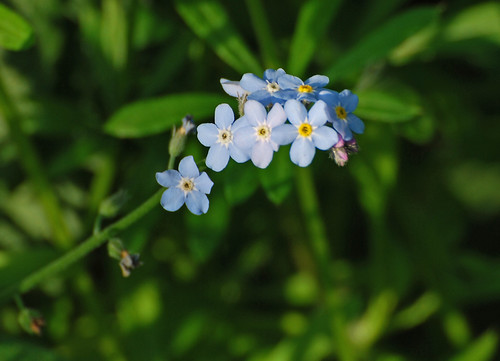
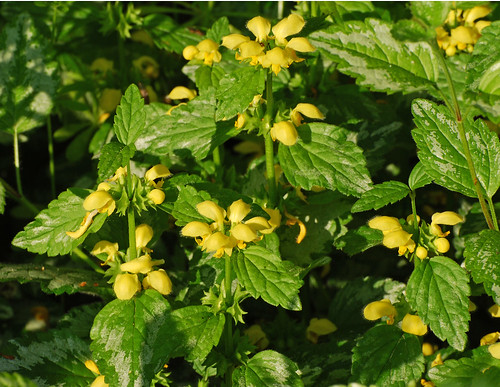
Slightly further afield in the hedgrows and scrub bordering the farmland around Histon it’s a very good time to survey the local wildlife. As I mentioned in a previous post many species of wild flower now including forget-me-not, yellow archangel…


Forget-me-not

Yellow archangel – Lamiastrum galeobdolon, this variegated version is an invading subspecies ‘argentatum’

…herb robert, cow parsley and periwinkle are all in bloom and lining the paths through the countryside filling them with a palette of colour.

And in the fields, trees and bushes there is an abundance of birdlife:


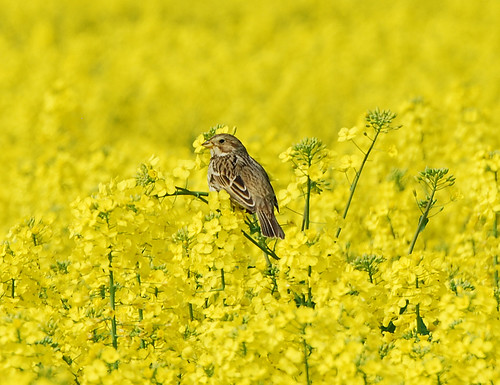
Corn bunting perched in the midst of a field of oil seed rape

The countryside is ablaze with the yellow of rape flowers right now and just occasionally a photographic opportunity such as this one arises. I’m not particularly keen on the vast swathes of rape but it created a lovely backdrop for this corn bunting which are becoming increasingly uncommon.

It’s not unusual to see and hear bullfinch in one patch of scrub near the church in Histon, which is a regular destination for my birdwatching outings. That makes me very happy because I used to see them all the time when I was a kid in the 1970’s but since the 80’s they seem to have been persecuted to near extinction in alot of the UK because of their fondness for the green shoots of commercial fruit trees. They are still fairly elusive but I managed to get this photograph of a male (just!):


Male bullfinch – the female has similar markings but they are not pink she is more pale grey/brown

And in the same field as the bullfinch linnet are in residence, as are willow warbler, chiffchaff and blackcap which have now returned from over wintering in Africa:


Blackcap male

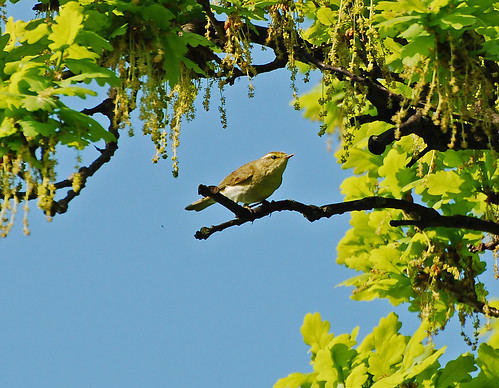
Chiffchaff

…as are whitethroat:


A female whitehroat, one of a pair patrolling a patch of brambles in the middle of the field

This field is an amazing place, I reckon it’s approximately 10-12 acres and it comprises several habitats including open-ish grass, it’s sorrounded by some old established trees: oak, ash and horse chestnut with hedgerow joining up the old trees consisting mainly of hawthorn and in the field itself there are alot of ash and other saplings and some large patches of bramble. Consequently it provides good supplies of food and cover for nesting for a number of different species. Green woodpeckers can be constantly heard yaffling to each other:

…and birds of prey including kestrel, sparrowhawk and buzzard are regularly in the skies above. The green woodpecker are there all year round and are usually hidden in the grass so I’ll flush one off the ground only for it to disappear into a tree too distant to allow a photograph. So this is about the best image I have of one. Most of the common or garden birds are regulars here too, house sparrow, dunnock, blue tit, great tit, long tailed tit:

…and chaffinch

…blackbird, songthrush, rook, crow and magpie are all present every day. So a small area of mixed scrub an the edge of the village supports a wonderful number of our birds.

There’s lots to see by simply look up in the village too. On the way back from the playground in Impington with my kids today we cycled along a road under a tree as a jay emerged from a silver birch on the other side of the road and landed in the tree a few metres over our heads. We all stopped to look at it and marvel at it’s amazing colours, and it looked at us for a minute or two before flapping off higher up the tree.

April in bloom

A walk along a hedgerow can be a particulalry rewarding experience just now. The trees are all in leaf and horse chestnut (Aesculus hippocastanum) trees are in bloom and hawthorn (Crataegus monogyna) is puntuating the hedgerows with gorgeous stretches of white flowers,


Willow warbler (Phylloscopus trochilus) beautifully fremed by hawthorn blossom on a sunny day in April

Wildflowers are also in bloom, and lining my walk routes this month are  cowslips (Primula veris):

…and white deadnettle (Lamium album)

The cowslip, a member of the Primula family which includes primrose and oxlip, are not as common as they used to be but occasionally a roadside verge or a bank or edge of a ditch will be swathed in yellow from their flowers. The cowslip could be confused with the similar oxlip but the flowers of the oxlip are more pale and more open, like those of a primrose. Until recent times it was used  to make wine and the garlands on Maypoles, and has been used medicinally to treat headaches, whooping cough and as a diuretic and expectorant.

Conversely, white deadnettle is much more common and can be found lining field edges, road verges and hedgerows. It flowers from March to December and the nectar is at the back of the flower so can only be fed on by larger insects such as bumble bees which can open up the flower to get to the nectar. It is known as a ‘deadnettle’ because its leaves resemble the stinging nettle but it can’t sting because it doesn’t have the stinging hairs. It is easily distinguished from the stinger by its flowers which are white or pink compared to the stinging nettle flowers which are small and green. It has historically been used in herbal remedies for catarrh and the young leaves and flowers can be eaten as a vegetable.

Many other flowers are blooming now such as the common-or-garden buttercup (Ranunclus acris), daisy (Bellis perennis) and dandelion (Taraxacum offficinale):


Dandelion flower, named from the French for ‘lions tooth’ – Dent de lion

Dandelion flowers heads are made up of many smaller florets and are open in the daytime but close up at night. The leaves have been used in salads in many countries either raw or blanched in boiling water to remove any bitter flavour, and the roots can be roasted and ground into a coffee-type drink. It has been used as a traditional remedy for urinary tract infections and as a diuretic.


A dandelion seedhead – a masterpice of natural architecture!

Cow parsley mallow and other wild flowers will all b e in full bloom on the near future and the flies and butterflies that depend on them will also be out and about.

Norsey Wood

Last weekend my wanderings took me to Norsey Wood on the  eastern edge of Billericay in Essex. The weather was sunny and warm so a stroll through this chunk of ancient woodland was compulsory. The wood is a lovely place and has a history dating back 4000 years. It is now a mixed coppice bluebell wood and in a month or so the floor will be completely blue. At the moment, the bluebell leaves are sprouting but no flowers are out but there are wood anemones (Anemone nemorosa):

Wood anemone flowers pointing at the sun

And lesser celandines (Ranunculus ficaria):

Wood anemones are interesting plants. They’re toxic and contain chemicals which have been used medicinally but which can cause some pretty unpleasant effects if ingested such as vomiting, diarrhoea and gastric bleeding. Best avoided. Despite that, a wood floor covered in them is a wonderful sight to behold. Lesser celandine are rather lovely too, with similarly interesting properties. According to its Wikipedia entry it has warty nodules which resemble haemarrhoids, so ancient law dictated it must therefore possess anti-haemorrhoidal properties. Bizarre logic, but you never know, maybe there was a grain of truth in it. It doesn’t mention how the active ingredient was applied though!

I saw a group of four jays squabbling in a tree but the woods were generally fairly quiet for birds on that day. The animal which was present in enormous abundance was the woodant, Formica rufa,


Wood ant worker – these are around 1cm long

The workers are all female and if attacked they have a ferocious bite and can spray formic acid from the rear of the abdomen. A loner wouldn’t trouble a human but disturbing a nest which may contain several hundred thousand would be ill advised.


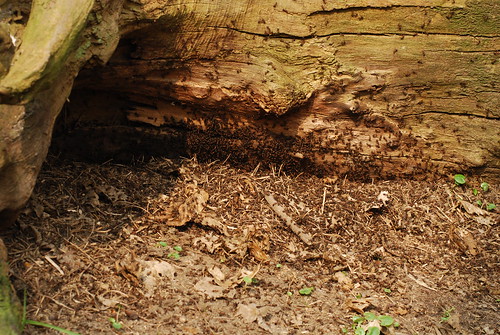
Thousands of woodants all busy around the entrance to the nest

They’re amazing creatures and build nests from plant material such as leaves and pine needles which can be a metre deep. As they act as an incubator and creche the temperature has to be very carefully controlled which is achieved by opening and closing vents to regulate airflow through the nest. So they’re fearsome warriors, highly competent parents and civil engineers too.

The organisation and division of labour amongst woodants is also remarkable. They have territories covering large areas and I’ve tracked them from a nest to a foraging site and the distance is many tens if not hundreds of meters which they negotiate in straight lines where possible and will clear away any debris which  blocks the way. Amazing creatures.

I’m hoping to make a trip to Norsey Wood in May when the bluebells are in bloom so I’ll hopefully post from there again later in the year.

Rotten borough, wonderful wildlife

I spent the last two days in Dunwich on the Suffolk coast. Dunwich and its surrounding countryside is a very interesting place from a political and natural history viewpoint. A paragraph about the political history first:

Until the Great Reform Act of 1832 Dunwich was classed as a ‘rotten borough‘, this was a parliamentary constituency with a very small number of voters for which the parliamentary seat could be bought and sold by wealthy patrons. Prior to 1286 Dunwich was the capital of East Anglia and a thriving sea port but in that year the first of several great tidal surges destroyed a large part of the town, sweeping it into the sea, reducing it to a small number of houses and therefore residents and voters. As a result of its earlier preeminence Dunwich had two parliamentary seats and despite it’s sudden demise retained these seats, with a very small number of voters, until the Great Reform Act was passed, (interestingly, it was his opposition to parliamentary reform which ended the premiership of the Duke of Wellington after he lost a vote of no confidence in November 1830). In the early 18th century the seat was held by Sir George Downing, 3rd baronet, whose grandfather (1st baronet) had built Downing Street in London. He was succeeded by his cousin, Sir Jacob Downing, who died childless and whose fortune was used to found Downing College, Cambridge, in 1800. An awful lot of history for a tiny village on the Suffolk coast.

Moving on to current natural history, the weather on the first day there was horrendous, rendering nature watching pretty much impossible. But on the second day the weather changed completely and was warm and sunny. The woods around the ruined friary were looking delightfully spring-like with snowdrops (Galanthus nivalis) covering the ground.


Snowdrops growing in profusion amongst moss covered dead wood from fallen branches around Greyfriars at Dunwich.

A pair of goldcrests were very busy feeding in a bush at the edge of the wood which was good to see as they are not a common sight during my regular walks around Cambridge. Heading to the beach to the north of the Friary a pied wagtail (Motacilla alba)  was bathing in a puddle:

And a flight of four mute swans (Cygnus olor) flew by, heading south towards the lakes at Minsmere RSPB reserve:

Later in the morning a walk in Dunwich Forest was eerie. It started in a pine plantation which was all but silent, no birds were singing and there were few other signs of wildlife. Leaving the plantation behind I entered mixed woodland which was still quiet but  more diverse, with a mixture of predominantly pine and silver birch trees (Betula pendula). Birds were singing here but not in the profusion I’d hope for. Many of the pines were exuding aromatic sap:


Sap oozing from a wound in the bark of a pine tree. This stuff was extremely sticky but had a gorgeously delicate scent of pine resin.

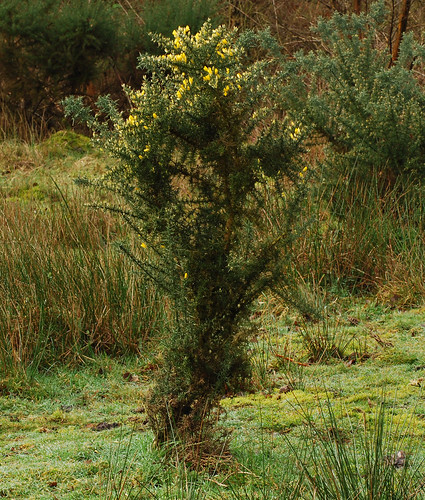
The exudate was running down the trunks for several feet and in some cases from multiple places on their trunks, the aroma on a warm spring morning was lovely. A mixture of the earthy smell of well rotted compost and pine trees. Gorse bushes (Ulex europaea) were in flower here too, adding the scent of mild coconut into the mix.

Gorse bush in flower

The ground under the trees was littered with dead wood and moss and numerous fungi including puffballs, parasitic birch brackets growing on live trees and other brackets growing on dead branches, most of which defy identification by anyone who doesn’t possess the requisite expert knowledge. Which, alas,  includes myself.

After the forest I ventured to Dunwich Heath, parking by the lighthouse at the top of the cliff where gangs of black headed gulls (Larus ridibundus) were wheeling around the carpark and magpies (Pica pica) were bouncing along the ground around the cars scavenging scraps discarded by picnicers making the most of the glorious spring weather.


Black headed gull looking for leftover crumbs in the carpark at Dunwich Heath lighthouse…

… and a magpie using a signpost as a vantage point.

Leaving the carpark I headed down towards the reedbeds which I skirted for several hundred metres. The habitat here is varied with the reedbeds, scrub woodland, heath and waterways.


Looking east over reedbeds at the sourthern edge of Dunwich Heath between the heath and RSPB Minsmere, the sea is a thin grey line in the distance.

Consequently I was hoping to see a diverse range of wildlife. There was evidence that otters are in residence and sheets of corrugated iron had been placed on cropped bracken presumably to provide shelter for reptiles such as adders, grass snakes and lizards. The sun was shining and I was  sheltered from the wind so the conditions for a stroll were nigh on perfect for a February afternoon and plenty of birdlife was to be seen. Wrens (Troglodytes troglodytes) were hopping around the undergrowth and a flock of around 40 lapwing (Vanellus vanellus) passed overhead whilst numerous blue tits (Cyanistes caerulius), great tits (Parus major) and chaffinch (Fringilla coelebs) were busy in the trees lining the path.


Cock chaffinch sitting high in a tree singing for a mate.

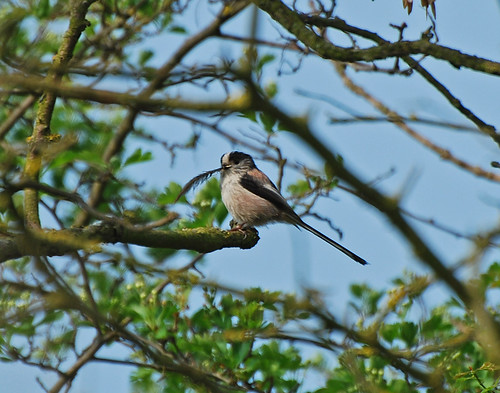
A single long tailed tit (Aegithalos caudatus) also flew by and landed very close allowing me to take some photographs:


Long tailed tit providing a rare opportunity to take some close-up pictures.

The area around Dunwich is a great place to see all kinds of wildlife, the Dingle reedbeds running north to Walberswick are the largest in England and there are large areas of heath and woodland and the salt water lagoons at Minsmere to the south all providing a huge area of diverse habitat. It is also ideally located for migrants from mainland Europe in the winter.

And right in the middle is The Ship Inn where you can get a pint of Adnams  beer to slake the thirst after a days walking. Dunwich is very high on my list of favourite places to explore.


Fungal foray

Now the weather has turned cooler and damper all types of fungi are appearing in fields and woods. As well as providing something fascinating to look at, and wondering if they’re safe to eat, they can be fairly challenging to photograph. They are often to be found lurking in long grass or in the undergrowth in a wood and getting down to ground level is usually a requirement for getting half decent pictures. Here are a couple I’ve taken in the last few weeks:

                   Amanita citrina

Fungi are extremely interesting from a biochemical viewpoint too. They sequester by-products of metabolism (secondary metabolites) leading to some properties which you need to be aware of before eating them. Whilst very few can kill you there can be unpleasant side effects lying in wait for the unwary e.g. members of the Coprinus genus, such as the shaggy ink cap, or lawyers wig (Coprinus comatus) which is very good to eat, contain a toxin called coprine which only makes its presence felt if eaten whilst drinking alcohol. It induces vomiting, and unfortunately it can do this for up to a week after eating the mushrooms. Drinkers beware!

Small quantities of Amanita phalloides, the aptly named death cap agaric, can be fatal, and it resembles some other edible species. It contains a toxin called phalloidin which destroys the liver… and there’s no antidote – to be avoided at all costs.

Other species are hallucinogenic, such as those containing psilocybin, magic mushrooms (those outfield cricketers staring at the ground might not simply be bored), and another Amanita species called the fly agaric (A. muscaria) which legend has it was eaten by the Vikings before going into battle, with well documented and fearsome results.

Panaeolina foenisecii is a small brown field mushroom growing gregariously in grassland which may also be hallucinogenic if eaten in large quantities.

                     Panaeolina foenisecii

Many species of small mushrooms can be found by simply walking through any grassy field at this time of year. But I think the really interesting ones are to be found in woodland growing as parasitic brackets, saprophytically feeding on dead material or symbiotically swapping nutrients with tree roots.

If you’re going to collect them to eat be cautious, most of them aren’t dangerous and alot make extremely good eating, but the bad ones can be deadly. I’m fascinated by fungi so I’ll probably post again in the near future about interesting species I come across.