Category Archives: Insects

The Isle of Wight, Part 2

My first view of the Needles, at the western tip of the Isle of Wight, was a long time ago when I flew round them in a light aircraft. The weather was much like it is below and it was quite a spectacle!

The Needles looking across to the Isle of Purbeck. Old Harry Rocks are the thin sliver of white chalk in the distance at 11 o’clock from the lighthouse

I’d heard it said that the Needles were at one time joined to the Old Harry Rocks at the southern end of Studland Bay, around 15 miles away on the Isle of Purbeck. I’d thought it entirely possible but never had it confirmed. And then just after I took this photograph I overheard a very knowledgeable old gentleman telling his companion all about the local geology, so I stood close by and earwigged the conservation.

As you can see, the Needles are made of limestone and apparently they were once a single strip of rock with a gap in the middle from which a single calcareous stack protruded, known as ‘The Needle‘. And then in the 18th century a storm caused a collapse which resulted in the Needles of today.

But before that, Old Harry and the Needles were a single limestone structure and the Isle of Wight wasn’t an Isle, and the Solent – the stretch of sea which separates the Isle of Wight from the mainland – was the River Solent. But around 4-5000 years ago a storm breached the limestone wall and the River Solent became a seaway overnight and the inhabitants of the Isle of Wight were cast adrift on a new island. And interestingly, all the rivers on the mainland from Poole Harbour in the west eastwards to Portsmouth: the Meon, Itchen, Test, Avon, Frome and Piddle all flow southward, and those on the Isle of Wight: the Eastern Yar, Western Yar, Newtown, Wootton Creek and Medina all flow northward, and they all drained into the River Solent.

Pyramidal orchid – Anacamptis pyramidalis

The terrain all around the Needles is chalk downland which has very characteristic flora and fauna, amongst which is the pyramidal orchid and this lone flower was lurking at the edge of The Needles carpark. It thrives on the chalk downs to such a degree that it has been chosen as the county flower of the Isle of Wight. In the air high over the car park was a peregrine falcon (Falco peregrinus, Dansk: vandrefalk) but I didn’t have a telephoto lens with me on this trip, so alas, no pictures. From the car park it’s about a mile to walk to The Needles themselves and on a sunny day it’s a terrific walk, the views are magnificent.

To the east, north and west the air was full of falcons, songbirds, bees and butterflies, and when we got to the very end there was a historic naval gun emplacement. In WWII the gun guarded the Solent and the strategically important ports of Poole, Southampton and Portsmouth against enemy shipping, and just over the top of the cliff from the gun emplacement was a test site for missile engines which had been hewn from the rock – a hangover from the Cold War. The whole thing was fascinating, geologically, biologically and historically!
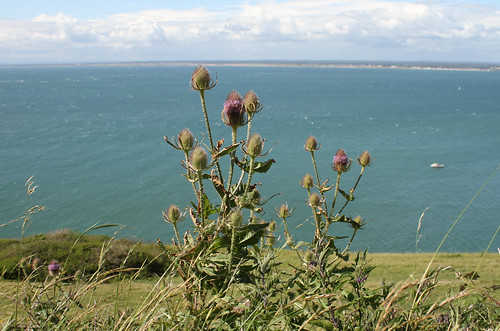
Teasels – Dipsacus fullonum

Whilst trying to photograph a stonechat which was darting around next to the path I noticed these teasels which were still sporting their downy purple flowers. I have lots of photographs of the dried out brown seedheads of teasels after they’ve flowered but but I’ve been after a good one of the flowers themselves. And I think this is the best backdrop I could have found, looking out across the Solent towards the New Forest on a sunny day.

Also flitting around in the chalky grassland were hundreds of chalkhill blue butterflies. It was a very windy day and I think the butterflies may have been staying down low becausse of the wind, preferring to be stationary rather than risk being blown away. Consequently they were fairly easy to get close to:

Chalkhill blue male (Lysandra coridon)

I absolutely love blue butterflies. In fact anything living and blue – insects, flowers, fish reptiles – blue seems to convey a unique beauty on a creature, so to see so many of these blues was a real pleasure. And the chalkhill blue is a big butterfly too, with a wingspan of 33-40mm.

One of the curious facts about blue butterflies is that some of them are actually brown, and with chalkhills as with common blues, the females are brown:
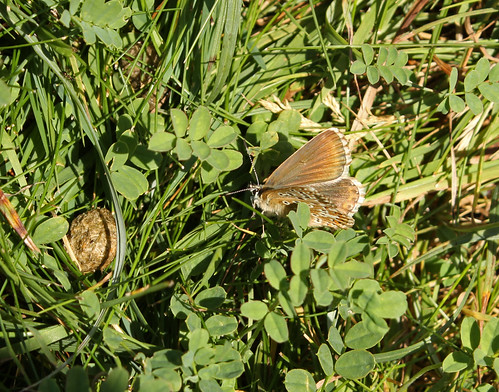
The female chalkhill blue. She’s brown, not blue, but still a beauty!
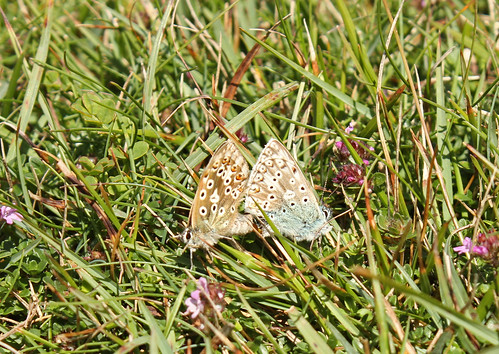
Chalkhill blues mating, the brown female is on the left

Apparently this year was a particularly good one for the chalkhill blue. Despite being a devastating one for most other butterfly species in the UK, there were huge numbers of breeding chalkhills recorded in their traditional territories, and in my humble opinion that’s very good news indeed.
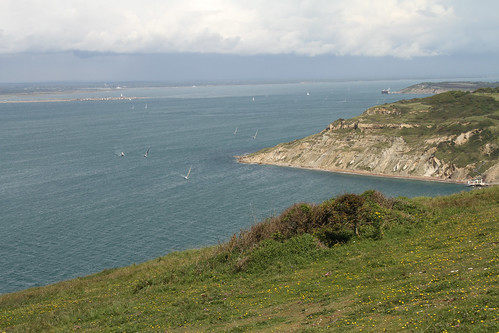
The view along the north of the island looking east towards Southampton, with yachts racing toward us

The geology of this part of the south coast is remarkable too. Limestone was formed at the bottom of oceans by the compaction of dead shellfish over millions of years, so it may seem odd to find it at the top of the cliffs. Or indeed whole cliffs made of it. There is a clue to how this happened in the cliff below, which is looking round to the southeast from The Needles, in which there are clearly delineated strata in the rock running upwards from left to right at around 45 degrees. The reason for angled strata is that in this part of the world tectonic shifts have concertinad the rock strata all the way from the east of England along the south coast as far as Dorset to the west forcing them upwards.
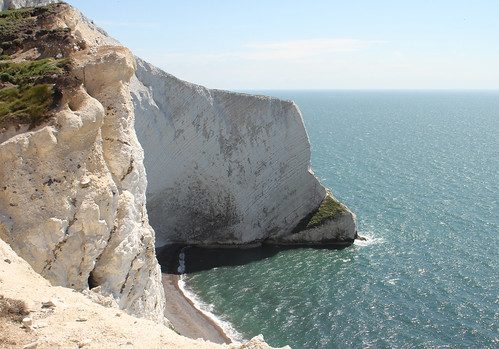
This folding of the rock means that in the east the rock is relatively young but the deepest, oldest, layers have been exposed in Dorset around the town of Lyme Regis. So the region around Lyme is referred to as the ‘Jurassic Coast’. Of which more in a subsequent post.

The Isle of Wight, Part 1

This summers holiday took myself and the family to the Isle of Wight. I’ve often sat on the mainland and gazed at the island wondering what it was like, but apart from a sailing weekend from Cowes some years ago I’d never been there. Prior to the trip, several folk I spoke to who had been there said, ‘It’s very nice, but very 1950’s’, implying that were a bad thing. I wasn’t entirely sure what it meant, so I set off expecting bakelite telephones, knobbly knee competitions and casual racism. But the reality was nothing like that, in fact the Isle of Wight turned out to be a lovely place, very green and full of cool wildlife.

Shanklin Bay looking over the garden of out holiday abode

Within a day of arriving at our destination at Shanklin, on the southeast corner of the island, we’d encountered a pair of ravens who were keen to share our fish and chips on the seafront, and several red squirrels running around the trees in the garden below our apartment. Red squirrels are delightful creatures and the island is one of the few places in the UK where they haven’t been ousted by the bigger and more aggressive North American grey squirrel. Unfortunately I wasn’t able to get photographs of these but there was plenty of other flora and fauna to keep me occupied.

The weather on the island during the first week in August was remarkable, it was hot and sunny virtually the whole time we were there, but that coincided with continuous heavy rain and big floods a short distance to the west in Devon and Cornwall. As well as the trees in the garden, there were flowers and butterflies basking in the glorious sunshine:

Wild pansy (Viola tricolor)

The wild pansy is a lovely little flower and has been used as a herbal remedy for eczema and asthma and it was believed it was good for the heart, hence its other name of ‘heartsease’. It’s laden with potentially beneficial chemicals including salicylates (aspirin), antibacterials and antiinflammatories and has many amusing common names such as ‘love lies bleeding’ (!), bullweed, ‘tickle my fancy’ and ‘love in idleness’.

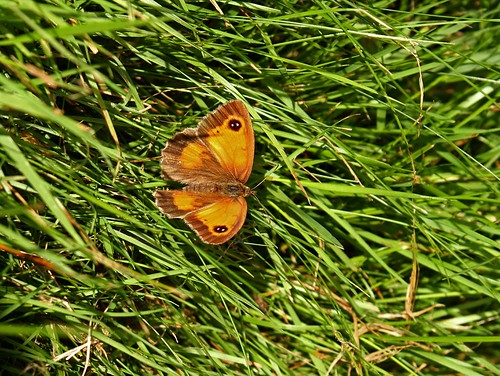
Gatekeeper

Also frequenting the garden was the equally beautifully coloured, but less poetically named, gatekeeper butterfly (Pyronia tithonus). I was pleased to see lots of butterflies here because the dreadful spring weather meant I’d seen very few around Cambridge, a horrid situation which, alas, prevailed for the rest of the summer.

Below the garden at the bottom of the cliff was lots and lots of beach with lots and lots of birds, including the ravens I mentioned earlier. And amongst them was this gull youngster. It wasn’t at all fazed by me and my son running around and seemed more curious than nervous.

A young gull – either a herring gull or a lesser black backed

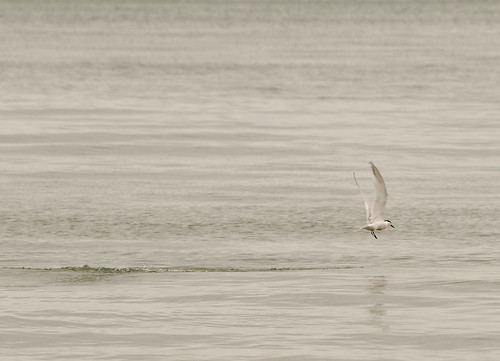
Alas, I’m not sufficiently knowledgeable about gulls to be able to differentiate the first year herring gull (Larus argentatus, Dansk: Sølvmåge) from the lesser black backed gull (Larus fuscus, Dansk: sildemåge), even with my Collins bird guide to assist. And while the gull was peering at us a sandwich tern patrolled the shallows occasionally diving into the water:

Sometimes returning to the surface with a fish… and other times not:

Sandwich tern (Sterna sandvicensis, Dansk: splitterne) fishing off Shanklin beach

From our limited explorations around the island it seemed to be quite distinctly in two halves. The eastern end, where we were based was green and agricultural with wide sandy beaches, and the western end, at least on the south side, was more chalk down rising to imposing cliffs toward the Needles at the far western tip. All the photographs in this post were from in and around Shanklin in the east and I’ve divided the IoW into two posts, so ‘Part 2’ will be from the western end.

Correction – Volucella zonaria

In my post ‘Backyard Safari‘ from September 15th I included this photograph of a magnificent hoverfly which I identified as Volucella inanis:

I subsequently received a comment from Roger Morris of the Hoverfly Recording Scheme (HRS) to let me know that I had incorrectly identified the fly and it is in fact Volucella zonaria. So thanks to Roger for putting me straight.

When it appeared in my garden I mistook it for a hornet, it’s our largest hoverfly and I’ve seen it described as a ‘hornet mimic’. The adults feed on flowers such as buddleia which may be why it appeared in my garden, and the larvae feed on the detritus which accumulates in the cavity at the bottom of wasp nests. It wasn’t recorded as resident in the UK until the 1940’s when it appeared around London and then spread across the south of England to the west country. It’s population is still most dense in the south east but it is regularly recorded in the east Midlands with occasional recordings in the northwest of the country.

Lunchtime nature walk

Several years ago I took a lunchtime walk around the lakes on the Science Park in Cambridge and the banks of one of the lakes to a depth of 5-10m was absolutely jumping with froglets. These little guys must have just emerged from the shallows en masse, there were literally 10’s of thousands of them and when I stood still it looked as though the grass was moving. It was an amazing sight.

I took another walk around the same lake this summer and the frogs were there again, not in anything like the numbers the first time I saw them, but big numbers nonetheless. They were the young of the common frog, Rana temporaria. Fortunately, this time I had a camera with me and I managed to get a picture of this little chap. As you can see, he was tiny, smaller than a clover leaf which was approximately 1cm across.


A tiny froglet seeking cover under a clover leaf


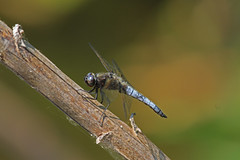
Scarce chaser in flight, reflected in the lake

The timing of my foray was just as the rains were subsiding and several species of darter, hawker and chaser dragonflies were busy hunting over the lakes, including this adult male scarce chaser, Libellula fulva. I’ve decided to try to photograph dragonflies in the act of doing soemthing other than sitting still and this the first shot I have of one flying. Not brilliant, but OK for a first attempt!

Because the Science Park is all neatly kempt and the grass cut regularly it’s not the best place to see wild flowers. So it was a pleasant surprise to see an orchid lurking in the undergrowth close to the lake where the blades of the grass cutters can’t reach.

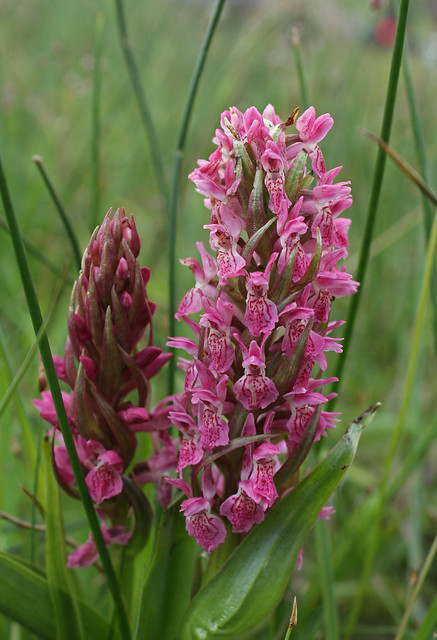
Common spotted orchid – Dactylorhiza fuchsii

I think of all orchids as being terribly exotic, but this little beauty is relatively common, as its name suggests. It’s found over nearly all of the UK and thrives on a wide range of habitats including marshy wetland, chalk downland and also colonises wasteland. It’s a favourite food source for day flying moths and gets its name from the purple spotted leaves which are clearly visible on this flower.

Histon wildlife

I’ve been meandering around the country over the summer so my local flora and fauna have been a tad neglected here. So here are a few of my favourite photographs from Histon.

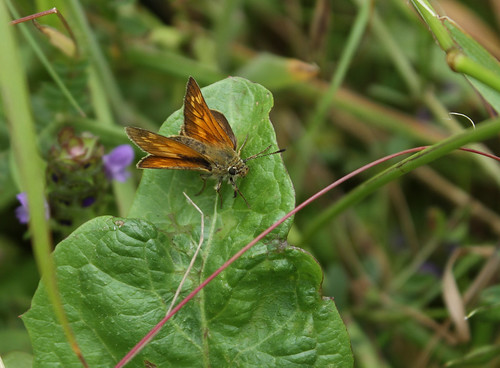
Wild flowers and grasses shot up to shoulder height in no time at all through the spring and into the summer and everywhere was lush and verdant, watered by the seemingly endless rain that started a few days after the hosepipe ban at the beginning of April, and carried on until early July. The rains were good for the greenery but not good for butterflies and other insects, so it was good to see the large skippers emerge at the end of June.


Large skipper  – Ochlodes faunus

The large skipper ususally emerges in June and July, so the earlier stages in its life cycle must be particularly well water-proofed to have survived the spring! The caterpillars feed on orchard grass (Dactylis glomerata) which is common in meadows and hedgerows, and the adults seek nectar from a range of flowers including birdsfoot trefoil, dandelion, yarrow and field scabius. All of these are common in my local fields which explains their annual presence around here.


Small skipper – Thymelicus sylvestris

Both the skippers here appear to be females, the genders are differentiated by the presence of ‘androconica‘ on the forewings of the males. These are lines of dark, specialised pheromone producing cells which appear to be absent on both these butterflies.


Field poppies – Papaver rhoeas

A journey through the countryside in July and August was a gorgeous sight this year due to the abundance of poppies. The red field poppy, also called the ‘Flanders poppy’ is, of course, the symbol of remembrance in the UK for the slain of the two World Wars. They seemed to be everywhere, and fields which would normally be plain green were a sea of red, and my local fields were no different. It transpired that this was also a consequence of the rains but not for the reason you may think. As well as watering the earth and creating good conditions for alot of plants the rain also washed away the herbicides used by the farmers to protect the monocultures we’re accustomed to seeing in the fields. Which shows how rapidly nature can regain lost territory when the opportunity arises.


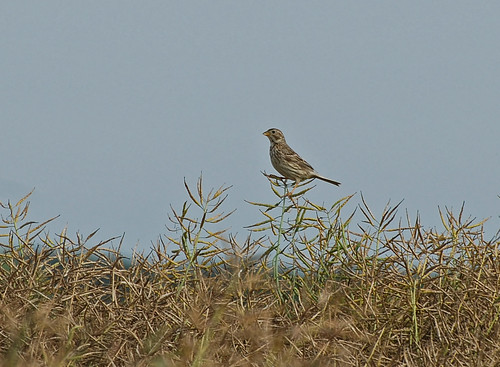
Corn bunting – Emberiza calandra

Another of my local fields was planted up with rape this year. I’ve previously disliked rape because it has a completely unnatural colour, and the smell is not too pleasant either. But since I’ve been getting close to it and seeing the variety of birdlife it supports I’m changing my mind. Not least because it plays host to corn bunting which are becoming increasingly uncommon due to loss of habitat. This rape field regularly had linnet, reed bunting and corn bunting feeding on the seedpods which are extremely rich in oil and therefore a good energy source for small songbirds.

Reed bunting male – Emberiza schoeniclus – perched on top of the mature rape plants resplendent with his black head and white collar

Skylark numbers have been dropping across the UK due to modern farming methods but I hope that my local patch is bucking the trend because year on year there always appear to be good numbers of them. The combined song of a multitude of skylarks as they slowly climb and then drop like a stone is one of natures wonders in my opinion, so it’s good to see them in the skies here.

Skylark – Alauda arvensis

Looking through my photographs for this year there has been alot to see but it seems it many species were scarce until July. Maybe that’s because the dreadful weather meant that I wasn’t looking quite so hard, but I think many natural phenomena were late this year due to climatic extremes. But many species eventually appeared so they are still out there. I’m hoping we now have a year of relatively normal weather from here on so the wildlife has a chance to recover.

Back yard safari

A couple of posts ago I described my Fenland safari and since then I just happened to have had my own ‘back garden safari’! Lots of colourful creatures have been stopping by to refuel.

I’ve previously expressed concern for the depleted populations of insects, in particular butterflies and dragonflies, due to the mad weather we’ve experienced in the UK this year, but in the last couple of weeks there have been some great sightings outside my back door.


Common darter (Sympetrium striolatum) female perched on the clothes line

The dragons have been late to appear but since the last week in August there have been common darters regularly alighting and migrant hawkers hunting overhead.

And of course it’s that time of year when the arachnids are most in evidence, and my garden is festooned with garden spiders, there are webs attached to every surface: walls, plants, windows… everywhere.

Garden spider female, Araneus diadematus, despatching her prey, a small fly

The female garden spider has a bulbous abdomen which is adorned with the fabulous diadem that gives the species its name. The male is smaller than the female and has a flatter, kite shaped, abdomen, but he also carries the diagnostic markings. A couple of years ago I posted about the perilous love life of the garden spider, suffice to say the sex life of the male can be dramatically and terminally curtailed if he fails to show the lady sufficient respect!


This garden spider male set up home inside the bedroom window – until  the resident arachnophobre found him and relocated him

As well as the spiders, the occasional cricket strolls by, and this little chap was taking shelter under a sunshade from the unseasonally hot weather last weekend:


Oak bush cricket – Meconema thalassinum – the male of the species. The female has a long, upturned ovipositor protruding from her rear

The oak bush cricket is quite a small example of the genre, they are 13-17mm long and are carnivorous, feeding on small insects. They live on the edge of woods and in gardens and appear from July into the Autumn.

Also putting in a welcome appearance was a common buzzard, Buteo buteo:

The buzzard has been one of the birds which has really bounced back since the more stringent controls on of agricultural pesticide use were introduced in the 1980’s. I’d never seen a buzzard until I was in my 20’s and even then it was the occasional sighting in the wilds of west Wales or down in Cornwall. But they can now be seen over all of England – even from my garden.

Hoverfly – Volucella inanis

Hoverfies rarely have common names, they’re simply known under the generic name ‘hoverfly’. And V. inanis is no exception, at least as far as my research reveals. There was great excitement when it first buzzed into the garden because at first glance we thought it was a hornet due to it’s size and its yellow and red colouration. And it was a whopper! They can grow up to 15mm long and this one was one of the bigger ones. It eventually settled and posed rather obligingly on the edge of the rabbit run while I snapped a portrait, and it is a very handsome fly. It has an interesting breeding tactic too laying its eggs in the nests of other social wasps, including hornets – which probably explains its size and colour scheme – where they hatch and feed on the larvae of the host.
Comma – Polygonia c-album

I waited expectantly for this comma to open its wings and show the gorgeously ragged orange symmetry, but it didn’t. So I had to content myself with this silhouette of it perched on a cooking apple.

Fenland safari

Wicken Fen is the largest remaining area of true fen in England and has survived because it has been conserved by encasing it in what is effectively a gigantic plastic bag. The earth on the Fen is waterlogged and if the bag weren’t there the water would simply drain away leaving very rich agricultural soils but none of the wildlife associated with fenland habitats. Another result of the water retention is that the Fen is 6-8 feet above the surrounding farmland and the earth literally shakes if you jump hard on the ground as it’s like a saturated sponge.

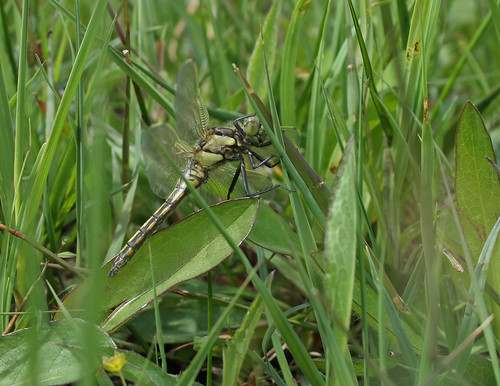
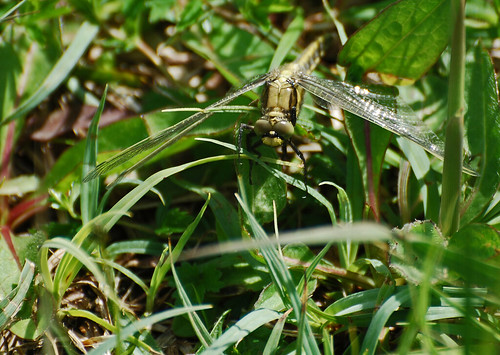
Because of the water the predominant habitats are reedbeds and waterways which is reflected in the wildlife. The Fen is so rich in wildlife that a hike around there is like a mini safari! I was there on a hot and sunny Sunday morning in June and wildlife of all sorts abounded. In particular the insects were very busy. This dragonfly had recently emerged from the larval stage as an adult and was sitting in the grass drying out before taking to the air.


Black tailed skimmer youngster preparing for it’s first flights

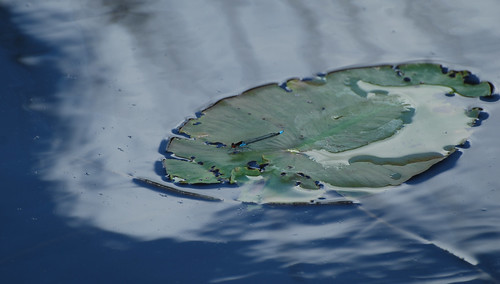
The young skimmer was on the edge of a path which ran alongside one of the lodes (man made water courses) and on the water opposite the skimmer were lily pads and sitting on one of them was a damselfly, warming itself up in the morning sunshine.


Red eyed damselfly (Erythromma najas) in beautiful repose on a lily pad, surrounded by reflections of the clouds

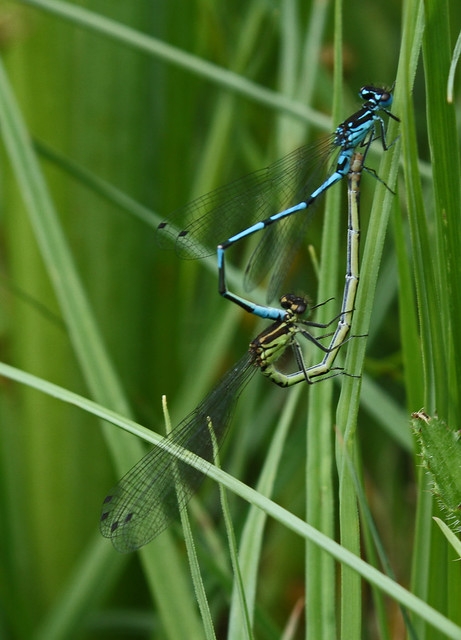
And of course, that time of year is the season for lurv for many creatures, including this pair of variable damseflies (Coenagrion pulchellum) which are in the process of mating. The male is the blue one and he is clasping the female by gripping the back of her head – the pronotum – whilst she has pressed her genitalia against his abdomen to receive the sperm.

As well the inscect diversity the unique habitat of the Fen is home to lots of beautiful plants and flowers, including this common spotted orchid. This orchid is indeed common and can be found in fens, marshes and other wetlands all over England, but is rare in Scotland. Common, or not, I think all orchids are spectacular flowers and it was really good to see them in such numbers on the Fen.

Common spotted orchid – Dactylorhiza fuchsi

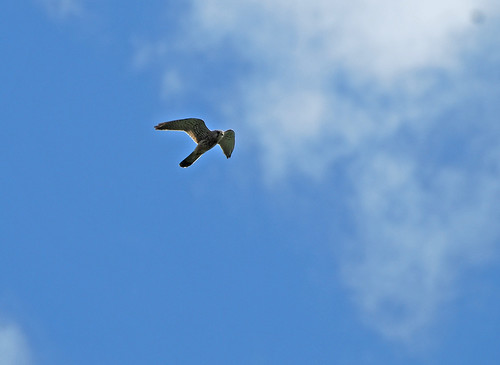
Whilst I was busying myself trying to get photogrpahs of the dragons and orchids a kestrel (Falco tinnunculus, Dansk: tårnfalk) was busy overhead. But even better than that a hobby (Falco subbuteo, Dansk: lærkefalk) was on the hunt for dragonflies and small birds.

The hobby is a small falcon which can be seen in these parts in the summer and hunts low over farmland and reedbeds at phenomenal speed. It’s one of very few predators that can hunt swallows and swifts in flight. This one was doing exactly that and in the distance, a few hundred metres away were at least another two. So I guess it was a family and the chicks had recently fledged and the adults were showing them the ropes. So I whiled away a good half an hour watching their breathtaking aerobatic exploits!


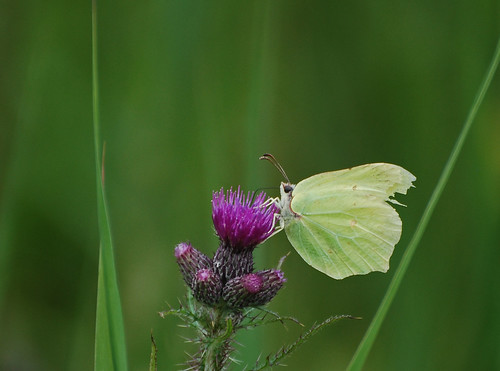
Brimstone butterfly sipping nectar from a thistle flower

I did volutary work at Wicken for 3 years or so back around the turn of the Millenium. It was incredibly rewarding and a good opportunity for a lab-based sedentary person such as myself to get outside and do some donkey work under the sky. One of the projects I worked on back then was scrub clearance to create an area suitable for butterflies to breed. I went and had a look at it on this walk for the first time since I helped to create it and it was very different. The scrub we cleared had been replaced by less scrubby, more proper woodland, trees, and there was small open glades with grasses and wild flowers. Whilst I was in there I flushed a leveret, which is about the closest I’ve ever been to a wild hare, it had been sitting tight but made a run for it when I got just a tad too close – about 5m!

So I didn’t manage a picture of the hare but I did manage a shot of the brimstone butterfly above (Gonepteryx rhamni), which I thought was absolutely lovely, sitting on the purple flower and framed by the two grass stems. It was terribly obliging and let me move all round it to get the best angle for a portrait. So this is about the best shot and one I’m very pleased with. I hope you like it too!

More wild flowers

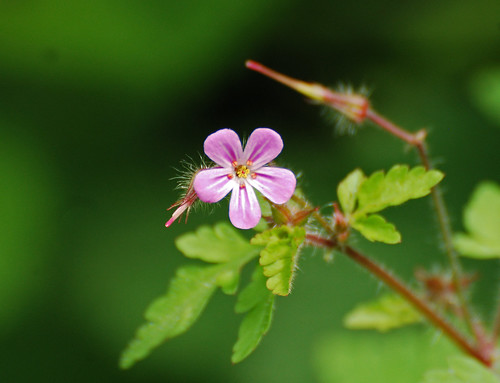
I keep seeing herb robert lining my route to work and in the hedgerows along my regular footpaths. It’s a member of the Geranium genus and is found in hedgerows, woods and on disturbed ground


Herb robert – Geranium robertianum

I’m a tad confused by this plant because it has all the normal attributes of herb robert; the pink flowers, leaf shape, hairy buds and stems, but this one has the same bud shape as a cranesbill and a quick web search hasn’t yielded another image of herb robert with seed pods shaped like this. (So if I’ve made a taxonomic error please let me know!). Herb robert smells quite unpleasant and has been used as an insect repellant.


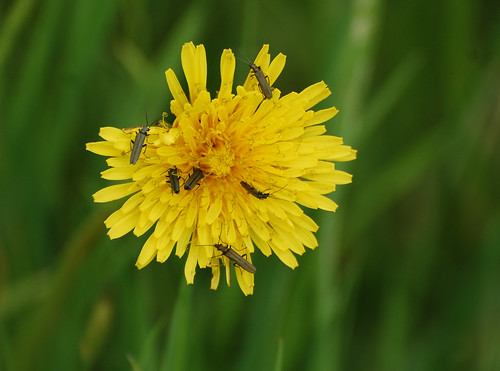
Dandelion – Taraxacum officinale

These pictures were taken a few weeks ago and at that time they were loaded with insect life, this danselion has six flower beetles (Oedemera nobilis) foraging on it, and it wasn’t at all unusual to see flowers in the meadow with this many bugs and more feeding on them.


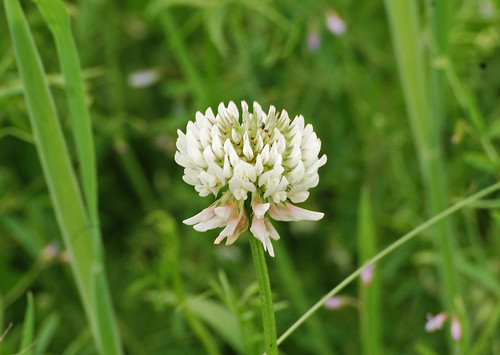
White clover – Trifolium repens

Clover grows abundantly in grassland. It is pollinated primarily by bumble bees but as bumble bee numbers decline it has become a major source of nectar for honey bees, therefore beekeepers became important people for cattle farmers who grow clover as a fodder crop for their livestock.

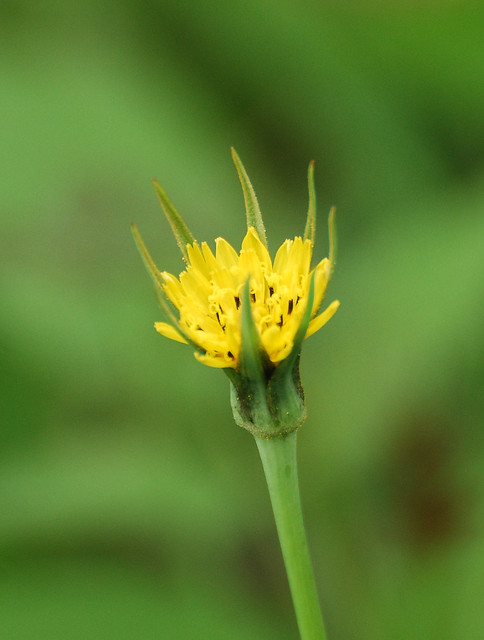
Jack go to bed at noon – Tragopogon pratensis

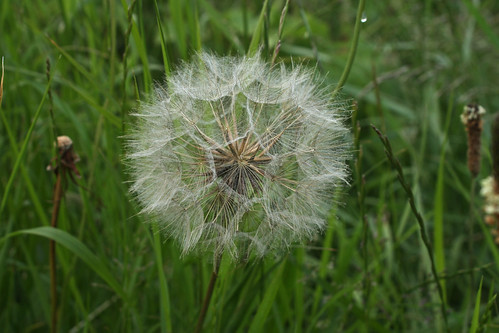
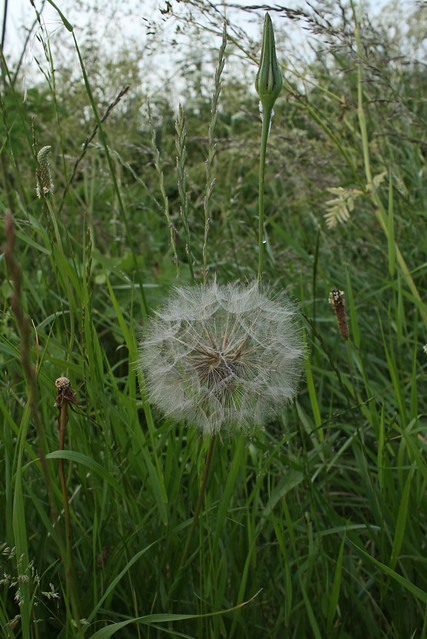
The lovely yellow star of ‘jack go to bed at noon’ is so named because the flowers open early in the morning and close up again at noon. It is also known as ‘goats beard’ and is a native annual in the UK. It has a milky latex sap which, according to Wiki, children from the countryside in Armenia make bubble gum from. It has a wonderful seedhead which is much bigger than than the dandelion and has fewer larger seeds.


Jack go to bed at noon seedhead

As with alot of other wild flowers, they are rampant just now because of the warm wet weather and are numerous in fallow fields and hedgerows.

A jack go to bed at noon seedhead with a closed flower behind it at the edge of a field

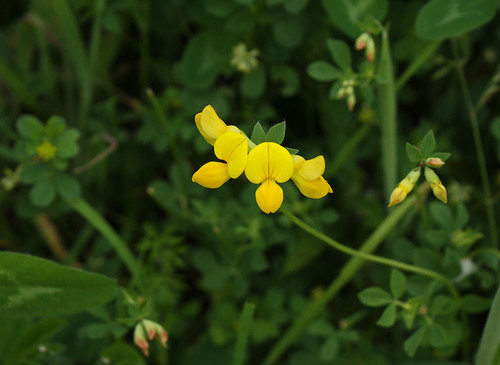
Also common around Cambridge right now is the birdsfoot trefoil. The flowers here are a gorgeous golden yellow but can also have red or orange which gives them their other common name: bacon and eggs.


Birdsfoot trefoil – Lotus corniculatus

Birdfoot trefoil is a legume which means it can actively fix nitrogen from the atmosphere. It can do this with the help of symbiotic bacteria which colonise root nodules and convert inert atmospheric nitrogen into ammonia, a form of nitrogen which plants can use. This ability makes the legumes a natural fertiliser because nitrogen is required by all plants, but unless they can fix it in this way they are reliant on alternative sources in the soil. Poor soil can be boosted by the application of other fertilisers such as good old fashioned manure, or more recently ‘NPK’ (Nitrogen/Phosphorus/Potassium, ‘K‘ being the chemical symbol for potassium). Or, when cycles of crop rotation are used, one of the crops used may be another legume, such as peas, which can help to replenish nitrogen levels in the soil naturally.

Damsels of Fen Drayton

One of the reasons for my trip to Fen Drayton a few weeks ago was to have a look to see which of our dragonflies were out and about. I went in early June and that time of year is a little early for the true dragons to have emerged, although it’s not impossible. But despite the shortage of the true dragons, the hedgerows and lake sides were abuzz with damselflies.


Male red-eyed damselfly – Erythromma najas

Dragonflies and damselfies are the two members of the taxonomic order ‘Odanata‘ or Odanates. There are two sub-orders within the Odanata: the Anisoptera – the true dragonflies, and Zygoptera – damselflies.

Azure damselfly – Coenagrion puella – the blue form of the immature female

Damselflies in the UK are approximately 4-5cm (1.5-2 inches) long and have thin abdomens and are all smaller and more delicate than the chunkier dragonflies. Having said that, the biggest living Odanate is currently a damselfly who resides in the rainforests of Central America, it has a wingspan of 19cm (7.5 inches) and the abdomen is 10cm (4 inches) long. A real whopper!

Blue tailed damselfly – Ischnura elegans – immature femaleBlue tailed damselfly – immature male – Ischnura elegans

Male and female Odanates, and immature and mature individuals, can often be distinguished by colour. The common blue female below is conspicuously brown so the species gets its name from the electric blue colour of the male. The common blue can easily be confused with the variable damselfly which is the same blue colour, but they are distinguished by the black markings on segment 2 of the abdomen which is shaped like a goblet on the variable and a club on the common blue. Also, the antehumoral stripes (on the side of the thorax) are complete on the common blue and broken on the variable. Although, as the name suggests, the variable is indeed variable and it can make distinguishing the two species a little tricky.


Common blue damselfly female – Enallagma cyathigerum – the only common blue we saw on this trip, perched on my friends finger

The black goblet on segment 2 is visible under the front of the wings on the variable damselfly below. But confusingly, it’s living up to its name because the antehumoral stripes are unbroken.

Male damselflies have two sets of paired claspers at the end of the abdomen which it uses to clasp the female on her pronotum, which is the protrusion in the middle of the back of the head. The claspers have tiny hooks on them which match grooves in the female pronotum and in order to avoid procreational mismatches the hooks and grooves are species specific.

Variable damselfly – Coenagrion pulchellum

In the picture above a variable male has clasped his lady by the pronotum. Male damselflies have primary genitalia at the end of the abdomen on the 8th segment, but in order for fertilisation to take place he needs to transfer a ‘spermatophore’ from the primary genitalia to the secondary genitalia on the second segment at the thoracic end of the abdomen. The female then curls round in to the ‘wheel’ position to transfer the sperm to her genitalia which are underneath her 8th abdominal segment.

A pair of variable damsels in the wheel position

All the Odanates are carnivores, and the larvae which hatch from eggs layed under water are ferocious carnivores, the larger ones will even take small fish! On one occasion last year while I was photographing large red damselflies (Pyrrhosoma  nymphula), a large hawker dragonfly (I think it was a migrant hawker, Aeshna mixta) which had been buzzing around higher up for several minutes suddenly dived down and caught one of my large red damsels. In a few seconds the migrant butchered it and ate it on the wing and the inedible bits of wing and leg were discarded and rained down around me.

Scarce chaser – an immature male

A lone Anisopteran, or ‘true’ dragon was spotted on this trip and it was an immature scarce chaser, Libellula fulva. He was a lovely mustard colour and he can be differentiated from the female by the colour of the thorax which is dark grey in the female, and from the male adult who is electric blue. He undergoes quite a transformation in transitioning from immature to adult.

Poison Parsley

Poison parsley is another name for hemlock. Hemlock originally attained notoriety around 2500 years ago when it was used to poison the Ancient Greek philosopher, Socrates. He was executed because his teachings were highly critical of the Athenian state and he was a thorn in the side of various high ranking Athenians. And in those days that tended to limit ones life expectancy.

Hemlock – Conium maculatum

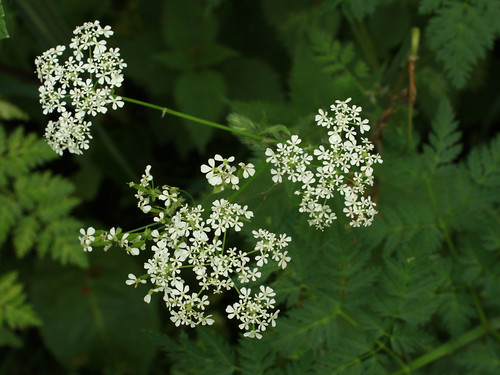
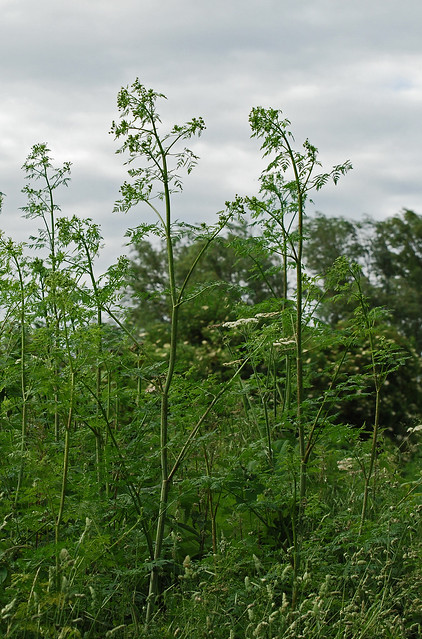
I hadn’t knowingly encountered hemlock until a couple of weekends ago when I was strolling around the RSPB reserve at Fen Drayton, where it was lining the hedgrows in some profusion. It is an imposing plant that was growing taller than me, up to around 2m, it has dark green feathery leaves and white flowers that resemble the hogweeds.


This plant was growing amongst hogweed and cow parsley, and it can appear fairly similar to both, to the uneducated eye.

A variable damselfy (Coenagrium pulchellum) warming itself in the early morning sunshine perched on a hemlock frond

The hogweeds used to provide fodder for pigs, hence the name, but giant hogweed is toxic to humans due to its sap which contains a type of chemical called a ‘furanocoumarin‘ that causes the skin to become sensitive to ultraviolet light. That can result in extremely unpleasant blistering of the skin and blindness if it gets in the eyes. Derivatives of furanocoumarins have been developed as drugs for the treatment of psoriasis.

But the hemlock toxin works in a different way. It is called ‘coniine‘ and the chemical name is 2-propylpiperidine:

I think this compound is remarkable because it is very small for a molecule which has such a specific and catastrophic effect. It exerts its effect by blocking a receptor for a neurotransmitter, acetylcholine, which resides on the membrane on the far side of nerve synapses. This results in a condition called ‘flaccid paralysis‘. Basically, the nerves which facilitate muscle contraction get blocked and stop firing. It starts in the feet and travels upwards, the muscles go floppy and that’s ultimately fatal when the effect reaches the heart and lungs. Socrates’ death was described by Plato and his last words were to his friend, Crito:

“Crito, we owe a rooster to Asclepius. Please, don’t forget to pay the debt.”

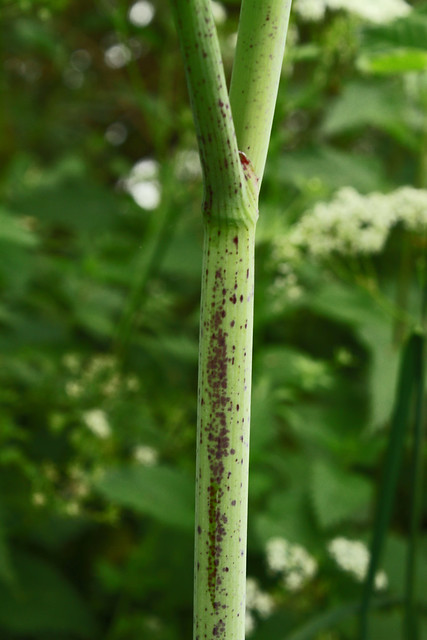
The smooth stem of the hemlock plant

The purple spots on the stem of the hemlock are diagnostic, other similar plants don’t have this, so if you see it, admire it, but don’t touch it! All parts of the plant are toxic and it doesn’t take much to have an effect.

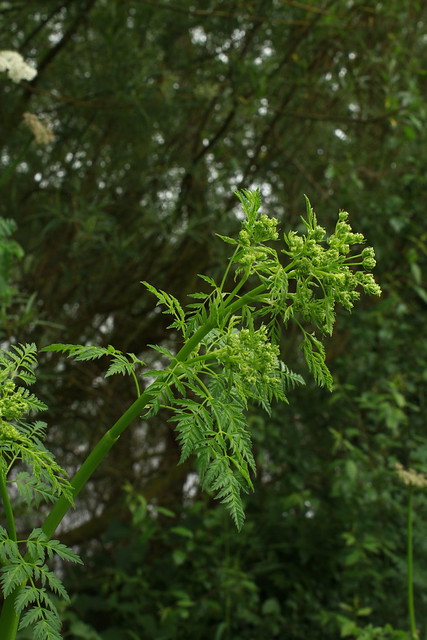
The flower head just before the white flowers emerge

Hemlock has a number of names according the the Royal Horticultural Society: California fern, cashes, herb bennet, Nebraska fern, poison hemlock, St Benedict’s herb, snakeweed, spotted hemlock, spotted parsley and winter fern. Also according to the RHS, its range is Europe only, but it has been introduced to the United States, hence the two names which include U.S. states.

Hemlock grows in damp poorly drained soils and is fed on by various insects including caterpillars and occurs in field borders and roadside verges aswell as along the lakes and ditches where I found it at Fen Drayton.