Category Archives: Songbirds

All the other garden birds…

In the last post I described the tits visiting my bird feeders. But of course they’re not the only species fattening up in the garden so this post is about the others. The berries and other food from the countryside are now becoming rather more scarce so greater numbers of more species are appearing.

One of the first to arrive, which has been around for a couple of months now, was my resident robin (Erithacus rubecula, Dansk: rødhals). Robins are fiercely territorial and this little guy being  no exception makes it clear that my garden is his manor, in fact it’s fair to say he’s a complete thug. He only picks on birds of a similar size or smaller and he won’t tolerate them for even a second. The two species he seems to dislike most are the dunnocks (Prunella modularis, Dansk jernspurv) and the coal tits (Periparus ater, Dansk: sortmejse) who have the temerity to enter his domain and he chases and beats them up remorselessly. Earlier this afternoon another robin turned up and I expected real fireworks as I’ve heard stories of rival robins fighting to the death and scalping each other! The fighting this time was restricted to a short chase and a bit of posturing and then it was all over, fortunately no injuries or fatalities were sustained.

A source of much concern this winter has been the absence of goldfinches (Carduelis carduelis, Dansk: stillits). I have a niger seed feeder for them which I keep full, but they ignored it until a few weeks ago, but even then there was only ever one or two making the occasional visit whereas previously they would be feeding there every day, often five or six at a time. And then a sparrowhawk (Accipiter nisus, Dansk: spurvehøg) attacked a goldfinch on the feeder and I didn’t see another one until a few days ago. I don’t know if the memory of the sparrowhawk was enough to keep them away but they have been conspicuous by their absence.

A lone goldfinch feeding on niger seed

There is a tall old tree 10 metres from my garden which I often see flocks of 20+ goldfinches in but they just don’t seem to want to drop down onto the feeder. Maybe if the weather turns icy they’ll alter their behaviour as food gets even more difficult to find.

Greenfinch (Carduelis chloris, Dansk:  grønirisk)

I’m always pleased to see greenfinches because they’re one of my favourite small birds and also because their numbers have been under threat from a nasty parasitic infection called ‘trichomonosis‘ which I posted about last year. So this little chap was very welcome. I was surprised to see him sitting on the niger seed feeder, but he wasn’t eating the seed, he was waiting for an opportunity to descend onto the seed tray which was already occupied.

The small birds usually have free access to the seed tray but occasionally it’s fully occupied by a pair of collared doves:
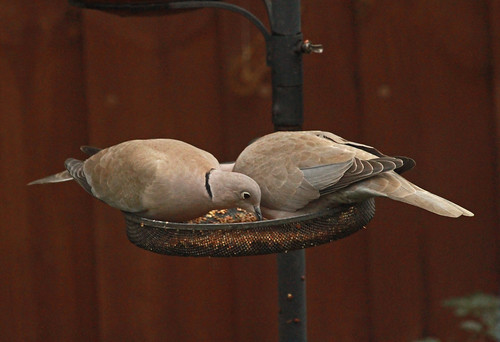
Collared dove (Streptopelia decaocto, Dansk: tyrkedue)

This was one of a pair and its partner was just out of shot further along the fence. A lot of folk seem to be very unimpressed by collared doves but I like having them around and I particularly like this guy with his feathers ruffled by the wind.

Previously I’ve been taking my close ups with a Nikon D40x and a Nikon 70-300mm zoom lens. This has been a really good combination, it’s small and light and therefore easily portable and has performed really well. But last year I bought a Canon 7D because I wanted to upgrade my camera body to one which is more robust and with more capability. I chose Canon rather than Nikon because the lens I thought most appropriate for what I needed was the 80-400mm telephoto zoom, but every review I read of it was that it was no good at all for wildlife photography because the autofocussing speed was much too slow. So I reckon Nikon missed a trick there because Canon have the 100-400mm L series telephoto zoom for around the same price as the Nikon lens which I decided to go for because it is supposed to be good for wildlife.


Wood pigeon (Columba palumbus, Dansk: ringdue) keeping the small songbirds away from the seed tray all by himself

All the photographs in this post except for the greenfinch were taken in murky conditions using my new Canon lens and I’m very pleased with the image quality. So now I’m looking forward to experimenting with it further afield. I’ll post the results as soon as I can.

Tits, tits, tits!

Coal, long tailed and great, that is, in case you were thinking the News of the World had reinvented itself in blog format! The reason I’ve dedicated a post to the tits is because they have been the most regular visitors to my feeders and on many days I’ve seen these four species there at the same time: blue tit (Cyanistes caeruleus, Dansk: blåmejse), great tit (Parus major, Dansk musvit), coal tit (Periparus ater, Dansk: sortmejse) and long tailed tit (Aegithalos caudatus, Dansk: halemejse).

Two factors combined to make photographing the songbirds in my garden considerably more challenging than is customary. Long periods of murky wet weather meant that the light was rarely optimal, and secondly, very few birds came to the garden at all up until November, and even then not in the numbers that have visited in previous years. I think the reason for that may have been the relative abundance of food in the countryside due to the mild and wet conditions that prevailed in the summer and autumn which gave rise to an abundance of blackberries, haws, sloes, hips and other berries. Then after November the birds started to reappear but the light didn’t improve so I took photographs at ISO settings of 1000-2000 to get the requisite shutter speeds, which is higher than I would normally use because of the higher background noise. Despite that I got some nice images:

Coal tit looking for a meal on a murky morningCoal tit looking for breakfast on a cold foggy morning

The coal tit is distinguishable at a glance by the prominent white stripe on the nape of its neck. They’ve been regular but infrequent visitors to my garden in other years but in the last couple of months they’ve been coming in ones and twos every day. The tits are not always easy to capture because they usually feed by grabbing a seed or nut and then flying into the cover of an adjacent bush to eat it. But just occasionally they linger for long enough, as this coal tit did. They prefer coniferous woodland in the breeding season where they feed on spiders and insects and in wintertime they are also prevalent in towns when they will also feed on seeds. Their conservation status is green, they’re resident breeders in the UK and can be found across Europe and Asia and in Africa too.

Long tailed tits disobeying the cardiologist!Two of a small flock of long tailed tits

As with coal tits, the long tailed tit is also immediately recognisable. Seeing one almost invariably means there are more close by. They fly from A to B one at a time, each following the previous one by half a second or so and are usually in small flocks of 10 or a dozen. I often hear them before I see them as they chatter to each other as they’re on the move. They like to feed on the fat balls I hang out, as do the other tits, and there can be 3 or 4 there at the same time with several more in the adjacent bushes, waiting their turn. They’re very charming little birds and I’m looking forward to them visiting on a bright sunny day so I can get some better images. Like coal tits they are also woodland birds, found across Eurasia they are resident breeders in the UK and their conservation status is green.

Great tit preparing himself to launch onto the seed tray

Great tits are probably the most regular partakers of the fare provided by my feeders, and that’s no bad thing, they’re handsome birds. There are a pair, male and female, feeding on seeds as I write, and they’ve just been joined by a pair of blue tits. The great tit is one of the birds that put the ‘song‘ in songbird, my Collins guide describes them as having a ‘rich repertoire’ and I’ve read they have around 70 different vocalisations, which suggests highly complex vocal communication for a small bird.

The male above has a chunk of peanut between his toes which he is pecking from. He is distinguishable from the female by the width of his black breast stripe which reaches as far as his legs, and the female below who has a very thin stripe which tapers downwards, is nibbling at a fat ball. In the depths of winter small birds need to spend most of the day feeding because the majority of their energy intake is used to maintain body temperature. Birds as small as a coal tit, which weighs 8-10g, therefore spend virtually all day feeding just to stay warm and they can die of hypothermia very quickly on a wintry morning if they don’t find food within a short time of waking up. So as us humans have destroyed so much natural habitat, our gardens and feeding stations are an essential lifeline for many species of birds.

Great tits also have green conservation status, numbering 2 million in summer 2000 according to the British Trust for Ornithology. Other species which have put in an appearance are the wren (Troglodytes troglodytes, Dansk: gærdesmutte), blackbird (Turdus merula, Dansk: solsort), dunnock (Prunella modularis, Dansk jernspurv) and a lone male blackcap (Sylvia atricapilla, Dansk: munk) flew through on one occasion – one of our eastern European overwintering blackcaps. Early one dark foggy morning as I was replenishing the feeders I caught a small movement out the corner of my eye so I glanced round without moving my head and a wren sat around 3 feet away watching me. When I finished I stood and watched him and he just waited for me to leave before grabbing some breakfast. I found out recently that wrens are our commonest bird, which really surprised me, but then they are adaptable and aren’t restricted to one particular habitat. It’s nice to see them flitting around the garden in their perpetual search for insects to see them through the winter.

(N.b. I source my bird feed from Vine House Farm. I wouldn’t normally do a free plug but I really like what these people do. They work together with the Wildlife Trusts and they farm the land to produce bird feed in the most wildlife-friendly way they can, and they publish a free newsletter to update on progress and news from the farm. Their feed is not always the cheapest but I’ve always found it to be very high quality.)

Passerines and Ponies

One weekend in the middle of July we took off down to the New Forest for a couple of days. The New Forest was originally a hunting forest for King William in the 12th century and 800 years later was eventually awarded National Park status in 2005. It lies along the south coast of England in Hampshire in a triangle delineated by Southampton, Salisbury and Bournemouth, and covers around 150 square miles, which in the context of southern England is a fairly sizable area. As the name suggests it consists of ancient forest which is interspersed with large areas of heathland and it’s renowned for its wildlife, being home to many less abundant species of birds, butterflies, mammals and reptiles.

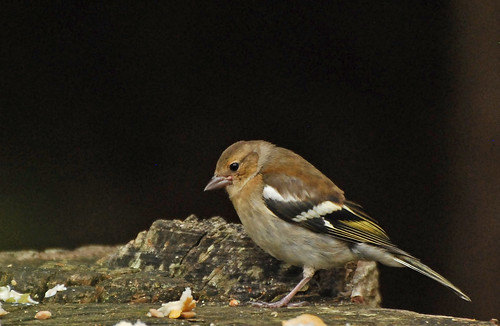
One day while we were there we found a secluded spot on the edge of Stoney Cross to eat our picnic. We parked the car adjacent to some woodland where the canopy was so dense it was nearly dark on the forest floor and impossible to see in. There were lots of small birds darting around and I could see that some of them were chaffinches, but there were others that it was simply too dark to see properly and identify. So when one of the kids had finished their sandwich and there was some left over I broke it up and put it on a rotting tree stump on the edge of the forest and sat in the boot of the car with my camera. Within seconds the stump was full of birdlife, and now I could see them properly most of them were chaffinch:

Hen chaffinch (Fringilla coelebs, Dansk: bogfinke) eyeing up a crusty morsel

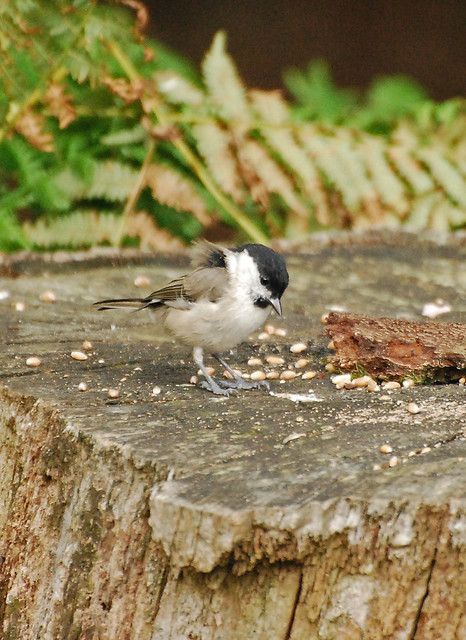
It was challenging photographically because it was starting to rain and as you can see above, looking into the forest it was very murky indeed, so I increased the ISO to 800 and hoped the shutter speed would be fast enough. Shortly after the chaffinch descended, there were great tits (Parus major, Dansk: sortemejse), marsh tits (Poecile palustris, Dansk: sumpmejse), a robin (Erithacus rubecula, Dansk: rødhals) and my favourite of them all:

Nuthatch (Sitta europaea, Dansk: Spætmejse)

I like nuthatch and I rarely get to see them. Occasionally my parents have one visiting their feeders in the winter but it’s a long time since I saw one in the wild, so this was a treat. And this one liked sausage roll:

The nuthatch is a woodland bird which nests in holes in deciduous trees and is the only bird I can think of which I have seen walking headfirst down a tree. The marsh tit is also a bird of dense deciduous woodland which nests in cavities in old and rotten trees, so it was no surprise to see either of them in this particular spot. But I can highly recommend taking an old baguette or sausage roll to entice them down out of the tree canopy to get a good view.

Marsh tit (Poecile palustris, Dansk: sumpmajse)

The most famous and charismatic residents of the New Forest are the wild ponies. They are common in the forest and can be seen wandering around the towns and villages:


My daughter making friends with a New Forest pony

We were standing on the terrace of an ice cream shop tucking into our soft-ices as a small herd of ponies sauntered down the road from the direction of the car, top left. They spotted us and three or four of them came up the slope to join us on the terrace and attempted to share our ice creams! They are completely wild but they’re accustomed to humans being about. But if you happen to be in the forest when a herd come thundering past at high speed it’s an alarming experience, as we found out shortly before this picture was taken. They came by around 25m away and a few minutes later came back even closer. I’ve stood on the rail at Cheltenham watching the Gold Cup as the horses come past on their way to the finish line, and it’s extremely exciting – but it’s a lot more exciting when there’s no rail and no jockeys to keep them in a straight line!

Flowers and foliage

The greatest thing about a sodden Springtime was the abundance of bloom that resulted. So I spent alot of time this year recording the wild flowers and foliage that flourished in the wake of the deluge.

Some years ago I attended a lecture in which the speaker said that due to modern farming methods which involve the use of mechanisation and toxic chemicals to create a sterile monoculture,  verges and drainage ditches have now become an invaluable seed bank where many of our wild flowers can still prevail. Without these unpolluted conduits criss-crossing the countryside the flora seeking refuge there would be even more threatened. This idea seems to be born out in my local area as the drainage ditches are indeed full of wild flowers year on year.

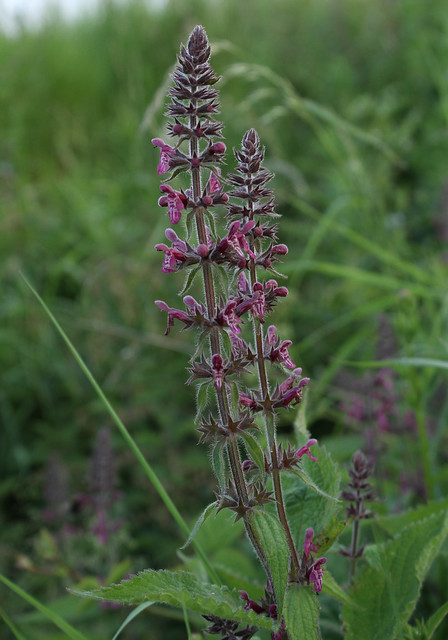
Hedge woundwort – Stachys sylvatica

Hedge woundwort has lined the field margins and ditches in greater abundance this year than in previous years, its delicate purple flowerheads, growing up to around a metre tall, poking  over the top of the ditches. It’s a lovely flower and it gets its name from its preference for hedgerows and because the crushed leaves were traditionally applied to wounds to stem bleeding.

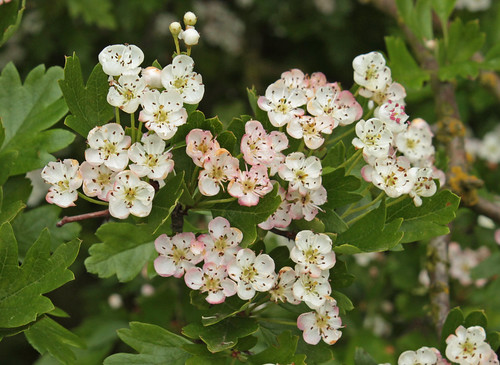
Hawthorn flowers lined all the hedgerows ealier in the year and heralded a glut of berries which are currently providing rich pickings for the birds, and will continue to do so well into the colder months.

Hawthorn blossom – Crataegus monogyna

The October 2012 edition of British Trust for Ornithology’s BirdTrack reveals that the migrant redwings (Turdus iliacus, Dansk: vindrossel) should be arriving here from Scandinavia any day now and will be followed closely by the fieldfare (Turdus pilaris, Dansk: sjagger), and the hedges fulls of haws will help to replenish their fat reserves after the migration across the North Sea. I think I saw my first redwing over Histon on Sunday, they have a characteristically undulating flight during which they fold back their wings and form a teardrop shape, which is what my sighting today was doing. So the fieldfare should be along soon too, according to the BTO.


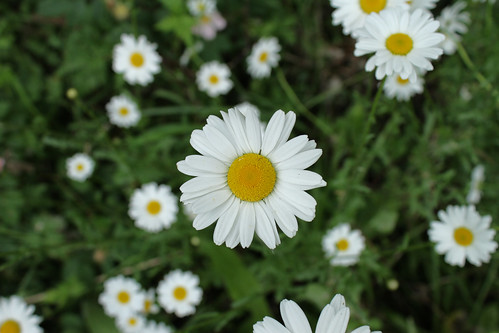
Oxeye daisy – Leucanthemum vulgare

Oxeye daisies are my Mother’s favourite flower and she has been pestering me to publish a picture of one. This year they lined my cycle route to work alongside the Cambridge Guided Busway in their thousands so I’m finally able to complete my commission. So, Ma, this one’s yours!

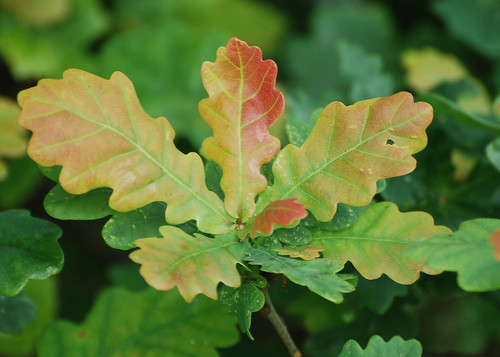
The wild flowers have been spectacular but the leaves and some of the trees have also been contributing their own splash of colour to the countryside such as the cluster of oak leaves below.

(Dramatic interlude: Wow, the first goldfinches (Carduelis carduelis Dansk: stillits) arrived on my niger seed feeder a couple of days ago after being absent through the summer and until a minute ago there was an adult and a late fledgling feeding there. I just caught a blurr out the corner of my eye as I was writing this post and looked up just in time to see a sparrowhawk (Accipiter nisus, Dansk: Spurvehøg) swoop through a gap in the buddleia bush next to the feeders, the goldfinches fled but it all happened too fast to see if the hawk was successful. It was all over in less than a second!)

Back to the oak leaves though, they were lovely colours, almost autumnal. Oak trees are amazing organisms, in fact they are substantially more than organisms, they are ecosystems in their own right. They live to be several centuries old and when coppiced or pollarded (pollarding is pruning back a tree to the top of the trunk to promote new branch growth, compared to coppicing which is pruning it back to ground level), but there are numerous examples of oaks living for 1000-1500 years. And they become home to hundreds of other species of fungi, lichens, insects, birds and mammals.


Oak leaf cluster – Quercus robur – the English oak

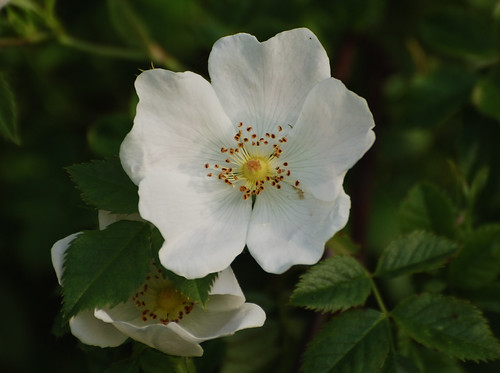
And right next to the oak was this gorgeous, delicate field rose. The field rose, Rosa arvensis, grows in hedges and has white to cream coloured flowers and lovely golden yellow anthers. It flowers later than the dog rose (Rosa canina) which has pink flowers and the leaves are smaller. Later in the autumn the flowers turn into bright red hips which provide food for birds as well as humans. When I was a kid we used to have rosehip syrup which was sweet and delicious and I’ve been toying with the idea of trying to make some. If I succeed in creating something pleasant I’ll post the recipe here.

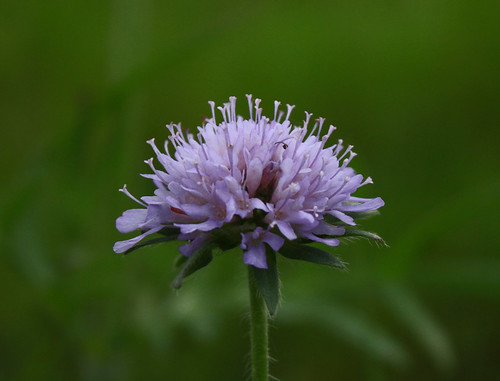
Without doubt my favourite wild flower is the field scabius (Knautia arvensis). I think they’re utterly beautiful and if I have a camera to hand I struggle to walk past one! Fortunately for me the field margins around here are replete with them so I’m rarely short of photographic opportunities.

The glorious flower of the field scabius

And from side on:

The hue of the flowers can vary from a pale pastel shade to quite dark purple. Each flower contains male stamens which can be seen protruding from this flower from between the female florets. The stamen consists of the filament (the stalk) and the anther (the pollen bearing part at the end of the filament). The stamens die back before the female florets mature in order to prevent self-fertilisation. Field scabius is named afer the German botanist Dr Knaut and has historically been used to treat skin ailments such as scabies and eczema.

Titchwell birds – the final episode

I’ve posted several times with pictures from my trip June to Titchwell on the north Norfolk coast but I’ve now exhausted my photo collection from that trip so this is the last one. There was a terrific number of bird species present the day I was there including ducks, waders, raptors, passerines and gulls, but the wildlife wasn’t confined to birds, a wall brown butterfly and a chinese water deer also putting in appearances.

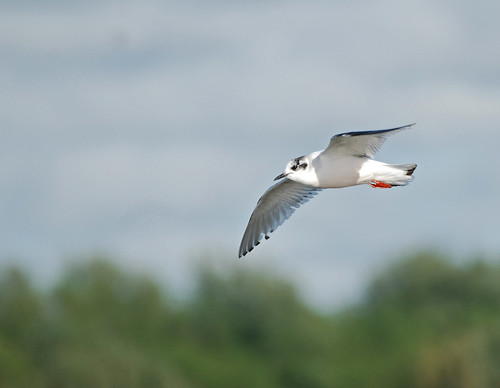
Gulls are many and often not-so-varied and can be easy to overlook: “What’s that bird?”, “Oh it’s just a gull”. But I like gulls and and it’s always good to have a new species identified and on this trip it was the little gull (Hydrocoloeus minutus, Dansk: dværgmåge). At first glance the little gull looks like a black headed gull, but it is noticeably smaller:


Little gull in winter colours – the summer plumage includes a completely black head

The other obvious difference between the two species is the colour of the beak which is black on the little gull and red on the black headed. It may also be mistaken for a tern as it swoops down on the water in a similar way to a tern but it’s not fishing it’s picking food from the surface of the water. I haven’t seen other gulls feed in this way.


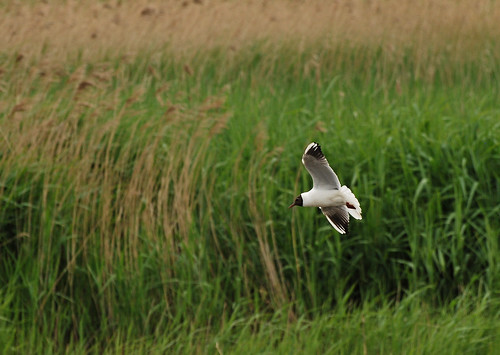
Black headed gull (Larus ridibundus, Dansk: hættemåge)

The black headed gull is common and I see large flocks of them feeding in the fields around Cambridge in the winter, unlike the little gull which is a rare breeder in the UK and a passage and winter visitor on it’s way to the Mediterranean.
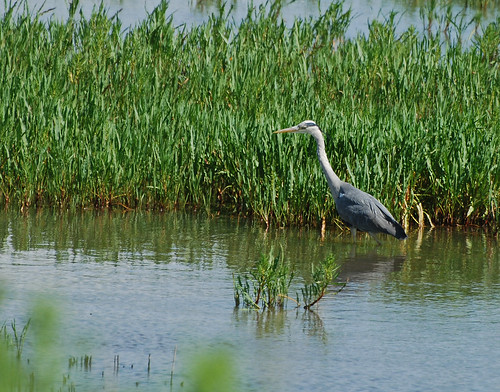
Grey heron (Ardea cinerea, Dansk: fiskehejre)

Stalking the shallows were several grey herons searching for fish and amphibians. The heron is a very effective predator unlike the pied wagtail perched just a few metres away serenading the comings and goings of serried ranks of twitchers passing to and from one of the hides:


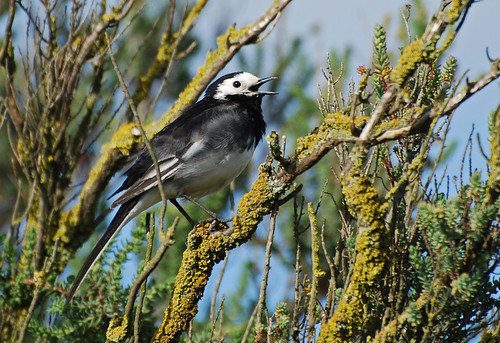
Pied wagtail (Motacilla alba, Dansk: hvid vipstjert)

This wagtail is an adult male, his colours are much darker and the black bib more extensive than the more delicately shaded female. The pied wagtail is a resident and migrant breeder and I regularly see them patrolling lawns, meadows and carparks with their characterisitic twitching tail.

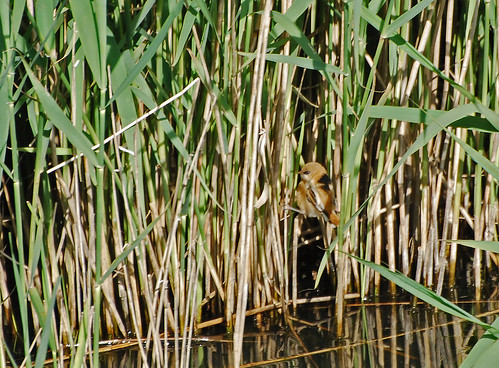
The one bird which I knew could be seen at Titchwell, but which I also knew was very elusive, so I didn’t really expect to catch a glimpse of it, was the bearded tit (Panurus biarmicus, Dansk: skægmejse). It’s one of those birds that I’ve seen pictures of and thought it almost looks unreal, like a childs drawing of an imaginary colourful songbird. A notion which seemed to be corroborated when I looked in my Collins field guide and it wasn’t listed! It transpires that it was listed, but as the ‘bearded reedling‘ instead of the ‘bearded tit‘, and it’s actually more closely related to the larks than the tits, to which it’s resemblance is only superficial. Despite the alternative name in my field guide it is listed on the British Trust for Ornithology ‘BirdFacts‘ website as the ‘bearded tit


Bearded tit juvenile

The bearded tit is resident in the UK but confined to the southern and eastern extremities. However, I did see some and even managed to get a photograph, albeit a not very good one(!). This one is a youngster, identified by the black eyestripe which differentiates it from the female, and the black patch on the nape which is absent in both adult genders. Of all the birds I saw on this visit the bearded tit (or reedling) was probably the highlight.

Histon wildlife

I’ve been meandering around the country over the summer so my local flora and fauna have been a tad neglected here. So here are a few of my favourite photographs from Histon.

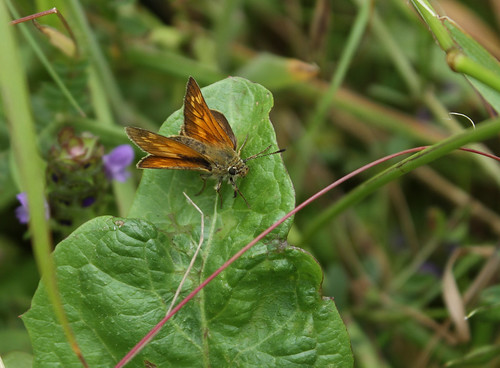
Wild flowers and grasses shot up to shoulder height in no time at all through the spring and into the summer and everywhere was lush and verdant, watered by the seemingly endless rain that started a few days after the hosepipe ban at the beginning of April, and carried on until early July. The rains were good for the greenery but not good for butterflies and other insects, so it was good to see the large skippers emerge at the end of June.

Large skipper  – Ochlodes faunus

The large skipper ususally emerges in June and July, so the earlier stages in its life cycle must be particularly well water-proofed to have survived the spring! The caterpillars feed on orchard grass (Dactylis glomerata) which is common in meadows and hedgerows, and the adults seek nectar from a range of flowers including birdsfoot trefoil, dandelion, yarrow and field scabius. All of these are common in my local fields which explains their annual presence around here.


Small skipper – Thymelicus sylvestris

Both the skippers here appear to be females, the genders are differentiated by the presence of ‘androconica‘ on the forewings of the males. These are lines of dark, specialised pheromone producing cells which appear to be absent on both these butterflies.


Field poppies – Papaver rhoeas

A journey through the countryside in July and August was a gorgeous sight this year due to the abundance of poppies. The red field poppy, also called the ‘Flanders poppy’ is, of course, the symbol of remembrance in the UK for the slain of the two World Wars. They seemed to be everywhere, and fields which would normally be plain green were a sea of red, and my local fields were no different. It transpired that this was also a consequence of the rains but not for the reason you may think. As well as watering the earth and creating good conditions for alot of plants the rain also washed away the herbicides used by the farmers to protect the monocultures we’re accustomed to seeing in the fields. Which shows how rapidly nature can regain lost territory when the opportunity arises.


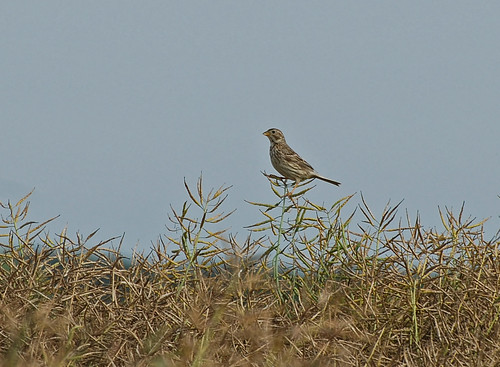
Corn bunting – Emberiza calandra

Another of my local fields was planted up with rape this year. I’ve previously disliked rape because it has a completely unnatural colour, and the smell is not too pleasant either. But since I’ve been getting close to it and seeing the variety of birdlife it supports I’m changing my mind. Not least because it plays host to corn bunting which are becoming increasingly uncommon due to loss of habitat. This rape field regularly had linnet, reed bunting and corn bunting feeding on the seedpods which are extremely rich in oil and therefore a good energy source for small songbirds.

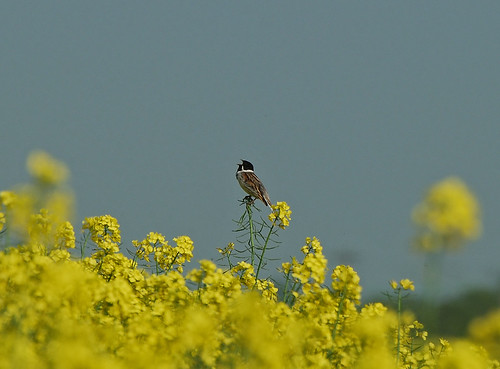
Reed bunting male – Emberiza schoeniclus – perched on top of the mature rape plants resplendent with his black head and white collar

Skylark numbers have been dropping across the UK due to modern farming methods but I hope that my local patch is bucking the trend because year on year there always appear to be good numbers of them. The combined song of a multitude of skylarks as they slowly climb and then drop like a stone is one of natures wonders in my opinion, so it’s good to see them in the skies here.

Skylark – Alauda arvensis

Looking through my photographs for this year there has been alot to see but it seems it many species were scarce until July. Maybe that’s because the dreadful weather meant that I wasn’t looking quite so hard, but I think many natural phenomena were late this year due to climatic extremes. But many species eventually appeared so they are still out there. I’m hoping we now have a year of relatively normal weather from here on so the wildlife has a chance to recover.

Wee brown birdies

In the brief intervals between howling gales and torrential rain in these parts we’ve had the occasional glimpse of sunshine, and in those moments I’ve managed to grab a few pictures of some small birds; those little ones that look small and brown at a distance and can defy attempts at identification.

I’ve been a little concerned at the small numbers of certain migrants which have returned to my local patch, in particular blackcap, yellow wagtail and whitethroat.


Common whitethroat – Sylvia communis, one of the few to return to the Meadow in 2012

Last year at this time I would expect to see 5-10 whitethroat during a circumnavigation of the Meadow but this year I hadn’t seen any until I spotted this one and his mate, last week, bringing food to the nest. I also found another pair which I think are nesting in a tree on the other side of the track to this pair, but I’m yet to confirm that. And I still haven’t seen a single blackcap or yellow wagtail in 2012. Hopefully they made a successful migration back here and are just elsewhere, but I do miss ’em, they liven up my walks with the dog.


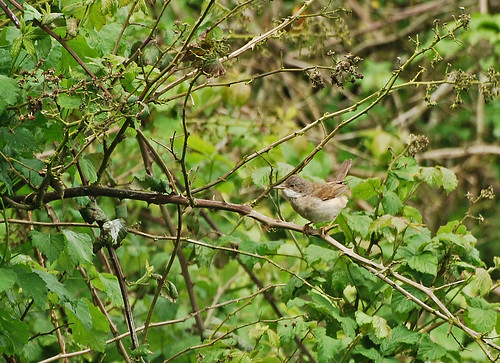
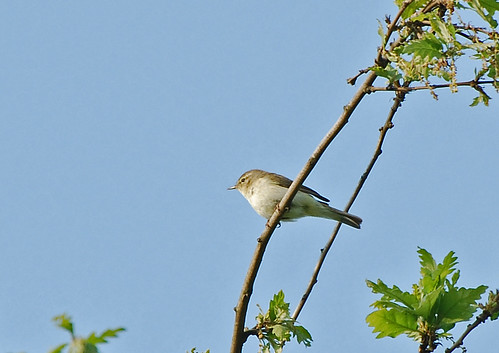
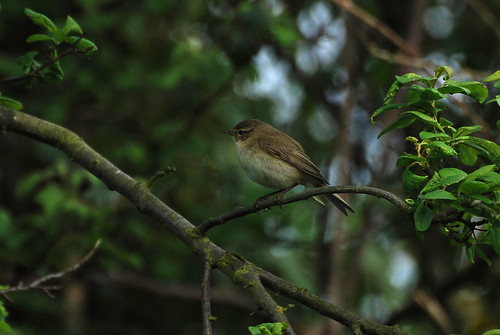
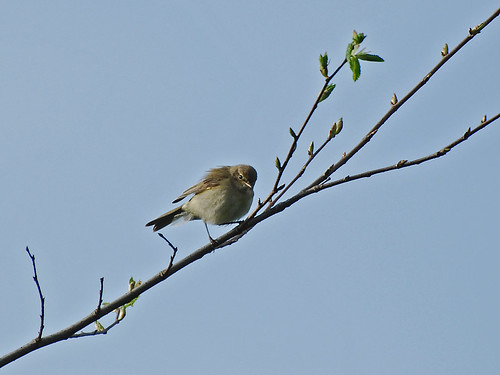
Chiffchaff – Phylloscopus collybita

A wandering warbler which has returned in numbers is the chiffchaff, and I hear them singing almost everywhere I go. This one was in a field here in Histon, and let me get close enough to take this picture, which is my favourite chiffchaff shot.

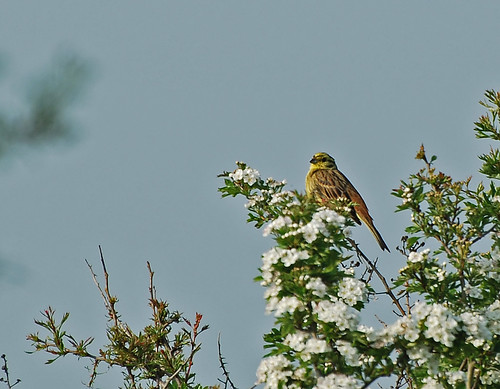
The rest of the birds in this posts are not migrants in the UK and I see them all year round. The yellowhammer is a bunting that has a very distinctive song, described in numerous field guides as ‘a-little-bit-of-bread-with-no-cheese‘. Which is a very good example of the pitfalls of trying to over-interpret birdsong! I was with my daughter when we saw (and heard) this one calling, and after telling her about the ‘little-bit-of-bread…’ thing we spent the rest of the walk thinking up alternatives. My favourite was ‘I’m-going-down-the-pub-for-a-beer‘.

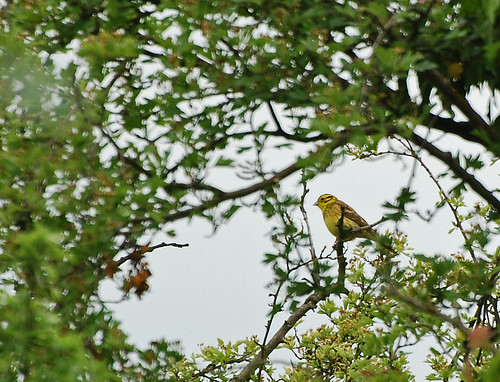
Yellowhammers – Emberiza citrinella

I was particularly pleased with the second yellowhammer picture because I like the out-of-focus foliage surrounding the focussed bird. I recently upgraded my DSLR to one with more sophisticated focussing capabilities than my ageing Nikon D40x, which all my pictures up to now have been taken with. And one of the main reasons was so I could focus more quickly on small birds in bushes, such as this one, where the foliage was moving around in the breeze causing the camera to struggle to find focus. This picture was taken with my D40x and I was surprised by how well it turned out, so maybe I’d have delayed upgrading if I’d captured this image first!


Reed bunting – Emberiza schoeniclus

Reed buntings are present in the local fields and hedgerows all year round and this little chap, for he is indeed a male, was singing long and loud perched on the top of the rape flowers. A circuit around this field is an ornothological treat, on one lap I’d expect to see several reed buntings, at least one or two corn bunting, lots of skylark and occasionally linnet and goldfinch. And on Saturday (9th June) there were two bullfinch, an adult male, resplendent in his black cap and peach breast, and a male youngster, the same colours but a tad smaller and with more muted colours, perched in a tree together on the edge of the field.


Dunnock – Prunella modularis

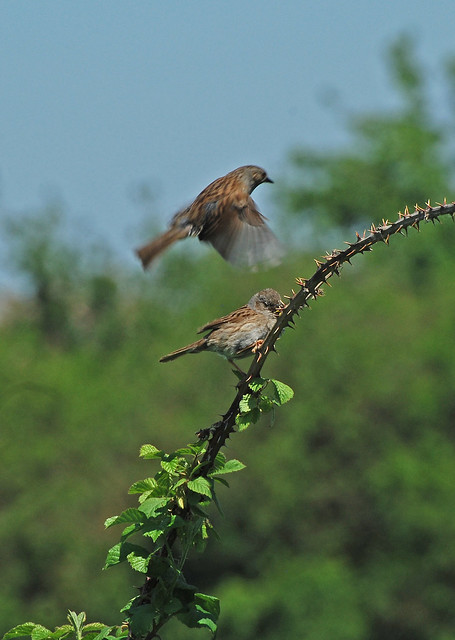
And my favourite little brown bird is the dunnock, which are also here all year round, and in the winter are regular visitors to my garden. These two were transporting food to the youngsters in the nest in the midst of a bramble thicket. Fortunately, despite the low numbers of migrants in my locality there are still enough birds around to liven up a walk in the countryside.

The chiffchaff and the willow warbler

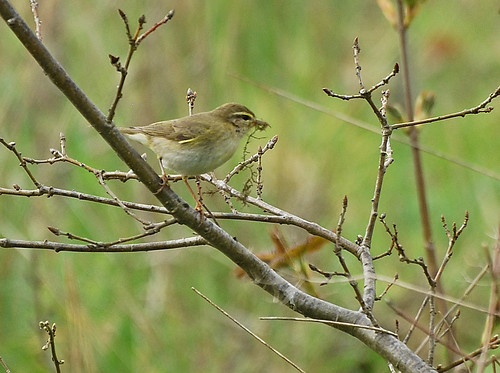
The chiffchaff and the willow warbler both members of the warbler or ‘Sylviidae‘ family. There are 63 members of the Sylviidae of which 14 species breed in the UK. They’re very similar to look at and can be pretty tricky to tell apart. Last week in my local meadow I came across both species in photographable locations so I  thought I’d try to show the differences. Both species are summer migrants to the UK having overwintered in Africa, the chiffchaff goes to the Mediterranean and some head south of the Sahara, and the willow warblers all  go down to tropical sub-Saharan Africa.

This publication from Birdlife International tells us that the global population of willow warblers is estimated to be between 300 million and 1.2 billion individuals, and a fact that blew my socks off was that the northern Siberian population overwinters in southern Africa, which is a journey of over 7000 miles or 11000 km… and back! And they’re only 19cm long and weigh 10g, so they may be tiny, but they’re incredibly tough. The chiffchaff is also a scarce winter visitor to the UK.

Willow warbler (Phylloscopus trochilus, Dansk: løvsanger) collecting nesting materialWillow warbler showing off her pink legs, bright supercilium and pale ear coverts

The willow warbler has longer primaries and the light stripe over the eye, the ‘supercilium‘ is brighter and more pronounced than that of the chiffchaff, and the ear coverts of the willow warbler (the patch under the eye) are a pale olive colour. The other visual diagnostic feature which is probably easiest to see at a glance is the leg colour, the willow warbler has pinkish brown legs whilst those of the chiffchaff are much darker, almost black.

Chiffchaff showing off its more subdued facial markings and overall colour scheme and the dark coloured legs

In the absence of a clear sighting the easiest way to differentiate between these two species is by their song: click here to hear the chiffchaff song, and here for the willow warbler song.

The conservation status of the chiffchaff is green and in 2000 there were around three quarters of a million territories in the UK, but the willow warbler is amber due to a decline in the breeding population, but despite that there were still two milion territories in 2000.

Returning songbirds

There’s a particular spot in my local meadow where there are some large clumps of brambles which are home to numerous species of bird including songthrush, blackbird, linnet and house sparrow. And in the summer chiffchaff, willow warbler, blackcap and common whitethroat are all there too. Chiffchaff have been here for a couple of months now, and willow warbler almost as long but I hadn’t yet seen a whitethroat, so I set off last Monday in the hope of seeing the first one of the year.

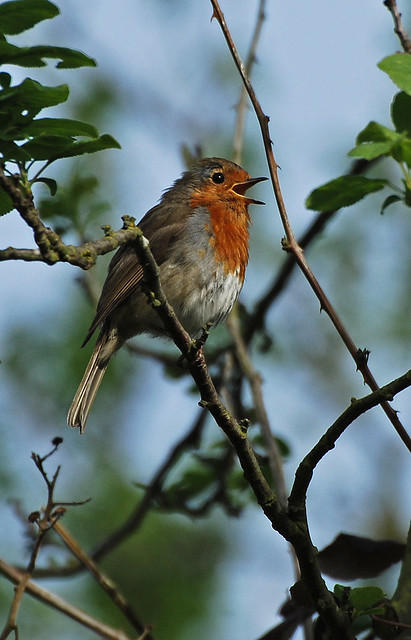
A cock robin singing to the ladies

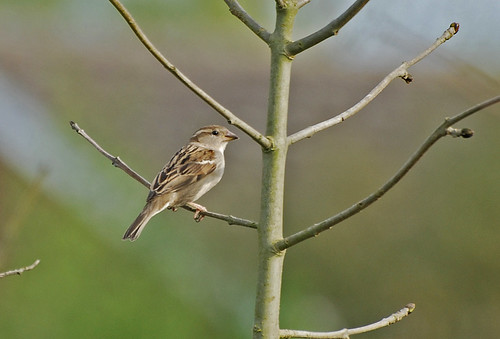
There were many species of songbird in the meadow including the robin (Erithacus rubecula: Dansk: rødhals) and the house sparrow (Passer domesticus, Dansk: gråspurv) and the air was alive with the song of all these species.


House sparrow female

Robin and house sparrow are resident species in the meadow and I see them all year round there, but not the chiffchaff:

The chiffchaff (Phylloscopus collybita Dansk: gransanger), which is a warbler, and willow warbler (Phylloscopus trochilus, Dansk: løvsanger) can be very difficult to tell apart if only seen at a glance, but they can be distinguished by their song, of which more in the next post. This chiffchaff was one of a pair which were calling to each other and flitting around the bushes passing within a few feet of me on several occasions and seemingly unfazed by my presence.

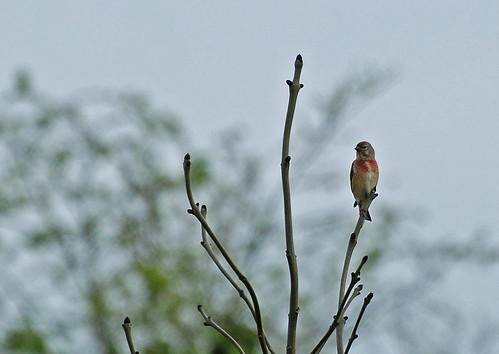
Cock linnet

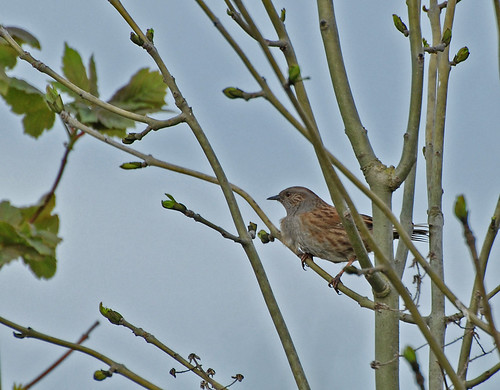
Resident in the UK is the linnet (Carduelis cannabina, Dansk: tornirisk), they disappear from the fields around Histon in the Autumn, presumably to congregate at a winter feeding ground, and they reappear in the Spring. And they have recently turned up in the meadow. Also resident, and present all year round, is the dunnock…


Dunnock, Prunella modularis, Dansk: jernspurv

… and the chaffinch:

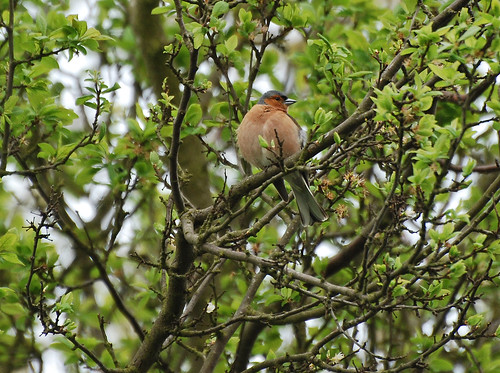
Cock chaffinch, Fringilla coelebs, Dansk: bogfinke

There were no whitethroat back in the meadow last Monday but as you can see there were plenty of other birds. In the last week I’ve also seen kestrel, sparrowhawk and buzzard, blackcap, green woodpecker, jay and magpie.

I recce’d the meadow again this weekend and the whitethroat are now back from wintering in Africa. They are very distinctive and both sexes are easily identified by their strikingly white throat, and the males display by singing from the top of a bramble thicket or a sapling and flit 4-5m vertically into the air and then descend to land in the same spot. They’re lovely little birds, with a very distinctive song, and I’ll hopefully have some pictures to show you in the near future.

Carduelis (or Chloris) chloris

A sound I hear frequently at the moment when I open a door or a window which stands out from all other birdcalls is the call of the male greenfinch. It’s quite variable in tone from fairly high pitched, as in the recording here, to lower pitched where it almost sounds like a whirring mechanical toy.

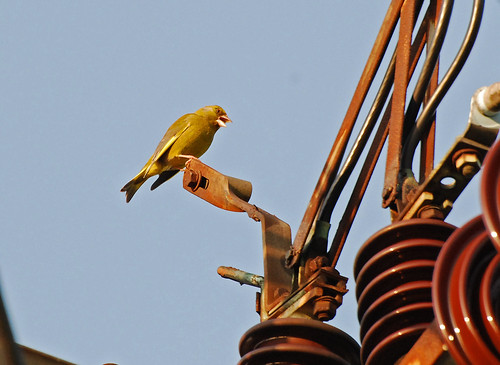
The bird in these pictures has a reddish hue to it because it was being lit by the evening sun as it was getting lower in the sky, and also from the reflected light of the rusty ironwork and insulators of the electricity supply cables:


Greenfinch male calling from the top of a telegraph pole

The female greenfinch is similar to the male but her colours are much more drab, she is darker grey/brown without the vibrant green of the male.

The greenfinch is a resident breeder in the UK and can be found in gardens and parks at all times of the year feeding on bigger seeds and sometimes insects when rearing youngsters. It has a chunky beak which is typical of finches and is custom built for cracking open seeds.

The taxonomic name for the greenfinch is listed in some references as ‘Carduelis chloris‘, as in my RSPB ‘Complete Birds of Britain and Europe’ by Rob Hume published in 2002, (RSPB – Royal Society for the protection of Birds) ISBN 0751373540, and also in the RSPB Bird Identifier website. But in the BTO BirdFacts website (BTO – British Trust for Ornithology) and in my Collins Bird Guide 2nd edition from 2010, ISBN 978 0 00 726726 2, it is listed as ‘Chloris chloris‘ (Dansk: grønirisk). Somewhat confusingly the BTO entry goes on to explain that the name derives from ‘carduelis‘ meaning ‘goldfinch’ and the Greek ‘khloros‘ meaning ‘green’. So it appears that the two names may be interchangeable. Incidentally, the chemical element chlorine also derives its name from khloros as it exists as a green gas.

He’s turned round to keep on eye on me – his seed-cracking beak clearly visible

The poor old greenfinch has taken a bit of a battering in the last few years since 2005 from the trichomonad parasite which causes a disease called trichomonosis. This microscopic parasite lives in the upper digestive tracts of several birds species including other finches, house sparrows (Passer domesticus, Dansk:  gråspurv) and pigeons and doves. I’ve heard that feeders may become contaminated by pigeons from where it infects the smaller birds. It’s particularly unpleasant (as are most parasitic infestations!) because it causes the throat to swell to the point where the birds can’t swallow so they eventually die of starvation.

Fortunately I’ve never seen any evidence of infected birds but if you think you may have a problem you can click here for the RSPB advice sheet which has details on how to identify the problem and how best to deal with it.