The Magnificent Mute

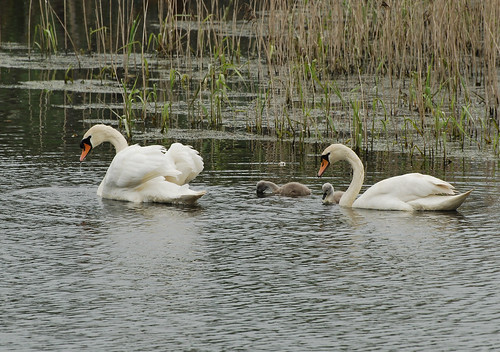
Mute swans are beautiful birds. There are few sights as impressive as a male mute, wings cocked, protecting his youngsters. The family below were on a very small lake at RSPB Fen Drayton and just before I took the pictures below, the male had launched a pre-emptive strike against a perceived threat at the other side of the lake, around 40m away. I couldn’t see who the interloper was but the sight and the sound of the big male as he raced across the lake, wings outstretched and beating on the water, must have been extremely intimidating. It was unnerving from where I was standing!


The male on the left is back with his brood after nullifying the threat. But he’s still got his wings cocked.

The mute (Cygnus olor, Dansk: knopsvane) is one of the biggest flying birds with a wingspan greater than two metres and an average weight for the male of approximately 11kg, it is a very impressive bird indeed and a group in the air flying close by is a real jaw dropper.

In the UK mute swans belong to the monarch and no one else is allowed to take them. They are marked every year, a practice that was originally identifying them  for the monarchs table, but I think Her Maj’s palate has evolved since then and eating swans is, fortunately, no longer fashionable.

It is native to the UK and a resident breeder but when things get too cold on mainland Europe winter migrants can show up here too. They tend to remain in their home territory all year round but can also form groups in the winter and move to a winter feeding ground, presumably this behaviour is driven by the temperature, availability of food and safety in numbers.

The ‘mute‘ in ‘mute swan’ is apparently derived from the fact that the mute swan is not as noisy as other swans. I’ve strayed too close to a nest before though, and at that moment mute was probably the last adjective to spring to mind as they voiced their discontent by making a violent hissing sound to warn me off. I took the hint and retreated as swiftly as possible.

Poison Parsley

Poison parsley is another name for hemlock. Hemlock originally attained notoriety around 2500 years ago when it was used to poison the Ancient Greek philosopher, Socrates. He was executed because his teachings were highly critical of the Athenian state and he was a thorn in the side of various high ranking Athenians. And in those days that tended to limit ones life expectancy.

Hemlock – Conium maculatum

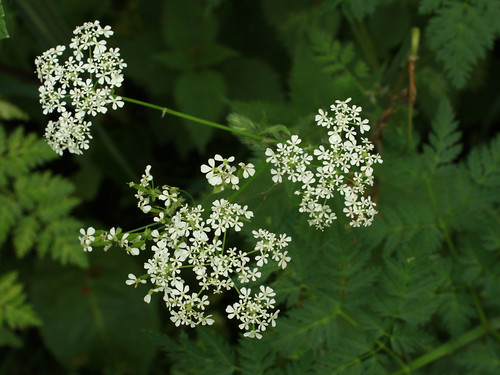
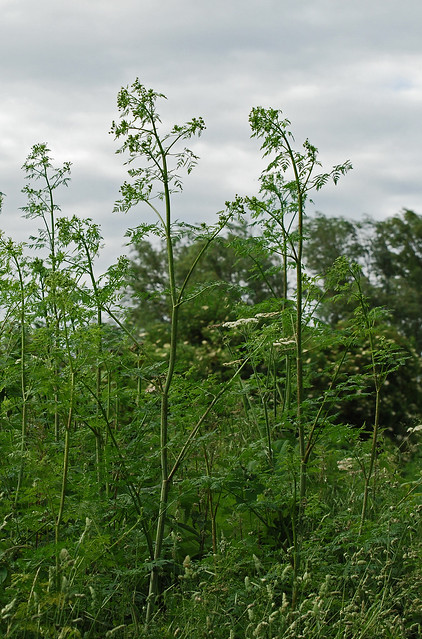
I hadn’t knowingly encountered hemlock until a couple of weekends ago when I was strolling around the RSPB reserve at Fen Drayton, where it was lining the hedgrows in some profusion. It is an imposing plant that was growing taller than me, up to around 2m, it has dark green feathery leaves and white flowers that resemble the hogweeds.


This plant was growing amongst hogweed and cow parsley, and it can appear fairly similar to both, to the uneducated eye.

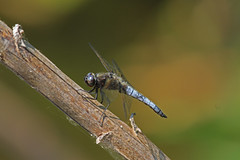
A variable damselfy (Coenagrium pulchellum) warming itself in the early morning sunshine perched on a hemlock frond

The hogweeds used to provide fodder for pigs, hence the name, but giant hogweed is toxic to humans due to its sap which contains a type of chemical called a ‘furanocoumarin‘ that causes the skin to become sensitive to ultraviolet light. That can result in extremely unpleasant blistering of the skin and blindness if it gets in the eyes. Derivatives of furanocoumarins have been developed as drugs for the treatment of psoriasis.

But the hemlock toxin works in a different way. It is called ‘coniine‘ and the chemical name is 2-propylpiperidine:

I think this compound is remarkable because it is very small for a molecule which has such a specific and catastrophic effect. It exerts its effect by blocking a receptor for a neurotransmitter, acetylcholine, which resides on the membrane on the far side of nerve synapses. This results in a condition called ‘flaccid paralysis‘. Basically, the nerves which facilitate muscle contraction get blocked and stop firing. It starts in the feet and travels upwards, the muscles go floppy and that’s ultimately fatal when the effect reaches the heart and lungs. Socrates’ death was described by Plato and his last words were to his friend, Crito:

“Crito, we owe a rooster to Asclepius. Please, don’t forget to pay the debt.”

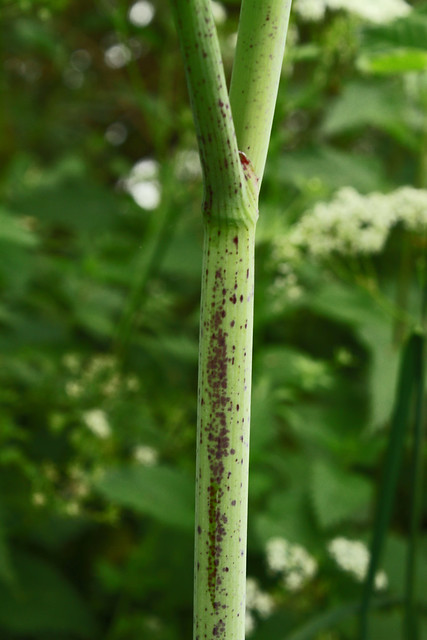
The smooth stem of the hemlock plant

The purple spots on the stem of the hemlock are diagnostic, other similar plants don’t have this, so if you see it, admire it, but don’t touch it! All parts of the plant are toxic and it doesn’t take much to have an effect.

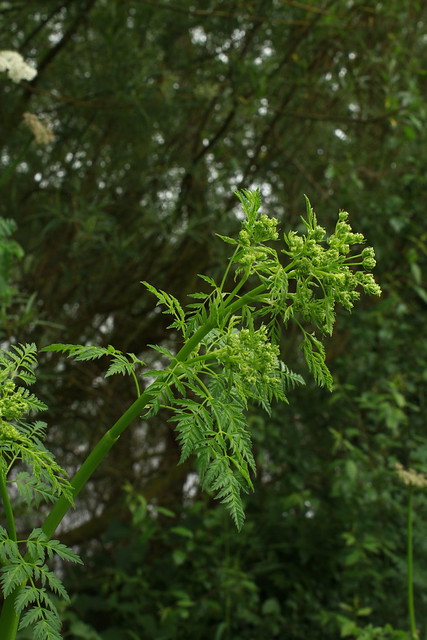
The flower head just before the white flowers emerge

Hemlock has a number of names according the the Royal Horticultural Society: California fern, cashes, herb bennet, Nebraska fern, poison hemlock, St Benedict’s herb, snakeweed, spotted hemlock, spotted parsley and winter fern. Also according to the RHS, its range is Europe only, but it has been introduced to the United States, hence the two names which include U.S. states.

Hemlock grows in damp poorly drained soils and is fed on by various insects including caterpillars and occurs in field borders and roadside verges aswell as along the lakes and ditches where I found it at Fen Drayton.

Wee brown birdies

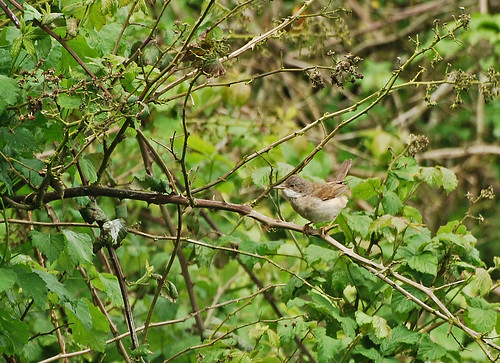
In the brief intervals between howling gales and torrential rain in these parts we’ve had the occasional glimpse of sunshine, and in those moments I’ve managed to grab a few pictures of some small birds; those little ones that look small and brown at a distance and can defy attempts at identification.

I’ve been a little concerned at the small numbers of certain migrants which have returned to my local patch, in particular blackcap, yellow wagtail and whitethroat.


Common whitethroat – Sylvia communis, one of the few to return to the Meadow in 2012

Last year at this time I would expect to see 5-10 whitethroat during a circumnavigation of the Meadow but this year I hadn’t seen any until I spotted this one and his mate, last week, bringing food to the nest. I also found another pair which I think are nesting in a tree on the other side of the track to this pair, but I’m yet to confirm that. And I still haven’t seen a single blackcap or yellow wagtail in 2012. Hopefully they made a successful migration back here and are just elsewhere, but I do miss ’em, they liven up my walks with the dog.


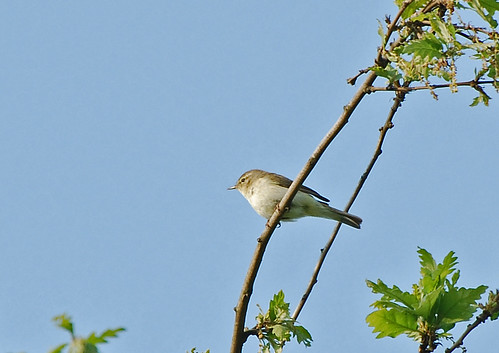
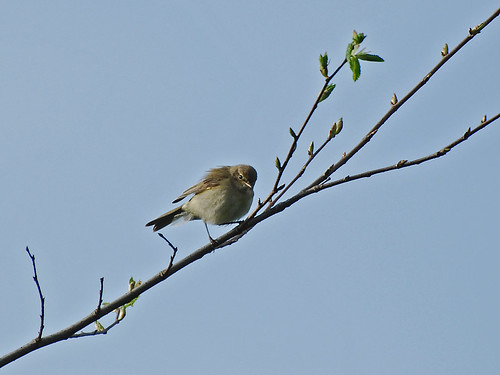
Chiffchaff – Phylloscopus collybita

A wandering warbler which has returned in numbers is the chiffchaff, and I hear them singing almost everywhere I go. This one was in a field here in Histon, and let me get close enough to take this picture, which is my favourite chiffchaff shot.

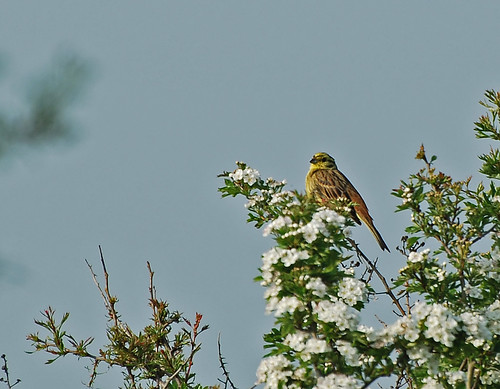
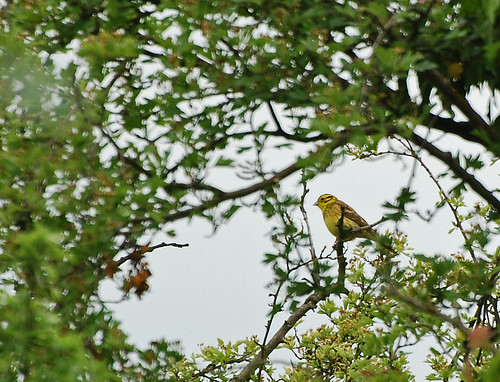
The rest of the birds in this posts are not migrants in the UK and I see them all year round. The yellowhammer is a bunting that has a very distinctive song, described in numerous field guides as ‘a-little-bit-of-bread-with-no-cheese‘. Which is a very good example of the pitfalls of trying to over-interpret birdsong! I was with my daughter when we saw (and heard) this one calling, and after telling her about the ‘little-bit-of-bread…’ thing we spent the rest of the walk thinking up alternatives. My favourite was ‘I’m-going-down-the-pub-for-a-beer‘.

Yellowhammers – Emberiza citrinella

I was particularly pleased with the second yellowhammer picture because I like the out-of-focus foliage surrounding the focussed bird. I recently upgraded my DSLR to one with more sophisticated focussing capabilities than my ageing Nikon D40x, which all my pictures up to now have been taken with. And one of the main reasons was so I could focus more quickly on small birds in bushes, such as this one, where the foliage was moving around in the breeze causing the camera to struggle to find focus. This picture was taken with my D40x and I was surprised by how well it turned out, so maybe I’d have delayed upgrading if I’d captured this image first!


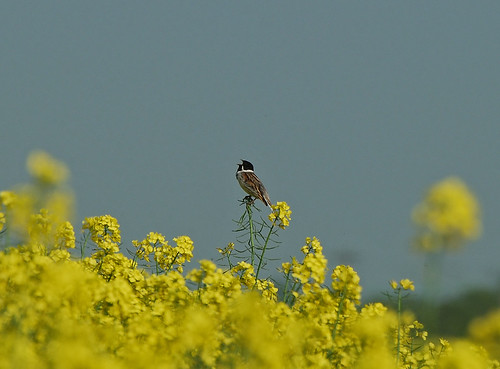
Reed bunting – Emberiza schoeniclus

Reed buntings are present in the local fields and hedgerows all year round and this little chap, for he is indeed a male, was singing long and loud perched on the top of the rape flowers. A circuit around this field is an ornothological treat, on one lap I’d expect to see several reed buntings, at least one or two corn bunting, lots of skylark and occasionally linnet and goldfinch. And on Saturday (9th June) there were two bullfinch, an adult male, resplendent in his black cap and peach breast, and a male youngster, the same colours but a tad smaller and with more muted colours, perched in a tree together on the edge of the field.


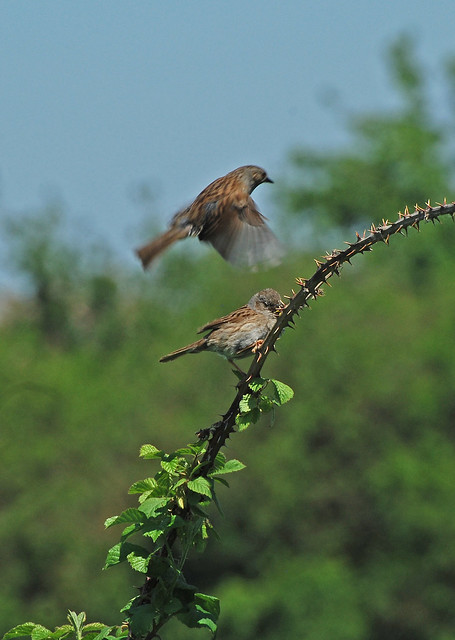
Dunnock – Prunella modularis

And my favourite little brown bird is the dunnock, which are also here all year round, and in the winter are regular visitors to my garden. These two were transporting food to the youngsters in the nest in the midst of a bramble thicket. Fortunately, despite the low numbers of migrants in my locality there are still enough birds around to liven up a walk in the countryside.

Insects and molluscs

Over the last couple of weeks I’ve been out and about photographing wild flowers, and of course the raison d’etre of flowers is to produce the reproductive cells of the plant in order to ensure survival. And as plants are immobile they rely on other vectors to connect the male and female parts, that can be the wind and the rain but many flowers are exquisitely evolved to attract one or more species of insect to carry the pollen to the ovum and effect fertilisation.

So in the course of photographing the flowers some of them were hosting a pollinator or two:

Tree bumble bee – Bombus hypnorum

This tree bumle bee was sipping nectar from the flower of the white deadnettle. It’s one of the insects that is strong enough to get to the back of the flower and take the nectar. Flowers have evolved in this way such that the insects have to pass the stamen, which is where the pollen, or plant sperm, is produced. The stamen is made up of the filament and the anther, and foraging insects brush against the anther picking up pollen which they carry to the next flower where it is deposited on the female part of the plant – the ‘carpel’, and fertilisation ensues.

There are various species of bees in the UK but only around half a dozen common ones. Bees are in trouble in this country and no one seems to know why, both honey bees, which live in colonies, and solitary bumble bees are dying out at an alarming rate.

Buff tailed bumble bee – Bombus terrestris

The buff tail above was in a particularly poorly condition and had tiny mites crawling on it’s body so I imagine it didn’t do much more pollinating.

Soldier beetle – Cantharis rustica

The soldier beetles are related to the fireflies and they get their common generic name from one species which is bright red and is therefore named after the ‘redcoats‘ – English soldiers from days of yore. The larvae and the adults are carnivorous, the larvae feeding on insect eggs and caterpillars and the adults on aphids. They also feed on nectar and can therefore pollinate too.


Black slug – Arion ater

Alot of people have an aversion to slugs because of the damage they can do to fruit and vegetables, but this chap was out in the field making a meal out of a couple of dandelion seedheads. I don’t think they contribute much to pollination and they are predated by frogs and toads and also hedgehogs. Although I’ve heard that if too much of a hedgehog’s diet consists of slugs, parasitic worms living in the slugs can get into the lungs of the hedghog and kill it because its lungs fill up with fluid. Which sounds pretty unpleasant but I guess it’s not the fault of the poor old slug!


Brimstone moth – Opisthograptis luteolata

The brimstone moth is a splendid creature with a wingspan of 32-37 mm. It’s common and widespread across the UK. In the warmer climes of  the southern UK there can be three generations in a year but in the north there is only one brood per annum, and adults can be seen on the wing between April and October. The caterpillars feed on various trees and bushes including hawthorn and blackthorn.

A couple of weeks ago after days of rainfall which had moistened everything I found a 50m stretch of verge which was crawling, literally, with hundreds of yellow and brown snails.


Brown lipped snails – Ceppaea nemoralis. Just a few of the hundreds that were making the most of the damp conditions

The ‘lip‘ of the snails in their name is the front edge of the shell which can be seen in the next two pictures and is lighter brown on the yellow one and a much darker brown on the brown one:

Snails are predated by songthrushes. They pick up the snail by the fleshy part and crack the shell on a handy stone. Some years ago I was sitting at home on my own reading a book and everything was very quiet. I heard ‘tap tap tap’ on the front door, but when I went to answer it their was no one there. So I went back to my book. A few mintes later I heard the same tapping and again there was no one there, so I opened the door to have a look up the street and rather than a visitor there was a collection of broken snail shells on my front doorstep. It transpires the tapping I’d heard was a songthrush using my front doorstep as an anvil to swing the snails against and hammer open the shells!

More blooming flowers

Hedgerows, field borders and roadside verges continue to thrive in this part of the world as a result of the recent rainy weather. Nettles are in abundance at the moment, in particular the white deadnettle (Lamium album):

The white deadnettle is, as the name suggests, not a stinger, and it’s common all over the UK, Europe and Asia. It’s white or pink flowers need to be prised open in order to reach the nectar at the back of the flower so only bulky insects such as bumble bees can reach it. It flowers from March to December so it can provide a food source for these insects for most of the year.

According to the Royal Botanic Gardens at Kew, the leaves and flowers can be eaten raw when they are young and tender and the fresh leaves can also be boiled and eaten as a vegetable. The flowers can also be boiled in water and used as a traditional herbal remedy for catarrh and dropsy, which is another name for oedema, or build up of fluid under the skin. The roots can be boiled in wine, which will extract compounds that are insoluble in water into the alcohol fraction of the wine, and the resulting concoction can be used as a remedy for kidney stones. White deadnettle is also used as a herbal treatment for benign prostate hyperplasia, which is enlargement of the prostate gland, and for gastrointestinal problems. So this humble hedgerow plant has the potential to provide a plethora of therapeutic compounds.

The white deadnettle is also known as bee nettle, blind nettle, day nettle, deaf nettle, dog nettle, snake flower and white archangel.

And the other nettle which is springing up everywhere is the much maligned stinging nettle, Urtica dioica:

The flowers of the stinger are tiny and green and grow in strings which are several centimetres long. The stinging mechanism is via hairs, or ‘trichomes‘, and each one has a bulbous end that breaks off when brushed by a passer by, leaving a sharp hollow tube. The tube acts like a tiny hypodermic needle that injects a cocktail of irritant chemicals including histamine and acetycholine which potentiate an inflammatory immune response which is the cause of the stinging sensation. The sting protects the nettle from grazers but also offers protection for other species which are resistant to the sting and the stinging nettle is therefore home to various species of insect and is an important refuge for caterpillars such as that of the peacock butterfly. Before slashing them down in your garden see if you can’t find an out-of-the-way corner to let them grow and provide a home for the butterflies.

Cooking the nettle leaves removes the sting and they are rich in vitamin C so they are used to make soup, herbal tea and, latterly, pesto and in the production of a cheese called ‘yarg‘ from Cornwall.

Charlock, Sinapis arvensis

The yellow flowers of the charlock plant, also known as carlock, corn mustard, field kale, kedlock, kerlock, kinkle, wild kale and wild mustard, have sprung up along the field-side drainage ditches and hogweed, Heracleum sphondylium, is well established too:

Hogweed flowerhead

Hogweed grows all over Europe and flowers from June to August. The flowers burst out of large pods at the top of the stems and are initially pink but fade to white. The young shoots are reputed to be good to eat with a flavour similar to asparagus and the plant gets its name because it was gathered to provide feed for pigs in times past. Hogweed is also known as cow parsnip, cadweed, clogweed, eltrot, giant parsnip, madnep and meadow parsnip.

Pansy, Viola arvensis

Lurking along the edge of the nearby rape fields, almost hidden in the undergrowth, are pansies. The name of the pansy originates from the French word ‘pensee‘ – thought. It is also know as heart’s ease, ladies’ delight and stepmother’s flower.


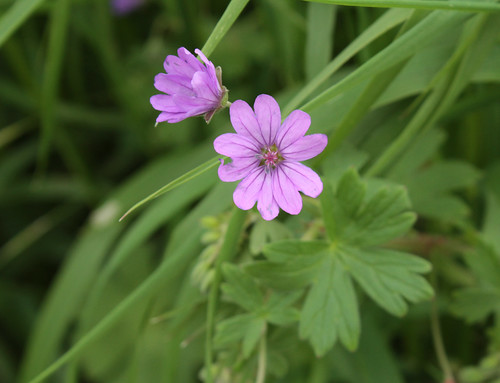
Hedgerow cranesbill, Geranium pyrenaicum

Hedgrow cranesbill, aka mountain cranesbill, is very common at the moment. It flowers from May to August and it gets it’s name from the shape of the seedpod in some species of geranium which is long and pointed and said to resemble the beak of the crane.

Herb bennet, Geum urbanum

According to the RHS herb bennet also has a number of colourful names: blessed herb, city avens, clove root, colewort, Indian chocolate, minarta, St Benedict’s herb, star of the earth, water flower and wood avens. This plant grows in shaded spots and flowers from May to August. It has aromatic roots which have been used to flavour ale and give off a smell of cloves so it was hung by the door to ward off evil spirits. It was also used medicinally by the Romans as a substitute for quinine.

My day job is in the pharmaceutical industry so I have a professional interest in chemicals which could have medicinal applications either on their own or as cocktails of compounds which may be contained in the same plant. So when I’m researching a post like this I wonder how many species we’ve lost due to modern agricultutal practices and how much herbal knowledge and potential drug molecules have passed into history. Many have probably been lost but there are still thousands remaining to provide us with food, herbs and spices, medicines, and to add the wonderful shapes and colours to the countryside.

Serendipity II – The charismatic cuckoo

I don’t recall having seen a cuckoo before, even though I’ve heard their unique call many times. But on my sojourn over to Wicken Fen a couple of weeks ago there were lots of them. ‘Lots‘ is a relative term because cuckoos are becoming increasingly scarce, their conservation status is red due to recent declines in the breeding population and in 2000 there were 9.6-19000 breeding pairs in the UK. But on this trip we heard and saw at least 5 and possibly several  more.

Just before I spotted the first cuckoo I glanced across the lake and this was the view:


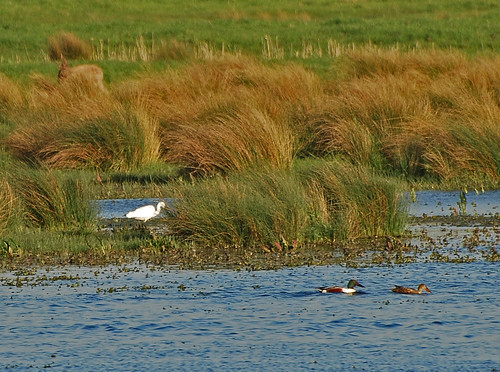
A pair of shoveler in the foreground, a little egret behind and a roe deer just beyond the reeds

I really like this picture because of the colours of the reeds and the water in the evening sunshine, but also because it contains three interesting species. Apart from rabbits, any wild mammal is exciting to see in this country, so the roe deer was a pleasing encounter. The little egret (Egretta garzetta, Dansk: silkehejre) is a member of the heron family which is now resident in the UK, presumably as a result of climate change. I associate them with warmer places because that’s where I saw them before 2000, but nowadays they’re not particularly uncommon here. And in the forefround are two shoveler (Anas clypeata, Dansk: skeand) which are migrant visitors to the UK, but this pair obviously liked it enough to linger and are still here in the middle of May, long after they would normally have left.
And then there were the cuckoos:


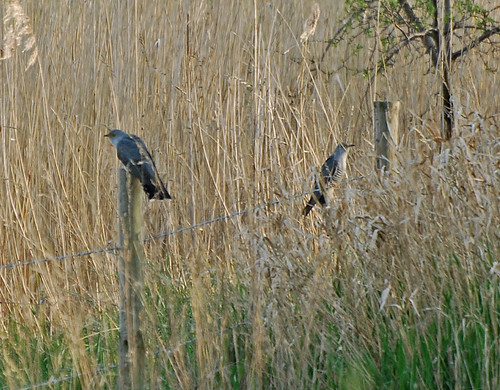
A pair of cuckoo, Cuculus canorus, Dansk: gøg

The cuckoo is an incredible bird and until very recently it was poorly understood. Last year the British Trust for Ornithology (BTO) managed to tag five male cuckoos with tiny satellite tracking devices and found out that they headed to the tropical sub-Saharan rainforests of Cameroon and the Democratic Republic of Congo. The cuckoo arrives back in England from Africa in late March or April and departs in July or August. It leaves earlier than other species because its parasitic breeding strategy removes the need for chick rearing. That means the cuckoo spends a minimum of 8 months a year in Africa so to call it a British bird is, I suppose, less than accurate, even though it breeds here.


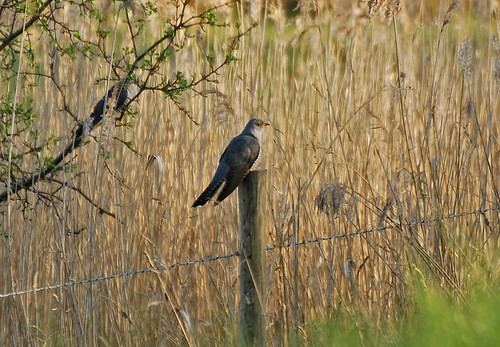
The classic hanging wings pose which I always associate with the cuckoo

The tagged birds were all fitted with solar powered devices which transmit location data once every 48hr. The tracking data revealed that all five birds headed south over France and across the Mediterranean before heading down across Africa to Cameroon and DRC. All five made it. One of the birds died in Cameroon and two more died on the way back, but two of the five made it back to East Anglia this year. I believe the BTO plan to tag more birds including females and I’m very keen to see the results of that experiment.

The cuckoo is an iconic bird in the UK and it’s call is very distinctive. The call is generally recognised as a signal that Spring has arrived and there are local traditions around the UK based on the cuckoo. It is said in Worcestershire that the cuckoo is never heard before Tenbury Fair on April 21st or after Pershore Fair on June 26th. The song actually changes in June from the characteristic ‘cuck-coo‘ song to a shortened ‘cuck‘, and there is a rhyme about this:

In April I open my bill
In May I sing night and day
In June I change my tune
In July far far I fly
In August away I must

My Dad remembers a similar rhyme he used to sing when he was a kid in the 1940’s which was essentially the same but with some local Northamptonshire words substituted in.

I’m not quite sure what these two were doing but they were acting as a pair, and every minute or two one of them would dive off into the adjacent reedbeds to return a minute or so later. As I mentioned above, cuckoos are parasites and they could have been looking for nests to parasitise. There breeding strategy is unique, at least as far as I know. They lay their eggs in the nests of one of three other small songbird species: the reed warbler, the meadow pippit and the dunnock. All of these are the size of a sparrow (ish) so are much smaller than the cuckoo which is dove-sized, which I guess guarantees that the cuckoo chick will be much bigger than its ‘siblings’ and it won’t be threatened. The cuckoo chick then ejects the other chicks from the nest to die and the parents assume it is one of their own and feed it until it fledges. I’ve seen film of a cuckoo chick turfing out the other chicks and it’s a remarkable process, and not particularly pleasant to watch!

Despite their unsavoury procreation habits they are spectacular and charismatic birds and I hope the BTO research can find ways to guarantee their continued return here to brighten up the Spring and Summer.

Serendipity I – The Short Eared Owl

Serendipity struck on Sunday a couple of weeks ago. I’d fixed up to go for a stroll with an old friend who I hadn’t seen for a few years to Wicken Fen. That was on the 20th May, but he got his Sundays confused and we ended up going on the 13th.

It was serendipitous because the weather had been grim leading up to that weekend but on the evening of the 13th it was perfect: sunny, warm, calm and we couldn’t have wished for better conditions. And on top of that there was wildlife in abundance. As we got out the car the air was full of swifts screeching overhead – lots and lots of them – along with swallows and house martins. Various species of geese and ducks and great crested grebes (Podiceps cristatus, Dansk: toppet lappedykker) were on the lakes, and we were serenaded by cettis warbler (Cettia cetti, Dansk: cettisanger), grasshopper warbler (Locustella naevia, Dansk: græshoppesanger) and other songbirds in the undergrowth, and a snipe drummed in the reed bed. Snipe (Gallinago gallinago, Dansk: dobbeltbekkasin) make this sound by spreading their tail feathers and the wind generates the piping sound by making them vibrate.

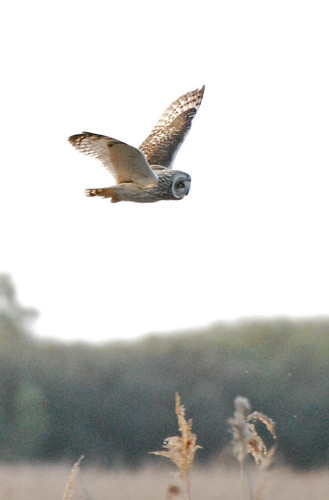
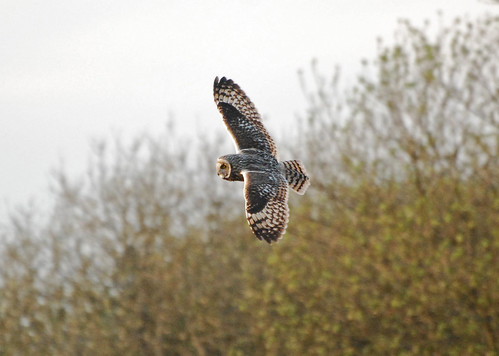
Wicken fen is a really good place to see birds of prey too: marsh harrier (Circus aeruginosus, Dansk: rørhøg), hobby (Falco subbuteo, Dansk: lærkefalk), kestrel (Falco tinunculus, Dansk: tårnfalk), sparrowhawk (Accipiter nisus, Dansk: spurvehøg) and assorted owls can all be seen there. We had been commenting how the birds of prey were conspicuous by their absence and a few minutes later we spotted a hobby perched on a fence post. As we wallowed in our good fortune I spotted an owl behind a tree which emerged right in front of us and it turned out to be a short eared owl:


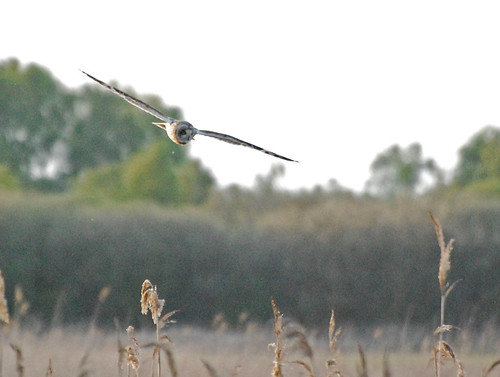
Short eared owl, Asio flammeus (Dansk: mosehornugle)

I thought our short eared owls were winter visitors, migrating to the relative warmth of the UK from the frozen icefields of Scandinavia and returning in the Spring. But it transpires they are also resident breeders in the east and north of England and the east of Scotland so can be seen here all year round.

This one treated us to several minutes worth of hunting, flying to and fro and diving down into the reeds in search of rodents.

I last saw short eared owls at Burwell Fen, east of Cambridge, several months ago when there was a large number of Scandinavian visitors in residence. While we were there we chatted to a BBC camerman who was there to film them for a TV nature series. I think he would have got some good footage on that day but I’m sure he would have been pleased to get this close to one!

Like all owls, it’s a hunter which is supremely evolved for its particular function.

And then on the journey home, continuing the owl theme, there was a barn owl taking the lazy approach to rodent hunting:

Barn owl numbers have been on the decline for a long time and the exceptionally cold winters of 2009 and 2010 badly affected them. We didn’t see one at Wicken which surprised me because I usually see at least one when I’m there at that time of the evening, so it was good to find this one perched on an advertising hoarding alongside the road home.

I’m a firm believer in serendipity playing her part in human endeavour and she adequately rewarded us on this excursion!

My tame wood pigeon

Several posts ago I mentioned the wood pigeons that were frequenting my garden. For the last 2-3 weeks there has just been one, but he has been very regular, dropping in and mooching around the back lawn and vacuuming up the spilled from the feeders, even though he’s fairly adept at balancing on there and helping himself. I’m calling him a he because I’m imaging it is the same one and that if he were a female he’d be busy incubating eggs and rearing chicks.


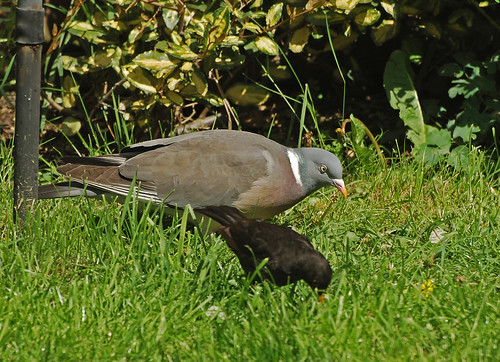
Tidying up the garden with one of the local blackbirds

This particular pigeon seemed very relaxed in the garden, he would fly in and spend alot of time just wandering around and feeding on seeds and a couple of weeks ago I happened to glance out the window and he was still on the ground. I watched him for a couple of minutes and he didn’t move so I went off to get my camera but by the time I got back he had disappeared.


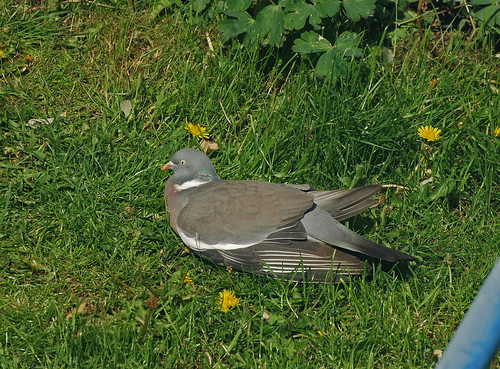
Enjoying the sunshine

Then several hours later he was back and doing the same thing again. He was hunkered down on the ground with his wings extended. I’ve never seen wood pigeons do this before but I can only assume that he felt sufficiently secure to relax and enjoy the sunshine! He was there for several minutes before he was disturbed by another bird and then he wandered around for a few more minutes before flying away.


Columba palumbus (Dansk: ringdue)

And in my humble opinion he is a very handsome bird. This evening as I write this there are three wood pigeons sitting on my garden fence, so maybe he’s told the wife and kids about it too. I’ll have to put out more seed and nuts than usual tomorrow.

The wild flowers are blooming

A combination of the recent rains and the rising temperatures we’re getting now is creating ideal conditions for wild flowers. Any piece of uncultivated land is starting to bursting forth with flora which in turn is providing food and cover for flies, bees, beetles, butteflies and a plethora of other insect life. Which is also good for the birds, small mammals and other predators, and so on up the food chain. And on top of that it’s lovely to look at. So here’s a selection of flora currently blossoming in my patch of East Anglia:


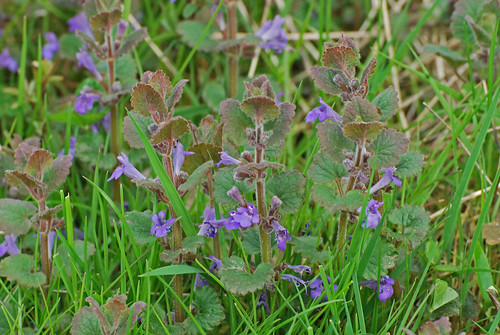
Ground ivy – Glechoma hederacea

I like ground ivy because it occurs early in the year, first appearing in March, but like many other phenological phenomena it may now be happening earlier. It creeps across the ground, like ivy, forming carpets of blue flowers and with the green and red leaves it adds lots of colour to the undergrowth. It has numerous names and here are a few from the Royal Horticultural Society website: Devils candlestick, creeping charlie, crows guts, wild snakeroot, hens and chickens, gill-go-by-the- street, and my favourite: ale gill.

Another creeper which grows across the ground and in hedgerows and which has lovely blue flowers is the periwinkle. There are two types of periwinkle, the lesser (Vinca minor) which may have been introduced to the UK and the greater (Vinca major), which was introduced (both according to my wild flower guide).


The greater periwinkle

I’m a tad confused by this flower because they are meant to have 5 petals but this one only has 4. It is also known as creeping myrtle, cut-finger, flower of death (!), grave myrtle, and sorcerer’s violet, among others.

Sprouting next to this periwinkle flower was a nascent white deadnettle, Lamium album. It normally has white flowers which haven’t yet arrived, but the closed buds are visible below the crown. Everything is very green at the moment because of all the rain and looks beautiful against the red wing cases of the ladybird .


White deadnettle about to burst into bloom


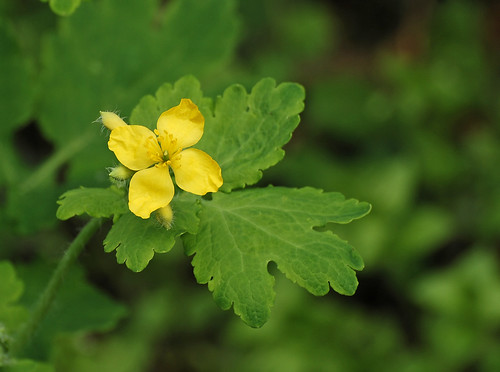
Greater celandine, Chelidonium majus

It is thought the greater celandine is named after the swallow (‘khelidon’ is Greek for swallow) and it’s a member of the poppy family. When the stems are broken they ooze a latex sap which is as yellow as the flowers, and the colour can be as deep as orange. It contains a host of alkaloids which confer therapeutic properties but it can also be toxic. It is also known as cocks foot, sight wort and wart wort as the sap has been applied as a treatment for warts. I’m not sure where ‘sight wort‘ comes from, but if it burns off warts I wouldn’t want it anywhere near my eyes!


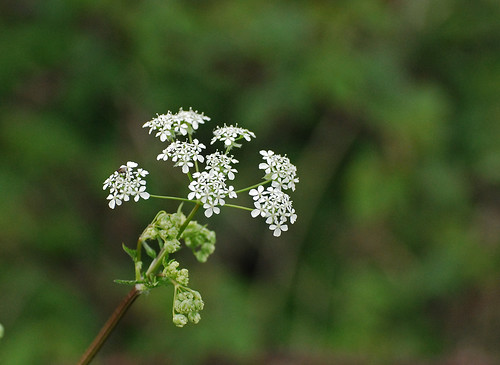
Cow parsley – Anthriscus sylvestris

As far as I know cow parsley doesn’t have medicinal properties and according to Wiki it’s not pleasant to eat. But I think the flowers are lovely and they bring back childhood memories of running through the woods in springtime when the cow parsley or ‘keck‘, as it was referred to by my Dad, was as tall as me. There’s nothing quite like a forest floor which is full of cow parsley, in it’s own way it’s as iconic as blue bells. It’s also known as wild chervil and Queen Anne’s Lace.


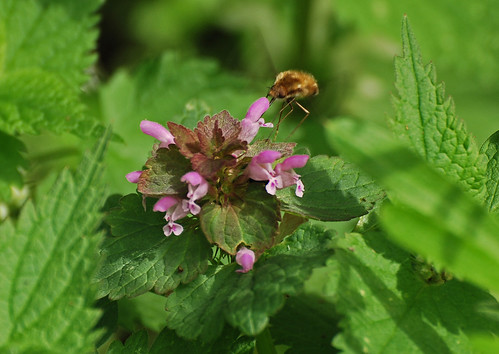
Beefly – Bombylius major

At the end of my flower finding mission I was looking for a ground ivy flower head and I found this little beauty, and just as I was just about to open the shutter a beefly zoomed in to sip the nectar. Flower pictures can benefit from some insect action and I like beeflies, so this was a highly serendipitous encounter!

Erratum: Maggie from http://www.intouchwithnature.co.uk‘ has pointed out that the last flower with the beefly on is in fact red deadnettle  – not ground ivy. So a big thankyou to Maggie for keeping me honest with my plant identification 🙂

The chiffchaff and the willow warbler

The chiffchaff and the willow warbler both members of the warbler or ‘Sylviidae‘ family. There are 63 members of the Sylviidae of which 14 species breed in the UK. They’re very similar to look at and can be pretty tricky to tell apart. Last week in my local meadow I came across both species in photographable locations so I  thought I’d try to show the differences. Both species are summer migrants to the UK having overwintered in Africa, the chiffchaff goes to the Mediterranean and some head south of the Sahara, and the willow warblers all  go down to tropical sub-Saharan Africa.

This publication from Birdlife International tells us that the global population of willow warblers is estimated to be between 300 million and 1.2 billion individuals, and a fact that blew my socks off was that the northern Siberian population overwinters in southern Africa, which is a journey of over 7000 miles or 11000 km… and back! And they’re only 19cm long and weigh 10g, so they may be tiny, but they’re incredibly tough. The chiffchaff is also a scarce winter visitor to the UK.

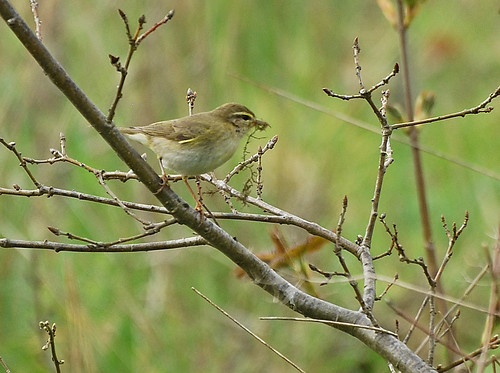
Willow warbler (Phylloscopus trochilus, Dansk: løvsanger) collecting nesting materialWillow warbler showing off her pink legs, bright supercilium and pale ear coverts

The willow warbler has longer primaries and the light stripe over the eye, the ‘supercilium‘ is brighter and more pronounced than that of the chiffchaff, and the ear coverts of the willow warbler (the patch under the eye) are a pale olive colour. The other visual diagnostic feature which is probably easiest to see at a glance is the leg colour, the willow warbler has pinkish brown legs whilst those of the chiffchaff are much darker, almost black.

Chiffchaff showing off its more subdued facial markings and overall colour scheme and the dark coloured legs

In the absence of a clear sighting the easiest way to differentiate between these two species is by their song: click here to hear the chiffchaff song, and here for the willow warbler song.

The conservation status of the chiffchaff is green and in 2000 there were around three quarters of a million territories in the UK, but the willow warbler is amber due to a decline in the breeding population, but despite that there were still two milion territories in 2000.