Tag Archives: histon

Unseasonal Lepidoptera

I was walking in the countryside last Saturday morning around 8am and the weather was bright and sunny. It was also freezing and the grass was glistening  with the first frost of the Autumn. Despite the temperature it was a beautiful morning, enhanced by a deep blue, cloudless, sky and a three quarter moon, and as I wandered along a hedgerow a red admiral butterfly fluttered past.


Red admiral – not the one that fluttered by on Saturday, this one is from earlier in the year.

The colours of the red admiral are gorgeous. It was only when I studied a photograph of one that I really noticed the electric blue spots at the back of the wings and lining the tip of the forewings, and I wonder if the red circle is meant to resemble a fearsome Cyclopean eye to deter potential predators. Whatever the biological rationale they look stunning against the green foliage.

The appearance of the red admiral surprised me for two reasons, firstly because it was so cold, and secondly because in my part of the world all butterfly numbers seem to have been massively reduced compared to last year.

Last year was a really good year for butterflies and in early August, on a hot summer day, myself and my daughter went to a close-by fallow field and did the Big Butterfly Count organised by Butterfly Conservation (http://butterfly-conservation.org). We counted 9 species in our 15 minute survey window, including painted ladies which migrate to the UK for the summer from as far afield as Africa.
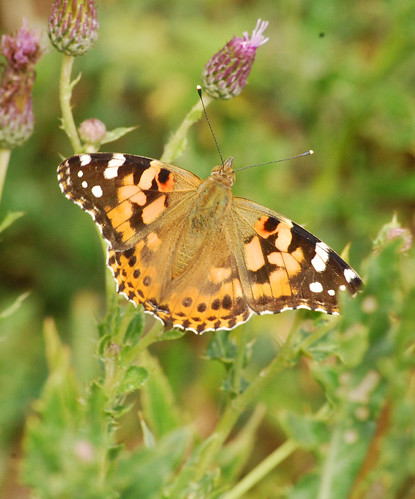
Painted lady

I think intercontinental migration is an astonishing feat of endurance for any creature, but for one as delicate and ephemeral as a butterfly it’s totally awe-inspiring. The odds stacked against any individual surviving such a journey must be mightily slim!

Conversely, it was very noticeable that the weather in 2011 was alot colder (it was the coldest summer since 1993 apparently) and butterfly numbers were significantly down compared to last year, in particular the common blue:
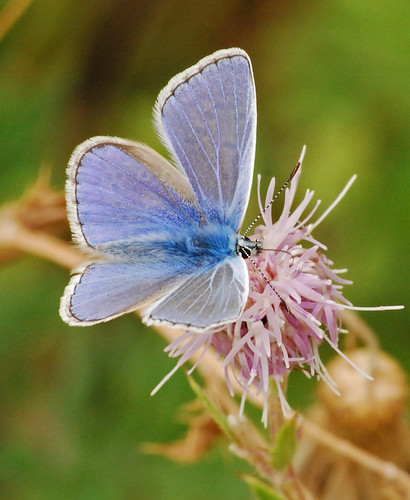
The aptly and, this year, inaptly named common blue. This one, with his wings wide open, is a male…
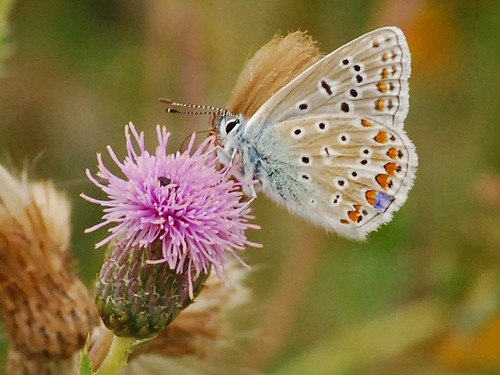
…and with his wings closed


Bizarrely, the female common blue is actually brown

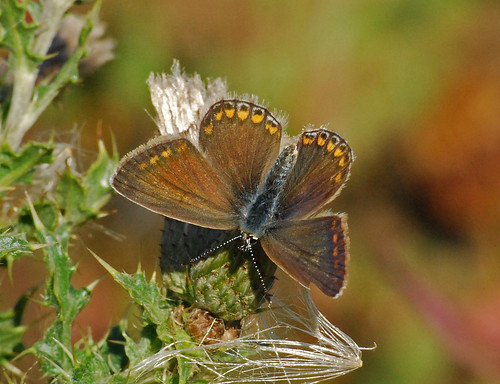
She is looking ragged after a hard summer of mating and egg laying necessary to secure next years population. Common blues and brown argus butterflies can commonly be seen together, they are closely related and the brown argus and female common blue can be tricky to tell apart. She is distinguishable from the brown argus by her overall shape which is very similar to the male above, the white around the orange spots on the hindwing, the blue along the wingroots and the lack of a black cell spot on the forewing, all of which are not observed on the brown argus:
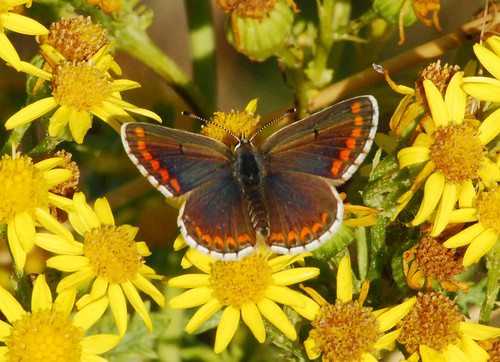

Brown argus sipping nectar from ragwort flowers above. And below revealing the slight differences in the spot pattern compared to the common blue female:
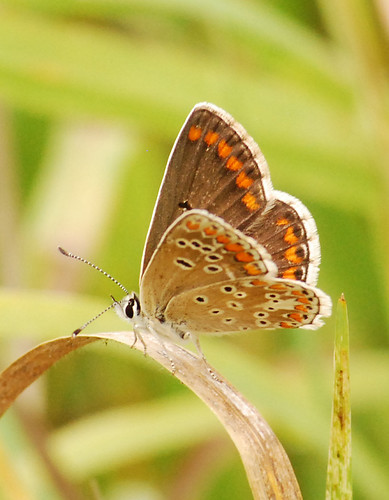

The brown argus can have a blue irridescent sheen when it catches sunlight at the right angle and the wing veins extend through the white wing border, which they don’t in the female common blue.

During a walk through our field at the start of August last year I would see tens of common blue, both male and female, but on the same walk at the same time this year I was lucky to see more than 2 or 3. The results from this years Big Butterfly Count corroborated my unscientific observations and it reports that common blue numbers were down by 61% in this years survey. I’m hoping we get a milder winter this year and a warmer summer next year so the numbers of these beautiful creatures can recover.

I took lots of cool butterfly pictures last year, but as it was before I started writing the Naturephile I was hoping to post them this year. But it didn’t quite come to pass so I’ll try to sneak some of them out under spurious pretexts to brighten up this winter!
Autumn arachnids

It’s that time of year when on misty mornings the trees and shrubs – and just about any amenable surface – are festooned with the webs of garden spiders (Araneus diadematus). This time last year I posted about an arachnid encounter that occurred outside my back door and this year seems to be a good year for them and my garden is full of them.


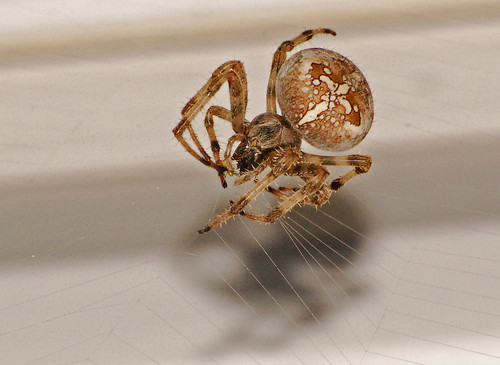
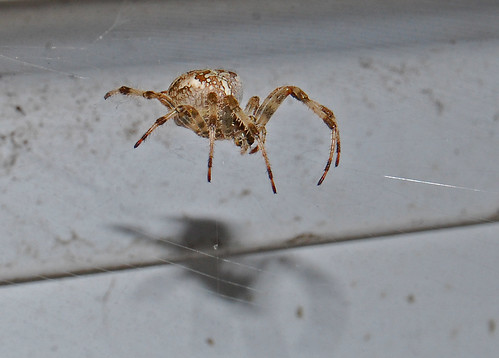
This female garden spider was waiting patiently for prey in her web outside my sons bedroom window


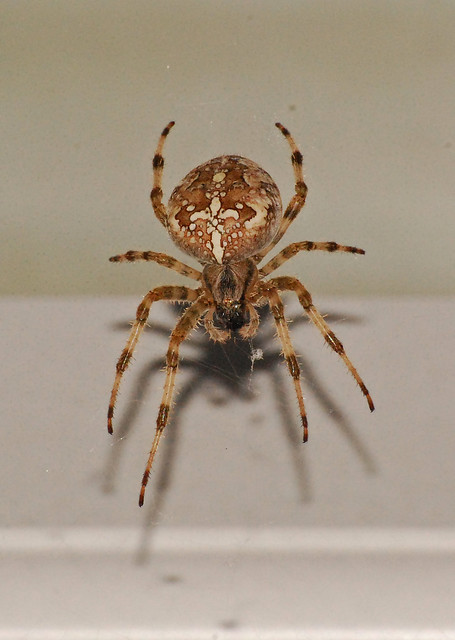
The lady in these photographs was spotted by my son and it is the biggest example of this species that I’ve ever seen. The data I’ve seen for them suggests a maximum body size of 18-20mm, she’s all of that and her leg span is around 4cm. She’s in her web outside a first floor window and is still clearly visible from the ground when she’s hiding under the guttering. She really is huge.

Garden spiders are a genus of the ‘orb weaver’ spiders, so named because the webs they build are circular, or orb shaped. The webs can be seen in hedgerows and window frames and just about anywhere else outside at the moment, laden with dew and glistening in the early morning sunshine.

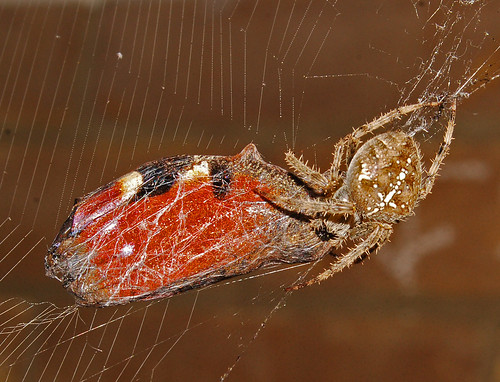
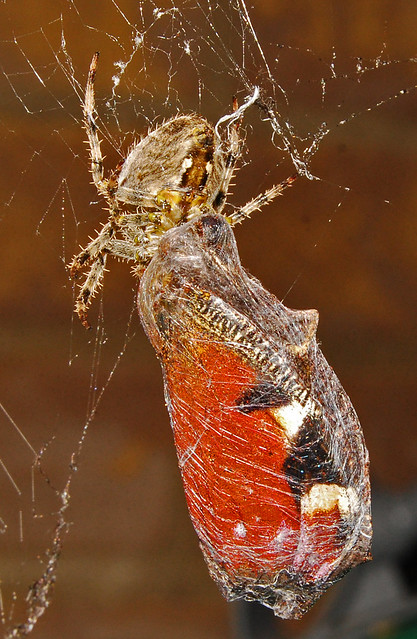
The one below was outside my kitchen window and was in the process of encasing what I think is a male small tortoiseshell butterfly in a silken coffin. It looks as though the butterfly put up a respectable fight as half the web was shredded, but to avail. The spider was poised for some time with its fangs in the body of the butterfly and was completely unfazed by me taking flash photographs within a few inches

They have rather interesting markings too, and another name for them is the ‘cross spider’ from the ornate cream coloured cross on the back of the abdomen. My daughter thinks the cross resembles a design from a stained glass window from a church. Spectacular creatures!

Seahouses Seabirds

Seahouses, on the Northumberland coast, has proved a fertile hunting ground for birdlife in the past and my most recent visit in August was no exception. It has a  sheltered harbour which plays host to numerous gulls, ducks and other seabirds and to the north are miles of beaches interspersed with rocky outcrops and some great rockpools which keep the kids (and me, of course) entertained for hours. I accidentally slipped into a bed of seaweed whilst leaping around between rockpools, my foot disappeared up to the knee making a glutinous squelching sound as it went, and when I pulled it out it was a rather fetching greenish brown and the stench was worse than the inside of a packet of dry roasted peanuts! But that aside, the wildlife was spectacular.

I’d never seen goosander before (Mergus merganser) then I spotted this trio of females standing at the edge of the water in the harbour. I think they are handsome birds, they nest in holes in trees and have a hooked and serrated beak which is designed to catch and hold onto their main prey item which is fish, thus they are also referred to as ‘sawtooths’.


Three female goosander (Dansk: stor skallesluger) relaxing on the shoreline in Seahouses harbour

Shags frequently patrol the harbour diving for fish, they were plentiful both in the sea and perched on rocks and seawalls. They were the only seabird other than gulls that I saw on the Farne Islands, but more of that in a subsequent post.

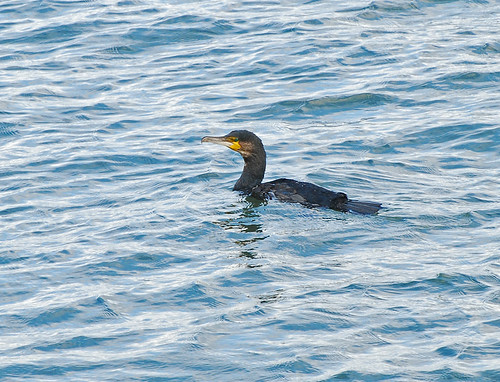
The shag (Dansk: topskarv) could only really be confused with a cormorant (Phalacrocorax carbo), but the shag is alot smaller with a wingspan of 95-110cm compared to the  120-150cm wingspan of the cormorant, and it doesn’t have the white patch behind the lower mandible. The prominent yellow patch on the shag above indicates this is a  juvenile. On the water cormorants swim with a straight neck and their beak pointing up in the air and will leap up into a dive, and in flight they have a longer neck with a pronounced kink in it.

Cormorants are now regularly resident inland. About 20 years ago I was walking along the Woodford Valley to the north of Salisbury and was somewhat taken aback by the sight of a cormorant in a tree. I’d never seen that before and I think it was around this time they were starting to encroach inland. They’re now a fairly common site around our inland waterways, there are several which overwinter on a lake here in Histon – the first one arrived here about a week ago – and there is a flock of a few tens of bachelor males resident at Wicken Fen nature reserve a few miles from here. I think anglers take a rather jaundiced view of their fondness for fish, but I regard them as a welcome addition to our local fauna.

Another common site in the waters around the Northumberland coast was the eider (Somateria mollissima, Dansk: ederfugl):


Juvenile eider trying to dislodge a foreign body from its wing.

This youngster could be confused with an adult female but it lacks the white beak tip and white edges to the covert feathers. The pale stripe over the eye suggests it’s a male. I first saw a male eider in full breeding rig when I was at Skagen on the northern tip of Denmark and they are magnificent birds:


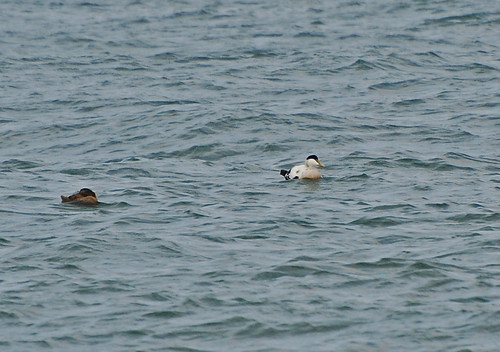
Male eider on the right, distinctive in his white breeding plumage with black cap, flanks and tail, and malachite green nape. Alas he didn’t come any closer!

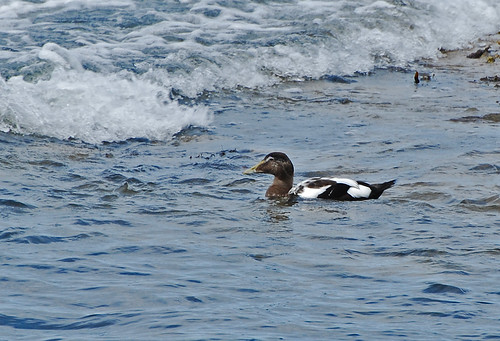
At the end of the summer male eiders malt, during which time they can’t fly. Because they can’t fly the malting plumage needs to provide camouflage and is known as ‘eclipse‘ plumage. They can become almost black during this period.


From the distribution of the white patches I think this one is a second year male undergoing his malt

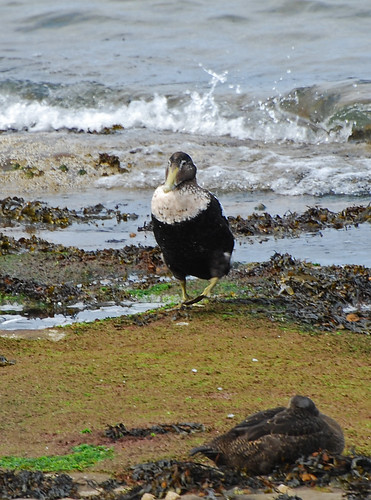
And this is him emerging from the water with another juvenile in the foreground

Eider nest close to the water where the female sits tight. They feed on crustaceans and molluscs, predominantly mussels, which they open with their powerful beaks. They overwinter all around the UK coast but are only resident in the north and Scotland.


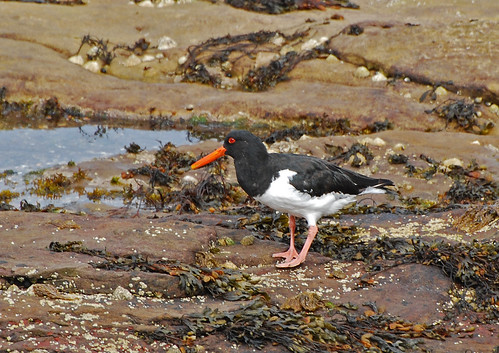
One of my favourite birds – the oystercatcher

Oystercatcher (Haematopus ostralegus, Dansk: strandskade) can be found all around the coast of the UK, at least all the parts that I’ve visited, and I think they’re splendid. That awesome flame-red beak is vertically flattened and blunt and is adeptly used for opening cockles and other shellfish, digging for worms and probing between rocks for insects.


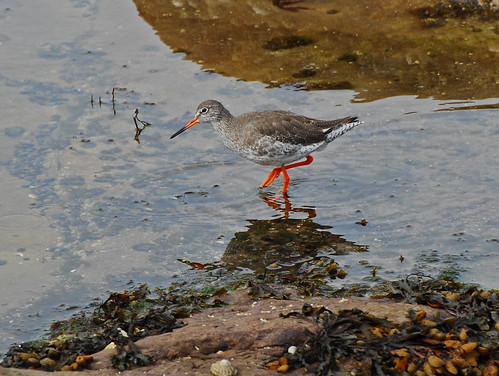
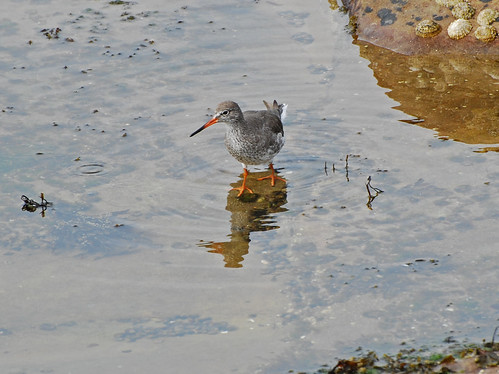
The redshank – I think this bird is exquisite, the colours are beautiful and the shape is perfect, nature at its aesthetic best!
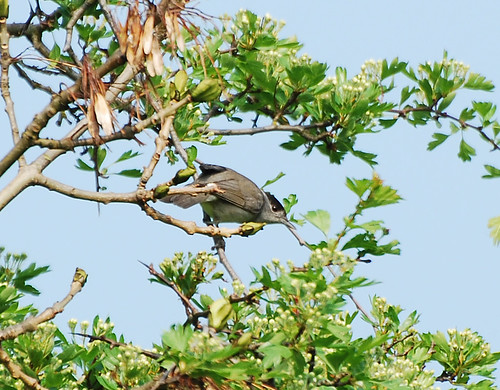
The redshank (Tringa totanus) is a resident breeder and migrant visitor which feeds on worms, crustaceans and molluscs. It’s Danish name is ‘rødben‘ which translates literally as ‘redshank’ and it is also known as ‘the sentinel of the marshes’ from being the first species to take to the air when flushed whilst making an awful lot of noise.

All the photographs here in this post were taken in Seahouses, so hopefully it’s easy to see what a great place it is for wildlife, and birds in particular.

The Butterfly Summer

Two weekends ago whilst walking through a meadow of long grass and wild flowers such as scabius, ragwort and bramble it was immediately noticeable that butterflies are now out in force. On several outings around Histon since then many species are frequenting the hedgerows and grasslands. The species which I think heralds the onset of the butterfly summer is the gatekeeper. It always seems to be the the one I see first in June/July and is rapidly followed by the other summer species:


The Gatekeeper – harbinger of sunny summer days


Holly blues were around in the spring months but have now disappeared in favour of species more associated with summer such as the common blue:

Common blue male. I think this is one of the best photographs I’ve ever taken – it’s a beautiful creature!

…and

A comma soaking up some intermittent morning sunshine perched on a cluster of oak leaves

I particularly like commas with their ragged edges and the rich colours of a young one are exquisitely juxtaposed against the green foliage of the oak leaves.

Small tortoiseshell, peacock and red admiral regularly abound on the flowers of a huge buddleia in my garden. And whilst I’m not averse to getting up really close to snap pictures there, it’s a bit like shooting fish in a barrel, it’s a tad more challenging to get good pictures out in the countryside on some of our indigenous wild flowers:


Small tortoioseshell feeding on nectar from field scabius flower, and

A red admiral

I spent 20 minutes lurking in the undergrowth waiting for this red admiral to open it’s wings and when I looked down amongt the nettles I was standing in it was festooned with caterpillars:


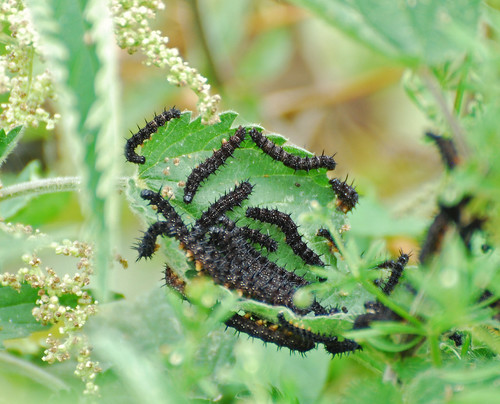
Peacocks before pupation – the ‘ugly duckling’

And after pupation – a spectacular metamorphosis (this one is on the buddleia in my garden, but I love the colours)

A notable absentee from the rollcall of butterflies is the painted lady which was here in good numbers last summer but I haven’t a single one yet. Despite that, lots of other species are out there too, such as speckled wood, brown argus, large and small white and small skipper. But more of those next time I post about butterflies.

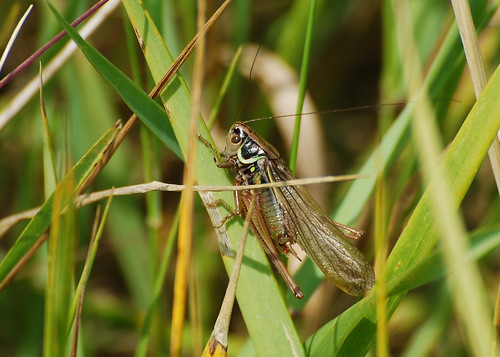
Roesels bush cricket

A couple of weeks ago I was sitting at my dining table gazing out the window when I spotted this silhouette throught the blind:

So I snapped a picture and I really like the detail through the blind. It’s clearly a cricket, and a male (it lacks the long pointed ovipositor of the female which would be protruding from the back end) and its very long, very fine antennae are visible too.

So I popped around the other side of the blind to take a proper photograph, which unfortunately had to be through the window:


The markings on this creature suggest he’s a Roesels Bush Cricket

I went on to do some research on the Roesels bush cricket, Metrioptera roeseli, and it turns out it’s quite an interesting creature. It is a European species, named after the German artist and entomologist August Johann Rösel von Rosenhof, which found its way to England in the late 19th century where it established a toe hold in the far south east, in Kent and Sussex, where it remained for several decades. In the last few decades, possibly assisted by climate change, it has spread over much of south east England and the Midlands.

The migration of this species may have been assisted by the road network which could provide conduits for travelling further afield. There are two forms of this insect, the macropterous or long winged form, and a short winged form. It is reasonable to imagine that the long winged cricket would migrate further and faster, but even though Cambridgeshire appears to be towards the northern periphery of their range this short winged individual has arrived here too.

Roesels bush cricket is distinguished from all other bush crickets by the yellow/green edge to the hard cover of the thorax – the ‘pronotum‘ – and the light spots immediately behind the pronotum. One other similar species, the bog bush cricket, also has a light edge to its pronotum but it doesn’t extend all the way round as it does with Roesels bush cricket.

I’d never heard of Roesels bush cricket before I started trying to identify this individual, and then a few days later I was rooting around in the undergrowth of a field of scrub, also here in Histon, and I spotted a creature which I thought was a very green grasshopper. I managed to fire off a couple of photographs and when I uploaded the images it turned out to be a cricket not a grasshopper:


The macropterous form of Roesels bush cricket

And it was another male Roesels bush cricket but he clearly has the long wings of the macropterous form which extend well beyond his abdomen. So it appears I’ve found both forms of this colourful creature within a week. It’s amazing what can be found by poking around in the long grass!

Summer songbirds mainly, especially linnet

The summer solstice was a couple of weeks ago, the weather is warm and sunny and the evenings are light until after 10pm. For the last week I’ve been heading out across the fields in all hours of daylight and the wildlife has changed significantly. Until a few weeks ago there was alot of bird activity around the nests and I could watch whitethroat and blackcap in the same place for several weeks before that.


Common whitethroat about to head for the nest

The birds are still around but they have dispersed and a tad more legwork is required to see the same species I was seeing 2-3 weeks ago. But now, the first broods of the next generation have all fledged and while my garden has played host to families of starling, great tit, and goldfinch – the fledglings easily distinguished from the adults by their lack of a crimson face – further afield, the hedgerows are thronged with linnet, whitethroat, reed bunting, corn bunting and yellowhammer.


An adult goldfinch and two fledglings on the niger seed feeder in my garden. The speckled brown and lack of a red face makes the youngsters easy to identify.

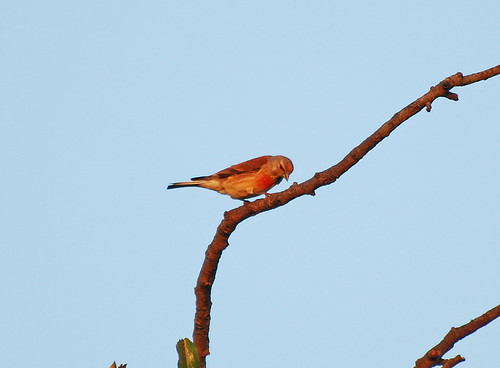
Another finch of which there are many adults and fledglings in the countryside are linnet. Linnet are one of my favourite birds for several reasons: they are delightful to look at with their cerise breast patches, they have a lovely song as they fly overhead and as long as I don’t do anything daft they will often sit tight and let me get really close to photograph them.


A cock linnet, underlit by the late evening sun, showing several diagnostic freatures including the cerise breast, grey head and pale grey grey cheekspot and the crimson spot on the forehead

Rather interestingly the taxonomic nomenclature is Carduelis cannabina, which approximately translates from the Latin as the ‘cannabis finch’! The linnets diet consists of small seeds so I imagine the name derives from the days when hemp was grown to make rope and they were seen in numbers feeding on the seeds.

There is a field of oil seed rape on the edge of Histon which I had always imagined to be devoid of wildlife but in the last few weeks families of linnet, reed bunting, greenfinch and whitethroat are regularly perched on top of the rape plants.


Greenfinch male in the middle of the rape field

The rape seed pods are full of small black seeds and if you squeeze one seed between your fingers there’s enough oil in it to make the ends of your thumb and forefinger really greasy, so it’s easy to see why rape is a lucrative crop and why it is a good energy source for songbirds.


Female linnet perched on top of a hawthorn tree at the edge of the rape field, she doesn’t have the cerise breast patches of the male, but lovely colours none the less

Linnet are migrant and resident breeders and passage and winter visitors. In the winter they can be seen in flocks of several hundred over farmland and often mingle with other finches. There conservation status is red due to population decline over the last forty years even though the European population numbers between 10 and 30 million pairs! Despite the overall numbers, along with a multitude of other bird species they are the victims of habitat destruction and the systemic use of herbicides which kill off their food supplies.


Cock linnet perched on top of an apple tree also on the edge of the rape field…

… and another one sitting on power lines. Look at the colour of that breast – they’re beautiful birds!

So if you can’t think of anything else to do this weekend and you feel like some gentle excercise and peace and quiet take a walk in the countryside and keep your eyes open for all the songbirds.

Many species of butterfly including large and small white, red admiral, small tortoiseshell, ringlet and small skippers were flapping lazily around the hedges on Guns Lane this morning, basking in the warm sunshine and I saw the first gatekeepers of the year today too:

A gatekeeper probing for nectar in ragwort flowers

All in all, it’s well worth a trip to the countryside armed with a pair of binoculars!

Insectivora

The hedgerows and the edges of country paths are home to an immense variety of small creatures, especially those which aren’t in the firing line for agricultural chemical spraying, and it can be easy to overlook them.

Last weekend I spent a morning chasing insects around and I followed a red admiral butterfly into a thicket of nettles where it sat tight with it’s wings closed. Over the next twenty minutes it very briefly opened its wings, but only partially, but enough to enable me to see that its colours were pristine:

And then it opened them fully, and the colours really were sumptuous:


…well worth half an hour stood in a nettle bed!

But I thought the half hour definitely wasn’t wasted when I looked down at my feet and saw this cluster of peacock caterpillars eating nettle leaves:

I moved to one side to get some pictures of the caterpillars, and fortunately after I’d spent some time doing that the red admiral was still in situ.

Peacocks are hardy butterflies which can be found over most of the UK including the Shetland Isles and can be found hibernating in garden sheds. They emerge from hibernation at any time of year if the weather is warm enough, they mate in March and lay eggs then the caterpillars can be seen from the middle of May into July.

Not only are they hardy, they are quit beautiful too. A close look at their wings reveals a fabulous array of brightly coloured detail:

Male peacocks hold fort in their territory and wait for passing females to pass by when they fly up to greet them and attempt to mate. Male and female peacocks are very difficult to tell apart and watching the males performing this courtship behaviour is one way to differentiate the genders.

And close to the same spot I was looking at the flowers and I spotted this hoverfly cleaning his eyes:

…and this beetle wandering over a convulvulus flower, I don’t know what it is but it has gorgeous colours:

The brambles in the hedgerows were also full of bees in the sunshine, many species of honey bees and bumble bees were harvesting nectar from the flowers:


White tailed bumble bee flying from flower to flower feeding on bramble nectar

And than this marvellous creature was hunting in my kitchen last week:


Violet ground beetle, isn’t he magnificent!

Violet ground beetles are carnivorous, as are their larvae. They hunt at night and hide up during the day under log piles or other cool dark places. They eat a variety of insects, including a number of species that gardeners would be glad to be rid of. They’re big beetles, around 3cm long, and they have irridescent blue or violet edges to the thorax and wing cases. So don’t use chemicals in your garden – let these guys get rid of your pests!

And now I’m looking forward to some warm sunny July days when the surrounding fields are full of butterflies. I’ll share some more insect photographs with you then.

A quick stroll round the meadow

Yesterday evening I accompanied the dog on a very quick circuit around Rowleys Meadow. I didn’t take my camera because I didn’t expect to be gone for very long, but fortunately I did pick up my binoculars.

Venturing along Guns Lane to the gap in the hedge which serves as the entrance to the Meadow I could hear a blackcap uttering its call in the undergrowth. As I was about to go through the gap it flew past me just in front and alighted in the bramble a few feet away and continued calling. It then circled around me for a minute or so as I entered the Meadow and sat singing in the trees and brambles while I stood in the hedge and watched. I didn’t linger for long as I guessed it was probably guarding a nearby nest. If only I’d had my camera with me!


Blackcap male  – from a previous foray into the meadow

I’ve never spent so long so close to a blackcap, and it was lovely to see. There are a good number of them in the Meadow, and at least one nest, and they’re present in the hedgerows around the more open fields to the east of here too.

Moving on around the Meadow, chiffchaff were on parade in their customary locations and common whitethroat were singing on top of the brambles and in the low scrub.


Common whitethroat male proclaiming his territory

There are numerous common whitethroat in and around the Meadow which can be heard singing all through the day and many of the bramble thickets are home to their nests.


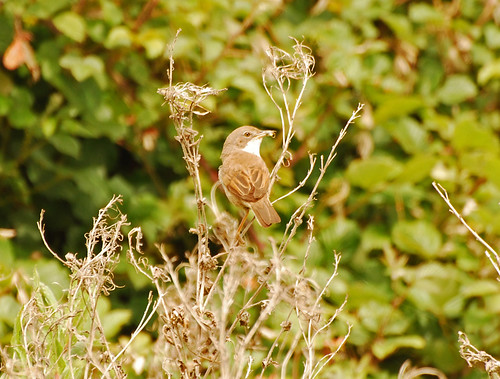
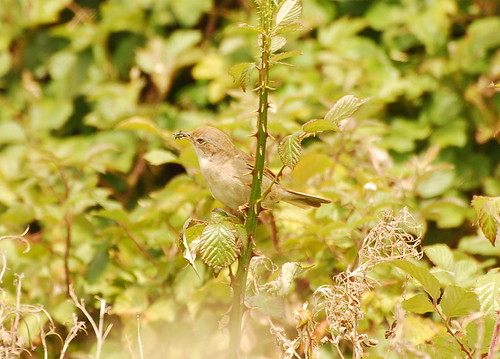
This female common whitethroat was waiting for me to move on before heading for the nest. I crouched down and hid in the long grass just long enough to get these photographs

When seen close up the female whitethroat is quite different to the male both in demeanour and plumage. She isn’t as bold in proclaiming her presence and her colours are more subdued, she doesn’t have the blue grey head of the male.

A kestrel was hovering over the Meadow at various heights for the duration of our walk, diving down into the undergrowth in pursuit of unwary rodents, but he didn’t seem to catch any. But next to the path there was evidence of another predator kill – the empty carcass from a sparrowhawk meal. The brown feathers remaining suggested it was a starling chick but it could also have been a blackbird or song thrush. There was insufficient forensic left to allow an unambiguous identification. Nature at its most brutal, but sparrowhawks have chicks to feed too. On the subject of our local birds of prey, a young buzzard was learning to fly over the Meadow today, it’s plumage was ragged and it was a less than competent aeronaut, and it’s great that they’re breeding in the area.

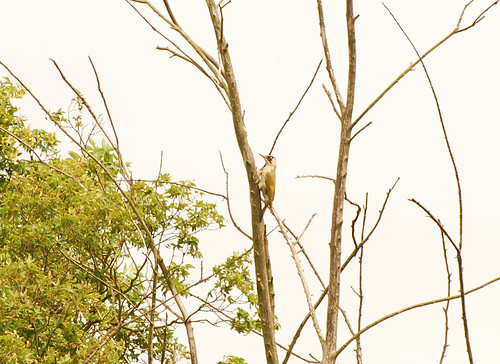
The other highlight of my quick stroll last night was the number of green woodpeckers. I counted seven, including two sightings of two together, one pair of which were squabbling on the ground. It’s quite possible, even likely, that I counted at least one of them twice, but I think there must have been at least 4-5 individuals.


A green woodpecker that I flushed out the grass

There’s lots of birdlife around at the moment and they all seem to be breeding successfully, including the local starling population.

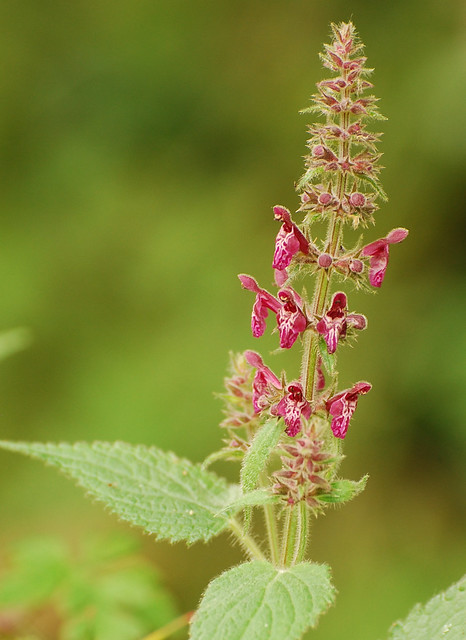
And before I finish, I want to share this wild flower with you:

How gorgeous is that?!

It’s the flowerhead of hedge woundwort (Stachys sylvatica) which has just started blossoming in the hedgerows along Guns Lane in Histon. It contains an antiseptic oil which was utilised in days of yore in wound dressings, hence the name. Absolutely exquisite.

The birds and the bees (and the flowers)

As our warmest and driest Spring on record turns into what is shaping up to be a warm and dry Summer, nature’s great events are occurring apace to exploit the prevailing climatic conditions.

The first swifts were seen over Histon 3 weeks ago (by me at least) after their heroic journey back to their breeding sites from overwintering in Africa. To celebrate this event I’ve spent several hours sitting in the garden of the Castle pub on Castle Hill in Cambridge enjoying a few convivial sharpeners and watching the swifts shrieking through the sky like an avian aerobatic team. I can heartily recommend both activities!

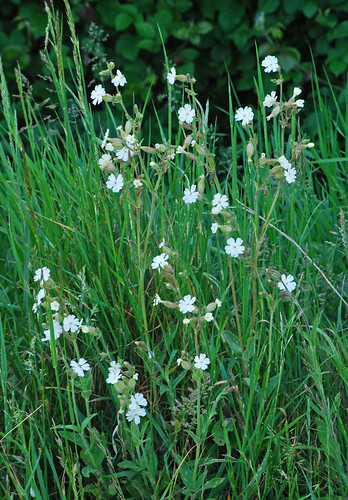
Wild flowers, including one of my favourites, white campion, are now in bloom:

White campion, Silene latifolia, decorating ditches and hedgerows

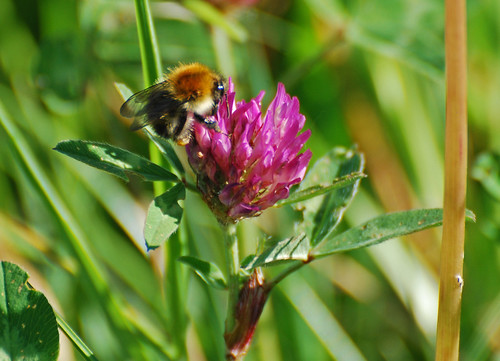
White campion is a dioecious plant which means the male and female reproductive machinery are on separate flowers. It grows in well drained earth and flowers from Spring to Autumn and is now delineating my walks across the open countryside. Another one of my favourite wild flowers is red clover (Trifolium pratense) which is a gorgeous colour and provides nourishment for bumble bees:


Red clover flower being harvested for pollen and nectar by a common carder bee (Bombus pascuorum). This is the national flower of Denmark.

And of course the local birdlife has been very busy breeding and raising chicks. Alot of species started this process earlier this year due to the unusually warm weather in Spring. I have a pair of blue tits raising a brood in the nestbox in my crab apple tree and my friend told me of a family of song thrushes which fledged from his garden a month ago. Which is very early.

A pair of great tit have been feeding their chicks on crushed peanuts which I put out on my bird feeder over the last month and last week they fledged and the whole family were feeding in my garden for just a day or two before they ventured further afield. (If you put nuts out for the birds during the breeding season please make sure you use crushed nuts as inexperienced parents can try to feed whole nuts to chicks and this can have fatal consequences). Great tits have over 70 different vocalisations which I think is remarkable, almost simple language! And on my explorations along the fields and hedgerows around Histon last weekend (21st May, 2011) I saw more great tit, blackcap and whitethroat all feeding gangs of fledglings:


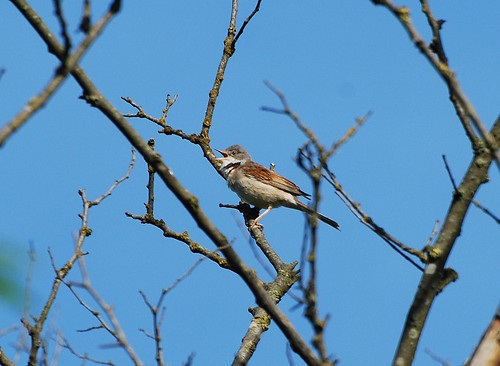
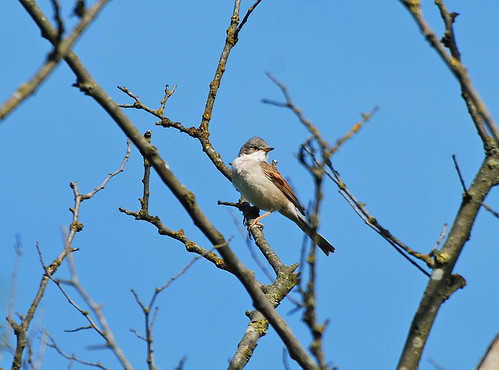
Common whitethroat male, Sylvia communis

There are two species of whitethroat to be found locally, the common and the lesser (Sylvia curruca). They are distinguished by their song, which I won’t try to describe because I’ve never yet read a book which gives the remotest idea of what birdsong actually sounds like by a written description! But if you want to compare them try here for the common whitethroat, and here for the lesser whitethroat.


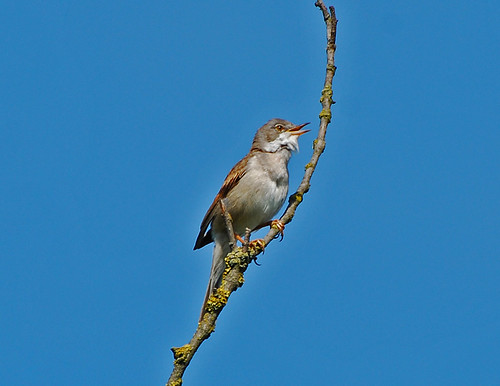
And another male whitethroat, this chap was singing long and loud, punctuated with characteristic jerky flights straight up in the air and back to the same spot

There are a good number of common whitethroat in the hedgerows north of Cambridge, lesser whitethroat are also here but are not so numerous. There are other distinguishing features between the two species, the lesser, as the name suggests is smaller (~11cm long compared to ~13 for the common), and is generally more grey with a pale grey head and noticeably darker grey ‘ear’ patches. It also has dark grey legs. Both species overwinter in sub-Saharan Africa, the common in central Africa and the lesser in eastern Africa.

Linnet can be regularly seen flying around the bramble thickets on the edges of the village and perching and singing on top of them. On Saturday early in the morning a fracas was going on in an elderbery tree in Rowleys Meadow in Histon which ended when a jay was chased out of the tree by a family of linnet and a family of whitethroat. The jay alighted on an adjacent shed to suss out the lie of the land and contemplate another raid whilst the indignant songbirds dispersed into some scrub to hide. Eventually the jay decided to keep his powder dry and disappeared into a nearby wood. Jays, like other members of the crow family, will raid nests of smaller birds for eggs and chicks, so it’s a perilous business being a small bird with a family to rear.


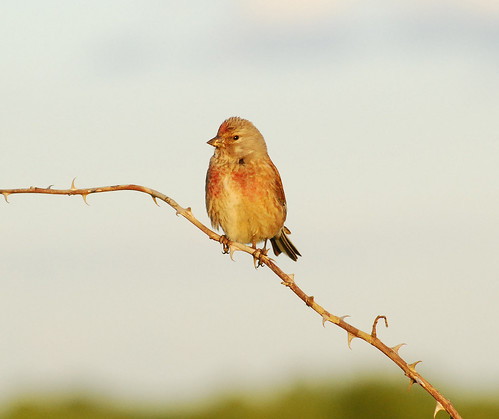
A linnet male perching on a bramble. When they’re not protecting a nest I’ve managed to sneak within 15 feet of linnet perched like this.

Linnet, Carduelis cannabina, are abundant resident and migrant breeders, although their numbers, as with many of our songbirds, are declining, and they are also passage and winter visitors. Due to their declining numbers over the past 40 years or so their conservation status is red, indicating they are globally threatened. They are finches which live in open country and farmland and feed on seeds.

Many species of moths, butterflies, bees, flowers and a plethora of other creatures are all appearing as trhe seasons are progressing and there’s something new to see every week!

Orange tip

I am of course referring to the butterfly, not an unsightly medical condition. I’ve spent plenty of time chasing them along hedgerows waiting for one to settle on a flower, but in vain, and you may recall that in a previous post I said that the orange tip was extremely difficult to photograph because they rarely settled.

That was until last weekend when, the weather was sunny, warm and calm so I went for a walk on Guns Lane to the north of Histon. I was rewarded fairly soon into my walk by a male orange tip settling on a plant on the edge of the pathway and allowing me to encroach within just a few inches:


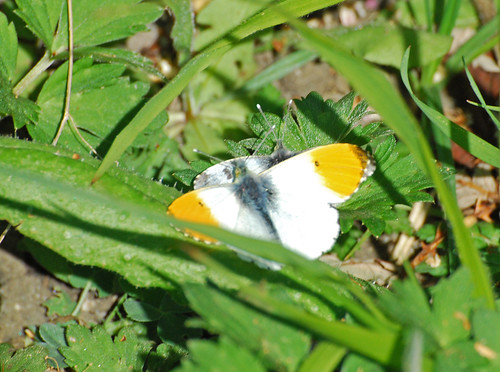
Male orange tip. I think his underwings are exquisite, and it’s perfect camouflage when he’s perched on a cow parsley flower head.

This fellow was a good omen. Several hundred metres further along the path where the dense hedgerow thinned out into more open territory lined with cow parsley there were many male and female orange tips and they were all intent on mating on this particular morning.


Another male orange tip, this time with his wings open. And the colours on top are gorgeous too.

The female of the species doesn’t have the orange tips but is still distinctive from the other white butterflies:

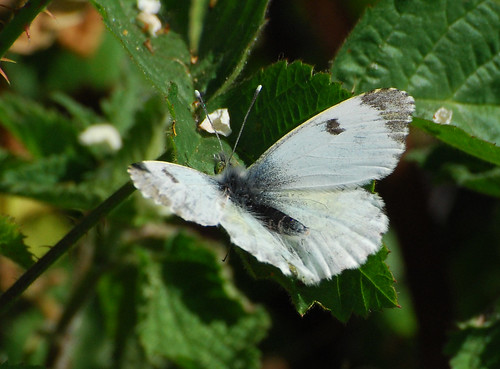
Female orange tip. She is aware of the presence of males and is pointing her tail in the air in preparation for mating…

…and a few seconds later a male flew within a few centimetres and her reproductive organs are clearly visible opening up here in response to his presence.

The female above didn’t mate in this instance, but:

This pair were mating on the ground close by

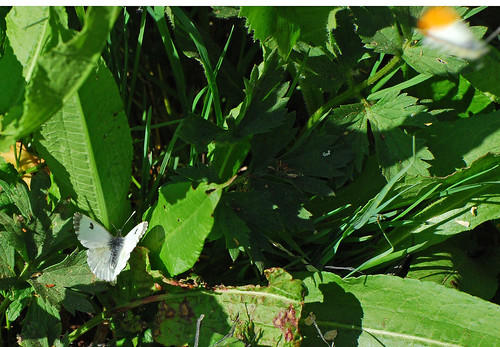
And another female sits on a leaf as the male beats a post-coital retreat top right

I promised some pictures a few weeks ago of orange tips in the post ‘Local Lepidoptera’ so I was very pleased to capture this series of the mating behaviour so soon after.