The Cambridgeshire Fens can be a bleak and windswept part of the world as the winter months descend, and today it was very bleak and very windswept, but it’s a great location for getting out and seeing some exciting and scarce wildlife.

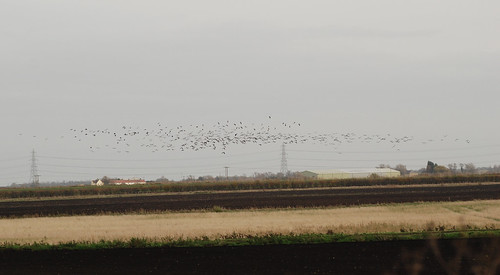
A small flock of lapwing and golden plover over Burwell Fen
For those of you who don’t know the Fens they’re characterised by wide open flatness and big skies. They were originally under water but were drained by Dutch engineers in the 17th and 18th centuries to leave high quality arable land. The soil is extremely rich in organic material which gives the soil the rich black colour evident in the picture above.
I set off there on Saturday with my friend David because there had been a report on the Cambridge Bird Club website of short eared owls (Asio flammeus, Dansk: mosehornugle) in the vicinity. After wending our way through Swaffham Prior and Reach we rocked up at Tubney Fen where we sat in a new National Trust hide overlooking a new pond with new reed beds which had four coots (Aythya fuligula, Dansk: blishøne) and a pair of mute swans (Cygnus olor, Dansk: knopsvane) paddling on it. And no other signs of life whatsoever.
As we watched, the mute swans took off and looped round low right in front of us and landed back on the water. At least one of them landed on the water in the spectacular and graceful way that mute swans do. The other one crash landed on the ground just short of the water and after regaining its equilibrium stood looking highly indignant but managed to retain it’s dignity in a way that only a mute swan could in those circumstances. We hoped it wasn’t injured but it looked to be suffering from little more than damaged pride.
After another five minutes sat in the hide the lack of further activity and the low temperature caused us to move on, and on the way back to the car we spotted eight whooper swans in a field several hundred meters away. The whooper (Cygnus cygnus, Dansk: sangsvane) is a winter migrant to the UK and a very scarce breeder, usually less than ten pairs a year will breed here. It’s a similar size to the mute swan but it’s neck is straighter and the beak is straight with a black tip and pale yellow base. Their breeding territory is in the high Arctic and they migrate south as far as Africa for the winter.

A family unit of eight whooper swans – two adults with white plumage and the charateristic yellow beak and six cygnets with pale grey/white plumage and without the yellow beak
We decided to move on to Burwell Fen from Tubney Fen and on the way we were considerably closer to the swans so we stopped for another look. And as we looked David noticed that a pale brown stripe in an adjacent field was in fact a flock of golden plovers (Pluvialis apricaria, Dansk: hjejle) and lapwings (Vanellus vanellus, Dansk: vibe). When I was a kid I spent a fair amount of time out and about exploring the countryside and huge flocks of lapwing consisting of hundreds and possibly thousands of birds were a fairly common sight. But their numbers have been dwindling for decades and these days I’m pleased if I see more than twenty. A carrion crow was getting agitated in the tree beyond the plovers because a buzzard (Buteo buteo, Dansk: musvåge) was perched there too, but the crow wouldn’t get too close and the buzzard just sat tight and ignored it. There turned out to be 243 lapwing in this flock and for me that alone justified the trip.

Around 10% of the lapwing in our flock of 243
There were also several hundred golden plover. As we watched another even bigger flock joined them and when they were flushed into the air we could see another flock as big again in the middle distance and beyond that another that was enormous. So we estimated that between these flocks there were several thousand birds. It was a amazing sight.
The flocks of waders eventually settled so we made off further into the Fen, pausing to gaze at a group of roe deer (Capreolus capreolus) relaxing in a field:

These very well camouflaged roe deer didn’t seem at all perturbed by our presence

As we watched the deer, a sparrowhawk (Accipiter nisus, Dansk: spurvehøg) quartered the field and then a peregrine falcon (Falco peregrinus, Dansk: vandrefalk) swooped past car, travelling with the customary haste that species is renowned for.
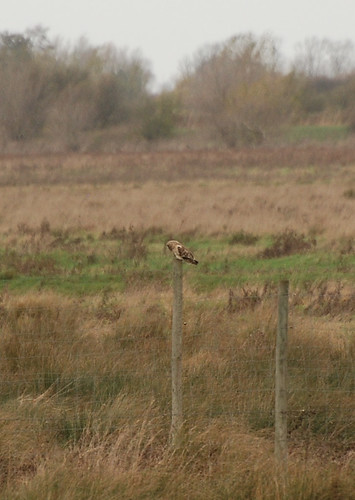
Arriving eventually at a car park, we continued on foot over a bridge where several kestrels (Falco tinnunculus, Dansk: tårnfalk) were quartering all the fields around and almost immediately spotted a short eared owl. It was perched on a fence post in the middle of the adjacent field and I initially mistook it for a little owl because I was looking at it from front-on and I could only see the top half, but when we saw it through David’s spotting scope we could clearly see it was of the short eared variety.
 Short eared owl hunting rodents the easy way, not wasting any energy
As a result of the inclement weather, low light and strong wind, and only having a 300mm lens I couldn’t get any good photographs, but it’s unmistakeably a short eared owl, so I’m happy.

We saw various small songbirds such as chaffinch (Fringilla coelebs, Dansk: bogfinke) and goldfinch (Carduelis carduelis, Dansk: stillits), five bird of prey species, whooper swans, and countless thousands of golden plover and lapwing. So despite the cold it was fine way to spend a Saturday morning.










 The Naturephile