Category Archives: Insects

Dragonfly drama

Early last Saturday morning I set off for Paxton Pits, a group of lakes on the edge of St Neots, between Bedford and Cambridge. It was anticapted that we wouldn’t see much birdlife but there could be some inteersting dragonfly activity. And apart from a lone turtle dove (which justifies the trip on its own!) and a sparrowhawk, we noticed surprisingly few birds. But the Odanata were there in abundance with large numbers of various species of damsels and true dragons.
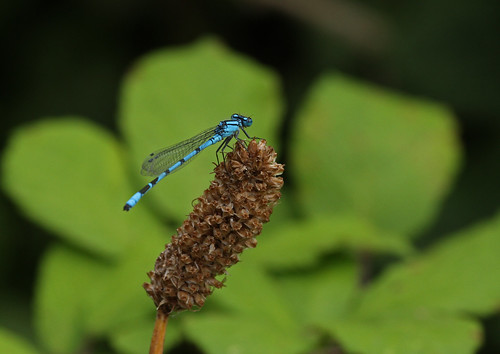

Common blue damselfly

I spotted this common blue (Enallagma cyathigerum) before I’d even got out the car. This one a male, was perched on a seed head at the edge of the carpark and there were several others in the vicinity warming themselves up in the early morning sunshine. At the other side of the carpark is the visitor centre which has a small pond outside and over the pond were a red eyed damsel (Erythromma najas) and another common blue warming up on the same rush leaf:

Paxton Pits are disused gravel workings and have been turned into a nature reserve that is managed by Huntingdonshire District Council with the back up of the voluteers of the ‘Friends of Paxton Pits’. If you happen to be contemplating a visit to the Pits, there is a lot of information on their website: (https://sites.google.com/site/paxtonpitsnaturereserve/home), and the reserve also has a blog where sightings at the lakes can be recorded: (http://paxtonpits.blogspot.co.uk/). The website lists all the Odanata that have been resident there and many of them were on display on Saturday. They don’t all emerge at the same time of year so it would never be possible to see all of them during one visit.
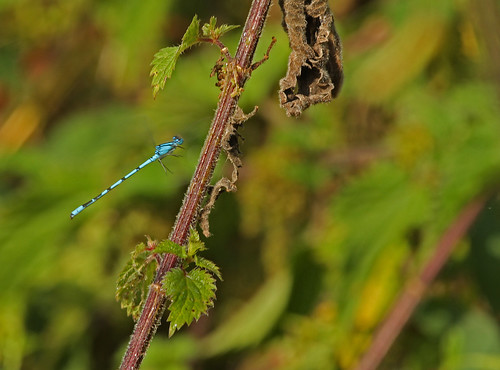

Another common blue damsel on final approach to land on a stinging nettle stem

The Pits are adjacent to the River Great Ouse and swarms (literally!) of banded demoiselles (Calopteryx splendens) were fluttering within 20m or so of the banks of the river. The banded demoiselle is one of two species of demoiselle in the UK and the only one in the east of England, and I think they’re absolutely beautiful as they sparkle in direct sunlight:

A female banded demoiselle perched on top of a nettle (I like the background here – out of focus brambles)

The other species of UK demoiselle is called the ‘beautiful demoiselle’ (Calopteryx virgo) and is found in the south and west but not the east. It is most easily distinguished from the banded version because the wing pigmentation in the male extends to the base of the wing, so it’s a much bigger spot than those on the wings of these banded demoiselles:

Above and below: male banded demoiselles
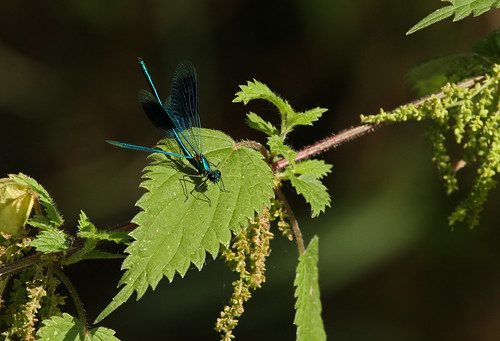
And the female beautiful demoiselle  has broader wings with a brown tint that’s lacking in the banded demoiselle. The male demoiselles were busy chasing females with all thoughts turned to mating.

But in the midst of all the the mating activity, danger, as always, was lurking in the undergrowth. This unfortunate female common blue damsel had been caught in  a spider web and was in the midst of a mortal struggle with the owner, which she eventually lost:
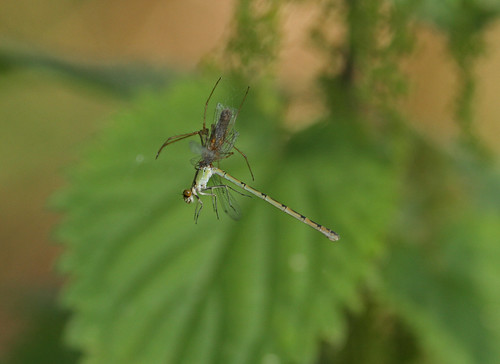
The male common blue was also caught in the web and was struggling to extricate himself. Fortunately for him, all the spiders efforts were needed to subdue the female and whilst it was otherwise distracted he made his escape whilst the female eventually succumbed to the spider venom.
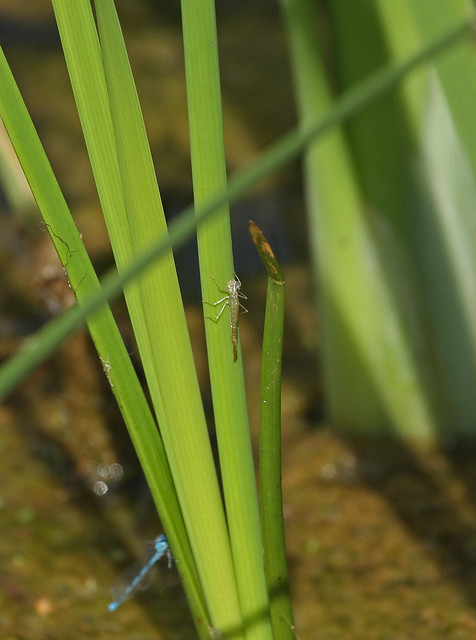
A dragonfly larva having scaled a stem to leave the water will shortly burst out of its skin and fly off as an adult dragon

It’s also that time of year when dragonfly larvae are metamorphosing into adults. The larval stage of all dragonflies is aquatic and so they require gills or ‘caudal lamellae‘ to breath underwater, and these can be seen protruding from the end of the abdomen of the larva above. At the end of its aquatic life the larva climbs a stem out of the water and emerges from its larval skin as an adult, leaving behind its discarded outer casing, or ‘exuvia‘:

Dragonfly exuvia  – a dried out larval husk left behind on a rush stem after the new adult has flown

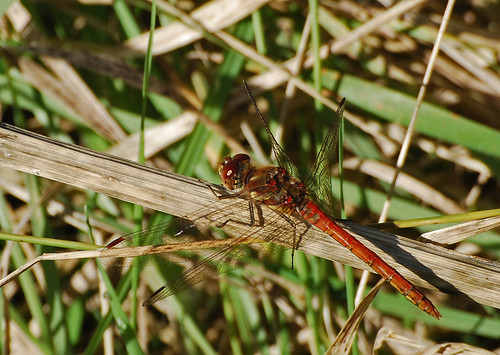
As well as the damsels, several species of true dragons were on the wing including brown hawker, migrant hawker, black tailed skimmer, and the grandaddy of all UK dragons, the emperor (Anax imperator):
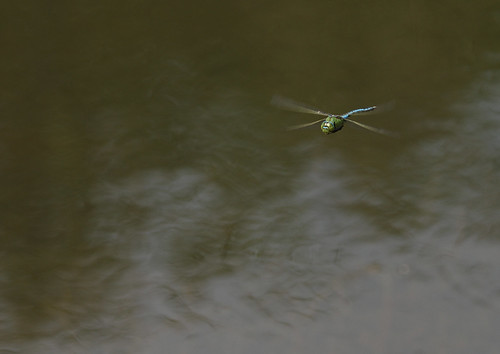
Emperor dragonfly male patrolling his stretch of water against allcomers

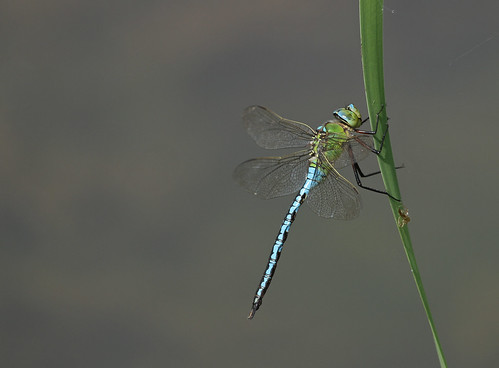
The emperor, as its name suggests, is a whopper. It is also an aggressive defender of its territory, a consummate aeronaut and a ferocious hunter, taking prey as big as other dragonflies. It’s easily distinguished from other dragons by its sheer bulk, the apple green thorax and the drooping abdomen. I sat and watched this one for some time and he rewarded my patience by posing for a portrait on a stem just  a few metres away:
And after all the dragon activity I peered into the water on the way home and spotted this little chap:
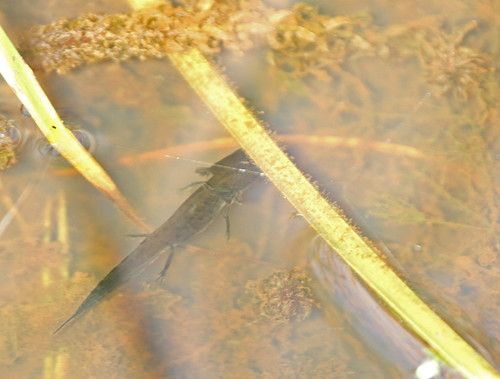
A young newt

I don’t know what species of newt this is but it’s still so young it hasn’t adapted to air breathing and still has its feathery gills which are visible just in front of the fore legs.

It’s been a long time since I last posted so it’s good to be back Life should be generally less busy for the back end of the year and I’ve got lots to share, so hopefully I can start to post more regularly again!
Birds and bees…

…and butterflies.

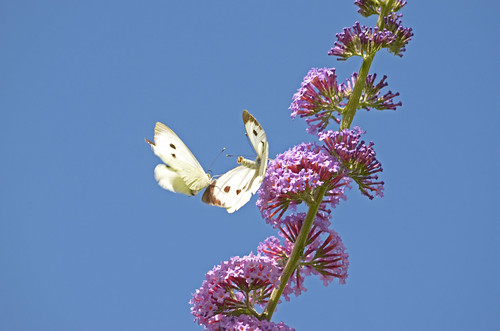
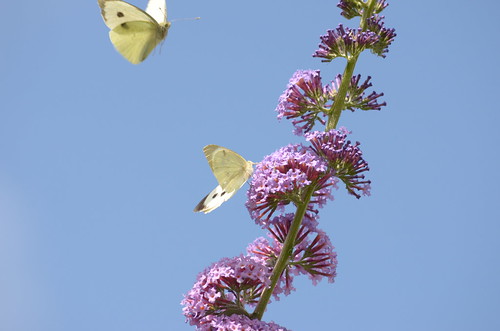
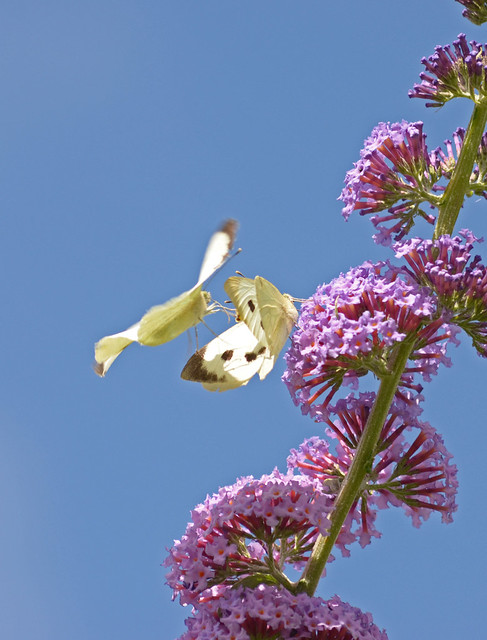
A male large white butterfly (Pieris brassicae, aka the ‘cabbage white’) zeroing in on a potential mate…

I normally try to avoid taking photographs of UK wildlife on imported garden plants, in this case buddleia, species of which grow endemically on several continents, and I believe our UK variety arrived here from the Himalayas.

No longer anything ‘potential’ about her!

But in this instance the drama was so compelling (and I was testing out my new macro zoom that I introduced in the last post) so I decided to share this sequence.

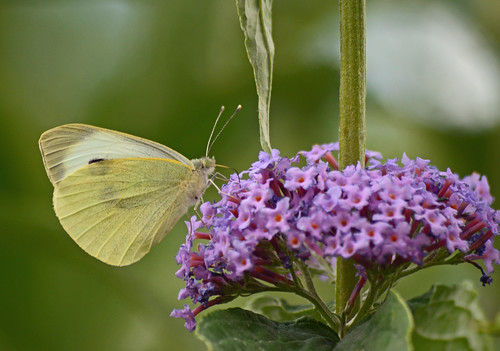
Several mating events ensued after which the male settled on a lower flowerhead to sip nectar and replenish his energy reserves:

The large white, along with the small white (Pieris rapae), are known as the ‘cabbage whites‘ because they lay their eggs on members of the cabbage family and the caterpillars can do a lot of damage to cultivated cabbages. But I’m quite happy to share my cabbage allowance with them and I love to see them fluttering through my garden and along the hedgerows.

Cheap and cheerful

Last year when I changed my old Nikon D40x for a Nikon D7000 I also bought a cheap second hand Sigma macro lens to go with it. I wouldn’t normally do that, but because of the attractive price tag I thought I’d give it a go in order to dip my toe in the water of  macro photography without upsetting my bank manager. Or, more importantly, my wife!

When I first got the lens I mooched around the house looking for small things to photograph and I didn’t have to wait long before a selection of arthropods presented themselves.

Vespula vulgaris, I also like this image because of the clear double reflection in both panes of the double glazing.
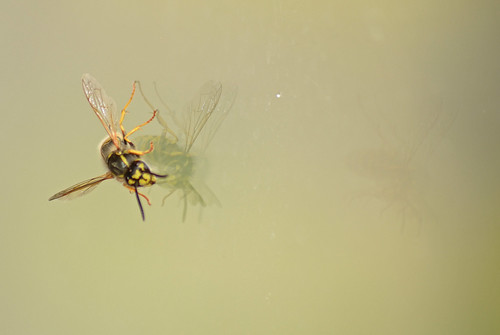
The wasp was buzzing up and down the glass of a door trying to find a way out so I practised my macro technique on it before opening the door and providing it with an escape route.

Even though the head is not in sharp focus I also like this image because of the reflections in the window glass

In this image the plane of focus has captured the wings and the head is slightly out of focus, demonstrating the narrower depth of field (DOF) inherent with macro photography. Tech note: DOF decreases in range with magnification and aperture, so for a given aperture the DOF will decrease with increasing magnification. Or put another way, if you need to open the aperture wider (smaller F-stop number) to get enough light on the sensor to generate an image, you may need to sacrifice some magnification.)

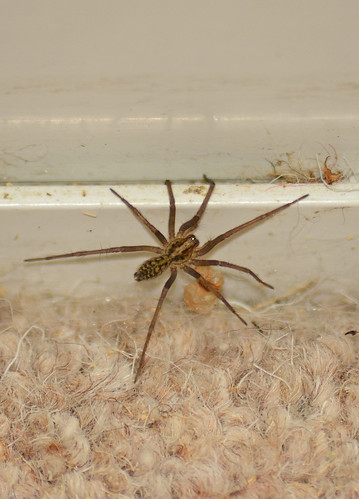
And while I was busy with the wasp a house spider appeared by my feet so I had a shot at that too:

Young house spider, a species of Tegenaria. Despite the size and speed, their bite, if not their induced terror factor, is harmless to humans

This individual was only 2-3cm long indicating it’s a young one and from the shape of its abdomen it’s a male. The female is bigger and has a more bulbous abdomen.

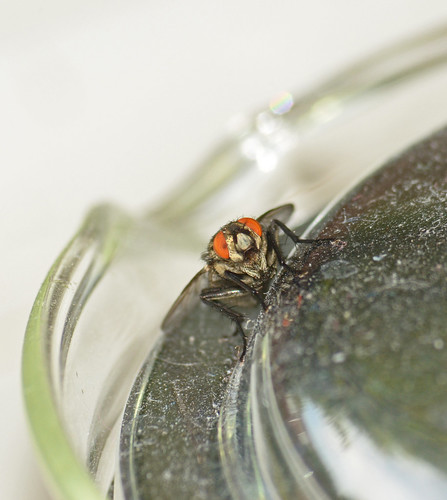
And on an earlier occasion, whilst fulfilling my domestic obligations and doing the washing up, this splendid red eyed dipteran appeared on the teapot on the kitchen window sill and sunned itself for long enough for me to grab the camera and snatch a few close ups.


I don’t know what species the fly is but if anyone is able to enlighten me I’d be very grateful. And it added an enjoyable interlude to the washing up too!

The lens I bought was the Sigma 70-300mm APO DG 4-5.6 macro zoom which can switch to macro between focal length 200-300mm. It has pretty solid build quality, it’s reasonably small (although it gains approximately 5.5cm in length at 300mm zoom) and is a pretty good little lens for general purpose zooming too.  It’s noisy and slow when moving from far away to close in, and vice versa, but as you can see I’ve had some fun with the local insects, and although I need a lot of practise it holds the promise of lots more minibeast shots. All in all it was a good ninety quids worth, and I shan’t be rushing out to spend lots of cash on a better quality lens just yet because I don’t think I need one. I shall carry on having fun with this cheap and cheerful one.


Brampton Wood

Again, harping back to last July, I took a stroll around a piece of woodland called Brampton Wood with a good friend of mine who is a bit of an expert on butterflies. Which is why we went to Brampton, which is ancient woodland made up primarily of oak, ash and maple and is famed for it’s exotic and scarce Lepidopterans such as black hairstreak, white admiral and silver washed fritillary.

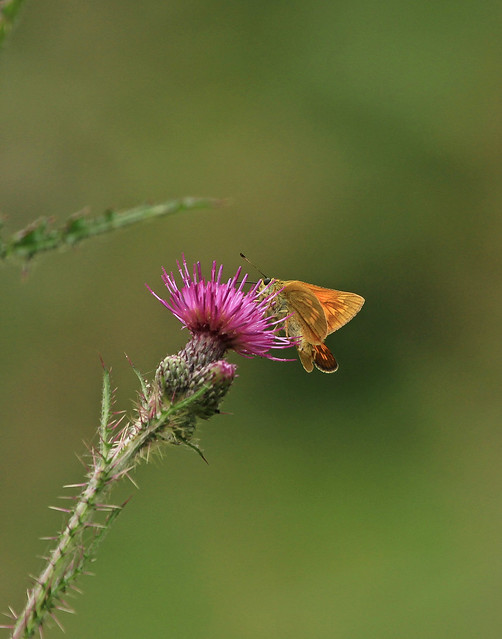
Large skipper – Ochlodes sylvanus

We didn’t see any of the rare species, mainly because the weather was generally unsuitable, but probably also because we were talking too much and not paying sufficient attention, but the species we did see gave some lovely photographs.

The large skipper is part of a big family of butterflies called the Hesperiidae or the ‘skippers‘, so called because they dash around from flower to flower in a skipping motion. They are also easily distinguished as a skipper because of the way they fold there wings at different angles when they are perched (for those of you with an aeronautical interest they remind me of the US Navy plane the F18 Hornet).

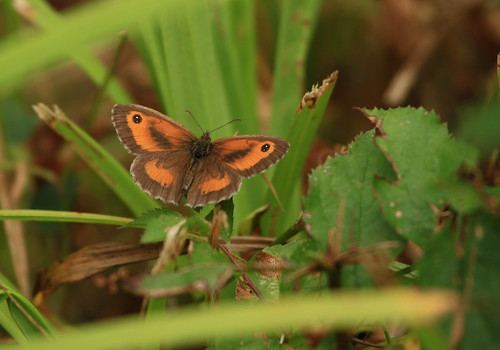
Gatekeeper, Pyronia tithonus, patrolling a leafy ride

The gatekeeper is a common hedgerow butterfly, but as with all the other wildlife in this part of the world, it suffers at the hands of intensive agriculture particularly when that involves grubbing out hedgerows. In 2010 my daighter and I did the annual ‘Big Butterfly Count’ in a scrubby field at the end of our road and we counted 11 species in the allotted 15 minute window, including the gatekeeper. A few weeks ago the tenant farmer, obviously a public spirited soul, grubbed out all the scrub and brambles which were home to all the butteflies, so I suspect numbers of all Lepidoptera, and the resident dragonflies, will be severely depleted this year. Which is a real shame as the field is fallow and not doused with chemicals so was a particularly good site for insects. The dark patches adjacent to the black spots on the forewings of the butterfly here are called the ‘sex brand‘ and mark this one out as a male, the same markings being absent in the female. The gatekeeper is also known as the ‘hedge brown’ which gives you a clue as to its preferred habitat.

The splendid creatrure below isn’t a butterfly, it’s a six spot burnet moth:

Six spot burnet – Zygaena filipendulae – adding some additional colour to a thistle head

The burnet moths consist of the burnets and forester families, they are day flying creatures and all have club shaped antennae. The six spot burnet is found in grassland feeding on thistles, scabius and and knapweeds, and its flight season is from late June to August. Apparently the red spots can sometimes be yellow, but I’ve never seen a yellow one.

The disappearing dove

Every year millions of migrating songbirds heading from Africa to Europe get blown out of the sky by weird people with shotguns. That combined with the policy in the UK of destroying habitat at an alarming rate is making life impossibly possibly difficult for some of our iconic bird species, one of which is the turtle dove (Streptopelia turtur, Dansk: turteldue).

But last summer I was exploring one of my regular haunts, Milton Country Park, on the northern edge of Cambridge, on a warm Saturday morning and the air was buzzing with insects including this handome hoverfly known as the ‘footballer‘ due to its rather fetching black and yellow striped thorax. This species is common in England reaching a peak in July which is when I snapped this individual.

The footballer hoverfly – Helophilus pendulus

And hoverflies aren’t the only abundant insects to be found in July. Milton Country Park is also home to mumerous species of Odonata, the dragonflies (Anisoptera) and damselflies (Zygoptera).

Common blue damselfly – Enallagma cyathigerum – perched on a seedhead

The Park has 4 big lakes:

MCP map

…and a few other streams and pools, and despite the abundant human presence it remains a haven for some properly exotic wildlife including a bittern that appeared for a week or so last year, and the occasional osprey stopping off on migration from sub-Saharan Africa to breeding sites further north in the UK.

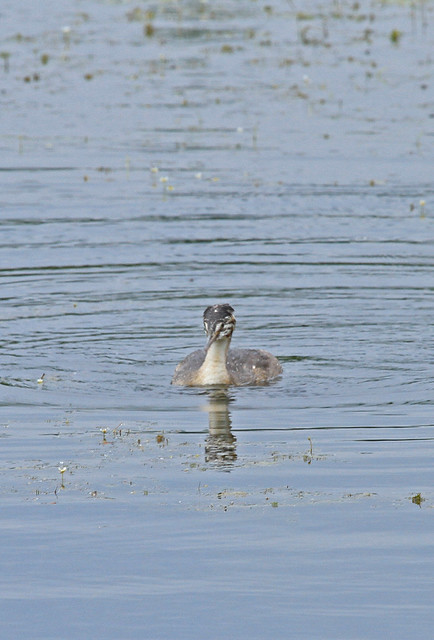
The great crested grebe (Podiceps cristatus, Dansk: toppet lappedykker) isn’t an exotic migrant but it’s a beautiful bird and can always be found here:

The grebe was almost hunted to extinction because its dense feathers were coveted as a substitute for fur. But it has recovered and can now be found on lakes over most of the UK. The one above is an adult and the one below still has the striped head markings of a juvenile.


But getting back to the point, the undoubted star of the show on this trip was the turtle dove:

The turtle dove is in very serious decline, I believe we have lost around 97% of our breeding population and it is anticipated it will become extinct in the UK by 2020 as it’s also under increasing pressure in Europe. The reason for its catastrophic decline is that it feeds on seeds from cereals and other plants and both of these are a scarce commodity in the fields of the UK at the time the doves need them.

So the birds arrive here in the UK exhausted after a heroic migration across the Sahara and the Mediterranean. And those that avoid the gun-toting imbeciles in southern Europe arrive here to find there’s not enough food. So as it takes them a long time to rest and feed and get back into breeding condition, they only have time for a maximum of one brood per season before they have to head all the way back. And this enforced curtailment of there breeding window means they just can’t sustain their numbers.

They arrive back in the UK from around mid April so I’ll try to capture some more photographs before they finally stop coming here all together.

Life in the kiln

After a lengthy absence from the blogosphere I’m rushing to squeeze a last post in in 2013. It won’t be topical so I’m harping back to a visit to the Lime Kiln in Cherry Hinton, on the southern edge of Cambridge, from back in July. I posted from here earlier in the year about the resident peregrine falcons.

The main reason for this visit to the Lime Kiln was to see if the peregrines were still in residence. One of them appeared overhead and gave chase to a pigeon, but it was in level flight not in  a stoop so the pigeon made good its escape. It was more like a juvenile practice run than a serious attempt to make a kill. It seemed that the family group had dissipated and were no longer spending the whole day at the Lime Kiln.

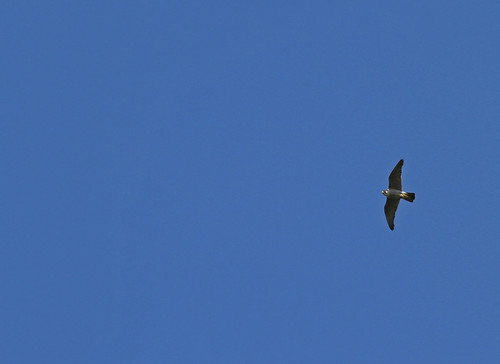
A single peregrine falcon – Falco peregrinus – quatering the Lime Kiln

The peregrine is the worlds fastest bird, but only in a stoop, which is gravity assisted and more a controlled fall than real flying. In level flight it is comparatively cumbersome and not the fastest, that accolade goes to a species of swift called the ‘white throated needletail‘ (Hirundapus caudacutus) with recorded level flight speeds of around 70mph (112km/h).

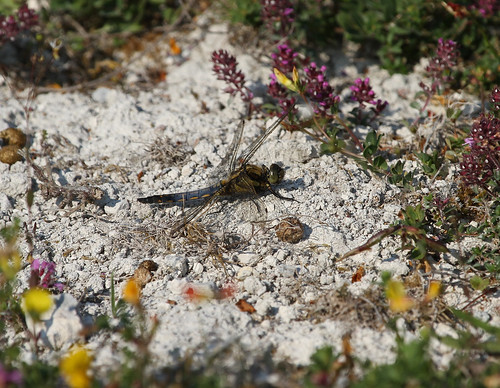
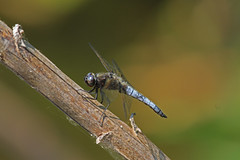
Black tailed skimmer – Orthetrum cancellatum

The black tailed skimmer dragonfly was perched on the chalky ground and this is characteristic behaviour of the species. As the temperature rises above the mid 20’s Celsius he will perch on low vegetation instead. This one is an adult male, his blue abdomen is diagnostic and can only be confused with the male scarce chaser, but he lacks the dark patches at the proximal end of the wings which distinguish the scarce chaser.

The female and the immature skimmer have yellow bodies instead of the blue of the male:

Black tailed skimmer female

I’m not entirely certain whether this skimmer is a female or a juvenile, the juvenile has pale green eyes and the female has darker grey/brown eyes so I think this one is a female. Interestingly, this species is associated with water and males will fiercely defend a bankside territory against other competing males. But as far as I know there is no water in the Lime Kiln so the male above may be a non-territory holding male, and females do spend time away fom water. The black tailed skimmer feeds on a variety of prey and can show a preference for bigger prey species such as butterflies and grasshoppers. They’re ferocious, albeit short lived,  predators!

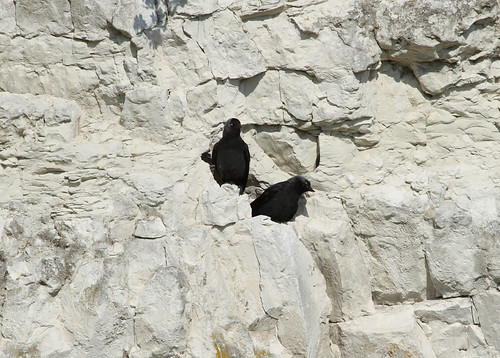
A pair of jackdaws, Corvus monedula

There were very few birds to be seen on this trip, it was at lunchtime on a very hot day (mid to high 20’s Celsius) so I think they may have been hunkering down in the shade, but I could hear a male whitethroat singing and a family of jackdaws were playing around on the white chalk cliff face.

Because of the relatively young age of the Lime Kiln, and possibly as a result of the unusual nature of the terrain, large areas of the floor are bare chalk and there are less plant species than there may be in a more conventional habitat.

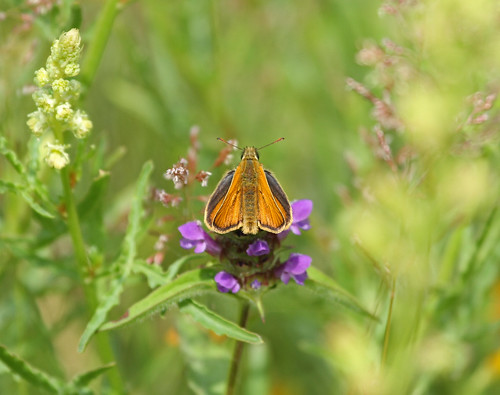
Either a small skipper (Thymelicus sylvestris) or an Essex skipper (Thymelicus lineola) sipping nectar from a self heal flower

One of the wild flowers growing there is self heal (Prunella vulgaris). This skipper butterfly was perched on a self heal flower head but I’m not sure if it’s an Essex skipper or a small skipper, they are very similar in size, shape and colour, and alas I’m not sufficiently expert to unambiguously identify them.

I didn’t manage to publish this post in 2013 so it’s now my first post of 2014. So Happy New Year to everyone, may the next 12 months bring you health and happiness!

Impington Lane

In the summer I posted about the desire of our local council to build houses on the green spaces around our village. One of those green spaces is a small area on Impington Lane which is between 5-6 acres in area, and a friend of mine who lives adjacent to this unassuming piece of scrub told me there were reptiles on the site which would be evicted if the proposed construction took place.

So with my campaigning hat on I set off very early one Sunday morning to try to capture some photographs of the resident reptilia to promote the argument that this diminutive fragment of green belt should remain unmolested.

Hedge woundwort – Stachys sylvatica

The reptiles were staying under cover but there were wild flowers in abundance along with the accompanying insects. Hedge woundwort, as the name suggests, has medicinal properties and was used to staunch bleeding.

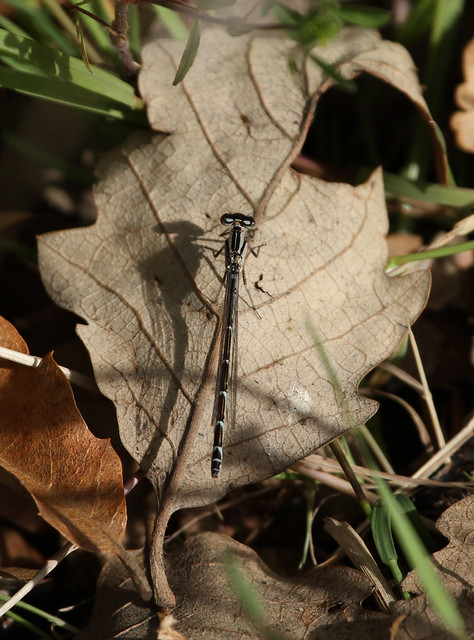
At 6am the sun was rising and it was already warm so damselfies were basking in the early morning sunshine to warm their bodies to enable them to go hunting. I found two species of damselfly:

Common blue damselfly – Enallagma cyathigerum

Variable damselfly – Coenagrium pulchellum

(I’m not totally confident of my damselfy identifications so if you spot a mistake please let me know).  The undergrowth in the field was waist high in most of it and it was full of these particular flowers:
Carder bumble bee landing to feed

It’s very similar in size and shape to another wild flower called jack-go-to-bed-at-noon which is yellow (Tragopogon pratensis). But all these flowers varied from pale pastel purple to rich dark purple. I don’t know what species these flowers are, or if they’re related to jack-go-to-bed-at-noon, or whether they are wild or escapees from gardens, but they are very pretty and the bees like them.

Fluttering amongst the stems of all the wild flowers were numerous examples of this handsome creature, which I first thought was a butterfly:


Subsequent research revealed that it’s not a butterfly at all, it’s a latticed heath moth, Chiasmia clathrata, and is one the moth species that is active by day in May and June in this part of the UK. They were fiendishly difficult to photograph as they were skittish and hunkered down close to the ground on the stems of the flowers, and any slight gust of wind rendered any photography impossible. But fortunately the wind abated for long enough to get one half decent portrait.

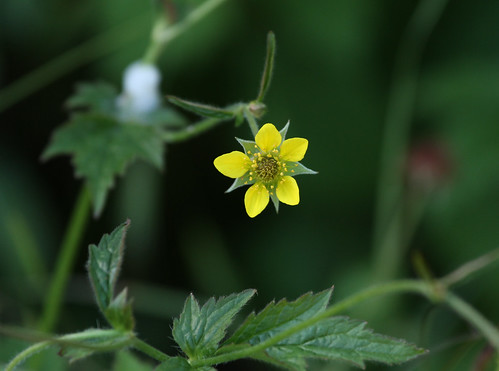
Herb bennet – Geum urbanum

Herb bennet, also known as wood avens, is a very pretty flower which prefers to grow in the shade and was lurking at the edge of the field out of direct sunlight.

Despite all the flora and insectivora, no reptilia put in an appearance on this outing. But in the weeks after my exploration my friend told me of two separate occasions where reptiles ventured into houses which are on the edge of this field, and as luck would have it both times someone managed to photograph the intrepid creatures and were good enough to send copies to me:

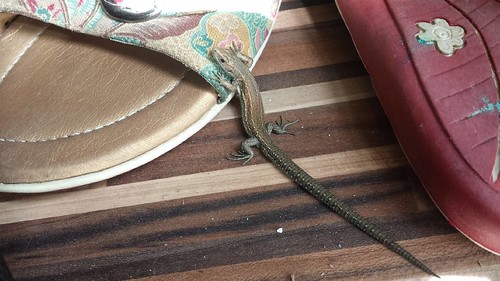
Common lizard – Zootoca vivipara

Despite the fact I very rarely see a common lizard they’re the UK’s most common reptile and can be found in most habitats including heathland, woodland,  grassland and gardens, from March to October. At my last house a quince bush grew around my front door and I found common lizards in there on a couple of occasions, showing that they can coexist with humans where suitable habitat and a lack of interference prevail.

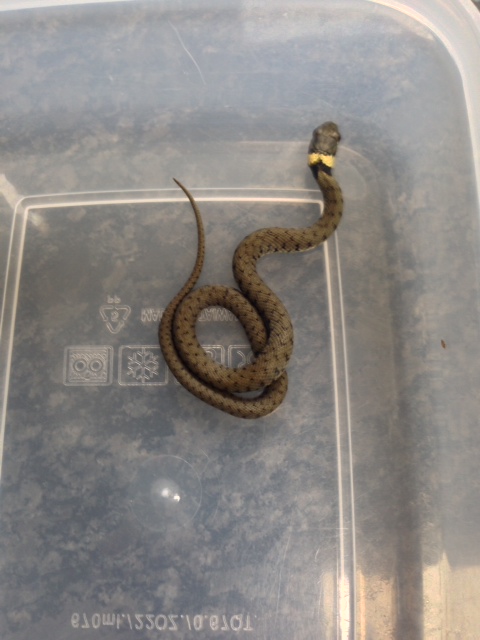
Grass snake – Natrix natrix – rescued in a sandwich box and restored to the wild

It’s not common to find reptiles in the UK and it’s extremely rare to find them in ones house! So the second invader, which I’m told caused much consternation, was a grass snake.  Grass snakes like to frequent damp recesses, they are proficient swimmers and feed mainly on amphibians.

My favourite grass snake story occurred some years ago when another friend of mine lived in Kent and had an enormous back garden with two small lakes in it. On a visit there I was helping declutter the edge of a lake by removing the offending undergrowth with a grass rake. And on shaking the rake to remove a big clump of weed a sizeable bright yellow snake fell off the bottom. I jumped out my skin and may even have uttered an involuntary yell (in fact it was probably more of a squeal), because I reasoned we don’t have big yellow snakes in the UK, and if it’s a foreigner it may well be less benign than Natrix natrix, and be unhappy at this unwanted intrusion. But a somewhat digruntled grass snake uncoiled itself, flipped the right way up and, glided into the lake and swam across to the opposite bank to take cover where the undergrowth was still undisturbed! I’m not sure who was most taken aback, me or the serpent.

Both the reptile species here are listed as priority species by the UK Biodiversity Action Plan (BAP). So I hope this will be taken into consideration when decisions are being made whether or not to destroy the green lungs of our village!

The birds and the bees

Insects have been hit hard by climatic aberrations in recent years and on my meanderings around the Cambridgeshire countryside this year numbers of bees and butterflies sightings have been down compared to previous years. It’s now the middle of June and I saw the first dragons of the year today; two damselflies. I also read this week in ‘The Guardian‘ newspaper that a third of managed honeybee colonies in the USA were wiped out in 2012. This article makes very sobering reading. And it’s a similar story in Europe, but in Europe neonicotinoid pesticides, which have been implicated in colony collapse disorder, have been banned for two years to evaluate their effect on honeybees. My concern is that the onslaught on the bees is complicated and removing one variable may not show a significant effect in the limited two year duration of the ban. But I hope it does!

Early last month the sun finally broke through and gave us some insect friendly weather and it was remarkable how quickly the microfauna emerged.

Beefly – Bombylius major

Beeflies are found over large parts of the globe and can be seen hovering in sunny glades from the springtime. The narwhal of the Dipteran world, the spike looks fearsome but is only used to probe flowers for nectar, there is  no sting. Beeflies procreate by flicking their eggs into the entrance to the burrows of wasps and bees where the larvae feed on the grubs of the occupants.

A pair of hoverflies doing their best to rectify the decline in the insect population

I think these hoverflies are ‘Eristalis pertinax’ but I’m not certain. It was good to see them though, especially as they were taking their biological responsibilities so seriously.
Addendum: on the subject of climatic aberration mentioned at the top of this post I just found and read with increasing concern this link:

http://robertscribbler.wordpress.com/2013/04/12/human-climate-change-is-wrecking-the-jet-stream-uk-met-office-calls-emergency-meeting/

which my blogging buddy Sam posted on her excellent WP blog ‘Science on the Land‘. This provides a chilling insight (in every sense) into why the weather in the northern hemisphere is behaving the way it is. And it doesn’t look as though it’s going to get any better folks.

Anachronous insecta

A few posts ago I showed you some of the spider I encountered in the short spell of good weather we had in the late summer and early autumn. I think maybe some species were making hay whilst the sun was shining because there were also a lot of hoverflies around at that time too. And here are  three of the species I found. It’s the wrong time of year to be posting about hoverflies, hence the title of the post, but I haven’t been able to get out with my camera so I reckon a hoverfly post is better than none at all! Identifying hoverflies can be tricky because there are species which look very similar to each other and I’m no expert, so I hope my identifications are accurate but if any of you spot an error please let me know.

Eristalis tenax

Eristalis tenax is a type of hoverfly known as a ‘drone fly’, so called because they mimic honey bee drones. They are common throughout the UK and the females, which mate before overwintering and laying their eggs in the springtime, can be seen in any month of the year because they emerge from hibernation to feed when the weather warms up sufficiently. The larvae of this species are called ‘rat-tailed maggots’ and feed in sewage outflows and rotting carcasses – the more putrid it is the more they seem to like it! They are aquatic and the reason they are called ‘rat-tailed’ is that they have an extendable tube which can protrude up to around 5cm which they poke out of the water and use to breath air.

Tapered drone fly – Eristalis pertinax

The tapered drone fly is so called because the male has a tapered abdomen which is visible on this individual. It is otherwise a similar species to E. tenax and it’s larvae are also known as rat-tailed maggots. Apart from the taper it’s also distinguishable from E. tenax by it front legs which are pale.

My favourite hoverfly I found this year is this one:

The footballer – Helophilus pendulus

It’s called ‘the footballer’ because it’s colours are likened to a football shirt. It’s scientific name means ‘dangling sun lover’. The larvae of this species feed on detritus and have been found in wet manure, drains and in very wet sawdust. It’s widespread throughout the UK and can be seen throughout the summer in bright sunny locations in hedgerows. Despite the unsavoury but indispensable habits of the larvae of all of these species they transform into the most handsome adults.

I haven’t done a dedicated Christmas post this year so here’s wishing you all a very merry Christmas and a happy and healthy 2013!

The Four Spot and the Strawberry

Regular readers of The Naturephile may have noticed numerous references to the loopy weather we have experienced in this part of the world this year, in particular the wetness of the spring and the subsequent brevity of the summer. And you may also have cottoned on to the fact that I have a spider fascination.

Despite the unusual summer weather conditions, later on in the summer and into the autumn I found lots of spiders including two species which I haven’t seen here before. Common garden spider webs (Araneus diadematus) adorned every surface in my garden in the autumn and this particularly nice example was strung between two hawksbeard stems in the local meadow:

Garden spider web bejewelled with dew

One of the most intricate webs I found was that of the labyrinth orb weaver (Agelena labyrinthica), they’re amazing constructions and most of them aren’t very visible until there’s a cold morning and the webs are laden with dew, then it’s possible to see that they adorn all the hedgrows and undergrowth.

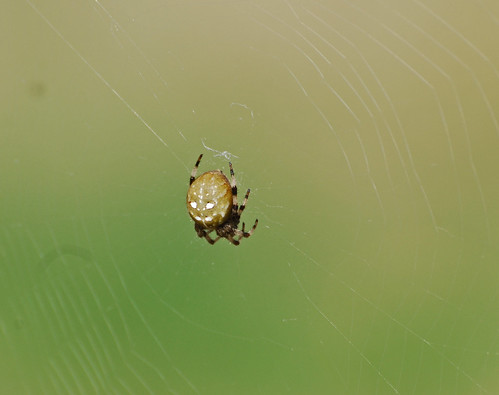
The two species I found which I hadn’t seen before were the four spot orb weaver (Araneus quadratus) and the strawberry spider (Araneus alsine, aka orange wheel weaving spider).

The green body of the four spot orb weaver

Both my initial encounters with these little beauties were a little unnerving because I was unaware that spiders with these colours were lurking in my local undergrowth. The four spot flew past me at high speed when I snagged it’s trip line when I was trying to get in position to photograph a male common darter dragonfly:

https://i0.wp.com/farm9.staticflickr.com/8066/8155314987_f0c0087b41.jpgA male common darter dragon – non-arachnid interloper in this post

And a strawberry spider dropped down a few centimetres from my eyes when I was unlocking my gate! All I saw was a bright red bulbous abdomen so my first thought was “Bloody hell, it’s a black widow!”. So I ran to get my camera before it disappeared. Both of these were females and around the same size as a regular garden spider, but as you can see the colours were very different.

The bright red body of the aptly named strawberry spider

Another spider I found in my garden this year was the missing sector spider (Zygiella x-notata). I was intrigued by the name of the missing sector spider and it transpires it comes from the design of the web. If the planar, circular web is a clockface, the part between 11 and 12 o’clock has no spiral threads, so is effectively a ‘missing sector’.

The missing sector spider making a meal out of a cranefly

This particular individual was busy securing a cranefly and it seemed to take great pains to ensure the fly was maximally envenomated. It spent a couple of minutes running around the struggling fly, inflicting multiple bites before wrapping it up in a cocoon of silk and carrying it off to be hung from the window frame and consumed at leisure.