Category Archives: Waders

All those flocking waders…

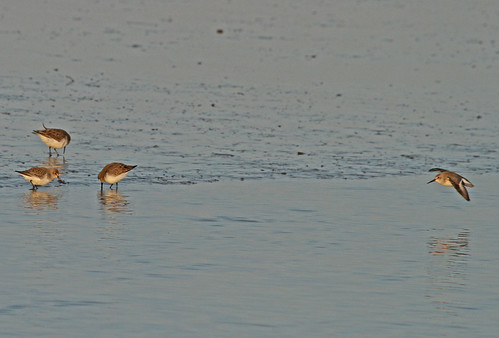
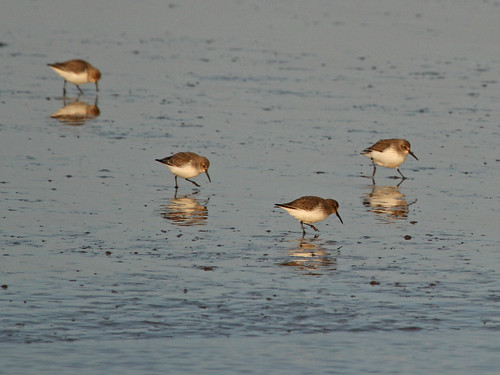
A couple of posts ago I wrote about the vast flocks of geese which overwinter on The Wash; and there were also big numbers of other birds including small groups of dunlin close in by the shore:

Dunlin (Calidris alpina, Dansk: almindelig ryle)

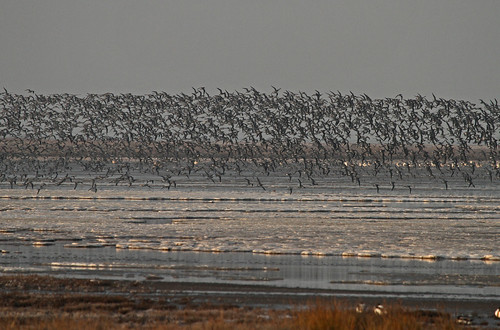
But a little further out, and almost invisible until they took to the air, were enormous flocks of thousands of dunlin. I couldn’t see what flushed them, but every few minutes they rose en masse and put on a stunning display of aerobatic prowess:

Thousands of dunlin moving in very close proximity at high speed and never colliding

Occasionally they turned into the sun creating a shimmering ribbon of grey and white across the sky:

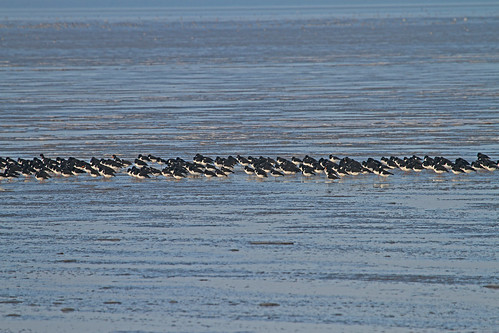
And as with the geese in the previous post the other thing which I hadn’t thought about until they were swirling overhead was the noise. It was a very different sound to the geese which gave a slow muted beating sound, the dunlin sounded more like a fast moving cloud of enormous insects. It was a really exciting spectacle. And as well as the dunlin flocks of oystercatcher wheeled over from behind and landed in a line on the mud flats:

Several hundred oystercatchers (Haematopus ostralegus, Dansk: Strandskade) seeking safety in numbers

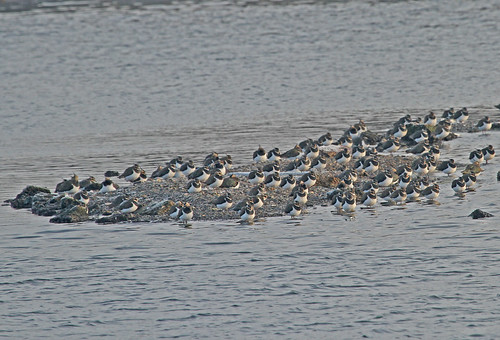
… and it’s always good, but increasingly seldom, to see flocks of lapwing (Vanellus vanellus, Dansk: vibe):

When I was a kid in the 70’s vast flocks of lapwing were a relatively frequent phenomenon in the fields out in the countryside around home, but their numbers have plummeted twixt now and then, so it’s good to see there are still places where thay can still be found doing what lapwing should be doing!

Winter in the Wash

One of the ‘must see‘ natural events in the UK occurs in the winter when hundreds of thousands of ducks, waders and, in particular, geese spend the season on the mudflats of the Wash. The Wash is a huge bay on the east coast of England into which the rivers Witham, Welland, Nene and Great Ouse all drain into the North Sea.

When the tide recedes, like Morecambe Bay in the previous post, enormous areas of mudflats are exposed which provide sustenance and a roost site for colossal numbers of birds. Every morning at dawn thousands of geese take flight to head inland to feed, and the geese are what everyone goes there to see.

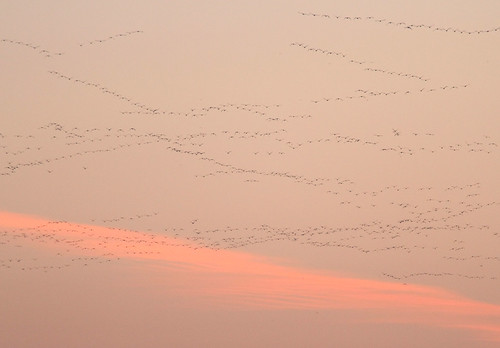
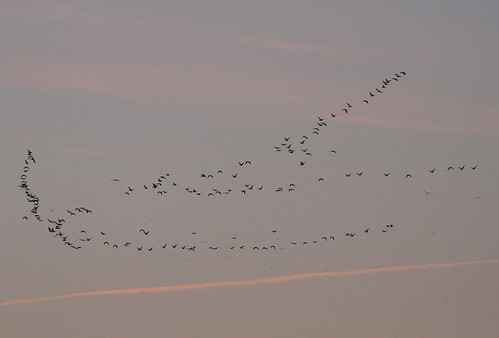
Multiple skeins of pink footed geese at Snettisham at dawn (Anser brachyrhynchus, Dansk: kortnæbbet gås)

I arrived at the coast at Snettisham on the north Norfolk coast around 6am when it was just starting to get light. Already sizable flocks of geese were in the air and I was concerned that I’d missed most of them. But then as the sun rose higher gargantuan flocks started to pass overhead and it was a truly incredible sight!

I don’t know how many thousands of geese were there but at the end of the day I went back to the same place to see them return. It was getting dark and all was still, so, as in the morning, I thought I’d missed them. And then they appeared, quite suddenly in their tens of thousands. I tried to estimate the numbers by counting small numbers of each wave and multiplying up, and I estimated there were between 30-40,000 birds returning.

Skeins within skeins, I like this formation

And if you’ve ever spent any time near geese you’ll know that they’re not afraid to announce their presence, so the other thing that I hadn’t expected, but maybe I should have done, was the noise. It was a magnificent cacophony! And not just the squawking, but the sound of them flying when they came over lower to the ground.

These birds breed in the summer up in the Arctic, in Greenland, Iceland and Spitsbergen and then head south to the relatively balmy conditions of the UK coast in winter (!).

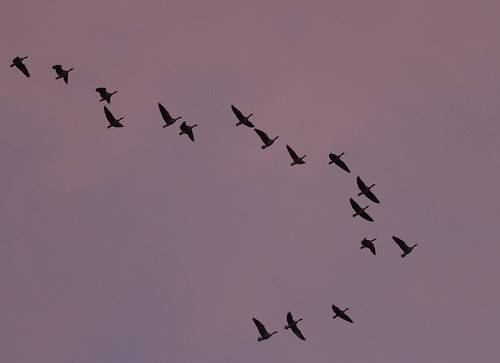
Another skein of pink footed geese passing low overhead

It’s unknown why geese fly in skeins, but it’s thought to provide an aerodynamic advantage to the ones behind as they slipstream in turbulent air generated by the bird in front. Which makes me wonder if they constantly switch the pacemaker or if the biggest and strongest bird is always the one at the front.

I estimated there were around 500 birds in this huge flock, but even that was a tiny proportion of the total

To see this meant getting up and out at 4am which is never my favourite thing to do, and it was ferociously cold, but it was worth it to see such a unique spectacle. And as the sun rose and it got lighter, it soon became apparent that the geese weren’t the only seabirds in the area:

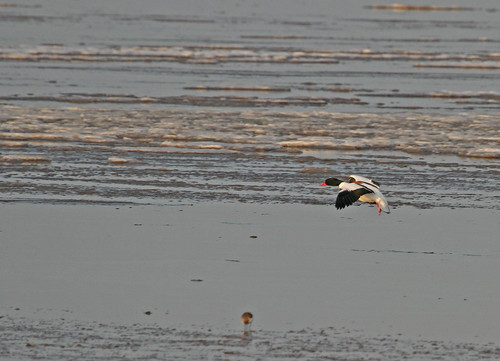
A shelduck (Tadorna tadorna, Dansk: gravand) on final approach past a lone dunlin in the foreground

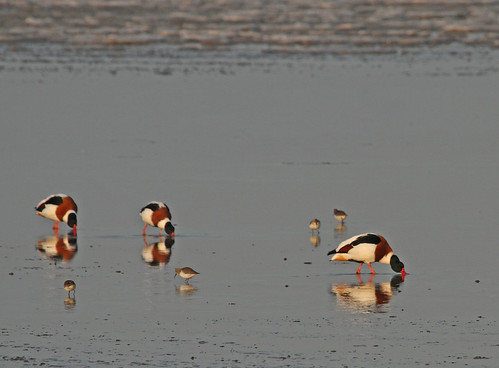
Small flocks of shelduck and dunlin were mingling and feeding close in to the shore

The Wash is now not the only significant area of coastal mudflat in East Anglia. In order to attempt to mitigate some of the anticipated ravages of climate change, flood defences protecting areas of farmland on the coast further south in Essex have been deliberately breached. This has allowed the land to be reclaimed by the sea and to regenerate the tidal mudflats that were there before humans originally interfered. The new habitat  was created with the millions of tons of earth removed the ground under London in order to build the Crossrail tube train tunnels. And as soon as this happened the wildlife started to recolonise, and even though it is still fairly barren in comparison to established habitat, I hope that in the near future it will also provide refuge to hundreds of thousands more birds, and lots of other wildlife too.

Dunlin (Calidris alpina, Dansk: almindelig ryle)

But more of dunlin in the next post, and plenty more species of sea birds both at Snettisham and after that at the RSPB coastal reserve at Titchwell.

Morecambe Bay

Since my posting rate plummeted a couple of years ago, due mainly to the increased pressure of work, I’ve still been out and about accumulating a lot of photographs so now I’m going to try to get some of them into posts.

In early spring 2014 I found myself at Morecambe bay in Lancashire which is famous for its vast tidal mudflats that constitute a well stocked larder for a multitude of seabirds, and maximum danger for the unwary beach walker. The Irish Sea tides race in and swirl about at incredible speed and there are areas of treacherous quicksand too.

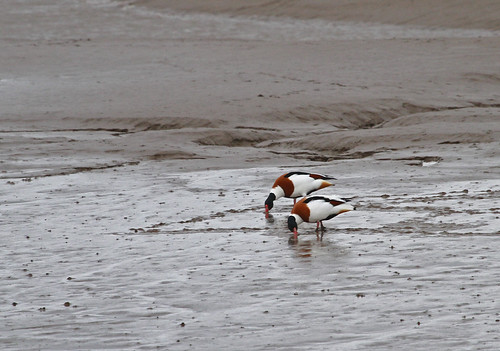
A pair of shelduck (Tadorna tadorna, Dansk: gravand)

The bay is so enormous that when the tide’s out it’s not always easy to see much wildlife, but by the pier in front of the Midland Hotel there were shelduck, curlew and oystercatchers and I also caught a tantalising glimpse of a distant red breasted merganser.

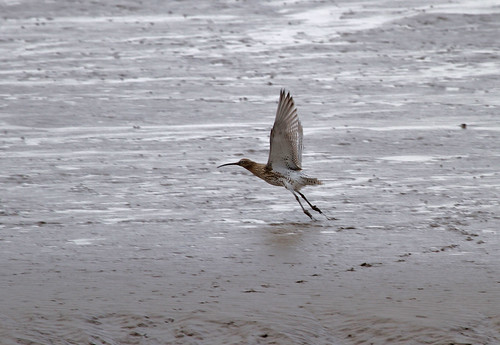
A curlew on full power for take off (Numenius arquata, Dansk: storpsove)

As I didn’t have my camera with me and I’d never succeeded in getting a picture of a merganser, I returned to the same spot very early the following morning with the relevant optics. It was the end of February and the weather was filthier than a Springbok in a ruck (which as any rugby fan will know is as dirty as it gets!) –  it was freezing cold and blowing a gale, so I sat on the ground with my back to the wind, and waited.

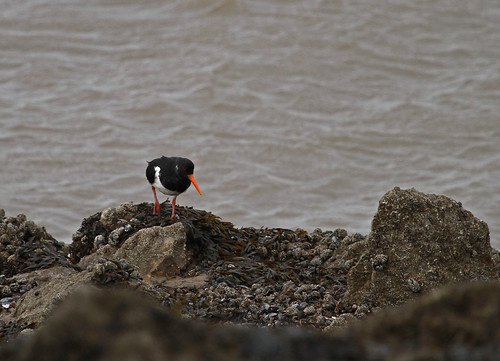
Despite what I said earlier, there were a good number of birds in the vicinity including curlew, shelduck, redshank and this oystercatcher who landed right in front of me and every so often he popped up into view as he mined the crevices in the rock for his breakfast.

An oystercatcher (Haematopus ostralegus, Dansk: strandskade) landed close by on the rocky shoreline

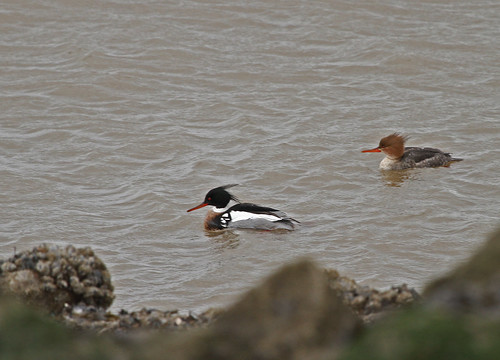
And I didn’t have to wait too long before not one, but a pair, of red breasted merganser appeared in the water just 20 or so metres away, which justified getting out early and braving the elements:

Male (dark headed) and female (brown headed) red breasted merganser (Mergus serrator, Dansk: toppet skallesluger)

I think these are spectacular birds. They are generally resident breeders on the west coast of England and winter visitors on the east, so these were probably residents. They are one of two species of saw-toothed ducks, the other one being the goosander, which are resident in the UK. They have serrated beaks which they need to grasp their fishy prey which they can catch by chasing them under water. According to the BTO there are 2200 pairs in the UK in the summer and their conservation status in the UK is green suggesting the population is stable at least in this part of the world. The only other time I’ve seen a merganser was a month ago down on the south coast at Keyhaven, so they’re an uncommon but splendid sight!

Loch Mallachie

Loch Garten is mainly associated with the osprey and is the home of the flagship RSPB reserve set up to protect and provide access to this most remarkable of birds.

But the osprey isn’t the only bird to be seen in this part of the world, and as I’d never been here before I was really hoping to see crested tit and Scottish crossbill in the coniferous forest around the lake. Suffice to say, despite looking long and hard I saw neither. But far from being despondent I see it as an excellent reason to go back there and try again!

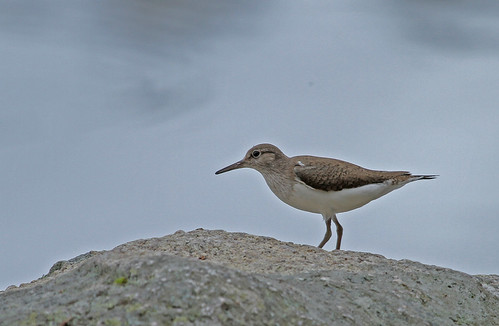
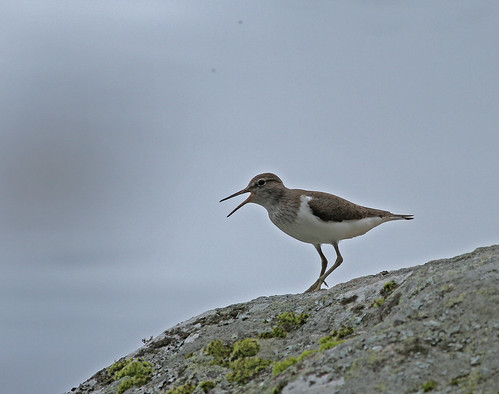
Common sandpiper – Actitis hypoleucos, Dansk: mudderklire

In the same part of Abernethy Forest and a short distance from Loch Garten is Loch Malachie, so myself and my companion decided to explore there after drawing a blank on tits and crossbills at Garten.  But instead of them, we found common sandpipers and in my book that’s a fair exchange:

The sandpipers are very neat little waders and there were several of them patrolling the large boulders on the shore of the lake. They weren’t overly impressed with our presence and to show their disquiet made several low looping flights along the shore and around behind us through the woods, which felt like an unusual place to see a sandpiper in flight. So we collected a few photographs and retreated to leave them in peace.

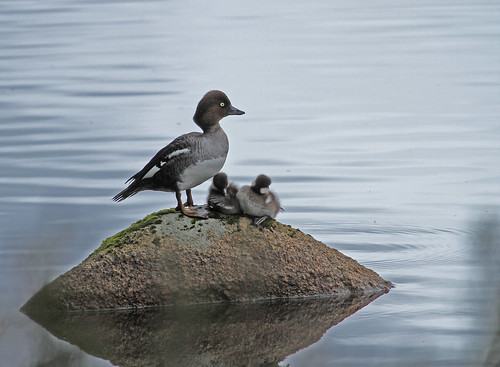
Goldeneye – Bucephala clangula, Dansk: hvinand

On the same piece of shore line as the sandpipers was this female goldeneye with a pair of chicks. The goldeneye overwinters over much of the UK but has a very small breeding population of only a couple of hundred pairs, largely due to a program of nestboxes on Speyside – the goldeneye is unusual amongst ducks in that it nests in holes in trees. There was no male accompanying this family which is pity because they’re spectacular!

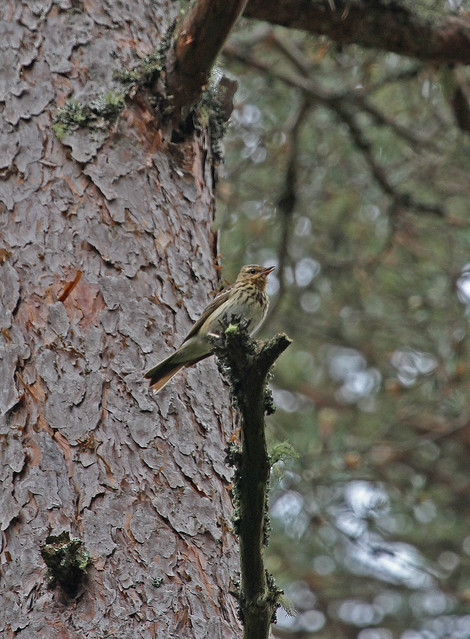
It  was a grey, damp, overcast morning in the Abernethy Forest around Loch Malachie and may be because of that it was eerily quiet. There were very few songbirds and the ones we saw most of were wren and chaffinch, which are also common visitors to my garden. But then we saw a spotted flycatcher which is definitely not a visitor to my garden:

Spotted flycatcher – Muscacapa striata, Dansk: fluesnapper

The spotted flycatcher is a migrant breeder to the UK, it overwinters in Africa and is red listed due to overall decline as a result of decreasing prey species caused by pollution and insecticide use (>30% over 10 years). Despite that, the European population is estimated to be 42-66 million individual birds (according to Birdlife International).

Apart from the beautiful wildlife, what I really noticed in the forest was the complete absence of human noise polution (it was silent apart from the wind and the birds), and the smell of the pine forest, and there are few natural aromas as delicious as the fresh smell of pine mixed in with the leaf mould underfoot. But the best thing was the silence!

Minsmere raptors

Whilst I was at RSPB Minsmere, which I described in my last post, I was expecting to see birds of prey because I know that marsh harriers (Circus aeruginosus, Dansk: rørhøg) nest in the reedbeds there and it wouldn’t be totally unexpected to see a hobby (Falco subbuteo, Dansk: lærkefalk) or a peregrine falcon (Falco peregrinus, Dansk: vandrefalk).

Avocet were nesting on the mudflats along with plenty of other birds including the black headed gulls (Chroicocephalus ridibundus, Dansk: hættemåge):

Black headed gull in full summer plumage guarding its nest

I was engrossed peering into the distance with my new spotting scope, and I found a spoonbill (Platalea leucorodia, Dansk: skestork). The Danish name translates as ‘spoon stork‘ which just about sums it up really. I didn’t get a photograph because it was too far away, but it looks exactly like a white stork with a long beak shaped like a spoon. The conservation status of the spoonbill is amber and it is extremely rare in the UK and not terribly common on mainland Europe either. According to the British Trust for Ornithology there are 75 individuals in the UK and between 1998 and 2002 there were only 4 breeding pairs.

But I digress. As I was gazing into the disatnce the air raid warning was sounded: “There’s a peregrine… there are two!”

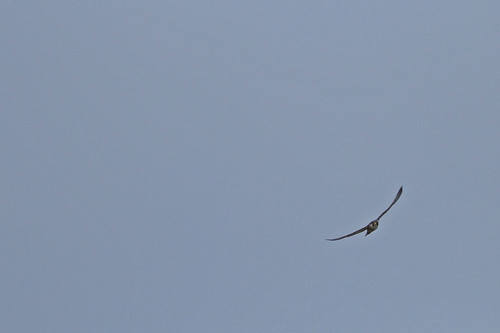
A peregrine falcon swooping down onto the nesting gulls

The falcons, I found out subsequently, were nesting on Sizewell B, the nuclear power station adjacent to the reserve. They arrived from that direction and when attacking they appeared to be working in tandem. The speed of their forays was absolutely breathtaking and caused total chaos on the ground:

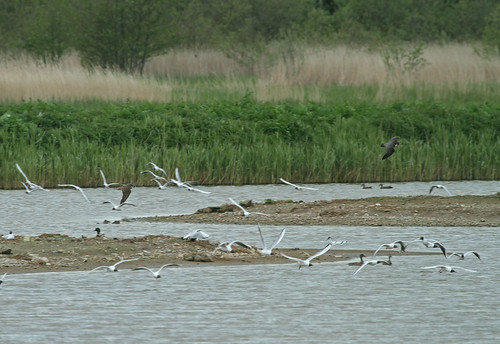
The nesting gulls trying to distract the pair of peregrines

I tried to capture the falcons in the middle of their attack which was not easy, but I managed to catch one just above the left hand point of the mudflat behind. It wasn’t until I looked at the image at home that I realised the second falcon was in shot on the right too. So even though this photograph won’t win any awards I really like the drama going on here!

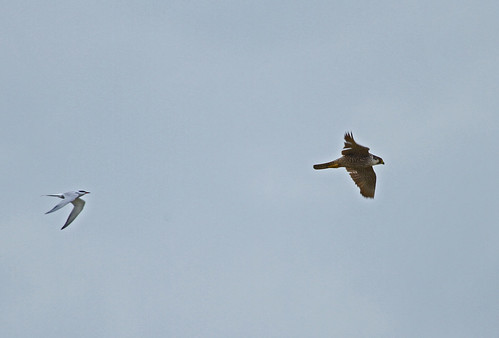
A common tern giving chase to deter the peregrine

The falcons raid lasted for several minutes and I didn’t see them catch any prey, thanks in no small part to the bravery of the common tern (Sterna hirundo, Dansk: fjordterne).

After the excitement of the falcons I ended up in a hide on the edge of the woods overlooking the reedbeds and sure enough the marsh harriers were much in evidence:

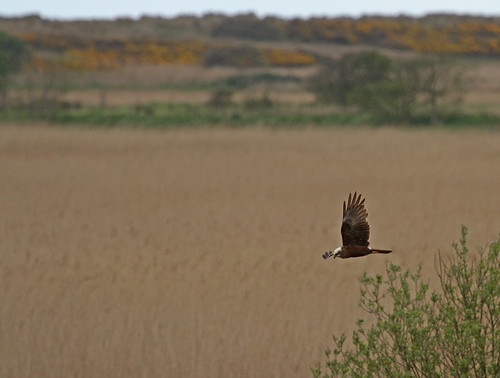
The female marsh harrier with her brown plumage and golden yellow crown

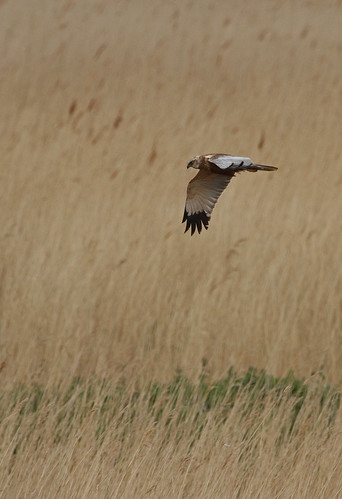
… and the male:

Whilst photographing the male marsh harrier a brown shape lifted out of the reeds and someone in the hide identified it as a bittern (Botaurus stellaris, Dansk: rørdrum). It was too fast for me to identify it by myself as I was focussed on the harrier, but that means I heard one booming at Lakenheath in the morning and saw one at Minsmere in the afternoon. Not a bad day out.

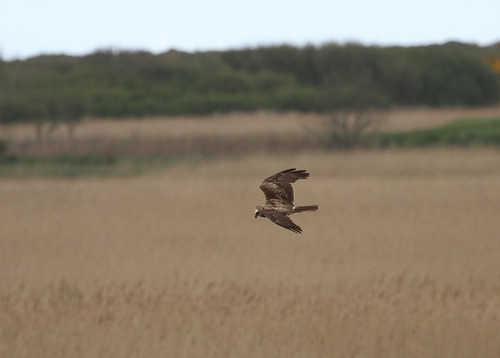
Juvenile marsh harrier with ragged brown plumage and no yellow crown

I didn’t see a hobby but it would be churlish to dwell on that after the excitement of the peregrines, the family of marsh harriers, and the bittern and spoonbill neither of which I’d previously encountered.

A day out at Minsmere

RSPB Minsmere is nestled on the North Sea coast in Suffolk sandwiched between the heather and gorse of Dunwich Heath and the nuclear power station at Sizewell. I spent a day there at the end of June and the plan had been to make a 5 a.m. start and get there for the sunrise. But the weather on that morning was foul so I started later and stopped off on the way there at RSPB Lakenheath Fen, on the west side of Suffolk, to wait for the rain to abate. Lakenheath Fen was previously owned by the Bryant and May match makers so the woodland there is primarily poplar which is apparently the wood of choice to make match sticks. Consequently the air is filled with that wonderful noise that poplars make when the wind blows.

Despite the pouring rain, which precluded photoghraphy on the Fen, the omens were good. There were reports of a red footed falcon which I didn’t see, but I did see a wild otter, the first time I’ve ever seen one. And I heard a bittern booming, and it was the first time I’d heard that too. So that was two new encounters even before I’d reached the coast.

The bittern (Botaurus stellaris, Dansk: rørdrum) is a small brown heron which lives in reed beds and hunts fish so stealthily that it’s next to impossible to see until it moves. The booming is an amazing sound and the recording can’t really do it justice, it can be heard for more than a kilometer and the only thing I can liken it to is a distant foghorn. Coming through the reedbeds early on a quiet rain sodden morning gave it a ghostly quality which is difficult to describe. Bittern are rare and to give you an idea of how unusual it is to see, or hear, one, there were only 600 individuals in the whole of the UK in 2010/2011 and only the males boom. East Anglia is a good place to look though because they migrate here across the North Sea from Holland, and the first breeding record was in Norfolk in 1911, having been extinct in the UK in 1868.

From the Fen I headed off in my rainsoaked state to Minsmere. But the gods were with me as the sun came out on the way and stayed out for the rest of the day. It turned into a scorcher.

Common whitethroat male guarding his bushes

On the way into the reserve from the carpark the habitat is woodland which opens out onto grassland before arriving at the fresh water and salt water lagoons. There were reports of stone curlew on the heath and an old twitcher with a telescope claimed to have spotted them, but I couldn’t find them and remained sceptical. But in an adjacent bush was a male whitethroat patrolling the apex, even though it was the end of June he was one of the first I’d seen this year. Pausing momentarily to snap the whitethroat I then wended my way to a hide overlooking the salt water lagoons.

Sandwich tern (Sterna sandvicensis, Dansk: splitterne) snapped from the comfort of the hide

The main hide overlooking the lagoon is, in my opinion, pretty much perfect. It’s a modern and substantial affair and it made me chuckle listening to the twitchers grumbling about how they preferred sitting in a draughty cold shed with limited views and no comfort whatsoever. I’ve got no problem doing it the old fashioned way when it’s the only option, but when the facilities are to hand I much prefer to sit in warmth and comfort with panoramic views through huge glazed windows which can be opened if so desired. And on this occasion the facilities were available, so that’s what I did, and I hope you like the results…

A pair of common terns – “Where’ve you been? I’ve been worried sick. You treat this place like a hotel!”

The common tern (Sterna hirundo, Dansk: fjordterne) on the left had been sitting there for many minutes, then the one on the right arrived to be scolded mercilessly by it’s companion, and this happened each time the second one came back after a brief fishing trip. The common tern could easily be mistaken for the arctic tern (Sterna paradisaea, Dansk: havterne) but is easily distinguished at a glance by the black tip to its beak which is absent in the arctic tern. Both species are consummate aeronauts and fishermen, and they both breed in Europe before migrating south to Africa and beyond.

There were big numbers of all kinds of seabirds on the lagoon including the terns. Gulls, black tailed godwits, a spoonbill (another first ever sighting for me), and numerous ducks including shoveller and shelduck, none of which I got really good photographs of. But this pair of gadwall (Anas strepera, Dansk knarand) were feeding close by and did allow me to photograph them:

Male gadwall behind nesting black headed gulls…and the female of the species

Gadwall can often be seen on lakes inland in the winter when they appear drab and uninteresting compared to say a shoveller or a goldeneye, but in bright light in their finest breeding plumage I think they’re quite splendid.

The star of the show at Minsmere is often the avocet. I’ve seen them and photographed them here before but this time they were nesting on a mudflat close by:

The iconic avocet (Recurvirostra avoseta , Dansk: klyde)

Avocet parent-to-be looking after the nest

The other avocet parent was sitting on the nest and occasionally stood up to turn the eggs. It did this every few minutes giving nice views of the eggs which would be extremely well camouflaged when exposed to potential predators such as the great black backed gull.

At one point a pair of peregrine falcons appeared and proceeded to launch multiple waves of tandem attacks on the ground nesting birds. It reminded me of the scene at the start of the film ‘Battle of Britain’ when the Luftwaffe fighters swoop down and shoot up a British airfield. Suffice to say all hell broke loose, it was highly entertaining to watch, and I’ll write more about that in my next post.

It’s not just the birdlife which marks Minsmere out as a special place for wildlife. I knew there were red deer (Cervus elaphus) in this part of Suffolk but I’d only ever seen occasional individuals and one or two small groups in the past. But on the way off the reserve in the early evening there was a big field in which there were several hundred of them.

Grazing red deer

On first spotting these I thought they were livestock on a farm, but then I realised there were no fences that they wouldn’t be able to simply step over so they must be wild. I’d never seen so many of these in one place before.

On an unrelated note (the trip to Minsmere was in June and I’m writing this in August), so far this year in Cambridgeshire there has been a dearth of butterflies especially small tortoiseshell. But the day before yesterday there was one flitting around the entrance to work when I came home and when I got here there were five more on my buddleia bush. And yesterday there were more in the garden. So I hope they’re making a late recovery, along with other hard hit species, from the Lepidopteran devastation inflicted on them by the cold weather in previous three years.

Bridlington beach

After spending the morning up at Flamborough Head I spent the afternoon on the beach in Bridlington harbour.

Flamborough Lighthouse from the beach at Bridlington

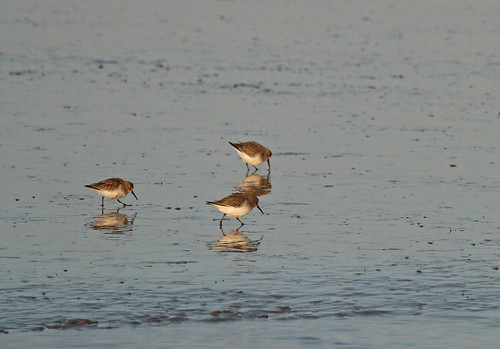
Groups of knot were scouring the tideline

I like knot, they are very busy birds hunting invertebrates on the tidal mud and their taxonomic name is ‘Calidris canutus‘ (Dansk: islandsk ryle) named after the Viking king famed for being able to hold back the tides. I think that’s probably where the English name comes from too, because the Danish spelling of ‘Canute‘ is ‘Knud‘ – which isn’t a million miles from ‘Knot‘. They can sometimes be seen in enormous flocks of to 100,000 birds, which is a sight I’d love to see.

A knot and a redshank with an oddly distended neck

The knot has the most gorgeous rufous breeding plumage where the breast turns to a coppery red colour and the light parts of the feathers on the back turn brown, but as I only ever see them in winter I’ve never seen the full breeding regalia.

Another redshank (Tringa totanus, Dansk: rødben) cooling its feet in the ‘surf’

I wrote about the turnstone (Arenaria interpres, Dansk: stenvender) in my last post about Bridlington, but this one was a real character. It scuttled along the parapet of the sea wall as people were walking to and fro just a few feet away and was quite happy for me to point a camera at it. And I got some nice portraits of it standing on the stone sea wall with the blue sea in the background:

And the whole time we were in Bridlington a lone barnacle goose (Branta leucopsis, Dansk: bramgås) was in residence. Barnacle geese nest way up in the Arctic, in Greenland and Spitsbergen. Because they are never seen on a nest in the UK it was thought that they didn’t originate from eggs but that they started life as goose barnacles which live in deep water but can sometimes be found washed up on debris dislodged from the sea bed.

Barnacle goose fattening up in England before a long flight north to the Arctic

The day after the day before

It’s been far too long since my last post, life has been frenetic resulting in little or no time for WP’ing. But I’m back now and after I’ve completed this post I shall be taking a grand tour of all your blogs that I’ve been  neglecting recently!

In my last post I mentioned the frigid weather conditions prevailing on top of the cliffs at Bempton back at the end of February. But the day after that clifftop adventure was bright, sunny and warm, and we were up on top of Flamborough Head, just a few miles south of Bempton, running around in shirt sleeves. What a difference a day makes.

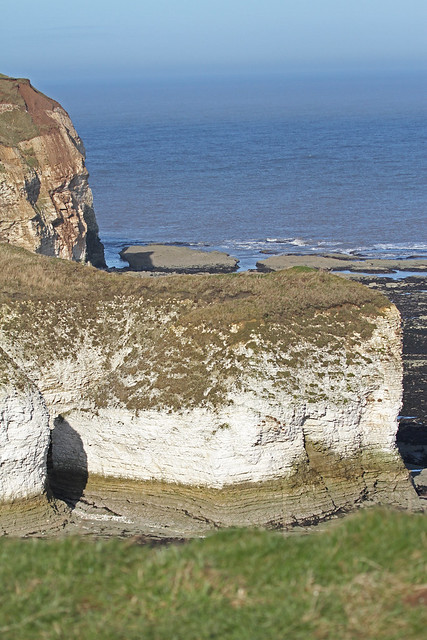
Looking north along the cliffs from Flamborough lighthouse in lovely warm sunshine!

On a sunny day the coast in that part of the world is a wonderful place to be, and there’s wildlife in abundance:

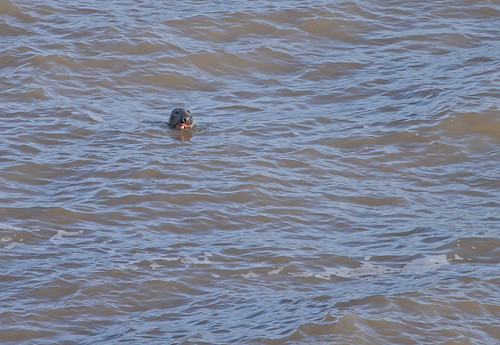
North Atlantic grey seal enjoying breakfast in relaxed fashion

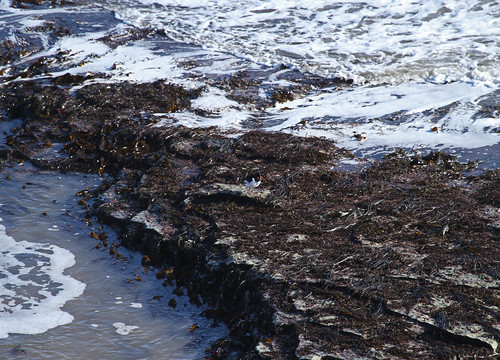
And while the seals were taking life easy in the sea the shoreline was patrolled by various seabirds including this oystercatcher who was picking over the recently exposed seaweed looking for crustaceans.

Not the best picture of an oystercatcher (Haematopus ostralegus, Dansk: strandskade) I’ve ever taken but I like the rock and the surf! After the clifftop we headed down to the harbour at Bridlington where the tide was out and lots of seabirds were picking over the detritus you might expect to find around a working harbour.

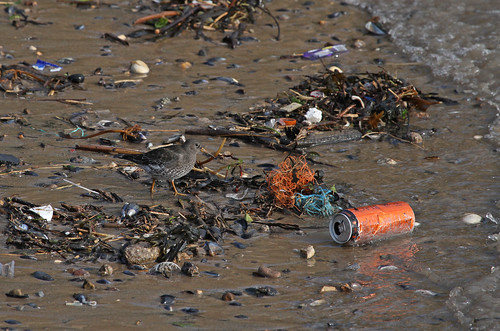
Purple sandpiper (Calidris maritima, Dansk: sortgrå ryle)

The purple sandpiper breeds in the Arctic, very rarely in the UK, but overwinters on the coast here where it can be found in large flocks, often alongside turnstone.

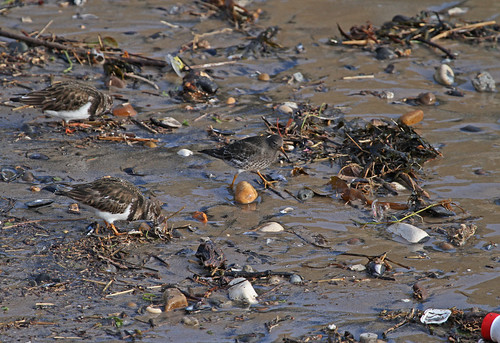
A lone purple sandpiper accompanied by a pair of turnstone

Even though the tons of litter that lined the beaches offended me, the birds didn’t seem to mind, they were racing along the tide lines picking over all the debris, human and natural.

The turnstone (Arenaria interpres, Dansk: stenvender) is also a winter visitor to the UK, very rarely breeding here. It feeds mainly on insects during the summer but according to the British Trust for Ornithology they also feed on birds eggs, chips and even corpses. It suggests the corpses are human but I wonder where they would find one of those, I’ve never encountered one on my seaside meanderings!

Alas, no bullfinch, but…

The weekend before last I went for a walk around the lakes of RSPB Fen Drayton. It was a customarily grey and cold morning and there was a lot of water standing where there wouldn’t normally be. But the lakes were full of ducks, waders and other water birds and the trees and hedgerows were thronged with other birds, but alas no bullfinch. To explain, the approach road to the car park is lined with hawthorn and other trees and they are home to many bird species including bullfinch, so I was hoping to see one or two and get photographs. But on this occasion alas, they were conspicuous by their absence.

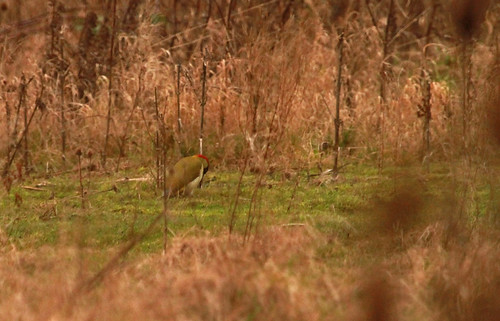
No bullfinch, but hey ho, woodpeckers there were:

Green woodpecker (Picus viridis, Dansk: grønspætte) mining ants next to the car park at Fen Drayton lakes and fastidiously refusing to look up

And the green woodpecker wasn’t the only woodpecker hanging around the lakes:

Great spotted woodpecker (Dendrocops major, Dansk: stor flagspætte) patrolling the treetops

There was also great crested grebe (Podiceps cristatus, Dansk: toppet lappedykker), a large flock of mixed waders including bar tailed godwit (Limosa lapponica, Dansk: lille kobbersneppe) and several flocks of greylag geese (Anser anser, Dansk: grågås). And lots and lots of lapwing:

A small fraction of a much bigger flock of lapwing, I make it 84 in this group

In the 1970’s lapwing (Vanellus vanellus, Dansk: vibe) were a common sight in the English countryside. Huge flocks consisting of hundreds, if not thousands, of individuals weren’t particularly unusual. My Dad used to call them plovers, or ‘peewits’, a name they acquired because of their distinctive call. But like many species, they have suffered hugely from habitat destruction as a result of modern farming methods. On this particular morning at Fen Drayton there was at least one flock and possibly two, at opposite ends of the lakes, there were a heck of a lot of them and they were frequently rising into the air en masse. And since the snow arrived this week there has also been a small flock of 30-40 birds close to Cambridge Science Park which I spotted on my way to work, and a small group of them alighted on the field right outside my lab.

A blue tit deftly plucking seeds from a swaying reed seedhead

On the last part of my outing round the lakes I headed for a hide overlooking an expanse of water where I was hoping to see water birds. A flight of four goosander containing a male and three females flew over on the way there and seemed to be a good omen! Outside the hids this blue tit (Cyanistes caerulius, Dansk: blåmejse) was busy hopping from stem to stem in the reeds outside acrobatically harvesting the seeds.

And on the water there were A LOT of birds. The flock of lapwing higher up this post were on the ground at the far side of this lake, and the water was hosting gulls, ducks, swans and a lone heron. One of the loveliest ducks, easily identified by it’s triangular black head, white cheek spot and his regal black and white plumage is the goldeneye.

Goldeneye drake – elegance personified

There were a pair of goldeneye here, (Bucephala clangula (great name too!), Dansk: hvinand) and as with other duck species the lady is drab in comparison with the resplendent males. I spent half an hour waiting for them to paddle into the gap in the reeds just infront of this one for a clear shot. But they never did, so this is the best picture I could get. But isn’t he a beauty!

Titchwell waders

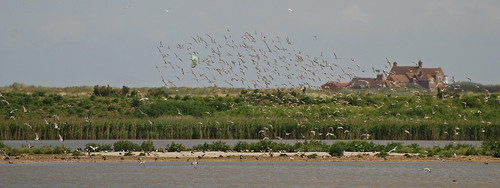
RSPB Titchwell consists of fresh and salt water lakes, mudflats, reedbeds and woodland, consequently it’s home to alot of bird species. One of the rreasons I like visiting places like Titchwell is to see waders, especially when there arfe large flocks of them. And on this visit a mixed flock of hundreds of knot (Calidris canutus, Dansk: islandsk ryle) and bar tailed godwit (Limosa lapponica, Dansk: lille kobbersneppe) would rise from a small island in one of the lakes every few minutes and provide a wonderful display of team aerobatics before settling down on the same island.

A flock of knot and bar tailed godwit taking to the air

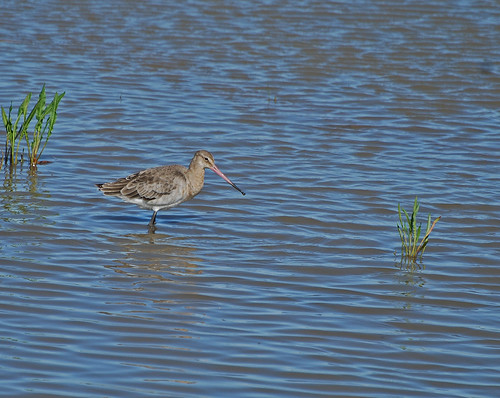
The knot remained resolutely in situ on the island so I was unable to snap a picture of one close up, but a bar tailed godwit was a little more accommodating:

A handsome bar tailed godwit showing it’s magnificent beak

Both the knot and the godwit are winter and passage visitors to the UK so it was nice to see  numbers of them here in June. Both birds breed in the north and head to the southern hemisphere in the winter. Alsakan godwits overwinter in New Zealand, which is an 11,000km which they accomplish in a single hop and it takes them around 7 days! I’m easily impressed by natural phenomena but I think the migration of the Alaskan godwit is a truly awesome achievement.

An agitated redshank repelling intruders

The redshank (Tringa totanus, Dansk: rødben)above was in a highly vocal mood and kept alarm calling and flying down and around from it’s vantage point before returning to call again.  I watched it doing this for several minutes and then the source of its ire became apparent:


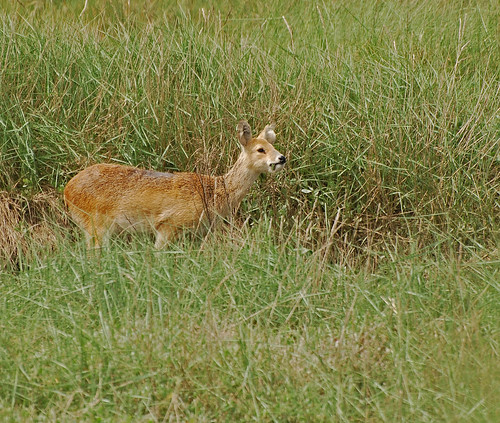
Chinese water deer (Hydropotes inermis)

This chinese water deer was foraging in the undergrowth and I guess the redshank was stressed because the deer was close to its nest. These deer were introduced to London Zoo in the 19th century and subsequent escapes from Whipsnade Zoo led to the establishment of a population in Bedfordshire, the Fens of Cambridgeshire and into Norfolk. The tusks are clearly visible on this adult and indicate the species is a primitive one, as tusks evolved in deer before antlers. The tusks are used for defence and for fighting during the rut. According to the British Deer Society the UK population of these deer constitute 10% of the world population. So I guess there can’t be that many left in China.


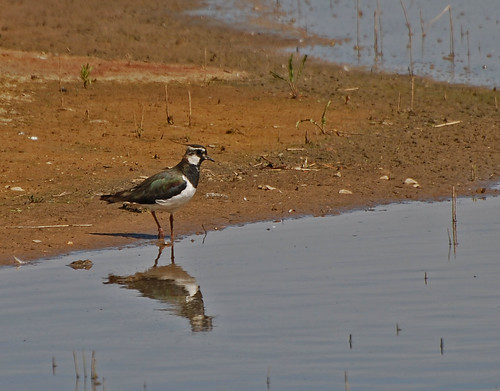
The lovely lapwing

One of my favourite birds, which I used to see huge flocks of when I wasa kid in the 1970’s, is the lapwing (Vanellus vanellus, Dansk: vibe). We aslo used to call it the ‘plover’ or the ‘peewit’ after its distinctive call. They are handsome black and white in the air with broad angled wings, but close up on the ground they have a lovely iridescent green and a long thin crest.