Category Archives: geese

Another wintry outing to the coast

This time I went to Frampton Marshes on a cold winter day in February; when the sun was out it was lovely, when it clouded over and rained it was fierce! Frampton Marshes is on the edge of the flatlands in that part of Lincolnshire which captures every last breath of wind and when it’s blowing in from the east in February the weather can tend toward the arctic. Despite that, there was an awful lot of wildlife around and I took a lot of photo’s. And here is a selection of them to share what I saw:

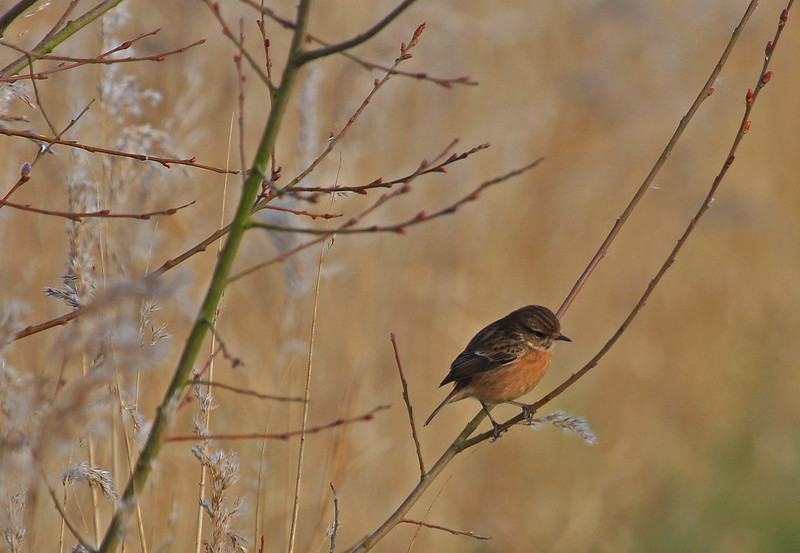
A male stonechat (Saxicola rubicola) perched on a bramble stem at the edge of the path

And on the fringe of a bush on the other side of the path was the female:

Swans, ducks, geese and waders were on parade in large numbers both in terms of numbers of species and numbers of individuals. Unusually the birds I didn’t see any of on this trip were birds of prey. Sparrowhawk, kestrel, peregrine falcon, buzzard and marsh harrier could all have put in an appearance, especially as there was so much on the menu, but they were all conspicuous by their absence.

A group of whooper swans (Cygnus cygnus) which had just made a spectacular landing (watering?) on the lagoon

Whooper swans are smaller than our more common mute swans and have a yellow saddle on a shorter, more pointed, beak, so they’re fairly easy to tell apart. They fly in from Siberia to overwinter in the UK and disappear again in the springtime.

A brent goose (Branta bernicla)

This goose has a very dark underside showing that it is from the Russian sub population which is what I would expect on the English east coast.

An elegant male pintail (Anas acuta)

The pintail is another primarily winter visitor to England in coastal areas and grazing marshes before heading north to Scottish, Icelandic and Scandinavian coasts to breed

A ruff (Calidris pugnax) – this won’t be the best photo you’ll ever see of a ruff, but it’s the first time I’d photographed one so it had to included
A flock of black tailed godwit (Limosa limosa) flying in formation

There are two species of godwit found in the UK, the bar tailed, and the black tailed. These ones are black tailed and can easily be distinguished in flight by the distinct eponymous black end to its tail. And also as its name suggests the black tail is replaced by grey and white bars in the bar tailed version.
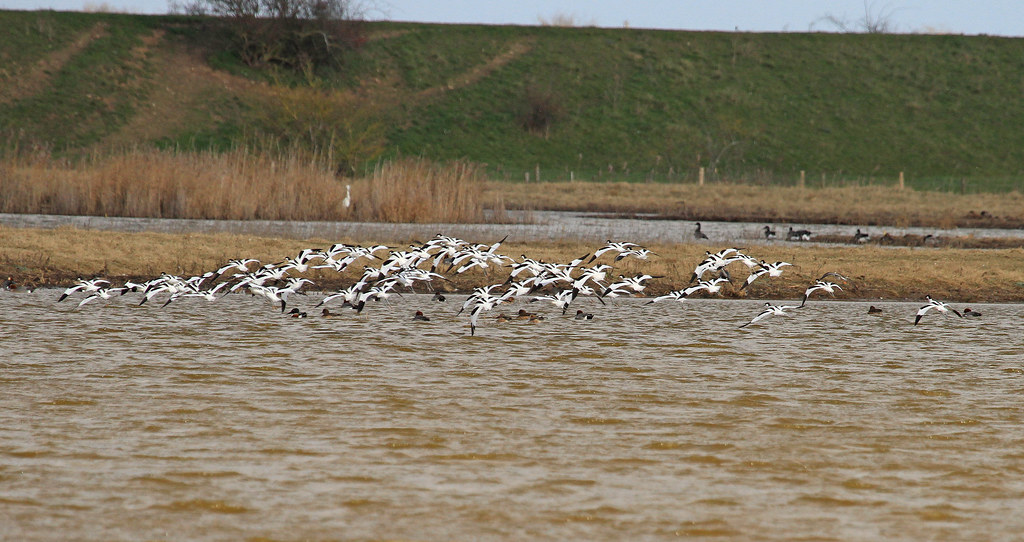
Avocet (Recurvirostra avosetta) taking to the air en masse possibly spooked by an invisible bird of prey

I read recently that someone has proposed a plan to build a tidal barrier across the Wash between north Norfolk and south Lincolnshire. This area, with its huge areas of tidal mudflats that provide feeding and shelter to hundreds of thousands of overwintering birds, is of true global significance, so I fervently hope that any interference doesn’t happen as it’s hard to imagine it would be anything other than catastrophic for already dwindling bird numbers. FIngers crossed!

But at the moment it’s a vast magical space and is home to vast numbers of all kinds of water birds and the predators that rely on them, and a great day was had in their company!

More bird diversity from RSPB Titchwell

RSPB Titchwell has a ‘linear’ layout encompassing various habitats and that make it a good place to see a diverse range of bird species. Following on from my last post here are few more waders, wildfowl and geese that were in residence when I was last there in November last year.

Shoveler pair – Spatula clypeata

The shoveler inhabits shallow lakes and marshland where there is open water and it can be seen all year round in the UK. It breeds in the UK before heading south for the winter when the breeding population is replaced by visitors migrating south from Scandinavia and eastern Europe. The size of the UK breeding population is around 1100 pairs.

Brent geese – Branta bernicla

The distribution of brent geese in the UK is interesting because their are three separate overwintering groups which migrate here to the UK. They come from Canada, Svalbard and Russia and overwinter primarily in Strangford Lough in Ulster, Lindisfarne in the UK and the rest of the UK respectively. There are 100-110,000 birds recorded annually in the UK but in the case of the Canadian and Svalbard visitors it’s easy to see how human activity could profoundly affect those very local populations. As these individuals were seen in Norfolk I guess they from the Russian cohort.

A flock of lapwing – Vanellus vanellus and golden plover – Pluvialis apricaria

Golden plover have a distinctive black face and breast stretching down to its legs in the summer but which fades to pale brown to white in the winter so the birds in this group all have their winter plumage which I would expect as this was in mid-November. The golden plover is resident all year in the UK with 33,000 breeding pairs in 2016 according the BTO and 410,000 individuals recorded in the winter of 2006-7 as the population swells in autumn as migrants arrive from the north.

The lapwing is for me an iconic bird and a sign of summer and I remember seeing big flocks of them over the farmland close to where I grew up in Northamptonshire. It’s now rare to see such flocks inland although I still see mixed flocks of lapwing and golden plover over the Cambridgeshire fens in the winter time. And that is refected in this mixed flock on the ground at Titchwell and it’s interesting to see the species separation on the ground.

RSPB Titchwell is a great place for a day out to see lots of wildlife in summer and winter. There is always something wonderful to see including migrants at the right times of year and I consider myself very lucky to live close enough to it to be able to make day trips there.

Winter in the Wash

One of the ‘must see‘ natural events in the UK occurs in the winter when hundreds of thousands of ducks, waders and, in particular, geese spend the season on the mudflats of the Wash. The Wash is a huge bay on the east coast of England into which the rivers Witham, Welland, Nene and Great Ouse all drain into the North Sea.

When the tide recedes, like Morecambe Bay in the previous post, enormous areas of mudflats are exposed which provide sustenance and a roost site for colossal numbers of birds. Every morning at dawn thousands of geese take flight to head inland to feed, and the geese are what everyone goes there to see.

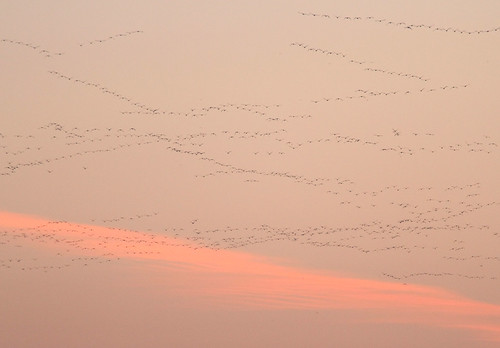
Multiple skeins of pink footed geese at Snettisham at dawn (Anser brachyrhynchus, Dansk: kortnæbbet gås)

I arrived at the coast at Snettisham on the north Norfolk coast around 6am when it was just starting to get light. Already sizable flocks of geese were in the air and I was concerned that I’d missed most of them. But then as the sun rose higher gargantuan flocks started to pass overhead and it was a truly incredible sight!

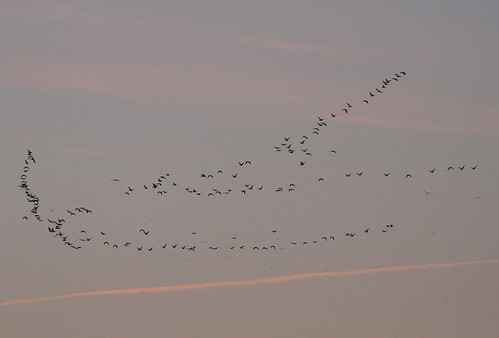
I don’t know how many thousands of geese were there but at the end of the day I went back to the same place to see them return. It was getting dark and all was still, so, as in the morning, I thought I’d missed them. And then they appeared, quite suddenly in their tens of thousands. I tried to estimate the numbers by counting small numbers of each wave and multiplying up, and I estimated there were between 30-40,000 birds returning.

Skeins within skeins, I like this formation

And if you’ve ever spent any time near geese you’ll know that they’re not afraid to announce their presence, so the other thing that I hadn’t expected, but maybe I should have done, was the noise. It was a magnificent cacophony! And not just the squawking, but the sound of them flying when they came over lower to the ground.

These birds breed in the summer up in the Arctic, in Greenland, Iceland and Spitsbergen and then head south to the relatively balmy conditions of the UK coast in winter (!).

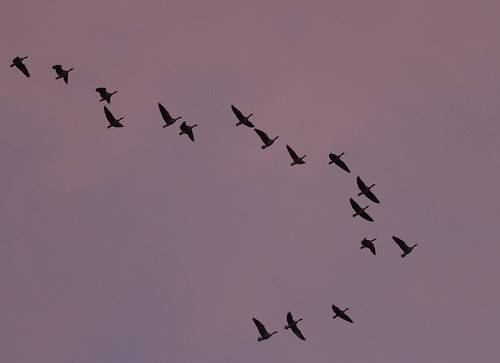
Another skein of pink footed geese passing low overhead

It’s unknown why geese fly in skeins, but it’s thought to provide an aerodynamic advantage to the ones behind as they slipstream in turbulent air generated by the bird in front. Which makes me wonder if they constantly switch the pacemaker or if the biggest and strongest bird is always the one at the front.

I estimated there were around 500 birds in this huge flock, but even that was a tiny proportion of the total

To see this meant getting up and out at 4am which is never my favourite thing to do, and it was ferociously cold, but it was worth it to see such a unique spectacle. And as the sun rose and it got lighter, it soon became apparent that the geese weren’t the only seabirds in the area:

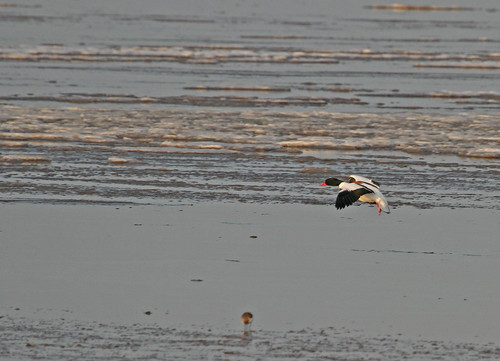
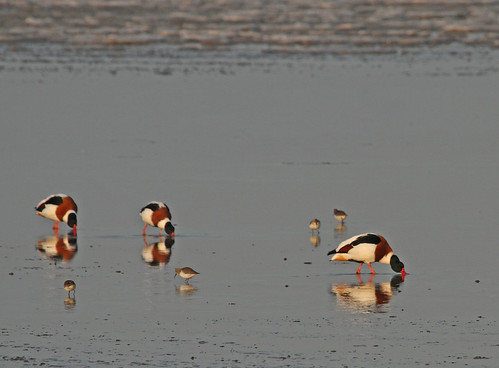
A shelduck (Tadorna tadorna, Dansk: gravand) on final approach past a lone dunlin in the foreground

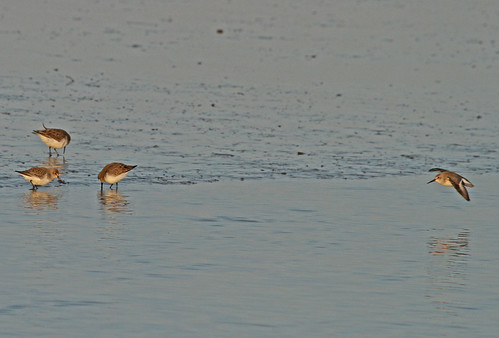
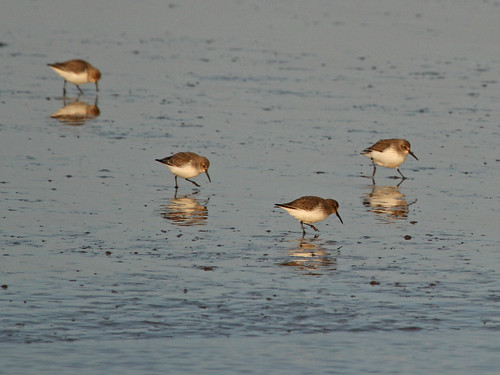
Small flocks of shelduck and dunlin were mingling and feeding close in to the shore

The Wash is now not the only significant area of coastal mudflat in East Anglia. In order to attempt to mitigate some of the anticipated ravages of climate change, flood defences protecting areas of farmland on the coast further south in Essex have been deliberately breached. This has allowed the land to be reclaimed by the sea and to regenerate the tidal mudflats that were there before humans originally interfered. The new habitat  was created with the millions of tons of earth removed the ground under London in order to build the Crossrail tube train tunnels. And as soon as this happened the wildlife started to recolonise, and even though it is still fairly barren in comparison to established habitat, I hope that in the near future it will also provide refuge to hundreds of thousands more birds, and lots of other wildlife too.

Dunlin (Calidris alpina, Dansk: almindelig ryle)

But more of dunlin in the next post, and plenty more species of sea birds both at Snettisham and after that at the RSPB coastal reserve at Titchwell.