Category Archives: Birds

All the other garden birds…

In the last post I described the tits visiting my bird feeders. But of course they’re not the only species fattening up in the garden so this post is about the others. The berries and other food from the countryside are now becoming rather more scarce so greater numbers of more species are appearing.

One of the first to arrive, which has been around for a couple of months now, was my resident robin (Erithacus rubecula, Dansk: rødhals). Robins are fiercely territorial and this little guy being  no exception makes it clear that my garden is his manor, in fact it’s fair to say he’s a complete thug. He only picks on birds of a similar size or smaller and he won’t tolerate them for even a second. The two species he seems to dislike most are the dunnocks (Prunella modularis, Dansk jernspurv) and the coal tits (Periparus ater, Dansk: sortmejse) who have the temerity to enter his domain and he chases and beats them up remorselessly. Earlier this afternoon another robin turned up and I expected real fireworks as I’ve heard stories of rival robins fighting to the death and scalping each other! The fighting this time was restricted to a short chase and a bit of posturing and then it was all over, fortunately no injuries or fatalities were sustained.

A source of much concern this winter has been the absence of goldfinches (Carduelis carduelis, Dansk: stillits). I have a niger seed feeder for them which I keep full, but they ignored it until a few weeks ago, but even then there was only ever one or two making the occasional visit whereas previously they would be feeding there every day, often five or six at a time. And then a sparrowhawk (Accipiter nisus, Dansk: spurvehøg) attacked a goldfinch on the feeder and I didn’t see another one until a few days ago. I don’t know if the memory of the sparrowhawk was enough to keep them away but they have been conspicuous by their absence.

A lone goldfinch feeding on niger seed

There is a tall old tree 10 metres from my garden which I often see flocks of 20+ goldfinches in but they just don’t seem to want to drop down onto the feeder. Maybe if the weather turns icy they’ll alter their behaviour as food gets even more difficult to find.

Greenfinch (Carduelis chloris, Dansk:  grønirisk)

I’m always pleased to see greenfinches because they’re one of my favourite small birds and also because their numbers have been under threat from a nasty parasitic infection called ‘trichomonosis‘ which I posted about last year. So this little chap was very welcome. I was surprised to see him sitting on the niger seed feeder, but he wasn’t eating the seed, he was waiting for an opportunity to descend onto the seed tray which was already occupied.

The small birds usually have free access to the seed tray but occasionally it’s fully occupied by a pair of collared doves:
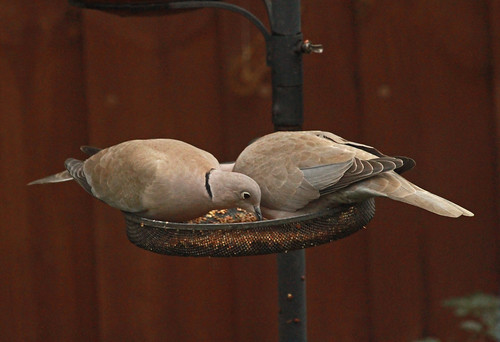
Collared dove (Streptopelia decaocto, Dansk: tyrkedue)

This was one of a pair and its partner was just out of shot further along the fence. A lot of folk seem to be very unimpressed by collared doves but I like having them around and I particularly like this guy with his feathers ruffled by the wind.

Previously I’ve been taking my close ups with a Nikon D40x and a Nikon 70-300mm zoom lens. This has been a really good combination, it’s small and light and therefore easily portable and has performed really well. But last year I bought a Canon 7D because I wanted to upgrade my camera body to one which is more robust and with more capability. I chose Canon rather than Nikon because the lens I thought most appropriate for what I needed was the 80-400mm telephoto zoom, but every review I read of it was that it was no good at all for wildlife photography because the autofocussing speed was much too slow. So I reckon Nikon missed a trick there because Canon have the 100-400mm L series telephoto zoom for around the same price as the Nikon lens which I decided to go for because it is supposed to be good for wildlife.


Wood pigeon (Columba palumbus, Dansk: ringdue) keeping the small songbirds away from the seed tray all by himself

All the photographs in this post except for the greenfinch were taken in murky conditions using my new Canon lens and I’m very pleased with the image quality. So now I’m looking forward to experimenting with it further afield. I’ll post the results as soon as I can.

Tits, tits, tits!

Coal, long tailed and great, that is, in case you were thinking the News of the World had reinvented itself in blog format! The reason I’ve dedicated a post to the tits is because they have been the most regular visitors to my feeders and on many days I’ve seen these four species there at the same time: blue tit (Cyanistes caeruleus, Dansk: blåmejse), great tit (Parus major, Dansk musvit), coal tit (Periparus ater, Dansk: sortmejse) and long tailed tit (Aegithalos caudatus, Dansk: halemejse).

Two factors combined to make photographing the songbirds in my garden considerably more challenging than is customary. Long periods of murky wet weather meant that the light was rarely optimal, and secondly, very few birds came to the garden at all up until November, and even then not in the numbers that have visited in previous years. I think the reason for that may have been the relative abundance of food in the countryside due to the mild and wet conditions that prevailed in the summer and autumn which gave rise to an abundance of blackberries, haws, sloes, hips and other berries. Then after November the birds started to reappear but the light didn’t improve so I took photographs at ISO settings of 1000-2000 to get the requisite shutter speeds, which is higher than I would normally use because of the higher background noise. Despite that I got some nice images:

Coal tit looking for a meal on a murky morningCoal tit looking for breakfast on a cold foggy morning

The coal tit is distinguishable at a glance by the prominent white stripe on the nape of its neck. They’ve been regular but infrequent visitors to my garden in other years but in the last couple of months they’ve been coming in ones and twos every day. The tits are not always easy to capture because they usually feed by grabbing a seed or nut and then flying into the cover of an adjacent bush to eat it. But just occasionally they linger for long enough, as this coal tit did. They prefer coniferous woodland in the breeding season where they feed on spiders and insects and in wintertime they are also prevalent in towns when they will also feed on seeds. Their conservation status is green, they’re resident breeders in the UK and can be found across Europe and Asia and in Africa too.

Long tailed tits disobeying the cardiologist!Two of a small flock of long tailed tits

As with coal tits, the long tailed tit is also immediately recognisable. Seeing one almost invariably means there are more close by. They fly from A to B one at a time, each following the previous one by half a second or so and are usually in small flocks of 10 or a dozen. I often hear them before I see them as they chatter to each other as they’re on the move. They like to feed on the fat balls I hang out, as do the other tits, and there can be 3 or 4 there at the same time with several more in the adjacent bushes, waiting their turn. They’re very charming little birds and I’m looking forward to them visiting on a bright sunny day so I can get some better images. Like coal tits they are also woodland birds, found across Eurasia they are resident breeders in the UK and their conservation status is green.

Great tit preparing himself to launch onto the seed tray

Great tits are probably the most regular partakers of the fare provided by my feeders, and that’s no bad thing, they’re handsome birds. There are a pair, male and female, feeding on seeds as I write, and they’ve just been joined by a pair of blue tits. The great tit is one of the birds that put the ‘song‘ in songbird, my Collins guide describes them as having a ‘rich repertoire’ and I’ve read they have around 70 different vocalisations, which suggests highly complex vocal communication for a small bird.

The male above has a chunk of peanut between his toes which he is pecking from. He is distinguishable from the female by the width of his black breast stripe which reaches as far as his legs, and the female below who has a very thin stripe which tapers downwards, is nibbling at a fat ball. In the depths of winter small birds need to spend most of the day feeding because the majority of their energy intake is used to maintain body temperature. Birds as small as a coal tit, which weighs 8-10g, therefore spend virtually all day feeding just to stay warm and they can die of hypothermia very quickly on a wintry morning if they don’t find food within a short time of waking up. So as us humans have destroyed so much natural habitat, our gardens and feeding stations are an essential lifeline for many species of birds.

Great tits also have green conservation status, numbering 2 million in summer 2000 according to the British Trust for Ornithology. Other species which have put in an appearance are the wren (Troglodytes troglodytes, Dansk: gærdesmutte), blackbird (Turdus merula, Dansk: solsort), dunnock (Prunella modularis, Dansk jernspurv) and a lone male blackcap (Sylvia atricapilla, Dansk: munk) flew through on one occasion – one of our eastern European overwintering blackcaps. Early one dark foggy morning as I was replenishing the feeders I caught a small movement out the corner of my eye so I glanced round without moving my head and a wren sat around 3 feet away watching me. When I finished I stood and watched him and he just waited for me to leave before grabbing some breakfast. I found out recently that wrens are our commonest bird, which really surprised me, but then they are adaptable and aren’t restricted to one particular habitat. It’s nice to see them flitting around the garden in their perpetual search for insects to see them through the winter.

(N.b. I source my bird feed from Vine House Farm. I wouldn’t normally do a free plug but I really like what these people do. They work together with the Wildlife Trusts and they farm the land to produce bird feed in the most wildlife-friendly way they can, and they publish a free newsletter to update on progress and news from the farm. Their feed is not always the cheapest but I’ve always found it to be very high quality.)

Crabs and Compasses

As a fitting coda to our trip to the Isle of Wight we had been invited to join some friends in Lyme Regis for the weekend. As I mentioned in my Isle of Wight post the eastern half of the English south coast was tipped on its end by tectonic forces so the geological history of that part of the world is exposed for all to see. In fact, moving from east to west is literally going back in time, heading as far as the Lower Jurassic era at Lyme Regis and Bridport, which is around 183-200 million years ago.

The Jurassic rock strata of the south coast westward from the Cobb at Lyme Regis

Those of you with a cinematographic interest may recognise the sea wall at Lyme Regis, it’s known as the ‘Cobb’, and was the location for the famous scene in The French Lieutenant’s Woman where Meryl Streep stands gazing out to sea. Which incidentally, is the only thing that myself and Meryl have in common, albeit for rather different reasons.

All our activities whilst we were in Lyme were marine orientated, I even managed to spend a couple of hours sea kayaking and peering into the crystal clear waters. The clarity of the water was incredible, it’s difficult to judge depth but I reckon at the deepest point I saw it was probably 15-20 feet deep. I could clearly see the bottom and the kelp fronds waving in the current, fish were darting in and out of the kelp and jellyfish were floating at the surface. I resolved to get up early the next morning and head out on the kayak to go snorkelling off the boat. So I got up and paddled out into the bay, but overnight a swell had risen which was swirling the sand around on the seabed and there was zero visibility in the water. So I need to make a return trip in the not too distant future so I can get in the water for a snorkel.

My son Jake and his friend Sam inspecting the contents of their crabbing bucket

Glancing over the sea wall while the children were crabbing I saw this handsome compass jellyfish (Chrysaora hysoscella) gently patrolling the periphery. I’d seen several of them in the bay the day before when I was kayaking and they’re common around English shores. They can pack a nasty punch for any poor unfortunate who makes contact with the tentacles which can cause a stinging, burning sensation and red raised lesions on the skin. I don’t know if it can get worse than that but it’s apparently fairly unpleasant while it lasts.

The compass can grow up to 30cm across which is about the size of this one.

Eyeing up the progress of the crabbing exploits was a hungry herring gull (Larus argentatus). He was very interested in any potential meals the kids may catch for him and he was ready to swoop onto any escapees.

Looking eastward from the Cobb are more cliffs and the rocks here are full of fossils. We were staying in the white houses on the left and just round the corner from there lies a prime fossiling beach which alas we were cut off from by the tide. There were lots of folk busy cracking open rocks on the part that was accessible but I think most of the fossils from that spot had already been found.

The cliff on the right with the yellow patch is called ‘Golden Cap’ and is the highest point on the south coast of England, rising to 627 feet (191m).

The catch:

Shore crabs – Carcinus maena

The bait for the crabs was bacon, they’re mad for it, and there was a prize for the first crab caught, the largest crab caught and the most crabs caught. My daughter won, every time she dropped her line into the water it was a couple of minutes or less before she hoicked one out. So, much to the chagrin of the boys, she won all three prizes and was as smug as hell for the rest of the day!

And as the bucket filled with crabs the gull got braver and braver:

But he was to be disappointed. At the end of the competition our bucket of crabs was emptied into the water at the bottom of those steps and they all scuttled away to freedom.

The Isle of Wight, Part 2

My first view of the Needles, at the western tip of the Isle of Wight, was a long time ago when I flew round them in a light aircraft. The weather was much like it is below and it was quite a spectacle!

The Needles looking across to the Isle of Purbeck. Old Harry Rocks are the thin sliver of white chalk in the distance at 11 o’clock from the lighthouse

I’d heard it said that the Needles were at one time joined to the Old Harry Rocks at the southern end of Studland Bay, around 15 miles away on the Isle of Purbeck. I’d thought it entirely possible but never had it confirmed. And then just after I took this photograph I overheard a very knowledgeable old gentleman telling his companion all about the local geology, so I stood close by and earwigged the conservation.

As you can see, the Needles are made of limestone and apparently they were once a single strip of rock with a gap in the middle from which a single calcareous stack protruded, known as ‘The Needle‘. And then in the 18th century a storm caused a collapse which resulted in the Needles of today.

But before that, Old Harry and the Needles were a single limestone structure and the Isle of Wight wasn’t an Isle, and the Solent – the stretch of sea which separates the Isle of Wight from the mainland – was the River Solent. But around 4-5000 years ago a storm breached the limestone wall and the River Solent became a seaway overnight and the inhabitants of the Isle of Wight were cast adrift on a new island. And interestingly, all the rivers on the mainland from Poole Harbour in the west eastwards to Portsmouth: the Meon, Itchen, Test, Avon, Frome and Piddle all flow southward, and those on the Isle of Wight: the Eastern Yar, Western Yar, Newtown, Wootton Creek and Medina all flow northward, and they all drained into the River Solent.

Pyramidal orchid – Anacamptis pyramidalis

The terrain all around the Needles is chalk downland which has very characteristic flora and fauna, amongst which is the pyramidal orchid and this lone flower was lurking at the edge of The Needles carpark. It thrives on the chalk downs to such a degree that it has been chosen as the county flower of the Isle of Wight. In the air high over the car park was a peregrine falcon (Falco peregrinus, Dansk: vandrefalk) but I didn’t have a telephoto lens with me on this trip, so alas, no pictures. From the car park it’s about a mile to walk to The Needles themselves and on a sunny day it’s a terrific walk, the views are magnificent.

To the east, north and west the air was full of falcons, songbirds, bees and butterflies, and when we got to the very end there was a historic naval gun emplacement. In WWII the gun guarded the Solent and the strategically important ports of Poole, Southampton and Portsmouth against enemy shipping, and just over the top of the cliff from the gun emplacement was a test site for missile engines which had been hewn from the rock – a hangover from the Cold War. The whole thing was fascinating, geologically, biologically and historically!

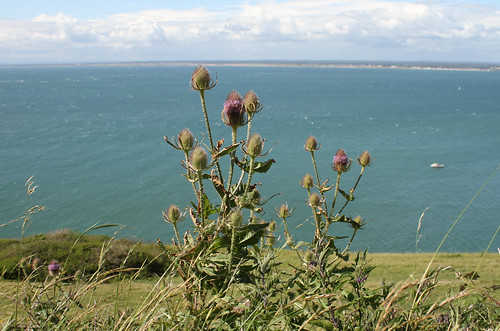
Teasels – Dipsacus fullonum

Whilst trying to photograph a stonechat which was darting around next to the path I noticed these teasels which were still sporting their downy purple flowers. I have lots of photographs of the dried out brown seedheads of teasels after they’ve flowered but but I’ve been after a good one of the flowers themselves. And I think this is the best backdrop I could have found, looking out across the Solent towards the New Forest on a sunny day.

Also flitting around in the chalky grassland were hundreds of chalkhill blue butterflies. It was a very windy day and I think the butterflies may have been staying down low becausse of the wind, preferring to be stationary rather than risk being blown away. Consequently they were fairly easy to get close to:

Chalkhill blue male (Lysandra coridon)

I absolutely love blue butterflies. In fact anything living and blue – insects, flowers, fish reptiles – blue seems to convey a unique beauty on a creature, so to see so many of these blues was a real pleasure. And the chalkhill blue is a big butterfly too, with a wingspan of 33-40mm.

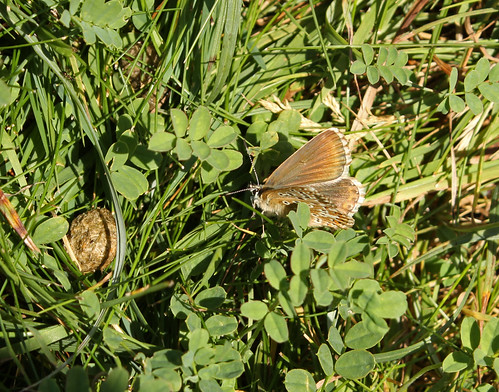
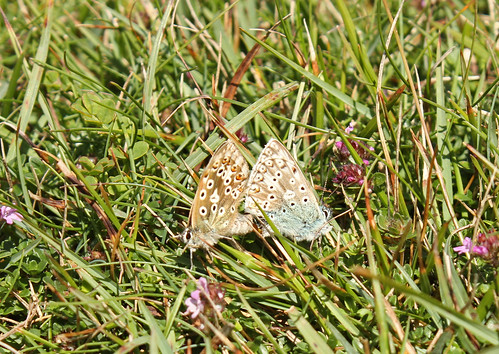
One of the curious facts about blue butterflies is that some of them are actually brown, and with chalkhills as with common blues, the females are brown:

The female chalkhill blue. She’s brown, not blue, but still a beauty!

Chalkhill blues mating, the brown female is on the left

Apparently this year was a particularly good one for the chalkhill blue. Despite being a devastating one for most other butterfly species in the UK, there were huge numbers of breeding chalkhills recorded in their traditional territories, and in my humble opinion that’s very good news indeed.

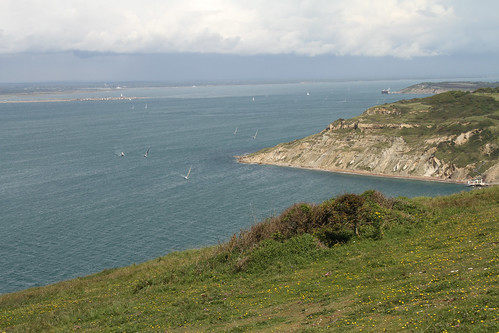
The view along the north of the island looking east towards Southampton, with yachts racing toward us

The geology of this part of the south coast is remarkable too. Limestone was formed at the bottom of oceans by the compaction of dead shellfish over millions of years, so it may seem odd to find it at the top of the cliffs. Or indeed whole cliffs made of it. There is a clue to how this happened in the cliff below, which is looking round to the southeast from The Needles, in which there are clearly delineated strata in the rock running upwards from left to right at around 45 degrees. The reason for angled strata is that in this part of the world tectonic shifts have concertinad the rock strata all the way from the east of England along the south coast as far as Dorset to the west forcing them upwards.

This folding of the rock means that in the east the rock is relatively young but the deepest, oldest, layers have been exposed in Dorset around the town of Lyme Regis. So the region around Lyme is referred to as the ‘Jurassic Coast’. Of which more in a subsequent post.

The Isle of Wight, Part 1

This summers holiday took myself and the family to the Isle of Wight. I’ve often sat on the mainland and gazed at the island wondering what it was like, but apart from a sailing weekend from Cowes some years ago I’d never been there. Prior to the trip, several folk I spoke to who had been there said, ‘It’s very nice, but very 1950’s’, implying that were a bad thing. I wasn’t entirely sure what it meant, so I set off expecting bakelite telephones, knobbly knee competitions and casual racism. But the reality was nothing like that, in fact the Isle of Wight turned out to be a lovely place, very green and full of cool wildlife.

Shanklin Bay looking over the garden of out holiday abode

Within a day of arriving at our destination at Shanklin, on the southeast corner of the island, we’d encountered a pair of ravens who were keen to share our fish and chips on the seafront, and several red squirrels running around the trees in the garden below our apartment. Red squirrels are delightful creatures and the island is one of the few places in the UK where they haven’t been ousted by the bigger and more aggressive North American grey squirrel. Unfortunately I wasn’t able to get photographs of these but there was plenty of other flora and fauna to keep me occupied.

The weather on the island during the first week in August was remarkable, it was hot and sunny virtually the whole time we were there, but that coincided with continuous heavy rain and big floods a short distance to the west in Devon and Cornwall. As well as the trees in the garden, there were flowers and butterflies basking in the glorious sunshine:

Wild pansy (Viola tricolor)

The wild pansy is a lovely little flower and has been used as a herbal remedy for eczema and asthma and it was believed it was good for the heart, hence its other name of ‘heartsease’. It’s laden with potentially beneficial chemicals including salicylates (aspirin), antibacterials and antiinflammatories and has many amusing common names such as ‘love lies bleeding’ (!), bullweed, ‘tickle my fancy’ and ‘love in idleness’.

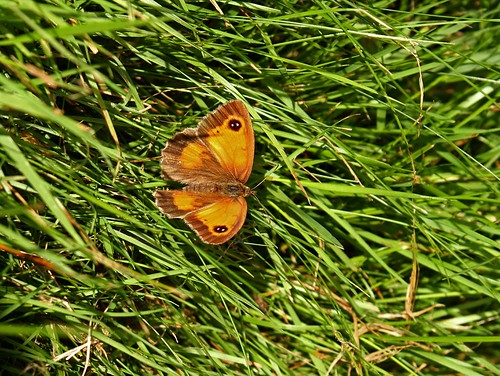
Gatekeeper

Also frequenting the garden was the equally beautifully coloured, but less poetically named, gatekeeper butterfly (Pyronia tithonus). I was pleased to see lots of butterflies here because the dreadful spring weather meant I’d seen very few around Cambridge, a horrid situation which, alas, prevailed for the rest of the summer.

Below the garden at the bottom of the cliff was lots and lots of beach with lots and lots of birds, including the ravens I mentioned earlier. And amongst them was this gull youngster. It wasn’t at all fazed by me and my son running around and seemed more curious than nervous.

A young gull – either a herring gull or a lesser black backed

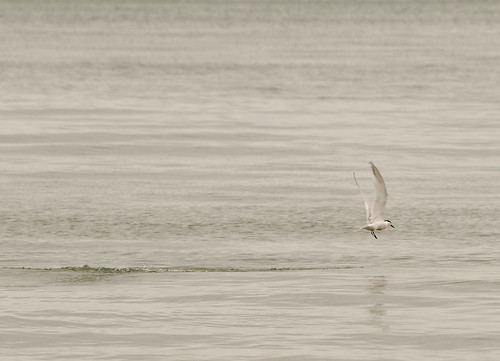
Alas, I’m not sufficiently knowledgeable about gulls to be able to differentiate the first year herring gull (Larus argentatus, Dansk: Sølvmåge) from the lesser black backed gull (Larus fuscus, Dansk: sildemåge), even with my Collins bird guide to assist. And while the gull was peering at us a sandwich tern patrolled the shallows occasionally diving into the water:

Sometimes returning to the surface with a fish… and other times not:

Sandwich tern (Sterna sandvicensis, Dansk: splitterne) fishing off Shanklin beach

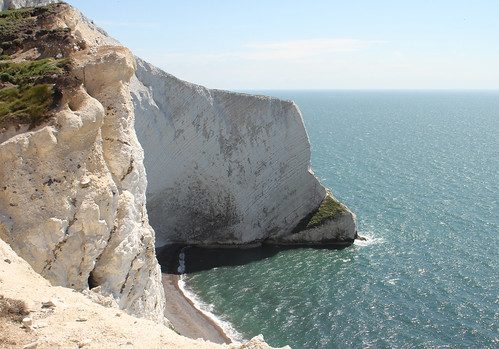
From our limited explorations around the island it seemed to be quite distinctly in two halves. The eastern end, where we were based was green and agricultural with wide sandy beaches, and the western end, at least on the south side, was more chalk down rising to imposing cliffs toward the Needles at the far western tip. All the photographs in this post were from in and around Shanklin in the east and I’ve divided the IoW into two posts, so ‘Part 2’ will be from the western end.

Diapause and Diminishing Diversity

Capreolus capreolus, aka the roe deer, is native to the UK and can be seen in good numbers in the Fens. During an evening stroll there in July I encountered several. As well as being delightful to look at they have some interesting reproductive biochemistry. The roe deer rut takes place in July and August but the fawns are not born until the following May or June, nearly a year after the rut. The length of roe deer gestation had puzzled zoologists for a very long time and then they discovered that the roe undergoes delayed implantation, or ’embryonic diapause‘.

A roe deer peering at me as I meandered around Wicken Fen

But that wasn’t the end of the story. It was assumed that hormonal messages from the mother would tell the dormant fertilised egg, or ‘blastocyst‘ when it should implant into the endometrial layer of the uterus, but the search for the maternal hormonal trigger which has been observed in other mammals drew a blank. It transpires the trigger is a novel mechanism whereby the embryo, which at that stage consists of around 30 cells and has its own internal timer mechanism, secretes a messenger molecule called ‘rdPAG’ (roe deer Pregnancy Associated Glycoprotein) which precipitates a maternal hormone cascade of oestrogens that initiates the second stage of the pregnancy with implantation of the embryo. This is a remarkable piece of biology because it is orchestrated by the embryo, not the mother, and ensures the fawn is born during the favourable weather conditions of the summer thereby guaranteeing it sufficient time to prepare for the winter.

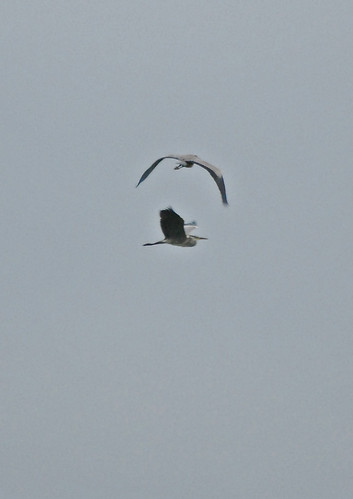
A visit to Wicken Fen always provides multiple unique photographic opportunities such as this pair of grey herons whose paths crossed, almost on a collision course:

Wicken Fen was mentioned in a BBC News article a couple of days ago about the importance of the Fens as a wildlife haven. The article is about a study into the biodiversity of fenland since 1670. Apparently, since the start of the study period 100 species of birds, bees and butterflies have been lost from the Fens and in total 504(!) rare species have not been recorded there in the last 25 years. A moments comtemplation on that rate of biodiversity loss is terrifying, and the implications of it even more so. It boggles my mind that the political decision makers, who are aware of all the environmental devastation, don’t appear to give a damn about it. Or at least not enough to want to do anything about it.

Despite that the Fens are still a very important refuge for endangered species, which I can vouch for based on my observations made whilst wandering around Wicken. The Fens are much maligned but are a unique and important haven for many species of all kinds of wildlife.

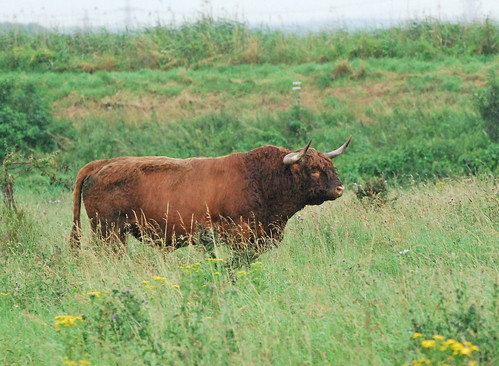
In order to manage and maintain the flora of the Fen which then provides shelter and sustenance for a multitude of other species, horses and cattle have been installed there, one of which is this magnificent chap:

This image doesn’t really do him justice, he is absolutely enormous – like a minibus on legs!

Passerines and Ponies

One weekend in the middle of July we took off down to the New Forest for a couple of days. The New Forest was originally a hunting forest for King William in the 12th century and 800 years later was eventually awarded National Park status in 2005. It lies along the south coast of England in Hampshire in a triangle delineated by Southampton, Salisbury and Bournemouth, and covers around 150 square miles, which in the context of southern England is a fairly sizable area. As the name suggests it consists of ancient forest which is interspersed with large areas of heathland and it’s renowned for its wildlife, being home to many less abundant species of birds, butterflies, mammals and reptiles.

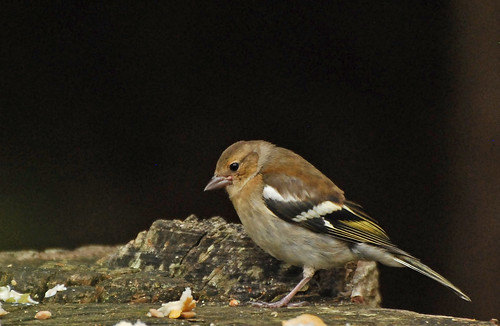
One day while we were there we found a secluded spot on the edge of Stoney Cross to eat our picnic. We parked the car adjacent to some woodland where the canopy was so dense it was nearly dark on the forest floor and impossible to see in. There were lots of small birds darting around and I could see that some of them were chaffinches, but there were others that it was simply too dark to see properly and identify. So when one of the kids had finished their sandwich and there was some left over I broke it up and put it on a rotting tree stump on the edge of the forest and sat in the boot of the car with my camera. Within seconds the stump was full of birdlife, and now I could see them properly most of them were chaffinch:

Hen chaffinch (Fringilla coelebs, Dansk: bogfinke) eyeing up a crusty morsel

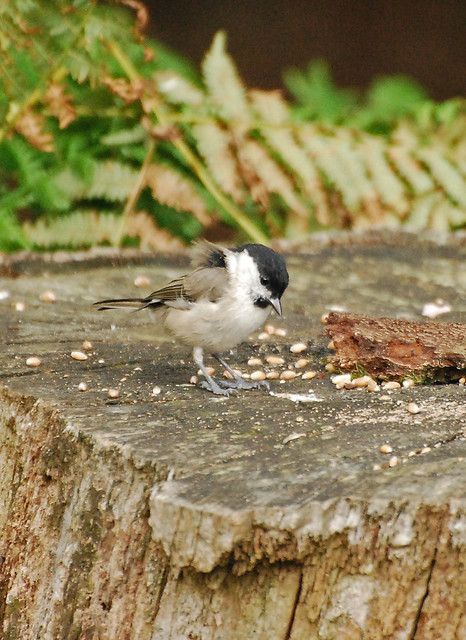
It was challenging photographically because it was starting to rain and as you can see above, looking into the forest it was very murky indeed, so I increased the ISO to 800 and hoped the shutter speed would be fast enough. Shortly after the chaffinch descended, there were great tits (Parus major, Dansk: sortemejse), marsh tits (Poecile palustris, Dansk: sumpmejse), a robin (Erithacus rubecula, Dansk: rødhals) and my favourite of them all:

Nuthatch (Sitta europaea, Dansk: Spætmejse)

I like nuthatch and I rarely get to see them. Occasionally my parents have one visiting their feeders in the winter but it’s a long time since I saw one in the wild, so this was a treat. And this one liked sausage roll:

The nuthatch is a woodland bird which nests in holes in deciduous trees and is the only bird I can think of which I have seen walking headfirst down a tree. The marsh tit is also a bird of dense deciduous woodland which nests in cavities in old and rotten trees, so it was no surprise to see either of them in this particular spot. But I can highly recommend taking an old baguette or sausage roll to entice them down out of the tree canopy to get a good view.

Marsh tit (Poecile palustris, Dansk: sumpmajse)

The most famous and charismatic residents of the New Forest are the wild ponies. They are common in the forest and can be seen wandering around the towns and villages:


My daughter making friends with a New Forest pony

We were standing on the terrace of an ice cream shop tucking into our soft-ices as a small herd of ponies sauntered down the road from the direction of the car, top left. They spotted us and three or four of them came up the slope to join us on the terrace and attempted to share our ice creams! They are completely wild but they’re accustomed to humans being about. But if you happen to be in the forest when a herd come thundering past at high speed it’s an alarming experience, as we found out shortly before this picture was taken. They came by around 25m away and a few minutes later came back even closer. I’ve stood on the rail at Cheltenham watching the Gold Cup as the horses come past on their way to the finish line, and it’s extremely exciting – but it’s a lot more exciting when there’s no rail and no jockeys to keep them in a straight line!

Flowers and frogs at Milton Country Park

Not long after my lunchtime spin around Cambridge Science Park I paid a visit to Milton Country Park which is about a mile from where I work, as the crow flies. Wild flowers were everywhere, the sun was out, and there was lots to see including a family of treecreepers (Certhia familiaris, Dansk: træløber). Prior to this I’ve only seen treecreepers individually but this time a whole family of at least five birds was flitting around a tree trunk before flying to an adjacent tree. Treecreepers are fun to watch, they begin hunting low down on a tree trunk and climb up it in a spiral pattern to ensure they don’t miss any insects lurking in the crevices of the bark, they are very aptly named. I didn’t have my long lens with me so I couldn’t get any photographs of the treecreepers, but I did capture some gorgeous flowers on this outing:


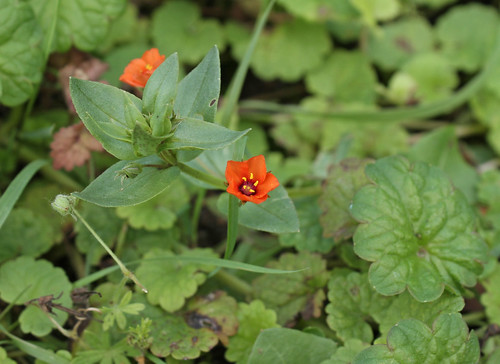
Scarlet pimpernel flowers

I’ve never noticed scarlet pimpernel (Anagallis arvensis) growing around Cambridge before but I’ll be happy if it spreads. The flowers, which were less than a centimetre across, open in the morning and close mid afternoon and were shooting from amongst the short grass. It’s common in England but less so in Scotland.

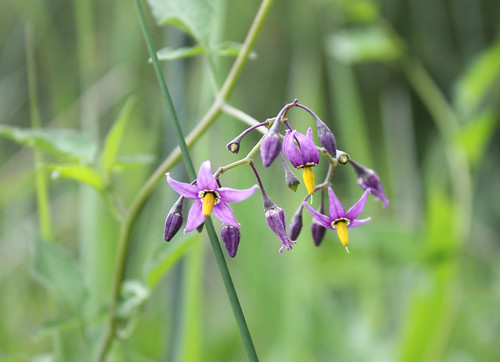
The purple and yellow flowers of the woody nightshade flowers (Solanum dulcamara) were illuminating the undergrowth:


Woody nightshade

The flowers of the woody nightshade are beautiful and eventually give way to berries which are green before they ripen into a lovely deep red colour. As the colour may suggest they are toxic, the main ingredient being an alkaloid called ‘solanine‘ (an alkaloid is a plant-derived nitrogen containing compound which can exert a physiological effect on humans. More infamous members of this category include opium, cocaine and marijuana).

The glycoalkaloid ‘solanine’ found in members of the Solanaceae family including the nightshades and potatoes

Solanine is also the active ingredient in deadly nightshade, Atropa belladonna, and is the compound which makes green potatoes toxic! The green pigmentation is due to chlorophyll which is produced when potato tubers become exposed to light and is not therefore toxic, but it is produced along with solanine. Solanine isn’t degraded by cooking so eating lots of green spuds is a bad idea.

As you might expect, solanine has physiological properties which make it a useful compound. Ancient Greeks would take it before consulting the priestess Pythia, the Oracle of Delphi, to utillise its halucinogenic properties. And Italian ladies used the sap of the deadly nightshade in days of yore to dilate their pupils as they believed this made them more beautiful. Hence the specific name of the deadly nightshade ‘belladonna‘ (‘beautiful lady‘ in Italian). It was also used by torturers as a medieval truth drug to extract confessions. In more recent and enlightened times therapeutic doses have been used to treat a range of conditions incuding inflammatory eye diseases such as uveitis, and it has also shown inhibitory properties when applied to melanoma (skin cancer) cells. It’s amazing stuff!


Common frog – Rana temporaria

A frog hopped across the path in front of me and hunkered down in the undergrowth to avoid being spotted and/or predated, so I got up close to capture some portraits. I was within 8-12 inches and it didn’t flinch, so I took half a dozen pictures before it hopped off deeper into the bush.

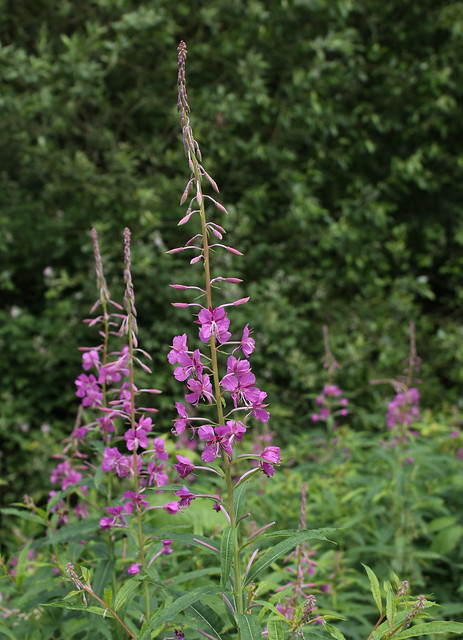
Rosebay willowherb – Chamerion angustifolium

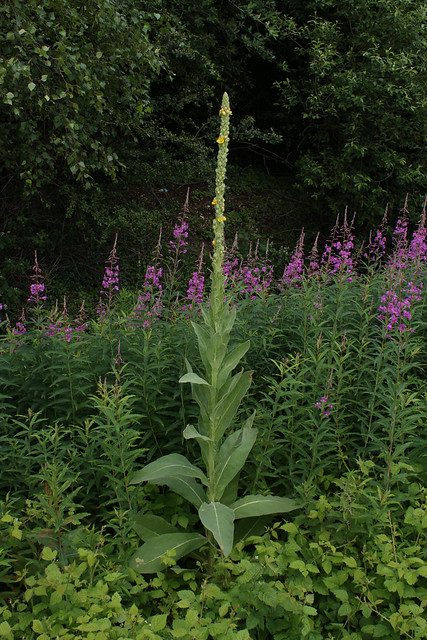
At the edge of a lake a stand of rosebay willowherb was just coming into flower. The flower spikes and leaves of willowherb have been used to treat grumbly bowels and apparently it makes a good mouthwash too. The willowherb was interspersed with spears of aarons rod:

Aarons rod – Verbascum thapsus

This aarons rod was a very fresh example and was only just coming into flower but when in full bloom the spear is full of yellow flowers from the leaves to the apex. They have been lining my route to work since June and there are still some hardy individuals lingering on into the autumn. Aarons rod has been used medicinally as an expectorant to treat coughs and for numerous other conditions including colic, eczema, boils and warts. It’s a very versatile plant.

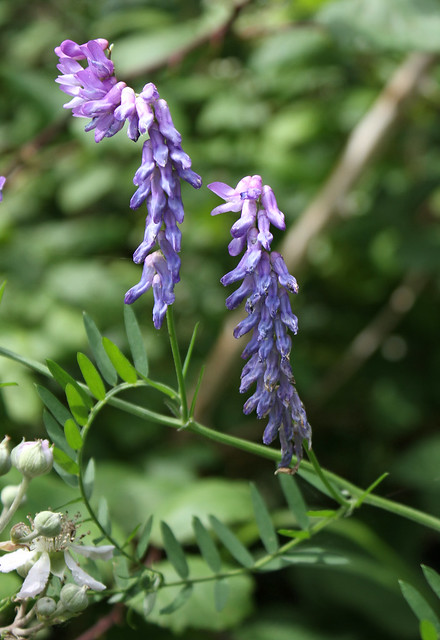
Tufted vetch – Vicia cracca

Many shrubs and bushes were festooned with the flowers of tufted vetch which is a European native and has also been introduced to the Americas where it is a weed. The flower heads were several inches long and a rather fetching blue/purple colour. It grows over other plants by shooting out tendrils which grasp stems and provide an anchor for further encroachment. It can grow up to 2m tall and can strangle smaller plants. But the flowers are lovely

Flowers and foliage

The greatest thing about a sodden Springtime was the abundance of bloom that resulted. So I spent alot of time this year recording the wild flowers and foliage that flourished in the wake of the deluge.

Some years ago I attended a lecture in which the speaker said that due to modern farming methods which involve the use of mechanisation and toxic chemicals to create a sterile monoculture,  verges and drainage ditches have now become an invaluable seed bank where many of our wild flowers can still prevail. Without these unpolluted conduits criss-crossing the countryside the flora seeking refuge there would be even more threatened. This idea seems to be born out in my local area as the drainage ditches are indeed full of wild flowers year on year.

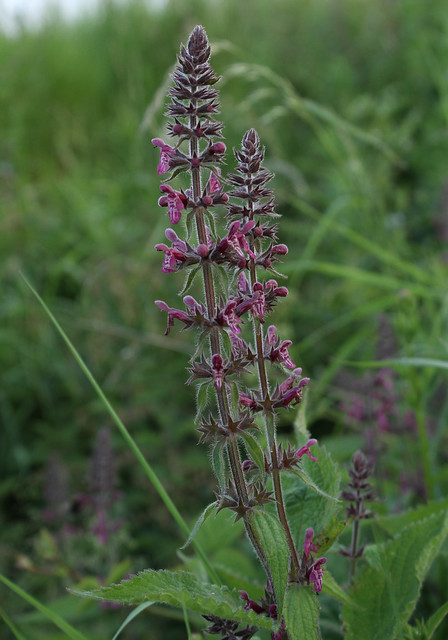
Hedge woundwort – Stachys sylvatica

Hedge woundwort has lined the field margins and ditches in greater abundance this year than in previous years, its delicate purple flowerheads, growing up to around a metre tall, poking  over the top of the ditches. It’s a lovely flower and it gets its name from its preference for hedgerows and because the crushed leaves were traditionally applied to wounds to stem bleeding.

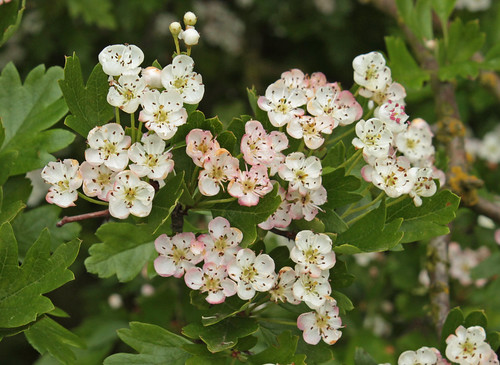
Hawthorn flowers lined all the hedgerows ealier in the year and heralded a glut of berries which are currently providing rich pickings for the birds, and will continue to do so well into the colder months.

Hawthorn blossom – Crataegus monogyna

The October 2012 edition of British Trust for Ornithology’s BirdTrack reveals that the migrant redwings (Turdus iliacus, Dansk: vindrossel) should be arriving here from Scandinavia any day now and will be followed closely by the fieldfare (Turdus pilaris, Dansk: sjagger), and the hedges fulls of haws will help to replenish their fat reserves after the migration across the North Sea. I think I saw my first redwing over Histon on Sunday, they have a characteristically undulating flight during which they fold back their wings and form a teardrop shape, which is what my sighting today was doing. So the fieldfare should be along soon too, according to the BTO.


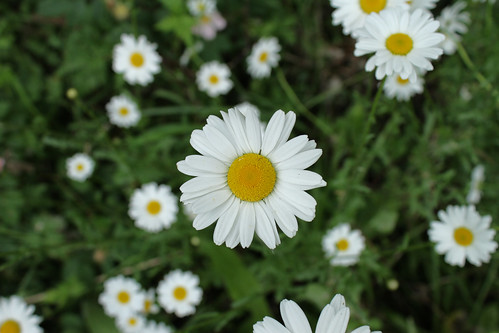
Oxeye daisy – Leucanthemum vulgare

Oxeye daisies are my Mother’s favourite flower and she has been pestering me to publish a picture of one. This year they lined my cycle route to work alongside the Cambridge Guided Busway in their thousands so I’m finally able to complete my commission. So, Ma, this one’s yours!

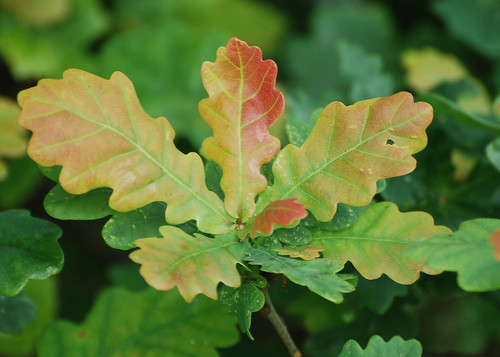
The wild flowers have been spectacular but the leaves and some of the trees have also been contributing their own splash of colour to the countryside such as the cluster of oak leaves below.

(Dramatic interlude: Wow, the first goldfinches (Carduelis carduelis Dansk: stillits) arrived on my niger seed feeder a couple of days ago after being absent through the summer and until a minute ago there was an adult and a late fledgling feeding there. I just caught a blurr out the corner of my eye as I was writing this post and looked up just in time to see a sparrowhawk (Accipiter nisus, Dansk: Spurvehøg) swoop through a gap in the buddleia bush next to the feeders, the goldfinches fled but it all happened too fast to see if the hawk was successful. It was all over in less than a second!)

Back to the oak leaves though, they were lovely colours, almost autumnal. Oak trees are amazing organisms, in fact they are substantially more than organisms, they are ecosystems in their own right. They live to be several centuries old and when coppiced or pollarded (pollarding is pruning back a tree to the top of the trunk to promote new branch growth, compared to coppicing which is pruning it back to ground level), but there are numerous examples of oaks living for 1000-1500 years. And they become home to hundreds of other species of fungi, lichens, insects, birds and mammals.


Oak leaf cluster – Quercus robur – the English oak

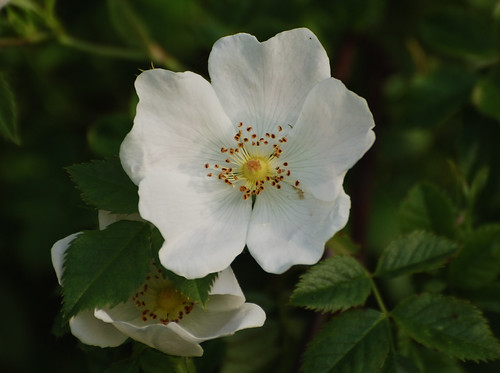
And right next to the oak was this gorgeous, delicate field rose. The field rose, Rosa arvensis, grows in hedges and has white to cream coloured flowers and lovely golden yellow anthers. It flowers later than the dog rose (Rosa canina) which has pink flowers and the leaves are smaller. Later in the autumn the flowers turn into bright red hips which provide food for birds as well as humans. When I was a kid we used to have rosehip syrup which was sweet and delicious and I’ve been toying with the idea of trying to make some. If I succeed in creating something pleasant I’ll post the recipe here.

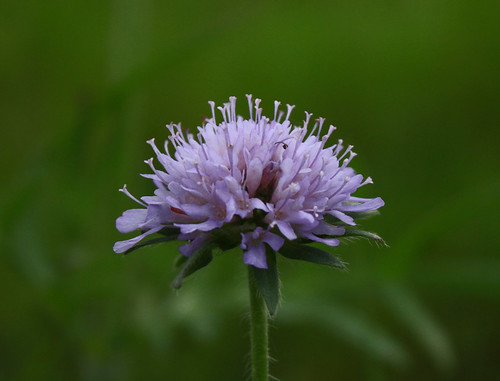
Without doubt my favourite wild flower is the field scabius (Knautia arvensis). I think they’re utterly beautiful and if I have a camera to hand I struggle to walk past one! Fortunately for me the field margins around here are replete with them so I’m rarely short of photographic opportunities.

The glorious flower of the field scabius

And from side on:

The hue of the flowers can vary from a pale pastel shade to quite dark purple. Each flower contains male stamens which can be seen protruding from this flower from between the female florets. The stamen consists of the filament (the stalk) and the anther (the pollen bearing part at the end of the filament). The stamens die back before the female florets mature in order to prevent self-fertilisation. Field scabius is named afer the German botanist Dr Knaut and has historically been used to treat skin ailments such as scabies and eczema.

Titchwell birds – the final episode

I’ve posted several times with pictures from my trip June to Titchwell on the north Norfolk coast but I’ve now exhausted my photo collection from that trip so this is the last one. There was a terrific number of bird species present the day I was there including ducks, waders, raptors, passerines and gulls, but the wildlife wasn’t confined to birds, a wall brown butterfly and a chinese water deer also putting in appearances.

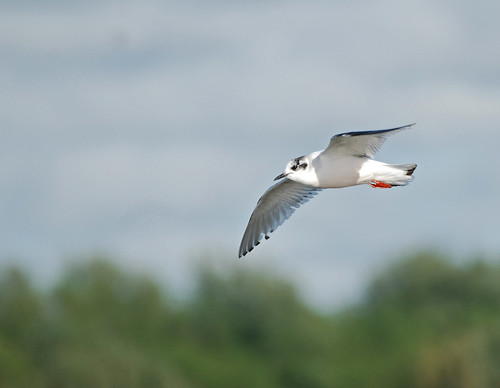
Gulls are many and often not-so-varied and can be easy to overlook: “What’s that bird?”, “Oh it’s just a gull”. But I like gulls and and it’s always good to have a new species identified and on this trip it was the little gull (Hydrocoloeus minutus, Dansk: dværgmåge). At first glance the little gull looks like a black headed gull, but it is noticeably smaller:


Little gull in winter colours – the summer plumage includes a completely black head

The other obvious difference between the two species is the colour of the beak which is black on the little gull and red on the black headed. It may also be mistaken for a tern as it swoops down on the water in a similar way to a tern but it’s not fishing it’s picking food from the surface of the water. I haven’t seen other gulls feed in this way.


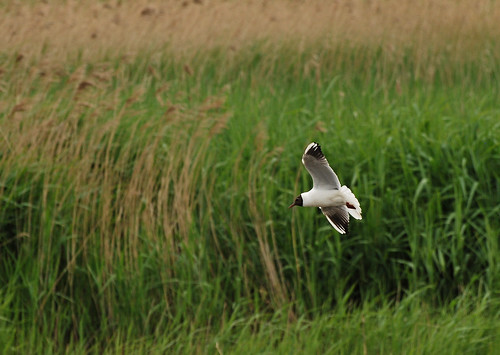
Black headed gull (Larus ridibundus, Dansk: hættemåge)

The black headed gull is common and I see large flocks of them feeding in the fields around Cambridge in the winter, unlike the little gull which is a rare breeder in the UK and a passage and winter visitor on it’s way to the Mediterranean.

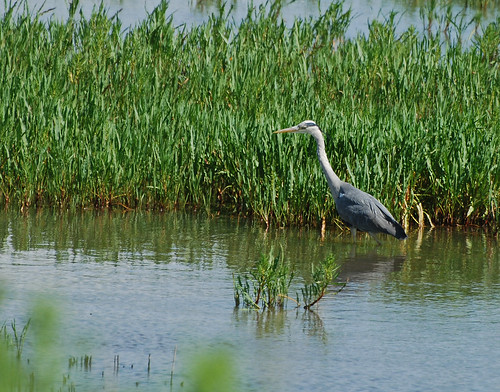
Grey heron (Ardea cinerea, Dansk: fiskehejre)

Stalking the shallows were several grey herons searching for fish and amphibians. The heron is a very effective predator unlike the pied wagtail perched just a few metres away serenading the comings and goings of serried ranks of twitchers passing to and from one of the hides:

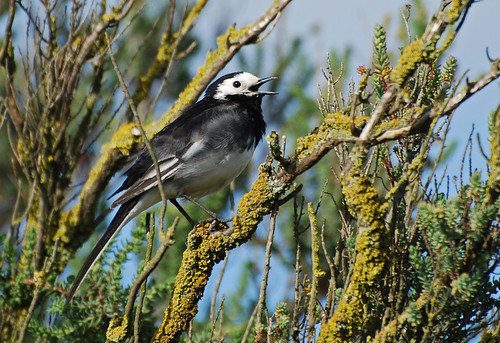
Pied wagtail (Motacilla alba, Dansk: hvid vipstjert)

This wagtail is an adult male, his colours are much darker and the black bib more extensive than the more delicately shaded female. The pied wagtail is a resident and migrant breeder and I regularly see them patrolling lawns, meadows and carparks with their characterisitic twitching tail.

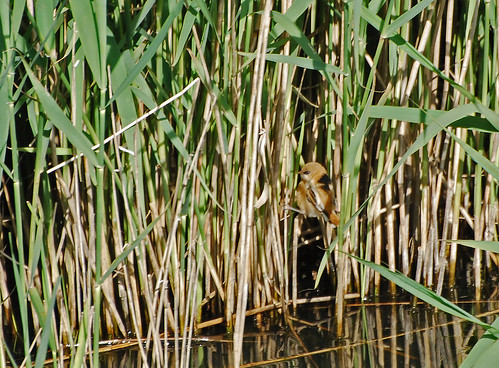
The one bird which I knew could be seen at Titchwell, but which I also knew was very elusive, so I didn’t really expect to catch a glimpse of it, was the bearded tit (Panurus biarmicus, Dansk: skægmejse). It’s one of those birds that I’ve seen pictures of and thought it almost looks unreal, like a childs drawing of an imaginary colourful songbird. A notion which seemed to be corroborated when I looked in my Collins field guide and it wasn’t listed! It transpires that it was listed, but as the ‘bearded reedling‘ instead of the ‘bearded tit‘, and it’s actually more closely related to the larks than the tits, to which it’s resemblance is only superficial. Despite the alternative name in my field guide it is listed on the British Trust for Ornithology ‘BirdFacts‘ website as the ‘bearded tit


Bearded tit juvenile

The bearded tit is resident in the UK but confined to the southern and eastern extremities. However, I did see some and even managed to get a photograph, albeit a not very good one(!). This one is a youngster, identified by the black eyestripe which differentiates it from the female, and the black patch on the nape which is absent in both adult genders. Of all the birds I saw on this visit the bearded tit (or reedling) was probably the highlight.