Category Archives: Wildlife locations

Histon Harvest

All the posts from my home patch have focussed on the wildlife and the impact of humans on the wildlife without much focus on the human activities per se. So as it’s harvest time now, or it would be in  a normal year, and the harvest is such an important event in human interaction with the countryside, I want to devote this post to it.

The harvest was nearly all done and dusted by the last week in July here this year, which is a good 2-3 weeks earlier than in a climatically normal year. These pictures are from last year when the bulk of the harvest took place in the second and third weeks of August. The crops vary in my local fields, and wheat, barley and oil seed rape are commonly planted.
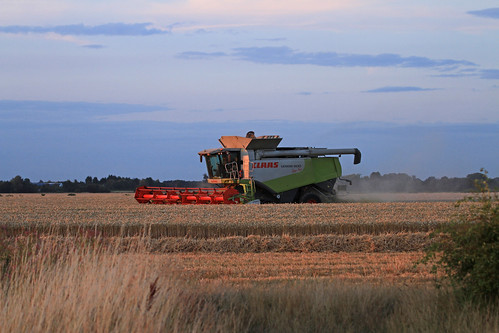
Leviathan of the Fens –  the combine harvester – gathering the crop

Last year it was either wheat or barley so when harvest time began it heralded the arrival of some seriously big machinery. The speed with which these gigantic beasts gathered the grain and separated it from the straw and depatched the produce was breathtaking.
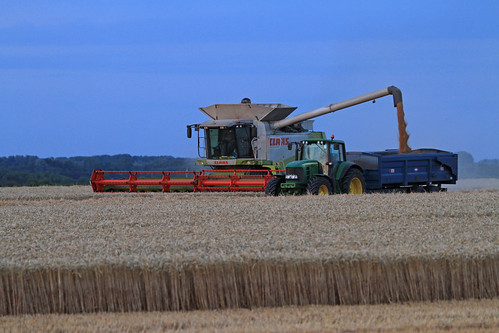
Dancing a duet with the tractor – it was all perfectly choreographed

The grain was unloaded into a trailer drawn by a tractor and the straw was jettisoned out the back to be simultaneously baled by a second tractor towing a baling machine :

And a quick change of partner for a waltz with the baler

The whole operation lasted just a few hours and was done with military precision and at the end all that was left was neatly arranged piles of bales amidst acres of stubble. A few years ago I was talking to a farmer in a pub near Cambridge and he told me that the harvesters have onboard computers which record how much grain is harvested from every part of the individual fields, and where yields drop it is all mapped via GPS so when fertiliser is applied prior to the next sowing operation, more will be applied in the areas of the fields which delivered the lower yields during the previous harvest. And of course, with that degree of efficiency applied to the whole process there is nothing left over for the wildlife as there was in the years pre-agro-intensification, and that’s a major reason why species such as tree sparrow, turtle dove, yellowhammer etc, are struggling. I’ve noticed in these fields that after the harvest nearly all the birdlife including yellowhammer, skylark, corn bunting, linnet and reed bunting all drastically decrease in numbers until the next springtime.

And whilst all that was ongoing there was another baler tidying up an adjacent field which is managed by a different farmer:
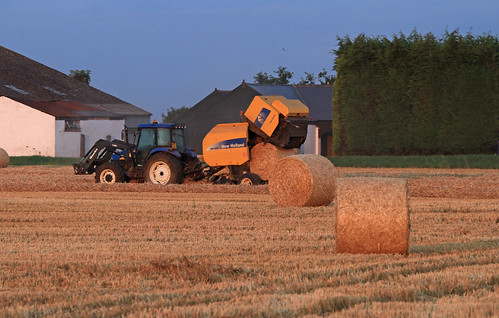
These monstrous bales aren’t the type that can be thrown around by a couple of farmhands and manually stacked on a flatbed trailer, they are around my height in diameter and require more big machinery to move them:

Another homeless (and endangered) farmland bird wondering what’s happened to his shelter and his meals:

A bewildered looking grey partidge (Perdix perdix) forced to the margins after the harvest

And of course, at this time of year, the grain isn’t the only harvest:

Juicy ripe plums hanging in the hedgerow

Another ramification of intensive farming is the destruction of the hedgerows. It’s something we wised up to in this country some years ago, with regard to grubbing them out, but nowadays farmers insist on attacking the ones that remain with flails (if anyone knows why they spend money and time doing this please let me know), including the one where these plums were growing. Not only does this thin the hedge right down so it provides less cover for overwintering birds, rodents, insects etc, the trees and bushes which grow there and provide food for the wildlife are producing less of these gorgeous fruit. So the wildlife is getting squeezed into a smaller and smaller fraction of the countryside and their shelter is under constant attack and their food source is constantly depleted. I think it’s not a good way to manage the countryside.
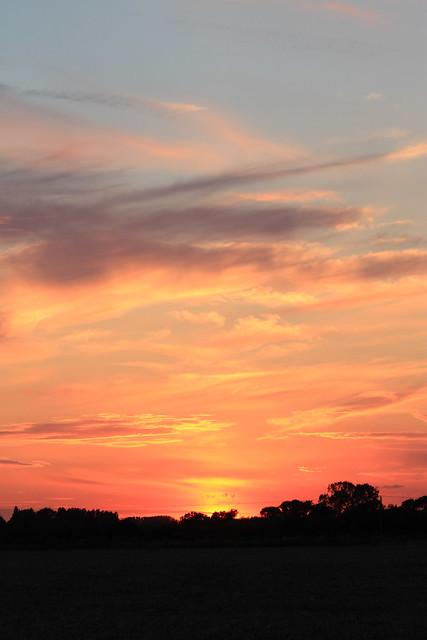
At harvest time with all the dust in the air it makes for some glorious sunsets

But on the optimistic side, I reckon it is possible for farmland to be managed to produce sufficient food for humans and still sustain our wildlife. I just hope that as a species we wise up before it’s too late. And at the risk of stirring up controversy… maybe we should simply learn not to waste so much.
Isle of Wight 2013

Part 1 – Lepidoptera

I’ve already grumbled in earlier posts about how the weather over the last three years leading up to 2014 was cold and unpredictable here in the UK, and how it had a very bad effect on our wildlife. In particular, overall numbers, and numbers of species, of butterflies, which are very sensitive to environmental change, seem to have been dramatically affected over those three years here in Cambridge at least.

But last year whilst on holiday on the Isle of Wight I took a walk from Shanklin up to the old WW2 radar station which is the highest point on the island, and apart from a flypast by a peregrine falcon, the most eyectaching natural phenomena were the butterflies, which seemed to be in direct contrast to the previous three years.

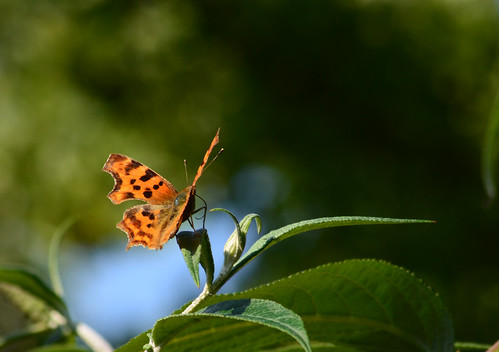
Comma – Polygonia c-album

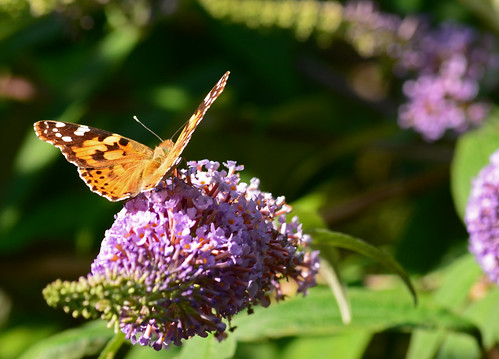
The first part of my route took me through a wooded area bound by sea cliffs on one side and farmland on the other. A huge buddleia bush overhung the pathway which was hosting numerous species of butterfly, including the comma, above, and a painted lady, of which I’d seen plenty in 2010 but virtually none in the intervening years when the weather had turned bleak.

Painted lady – Vanessa cardui

The comma is resident to the UK and in recent years its numbers and range have actually increased and this has puzzled the entomologists as it is bucking a general trend amongst all butterflies here in the UK. in contrast, the painted lady is a handsome migrant which, according to my field guide, may or may not show up in the UK, consequently the entire population depends on immigration from Africa. But that raises the question what happens to the adults that are born here?

But since my guide was published, some research has been published where populations were tracked in and out of the UK on their migration routes by radar, and it revealed that painted ladies leave the country at high altitude – 500-1000m – where they can’t be seen by eye. The application of technology is revealing many hitherto unknown phenomena about many species and it’s interesting that up until now it was thought the whole UK population of painted ladies died out each year simply because they fly back just out of visual range.  And even more amazingly, it has now been discovered that this species takes up to six generations to make a circular 14000km (9000 miles) round trip from the Arctic Circle to Sub-Saharan Africa!

Which raises another mind boggling question: how is it hard wired into this tiny creature to make successive steps of this awesome migratory feat, covering half the globe, all in the same direction, at any one time? Unbelievable! But on the other hand, if populations on a previous leg of the journey take a hit for whatever reason it may be the explanation of why population size can vary so much from year to year in the UK.

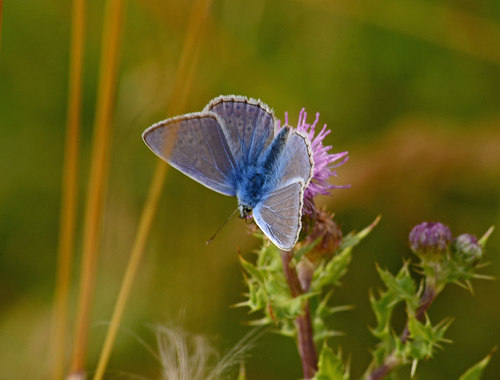
Common blue male  – Polyommatus icarus

After emerging from the woods I climbed a steep incline, crossing the main Shanklin to Ventnor road and up the chalk downland of Boniface Down towards the WW2 radar station. Consequently, the terrain and the vegetation changed and so did the butterflies. The common blue is another species which I sighted frequently before the three year cold snap of 2011-14, but this male was the first one I’d spotted for a while.

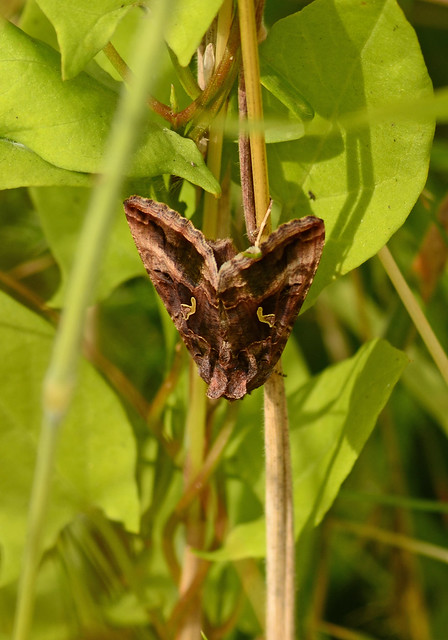
Silver Y moth – Autographa gamma

The silver Y – it’s easy to see how it got its name – is a migrant moth which isn’t peculiar to chalk downlands and can be seen in most habitats, including the farmlands here around Cambridge, and this one was soaking up the sunshine on the down.

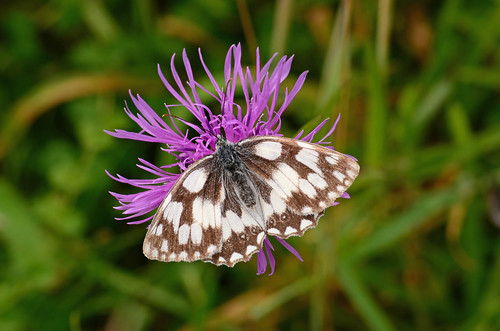
Marbled white  – Melanargia galathea

But the real gem of this trip was the marbled white, of which there were numerous examples fluttering around the down, and this one was sipping nectar from a greater knapweed flower. The marbled white is a UK resident and its favoured habitat is chalk downland.

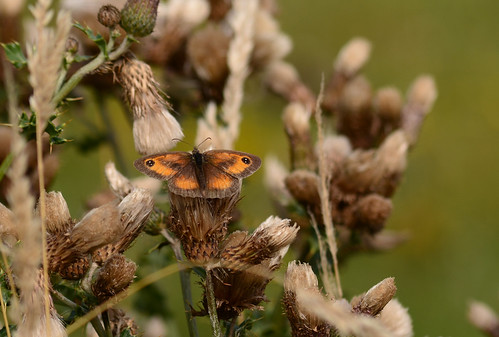
Emerging on the top of the downland the vegetation changed to primarily low scrub consisting of acres of thistles which were home to more gatekeepers than I’ve ever seen before in one spot, I’m not exaggerating when I say there were literally hundreds of them. The information board at the entrance said that small coppers were also in residence but I only saw one and unfortunately it didn’t settle, which was a pity because they’re beautiful little brown and orange chaps and I wanted to get a photograph of one to share. Oh well, next time.

Gatekeeper – Pyronia tythonus – this one is a male, identifiable by the brown patches on the forewings, the ‘sex brands’

During the winter of 2013-14 and so far through this year the weather has warmed up, the cold, the rain and the high winds have all abated allowing many species to start to recover. It’s been a good year so far for butterflies and dragonflies, and hopefully lots more insects and the other creatures that predate them. The resilience of the natural world is astonishing, but I’m hoping we get another couple of mild years so the recovering wildlife can consolidate its numbers before the next big change in the weather.

The views from the top of Boniface Down were lovely. The cliffs on the southern edge of the island falling away to the English Channel were to the left, and when I looked north I could see mainland England. It’s not discernible in this photograph but the Solent and the south coast of the mainland are in the distance:

The only bird I managed to photograph up there was this little fellow who I think is a meadow pippit:

The pippits were very busy feeding youngsters, toing and froing across the scrub with beaks full of insects.

And the other reason I hiked up the hill was to see the old radar station at RAF Ventnor at the top of Boniface Down. This was one of the original installations set up before WW2 and was instrumental in detecting and reporting the massed attacks on southern England by the Luftwaffe during the Battle of Britain.

The remaining pair of radar towers at RAF Ventnor – there were originally six

The station was twice bombed by the Luftwaffe and I believe it holds the dubious distinction of being the only radar station to be destroyed by the enemy!

Dragonfly drama

Early last Saturday morning I set off for Paxton Pits, a group of lakes on the edge of St Neots, between Bedford and Cambridge. It was anticapted that we wouldn’t see much birdlife but there could be some inteersting dragonfly activity. And apart from a lone turtle dove (which justifies the trip on its own!) and a sparrowhawk, we noticed surprisingly few birds. But the Odanata were there in abundance with large numbers of various species of damsels and true dragons.


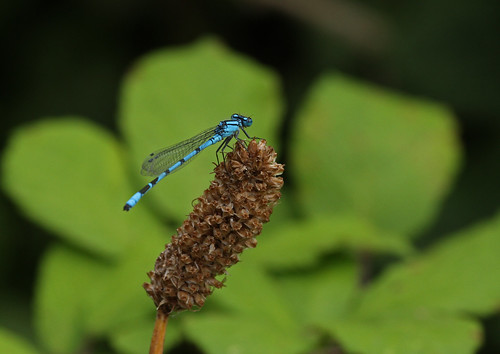
Common blue damselfly

I spotted this common blue (Enallagma cyathigerum) before I’d even got out the car. This one a male, was perched on a seed head at the edge of the carpark and there were several others in the vicinity warming themselves up in the early morning sunshine. At the other side of the carpark is the visitor centre which has a small pond outside and over the pond were a red eyed damsel (Erythromma najas) and another common blue warming up on the same rush leaf:

Paxton Pits are disused gravel workings and have been turned into a nature reserve that is managed by Huntingdonshire District Council with the back up of the voluteers of the ‘Friends of Paxton Pits’. If you happen to be contemplating a visit to the Pits, there is a lot of information on their website: (https://sites.google.com/site/paxtonpitsnaturereserve/home), and the reserve also has a blog where sightings at the lakes can be recorded: (http://paxtonpits.blogspot.co.uk/). The website lists all the Odanata that have been resident there and many of them were on display on Saturday. They don’t all emerge at the same time of year so it would never be possible to see all of them during one visit.


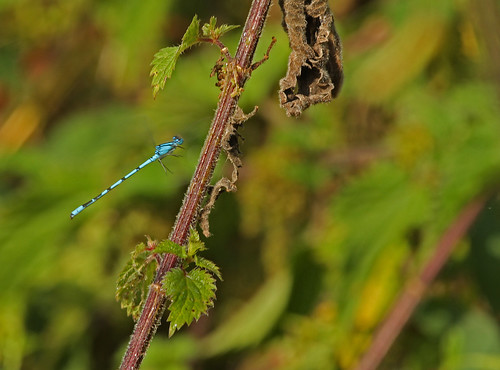
Another common blue damsel on final approach to land on a stinging nettle stem

The Pits are adjacent to the River Great Ouse and swarms (literally!) of banded demoiselles (Calopteryx splendens) were fluttering within 20m or so of the banks of the river. The banded demoiselle is one of two species of demoiselle in the UK and the only one in the east of England, and I think they’re absolutely beautiful as they sparkle in direct sunlight:

A female banded demoiselle perched on top of a nettle (I like the background here – out of focus brambles)

The other species of UK demoiselle is called the ‘beautiful demoiselle’ (Calopteryx virgo) and is found in the south and west but not the east. It is most easily distinguished from the banded version because the wing pigmentation in the male extends to the base of the wing, so it’s a much bigger spot than those on the wings of these banded demoiselles:

Above and below: male banded demoiselles
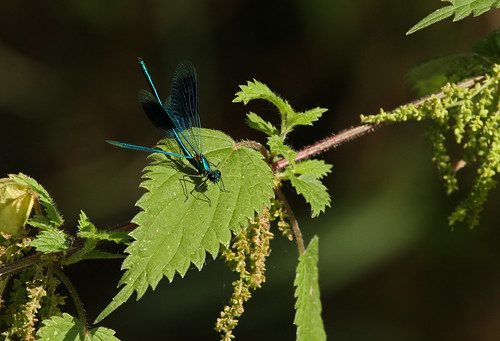
And the female beautiful demoiselle  has broader wings with a brown tint that’s lacking in the banded demoiselle. The male demoiselles were busy chasing females with all thoughts turned to mating.

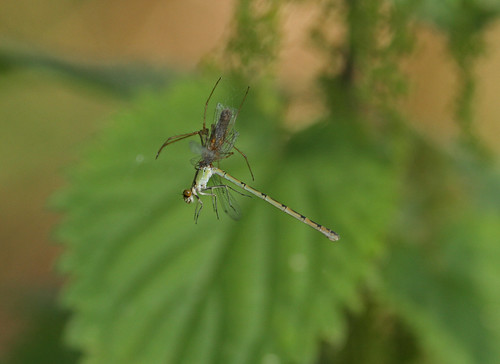
But in the midst of all the the mating activity, danger, as always, was lurking in the undergrowth. This unfortunate female common blue damsel had been caught in  a spider web and was in the midst of a mortal struggle with the owner, which she eventually lost:

The male common blue was also caught in the web and was struggling to extricate himself. Fortunately for him, all the spiders efforts were needed to subdue the female and whilst it was otherwise distracted he made his escape whilst the female eventually succumbed to the spider venom.

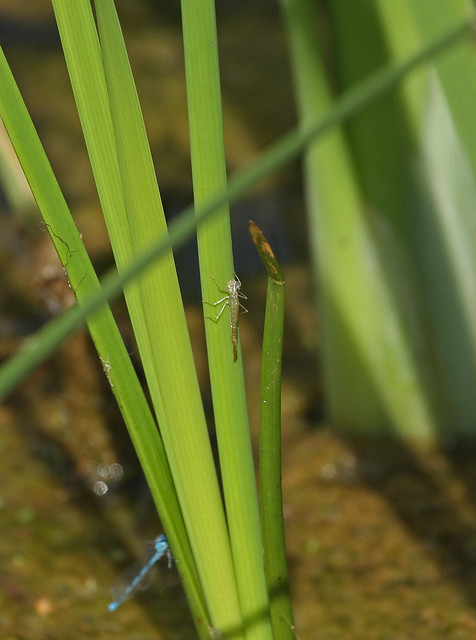
A dragonfly larva having scaled a stem to leave the water will shortly burst out of its skin and fly off as an adult dragon

It’s also that time of year when dragonfly larvae are metamorphosing into adults. The larval stage of all dragonflies is aquatic and so they require gills or ‘caudal lamellae‘ to breath underwater, and these can be seen protruding from the end of the abdomen of the larva above. At the end of its aquatic life the larva climbs a stem out of the water and emerges from its larval skin as an adult, leaving behind its discarded outer casing, or ‘exuvia‘:

Dragonfly exuvia  – a dried out larval husk left behind on a rush stem after the new adult has flown
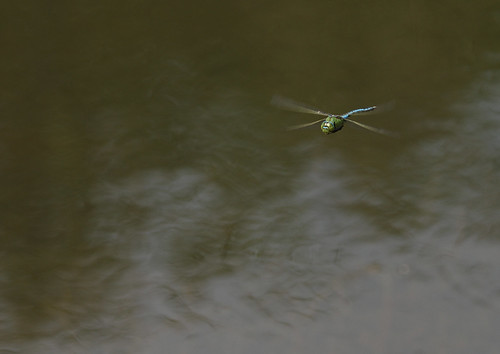
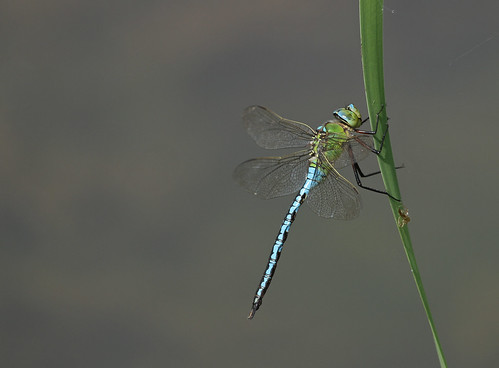
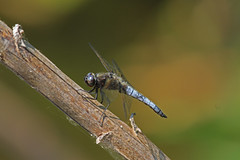
As well as the damsels, several species of true dragons were on the wing including brown hawker, migrant hawker, black tailed skimmer, and the grandaddy of all UK dragons, the emperor (Anax imperator):

Emperor dragonfly male patrolling his stretch of water against allcomers

The emperor, as its name suggests, is a whopper. It is also an aggressive defender of its territory, a consummate aeronaut and a ferocious hunter, taking prey as big as other dragonflies. It’s easily distinguished from other dragons by its sheer bulk, the apple green thorax and the drooping abdomen. I sat and watched this one for some time and he rewarded my patience by posing for a portrait on a stem just  a few metres away:

And after all the dragon activity I peered into the water on the way home and spotted this little chap:

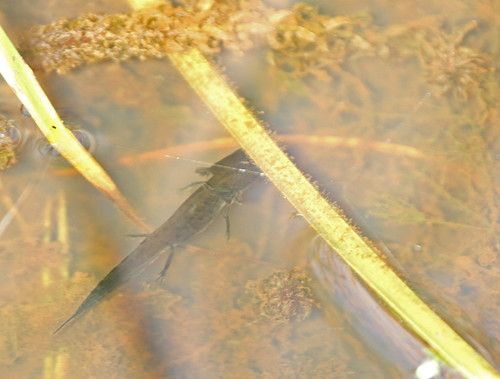
A young newt

I don’t know what species of newt this is but it’s still so young it hasn’t adapted to air breathing and still has its feathery gills which are visible just in front of the fore legs.

It’s been a long time since I last posted so it’s good to be back Life should be generally less busy for the back end of the year and I’ve got lots to share, so hopefully I can start to post more regularly again!

Birds and bees…

…and butterflies.

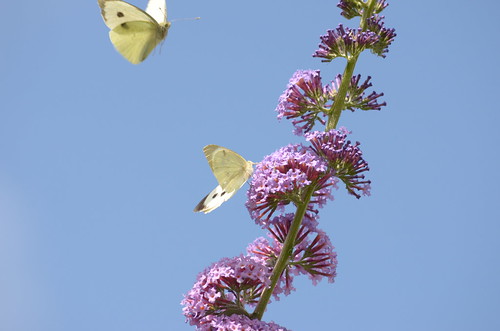
A male large white butterfly (Pieris brassicae, aka the ‘cabbage white’) zeroing in on a potential mate…

I normally try to avoid taking photographs of UK wildlife on imported garden plants, in this case buddleia, species of which grow endemically on several continents, and I believe our UK variety arrived here from the Himalayas.

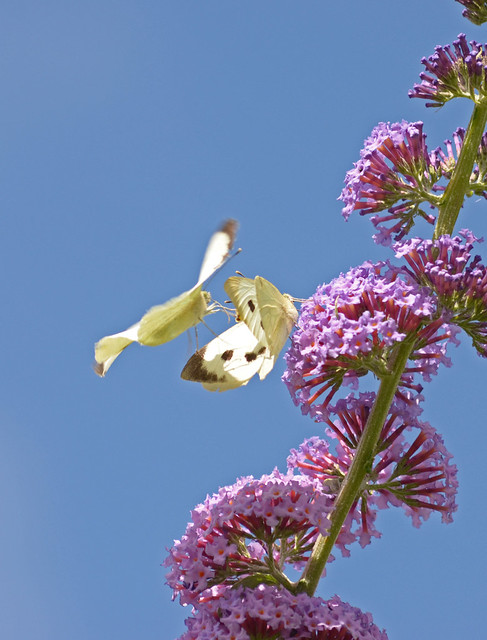
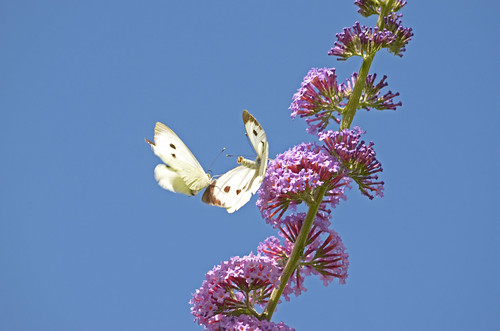
No longer anything ‘potential’ about her!

But in this instance the drama was so compelling (and I was testing out my new macro zoom that I introduced in the last post) so I decided to share this sequence.

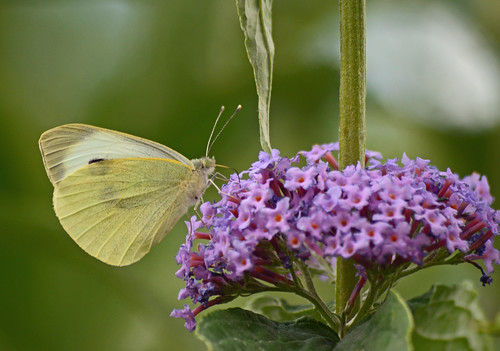
Several mating events ensued after which the male settled on a lower flowerhead to sip nectar and replenish his energy reserves:

The large white, along with the small white (Pieris rapae), are known as the ‘cabbage whites‘ because they lay their eggs on members of the cabbage family and the caterpillars can do a lot of damage to cultivated cabbages. But I’m quite happy to share my cabbage allowance with them and I love to see them fluttering through my garden and along the hedgerows.

Tyto alba

A few posts ago in ‘The Owl and the Woodpecker‘ I mentioned that a pair of robins may have started getting fruity in my garden as early as the begining of January. And then last Friday I saw another robin feeding a fledgling on the grass outside work, so it looks as though the avian breeding cycle may have been able to start early this year. I hope it has, and that it allows other species to recover some of their numbers too.

Also in that post, I talked about our local barn owls, of which we had two breeding pairs in and around the village last year. And one gloriously sunny evening in July myself and my daughter, Sophie, set off across the fields with a portable hide, binoculars and a camera to try to see the owls and take some photographs. I know where the owls nest so we tried to get in position to see them heading to and from the nest site via a circuitous route to avoid disturbing them.

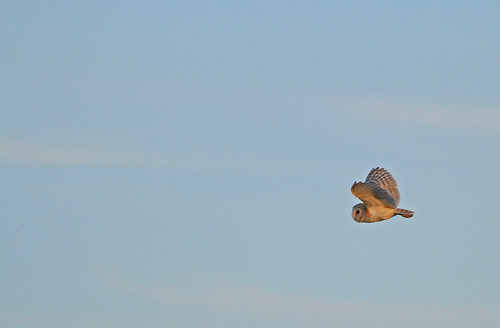
A barn owl, Tyto alba, heading out on a hunting mission

We eventually found a spot at the top of a drainage ditch between two fields around 150m from the shed where the owls had built the nest, and we didn’t have to wait long for them to appear. Truth be told I’ve always had a thing about all owls, but especially barn owls. I think they’re beautiful and iconic creatures, and very reminiscent of warm summers evenings in the English countryside. It’s always an exciting moment when I catch sight of one.

And the other thing that struck me as we sat and watched these was how they are incredibly efficient predators:

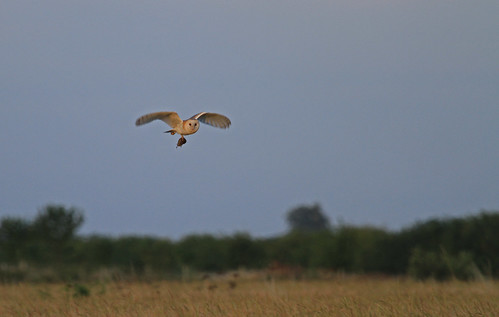
…and heading back again clutching the booty

We sat and watched them coming and going for about an hour and in that time they arrived 6 times with prey. So on average every 10 minutes one of the parents returned with a meal for a youngster, this one was carrying a rodent in its talons which it delivered to the nest, spent a couple of minutes with the youngsters, then departed on the next foray.

And another meal being delivered

And they carried on hunting into the dusk at which point we upped sticks and headed for home. I don’t know how long the owls carried on hunting but the parents seemed to be so successful that they may not have needed to carry on for much longer, after which they would have spent the night at a roost site separate from the nest with the youngsters in.

It was a glorious evening and Sophie was beside herself as one of the owls flew right overhead and looked straight at her, as barn owls are wont to do, as she looked straight at it. A memory that will stay with me, and her I hope, for a very long time!

Brampton Wood

Again, harping back to last July, I took a stroll around a piece of woodland called Brampton Wood with a good friend of mine who is a bit of an expert on butterflies. Which is why we went to Brampton, which is ancient woodland made up primarily of oak, ash and maple and is famed for it’s exotic and scarce Lepidopterans such as black hairstreak, white admiral and silver washed fritillary.

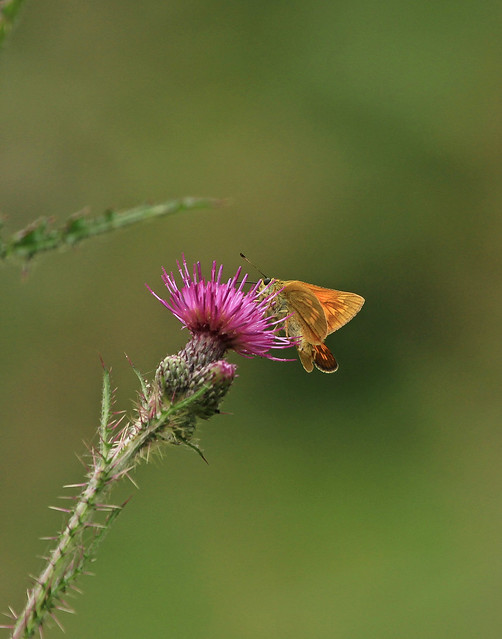
Large skipper – Ochlodes sylvanus

We didn’t see any of the rare species, mainly because the weather was generally unsuitable, but probably also because we were talking too much and not paying sufficient attention, but the species we did see gave some lovely photographs.

The large skipper is part of a big family of butterflies called the Hesperiidae or the ‘skippers‘, so called because they dash around from flower to flower in a skipping motion. They are also easily distinguished as a skipper because of the way they fold there wings at different angles when they are perched (for those of you with an aeronautical interest they remind me of the US Navy plane the F18 Hornet).

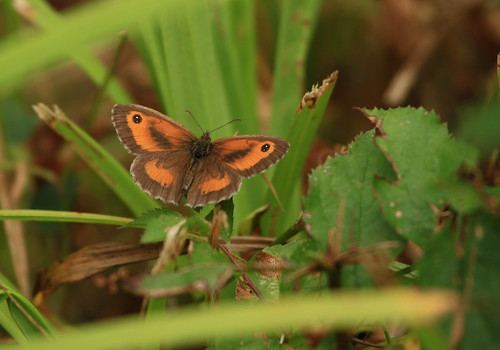
Gatekeeper, Pyronia tithonus, patrolling a leafy ride

The gatekeeper is a common hedgerow butterfly, but as with all the other wildlife in this part of the world, it suffers at the hands of intensive agriculture particularly when that involves grubbing out hedgerows. In 2010 my daighter and I did the annual ‘Big Butterfly Count’ in a scrubby field at the end of our road and we counted 11 species in the allotted 15 minute window, including the gatekeeper. A few weeks ago the tenant farmer, obviously a public spirited soul, grubbed out all the scrub and brambles which were home to all the butteflies, so I suspect numbers of all Lepidoptera, and the resident dragonflies, will be severely depleted this year. Which is a real shame as the field is fallow and not doused with chemicals so was a particularly good site for insects. The dark patches adjacent to the black spots on the forewings of the butterfly here are called the ‘sex brand‘ and mark this one out as a male, the same markings being absent in the female. The gatekeeper is also known as the ‘hedge brown’ which gives you a clue as to its preferred habitat.

The splendid creatrure below isn’t a butterfly, it’s a six spot burnet moth:

Six spot burnet – Zygaena filipendulae – adding some additional colour to a thistle head

The burnet moths consist of the burnets and forester families, they are day flying creatures and all have club shaped antennae. The six spot burnet is found in grassland feeding on thistles, scabius and and knapweeds, and its flight season is from late June to August. Apparently the red spots can sometimes be yellow, but I’ve never seen a yellow one.

The disappearing dove

Every year millions of migrating songbirds heading from Africa to Europe get blown out of the sky by weird people with shotguns. That combined with the policy in the UK of destroying habitat at an alarming rate is making life impossibly possibly difficult for some of our iconic bird species, one of which is the turtle dove (Streptopelia turtur, Dansk: turteldue).
But last summer I was exploring one of my regular haunts, Milton Country Park, on the northern edge of Cambridge, on a warm Saturday morning and the air was buzzing with insects including this handome hoverfly known as the ‘footballer‘ due to its rather fetching black and yellow striped thorax. This species is common in England reaching a peak in July which is when I snapped this individual.

The footballer hoverfly – Helophilus pendulus

And hoverflies aren’t the only abundant insects to be found in July. Milton Country Park is also home to mumerous species of Odonata, the dragonflies (Anisoptera) and damselflies (Zygoptera).

Common blue damselfly – Enallagma cyathigerum – perched on a seedhead

The Park has 4 big lakes:

MCP map

…and a few other streams and pools, and despite the abundant human presence it remains a haven for some properly exotic wildlife including a bittern that appeared for a week or so last year, and the occasional osprey stopping off on migration from sub-Saharan Africa to breeding sites further north in the UK.

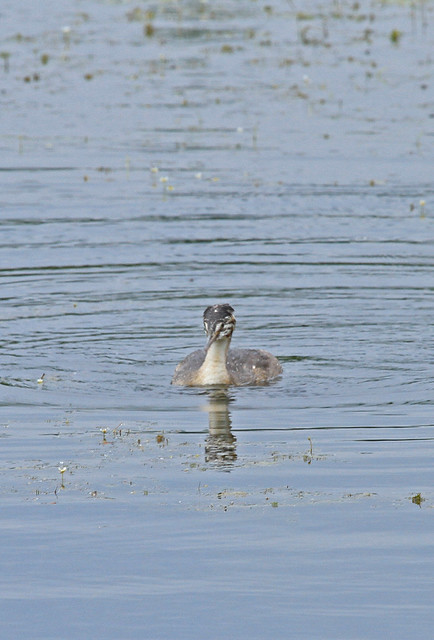
The great crested grebe (Podiceps cristatus, Dansk: toppet lappedykker) isn’t an exotic migrant but it’s a beautiful bird and can always be found here:

The grebe was almost hunted to extinction because its dense feathers were coveted as a substitute for fur. But it has recovered and can now be found on lakes over most of the UK. The one above is an adult and the one below still has the striped head markings of a juvenile.


But getting back to the point, the undoubted star of the show on this trip was the turtle dove:

The turtle dove is in very serious decline, I believe we have lost around 97% of our breeding population and it is anticipated it will become extinct in the UK by 2020 as it’s also under increasing pressure in Europe. The reason for its catastrophic decline is that it feeds on seeds from cereals and other plants and both of these are a scarce commodity in the fields of the UK at the time the doves need them.

So the birds arrive here in the UK exhausted after a heroic migration across the Sahara and the Mediterranean. And those that avoid the gun-toting imbeciles in southern Europe arrive here to find there’s not enough food. So as it takes them a long time to rest and feed and get back into breeding condition, they only have time for a maximum of one brood per season before they have to head all the way back. And this enforced curtailment of there breeding window means they just can’t sustain their numbers.

They arrive back in the UK from around mid April so I’ll try to capture some more photographs before they finally stop coming here all together.

The owl and the woodpecker

As I started to write this post there was some interesting robin behaviour going on in the garden. Robins (Erithacus rubecula, Dansk: rødhals) are fiercely territorial and will kill each other to defend their patch and I often see them chasing off not just other robins but any bird smaller than a blackbird (Turdus merula, Dansk: solsort)! But just now there was a pair being relatively nice to each other and even sharing the same feeder. So I’m wondering if these two were a pair beginning to contemplate the imminent breeding season, as early as January the 12th. The weather has been much warmer than the previous three winters so maybe they are already thinking of making up for lost time.

But I began with a digression, so now to get back on message. I’ve been dithering about writing this post for a few days but I was finally inspired to start when I saw some recent posts on the blog of a good blogging friend, Gary, from ‘Krikitarts‘ (if you haven’t seen Krikarts yet make sure you check it out, it’s very, very, good!). Gary’s posts included pictures of skies and rainbows which were digitally reproduced form the original slides. And seeing these spectacular images spurred me on to get this post written to show you some evening skies from Cambridgshire in summertime.

But before I get on to the sky, on this particular evening from July 2013, green woodpeckers, which breed successfully close by, had their most recent brood of fledglings and were out and about learning how to dig up termites:

A pair of green woodpeckers flying away from me, they’re skittish creatures (Picus viridis, Dansk: grønspætte )

Whilst many bird species have been on the decline, the green woodpecker seems to be thriving, at least in my part of the world. I see them around the village, in the trees and on the ground around work, and on the way to work too, and I’ve heard they are generally doing OK. They’re handsone, colourful, creatures and it’s good to see them coping well with all the insults humans throw at them.

A greenie keeping an eye on me and the dog

This particular evening was a very warm and sunny one and as I meandered across the fields the sun got lower and lower, and bigger and bigger, in the sky:


And as the sun got lower and plunged us into the crepuscular phase twixt day and night, a barn owl (Tyto alba, Dansk: slørugle) was quartering the fields looking for rodents. Barn owls were hit really hard by the previous three bitterly cold winters and then by the brutal wet and cold weather last spring. But we had at least two breeding pairs in Histon and this individual was half of one of those pairs. Bearing in mind the precipitous decline in barn owl numbers in the UK and beyond, I think that makes Histon an important place for them. I don’t know how many chicks were fledged but I’m hoping some survive the cold weather holds off this year and we get more breeding pairs in 2014.

Barn owls are great to watch. I know the routes they take in the fields local to here and when I see them coming I can crouch down and often, but not always, they fly slowly right over my head, around 10-15 feet up, and sometimes we eyeball each other and I wonder what they’re thnking. Of which more in another post in the near future.
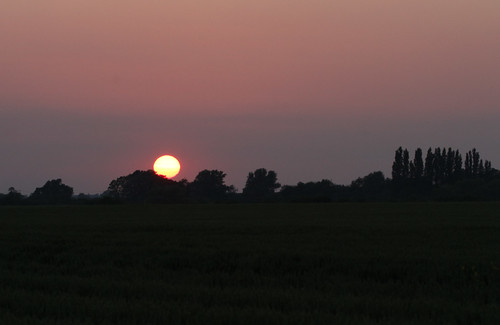
And as I meandered home from watching the owl, the sun disappeared below the horizon leaving these magnificent colours hanging in the sky which slowly turned into dark blue-grey and then the black of night

Not a bad way to spend an evening!

Down on the farm in July

Summer was late arriving in  2013. The weather was cold and wintry up until June and that had a profound effect on the wildlife. Breeding seasons were knocked out of kilter by it, and the numbers of many species have suffered as a result. But it seemed that once summer did arrive the wildlife got very busy very quickly to make up for lost time.

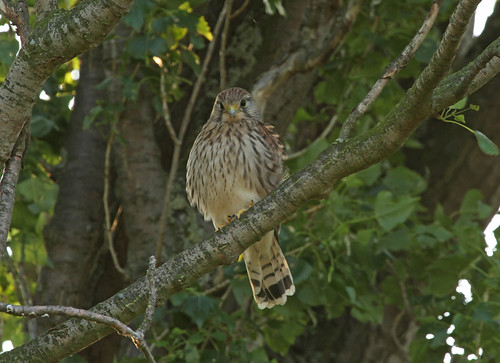
The skyline on my regular dog walking route is dominated by a magnificent poplar tree which makes a wonderful sound when the wind blows. It’s right on the pathway where many walkers pass every day and there is a bench underneath it which folk sit on occasionally. But despite all the human activity in such close proximity a pair of kestrels (Falco tinnunculus, Dansk: tårnfalk) were brave enough to build a nest in it about 20-25 feet up.

Kestrel fledgling taking it easy and apparently unfazed by me pointing a telephoto lens at it

I posted about the adults taking up residence in the poplar in August last year. Their decision to nest in this exposed location paid off in spades as the kestrel pair fledged three youngsters who could be seen in around the poplar into the later months of 2013.

And a pair of the fledglings sheltering in the poplar

I made a point of not lingering too long around the poplar to avoid disturbing the birds, but because of the constant human presence there I think they were relaxed about me taking pictures as long as I didn’t try to stay too close for too long.

All the pictures in this post were taken on one summers evening stroll in July, and as well as the kestrels there was lots of other wildlife.

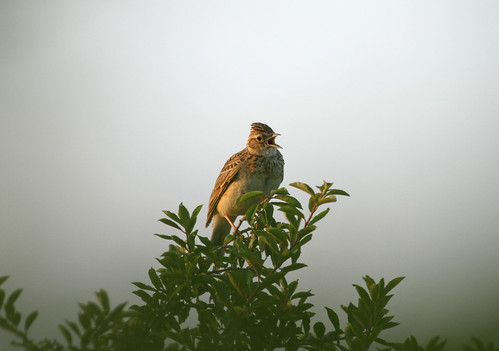
Also breeding in the field adjacent to the poplar tree were numerous skylark (Alauda arvensis, Dansk: sanglærke). I’ve been trying unsuccessfully to get photographs of skylarks for a long time but on this particular evening this one perched on top of a low bush and sang for England. I called the dog to heel and using an adjacent bramble as a shield I crawled as close as I could, which was less than 10m in the end, and poking my lens though the bramble I finally got some pictures:

A singing skylark lit by the low, late evening sun

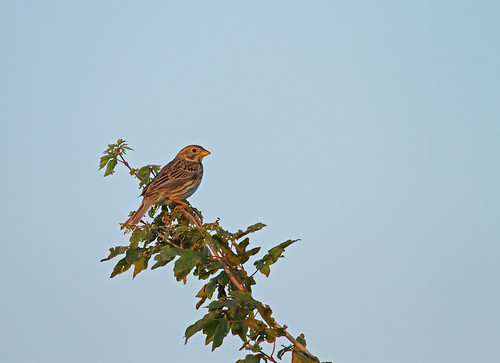
The resident corn buntings (Emberiza calandra, Dansk: bomlærke ) usually vacate the fields around Histon with the harvest at the beginning of August, but in 2013 they stayed much later. I don’t know if that was coincidence, because there was still cover in one of the fields, or if it was a result of the enforced delay in the breeding cycle due to the cold spring weather. But they were here in much greater numbers and much later in the year than normal. According to the British Trust for Ornithology the corn bunting is so sedentary that individulas only 30km apart sing in different dialects, but I’d love to know how that was discovered.

Corn bunting on a regular perch in the late evening sunshine

Corn bunting are red listed in the UK due to rapid decline in numbers as a result of habitat destruction for agriculture. Despite that, and decreasing numbers in Central Europe for the same reason, it’s not considered under threat as a species in mainland Europe… yet.

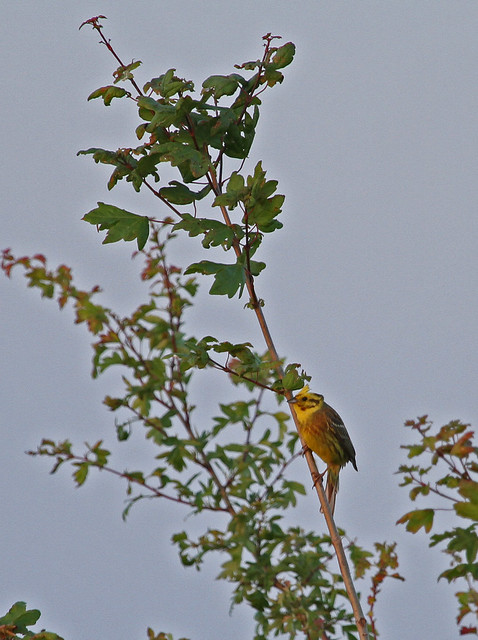
Another songbird which is also red listed in the UK, also as result of rapidly declining numbers, is the yellowhammer (emberiza citrinella, Dansk: gulspurv).

Male yellowhammer with his striking yellow head plumage

The yellowhammer has suffered catastrophic decline in numbers over the last few decades and over the last 2-3 years I’ve noticed the numbers in my locality seem to be on the wane too. I think it hasn’t been helped here by the farmer who recently took a flail to all the hedgerows and a lot of the drainage ditches and stripped most of the winter cover and food away. I just don’t see the sense it that – it wasn’t impinging on the crops or impeding access to farm machinery. Seems completely pointless to me.

Yellowhammer and corn bunting are both species of bunting and prefer arable farmland, but due to the intensive nature of arable agriculture and the resulting lack of seed, either natural or crop, both species are under dire threat in the UK. I’ve seen evidence to show that rates of decline can be slowed by changes in farmland management such as set aside or organic cropping, but I think attempts to conserve need to be applied in more holistic fashion to ensure survival of the wildlife.

One species which appeared to be abundant last summer was the hare. They’ve been ever present on any summers evening stroll across the fields in 2013. And I’m still seeing them through the winter too.

And as I headed home there was a spectacular sunset:

…one of many through the summer of last year.

Life in the kiln

After a lengthy absence from the blogosphere I’m rushing to squeeze a last post in in 2013. It won’t be topical so I’m harping back to a visit to the Lime Kiln in Cherry Hinton, on the southern edge of Cambridge, from back in July. I posted from here earlier in the year about the resident peregrine falcons.

The main reason for this visit to the Lime Kiln was to see if the peregrines were still in residence. One of them appeared overhead and gave chase to a pigeon, but it was in level flight not in  a stoop so the pigeon made good its escape. It was more like a juvenile practice run than a serious attempt to make a kill. It seemed that the family group had dissipated and were no longer spending the whole day at the Lime Kiln.

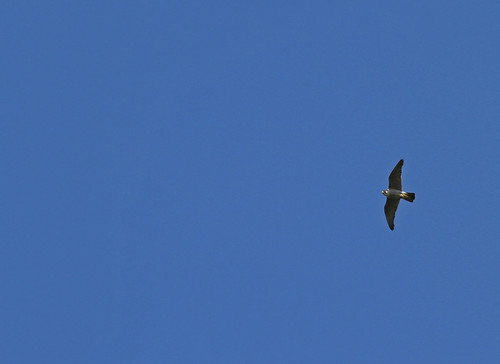
A single peregrine falcon – Falco peregrinus – quatering the Lime Kiln

The peregrine is the worlds fastest bird, but only in a stoop, which is gravity assisted and more a controlled fall than real flying. In level flight it is comparatively cumbersome and not the fastest, that accolade goes to a species of swift called the ‘white throated needletail‘ (Hirundapus caudacutus) with recorded level flight speeds of around 70mph (112km/h).

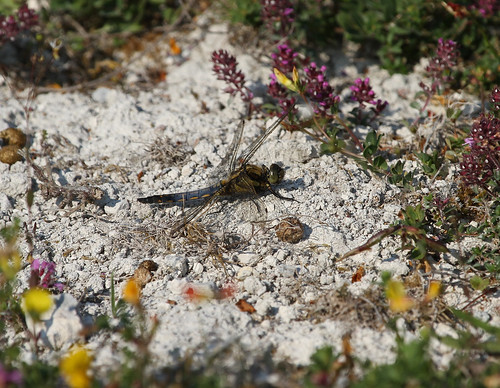
Black tailed skimmer – Orthetrum cancellatum

The black tailed skimmer dragonfly was perched on the chalky ground and this is characteristic behaviour of the species. As the temperature rises above the mid 20’s Celsius he will perch on low vegetation instead. This one is an adult male, his blue abdomen is diagnostic and can only be confused with the male scarce chaser, but he lacks the dark patches at the proximal end of the wings which distinguish the scarce chaser.

The female and the immature skimmer have yellow bodies instead of the blue of the male:

Black tailed skimmer female

I’m not entirely certain whether this skimmer is a female or a juvenile, the juvenile has pale green eyes and the female has darker grey/brown eyes so I think this one is a female. Interestingly, this species is associated with water and males will fiercely defend a bankside territory against other competing males. But as far as I know there is no water in the Lime Kiln so the male above may be a non-territory holding male, and females do spend time away fom water. The black tailed skimmer feeds on a variety of prey and can show a preference for bigger prey species such as butterflies and grasshoppers. They’re ferocious, albeit short lived,  predators!

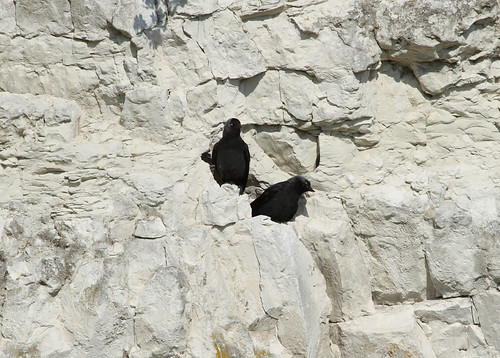
A pair of jackdaws, Corvus monedula

There were very few birds to be seen on this trip, it was at lunchtime on a very hot day (mid to high 20’s Celsius) so I think they may have been hunkering down in the shade, but I could hear a male whitethroat singing and a family of jackdaws were playing around on the white chalk cliff face.

Because of the relatively young age of the Lime Kiln, and possibly as a result of the unusual nature of the terrain, large areas of the floor are bare chalk and there are less plant species than there may be in a more conventional habitat.

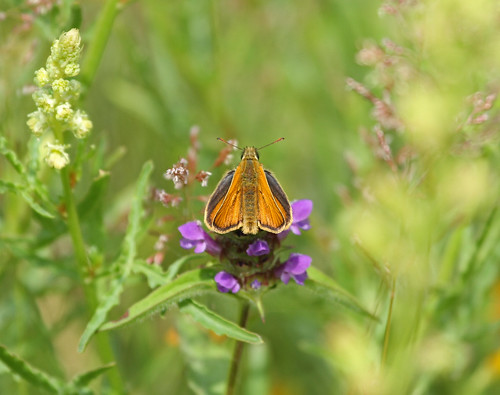
Either a small skipper (Thymelicus sylvestris) or an Essex skipper (Thymelicus lineola) sipping nectar from a self heal flower

One of the wild flowers growing there is self heal (Prunella vulgaris). This skipper butterfly was perched on a self heal flower head but I’m not sure if it’s an Essex skipper or a small skipper, they are very similar in size, shape and colour, and alas I’m not sufficiently expert to unambiguously identify them.

I didn’t manage to publish this post in 2013 so it’s now my first post of 2014. So Happy New Year to everyone, may the next 12 months bring you health and happiness!